Monday, July 24, 2006

This Week in U.S. Senate: Drilling America's Coasts for Oil


Under the cloak of the ongoing crisis in the Middle East, the Republican-majority Senate is set to debate legislation this week to open 8.3 million acres (beginning 125 miles south of the Panhandle) for oil and gas production, possibly with support from both of Florida's senators. The House passed a broader offshore drilling bill last month.


If the Senate passes a bill, any bill to drill oil, it will go to conference committee. Once in conference committee, the bill turns into the more all-encompassing one that the House passed - drilling off of all of U.S. coastlines. That is what has happened on every piece of legislation of the last six years in the Republican-controlled Congress that went to conference committee.

The Republican-controlled House passes legislation that the corporate lobbyists working out of the Bush-Cheney White House have written. The Republican-controlled Senate then passes a different version, slightly more sensitive to the People of the U.S. The leaders of both Houses then choose a couple of members from their chambers, Republican majority again, and send them to come up with a compromise bill. In conference, the bill will only contain those provisions from the Senate's bill as are necessary to get a majority vote. And sometimes, not even those. Conferenced bills will be brought to the floors of both Chambers for a vote, thousands of pages that the members of Congress haven't had time to read, but are then pressured to vote for it. That's how most of the Bush-Cheney administration got passed in the first term.

Instead of moving to alternative energies, the oil-owned Senate:
....is expected to decide this week whether to open vast areas off the coast of Florida to oil and gas drilling, a debate with billions of dollars in energy royalties at stake that could affect the ability of coastal states like California to prevent drilling off their shores.

Senate Republicans want to allow drilling in Lease Area 181, a portion of the eastern Gulf of Mexico south of Florida's Panhandle that is believed to contain one of the nation's largest untapped reserves of oil and natural gas. Proponents claim that opening the new area could help rein in the high energy prices consumers are paying and reduce America's dependence on foreign sources.
It hasn't yet.

No matter how much profit the oil corporations enjoy, they have never passed it on to the consumer. Never.
But environmentalists and many California officials are worried the bill, if approved, could be merged with a more sweeping House measure approved last month that would end the quarter-century federal ban on drilling off the Pacific and Atlantic coasts and offer states lucrative financial incentives to approve oil and gas exploration.

"It is too early to speculate about what the final Senate bill will look like and what compromise, if any, can be reached in conference," said Rep. Lois Capps, D-Santa Barbara, a leading opponent of drilling in the House. "I would submit that any expansion of offshore drilling is a step in the wrong direction because it continues to enable our addiction to fossil fuels rather than pursuing efforts to reduce consumption and develop alternative energy sources."

Whenever the Republican Congress has been faced with obstacles, they break up their goal into steps. Once they get their foot in the door, it's only a matter of time before they are able to get everything on their wishlist. With a GOP-controlled Congress, it's only been a matter of months until they have been able to blow past all of the obstacles.

California's two Democratic senators -- Dianne Feinstein and Barbara Boxer -- had joined with New Jersey's two Democratic senators to stop the bill, until they received assurances it would not harm their states' coasts. But Senate Republican leaders decided to put the measure on the fast track, despite the threat of a filibuster led by drilling opponents. Key votes on the drilling measure are expected as soon as Wednesday.

This is one reason why both Feinstein and Boxer have to go. They have consistently failed to recognize the overall Republican strategy of "dividing and conquering," and it won't be long before Florida's and California's coastlines, two of America's greatest tourist meccas, are covered in black tar.

And Mary Landrieu should be facing the same fate as Joe Lieberman - she is no Democrat, and has sold out the people of Louisiana. All of Landrieu's kissing up to Bush and voting with Republicans (bankruptcy bill, inheritance tax bill, far-rightwing judges, etc.) has gotten Louisianans' nothing but corporate pollution that is killing the people.
Much of the debate has focused on the generous revenue-sharing provisions added by lawmakers in Louisiana, Texas, Mississippi and Alabama. Oil and gas rigs have drilled off the coasts of those states for decades, and the states stand to receive a windfall if the bill becomes law.

Under the narrower Senate bill, 37.5 percent of all oil and gas royalties would go to energy-producing states in the Gulf of Mexico starting next year. The bill would extend the new revenue-sharing formula to all offshore projects across the country starting in 2016.

The House-passed bill contains an even more generous revenue-sharing scheme. States would receive 63.75 percent of royalties for oil and gas platforms within 12 miles of shore, and 42.5 percent of revenues for areas more than 12 miles offshore.

"Fundamental fairness dictates that states and local communities who voluntarily sustain this important energy industry should receive part of the proceeds," said Sen. Trent Lott, a Republican from Mississippi.

But even the Bush administration is worried that the legislation could divert billions of dollars from the federal Treasury at a time the nation is facing a costly war in Iraq and steep budget deficits.

However, new Interior Secretary Dirk Kempthorne said last week he believes a deal to share royalties can be reached.

The Senate bill was the product of a compromise reached this month between Republican leaders and Florida Sen. Mel Martinez, a Republican who has mostly opposed efforts to drill off Florida's coast.

Martinez agreed to allow drilling in an 8 million-acre portion of the eastern gulf in return for the promise that Florida would be allowed to block drilling all other projects within 125 miles of its coast.

Martinez has since been blasted by environmental groups in full-page newspaper and TV ads in his home state for agreeing to the deal. Florida's other senator, Democrat Bill Nelson, has said he may filibuster the bill.

Lease Area 181, which is about 100 miles south of the Florida Panhandle, is not covered by the congressional moratorium on drilling, but President Bush and his brother, Republican Florida Gov. Jeb Bush, had worked out a deal not to offer any new lease sales in the area. The areas covered by the Senate bill are estimated to contain 1.25 billion barrels of recoverable oil and 5 trillion cubic feet of gas.

California officials, including Republican Gov. Arnold Schwarzenegger, are suspicious of the Senate measure, warning that it could pave the way for the House bill to become law. While the Senate bill would extend the federal ban on drilling nationwide by 10 years until 2022, the House bill would end the moratorium. The House measure also would require states that oppose drilling to petition the federal government every five years to block development of areas from 50 to 100 miles offshore. And states would have no control over oil and gas leases more than 100 miles off shore.

House Resources Committee Chairman Richard Pombo, R-Tracy, the chief architect of the House measure, said that if the Senate passes its bill this week, he plans to work in conference committee to add as many of the House provisions as possible.

"If the deal is good for Florida, why aren't my senators insisting that we get the same protections for my state?" Pombo said, referring to the Senate's bill provision to block drilling within 125 miles. "I want the same protections for California that they are willing to give Florida."

But the Senate bill faces major hurdles. It will take 60 votes to override a possible filibuster against the measure.

Among the bill's opponents is Sen. Ted Stevens, the powerful Alaska Republican lawmaker who chairs the Senate Commerce Committee.

Stevens supports offshore drilling, but was angered that Senate Republican leaders did not include Alaska among the states that will share in the billions of dollars in revenue. He said he plans to object on the Senate floor.
And nobody is talking about the devastating effects of oil spills.

Did you know that Exxon has yet to pay a penny for the destruction that their tanker, the Exxon Valdez, caused to Prince William Sound? It's been 17 years, and despite numerous judgments against them, Exxon files one appeal in U.S. courts after another, in their effort to avoid responsibility for future spills that will inevitably occur. Prince William Sound has not recovered, nor has the region or the people of Cordova, Alaska.

The fact is that all things conveying oil (rigs, pipelines, ships) leak, even excluding hurricanes, earthquakes and human error. The damage that is done to everything that the oil leaks into and onto (the ocean, beaches, land, the animals in and on, including human beings) is permanent, including our food supply and countless other industries.

The 1969 spill off of the coast of California led to the coastal drilling moratorium. 200,000 gallons of crude oil spilled out of a disabled oil rig stationed six miles off the coast of Santa Barbara, California, and spread out into an 800 square mile slick. Even today, you can't walk 35 miles of coastline without tar coating your feet. Try getting this off of your skin:

Tip: Soaking with acetone will take some of it off, but not all. To get it all off, you have to wait until your skin naturally sluffs off, which can take days to weeks. All the while, toxic sludge is glued to your body, risking your health.


Santa Barbara coastline, 1971:


In 1989:


Santa Barbara, May 1973


San Francisco, Golden Gate Bridge, 1970s. More than 1000 oil tankers pass under the Golden Gate bridge each year.


Santa Barbara Coast, Holly oil spill, November, 1981


In 1996 off the south coast of Wales, a supertanker ran aground on rocks, spilling between 65,000 and 70,000 ton of crude oil.


The 2001 Galopagos oil tanker spill leaked over 160,000 gallons of crude oil:


In 2002, an oil tanker carrying 20 million gallons of crude oil split open off of the northwest coast of Spain, spilling an unknown amount into the ocean and onto the coastline of Spain and Portugal:Two people walk across the Barranan beach covered with oil in Arteixo, northwestern Spain, Sunday Nov. 17, 2002 after oil spilled from the Bahamas-flagged tanker `Prestige' washed ashore Saturday. The tanker, that was in danger of splitting in two, was towed out to sea "to avoid an environmental catastrophe."
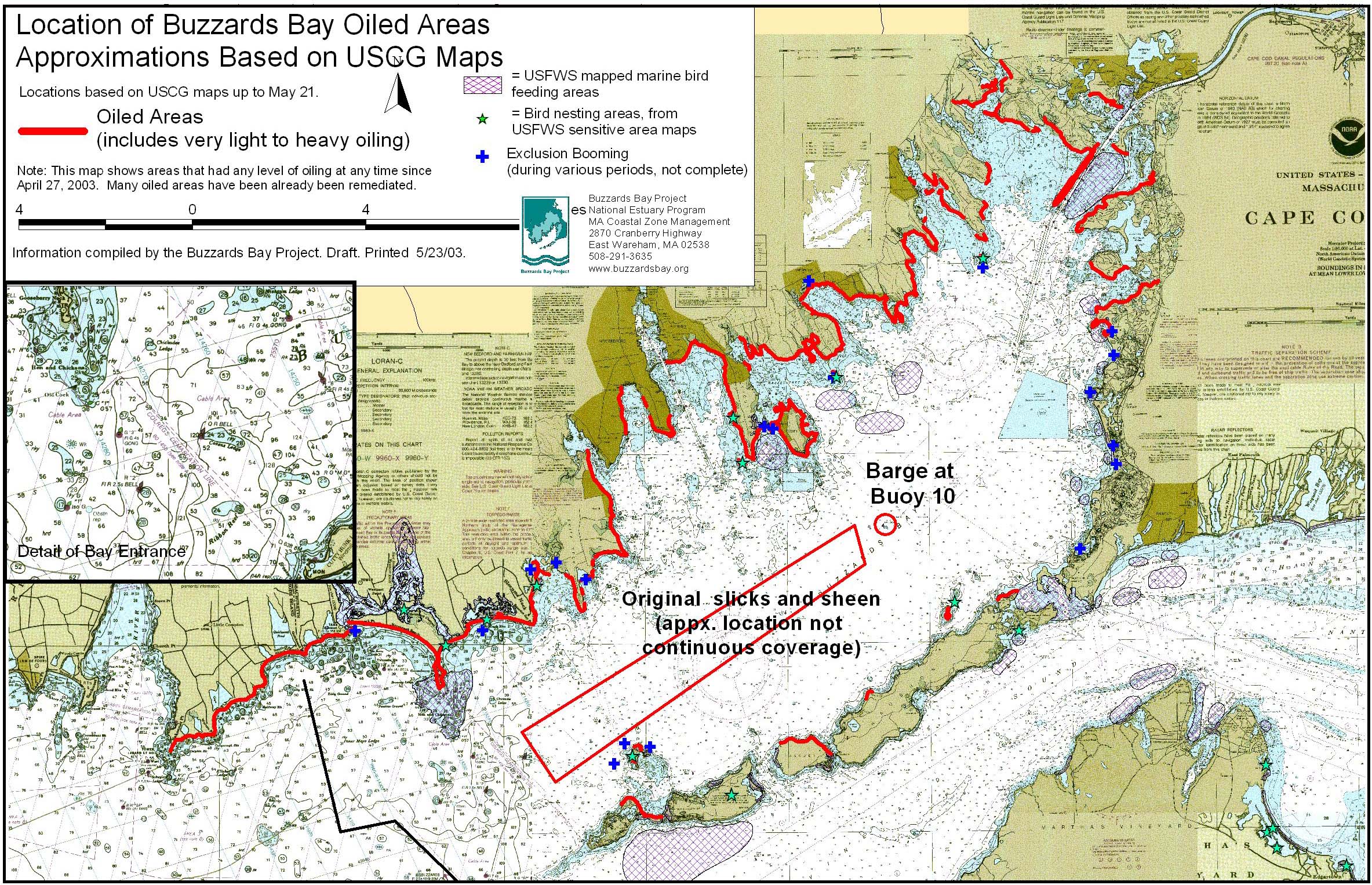


The Bouchard's spill in 2003

After Hurricane Katrina, 2005:

....a toxic soup that floated over the city of New Orleans and soaked into everything.


In 2005, BP (British Petroleum, now going by the green-sounding name of "Beyond Petroleum") operates the pipeline in Prudhoe Bay field, the "model" for proposed drilling in ANWR. BP is facing charges of failing to maintain the operation properly after a spill of some 267,000 gallons of oil was discovered on Alaska's North Slope region. It could lead to criminal charges and ultimately fines and prison sentences.

These are just a few of the spills - they happen every day, all over the world. Very few get reported in the media.

There are alternatives. Be a part of the solution and join the wave of change.

Tell Congress this is not the energy policy you want!


It's Another "Quit Complaining About YOUR Job"-Monday


Get-rich-quick scheme: "Let's package it and sell it as 'Findhorn Fertilizer'."


Friday, July 21, 2006

U.S. Arming of Israel

American Taxpayers Purchase Weapons for Israel; U.S. Weapons Manufacturers Profit From Middle East Conflict


This is a direct cash deal. This is what our politicians are doing, in our name, and why we are the targets for Middle Easterns' fury.

Democracy Now!reports:
Much has been made of the Syrian and Iranian origin of weaponry used by Hezbollah but there has been little discussion of where Israel's weapons come from. A new report by the World Policy Institute examines how the United States provides billions of dollars of military aid to Israel each year and how their current arsenal is composed of U.S made equipment.

Much has been made of the Syrian and Iranian origin of weaponry used by Hezbollah but there has been little discussion of where Israel's weapons come from. A new report by the World Policy Institute examines how the United States provides billions of dollars of military aid to Israel each year and how their current arsenal is composed of U.S made equipment. The report is titled "U.S Military Assistance and Arms Transfers to Israel."

Frida Berrigan is a Senior Research Associate with the Arms Trade Resource Center at the World Policy Institute. She is the co-author of the report.

AMY GOODMAN: One of the authors of the report joins us now, Frida Berrigan. She’s Senior Research Associate with the Arms Trade Resource Center at the World Policy Institute. Welcome to Democracy Now!

FRIDA BERRIGAN: Thank you.

AMY GOODMAN: Well, tell us what are the weapons being used? Did you also look at where the weapons that Hezbollah is using comes from?

FRIDA BERRIGAN: Sure. Almost all of the weapons used by Israel are from the United States. There might be a couple French fighter planes that they’re using, but its F-16s made in Fort Worth, Texas; its Apache helicopters; its Sparrow and Sidewinder missiles; it’s all from the United States. So you have this real disconnect between an overemphasis on the supply by Iran and Syria of Hezbollah's weapons and no discussion of the fact that all of the Israeli arsenal is from the United States, and that that is in contravention to U.S. law. to the Arms Export Control Act, which says that U.S.-origin weapons are only to be used for self-defense and for internal security.

JUAN GONZALEZ: And your report indicates that Israel has always been the largest recipient of military aid from the United States, but that that’s actually increased since 2001?

FRIDA BERRIGAN: We’re looking at incredible increases in U.S. military aid and weapons sales to Israel. Military aid stands at about $3 billion a year. That’s about $500 for every Israeli citizen that the United States provides on an annual basis. And then, weapons sales, most recently, since the Bush administration came into power, we’re looking at $6.3 billion worth of weaponry sold to Israel.

Israel's relationship with the United States is unique in a number of ways. And one of those ways is that essentially the United States provides 20% of the Israeli military budget on an annual basis, and then about 70% of that money that is given from the United States, from U.S. taxpayers, to Israel is then spent on weapons from Lockheed Martin and Boeing and Raytheon. Most other countries don't have that sort of cash relationship, where they go straight to U.S. corporations with U.S. money to buy weapons that are then used in the Occupied Territories and against Lebanon.

AMY GOODMAN: What kind of leverage does the U.S. money, the U.S. aid for Israel provide?

FRIDA BERRIGAN: Well, when you’re talking about 20% of the Israeli military budget, you’re talking about a huge fulcrum of leverage, right? The United States could today say, you know, “This incursion into Lebanon, the killing of civilians, the bombing in Gaza, all of this is not internal security, all of this is not self-defense, and we’re cutting it off.” And they could cut it off tomorrow. And that would essentially not only send an incredibly strong message to the Israeli military, but it would remove the tools of the occupation, the tools of the bloodshed and the suffering that’s happening in Lebanon and in Gaza.

It was interesting to sort of place the very weak statements that have come from the administration -- “Oh, there should be” -- you know, they have said things, like “They should practice restraint,” and stuff like that. Meanwhile, just on the 14th, the United States decided to sell $120 million worth of jet fuel to the Israeli military. The little notice that announced the sale from the Defense Security Cooperation Agency said, “This fuel will be used to promote peace and security in the region.” And then, meanwhile, you have jets strafing villages, bombing civilians, taking out bridges, destroying water treatment plants. So the United States could decide and would have a very strong case and a historic precedent for deciding to cut military aid.

AMY GOODMAN: What’s the precedent?

FRIDA BERRIGAN: In 1981, the last time there was a full-on invasion by the Israeli government into Lebanon, the Reagan administration cut military aid and froze weapons sales to Israel, while it did an investigation of whether or not the weapons were being used for self-defensive and internal security purposes. So for ten weeks in 1981, nothing went into Israel. Now, at the end of that ten weeks, they said, “Oh, well, you could argue ’til eternity about what constitutes defensive use of weapons.” But under the Reagan administration, while Alexander Hague was the Secretary of State, we did cut off weapons sales and military aid. And we certainly haven't done that since. And when we look at how the conflict and the war continues to unfold with so many civilians being killed and this bare use of force and power by the Israeli military, it seems like it’s time to explore that option again.

JUAN GONZALEZ: Well, one of the things that’s gotten a lot of attention in recent days have been the missiles fired by Hezbollah into Israel. But I see by your report that to some degree the Hezbollah missiles might also almost be seen as a self-defense measure, because you have here a thousand Redeye missiles that Israel has, surface-to-air missiles, 400 Stinger man-portable air defense missiles, 444 Harpoon missiles. So Israel has quite an extensive missile arsenal of its own.

FRIDA BERRIGAN: Right, we’re talking about one of the strongest militaries in the world going up against basically the defenseless Lebanese, and then a, you know, not very well armed Hezbollah. There was an article in the newspaper yesterday that quoted Israeli defense officials, who said, “Maybe 900 Hezbollah missiles have hit Israeli territory.” That’s 900 missiles, and probably 30 Israeli civilians have been killed. So they’re obviously not very effective weapons. They do get weapons from Syria, from Iran. They manufacture their own weapons. But --

AMY GOODMAN: You’re talking about the New York Times quoting the Fajr-3 from Syria?

FRIDA BERRIGAN: Right, yeah. There was an article in the Times, I think on Monday, about Iranian missiles being used by Hezbollah, and they pulled Syria in, too, because Syria was producing an Iranian model missile and then had transferred it to Hezbollah. So, but the missiles haven't been very effective, and they can’t -- the range is between 30 and 45 miles.

AMY GOODMAN: You talk about, Frida Berrigan, the U.S. government supporting the Israeli government and military. But this kind of weapons relationship also is a great boon to the U.S. weapons manufacturers. Can you talk about the relationship the U.S. has with these weapons manufacturers and name them?

FRIDA BERRIGAN: Sure. Well, the largest weapons manufacturer in this country is Lockheed Martin. It’s based in Texas. And it manufactures the F-16 fighter plane, all manner of missiles. It manufactures the C-130, which is a huge transport plane. It’s the biggest weapons manufacturer in the world.

Lockheed Martin and the Israeli military recently went into business together, co-producing a version of the F-16 fighter plane called the Sufa, which means “storm” in Hebrew. It’s built partially outside of Tel Aviv, and then the final work is done in Ft. Worth, Texas. It’s a $4 billion deal with the Israeli military. For the first time, an Israeli military company is contributing in its manufacturing the avionics of the plane. So there’s this -- it’s almost this supranational relationship between Lockheed Martin and the Israeli defense industry. It’s a kind of relationship that weapons corporations in this country would like to see with other countries, where they work directly with -- they sort of transcend government and work directly with the manufacturers of weapons in other countries.

Another major corporation -- you mentioned the missiles -- is Raytheon, which is based in Massachusetts. They manufacture the Tomahawk missile, the Sidewinder, a number of other high-tech missiles that Israel has in its arsenal. These missiles have very sophisticated targeting components -- heat-seeking, they’re interfaced with GPS for very targeted attacks.

Boeing is another major corporation. They manufacture all sorts of planes: the F-18 fighter plane, the F-14. So you have maybe ten weapons corporations in this country that have a stake in -- essentially in Israel using its military arsenal so that it can be replenished again. And the great thing about this relationship with Israel is, Israel doesn’t have to pay for it itself. It comes directly from U.S. taxpayers in the form of foreign military financing, which is transferred to Israel, and then turns right back around and goes to Lockheed Martin or Raytheon.

JUAN GONZALEZ: And as we can see by the votes in Congress this week, both in the House and Senate, supporting the current military actions of Israel, there doesn't seem to be much opposition in Congress to this kind of a continued arms support from the United States for Israel.

FRIDA BERRIGAN: Right, yeah. You have complete silence, and worse than silence from the U.S. Congress. So there's got to be some way to go around Congress and hold the defense corporations, these military corporations, directly responsible for what their hardware and software is doing in Lebanon and Gaza.

AMY GOODMAN: Frida Berrigan, I want to thank you for being with us, of the World Policy Institute, just out with its report.

So when Israel warns hundreds of thousands of residents to flee from southern Lebanon as it edges toward a full ground invasion, as it now has, we in America should not be surprised when the Lebanese hold it against us when American-made and paid-for weapons destroy their homes and country. Thousands of Israeli troops are reportedly already operating inside the Lebanese border. Israeli planes dropped leaflets and broadcast warnings telling people they would be in danger if they remained in the region.

Democracy Now! reports:
The number of Lebanese killed from the assaults now tops 330 - nearly all of them civilians. About half a million people have been displaced. Thirty-four Israelis have been killed, including 15 civilians. We speak with Rami Khouri, editor of the Lebanese newspaper, the Daily Star.

Meanwhile, Israel's bombardment of Lebanon is continuing for a tenth day. Warplanes targeted more that 40 sites on Friday, mainly in southern Lebanon. The number of Lebanese killed now tops 330 - nearly all of them civilians. About half a million people have been displaced - or one in eight residents. Bombed-out roads and bridges are hampering aid efforts. The UN has warned the humanitarian crisis is worsening by the hour. Thirty-four Israelis have been killed, including 15 civilians killed by rockets fired by Hezbollah into Israel.

Rami Khouri, editor-at-large of the Beirut-based Daily Star newspaper and an internationally syndicated political columnist and author. He is Palestinian-Jordanian and a U.S. citizen.
AMY GOODMAN: We’re joined on the phone now by Rami Khouri, editor-at-large of the Beirut-based Daily Star newspaper, an internationally syndicated political columnist and author. He is Palestinian Jordanian and a U.S. citizen. He joins us on the phone from Amman, Jordan. Rami Khouri, welcome to Democracy Now! I understand you’re one of the few people trying to get into Lebanon.

RAMI KHOURI: Well, yes. I mean, figuratively there’s some other people trying to get back in. Everybody there is trying to flee. I mean, certainly all the foreigners -- most of the foreigners, not all of them. But I want to get back because our home is there, and my wife and I were in Europe on a personal visit. We couldn't get back to Beirut Airport, because the Israelis had bombed it, so we came to Amman. And we’re going back to Beirut tonight by car via a circuitous route, which we hope will be safe.

But it’s very important for us to go back to stand, first of all, in solidarity with the Lebanese; second of all, in defiance of the Israeli military machine -- I mean, we're going to be safe in our home, we’re not on the frontline -- and third of all, to send a message, I think, to George Bush that this kind of insanity that he is officially sanctioning is one that ordinary people reject and that there is a defiance now of the U.S. and Israel that permeates this entire region. And I think our job as individuals and my job as a journalist is to be there and to cover the story and just to stand our ground.

JUAN GONZALEZ: And the images that we’ve been seeing for the last week of the enormous damage and the killing of innocent civilians, the incredible damage to the infrastructure of Lebanon; your thoughts?

RAMI KHOURI: Well, my thoughts are this is doubly tragic, because it’s the third or fourth time that Israel does this. I mean, it’s just extraordinary that a people as enlightened and with such a difficult history as the Jewish and Israeli people would actually now be the perpetrators of this kind of savagery over and over again, and each time they do it they reap a much worse counter-reaction.

You know, they started this in the late ’60s, when there was a couple Fatah guerrillas in South Lebanon. They bombed Beirut Airport in 1968 for the first time. Then what they got back was a much bigger Lebanese resistance, a leftist nationalist resistance, with the PLO. Then they went into Lebanon in the ’70s, and then in ’80 they occupied South Lebanon, and they reaped in return for that Hezbollah. And they went into Hezbollah in 1996. They tried to wipe them out from the south, and what they have now is a much stronger Hezbollah, supported by Syria and Iran, with missiles that are hitting Haifa and Safed and other Israeli towns.

So I think there’s a kind of an irrationality to Zionism that we’re seeing today, or at least to the Israeli political leadership, that just don't seem to get it, that when you repress somebody and you brutalize them, what you get is not acquiescence and subservience. What you get is defiance and resistance. And I think this is a lesson that most military powers have learned. Certainly the Americans learned it in Vietnam. They’re learning in Iraq. The Russians learned it in Afghanistan. And the Israelis seem unable or unwilling to learn these lessons in Lebanon.

AMY GOODMAN: Well, what Israel says is what they get is they break Hezbollah, and they stop the rockets from flying in. They punish them for taking the soldiers, and they are trying to get them back. Can you talk about the beginning of Hezbollah, and can you talk about Israel's rationale?

RAMI KHOURI: Yeah. I mean, Israel's rationale certainly sounds logical from an Israeli point of view. Anybody -- one of the few things I agree with George Bush on on the world is that, yes, everybody has a right and a duty to defend themselves -- there’s no question about that -- which is precisely what Hezbollah is trying to do. They're trying to get back their prisoners in Israel and the bits of land that are still occupied by Israel.

But the way that the Israelis are trying to defend themselves is actually making themselves more vulnerable. It’s enhancing the political resistance to Israel. It is enhancing the political movements all around the Middle East that are the Islamist movements mostly, like Muslim Brothers, Hezbollah, Hamas. These guys are winning elections all over the place. They’re critical of the U.S. They’re critical of Israel. They’re critical of moderate Arab regimes. They’re close to Iran. What Israel is doing is counterproductive to such an extreme degree that it’s really perplexing how such an enlightened people as the Israelis, who have achieved so much in so many other fields, can be so blind to this issue.

This is a political problem that needs a political solution. There is no military solution to a political problem. And this is a war. Hezbollah and Israel have been doing this for many years. Israel has tried this before, has done it. They’ve occupied. They’ve had free-fire zones, blue lines, red lines, green lines, surrogate armies, no-fly zones, occupation zones. They have tried every trick in the book two or three times. They bombed Beirut Airport now three times in the last 25 years. What more do they have in their arsenal that they haven't used?

And what is fascinating, what they should learn as quickly as possible, is that every time they try to generate security through either punitive military attacks or controlling other peoples' lands in South Lebanon, this only inspires Hezbollah and Hamas now to get missiles and rockets that can have longer range. So all Hezbollah does now is fire these over the Israelis. And you’ve had three groups now in the Arab world in the last 15-20 years who have developed rockets to fire over any kind of zones to hit Israel: Iraq, Hezbollah and Hamas. At some point, you’d think the Israeli leaders or people would wake up and see what is the reality and find an alternative political, diplomatic, peaceful, negotiated and legitimate resolution to this conflict, which I think is the only way out now.

JUAN GONZALEZ: And your sense as a journalist of the impact of the fighting, which is now really on three fronts -- the West Bank, Lebanon and Gaza -- on the other Arab governments in the region, particularly those who have come out critical of Hezbollah and these latest armed actions?

RAMI KHOURI: One of the important dimensions of the phenomenon that we’re witnessing, which is the rise of these Islamist political, social and military groups and resistance groups, like Hamas and Hezbollah, is that they are increasing in their credibility and popularity all over the region, mainly because of what they do, but also because they are a strong antidote to the lack of effectiveness and the declining legitimacy of many of the existing Arab regimes and governments and political elites. So what you’re seeing very clearly all over the region is Arab governments who are criticizing Hezbollah, but Arab societies and political culture, mainstream political culture, and certainly the man and woman on the street, who are increasingly supporting Hezbollah and Hamas.

A lot of people are critical of Hezbollah, to be fair, because they’re saying, well, look, you know, Hezbollah brought about this massive Israeli overreaction and has destroyed Lebanon and is really causing incredible pain to people. So there are criticisms of Hezbollah that are strong and sincere, but the support of Hezbollah, I think, is much, much more significant, and it’s not only about this particular incident in the south.

I think Hezbollah, Hamas and these groups represent an organic natural reaction that has brewed and percolated and now is materializing after 15-20 years, a reaction of societies in the Arab world that has been extremely disappointed by the autocracy and corruption and ineffectiveness of their own Arab regimes, by the brutality and occupation of Israel, and by the rather racist and then now neocolonial and imperial in the military policies -- whatever you want to call them -- of the United States. They’re the reliance on using military force, giving Israel the green light to do whatever it wants; that those three issues -- the Israeli policies, the American policies and Arab governments -- all three have really weighed heavily on Arab societies and normal average decent people, and this is the reaction that we’re seeing.

People are not going to live in a vacuum, and they’re not going to be humiliated and degraded. And they’re going to look for alternatives. And the alternative now that seems to be sweeping this region is the Islamist movements, including the ones doing serious military resistance to Israel. And if you look at Hezbollah, Hezbollah is doing something now which no Arab government in the last 50 years has been able to do, which is to fight a war against Israel, be heavily attacked and keep fighting back, hit Israeli cities with rockets, send one-third of the Israeli populations into shelters for two or three days in a row, and traumatize an entire Israeli population, just as Israel has traumatized Palestinian and Lebanese populations for many, many years. So there is something very significant here politically in terms of what’s going on.

And again, I say this with great sort of sorrow, because it’s not something that we should be proud of or happy about. But it does represent a political shift in the balance of power and the balance of terror, and hopefully it will cause both sides, including when they wake up in the White House, to recognize that only a diplomatic negotiated solution is going to resolve these issues.

AMY GOODMAN: Rami Khouri, we want to thank you very much for being with us, editor-at-large of the Beirut-based Daily Star newspaper, a Palestinian Jordanian, a U.S. citizen now in Amman trying to make his way into Beirut.


USDA To Eliminate Most Mad Cow Testing As The Number of Cases Found Increases


The Chicago Tribune reports:
The Department of Agriculture is cutting its tests for mad cow disease by about 90 percent.

The current testing level--1,000 each day--reflects the concern that followed the discovery in December 2003 of mad cow disease in the U.S.

Since then, tests have turned up two more cases of the disease, also known as bovine spongiform encephalopathy. The government says a handful of cases may be undetected.

"It's time that our surveillance efforts reflect what we now know is a very, very low level of BSE in the United States," Agriculture Secretary Mike Johanns said Thursday.

Critics say now is not the time to scale back on the testing.

"It surely will not encourage consumers in the U.S. or Japan to rush to the store to buy more beef," said Carol Tucker-Foreman of the Consumer Federation of America.


Those who are behind this decision (deregulating food supply safety) are counting on being out of office and out of the public eye when people eating infected meat today will get sick: The lead time from eating meat infected with BSE (Mad Cow) to showing symptoms can take years, even a decade or two.


It's time to pull another Oprah and bring the full weight of the consumer down on the beef industry and politicians. Boycotting meat is the only way to force them to make the food supply safe.

Howard F. Lyman, a 4th generation cattle rancher, wrote a book and was on Oprah in 1996. Lyman exposed the truth about the meat industry - he loves meat, but won't eat it anymore. PBS will be rebroadcasting a documentary about him in the coming days and weeks.

Still want to grill this weekend? Instead of meat (no amount of heat is going to kill prions), maybe grill a piece of fish:

Spicy Grilled Salmon with Mango, Radish and Lime Salsa

Salsa:
2 mangoes, peeled, pitted and cut into chunks
1 red onion, chopped
6 red radishes, chopped, plus 1 sliced for garnish
2 limes, peeled and cut into segments
1 handful fresh cilantro leaves
2 tablespoons extra-virgin olive oil
1 teaspoon Southwest Spice Mix, recipe follows
1 (2 to 3 pound) salmon fillet
Extra-virgin olive oil
Kosher salt and freshly ground black pepper

For the Salsa, put all the ingredients into a food processor and pulse until finely chopped; set aside.
Heat the grill to medium high.

Drizzle some olive oil over the salmon and season it with salt and pepper. Gently rub 2 tablespoons of the Spice Mix into the salmon. Pour some olive oil onto a paper towel and rub the grill with it - this will help to prevent the fish from sticking. Grill the salmon flesh side down for about 12 to 15 minutes.

To serve, spread most of the Salsa onto a platter and place the salmon, skin side down, on top. Garnish with more Salsa, radish slices, cilantro, and a drizzle of olive oil.

Southwest Spice Mix:
2 ancho chiles, stemmed and seeded
2 tablespoons whole cumin
2 tablespoons whole coriander
1 cinnamon stick
1 tablespoon sweet paprika
Put the ancho chiles, cumin, coriander, cinnamon stick, and paprika into a small dry skillet over medium-high heat, and toast the spices just until they begin to smell, about 1 minute. Empty into a spice mill and grind to a powder.


Friday Cat Blogging

Thursday, July 20, 2006

Israel Assault on Lebanon Inflicting Mass Punishment on a Whole People

On the outskirts of Beirut:


Democracy Now! reports:
The Israeli attack on Lebanon has entered its second week and the death toll now stands at about 300, nearly all Lebanese civilians. We go to Beirut to speak with Robert Fisk, chief Middle East correspondent for the London Independent. Fisk discusses the assault on Lebanon, Lebanese Prime Minister Fouad Siniora, the role of Syria and Iran in the crisis, embedded reporters in the Israeli military and more.

The Israeli attack on Lebanon has entered its second week and the death toll now stands at about 300, nearly all Lebanese civilians. The humanitarian crisis continues to worsen with hundreds of thousands of people displaced from their homes.

For a report from Lebanon on the crisis we turn to journalist Robert Fisk. He is the chief Middle East correspondent for the London Independent and has lived in Beirut for over two decades. He is author of "Pity the Nation: The Abduction of Lebanon." His latest book is "The Great War for Civilisation: The Conquest of the Middle East. We reached him Tuesday at his home in Beirut. He spoke about the Israeli assault on Lebanon, Lebanese Prime Minister Fouad Siniora, the role of Syria and Iran in the crisis, embedded reporters in the Israeli military and more.

Robert Fisk, chief Middle East correspondent for the London Independent. He joins us on the line from Beirut.

AMY GOODMAN: For a report from Lebanon on the crisis today, we turn to journalist Robert Fisk. He's the chief Middle East correspondent for the London Independent. He's lived in Beirut for almost three decades. He's the author of Pity the Nation: The Abduction of Lebanon. His latest book is The Great War for Civilization: The Conquest of the Middle East. We reached him late yesterday at his home in Beirut. He spoke about the Israeli assault on Lebanon.

ROBERT FISK: What's happening is obviously the mass punishment of a whole people, the Lebanese, in response to the capture of two Israeli soldiers and the killing of three others on Wednesday of last week. The death toll now has just topped 240 in the last few minutes. We've -- almost all of the Lebanese dead are civilians, of course, as usual. The Americans, in the usual pusillanimous way of Mr. Bush, are doing nothing to prevent this from taking place.

It amazes me -- I mean, living here in Beirut, as I have for 30 years. Here are the Lebanese people, sophisticated, educated, cosmopolitan, people who don't look like the Arab world, they look like us; I mean, people who could be quite at home on the streets of Paris or New York and London, and some of them are; people who read, who are very well educated; people who speak English fluently, French beautifully, and fluent Arabic, as well, of course; and who, when they die in such large numbers, the best we can produce is a call for restraint by the State Department and a claim by the British, our own dear Tony Blair, that the Israelis are using disproportionate force.

The exchange rate for neutral slaughter between Israel and here at the moment is now 1 to 10. 24 Israelis – I think 25 now -- to 242 Lebanese, many of whom, as I say, most of whom, but a far larger proportion of civilians. Many Beirut people were very moved Saturday when the Lebanese Beirut newspapers carried a very, very tragic picture of a young girl, a little girl -- must have been 4 or 5 years old -- near a place called Ter Hafra, lying dead in a field in her blue pajamas, looking, as I said in my newspaper, very similar to that terrifying picture from Poland in 1939 of a little Polish girl lying dead with her weeping sister beside her.

I did receive a phone call today from an Israeli woman living in the East Coast of the United States, who said she thought that what was being done to the Lebanese was unforgivable. I thought she was a very generous and good woman, saying she prayed for the Lebanese people and the Palestinians, and for the Israelis, of course.

But it's a tragedy of immense proportions, because it’s also tearing apart a country. In the last 24 hours we found the Israelis have turned to attacking a milk factory, Liban Lait -- it’s actually the producers of milk I drink every morning in my tea -- a paper box factory, for heaven’s sakes, hardly a terrorist target. We've already seen them smash up the runways of Beirut Airport and destroy part of the -- most of the lighthouse, the new Manara lighthouse, in Beirut. The Israelis today even attacked the factory which imports Procter & Gamble goods here. We've had an ambulance convoy, a convoy of new ambulances from the United Emirates, cross from Syria into Lebanon, got attacked from the air. It's an all-out war against the economy infrastructure of a country that was at last beginning to look modern again, after the 15 years of civil war, which cost 150,000 lives. And it's very sad to see.

I think the massacre of the innocents must obviously apply to both sides. The Israeli dead have an equal right to that claim. But the scale -- I mean, “disproportionate” is not the word for it -- the scale of the response is obscene. Even a small example, I’ll give you. Yesterday, something fell out of the sky over a small area of Beirut called Qurashim [sic]. I think it was part of the wing, the wingtip of an F-16. The Israelis say it’s not, but I think it probably was. And it crashed in a fiery volcano glow and burned trees, bushes, the roadway, and decapitated a young man in his car who was driving home to his family.

I got there in about eight minutes. And there were three very friendly Lebanese soldiers. By chance, I knew one of them, the sergeant, who said, “Mr. Robert, you must be very careful. The Israelis will come back and bomb again, but we’ll take you into the fire and show you as much as we can.” And they stood around me and protected me as we went up the road for about a mile walking -- or running, to be very honest with you, because Mr. Fisk here is not a very brave warrior. And I saw parts of what appears to be a wing. I think it was burning fuel all over the road. I think it came out of whatever the aircraft was. I think what actually happened is a Hezbollah missile probably hit an F-16, and the Israelis didn't want to claim it. They said that it was part of a barrel containing propaganda pamphlets and leaflets, which -- well, I didn't see leaflets anyway, and I know they burn on fuel, but anyway, I saw what I could and got away afterwards and said, you know, waved at the soldiers and thanked them.

And the Israelis did come back some hours later and bombed the barracks of these soldiers, which were members of a logistics unit. Their job was to repair bridges and electrical lines. They weren't combat soldiers. And they killed ten Lebanese soldiers, including the three young men who had protected me the previous day. This was outrageous, because the Israelis know what each individual Lebanese army unit is doing. They know if it's a combat unit, armored personnel carriers, helicopters, whatever.

And they picked on this sole barracks to destroy those men, to exterminate them, because, of course, their job was to keep Beirut alive, to keep the power systems running, to repair the bridges which were being destroyed -- 46 bridges now, according to Minister of Finance, who told me this a few hours ago, have been destroyed in Lebanon. This is the inheritance, of course, of former prime minister, assassinated prime minister Rafik Hariri, who was murdered on the 14th of February last year. He rebuilt this country. He rebuilt the city of Beirut. Now, bit by bit the bridges, the lighthouse, the international airport are being destroyed.


AMY GOODMAN: When Robert Fisk was almost killed by an angry Afghan mob, when he was covering the war in Afghanistan, Rafik Hariri called him after he had gotten out of that situation, almost died, and asked if he could send a plane. But Robert Fisk said he felt that was inappropriate to receive anything from a government or former government official.

Well, on Tuesday the Lebanese prime minister said Israel's opening the gates of hell and madness in his country and urged Hezbollah to release the two captured Israeli soldiers, but said Israel's response has been disproportionate. I asked Robert Fisk about the Prime Minister's comments.

ROBERT FISK: You know, I know Fouad Siniora, the Lebanese prime minister, quite well, and I like him very much. And he's a very affable, friendly and honorable man, but his response has been pretty pathetic. You know, to call the Israeli response “disproportionate” is to go along with the European, the E.U.'s equally pusillanimous response. Roaring on about gates of hell is not something that Lebanese prime ministers can do. He appeared on television not long ago crying, which I don't think Winston Churchill was doing in May of 1940. But he's not Rafik Hariri and never claimed to be. He's an economist, not a professional politician.

The usual problem -- I mean, the moment the attack took place, the Israelis blamed the Lebanese government, who can't even control a water faucet, let alone a Hezbollah militia man. And that, by saying the Lebanese were responsible, gave them the excuse to start destroying the infrastructure of Lebanon. Even the beautiful new viaduct that Hariri had built on the transnational highway to Syria has been broken by the Israeli bomber strikes. I’ve been there and seen it and stood on it.

You know, what it needs is a government, which -- there's no power in the Lebanese army. It’s 50,000 strong, but they can't defend Lebanon. And there's only three Vietnam-era helicopters or some ancient hawk hunter fighters belonging to Lebanon. They can't fight off the Israelis.

But, you know, I asked tonight, for example, the Minister of Finance whether he's considered suing the major American armaments manufacturers, who are producing the missiles, who are killing all of these innocent people here. And he hadn't thought of it. You know, I mean, most of the missiles which are landing here are made in Seattle and in Miami, Florida, by Lockheed Martin or Boeing.

But it's as if you've got this little tiny parish council, you know, parish pump government. And they talk about the gates of hell, and then they talk about disproportionate, and then they cry. I’m afraid that's not a way to run a country. But Lebanon is a very small weak country, and Israel is a nuclear-powered superpower, nuclear-armed superpower; what can you do?

AMY GOODMAN: Robert Fisk speaking from his home in Beirut late Tuesday night. We'll come back to the interview in a minute.

[break]

AMY GOODMAN: We return to our interview with Robert Fisk, chief Middle East correspondent for the London Independent. I reached him at his home late last night in Beirut, where he has lived for almost three decades. I asked him about the World Health Organization’s announcement Monday that it expects the number of Lebanese residents displaced from their homes to reach 900,000.

ROBERT FISK: I think it's probably a little bit less than 900,000, but it's probably moving towards half a million. I mean, the people from the southern suburbs, where, of course, the Hezbollah did have their headquarters -- “did” being the optimum word now -- there are about half a million of them scattered across Beirut in schools, public parks. They’re living out in the open in parks, where it's warm, but what a filthy place to live, under trees on dried grass. I mean, this is a mass punishment of a whole people for the actions of a very ruthless, powerful guerilla army, Hezbollah, which does not represent the Lebanese people.

Anyway, it is important to remember that the Hezbollah crossed that border against all international law. No one gave them a referendum or a vote to cross the border and kill Israelis and capture two Israelis and start off this war. But, you see, they relied upon -- they totally relied upon the cruelty of Israel's response. And Israel, as usual, obliged them. So no one will now criticize the Hezbollah in Lebanon.

But it's a catastrophe, because here is a country that began to believe in itself again after the years of civil war, and now it's the same old story. The country is being vandalized and smashed up by a country which says it believes in purity of arms. And these civilian deaths, I don't believe that they’re by chance. I don’t believe it was a mistake when they hit that army barracks of logistic soldiers, who are trying to repair their own country, which they have every right to do.

And Marwaheen is a particular -- this is a village in Southern Lebanon, where Mossad, the Israelis, ordered the villagers out. I should add that this is a village closest to the scene of the killing and capture of the Israeli soldiers on Wednesday. They were ordered to leave the village. They did so in a convoy of cars, 20 of them. They went to the United Nations, who ordered them away -- Ghanaian Battalion, shamefully -- and set off to Tyre. And an F-16 came down and burned them all alive with bombs. Outrageous massacre. The Israelis keep boasting that they are picture-perfect, punctilious, surgical strike operations. Well, if that's true, then that was mass murder and a war crime; if it's not true, then we can't believe in the riffraff of the Israeli Air Force anymore -- it's as simple as that -- or the riffraff of the Hezbollah, if you listen to some of their roaring, by the way. But one has to be as cynical and as critical as one wants in a war, because no one else will be, usually.

AMY GOODMAN: Robert Fisk speaking to us from his home in Beirut. On Tuesday, we broadcast an interview with Syrian President Bashar Al-Asad, and I asked Robert Fisk about this. But I want to play for you just an excerpt of that interview that we played yesterday, done by independent journalist Reese Erlich in Damascus. Erlich asked President Asad about whether Syria plans to demarcate its borders with Lebanon or open embassies between the two.

PRESIDENT BASHAR AL-ASAD: The first part about the borders, we had a letter, formal letter, from the Lebanese prime minister, and we sent him a reply, formal reply, that we are ready to demarcate the borders. We don't have any problem, because we had such a problem with Jordan a few years ago, and we solved it.

About the embassies, as a concept, we cannot say we don't want to have an embassy in another country, as a concept, but that needs normal relation. Now, we don't have this normal relation with the Lebanese, so it needs better relation to discuss this issue.

REESE ERLICH: What kinds of issues would have to be resolved in order to have a normal relation?

PRESIDENT BASHAR AL-ASAD: First of all, not to have a government that works against your country. This is first of all. And second of all, you need the Syrians to feel that they have real neighbors, not cradle for or not a hub for terrorists to come and do such terrorist acts in Syria.

REESE ERLICH: One last question, what would it take to improve relations between the United States and Syria now? Are there any steps that could be taken that would improve them?

PRESIDENT BASHAR AL-ASAD: Definitely by the United States, not by Syria, because we did a lot, and we couldn't get any result, because they don't have the will. So first of all, they should know and they should understand the situation in the region. They should appreciate the role of Syria in the region. They should know that we have common interests that they don't see. And I think they should be neutral in dealing with our causes. That's how we can get back our relation to normal.

AMY GOODMAN: Syrian President Bashar Al-Asad speaking with independent journalist Reese Erlich last month in Damascus. The full interview is available on our website at democracynow.org. Well, during our conversation yesterday with journalist Robert Fisk, I asked him about what role he thinks Syria and Iran are playing in the current crisis.

ROBERT FISK: They are behind all of it. Look, last year under U.N. Security Council Resolution 1559, Bashar Al-Asad, the President of Syria, was forced to make a very humiliating military withdrawal of his army from Lebanon. Since then, he's been constantly condemned by the State Department, the Pentagon, the White House, Israel, of course, as a bastion of evil, as helping the insurgents of Iraq, which up to a point I think he probably does.

And Lebanon has been allowed to believe, especially by the U.S. ambassador here, Feltman, who is now mutely and pusillanimously silent, that it was a democracy, that it won its freedom in “Cedar’s Revolution,” remember, from last year, which is actually a fake one, in quotation. It wasn't made up by the Lebanese.

And now, suddenly this democracy counts for nothing, because, of course, what President Asad has done effectively is say, “Look, you may think you have your little seat of democracy over there, but I control events.” Syria is the chief supporter politically of the Hezbollah. And Iran is the chief supporter military of the Hezbollah. And this is Syria’s work. This is Syria saying, “We're back. We control events. Negotiate over the occupied Golan Heights.” And as usual, poor old Lebanon and the poor old Lebanese are paying the price for it.

But you need to realize this was planned a long time ago. No one suddenly got up in the morning and ate their hummus and had some coffee and said, “Let’s fire a missile at a warship.” The tele-guided missile attack on a major Israeli naval vessel had been planned a long time in advance. And militarily for the Hezbollah, it was an enormous success. It set the vessel on -- the ship set on fire for hours, and four sailors were blown overboard. And since then, I have to tell you, I’ve only seen one gunboat off the coast of Lebanon, and that was miles away. They don't come in close anymore, not at least during daylight hours.

There’s another point which the Israelis have not talked about, because it's under strict censorship in Israel, that the Hezbollah, who had weeks earlier sent a pilot-less reconnaissance drone over Israel, made, of course, in Iran, taking pictures, they had identified the headquarters of Israel's top secret military air traffic control center at Miron in Northern Israel. This is basically where the military scientists are based. It’s like caves in a mountain. They're untouchable. But the drone identified the antenna on the top of the mountain and put missiles onto it. Israel has a secret code name of Operation Apollo. Now, this was an extraordinary breech of Israeli security. Never, insofar as I know, since the ’73 war, has it been breeched like this.

And now, of course, now we're having these constant flurries of Zalzal-2 missiles onto Haifa, an amazing situation, which, of course, is frightening, or not frightening, but is deeply concerning, worrying to the Israeli security people.

AMY GOODMAN: I went on to ask Robert Fisk about Hezbollah and the reaction in Lebanon to their capturing the two Israeli soldiers, which sparked the current crisis. Hezbollah has called for a prisoner swap with Israel, and many in the Arab world see their act as having been in solidarity with Hamas taking a soldier hostage in Gaza last month. I asked Robert Fisk to respond.

ROBERT FISK: Obviously, Hezbollah knew when they carried out this attack across the border on Wednesday that the soldier had been captured and taken into the Gaza Strip. But I think it's expecting a bit much in terms of coordination to assume that this was some massive plot by both Hamas and Hezbollah. I don't believe so for a moment. No, initially the Lebanese reaction was great fury at Hezbollah, because they realized that all of these enormous forward movements of the country, the infrastructure, the money, the security, the safety, had had all been thrown away.

But the Hezbollah, as I said, had obviously relied upon the cruelty of the Israeli response, the extent of the cruelty of it, to make sure that at the end no one was going criticize Hezbollah. And as I say, the Israelis obliged. Their response has been outrageous. It has been obscene. And, you know, this is -- we've now got more dead than we had in ’96, when the Qana massacre happened, many more dead than in ’93. Now, it's not the same as, for example, the 1982 invasion of Lebanon, where 17,500 people were killed. We're only talking about just over almost 250.

But, nonetheless, many Lebanese now, you see, don't have an experience of that civil war and that area of invasion. They're young. Many Lebanese during the civil war were sent away to be educated in Harvard, New York, London, Geneva, Paris. And they came back believing in a new world, in the West. And they're suddenly seeing what Israel is doing, and it is shattering. And when they look around and ask what the Americans are doing, well, the Americans are evacuating their precious American citizens, and the British are evacuating their precious English British citizens, and the French -- and so on. We're more concerned about the lives of our beautiful blue-eyed white people than we are about the poor old Lebanese. And this is a big problem, you know, because the Lebanese are a very sophisticated people. They look like us. They feel like us. They speak foreign languages. They’re much more better educated than most Westerners. And we don't care about them. We don’t care about them.

AMY GOODMAN: Finally, Robert Fisk went on to talk about the media coverage of the current crisis and reporters embedded in the Israeli military.

ROBERT FISK: There were reporters embedded in the Israeli navy, watching them shell the coast of Lebanon, and I’ve seen the footage. Then, suddenly, one of those Hetz-class gunboats is hit by an Iranian missile. And within a minute, Hezbollah's television station, Al-Manar, which has been totally bombed, pulverized, pound into dust -- it’s still broadcasting presumably from bunkers elsewhere in Beirut -- suddenly shows all the embedded footage on television, like “Here's the ship. Here it is firing on Southern Lebanon. This is the ship we hit.” Extraordinary bit of propaganda. I mean, absolutely amazing, outrageously so.

How on earth did they have those pictures aligned and ready to put out on the air within a few minutes of the attack on the gunboat? You know, Nasrallah came on television in Beirut within minutes after the Israelis had bombed his home and tried to kill him and, of course, failed to do so, saying, “You don't have to worry about me, but go out onto the beach of Beirut and look out to sea, and you'll see the ship burning.” My goodness me, that was a stunning piece of propaganda. But, of course, the embedded reporters, as usual, will do their job in extolling, I’m sure, the surgical strikes of the Israelis, “as usual.” I put that in quotation marks.

But, you know, there is an awful lot of propaganda roaring on and on. I get very tired of watching Nasrallah saying it will be all-out war, we have more surprises, etc. And then Ehud Olmert says we may have a full-scale land invasion of Lebanon, which is absolute tosh. He has no intention of doing that. He'd lose hundreds of men if he did such a thing. And there are all these sort -- I call them the roarers, you know. Nasrallah and Ehud Olmert are now trying to outdo each other in all kinds of terror language.

I’m constantly reminded of that wonderful line in King Lear, where he says, “I shall do such things I know not, but they shall be the terrors of the earth.” I’m contemplating a piece on the roarers of the Middle East. Ahmadinejad, the President of Iran, is another roarer. And, of course, the worst thing is that they say this, so that the Western press will pick it up. And heaven spare us all, the Western journalists do pick it up and use it. You know, they're looking for a good line, as if this is a football match or football game or a hockey match, instead of a tragic war which is taking the lives of people like that little girl in the field.

AMY GOODMAN: Robert Fisk, chief Middle East correspondent for the London Independent. He's covered the Middle East for the last three decades. He was speaking from his home late last night in Beirut, Lebanon.

Wednesday, July 19, 2006

Want to Prevent WWIII? Join the Movement to Impeach


With ballot initiative and resolutions for impeachment underway in several towns and cities throughout the country, how can YOU take action to built nation-wide pressure to impeach George W. Bush?

In March 2006, the Center for Constitutional Rights (CCR) wrote and published Articles of Impeachment Against George W. Bush which outlines the constitutional grounds for impeachment as the argument would be made to the House of Representatives.

CCR attorneys are embarking on a nation-wide tour to impeach President George W. Bush. The tour, entitled "How to Impeach a President," includes teach-ins organized by local, progressive activists in almost 30 states around the country to discuss the case for impeachment and how to build public pressure and make impeachment a real, viable option!

Join CCR attorneys and activist groups around the country to learn more about this national movement and to participate in local actions that will have a national impact.

Get information about an impeachment teach-in in your area.


Monday, July 17, 2006

Mexicans Show Americans How To Fight Republican Election Stealing

1.1 Million Supporters in Mexico City to Call for Presidential Vote Recount


"No to the damned fraud!" was the message on their signs:


Democracy Now! reports:
In Mexico, over 1.1 million people rallied on Sunday in Mexico City to demand a full recount in the country's contested presidential election. Presidential candidate Andres Manuel Lopez Obrador called on the crowd to commit acts of peaceful civil resistance to force a recount.

We take a look at the disputed Presidential elections in Mexico. Yesterday, populist candidate Andres Manuel Lopez Obrador led a huge march of 1.1 million supporters through the capital on Sunday to pressure the court to order a ballot by ballot recount of the election that took place two weeks ago. On July 6th authorities announced that conservative candidate Felipe Calderon, a former energy minister, had defeated Obrador by a razor slim margin. This was after electoral officials recounted ballot tallies from the initial vote. The recount showed that Calderon won the presidency by the closest margin in Mexico's history - around 220,000 votes of 41 million cast - or just over half a percentage point.

Lopez Obrador filed soon filed claims challenging the election results in Mexico's electoral court. He is alleging fraud and government interference. The march yesterday is the second large-scale protest in a week demanding a recount.

John Ross, a regular contributor to the Nation, Counterpunch and the Mexican daily La Jornada. John has also written three books chronicling the Zapitista movement in Mexico. They are "Rebellion From the Roots", "The Annexation of Mexico" and "The War Against Oblivion.” He has just completed "Making Another World Possible: Zapatista Chronicle 2000-2006" to be published by Nation Books in October 2006.

AMY GOODMAN: We turn now to our guest in Mexico City, John Ross. John Ross is a regular contributor to Counterpunch, to the Mexican daily La Jornada and to The Nation. His latest book, Making Another World Possible: Zapatista Chronicle 2000-2006, will be coming out in October. Welcome to Democracy Now!, John.

JOHN ROSS: How are you doing, Amy?

AMY GOODMAN: Can you talk about the events of yesterday?

JOHN ROSS: Quite impressive. A march of variously between 1.1 million, which is a police estimate, and 1.5 million, which is the party estimate, which is Lopez Obrador’s estimate. It was impossible to tell whether it was 1.1 or 1.5. I was locked into the Zocalo, the great central plaza here, and you couldn't move in any direction, so it was impossible to judge what was going on outside the Zocalo. But there was a 15-kilometer length march all the way from the edge of town into the center of the city.

Andres Manuel -- and it’s interesting to note, the 1.1 and the 1.5 million are kind of up for grabs, because if it is 1.5 million, it is the largest political demonstration in the history of Mexico. If it’s only 1.1 million it’s 100,000 short of Andres Manuel Lopez Obrador’s previous record of 1.2 million, when they tried to keep him from the ballot.

And indeed, there will be another march in two weeks, and I think that will definitely settle whether or not this was the largest or not. I think it’s really important to understand that just eight days ago after the election, Lopez Obrador called the rally for the Zocalo and put a half-million people in the Zocalo. Yesterday's rally doubled that, a little bit more; if we accept the PRD figures, it tripled it. And, you know, when they tried to prevent Lopez Obrador from being on the ballot in the spring of 2005, he held a rally on April 7, 2005 that brought 300,000 people to the Zocalo, a little bit more, and then just two weeks later he tripled that with the 1.2. So what’s important here is the growth in the numbers of people that are coming together around this issue.

AMY GOODMAN: Well, John Ross, talk about the election and what you know at this point of the charges of fraud. And what is the process that will take place now?

JOHN ROSS: There is an electoral tribunal, nicknamed the TRIFE, because the Federal Electoral Institute is the IFE and the tribunal is the TRIFE. It has another name, actually. Andres Manuel’s people have submitted the complaints, anomalies in 53,000 out of the little over 130,000 polling places in the country, and those will all be arriving at the court this week. The notification was filed last week. And they’re also, at the same time, trying to disqualify the election on the basis of some structural inequalities, everything from the way the media handled this to the intervention of the President, which was patently unconstitutional, throughout the election, and other structural anomalies that made this not a level playing field.

And the court does have the ability to do that. This is a court of seven justices. It was established in 1996, basically as a result of the great election fraud here in 1988 and eventually evolved into this tribunal. It has been quite active. The judges, seven of them, as I mentioned, over the past ten years have annulled elections and called for recounts in elections and done that on a statewide basis and on a district basis. They have never been faced with this in a presidential election. They do have the powers to either order a vote-by-vote recount, as Lopez Obrador is calling for, or to annul the entire election. And really the purpose of these enormous -- and I just can't describe how enormous they are -- meetings, as they are called, informative meetings, assemblies, informative assemblies, is really to impress upon these seven judges that this is an historic moment in Mexico -- it really does feel like an historic moment -- and they have an historic responsibility here to do what the people demand, which is to open up the ballot boxes and count the votes one by one.

AMY GOODMAN: John Ross, you have said that Lopez Obrador is considering calling on all PRD elected officials not to take office December 1, if the ballots aren’t recounted, a strategy that could trigger a constitutional crisis.

JOHN ROSS: Well, that’s one of the options. There’s many options here, and I think we’re working on some of the first levels here, and that would only, of course, come after the court had not ordered a recount or if they had confirmed the Calderon election.

Very dramatically yesterday, Andres Manuel called for, as I mentioned, another demonstration in two weeks, which will be enormous, but also called to strengthen -- there are now encampments in front of each one of the 300 electoral districts in the offices all over the country -- and called to reinforce them and make them into autonomous bodies that can take decisions on civil disobedience and civil resistance. His call was for civil resistance, and we’ll see the beginning of that this week. I expect it will take the form of boycotts and informative picket lines, before it gets to the point of blocking highways and roads and streets, which is, you know, an ultimate strategy here.

AMY GOODMAN: John Ross, I want to thank you for being with us. We’re certainly going to continue to follow this, and we will link to your articles at our website, democracynow.org. John Ross, longtime journalist, based in Mexico City. His book is coming out in October, Making Another World Possible.


Wednesday, July 12, 2006

Instead of Restoring FEMA to the Well-Run Agency It Was Under Clinton, Senate GOP Votes to Abolish It

Republican Senator Susan Collins wins support for abolishing FEMA

Maine Sen. Susan Collins, chairwoman of the Homeland Security Committee, won a victory when the Senate voted to abolish the Federal Emergency Management Agency and replace it with a retooled and strengthened agency.

Replacing FEMA in a functioning form, delivering the services as it used to to the American people, services that Americans expect and will require of it, will NEVER happen with Republicans in control of the government. That's not anywhere on the GOP playlist.

The abolishment of FEMA has been the wet dream of Republicans, who want to abolish it and all other government agencies except the military, the DoD. HHS, Labor, Transportation, Interior, Veterans' Affairs, Agriculture, et al, "if an agency serves the People of the U.S. and not the Corporations, then it has to go" is the motto of Republicans. Especially FEMA, which in the coming years would be expected to respond with rescue operations for increasing numbers of Americans from the climactic catastrophes that are being caused by Corporate|Republican policies.


Boston Globe reports:
The Senate voted 87-11 Tuesday in favor of an amendment to the Department of Homeland Security appropriations bill that would keep the overhauled agency under the Department of Homeland Security.


The measure would implement a key recommendation of the Homeland Security Committee, which investigated FEMA's response to Hurricane Katrina.


"The overarching objective of the amendment is to strengthen FEMA by giving it new authority, new capabilities, and new responsibilities for all-hazards emergency preparedness and response," Collins, R-Maine, said. "As last year's tragedy demonstrated, FEMA urgently needs our help to be more effective."


Collins and Connecticut Sen. Joseph Lieberman, the ranking Democrat on the committee, have introduced separate legislation that mirrors the amendment by Sens. Trent Lott, R-Miss., and Tom Carper, D-Del.


"We cannot legislate leadership. But we can legislate changes in government structures to make them more sensible and better suited to protecting people in times of disaster," Lieberman said in a statement.
As usual, Democrat Joe Lieberman is on the wrong side of this issue, and on the other side of the people. He talks a good game, but when it comes to delivering, he's like his evangelical soul-mate in the White House, "All hat, no cattle."
The spending bill faces additional votes. The House is debating whether or not an overhauled FEMA would remain within Department of Homeland Security or as a free-standing agency with cabinet-level status.
They have no plan. This is like Bush's desperate rush to begin the attack on Iraq with no plan for after "Mission Accomplished," Republicans are desperate to eliminate FEMA with no plan for its replacement.

In the coming years, the American people are going to need government agencies like FEMA more than ever, and not the anemic, Potemkin village-agencies that the Republican Congress and Bush administration have been un-funding and setting up for failure. Never trust people who don't believe in government and who have worked to eliminate government to run the government.


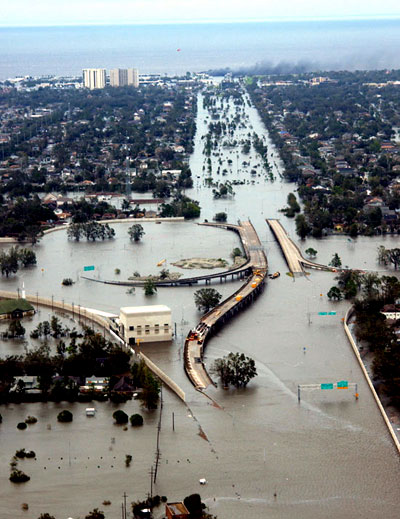
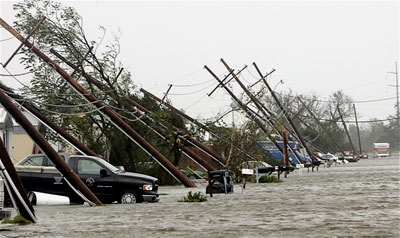
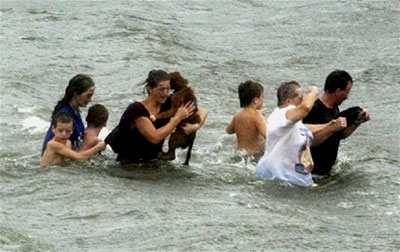
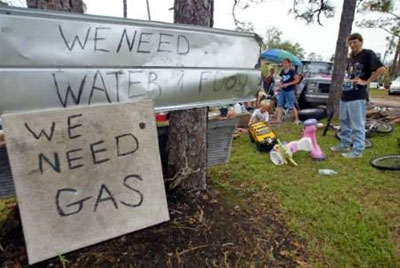
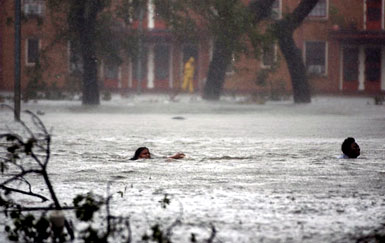
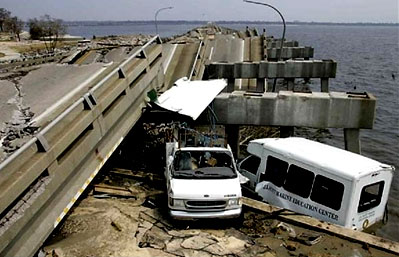
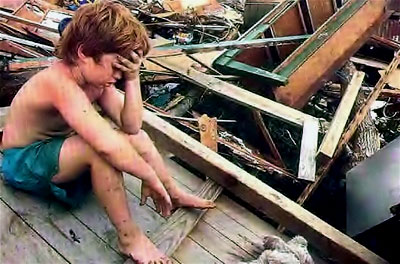
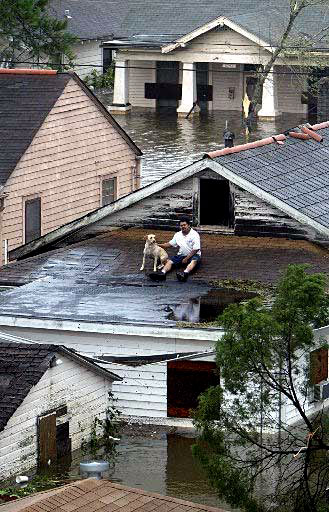
Look carefully at these pictures - you just may be gazing into your own future.


Monday, July 10, 2006

Another "Quit Complaining About Your Job"-Monday


While it seems as if we've been slacking off here at TCA, we've actually been busy behind-the-scenes here, working on a redesign of the blog (to be debuted soon), expanding the writing-talent base, researching several stories, and, okay, a little summer-slacking-off. We aim to be back at it (working overtime) by mid-August. Until then, we'll publish whatever we have as soon as it's ready so keep an eye out for us.

Saturday, July 08, 2006

Bush's Hand in Mexico's Election


There is evidence that left-leaning voters have been scrubbed from key electoral lists in Latin America.

At The Guardian, Greg Palast reports:
There's something rotten in Mexico. And it smells like Florida. The ruling party, the Washington-friendly National Action Party (Pan), proclaimed yesterday their victory in the presidential race, albeit tortilla thin, was Mexico's first "clean" election. But that requires we close our eyes to some very dodgy doings in the vote count that are far too reminiscent of the games played in Florida in 2000 by the Bush family. And indeed, evidence suggests that Team Bush had a hand in what may be another presidential election heist.

Just before the 2000 balloting in Florida, I reported in the Guardian that its governor, Jeb Bush, had ordered the removal of tens of thousands of black citizens from the state's voter rolls. He called them "felons", but our investigation discovered their only crime was Voting While Black. And that little scrub of the voter rolls gave the White House to his brother George.

Jeb's winning scrub list was the creation of a private firm, ChoicePoint of Alpharetta, Georgia. Now, it seems, ChoicePoint is back in the voter list business - in Mexico - at the direction of the Bush government. Months ago, I got my hands on a copy of a memo from the US Federal Bureau of Investigation, marked "secret," regarding a contract for "intelligence collection of foreign counter-terrorism investigations."

Given that the memo was dated September 17 2001, a week after the attack on the World Trade Centre, hunting for terrorists seemed like a heck of a good idea. But oddly, while all 19 hijackers came from Saudi Arabia and the Persian Gulf, the contract was for obtaining the voter files of Venezuela, Brazil ... and Mexico.

What those Latin American countries have in common, besides a lack of terrorists, is either a left-leaning president or a left candidate for president ahead in the opinion polls, leaders of the floodtide of Bush-hostile Latin leaders. It seems that the Bush government feared the leftist surge was up against the US's southern border.

As we found in Florida in 2000, my investigations team on the ground in Mexico City this week found voters in poor neighbourhoods, the left's turf, complaining that their names were "disappeared" from the voter rolls. ChoicePoint can't know what use the Bush crew makes of its lists. But erased registrations require us to ask, before this vote is certified, was there a purge as there was in Florida?

Notably, ruling party operatives carried registration lists normally in the hands of elections officials only. (In Venezuela in 2004, during the special election to recall President Hugo Chavez, I saw his opponents consulting laptops with voter lists. Were these the purloined FBI files? The Chavez government suspects so but, victorious, won't press the case.)

There's more that the Mexico vote has in common with Florida besides the heat. The ruling party's hand-picked electoral commission counted a mere 402,000 votes more for their candidate, Felipe Calderón, over challenger Andrés Manuel López Obrador. That's noteworthy in light of the surprise showing of candidate Señor Blank-o (the 827,000 ballots supposedly left "blank").

We've seen Mr Blank-o do well before - in Florida in 2000 when Florida's secretary of state (who was also co-chair of the Bush campaign) announced that 179,000 ballots showed no vote for the president. The machines couldn't read these ballots with "hanging chads" and other technical problems. Humans can read these ballots with ease, but the hand-count was blocked by Bush's conflicted official.

And so it is in Mexico. The Calderón "victory" is based on a gross addition of tabulation sheets. His party, the Pan, and its election officials are refusing López Obrador's call for a hand recount of each ballot which would be sure to fill in those blanks.

Blank ballots are rarely random. In Florida in 2000, 88% of the supposedly blank ballots came from African-American voting districts - that is, they were cast by Democratic voters. In Mexico, the supposed empty or unreadable ballots come from the poorer districts where the challenger's Party of the Democratic Revolution (PDR) is strongest.

There's an echo of the US non-count in the south-of-the-border tally. It's called "negative drop-off". In a surprising number of districts in Mexico, the federal electoral commission logged lots of negative drop-off: more votes for lower offices than for president. Did López Obrador supporters, en masse, forget to punch in their choice?

There are signs of Washington's meddling in its neighbour's election. The International Republican Institute, an arm of Bush's party apparatus funded by the US government, admits to providing tactical training for Pan. Did Pan also make use of the purloined citizen files? (US contractor ChoicePoint, its Mexican agents facing arrest for taking the data, denied wrongdoing and vowed to destroy its copies of the lists. But what of Mr Bush's copy?)

Mexico's Bush-backed ruling party claims it has conducted Mexico's first truly honest election, though it refuses to re-count the ballots or explain the purge of voters. Has the Pan and its ally in Washington served democracy in this election, or merely Florida con salsa?