
Houston Chronicle reports:
Exxon Mobil again broke its own record for highest annual profits ever by a U.S. company, pulling in $45.2 billion in 2008, an 11 percent jump over 2007’s $40.6 billion.
But the Irving-based oil giant’s lower fourth-quartery profits reflected how lower demand and plummeting oil and gas prices in the last three months of 2008 amid the global recession have siphoned the industry’s record-breaking streak, which became almost routine as crude rose to all-time highs.
In the quarter, the company earned $7.8 billion, down 33 percent from $11.6 billion in the last three months of 2007 and barely half its all-time quarterly record of $14.8 billion in the third quarter last year, when oil prices were still in triple digits.
However, Rex Tillerson, Exxon’s chairman and chief executive, said capital spending rose 25 percent last year to $26.1 billion and the world’s largest publicly traded oil company will stay its disciplined course through the tough economic times.
“Exxon Mobil’s financial strength continued to support its disciplined capital investment approach in the midst of a growing global economic downturn,” Tillerson said in a statement. “Through these investments we continued to demonstrate our long-term focus throughout the business cycle.”
Chevron, which also unveiled financial results today, bucked the quarterly trend. The San Ramon, Calif.-based company’s annual income rose 28 percent to $23.9 billion from $18.7 billion in 2007, and its quarterly profit rose slightly to $4.89 billion from $4.87 billion. The quarterly increase stemmed from lower costs of raw materials used in refining that increased margins on sales of gasoline and other products, Chevron Chief Executive Officer Dave O’Reilly said.
Like Tillerson, O’Reilly emphasized the oil major’s muscle and discipline amid the recession.
“We enter 2009 with the financial strength to meet the challenges of a difficult economy and with a continued focus on cost management and capital stewardship,” he said.
Exxon’s annual results included a one-time gain of $1.6 billion from the sale of a natural gas transmission business in Germany and a charge of $460 million related to litigation stemming from the 1989 Exxon Valdez oil spill in Alaska. Excluding those items, the company still surpassed its record with annual earnings of $44 billion.
Exxon attributed its lower quarterly earnings to weaker crude prices, higher operating expenses, lower chemical volumes and impacts of Hurricanes Gustav and Ike. Ike prompted shutdowns and repairs at two of Exxon’s major refineries in Baytown—the nation’s largest—and Beaumont.
Per share, including the one-time items, Exxon earned $8.69 in 2008 compared to $7.28 in 2007. In the quarter, per-share income was $1.55, down 27 percent from $2.13 in the October-December period of 2007. Revenue for the year was $477.35 billion, up from $404.5 billion. In the quarter, revenue fell to $84.7 billion from $116.6 billion.
Exxon also continued its trend of lower production. In the quarter, production fell 3 percent, largely because of lower entitlement volumes, divestments and effects of cuts by the Organization of the Petroleum Exporting Countries. Excluding those effects, production fell 1 percent. Increased oil production from projects in west Africa and the North Sea more than offset field declines, but natural gas production declines surpassed increased volumes and project additions in the North Sea, Qatar and Malaysia, the company said.
Exxon also said exploration and production income fell $2.6 billion to $5.6 billion in the quarter because of lower oil prices. Refining income suffered from hurricane-related repairs and higher operating costs, but higher margins increased earnings by $147 million to $2.4 billion.
Chevron’s production also fell in the quarter, to 2.54 million barrels of oil equivalent per day from 2.6 million barrels. The company said its decline largely stemmed from shutdowns and damage caused to production facilities by the hurricanes.
Per share for the year, Chevron earned $11.67, up from $8.77. In the quarter, per-share earnings were $2.44, up from $2.32. Revenue for the year rose to $273 billion from $220.9 billion, but quarterly revenue fell to $45.2 billion from $61.4 billion.
Chevron’s exploration and production income fell to $3.15 billion from $4.8 billion, while refining and marketing earnings rose to $2 billion from $204 million in the quarter, the company said.
Friday, January 30, 2009

Her Mother's Daughter, Her Father's Inspiration?
At Salon.com, Zac Frank writes, "What a 1988 college thesis by the former vice president's daughter tells us about the Bush presidency":
When I worked at the library at Colorado College, I quickly discovered the job had few perks. The free book loans on demand were little better than subprime mortgages when you realized anyone could get them. The only "exclusive" benefit was the chance to keep manuscripts the library threw out. Usually, I had a limited selection of titles, like Proceedings From the Third Workshop on Genetics of Bark Beetles and Associated Micro-Organisms. But occasionally I stumbled across a gem. Rummaging through a bin of discarded books one day, I saw an unusual spine: "CHENEY The Evolution of Presidential War Powers 1988."
In 1988, while Dick Cheney was Wyoming's sole representative in the House of Representatives, his daughter's senior thesis was quietly published in Colorado Springs. The 125-page treatise argued that, constitutionally and historically, presidents have virtually unchecked powers in war. Thirteen years before her father became vice president, she had symbolically authored the first legal memorandum of the Bush administration, laying out the same arguments that would eventually justify Guantanamo and extraordinary rendition, wiretapping of American citizens, and, broadly, the unitary theory of the executive that shaped the Bush presidency.
The Eisenhower Executive Office Building may be bereft of Dick Cheney, but his steadfast efforts to consolidate power around the president have left the scales of power tipped toward the executive. Then there is the force of Cheney's grim, blunt personality, felt even as he attended the inauguration in a wheelchair: His name will stand for the ideas he promoted well into the future, and his daughter's thesis offers an eerily prescient image of the presidency as Cheney believed it should be.
Though less known to the public than her sister, Mary, arguably the most prominent gay Republican, Elizabeth is the elder daughter of Dick and Lynne Cheney. After graduating from Colorado College, she took a job in the State Department before going to law school, and was eventually appointed as one of the chief diplomats for the Middle East in 2002.
Elizabeth Cheney begins her survey at the Constitutional Convention. Contrary to today's middle-school mythology, she tells us, fear of enabling a tyrannical monarch was not foremost in the Founding Fathers' minds. Rather, they did not want to repeat the failure of the Continental Congress' attempts to manage the war for independence. Our constitutional architects, she argues, believed they could not "foresee every possible future use of American armed forces" and, as a result, wanted a commander in chief endowed with great latitude in wartime.
For Cheney, Thomas Jefferson established the path presidents would and should take when dealing with Congress. In engaging American warships against Barbary pirates, Jefferson "chose to inform Congress of his actions at his own convenience." When he did, he fabricated an attack on an American ship to secure their support.
Cheney sides with the president whenever he clashes with Congress over war powers. Following an escalation in the Vietnam War ordered by Lyndon Johnson, she notes, Congress passed the Gulf of Tonkin resolution, based on questionable information, to provide cover for the president. Nevertheless, both he and Richard Nixon after him believed that the resolution provided no "legal basis for their action because they presumed all the authorization they needed was in the Commander and Chief [sic] clause."
Time and again, Cheney contends that in times of war, presidents since Washington have justifiably redefined their authority to preserve the country, and she is scornful of any who challenge that authority. As Congress challenged presidential authority toward the end of Vietnam, she casts them as scapegoating the executive. "As public support dwindled so did congressional willingness to accept responsibility," she writes, "Congress set about to blame the only two men who couldn't escape responsibility." For someone who has vested so much faith in executive wisdom, she is surprisingly unwilling to hold it accountable.
From beginning to end, it's clear that Cheney looks upon the model of the powerful executive approvingly. Her most forceful conclusion is that the Founders "certainly did not intend, nor does history substantiate, the idea that Congress should legislate specific limits on the President's power." To ensure American security, it needs to recognize that the "nature of military and foreign policy demand the 'unity of a singular Executive.'"
One cannot help but see echoes of this conclusion in the administration in which her father was so influential. The Bush White House repeatedly embraced the philosophy of acting first and asking for approval later, especially on issues that involved the power of the purse. They embraced a position that Cheney found repeatedly in history: "The president's duty to protect national security sometimes come before his responsibility to keep Congress informed."
This crusade against oversight was not new to Dick Cheney. In November of 1987, just six months before Elizabeth submitted her thesis, a report he commissioned following the Iran-Contra affair argued that "[c]ongressional actions to limit the president in this area therefore should be reviewed with a considerable degree of skepticism."
For Cheney, apparently, the Constitution and rule of law are no more of a check on this unitary power than Congress. During the Civil War, Abraham Lincoln's suspension of habeas corpus and imposition of military tribunals present no legal dilemma to her. "To assert that the Constitution is a shield of protection 'for all classes of men, at all times and under all circumstances,' " she writes, "is to deny the nation the right of self-preservation. There have been and will be times in the experience of the country when constitutional provisions will of necessity be suspended to guarantee the survival of our democracy." The Supreme Court's chief justice was wrong in declaring his actions illegal in Ex Parte Merryman because his power "was actually an assertion of the power of the people."* How he divined that will of the people, Cheney does not explain.
On the first page of her paper, above a neat signature in blue ink, she attests, "On my honor I have neither given nor received unauthorized aid on this thesis." Her father may not have written her thesis, but before and after its publication, he held unwaveringly to its ideas. As a report on an exit interview the outgoing vice president gave with CBS notes:
While Cheney could not say whether any action by a president in wartime should be considered "legal," he pointed to historic precedents for presidents taking extra-legal measures in order, he said, to protect the Constitution against all enemies, foreign and domestic.
That statement could well have been printed on the cover of his daughter's thesis.
Correction, Jan. 30, 2009: This article originally referred to Ex Parte Merryman as a Supreme Court case. It was a circuit court order written by Roger Taney, the chief justice of the Supreme Court, who was sitting on the circuit court at the time. (Return to the corrected sentence.)
When I worked at the library at Colorado College, I quickly discovered the job had few perks. The free book loans on demand were little better than subprime mortgages when you realized anyone could get them. The only "exclusive" benefit was the chance to keep manuscripts the library threw out. Usually, I had a limited selection of titles, like Proceedings From the Third Workshop on Genetics of Bark Beetles and Associated Micro-Organisms. But occasionally I stumbled across a gem. Rummaging through a bin of discarded books one day, I saw an unusual spine: "CHENEY The Evolution of Presidential War Powers 1988."
In 1988, while Dick Cheney was Wyoming's sole representative in the House of Representatives, his daughter's senior thesis was quietly published in Colorado Springs. The 125-page treatise argued that, constitutionally and historically, presidents have virtually unchecked powers in war. Thirteen years before her father became vice president, she had symbolically authored the first legal memorandum of the Bush administration, laying out the same arguments that would eventually justify Guantanamo and extraordinary rendition, wiretapping of American citizens, and, broadly, the unitary theory of the executive that shaped the Bush presidency.
The Eisenhower Executive Office Building may be bereft of Dick Cheney, but his steadfast efforts to consolidate power around the president have left the scales of power tipped toward the executive. Then there is the force of Cheney's grim, blunt personality, felt even as he attended the inauguration in a wheelchair: His name will stand for the ideas he promoted well into the future, and his daughter's thesis offers an eerily prescient image of the presidency as Cheney believed it should be.
Though less known to the public than her sister, Mary, arguably the most prominent gay Republican, Elizabeth is the elder daughter of Dick and Lynne Cheney. After graduating from Colorado College, she took a job in the State Department before going to law school, and was eventually appointed as one of the chief diplomats for the Middle East in 2002.
Elizabeth Cheney begins her survey at the Constitutional Convention. Contrary to today's middle-school mythology, she tells us, fear of enabling a tyrannical monarch was not foremost in the Founding Fathers' minds. Rather, they did not want to repeat the failure of the Continental Congress' attempts to manage the war for independence. Our constitutional architects, she argues, believed they could not "foresee every possible future use of American armed forces" and, as a result, wanted a commander in chief endowed with great latitude in wartime.
For Cheney, Thomas Jefferson established the path presidents would and should take when dealing with Congress. In engaging American warships against Barbary pirates, Jefferson "chose to inform Congress of his actions at his own convenience." When he did, he fabricated an attack on an American ship to secure their support.
Cheney sides with the president whenever he clashes with Congress over war powers. Following an escalation in the Vietnam War ordered by Lyndon Johnson, she notes, Congress passed the Gulf of Tonkin resolution, based on questionable information, to provide cover for the president. Nevertheless, both he and Richard Nixon after him believed that the resolution provided no "legal basis for their action because they presumed all the authorization they needed was in the Commander and Chief [sic] clause."
Time and again, Cheney contends that in times of war, presidents since Washington have justifiably redefined their authority to preserve the country, and she is scornful of any who challenge that authority. As Congress challenged presidential authority toward the end of Vietnam, she casts them as scapegoating the executive. "As public support dwindled so did congressional willingness to accept responsibility," she writes, "Congress set about to blame the only two men who couldn't escape responsibility." For someone who has vested so much faith in executive wisdom, she is surprisingly unwilling to hold it accountable.
From beginning to end, it's clear that Cheney looks upon the model of the powerful executive approvingly. Her most forceful conclusion is that the Founders "certainly did not intend, nor does history substantiate, the idea that Congress should legislate specific limits on the President's power." To ensure American security, it needs to recognize that the "nature of military and foreign policy demand the 'unity of a singular Executive.'"
One cannot help but see echoes of this conclusion in the administration in which her father was so influential. The Bush White House repeatedly embraced the philosophy of acting first and asking for approval later, especially on issues that involved the power of the purse. They embraced a position that Cheney found repeatedly in history: "The president's duty to protect national security sometimes come before his responsibility to keep Congress informed."
This crusade against oversight was not new to Dick Cheney. In November of 1987, just six months before Elizabeth submitted her thesis, a report he commissioned following the Iran-Contra affair argued that "[c]ongressional actions to limit the president in this area therefore should be reviewed with a considerable degree of skepticism."
For Cheney, apparently, the Constitution and rule of law are no more of a check on this unitary power than Congress. During the Civil War, Abraham Lincoln's suspension of habeas corpus and imposition of military tribunals present no legal dilemma to her. "To assert that the Constitution is a shield of protection 'for all classes of men, at all times and under all circumstances,' " she writes, "is to deny the nation the right of self-preservation. There have been and will be times in the experience of the country when constitutional provisions will of necessity be suspended to guarantee the survival of our democracy." The Supreme Court's chief justice was wrong in declaring his actions illegal in Ex Parte Merryman because his power "was actually an assertion of the power of the people."* How he divined that will of the people, Cheney does not explain.
On the first page of her paper, above a neat signature in blue ink, she attests, "On my honor I have neither given nor received unauthorized aid on this thesis." Her father may not have written her thesis, but before and after its publication, he held unwaveringly to its ideas. As a report on an exit interview the outgoing vice president gave with CBS notes:
While Cheney could not say whether any action by a president in wartime should be considered "legal," he pointed to historic precedents for presidents taking extra-legal measures in order, he said, to protect the Constitution against all enemies, foreign and domestic.
That statement could well have been printed on the cover of his daughter's thesis.
Correction, Jan. 30, 2009: This article originally referred to Ex Parte Merryman as a Supreme Court case. It was a circuit court order written by Roger Taney, the chief justice of the Supreme Court, who was sitting on the circuit court at the time. (Return to the corrected sentence.)
Friday, January 23, 2009
It's National Pie Day!
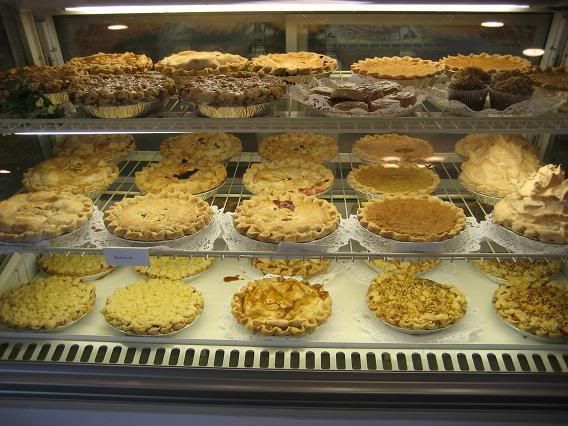
According to the American Pie Council:
Pie has been around since the ancient Egyptians. The first pies were made by early Romans who may have learned about it through the Greeks. These pies were sometimes made in "reeds" which were used for the sole purpose of holding the filling and not for eating with the filling.
The Romans must have spread the word about pies around Europe as the Oxford English Dictionary notes that the word pie was a popular word in the 14th century. The first pie recipe was published by the Romans and was for a rye-crusted goat cheese and honey pie.
The early pies were predominately meat pies. Pyes (pies) originally appeared in England as early as the twelfth century. The crust of the pie was referred to as "coffyn". There was actually more crust than filling. Often these pies were made using fowl and the legs were left to hang over the side of the dish and used as handles. Fruit pies or tarts (pasties) where probably first made in the 1500s. English tradition credits making the first cherry pie to Queen Elizabeth I.
Pie came to America with the first English settlers. The early colonists cooked their pies in long narrow pans calling them "coffins" like the crust in England. As in the Roman times, the early American pie crusts often were not eaten, but simply designed to hold the filling during baking. It was during the American Revolution that the term crust was used instead of coffyn.
Over the years, pie has evolved to become what it is today "the most traditional American dessert". Pie has become so much a part of American culture throughout the years, that we now commonly use the term "as American as apple pie."
Who makes the best pies in America? They do, so says the American Pie Council.
Thursday, January 15, 2009
Obama's Mighty Lean For All The Bread He's Been Breaking Lately
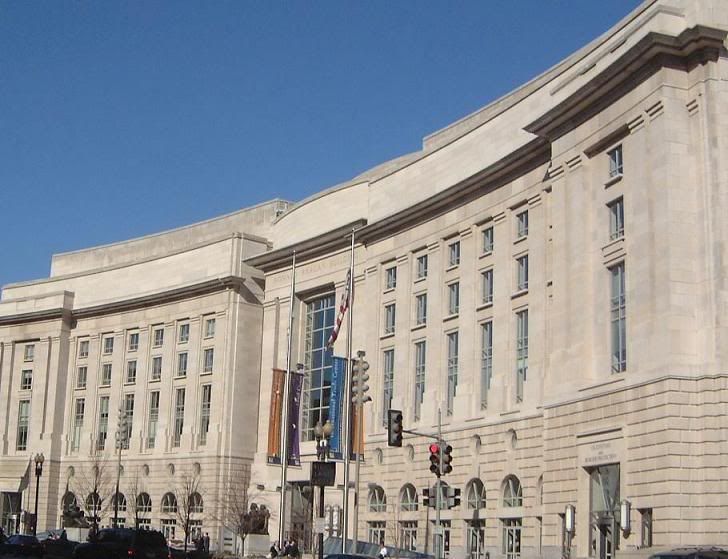
The secret dinner with Obama you haven't heard about
From ForeignPolicy.com:
At a quiet dinner meeting late last week in Washington's Ronald Reagan Building, President-elect Obama reached out to outside foreign-policy experts, trying to resist the presidential bubble that is rapidly closing around him.
Late afternoon last Thursday Jan.8, scholars and staff at the Woodrow Wilson International Center for Scholars noticed an unusual upgrade in the security of the top floors of their building, which also houses USAID, the EPA, a public food court, and some foreign television stations. The Wilson Center hosts high-level people all the time, but this security detail was of a different order, sources said.
And indeed, some suspected that Obama was coming to dine in the 8th-floor offices of Lee Hamilton, the quasi-governmental think tank's president -- a hunch they confirmed the next day.
Hamilton, the longtime House member from Indiana who cochaired the Iraq Study Group, the 9/11 Commission, and numerous others over the years, has become a kind of wise-man mentor to Obama. Last Thursday, the Wilson Center president assembled a small collection of scholars on the Middle East and South Asia for a meeting that stretched through dinner for hours into the night.
Among those who attended the off-the-record dinner: Iran scholar Haleh Esfandiari; Pakistani journalist Ahmed Rashid (who had flown in from Lahore); Obama friend and foreign-policy advisor Samantha Power of Harvard University (who accompanied PEOTUS to the meeting); incoming White House chief of staff Rahm Emanuel; and a few others. Obama told the group, none of whom reached would discuss the details, that he already felt in the bubble and was trying his best to meet with independent experts.
Scholars at the center noted the group leaned toward experts on the Middle East and South Asia. "They talked mostly about what was going on in the world, from Gaza to the financial crisis and its implications," one source summarized.
"It's clear from the nine or 10 people included that the meeting was mostly focused on Middle East issues," said one scholar who witnessed the security goings-on but did not attend the meeting. "It's part of the process that I think Obama wants to do to connect" given the demise of his Blackberry. "It was held here [at the Wilson Center], but from now on, I suspect such things will be held at the White House."
Contacted about the meeting, Wilson Center Middle East scholar Aaron David Miller declined to comment, saying he couldn't help on this one. Esfandiari, who was imprisoned last year by the Iranian regime, directed questions about the meeting to the Wilson Center's press officer. An executive assistant to Hamilton said her boss was getting on a plane in California to fly back to Washington, and couldn't be reached today.
A source close to Hamilton explained that he had a long relationship with Obama, and noted that many former Hamilton staffers had gone on to be key staffers and foreign policy advisors to Obama.
Among them: Obama speechwriter Ben Rhodes, who wrote speeches and was a policy advisor for Hamilton for several years; Obama's top foreign-policy advisor Denis McDonough; who worked for Hamilton on the staff of the House International Relations Committee, Obama Mideast advisor Daniel Shapiro, who worked for Hamilton as his professional staff member on the Middle East when Hamilton was chairman of the then-House Foreign Affairs Committee in the 103rd Congress (1993-94); Dan Restrepo, a top Obama Latin America advisor now with the Center for American Progress who worked for Hamilton on the Hill; and Mara Rudman, who worked for Hamilton on the Hill and is now a member of the formal Obama transition team.
"Ben Rhodes (the [President-Elect's] national security speechwriter) and I both are very close to Lee," McDonough said in an e-mail. "Ben wrote for Lee for a couple years, through the 9-11 Commission and the Iraq Study Group. Lee has been an indispensable ally to the P-E, offering wise counsel and hosting the P-E for discussions and a couple speeches during the campaign. He is a frequent sounding board for the P-E and the team."
"From what I understand, the president-elect wants to be able to have access to different ideas and opinions," said one Wilson Center associate. "What better person than Lee [Hamilton]? ... Lee was always tasked whenever there was anything to do with ethics. For instance, Iran-contra" [Hamilton was one of congressional chairs of Iran contra investigation]. "They went to Lee because he has the ability to transcend party lines. ... He's very congenial, very decent, he's willing to listen to everybody, ... he treats everybody with dignity and respect. And that comes through. He listens. He assesses. And that is what Hamilton said he likes about Senator Obama. Obama listens. He goes around the table. Lee has been in numerous meetings with him, and Obama listens to what people have to say. Hamilton has a great deal of respect for him."
The source said that Obama and Hamilton have met several times and that Hamilton's former law partner in Chicago early on introduced the Wilson Center president to this "amazing" young Obama years ago, long before Obama entered national politics.
Noting that Hamilton was the longtime chair in the 1990s of the House International Relations committee, one Hill source said, "Hamilton had access to the 'best and the brightest.' It's not a surprise that Obama is drawing on people from that staff.
"The more interesting point to me," the Hill source added, "Is that it shows that since Obama came onto the national scene in 2004, Obama seeks out these older, moderate members of the establishment. And seeks to curry their favor. It's been documented how he's done so with [Sen. Richard] Lugar [R-Indiana]. He seems to have done the same thing with Hamilton."
Also of note: the significance of Obama bringing Samantha Power along to the meeting. A veteran Washington foreign-policy hand says Power is likely to get a job in the Obama administration, probably in the NSC, but would not divulge what position. (Power's husband Cass Sunstein was named last week to be administrator of the Office of Information and Regulatory Affairs within the Office of Management and Budget.) Power did not respond to an e-mail query.
Wednesday, January 14, 2009
"If we told you (where the bailout money is going)..."
"...they would stop taking the bailout money."
Fed Vice Chair Donald Kohn testified before the Financial Services Committee today, along with John Bovenzi of the FDIC. The Fed's balance sheet has expanded by $1.2 trillion since September 1. Where did the money go? Kohn wouldn't say.
Fed Vice Chair Donald Kohn testified before the Financial Services Committee today, along with John Bovenzi of the FDIC. The Fed's balance sheet has expanded by $1.2 trillion since September 1. Where did the money go? Kohn wouldn't say.
Monday, January 05, 2009
The Greening of Restaurants
On this week of getting back to work after a holiday season of heavy eating on the heels of a campaign of unprecedent nervous eating that packed on the pounds (even the Food Channel is cooking light and healthy this week), it seems fitting that I get with the program, too, and ease into changing eating habits.
From the Associated Press:
I'm going to be dealing with 'green-eating' more in the coming weeks, but for now, it's time for a glass of carrot juice.
From the Associated Press:
The vibe at Germany's first carbon-neutral restaurant is more hip than hippie.
Minimalism is the mantra at Foodorama, with its cobalt-gray walls, soft lighting and single stem daisies perched atop gleaming blond maple tables, all nestled among the boutiques and stately balconies in Berlin's fashionable west Kreuzberg district.
Corporations such as Dell and Google have embraced the carbon-neutral ethos, but not many restaurants have followed suit.
Foodorama was dreamed up by German branding agency Lab One to sell environmentalism to foodies.
For every ton of carbon dioxide produced by the all-organic cafe, its owners say they will buy carbon certificates for a Kyoto-standard wind park in Karnataka, India.
The restaurant, which opened in September and seats 100 inside (and another 120 outside) marks a departure from Lab One's typical projects, which entail creating promotional material for clients such as rock bands and movie studios.
Agency director Ozan Sinan says Lab One is composed of "hedonistic people who asked each other what can we do besides our core business? We are afraid of what's happening in the world. We want to start something ourselves."
The menu is a combined effort to be both pure and break the rules, says Sinan, resulting in selections such as yakitori schnitzel and a gourmet version of the Berlin classic currywurst, with herb mayonnaise and homemade ketchup.
Though Sinan's childhood meals bore little resemblance to Foodorama's posh cuisine, his mother's economical and seasonal cooking neverless shares much philosophical ground with Foodorama's offerings.
"Many of the things we try to do here -- conserve energy, eat local, reduce waste -- are the things that I learned from my parents," he says. "I was raised with a natural sense for conservation precisely because it wasn't a luxury environment."
Lab One worked with Climate Partner, a Munich-based environmental consulting firm, to devise a checklist of eco-friendly measures in creating Foodorama. These included using bio gas, derived from agricultural byproducts and produced in gas plants outside Berlin, and zero-emission electricity, created from renewable energy sources.
In both cases, Foodorama pays extra for the green alternatives. Other strategies, such as insisting employees bike or take public transportation to work, and investing in state-of-the-art insulation, also shrank emission estimates.
Climate Partner project manager Kai Gilhorn said he and his colleagues even calculated the amount of emissions required to produce each dish on the menu, and considered putting the figures on the menus.
"But that might make people feel guilty for ordering beef instead of vegetables, which may not be what the restaurant wants," he says.
Despite the global financial crisis, Sinan believes the restaurant still can make a profit, even after the emission certificates are purchased at as much as $3,000 a year.
Though some organic French wines run around $120, most items on the Foodorama menu cost about $16, considered steep for the neighborhood but a bargain relative to many gourmet eateries.
Bernd Mueller, 64, munching on a salad, gave a more measured response, calling the food good but not exceptional -- and said he was largely attracted to the restaurant by its organic guarantee.
"Organic tastes different. I cook about 90 percent organic at home, and there aren't that many other organic restaurants in Berlin," said the retired lawyer who lives around the corner and already has become a regular.
I'm going to be dealing with 'green-eating' more in the coming weeks, but for now, it's time for a glass of carrot juice.
Saturday, December 20, 2008
Happier Holidays

With an Old Cuban:
- 3/4 ounce fresh lime juice
- 1 ounce simple syrup
- 1 1/2 ounce aged rum (Bacardi 8 Anejo)
- 2 dashes Angostura bitters
- 6 mint leaves
- 2 ounces champagne
Muddle 6 mint leaves in freshly squeezed lime juice and simple syrup. Add rum and bitters. Shake with ice. Strain (double-strain if you don't want bits of mint in the drink) into chilled and sugar-rimmed cocktail glass (champagne, martini, or sour glass). Top with champagne, garnish with mint leaf or a sugar-coated vanilla bean.
Created by Audrey Saunders from Pegu Club days
Thursday, December 18, 2008
Levi Johnston's Mother Hit With Drug Charges

Sherry L. Johnston was arrested by Alaska State Troopers at her Wasilla home Thursday December 18, 2008 and charged with six felony counts of misconduct involving a controlled substance. Johnston is the mother of Levi Johnston, the Wasilla 18-year-old who received international attention in September when Gov. Sarah Palin and her husband, Todd, announced their teenage daughter was pregnant and he was the father.
ADN.com reports:
A 42-year-old Wasilla woman was arrested Thursday at her home by Alaska State Troopers with a search warrant in an undercover drug investigation. Sherry L. Johnston was charged with six felony counts of misconduct involving a controlled substance.
Johnston is the mother of Levi Johnston, the Wasilla 18-year-old who received international attention in September when Gov. Sarah Palin and her husband, Todd, announced their teenage daughter was pregnant and he was the father. Bristol Palin, 18, is due on Saturday, according to a recent interview with the governor's father, Chuck Heath.
Troopers served the warrant at Johnston's home at the "conclusion of an undercover narcotics investigation," said a statement issued Thursday by the troopers as part of the normal daily summary of activity around the state.
Troopers charged Johnston with second-degree misconduct involving a controlled substance -- generally manufacturing or delivering drugs -- as well as fourth-degree misconduct involving controlled substances, or possession.
Troopers released no other information, including the kind or amount of drugs, because details could jeopardize an ongoing investigation, spokeswoman Megan Peters said.
Asked how long the investigation had proceeded before Johnston's arrest, Peters would only say "a while."
The Palmer District Attorney's office had no comment.
Sherry Johnston was arrested around noon and booked at Mat-Su Pretrial Facility, according to a booking officer there. She was released on a $5,000 unsecured bond just after 2 p.m.
No charging documents had been filed at Palmer courthouse by the end of the day, a clerk said.
Levi Johnston sat with Bristol and the rest of the Palin family in St. Paul, Minn., during Gov. Palin's speech to the Republican National Convention, and he joined the family on the stage afterwards.
When asked about the arrest, Palin's spokesman, Bill McAllister, issued the following statement by e-mail: "This is not a state government matter. Therefore the governor's communications staff will not be providing comment or scheduling interview opportunities."
Johnston didn't come to the door of her home on Caribou Loop Road outside Wasilla on Thursday afternoon. A teenage boy who answered the door said he couldn't provide any information.
Saturday, December 13, 2008
To Build Confidence, Aim for Full Employment
In the NY Times, :
Robert J. Shiller is professor of economics and finance at Yale and co-founder and chief economist of MacroMarkets LLC.
In the current crisis, discussions of economic policy have often centered on uninspiring, short-term goals. To restore confidence in our economic future, we need appropriate, firm targets that will clearly put us where we want to be.
For example, President-elect Barack Obama has framed his economic stimulus package in terms of the number of jobs he will create. The goal is to add 2.5 million jobs, he says, by hiring people to improve our highways, fix up our schools and do other infrastructure work around the country. All of that is fine, but it does not represent a commitment to full employment — providing a job for everyone who is willing to work. As a result, confidence remains abysmal.
If the new president had a target of full employment, and if Americans believed that he could reach it, the confidence problem could be quickly solved.
The Great Depression provides an analogy. Presidents Herbert Hoover and Franklin D. Roosevelt had at least a vague idea that economic stimulus would help the situation, but even Roosevelt lacked clear targets for such policies during the New Deal. The economic stimulus applied was inconsistent and inadequate. Confidence waned, and the depression was longer and deeper than it needed to be.
People still remember aspects of that depression history. The Works Progress Administration and the Civilian Conservation Corps tackled infrastructure projects, much as Mr. Obama proposes — but these New Deal programs were not enough to restore full employment. That history reduces the current credibility of Mr. Obama’s target of 2.5 million jobs.
On the other hand, there have been some worthwhile targets in monetary policy in recent years. A number of central banks have adopted firm inflation targets, which has helped to contain inflation expectations. Those expectations have tended to coincide roughly with the targets.
At the moment, of course, inflation is no longer the fundamental risk. Our current problems are deflation and recession — possibly even depression — and so we must rethink our targets.
An immediate shift to a full employment target may not be possible, simply because there is no confidence right now that we can hit it. While people seem to believe that central banks can control inflation, there is little consensus that central banks can prevent a depression under circumstances like this.
In a forthcoming book I’ve written with Professor George A. Akerlof of the University of California, Berkeley, we argue that current circumstances call for a couple of intermediate targets. If we can hit them, we may credibly be expected to hit the ultimate target of full employment — and keep inflation at bay. The intermediate targets should be announced forcefully, with an immediate effort to achieve them.
First, there should be an intermediate target for conventional fiscal and monetary policy, one ambitious enough to restore full employment in a typical recession. (Fiscal policy is the taxation and expenditure proposed by the president and voted by Congress; monetary policy is the province of the Federal Reserve Board.)
This target may be inadequate, however, because we are not in a typical recession. Conventional fiscal and monetary methods may fizzle, as they did in the 1990s in post-bubble Japan. After its stock market and real estate debacle early in the decade, the government of Japan moved its budget into deficit and brought interest rates down to zero. But the economy never entirely recovered, and in due course the government debt rose to 1.71 times the annual gross domestic product, versus a current multiple of 0.74 in the United States.
Similarly, we just do not know whether these measures will work in this country. That is why we also need a second intermediate target, for credit. The ability to borrow should be restored to an appropriate level for a normal economy at full employment.
This is crucial because the most salient problem in our institutions is the drying up of credit. Without credit, companies that count on outside finance will go bankrupt, requiring an impossibly large fiscal and monetary policy stimulus to achieve full employment.
Furthermore, as long as the credit crisis continues, the economy’s response to conventional fiscal and monetary policy may be drastically reduced. A person who cannot borrow, for example, is unlikely to buy a car, even if a generous fiscal policy has provided him with the needed down payment. Under the current circumstances, the Keynesian “multiplier,” the economy’s response to fiscal policy, may be unusually low. Our best econometric models just won’t tell us how low.
FOR months, the Fed has been working to expand credit, and has invented some good methods for doing so. On Nov. 25, it announced a smart method to jump-start credit, called the Term Asset-Backed Securities Loan Facility, which would issue loans, using securities backed by newly issued consumer and small-business loans as collateral. The Fed has started paying interest on reserves to control the inflationary impact of such a policy.
This plan and others like it are promising. But all the government loan programs announced so far represent only a tiny fraction of the $52 trillion of total credit market instruments outstanding. We will need to go much further and extend credit to households and businesses that would otherwise be ignored.
Along with fiscal and monetary policy, credit needs to be targeted on a scale that would get us out of our current economic mess. That’s what Washington should do now.
Robert J. Shiller is professor of economics and finance at Yale and co-founder and chief economist of MacroMarkets LLC.
Elsewhere Around The World . . . .
. . . . Life goes on as usual
The inmarch to the Nobel Banquet, 2008:
The inmarch to the Nobel Banquet, 2008:
Princess Madeleine and Paul Krugman [2:24-2:37]
Friday, December 12, 2008
Thursday, December 11, 2008
What Does $700 Billion Buy Taxpayers?
On NPR, bankruptcy and commercial law expert Elizabeth Warren explains how taxpayer money is being spent in the financial bailout program. A professor at Harvard Law School, Warren chairs the oversight panel appointed by Congress to monitor the spending of the $700 billion bailout money. The committee issues its first report on Dec. 10.
Wednesday, December 10, 2008
Are We A Nation Of Outlaws?
Is deregulation behind the economic meltdown, or have there been prosecutable crimes?
Reuters reports:
Reuters reports:
A failure to prosecute the "villains" responsible for the financial crisis that brought the United States to its knees will leave the country without the moral compass needed to avert future crises, a Wall Street luminary said.
Pioneer hedge fund manager Michael Steinhardt is angry that the bailout of America is eroding the nation's capitalist ethos while those whose deeds crippled the U.S. economy suffer scant opprobrium, their names still untarnished.
"Something really went wrong here. We're about to enter a period where our budget deficit will dwarf anything we've seen before," Steinhardt told the Reuters Investment Outlook Summit in New York.
"What we really needed a long time ago was a recognition that there were villains apace. The evils of the financial system should have been recognized long before this," said Steinhardt, who no longer manages billions of dollars but whose counsel is sought on Wall Street and among select politicians.
While scornful of the financial executives who should have known better, he also belittled Washington for its lack of leadership and for not spelling out what the future beholds.
The current and former Federal Reserve chairmen have proved ill-prepared for the job, said Steinhardt, a former chairman of the Democratic Leadership Council, where he helped promote the career of Bill Clinton before he became president.
Of former Fed Chairman Alan Greenspan, often criticized for keeping interest rates so low that they sparked the housing bubble, Steinhardt said he may have been stupid for a long time, "but he wasn't pernicious."
Current Fed chief Ben Bernanke is little better.
"When you see what Bernanke said five, four months ago, it's laughable," he said. "So Bernanke is not a villain but was he prepared for what has happened here? Not in the slightest."
Steinhardt, however, said Americans themselves must share the blame for running away from the debacle and for not questioning the enormous public debt the U.S. government is about to assume.
"If you cannot accept short-term pain, then you do all sorts of things to coat reality, to pretend, to fabricate, to lie. That is what has happened in American business in the last 10 years," he said.
Steinhardt, who now dedicates his time to philanthropy, still hues to the almost impossible standards that made him a legend. His Steinhardt Partners hedge fund returned an annual 24.5 percent after fees over 28 years before he shut the fund in 1995.
Steinhardt is aware of scandal and reputation. His firm was stung by a federal investigation into allegations he and others, including Salomon Brothers, tried to corner the two-year U.S. Treasury market in the early 1990s.
Steinhardt denied any wrongdoing, and paid a fine and fees of more than $70 million to settle the case.
Steinhardt asked that if the government and Americans are unwilling to prosecute by law, what are the consequences of not being responsible and holding the culprits up for contempt?
"The question is, What's going to come of this, if there are going to be no villains?" he said.
"Is Hank Greenberg a villain?" Steinhardt said, referring to the former chief executive of insurer American International Group (AIG.N: Quote, Profile, Research, Stock Buzz), recipient of a $152 billion federal bailout after it suffered massive losses mainly on complex securities tied to mortgages that had declined in value.
He rattled off other names: James "Jimmy" Cayne, former CEO and chairman of defunct investment bank Bear Stearns Cos, whose unsustainable leverage in two failed hedge funds sparked the crisis in summer 2007.
And Richard Fuld, ex CEO of failed investment bank Lehman Brothers Holdings Inc. (LEHMQ.PK: Quote, Profile, Research, Stock Buzz), whom Steinhardt said he saw last week in a restaurant "happy as a hero, blowing kisses."
Finally, he asked, referring to the senior counselor of Citigroup (C.N: Quote, Profile, Research, Stock Buzz) and a former Treasury secretary under Clinton. "Is Bob Rubin a villain? Still at Citibank? Is he a villain? You can't name a villain? Is this a villain-less debacle?"
Although a friend of Clinton, Steinhardt knocked Barack Obama's pick of ex-Clinton officials for key positions in his administration. The choices reveal a deep lack of substance on the president-elect's part, he said.
"We have a new president who I find to be an absolute tabula rasa in terms of his knowledge of anything," he said, referring to Obama as a blank slate.
"Pay attention to what Obama says and you will find he hardly ever says anything of consequence."
Steinhardt also railed against Congress, where the quality of intellect "is not exactly awing."
"It seems to me that the intellectual level that we are surrounded with both in government and in the industry is exceptionally low at the moment, it makes me angry."
Wednesday, November 26, 2008
We Have Another Winner!
 Washington State Supreme Court Justice and Federalist Society member Richard Sanders
State Justice Richard Sanders yelled "Tyrant!" at Attorney General Michael Mukasey before his collapse. The Seattle Times reports:
Richard Sanders, a justice on the Washington State Supreme Court, has never been one to shy from controversy or blunt language. And last week, as he sat at a Federalist Society dinner and listened to Attorney General Michael Mukasey, Sanders reached his tipping point.
After listening to Mukasey defend the Bush administration's counterterrorism policies — its detainment practices at Guantánamo Bay, its interpretation of the Geneva Conventions' reach — Sanders stood and shouted "Tyrant! You are a tyrant!"
"Frankly, everybody in the room was applauding or sometimes laughing, and I thought, 'I've got to stand up and say something.' And I did," Sanders told The Seattle Times Tuesday. "I stood up and said, 'Tyrant,' then I sat down again, then I left."
It wasn't until the next morning — when he turned on the TV in his hotel room — that Sanders learned what happened after he departed: Mukasey, later in his speech, began slurring his words, slumped at the podium and passed out. He was taken to a hospital, where he was released the next day after getting a clean bill of health.
"I couldn't believe it," Sanders said of the news that Mukasey had fainted.
Mukasey's collapse occurred well after Sanders shouted at him, and the two events appear unrelated.Despite Justice Sanders's walking-back ever-so-slightly from his outburst, his spontaneous 'excited utterance' earns him this blog's highest recognition.
The dinner, which took place in Washington, D.C., on Thursday, was hosted by the Federalist Society, a prominent collection of conservative judges and lawyers. Sanders, a state Supreme Court justice since 1995, belongs to the group.
In the initial days after the event, Sanders, when questioned by other reporters, danced around whether he was the person who shouted at Mukasey. He wouldn't confirm it, nor would he deny it.
But on Tuesday, Sanders told The Seattle Times that he'd simply reached the point where he couldn't remain silent.
"Never in my wildest dreams did I imagine there would be any mention of this in the press," he said. "But here we are."
The state's Code of Judicial Conduct requires judges to be "dignified" toward those they deal with "in their official capacity."
Asked if his outburst might violate that code, Sanders said: "Well, it's so open-ended and vague, maybe someone would think that it could apply. I don't know. I think it's a free-speech activity. In my mind this had nothing to do with my role as a judge."
Asked if it was dignified, Sanders said: "I think it was an impulse. ... At that particular time, I didn't have a chance to reflect on it. I didn't plan it out in advance. It just happened."
He left before Mukasey's speech was finished, Sanders said, because "I wasn't enjoying myself."
Sanders said he wouldn't call what he did heckling. Afterward, he said, he heard from a number of people — some supportive, others not. "Some people think it was the wrong thing to do," he said. "To other people, it was heroic."
Sanders said he now regrets what he did: "If I had it to do over again, I wouldn't."
Alternatively, he wishes he had said "Tyranny" instead of "Tyrant," "because in my mind, these policies can lead to tyranny."
Three years ago, Sanders was admonished — the state's least severe disciplinary action for judges — for violating the judicial-ethics rules in connection with a visit to the state's sex-offender treatment center on McNeil Island. The visit prompted a variety of concerns because judges are prohibited from speaking with litigants about their cases outside the courtroom.
During the visit, the Judicial Conduct Commission alleged, Sanders talked to sexual offenders and accepted documents from two of them.
In 1997, Sanders was reprimanded for speaking at a rally for abortion opponents, but that sanction was later overturned by an appellate panel.
Sanders said he took offense at what he believed was Mukasey's cavalier attitude toward the Geneva Conventions.
In his speech, Mukasey said that almost every article in the treaty is "plainly addressed to armed conflicts among the nations that signed the Conventions. It is hardly surprising that the United States concluded that those provisions would not apply to the armed conflict against al-Qaida, an international terrorist group and not, the last time I checked, a signatory to the Conventions."
Sanders, on Tuesday, said that being a signatory was beside the point. "I didn't sign the Geneva Conventions, you didn't sign the Geneva Conventions, but the United States did sign the Conventions. And that's the point, isn't it?"
He also took umbrage at the Bush administration's detention policies at Guantánamo Bay in Cuba, saying: "I think it's a disgrace to hold people without charge, without trial, to hold them incommunicado."
To Justice Richard Sanders, a Constant American, goes the Golden Picket award.

Tuesday, October 28, 2008
Friday, October 17, 2008
Thursday, October 02, 2008
The Chicken Or The Egg, 'Six-of-One, Half-a-Dozen of the Other'?
What's responsible for the economic meltdown - Gramm-Leach-Bliley or the repeal of the Glass-Steagall Act of 1933? Republicans, or do Democrats need to step up to plate for a share of the blame?

And whatever kind of game is Bill Clinton up to (and wouldn't you know that the Wall Street Journal would leap on it)?:

And whatever kind of game is Bill Clinton up to (and wouldn't you know that the Wall Street Journal would leap on it)?:
A running cliché of the political left and the press corps these days is that our current financial problems all flow from Congress's 1999 decision to repeal the Glass-Steagall Act of 1933 that separated commercial and investment banking. Barack Obama has been selling this line every day. Bill Clinton signed that "deregulation" bill into law, and he knows better.
In BusinessWeek.com, Maria Bartiromo reports that she asked the former President last week whether he regretted signing that legislation. Mr. Clinton's reply: "No, because it wasn't a complete deregulation at all. We still have heavy regulations and insurance on bank deposits, requirements on banks for capital and for disclosure. I thought at the time that it might lead to more stable investments and a reduced pressure on Wall Street to produce quarterly profits that were always bigger than the previous quarter.
"But I have really thought about this a lot. I don't see that signing that bill had anything to do with the current crisis. Indeed, one of the things that has helped stabilize the current situation as much as it has is the purchase of Merrill Lynch by Bank of America, which was much smoother than it would have been if I hadn't signed that bill."
One of the writers of that legislation was then-Senator Phil Gramm, who is now advising John McCain, and who Mr. Obama described last week as "the architect in the United States Senate of the deregulatory steps that helped cause this mess." Ms. Bartiromo asked Mr. Clinton if he felt Mr. Gramm had sold him "a bill of goods"?
Mr. Clinton: "Not on this bill I don't think he did. You know, Phil Gramm and I disagreed on a lot of things, but he can't possibly be wrong about everything. On the Glass-Steagall thing, like I said, if you could demonstrate to me that it was a mistake, I'd be glad to look at the evidence.
"But I can't blame [the Republicans]. This wasn't something they forced me into. I really believed that given the level of oversight of banks and their ability to have more patient capital, if you made it possible for [commercial banks] to go into the investment banking business as Continental European investment banks could always do, that it might give us a more stable source of long-term investment."
We agree that Mr. Clinton isn't wrong about everything. The Gramm-Leach-Bliley Act passed the Senate on a 90-8 vote, including 38 Democrats and such notable Obama supporters as Chuck Schumer, John Kerry, Chris Dodd, John Edwards, Dick Durbin, Tom Daschle -- oh, and Joe Biden. Mr. Schumer was especially fulsome in his endorsement.
As for the sins of "deregulation" more broadly, this is a political fairy tale. The least regulated of our financial institutions -- hedge funds -- have posed the least systemic risks in the current panic. The big investment banks that got into the most trouble could have made the same mortgage investments before 1999 as they did afterwards. One of their problems was that Lehman Brothers and Bear Stearns weren't diversified enough. They prospered for years through direct lending and high leverage via the likes of asset-backed securities without accepting commercial deposits. But when the panic hit, this meant they lacked an adequate capital cushion to absorb losses.
Meanwhile, commercial banks that had heavier capital requirements were struggling to compete with the Wall Street giants throughout the 1990s. Some of the deposit-taking banks that were allowed to diversify after 1999, such as J.P. Morgan and Bank of America, are now in a stronger position to withstand the current turmoil. They have been able to help stabilize the financial system through acquisitions of Bear Stearns, Washington Mutual, Merrill Lynch and Countrywide Financial.
Mr. Obama's "deregulation" trope may be good politics, but it's bad history and is dangerous if he really believes it. The U.S. is going to need a stable, innovative financial system after this panic ends, and we won't get that if Mr. Obama and his media chorus think the answer is to return to Depression-era rules amid global financial competition. Perhaps the Senator should ask the former President for a briefing.
Friday, July 25, 2008
Huckabee-Hopeful Hong Hung
GOP Stalwart Arrested in 2-Day St. Paul Prostitution Ring

The Star Tribune reports:
Peter Hong, a longtime Republican operative in Minnesota, was arrested Wednesday afternoon on a charge of soliciting prostitution in St. Paul.
Police spokesman Peter Panos said that the arrest came during the first day of a two-day sting operation during which "johns" and prostitutes responded to ads placed on the Internet and in print. Thirty-five people were arrested Wednesday and Thursday, Panos said today.
He declined to say where the undercover operation was based.
According to city and county records, Hong, 41, of Minneapolis, was arrested at about 3:40 p.m. on Wednesday and arrived at the Ramsey County jail just after 5 p.m. He was one of at least 19 men swept up during the first day of the sting, police records show.
Hong, reached by phone Thursday, said: "I don't have any comment."
Hong has been in and out of the Republican side of Minnesota politics since the mid-1990s, when he surfaced as a genial bulldog campaign press secretary for former Sen. Rod Grams, R-Minn. He served as a spokesman for Gov. Tim Pawlenty's campaign in 2002 and for the Bush-Cheney campaign in Minnesota in 2004.

Most recently, Hong was a point person for presidential candidate Mike Huckabee. Gina Countryman, a spokeswoman for the Minnesota Republican Party, said Hong is not currently working for any Minnesota candidate.
He is the third political figure to be arrested in a St. Paul prostitution sting in the past year.
Last summer, police arrested Tim Droogsma, a press secretary to former U.S. Sen. Rudy Boschwitz, who initially attributed his arrest to a "severe misunderstanding" before pleading guilty in January to an engaging-in-prostitution charge.
In February, New Brighton City Council member David Phillips was one of nine men nabbed in a prostitution sting. His next court appearance is in August.
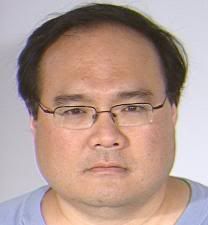
The Star Tribune reports:
Peter Hong, a longtime Republican operative in Minnesota, was arrested Wednesday afternoon on a charge of soliciting prostitution in St. Paul.
Police spokesman Peter Panos said that the arrest came during the first day of a two-day sting operation during which "johns" and prostitutes responded to ads placed on the Internet and in print. Thirty-five people were arrested Wednesday and Thursday, Panos said today.
He declined to say where the undercover operation was based.
According to city and county records, Hong, 41, of Minneapolis, was arrested at about 3:40 p.m. on Wednesday and arrived at the Ramsey County jail just after 5 p.m. He was one of at least 19 men swept up during the first day of the sting, police records show.
Hong, reached by phone Thursday, said: "I don't have any comment."
Hong has been in and out of the Republican side of Minnesota politics since the mid-1990s, when he surfaced as a genial bulldog campaign press secretary for former Sen. Rod Grams, R-Minn. He served as a spokesman for Gov. Tim Pawlenty's campaign in 2002 and for the Bush-Cheney campaign in Minnesota in 2004.
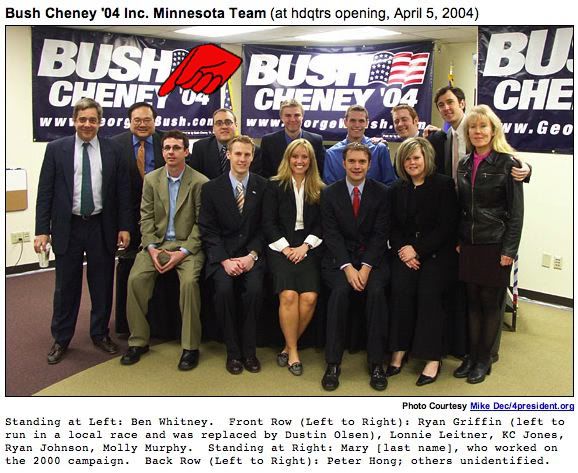
Most recently, Hong was a point person for presidential candidate Mike Huckabee. Gina Countryman, a spokeswoman for the Minnesota Republican Party, said Hong is not currently working for any Minnesota candidate.
He is the third political figure to be arrested in a St. Paul prostitution sting in the past year.
Last summer, police arrested Tim Droogsma, a press secretary to former U.S. Sen. Rudy Boschwitz, who initially attributed his arrest to a "severe misunderstanding" before pleading guilty in January to an engaging-in-prostitution charge.
In February, New Brighton City Council member David Phillips was one of nine men nabbed in a prostitution sting. His next court appearance is in August.
Monday, July 14, 2008
Hillary Clinton Asks To Keep Donor Money for 2012
The New York Observer reports:
Hillary Clinton's campaign is sending out letters to donors asking permission to roll a $2,300 contribution to Clinton's 2008 general election coffers to her 2012 senate election fund instead of offering a refund.
The letter, read to me by one recipient, includes a photocopy of a handwritten note from Clinton that says, "Dear friend, your commitment has meant so much to me over the course of my presidential campaign. You were there for me when I needed you the most and I'll never forget it. I hope you'll help me continue to fight for the issues and causes we believe in by filling out the enclosed form in support of Friends of Hillary."
The form says, "I hereby verify that my 2008 general election contribution may be designated to the 2012 Senate election. I designate the entire amount to the 2012 primary election. However if I have already contributed to the 2012 primary, I designate any amount in excess of $2,300 to the 2012 general election."
"If we do not hear back from you by August 28 2008 we will automatically refund your contribution."
This donor, at least, had no intention of signing. "Of course I'm going to get my money back," the donor told me.
Hillary Clinton's campaign is sending out letters to donors asking permission to roll a $2,300 contribution to Clinton's 2008 general election coffers to her 2012 senate election fund instead of offering a refund.
The letter, read to me by one recipient, includes a photocopy of a handwritten note from Clinton that says, "Dear friend, your commitment has meant so much to me over the course of my presidential campaign. You were there for me when I needed you the most and I'll never forget it. I hope you'll help me continue to fight for the issues and causes we believe in by filling out the enclosed form in support of Friends of Hillary."
The form says, "I hereby verify that my 2008 general election contribution may be designated to the 2012 Senate election. I designate the entire amount to the 2012 primary election. However if I have already contributed to the 2012 primary, I designate any amount in excess of $2,300 to the 2012 general election."
"If we do not hear back from you by August 28 2008 we will automatically refund your contribution."
This donor, at least, had no intention of signing. "Of course I'm going to get my money back," the donor told me.
Wednesday, July 09, 2008
A Constant American Takes A Stand, Quits Rather Than Lower Flag For Helms
L.F. Eason III gave up the only job he'd ever had rather than lower a flag to honor former U.S. Sen. Jesse Helms.
 L.F. Eason, III, 51, out of a job, but rich of character
News & Observer reports:

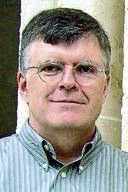 L.F. Eason, III, 51, out of a job, but rich of character
News & Observer reports:
Eason, a 29-year veteran of the state Department of Agriculture, instructed his staff at a small Raleigh lab not to fly the U.S. or North Carolina flags at half-staff Monday, as called for in a directive to all state agencies by Gov. Mike Easley.
When a superior ordered the lab to follow the directive, Eason decided to retire rather than pay tribute to Helms. After several hours' delay, one of Eason's employees hung the flags at half-staff.
The brouhaha began late Sunday night, when Eason e-mailed eight of his employees in the state standards lab, which calibrates measuring equipment used on things as widely varied as gasoline and hamburgers.To L.F. Easley, III, a Constant American, goes the Golden Picket award.
"Regardless of any executive proclamation, I do not want the flags at the North Carolina Standards Laboratory flown at half staff to honor Jesse Helms any time this week," Eason wrote just after midnight, according to e-mail messages released in response to a public records request.
He told his staff that he did not think it was appropriate to honor Helms because of his "doctrine of negativity, hate, and prejudice" and his opposition to civil rights bills and the federal Martin Luther King Jr. holiday.
Eason said in an interview Tuesday that he did not typically lower the flag himself, but that, as head of the lab, he supervised the technician who did. He also trained new employees on proper flag etiquette, including a one-person folding technique he learned in Boy Scouts.
When the lab opened Monday morning, the flags were not out at all. An employee called Eason's boss, Stephen Benjamin, who worked in another building in Raleigh. About 10:45 a.m., Benjamin told one of Eason's co-workers to put the flags at half-staff.
Another of Eason's superiors later drove by the lab to make sure the flags were up properly.
No one in the Governor's Office was aware of any time in recent memory when a state employee refused to lower a flag. Brian Long, a spokesman for the Agriculture Department, said Eason's refusal was unexpected.
"We've never had any conversations like that," he said.
An ultimatum
In a string of e-mail messages with his superiors, Eason was told he could either lower the flags or retire effective immediately.
Though he's only 51, Eason chose to retire, although he pleaded several times to be allowed to stay at the lab. Eason, who had worked for the Agriculture Department since graduating from college, was paid $65,235 a year as the laboratory manager.
Several people, including his wife, argued to Eason that the flags belonged to the state, as did the lab. But Eason said he felt a strong sense of ownership.
Eason and a previous boss had sketched out the building's rough design on a napkin at the Atlanta airport in 1984 after attending a national conference on weights and measures.
He then worked to get funding for it in the state budget, and he recently helped snag state money to study building another lab.
"I designed and built that lab," he said. "Even though technically the bricks and mortar belong to the state of North Carolina, I feel very strongly that everything that comes out of there is my responsibility."
It was not the first time Eason felt uneasy about lowering the flag.
A registered Democrat who frequently votes a split ticket, he said he had no problems lowering the flag for former Sen. Terry Sanford or President Reagan. But he remembers wondering whether he would be willing to lower the flag after President Nixon's death.
He never had to make that decision, since it rained both days.
Monday was sunny. And Eason was out of a job.
Subscribe to:
Posts (Atom)