Coffee stain Madonna
As newspapers across America close, one reporter finds comfort in a coffee stain as he packs up his desk.
I dunno. It looks more like Strawberry Shortcake to me.
 Coffee stain Madonna
As newspapers across America close, one reporter finds comfort in a coffee stain as he packs up his desk.
 Susan Boyle, who's performance on television show Britain's Got Talent sparked global interest, outside her home in Blackburn, Scotland, revealing a new look after undergoing a makeover Friday April 24, 2009. (AP Photo / Andrew Milligan ,PA)
We have lots of exclusive details on the Portuguese Water Dog President Barack Obama and Michelle are getting for Sasha and Malia. The pooch will make its grand entrance on Tuesday, and it's coming from a prominent Texas kennel, with the help of Senator Ted Kennedy's family.
The black dog -- a male -- is approximately six months old. We've learned it was bred at the kennel and sold to someone who gave it back. The kennel is now "re-homing" the dog to the Obamas. The dog was named Charlie, but the Obamas will rename it.With all the news lately of Bush, Cheney and their merry band of crooks and thieves trying to muscle their way back into the spotlight and assert their version of the last eight years and vision of the world, there's not been one word about Barney, Bush's Scottish terrier. That's a shame, as Barney's the only character from that administration that I'd like to know about since leaving the White House and how he's faring, being that he's forced to spend 24/7 with Bush, and with no reporters to take his frustration out on.
Now here's where the Kennedys come into play. The kennel has sold the Kennedys three Portuguese Water Dogs in the past, all from the same lineage. The dog the Obamas will be getting is from the same lineage as the Kennedy dogs. The Kennedy family will be presenting the new dog to the Obamas, but it's really coming from the kennel.
The reason this all sounds so technical is that there are issues regarding gifts to the Prez. The fact that the pup is being re-homed makes it all kosher.
The dog pictured is a Portuguese Water Dog, but not the pup the Obamas are getting.

Bo? No jest.
The first family has settled on a first pet _ a 6-month-old Portuguese water dog that the Obama girls are naming Bo.
The selection was one of the White House's most tightly kept secrets.
President Barack Obama's daughters, 10-year-old Malia and 7-year-old Sasha, picked a black and white pup, a White House official speaking on the condition of anonymity told The Associated Press Saturday night.
The dog is a gift from Sen. Edward M. Kennedy, D-Mass., who owns several Portuguese water dogs himself.
"We couldnt be happier to see the joy that Bo is bringing to Malia and Sasha," Kennedy said in a statement. "We love our Portuguese water dogs and know that the girls _ and their parents _ will love theirs, too."
The Washington Post reported in its online editions Saturday night that Obama's daughters chose the name Bo for the pup because first lady Michelle Obama's father was nicknamed Diddley. The name for the dog was an apparent reference to the singer "Bo" Diddley.
White House aides told the AP that the office of the first lady arranged an exclusive deal on the dog story with the Post. The officials, who demanded anonymity because of the deal with the Post on exclusive details, said the dog was not in the White House as of Saturday evening.
Throughout the day Saturday, celebrity Web sites and bloggers were abuzz with rumors of the first family's selection of a Portuguese water dog; one site even claimed it had pictures of the future first pet.
The president had embraced the frenzy: "Oh, man, now, that's top secret," Obama joked Friday to reporters.
Obama promised his daughters a puppy during the campaign.
"This is Washington. That was a campaign promise," Obama said when he appeared on Jay Leno's talk show last month, as the audience roared with laughter. "No, I'm teasing. The dog will be there shortly."
The president and first lady had said their choice was down to either a Portuguese water dog or a Labradoodle because they were considered good pets for children who have allergies, as Malia does.


Pie has been around since the ancient Egyptians. The first pies were made by early Romans who may have learned about it through the Greeks. These pies were sometimes made in "reeds" which were used for the sole purpose of holding the filling and not for eating with the filling.
The Romans must have spread the word about pies around Europe as the Oxford English Dictionary notes that the word pie was a popular word in the 14th century. The first pie recipe was published by the Romans and was for a rye-crusted goat cheese and honey pie.
The early pies were predominately meat pies. Pyes (pies) originally appeared in England as early as the twelfth century. The crust of the pie was referred to as "coffyn". There was actually more crust than filling. Often these pies were made using fowl and the legs were left to hang over the side of the dish and used as handles. Fruit pies or tarts (pasties) where probably first made in the 1500s. English tradition credits making the first cherry pie to Queen Elizabeth I.
Pie came to America with the first English settlers. The early colonists cooked their pies in long narrow pans calling them "coffins" like the crust in England. As in the Roman times, the early American pie crusts often were not eaten, but simply designed to hold the filling during baking. It was during the American Revolution that the term crust was used instead of coffyn.
Over the years, pie has evolved to become what it is today "the most traditional American dessert". Pie has become so much a part of American culture throughout the years, that we now commonly use the term "as American as apple pie."




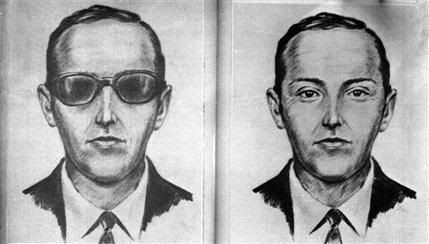 An artist's sketch released by the FBI of the skyjacker known as 'Dan Cooper' and 'D.B. Cooper', from the recollections of passengers and crew of a Northwest Orient Airlines jet he hijacked between Portland and Seattle, Nov. 24, 1971. 'Cooper' later parachuted from the plane with $200,000 in ransom money. Dead or alive, he has not been found.
 The FBI is making a new stab at identifying mysterious skyjacker Dan Cooper, who bailed out of an airliner in 1971 and vanished, releasing new details that it hopes will jog someone's memory. (AP Photo/FBI, File)
The FBI is making a new stab at identifying mysterious skyjacker Dan Cooper, who bailed out of an airliner in 1971 and vanished, releasing new details that it hopes will jog someone's memory. The man calling himself Dan Cooper, also known as D.B. Cooper, boarded a Northwest flight in Portland for a flight to Seattle on the night of Nov, 24, 1971, and commandeered the plane, claiming he had dynamite.
In Seattle, he demanded and got $200,000 and four parachutes and demanded to be flown to Mexico. Somewhere over southwestern Washington, he jumped out the plane's tail exit with two of the chutes.
On Monday, the FBI released drawings that it said probably are close to what Cooper looked like, along with a map of areas where Cooper might have landed.
"Who was Cooper? Did he survive the jump? We're providing new information and pictures and asking for your help in solving the case," the FBI said in a statement.
The FBI said that while Cooper was originally thought to have been an experienced jumper, it has since concluded that was wrong and that he almost certainly didn't survive the jump in the dark and rain. He hadn't specified a route for the plane to fly and had no way of knowing where he was when he went out the exit.
"Diving into the wilderness without a plan, without the right equipment, in such terrible conditions, he probably never even got his chute open," Seattle-based agent Larry Carr said.
He also didn't notice that his reserve chute was intended only for training and had been sewn shut.
Several people have claimed to be Cooper over the years but were dismissed on the basis of physical descriptions, parachuting experience and, later, by DNA evidence recovered in 2001 from the cheap tie the skyjacker left on the plane.
In 1980, a boy walking near the Columbia River found $5,800 of the stolen money, in tattered $20 bills.
"Maybe a hydrologist can use the latest technology to trace the $5,800 in ransom money found in 1980 to where Cooper landed upstream," Carr said. "Or maybe someone just remembers that odd uncle."

This is the season of frenetic shopping, but for a devious few people it’s also the season of spirited shopdropping.
Otherwise known as reverse shoplifting, shopdropping involves surreptitiously putting things in stores, rather than illegally taking them out, and the motivations vary.
Anti-consumerist artists slip replica products packaged with political messages onto shelves while religious proselytizers insert pamphlets between the pages of gay-and-lesbian readings at book stores.
Self-published authors sneak their works into the “new releases” section, while personal trainers put their business cards into weight-loss books, and aspiring professional photographers make homemade cards — their Web site address included, of course — and covertly plant them into stationery-store racks.
“Everyone else is pushing their product, so why shouldn’t we?” said Jeff Eyrich, a producer for several independent bands, who puts stacks of his bands’ CDs — marked “free” — on music racks at Starbucks whenever the cashiers look away.
Though not new, shopdropping has grown in popularity in recent years, especially as artists have gathered to swap tactics at Web sites like Shopdropping.net, and groups like the Anti-Advertising Agency, a political art collective, do training workshops open to the public.
Retailers fear the practice may annoy shoppers and raise legal or safety concerns, particularly when it involves children’s toys or trademarked products.
“Our goal at all times is to provide comfortable and distraction-free shopping,” said Bethany Zucco, a spokeswoman for Target. “We think this type of activity would certainly not contribute to that goal.” She said she did not know of any shopdropping at Target stores.
But Packard Jennings does. An artist who lives in Oakland, Calif., he said that for the last seven months he had been working on a new batch of his Anarchist action figure that he began shopdropping this week at Target and Wal-Mart stores in the San Francisco Bay Area.
“When better than Christmas to make a point about hyper-consumerism?” asked Mr. Jennings, 37, whose action figure comes with tiny accessories including a gas mask, bolt cutter, and two Molotov cocktails, and looks convincingly like any other doll on most toy-store shelves. Putting it in stores and filming people as they try to buy it as they interact with store clerks, Mr. Jennings said he hoped to show that even radical ideology gets commercialized. He said for safety reasons he retrieves the figures before customers take them home.
Jason Brody, lead singer for an independent pop-rock band in the East Village, said his group recently altered its shopdropping tactics to cater to the holiday rush.
Normally the band, the Death of Jason Brody, slips promotional CD singles between the pages of The Village Voice newspaper and into the racks at large music stores. But lately, band members have been slipping into department stores and putting stickers with logos for trendy designers like Diesel, John Varvatos and 7 for All Mankind on their CDs, which they then slip into the pockets of designer jeans or place on counters.
“Bloomingdale’s and 7 for All Mankind present the Death of Jason Brody, our pick for New York band to watch in 2008,” read a sticker on one of the CDs placed near a register at Bloomingdales. “As thanks for trying us on, we’re giving you this special holiday gift.” Bloomingdales and 7 for All Mankind declined to comment.
For pet store owners, the holidays usher in a form of shopdropping with a touch of buyer’s remorse. What seemed like a cute gift idea at the time can end up being dumped back at a store, left discretely to roam the aisles.
“After Easter, there’s a wave of bunnies; after Halloween, it’s black cats; after Christmas, it’s puppies,” said Don Cowan, a spokesman for the store chain Petco, which in the month after each of those holidays sees 100 to 150 pets abandoned in its aisles or left after hours in cages in front of stores. Snakes have been left in crates, mice and hamsters surreptitiously dropped in dry aquariums, even a donkey left behind after a store’s annual pet talent show, Mr. Cowan said.
Bookstores are especially popular for self-promotion and religious types of shopdropping.
At BookPeople in Austin, Tex., local authors have been putting bookmarks advertising their own works in books on similar topics. At Mac’s Backs Paperbacks, a used bookstore in Cleveland Heights, Ohio, employees are dealing with the influx of shopdropped works by local poets and playwrights by putting a price tag on them and leaving them on the shelves.
At Powell’s Books in Portland, Ore., religious groups have been hitting the magazines in the science section with fliers featuring Christian cartoons, while their adversaries have been moving Bibles from the religion section to the fantasy/science-fiction section.
This week an arts group in Oakland, the Center for Tactical Magic, began shopdropping neatly folded stacks of homemade T-shirts into Wal-Mart and Target stores in the San Francisco Bay Area. The shirts feature radical images and slogans like one with the faces of Karl Marx, Che Guevara and Mikhail Bakunin, a Russian anarchist. It says, “Peace on Earth. After we overthrow capitalism.”
“Our point is to put a message, not a price tag, on them,” said Aaron Gach, 33, a spokesman for the group.
Mr. Jennings’s anarchist action figure met with a befuddled reaction from a Target store manager on Wednesday in El Cerrito, Calif.
“I don’t think this is a product that we sell,” the manager said as Mr. Jennings pretended to be a customer trying to buy it. “It’s definitely antifamily, which is not what Target is about.”
One of the first reports of shopdropping was in 1989, when a group called the Barbie Liberation Organization sought to make a point about sexism in children’s toys by swapping the voice hardware of Barbie dolls with those in GI Joe figures before putting the dolls back on store shelves.
Scott Wolfson, a spokesman for the federal Consumer Product Safety Commission, said he was not sure if shopdropping was illegal but that some forms of it could raise safety concerns because the items left on store shelves might not abide by labeling requirements and federal safety standards.
Ryan Watkins-Hughes, 28, a photographer from Brooklyn, teamed up with four other artists to shopdrop canned goods with altered labels at Whole Foods stores in New York City this week. “In the holidays, people get into this head-down, plow-through-the-shopping autopilot mode,” Mr. Watkins-Hughes said “‘I got to get a dress for Cindy, get a stereo for Uncle John, go buy canned goods for the charity drive and get back home.’”
“Warhol took the can into the gallery. We bring the art to the can,” he said, adding that the labels consisted of photographs of places he had traveled combined with the can’s original bar code so that people could still buy them.
“What we do is try to inject a brief moment of wonder that helps wake them up from that rushed stupor,” he said, pausing to add, “That’s the true holiday spirit, isn’t it?”
 Owen Smith's "Sweetie", polychromed ceramic

Finding Global Solutions
Heifer has learned over the years that a holistic approach is necessary in order to build sustainable communities. So we’ve developed a set of global initiatives – areas of emphasis that must be addressed if we’re to meet our mission of ending world hunger and poverty and caring for the earth.
Agroecology
In a world where land is overused, community members need to learn how to protect and rejuvenate their land, water and other natural resources. Heifer helps by teaching environmentally sound agricultural techniques.
Animal Well-Being
Before any Heifer animal is passed along to a project partner, Heifer trains the new recipient in animal management, using our strictly enforced. Animal Welfare Guidelines
Gender Equity
In Heifer's view, gender equity is a social justice and human rights issue that directly leads to ending hunger and poverty. That's why our participants are equal partners in sustainable development projects.
HIV-AIDS
Today, we as a world community, confront AIDS, a virus that in the past 25 years has either infected or killed over 64 million people. It is not only a health issue, as it fractures every sector of society, for Heifer, it is a prominent concern in the arena of sustainable development. This is why Heifer is incorporating HIV/AIDS education in our community training groups.
Microenterprise
Heifer provides both "no-interest living loans" in the form of livestock, as well as small monetary loans to help people start and expand businesses that yield big benefits for families.
Urban Agriculture
Heifer is reconnecting city-dwellers with their food sources, building strong alliances and instilling an entrepreneurial spirit among adults and youth through our Urban Agriculture projects.
Young People's Initiative
Heifer weaves youth-focused programs through all our project work and emphasizes young people's needs.
 Tony Shaloub
 The PARK that is San Francisco Mayor Gavin Newsom's parking space in front of City Hall.

Before Kathy Griffin won a creative arts Emmy last weekend for her reality show, 'My Life on the D-List,' she joked that an award would move her to the C-list. She was right: 'C' as in censored. The TV academy said her raucous acceptance speech will be edited when the event, which was taped, is shown Saturday on the E! channel.
The main prime-time Emmy Awards air the next night on Fox.
'Kathy Griffin's offensive remarks will not be part of the E! telecast on Saturday night,' the Academy of Television Arts & Sciences said in a statement Monday.
In her speech, Griffin said that 'a lot of people come up here and thank Jesus for this award. I want you to know that no one had less to do with this award than Jesus.'
She went on to hold up her Emmy, make an off-color remark about Christ and proclaim, 'This award is my god now!'
The comedian's remarks were condemned Monday by Catholic League President Bill Donohue, who called them a 'vulgar, in-your-face brand of hate speech.'Bill Donohue, president of the Catholic League
According to the TV academy and E!, when the four hour-plus ceremony is edited into a two-hour program, Griffin's remarks will be shown in 'an abbreviated version' in which some language may be bleeped.
The program was in production and unfinished, an E! spokeswoman said Monday.
Requests for comment were left Monday evening by phone and e-mail with Griffin's publicist. They were not immediately returned.
The Catholic League, an anti-defamation group, called on the TV academy to 'denounce Griffin's obscene and blasphemous comment' at Sunday's ceremony.
The academy said Monday it had no plans to address the issue in the prime-time broadcast.
The organization may have another delicate issue to consider, this one involving an off-color fake music video that aired last December on 'Saturday Night Live' and won a creative arts Emmy for best song.
Andy Samberg of 'SNL' said Saturday that he had yet to be asked by the TV academy to perform the tune with Timberlake on the Fox broadcast, but he was willing.
Timberlake, on a concert tour, is scheduled to be in Los Angeles next weekend.
The subject of their '(Blank) in a Box' video: wrapping a certain part of the male anatomy and presenting it to a loved one as a holiday present.
The academy has said that 'show elements are in the process of being worked out.'
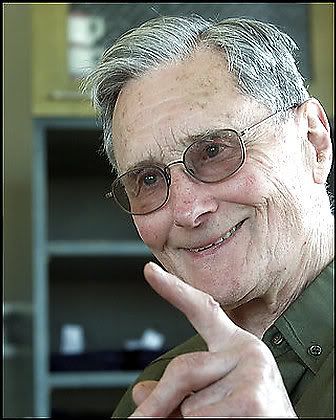 Alfred Peet
Coffee legend Alfred Peet, creator of Peet's Coffee & Tea Inc., a forerunner to Starbucks Corp., has died at his home in Ashland, Oregon, his company said. He was 87.
Peet, known as the grandfather of the specialty coffee movement in the United States, taught the tricks of the trade to the founders of Starbucks and sold them their first year's supply. He passed away on Wednesday.
"He had this great love of coffee," said Jim Reynolds, roast master emeritus of Peet's Coffee & Tea, who worked with Peet in his early years.
"He was so helpful to many people in the business. When Starbucks was getting going, the founders of the company really needed help. He let them work in his store and taught them about coffee," said Reynolds on Saturday.
Peet was born in Holland, the son of a coffee and tea merchant. He learned the trade in Amsterdam, London, Indonesia and New Zealand before moving to the United States in 1955. Peet opened his first shop in 1966 in a rundown neighborhood in Berkeley, California that was later dubbed the "Gourmet Ghetto."
The store flourished and Peet soon opened additional shops in the San Francisco Bay area. Peet sold his business in 1979 but stayed on as a coffee buyer until 1983, and as a consultant after that.
"Up to the time he started, the quality of coffee in the U.S. was really poor," said Reynolds. "But he developed a market for those types of coffee."
The gourmet coffee trend in the United States started on the West Coast and moved east. Peet was known for using high-quality beans and a roasting method that produces a distinctively deep flavor. His company, which went public in 2001, continues to use his techniques today.
Although a company spokesperson declined comment on the cause of death, Reynolds said Peet died of cancer.
He is survived by a daughter, two grandchildren and a sister.
Peet's Coffee & Tea is a specialty coffee roaster and marketer. It operates 151 stores, about 90 percent of which are in northern California.
 The original Peet's store on Walnut and Vine in Berkeley, CA, 1966. It's still there.
  The Iraqi-Americans grounded for speaking Arabic on an American Airlines plane.
 Two of the six Iraqi-Americans on the American Airlines plane exhibiting "strange behavior."
An American Airlines flight from San Diego to Chicago was delayed when passengers complained about a group of Iraqi men speaking Arabic, US media reported today.
The flight was supposed to leave about 11pm on Tuesday when a woman boarding the plane complained about the other passengers, airline spokeswoman Mary Francis Fagan said.
The dispute delayed the plane which was then forced to cancel when it fell under the curfew at San Diego airport, Ms Fagan said, acccording to the Daily Herald online.
According to media reports, the woman complained because the men were speaking Arabic.
Irene McCormack, a spokeswoman for the San Diego Unified Port District said the woman expressed concerns to the flight crew before boarding that six men were speaking a foreign language and exhibiting “strange behaviour”.
The passenger continued telling the crew her concerns, within earshot of the men, after the jet taxied from the gate, Ms McCormack said yesterday.
She said the pilot decided to return to the gate and police were called.
An Associated Press report said the six Iraqi men had been training Marines at Camp Pendleton and worked for Defense Training Systems, a unit of International Logistics Services.
The six Iraqis had been training US Marines at Camp Pendleton and worked for Defence Training Systems, a unit of the Alaska-based International Logistics Services Corp, said the company's chief executive R David Stephens.
“They did nothing wrong,” he said.
A company news release called it “an unfortunate situation for all flight passengers.”
"We were hired for this Government. We can prove ourselves. We are good people, not a bad people," said one of the men involved, Dave Alwatan, who is a US citizen.
"How can we be bad if we are helping our people here - American people? Why are we getting treated like that?" he was quoted as saying by ABC7 Chicago.
All 126 passengers had to be acccommodated overnight and put on other flights on Wednesday.
Ahmed Rehab, executive director of the Council on American-Islamic Relations in Chicago, was upset about the airline's actions.
"It is one thing to flag suspicious behavior, but to flag a global language? We are deplaning people for who they are, not what they do," Mr Rehab said.
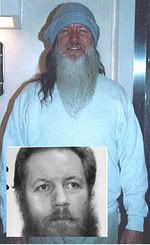 Is Thomas Silverstein a prisoner of his own deadly past — or the first in a new wave of locked-down lifer?
When the goon squad showed up at his place at five in the morning, Tommy Silverstein knew something was up. He wasn't accustomed to greeting guests at such an ungodly hour — much less a team of corrections officers, helmeted and suited up for action.
In fact, Silverstein wasn't used to company at any hour. His home was a remote cell, known as the Silverstein Suite, in the special housing unit of the federal penitentiary at Leavenworth, Kansas. He'd been cut off from other inmates and all but a few emissaries from the outside world for more than two decades.
He stayed in the Silverstein Suite 23 hours a day. His interactions with staff typically amounted to some tight-lipped turnkey delivering his food through a slot in the cell door. The only change of scenery came when an electronic door slid open, allowing him an hour's solitary exercise in an adjoining recreation cage. Visitors were rarely permitted, and entire years had gone by during which he never left the cell.
But this day was different. Silverstein could think of only a couple of reasons why so many well-padded, well-equipped officers would be at his door, ordering him to strip for a search. Cell shakedown? Time for a game of hockey, with Tommy as the puck? No, that was a captain leading the squad. Something big.
A transfer.
So it came to pass that on July 12, 2005, U.S. Bureau of Prisons inmate #14634-116 left his cage in Kansas for one in Colorado. Security for the move was tighter than Borat's Speedo — about what you'd expect for a former Aryan Brotherhood leader convicted of killing four men behind prison walls. (One conviction was later overturned; Silverstein disputes the second slaying but admits the other two.) The object of all this fuss didn't mind the goon squad. He was enjoying the view — and hoping that the move signaled the end to his eight-thousand-plus days of solitary confinement. Maybe, just maybe, his decades of uneventful good behavior had paid off.
"They said for me to keep my nose clean, and maybe one day it'd happen," he recalled recently. "So I foolishly thought this was it. If you saw me in that van, you'd think I was Disneyland-bound, smiling all the way."
But the smile vanished after Silverstein reached his destination: the U.S. Penitentiary Administrative Maximum, better known as ADX. Located two miles outside of the high-desert town of Florence, ADX is the most secure prison in the country, a hunkered-down maze of locks, alarms and electronic surveillance, designed to house gang leaders, terrorists, drug lords and other high-risk prisoners in profound isolation. Its current guest list is a who's who of enemies of the state, including Unabomber Ted Kaczynski, shoe bomber Richard Reid, plane bomber Dandenis Muñoz Mosquera, abortion clinic bomber Eric Rudolph and double-agent Robert Hanssen.
When it opened in 1994, ADX was hailed as the solution to security flaws at even the highest levels of the federal prison system. Much of the justification for building the place stemmed from official outrage at the brutal murders of two guards in the control unit of the federal pen in Marion, Illinois, during a single 24-hour period in 1983. The first of those killings was committed by Thomas Silverstein, who was already facing multiple life sentences for previous bloodshed at Marion. The slaying of corrections officer Merle Clutts placed Silverstein under a "no human contact" order that's prevailed ever since, and it gave the Bureau of Prisons the perfect rationale for building its high-tech supermax. Although he never bunked there until 2005, you could call ADX the House that Tommy Built.
What greeted Silverstein two years ago was nothing like Disneyland. His hosts hustled him down long, sterile corridors with gleaming black-and-white checkerboard floors that reminded him of A Clockwork Orange or some other cinematic acid trip. One set of doors, then another and another, until he finally arrived at the ass-end of Z Unit, on a special range with only four cells, each double-doored. His new home was less than half the size of the Silverstein Suite and consisted of a steel slab with a thin mattress, a steel stool and desk, a steel sink-and-toilet combination, a steel shower and a small black-and-white TV.
Stripped of most of his small store of personal belongings, Silverstein had little to do besides take stock of his eighty-square-foot digs. The Silverstein Suite was a penthouse at the Plaza compared to this place. There were steel rings on the sides of the bed platform, ready for "four-pointing" difficult inmates. A camera mounted on the ceiling to record his every move. If he stood on the stool and peered out the heavily meshed window, he could get a glimpse of a concrete recreation cage and something like sky. So this was his reward for all those years of following the rules — 24-hour surveillance in his own desolate corner of the Alcatraz of the Rockies. He was no longer simply in the belly of the beast. He was, he would later write, "stuck in its bowels, with no end/exit in sight."
The double doors muffled sound from outside. But over time, Silverstein realized that there was one other prisoner on the range. He shouted greetings. The man shouted back. He asked the man how long he'd been in the unit. Four years, the man said.
Silverstein told the man his name. His neighbor introduced himself: Yousef. Ramzi Yousef. Convicted of the 1993 World Trade Center bombing, the one that killed six people and injured a thousand. Nephew of Khalid Sheikh Mohammed, the al-Qaeda leader who recently confessed to planning that failed effort to bring down the towers as well as the 9/11 attacks.
His keepers had put Silverstein in the beast's bowels, all right — right next to the one man in the entire federal system more loathed than he was. Still, it was somebody to talk to. Shouting to Yousef was the first conversation with another inmate that Silverstein had managed in almost twenty years.
But talking wasn't allowed. Within days, a new barrier was erected in the corridor outside his cell, preventing any further communication between the two residents of the range. Inmate #14634-116's transfer to ADX was now complete.
Entombed, Terrible Tommy was alone again. Naturally.
In the late 1980s, Pete Earley, a former Washington Post reporter, persuaded Bureau of Prison officials to grant him an unprecedented degree of access to inmates and staff at the Leavenworth penitentiary. Earley was allowed to walk the yard without an escort, to interview inmates without official monitoring, to talk candidly with veteran corrections officers about the dangers and frustrations of their work.
The resulting book, The Hot House: Life Inside Leavenworth Prison, is one of the most vivid works of prison reportage ever published. Among several unsettling portraits of career criminals and their keepers, the most memorable character is probably one Thomas Silverstein, who was then being housed, a la Hannibal Lecter, in a zoo-like cage in Leavenworth's basement, where the fluorescent lights stayed on around the clock to make it easier to watch him. Wild-haired and bearded — the BOP would not allow him a razor or a comb — Silverstein spent hours talking into Earley's tape recorder, describing his violent past and the petty torments he claimed the guards were putting him through in an effort to drive him insane.
Earley's book made Leavenworth's dungeon monster seem not only rational but quite possibly human. Granting a journalist unfettered access to him was a public relations blunder the BOP has been unwilling to repeat. Silverstein hasn't been allowed to have a face-to-face interview with a reporter for the past fifteen years. When Westword recently asked to visit him, ADX warden Ron Wiley promptly denied the request, citing "continued security concerns." But then, Wiley and his predecessors haven't let any journalist inside ADX to interview any inmate since 2001 because of "continued security concerns" (see related story).
Although he readily agreed to an interview with Westword, Silverstein isn't a huge fan of the press, either. He remains friendly with Earley, but he's learned to be wary of hit-and-run tabloid writers following in his wake, eager to write about "the most dangerous prisoner in America." Most of what the outside world knows about him, if it pays any attention at all, is the fragmentary image presented in The Hot House; he's a captive of his own legend, like some prehistoric insect trapped in amber. His letters seethe with contempt for lazy "plagiarists" who have simply appropriated snatches of Earley's account as well as for those who've produced long magazine pieces or cheeseball cable programs about the Aryan Brotherhood that largely rely on the lurid tales of government snitches.
"For some odd reason the media pees when Master snaps his fingers," he wrote recently. "I wouldn't call 'em 'mainstream' any more cuz there isn't anything mainstream about 'em. They're just lackeys for the powers that be."
Silverstein's response to the "injurious lies" spread about him has been to launch his own information campaign at www.tommysilverstein.com. That's right — America's most solitary prisoner, a man who's been inside since before the personal computer was invented and has never been allowed near one, has his own website, maintained by outside supporters who forward messages to him and post his responses.
"He's got a pretty impressive network," says Terry Rearick, a California private investigator who has communicated with Silverstein by letter and phone over several years. After the two lost touch for a time, Rearick got a call from a woman in England on Silverstein's behalf.
The same woman posts regularly on the website, where Silverstein himself duels at length with his detractors. (A similarly heated debate has ignited over the wording of Silverstein's entry on Wikipedia; his defenders and his critics alternately revise the account to suit their competing versions of his crimes.) Some visitors to his site dismiss him as a textbook psychopath. But Silverstein contends that if people understood the grim context in which the killings at Marion took place, the snitch games and psychological warfare and organized violence of prison life, they wouldn't be so quick to demonize him.
It's a strangely disconnected argument — a garbled dialogue between cultures on different planets. Most of the visitors to his website know little about Silverstein's world, just as he knows little about theirs. He's been in prison for the past 32 years, and much of what he's learned about life on the street since he was put in solitary in 1983 has come from reading or watching television. No American prisoner, not even Robert Stroud, the Birdman of Alcatraz, has ever been condemned to such a walled-off existence for such a long period of time. Many of Stroud's years of solitary confinement were spent in relative ease at Leavenworth; he had not only frequent visitors, but also a full-time secretary. Even his seventeen-year stretch in Alcatraz allowed for much more daily communication with others than Silverstein has had.
"I'm amazed that he's not stark, raving mad," says Paul Wright, the editor of Prison Legal News, who's corresponded with Silverstein for years and published some of his writing. "He's been in total isolation for almost 25 years. The only people I can think of that have been held in anything remotely like this in modern times are some of the North Korean spies held in South Korea."
Yet the no-contact conditions imposed on Silverstein are becoming less unique by the day. There are now 31 supermax prisons in the country, with more under construction, including Colorado's own 948-bed sequel to the current state supermax, known as Colorado State Penitentiary II. They are costly on several levels — the operational expense per cell can be double that of a less-secure prison, and the rate of mental illness in solitary confinement far exceeds that of the general prison population — but lockdown prisons are all the rage with a vengeful public. Increasingly, they are being used not for short-term punishment (disciplinary segregation) but for long-term confinement of hard-to-manage inmates (administrative segregation), whose privileges keep shrinking. Colorado, for example, no longer allows journalists to interview its supermax inmates except by mail.
"The phenomenon is disturbingly common," says David Fathi, a staff attorney for the ACLU's National Prison Project. "If it's disciplinary confinement, it's finite — when you're done, you're done. But with administrative segregation, there's a real lack of transparency about what a prisoner can do to earn his way out."
In the federal system, the past decade has seen the rise of "special administrative measures," or SAMs, which are imposed on terrorists or other inmates whose communications with the outside world "could result in death or serious bodily injury to persons." There are now at least two dozen SAMs cases in federal prisons, including Yousef and Zacarias Moussaoui, whose access to mail, phone calls, media interviews or other visits are extremely limited or banned outright. At present the restrictions must be approved by the U.S. Attorney General, but the Bush administration is considering changes that would allow wardens at ADX or other high-security prisons to designate inmates as terror threats and thus ban them from all media contact — even if they haven't been convicted on terrorism charges yet, Fathi notes.
Silverstein isn't a SAMs case. He still has his website and his mail (although he claims it's frequently withheld or "messed with" in other ways). But he may be the prototype of what the government has in mind for other infamous prisoners — to bury them in strata of supermax security to the point of oblivion.
Responding in letters to questions about the psychological impact of his isolation, Silverstein struggles to find the right words. "Trying to explain it is like trying to explain what an endless toothache feels like," he writes. "I wish I could paint what it's like."
In an article a few years ago, he called solitary confinement "a slow constant peeling of the skin, stripping of the flesh, the nerve-wracking sound of water dripping from a leaky faucet in the still of the night while you're trying to sleep. Drip, drip, drip, the minutes, hours, days, weeks, months, years, constantly drip away with no end or relief in sight."
In a Darwinian world, predators have to adapt or die, just like their prey. Tommy Silverstein arrived in the federal prison system at a critical phase of its evolution, when the number of inmate assaults on other inmates and staff was rising sharply and officials were looking at the idea of control units as a way to neutralize the growing threat posed by prison gangs. Silverstein quickly became a symbol of the problem — and the inadequacy of the proposed solution. It's not a stretch to say that the Marion control unit helped to make him what he became, just as the mayhem that erupted there helped to reshape the American prison system.
Before he reached the nether regions of the BOP, Silverstein's criminal career had been thoroughly unremarkable. Born in 1952 in California, he'd grown up in a middle-class neighborhood in Long Beach, but he was bullied by other kids who thought he was Jewish. (According to The Hot House, Silverstein's biological father was a man named Thomas Conway, whom his mother divorced when Tommy was four years old; she later married a man named Silverstein.) As a teenager, he ripped off houses for money to buy drugs; his sister, Sydney McMurray, says he was battling a heroin addiction and problems with his volatile, controlling mother.
"We were taught never to throw the first punch, but never to walk away from a fight," McMurray recalls. "My brother started getting into trouble because he was running away from a violent environment at home. Then he got into drugs, and he became a brother I never knew."
At nineteen, Silverstein landed in San Quentin for armed robbery. Paroled, he was soon arrested again for series of robberies — pulled with Conway and another relative — that yielded less than $1,400. This time, he went into the federal system on a fifteen-year jolt. He was 23 years old, and his life on the streets was already over.
At Leavenworth Silverstein became closely associated with Aryan Brotherhood members who allegedly controlled the heroin trade inside the prison — close enough that when convict Danny Atwell was found stabbed to death, supposedly because he'd refused to be a mule for the heroin business, Silverstein and two other AB members were charged with the murder. In 1980, he was convicted at trial on the basis of shifting testimony from other inmates and sentenced to life in prison. A federal appeals court later ruled that much of the testimony should never have been allowed and threw out the conviction. But by that time, Silverstein was in the Marion penitentiary and facing more murder charges.
Marion opened in 1963, the same year that Alcatraz closed. It was intended to be not just a replacement for the Rock but an improvement, with a more open design and modern rehabilitation programs. Yet by the late 1970s, it had the most restrictive segregation unit in the BOP; not coincidentally, it was also the most violent prison in America, a dumping ground for gang leaders and crazies. Between 1979 and 1983, the prison logged 81 inmate assaults on other inmates and 44 on staff; 13 prisoners were killed. BOP reports issued in 1979 and 1981 proposed turning the entire facility into a "closed-unit operation."
Confined to a one-man cell in the control unit 23 hours a day, Silverstein says he spent much of his time learning how to draw and paint. [Silverstein's artwork.] "I could hardly read, write or draw when I first fell," he explains. "But most of us lifers are down for so long and have so much time to kill that we actually fool around and discover our niche in life, often in ways we never even dreamt possible on the streets. We not only find our niche, we excel."
Prison officials worried that Silverstein was finding his niche in other areas, too. Long-simmering disputes between white and black gangs had a way of coming to a boil in the control unit. In 1981, D.C. Blacks member Robert Chappelle was found dead in his cell. He'd apparently been sleeping with his head close to the bars and had been strangled with a wire slipped around his neck, plied by someone exercising on the tier. Silverstein and another convicted killer, Clayton Fountain, received life sentences for the crime; inmates who testified for the prosecution claimed the two had boasted of it.
Silverstein has always denied killing Chappelle. (Another inmate later claimed to have done the deed, but investigators found his confession at odds with the facts.) Yet even if he hadn't been convicted in court, the suspicion that he was responsible was sufficient to trigger more violence. Shortly after the slaying, the BOP saw fit to transfer one of Chappelle's closest friends, D.C. Blacks leader Raymond "Cadillac" Smith, to the Marion control unit from another prison. Within days, Smith had tried to stab Silverstein and shoot him with a zip gun. Silverstein and Fountain responded by cutting their way out of an exercise cage with a piece of hacksaw blade and paying a visit to Smith while he was in the shower. Smith was stabbed 67 times, in what Silverstein still describes as an act of convict self-defense.
"Everyone knew what was going on and no one did anything to keep us apart," he told Earley. "The guards wanted one of us to kill the other."
At the time, there was no federal death penalty for inmate homicides — and not much the system could do to Silverstein, who was already serving multiple life sentences in the worst unit of the worst prison the BOP had to offer. But some staffers, concerned about Silverstein's outsized rep among white inmates, apparently did their best to keep him in check. In the months that followed Cadillac's death, Silverstein began to regard Officer Merle Clutts, a bull-headed regular of the control unit, as his chief tormentor.
Silverstein has given different explanations about what Clutts did to deserve such attention. Clutts trashed his cell during shakedowns and withheld mail; he smudged his artwork and taunted him; he even tried to set him up for attack by other inmates, Silverstein has suggested. Silverstein claims he told Earley "the whole story," but only pieces made it into The Hot House. Earley won't comment, saying he no longer discusses Silverstein with other reporters because of past misunderstandings.
The BOP has denied that Clutts harassed Silverstein. Whatever the source of the feud might have been, there's no question that Silverstein became fixated on Clutts. One study by Harvard psychiatrist Stuart Grassian suggests that prisoners in control units sometimes experience "the emergence of primitive, aggressive fantasies of revenge, torture, and mutilation" of the guards who watch over them.
Silverstein thought about Clutts, and he thought about the difficulties involved in getting to his enemy when he was allowed out of his cell only one hour a day, shackled, escorted by three guards.
Locked down for life, he had a mountain of time to consider the problem.
One day in solitary is pretty much like another. Prisoners have different strategies for filling up their days, but there are always more days to come.
In his cell at Florence, 54-year-old Tom Silverstein usually rises before dawn, catches up on letters and reads, waiting for the grand event that is the delivery of his breakfast. He goes to rec for an hour, comes back to the grand event that is lunch, showers and cleans his cell. Time for some channel-flipping on the small black-and-white TV, in search of something fresh amid the religious chatter and educational programs he's watched over and over. More reading, some yoga. Then dinner, more TV - he's a sucker for Survivor, Big Brother and other "reality-type shows" — and so to bed.
When he was in the Silverstein Suite at Leavenworth, Silverstein had access to paintbrushes, pens and other art supplies. At ADX, he's only permitted pastels, colored pencils and "cheap-ass paper," he reports; consequently, he hasn't drawn a lick since he's been there. He says that every few weeks, he's moved from the cell with the heavily meshed window to one with no window at all, then back again a few weeks later. There are rare, glorious interruptions in the routine — a visit with sister Sydney last May, an occasional lawyer checking in. Visitors sit in a booth outside the cell and talk to him on a phone; he sits shackled on the other side of a glass partition and talks back. But these dazzling bursts of conversation quickly fade into a muddle. Did the last lawyers come before or after his sister? Silverstein isn't sure.
"It's all a blur, a dream state of mind," he writes. "Like my memories. When I venture back to my yesterdays, it's hard to distinguish fact from fiction."
Yet there is one memory, one day that stands out from all the rest — the day that started it all. Twenty-four years later, Silverstein is still in the position of analyzing, defending and regretting the act that has defined his fate. But nothing can explain away the act itself, a murder that was meticulously planned and ruthlessly executed.
Marion wasn't designed to be a supermax. Control unit prisoners had to be shackled and escorted to the shower every day, and the guards permitted them to have brief conversations with other inmates in cells along the way. On October 22, 1983, Silverstein was on his way back from his shower when another inmate in a rec cage called over one of his three escorts — Merle Clutts. Now flanked by only two guards, Silverstein paused at the cell of one of his buddies, Randy Gometz, and struck up a conversation.
Before the guards knew what was happening, Gometz had reached through the bars, uncuffed Silverstein with a hidden key — and supplied him with a shank. Silverstein broke away from the guards and headed toward Clutts, now isolated at the far end of the tier. "This is between me and Clutts!" he shouted.
He stabbed the officer forty times before the dying Clutts could make it off the tier. Hours later, Silverstein's friend Clayton Fountain pulled the same handcuff trick and attacked three more guards in the control unit, fatally wounding Robert L. Hoffman Sr.
Two federal officers slaughtered in one day, on what was supposed to be the most secure unit in the entire BOP, sent the system into shock. The bureau's response was to forge ahead with the long-considered plan to turn all of Marion into a control unit while whisking Silverstein and Fountain into even more restricted quarters. (Fountain died in 2004 at the age of 48).
For years prison activists attempted to challenge the Marion lockdown in court, charging that the prison staff set about beating other prisoners and subjecting them to "forced rectal searches" as payback for the deaths of Clutts and Hoffman. In 1988, a federal judge ruled that the inmate accounts of staff brutality were simply not credible.
By that point, Silverstein and the bureau were already on the road that would lead to ADX — a place where communication among inmates, and physical contact between inmates and staff, could be strictly controlled and all but eliminated.
If the guard killings in Marion happened at any federal prison today, the perpetrators would almost certainly face the death penalty. Silverstein has suggested more than once that death would have been a more merciful option in his case.
"Even though we may not execute people by the masses, as they do in other countries, our government leaders bury people alive for life in cement tombs," he writes. "It's actually more human to execute someone than it is to torture them, year, after year, after year."
Silverstein's last taste of some kind of freedom came in the fall of 1987. Rioting Cuban prisoners broke into his special cell in the Atlanta federal penitentiary and set him loose. For one surreal week, he was able to roam the yard while the riot leaders dickered with federal negotiators over the release of more than a hundred prison staffers who'd been taken hostage.
Then the Cubans jumped him, shackled him and turned him over to the feds. Surrendering Silverstein had been high on the BOP's list of demands for resolving the situation, right up there with releasing all hostages unharmed.
Contrary to the bureau's expectations, Silverstein didn't butcher any guards during his precious days of liberty. He didn't harm anyone. He suggests the episode shows that he's not the killing machine the BOP says he is, and that he could exist in a less restrictive prison without resorting to violence.
The bureau isn't convinced. He killed Clutts.
Terrible Tommy says he's changed. He claims to have gone 21 years without a disciplinary writeup. Other long-term solitaries go berserk, smearing their cells with feces and "gassing" their captors with shit-piss cocktails. Not him.
"The BOP shrinks chalk it up as me being so isolated I haven't anyone to fight with," he writes, "but they're totally oblivious to all the petty BS that I could go off on if I chose to. I can toss a turd and cup of piss with the best of 'em if I desired. What are they going to do, lock me up?
"But I just have more self-control now, after 25 years of yoga, meditation, studying Buddhism and taking some anger-management courses. All that goes unacknowledged."
McMurray says her brother has learned a great deal about patience and suffering over the years. "He's more like the brother I knew on the outside years ago," she says. "I have spoken with the guards who deal with him every day, and they don't have a bad thing to say about him. It's the ones in administration who are trying to make it as difficult as they can for him.
"But my brother has a spirit that is unbreakable. In Leavenworth, at least he could draw. It's been more of a challenge for him in this situation, but he hasn't let it break his spirit."
The bureau doesn't care about his spiritual progress. He killed Clutts.
Silverstein has told reporters that he wants to apologize to the families of the men he killed, "even though it was in self-defense." He has recanted some oft-quoted lines from his interviews with Earley about "smiling at the thought of killing Clutts" and feeling the hatred grow every time he was denied a phone call or a visit. He says he regrets the grief he's caused and no longer seethes with hatred.
The bureau is unmoved by his repentance. He killed Clutts.
Silverstein has been cut off from the operations of the Aryan Brotherhood for decades. His story is still told among the faithful, in an effort to keep his memory alive among the younger members, but he disputes that the group is a white supremacist organization. His own paintings include an ethnically diverse array of portraits. "I think it's worth noting that Tommy is no longer a racist, if he ever was," says Prison Legal News editor Wright.
The bureau could give fuck-all. He killed Clutts.
Twice a year, prison officials hold a brief hearing to review Silverstein's placement in administrative segregation. For many years, the hearings were held in the corridor outside the Silverstein Suite in Leavenworth. Silverstein stopped attending because the result was always the same: no change. At ADX, he's taken to filing grievances, claiming that the move has left him more isolated, with fewer privileges than ever before.
"I am being punished for good conduct under ploy of security reasons," he wrote last year in a formal appeal of his situation. "The goal of these units is clearly to disable prisoners through spiritual, psychological and/or physical breakdown."
In his response, Warden Wiley pointed out that Silverstein is provided with food and medical care, "daily contact with staff members" and access to television, radio and reading materials.
"It's ridiculous to call a nameless guard that shoves a food tray through the hole in the door...a source of meaningful 'human contact,'" Silverstein fired back. "I request placement in general population."
He took his appeal to the regional office, then to headquarters, where it was swiftly denied. "You are serving three consecutive life terms plus 45 years for bank robbery and murder, including the murder of Bureau of Prisons staff," an administrator noted. "You are a member of a disruptive group and an escape risk. Your heinous criminal and institutional behavior warrant a highly individualized and restrictive environment."
Wiley declines to comment on Silverstein's treatment at his prison. Last spring, a group from Human Rights Watch was allowed to tour certain areas of ADX. The group wasn't let in Z-Unit, where Silverstein lives, or anywhere near A-Unit — the "hole," where most disciplinary cases are housed. But they saw enough to realize that the staffers who bring meals "do not converse regularly, if at all, with the inmates." Despite claims that clinical psychologists checked on prisoners every other week, "several inmates said they had not spoken to a psychologist in many months," and such conversations tended to be brief.
The group also reported that many ADX prisoners are trapped in a catch-22 predicament — they've been sent there directly after sentencing but have never been provided any opportunity to "progress" to a less restrictive setting because of the nature of their crime. Every placement review finds that the "reason for placement at ADX has not been sufficiently mitigated."
"No matter how well they behave in prison, they cannot undo the past crimes that landed them in prison, generally, and then ADX, specifically," Human Rights Watch director Jamie Fellner wrote to BOP director Harley Lapin.
Some crimes, it seems, are beyond redemption.
Silverstein got a copy of the do-gooders' report and immediately fired off a letter to the group, suggesting that they come see him in Z-Unit if they want the real story about the government's "failed and draconian penal system."
No one from the group has come to see him yet. Silverstein waits for them in his box within a box. He knows that the bureau just wants to bury him and that he turned the key himself. But he also knows he didn't build that box all on his own.
His earliest possible date of release is eighty-eight years away. He has nothing but time.

Though the lion's share of publicity surrounding Tony Blair's recent departure as Britain's prime minister focused on his legacy as George W. Bush's top foreign cheerleader, a more lasting legacy for Mr. Blair's lengthy tenure as Britain's chief "decider" will be that he greatly accelerated Great Britain's ascendancy to the position of the "most surveilled" society in the world. Still, Michael Bloomberg, the Democrat-turned-Republican-turned-independent mayor of New York is giving Mr. Blair a run for the money as the most surveillance-hungry public official in the world.
Even though officials in other cities are embracing and installing surveillance cameras in huge numbers — Chicago, Detroit and Washington, D.C., to name a few — the latest plan unveiled by Mr. Bloomberg and his equally surveillance-enamored police commissioner, Raymond Kelly, leaves these other American cities in the surveillance dust. Truly what we are witnessing being created here is a 21st-century Panopticon.
The Panopticon, as envisaged by British philosopher Jeremy Bentham (1748-1832), was a society (initially proposed as a prison) in which surreptitious surveillance of the citizenry was always possible and ever-known. Control was exercised not by being surveilled continuously but by each person knowing they might be under surveillance at any time, or all the time.
Bentham was a man ahead of his time. His pet project was never fully carried out because the technology available at the time, relying as it did on direct, physical surveillance (electricity as a harnessable force, with which Benjamin Franklin was just then beginning to experiment, was still more than a century away) made creation of a workable Panopticon infeasible. Were Bentham alive today, he probably would be the most sought-after consultant on the planet.
The key to the surveillance society foreseen by Bentham more than two centuries ago was control. Crime was rampant in late 18th-century and early 19th-century London. Controlling the populace by modifying behavior became the central problem for Bentham and other social scientists of the day.
Of course, the notion that surveillance is key to control was not new with Bentham; centuries before, the Greek philosopher Plato had mused about the power of the government to control through surveillance, when he raised the still-relevant question, "Who watches the watchers?"
More recently, of course, George Orwell gave voice to the innate fear that resides deep in many of our psyches against government surveillance, in his nightmare, "Big Brother is Watching You" world of the novel "1984."
Whether in Bentham's world, or Plato's or Orwell's, the central task is to modify behavior by convincing people that the government — that entity with power over their lives — may be watching them all the time or at any particular time. As 20th-century American philosopher and advocate of personal freedom Ayn Rand noted, taking away a person's privacy renders to the government the ability to control absolutely that person.
In fact, studies by Bentham and others have established that individuals do in fact modify their behavior if they believe they are being watched by authorities.
Whether learned of these philosophical treatises or not, Mayor Bloomberg and former Prime Minister Blair epitomize the almost mindless, unquestioning embrace of surveillance as the solution to problems — real, manufactured or exaggerated — that pervades government post-September 11, 2001. Fear of terrorism as much as fear of crime is the currency by which government at all levels convinces a fearful populace that a surveilled society is a safe society.
Of course, Messrs. Bloomberg and Blair have one benefit available to them that was largely denied Bentham — money. Lots of money. "Homeland security" money taken from the wallets of taxpayers, but treated by government appropriators as theirs by right, is eagerly ladled out for cameras to surveill all. Add the magic words "for fighting terrorism" to your request for federal money and the chances of securing those dollars are made many times greater.
Not only is money readily available for government agencies to install, monitor and expand surveillance systems, but the cameras themselves are magnificent generators of money. Already in London, vehicle owners are billed for using their cars and trucks in certain areas and at certain times, through use of surveillance cameras that photograph, record and track vehicle license plates. The multimillion-dollar system being set up by Mayor Bloomberg and Commissioner Kelly will almost certainly be similarly employed down the road.
With more than 4.2 million closed-circuit television surveillance cameras now operating in Great Britain (the vast majority in and around London), Mr. Bloomberg has a long way to catch up to his British counterparts. Yet the eagerness with which he is approaching this challenge, coupled with the easy money available to him and a largely ignorant and compliant citizenry willing to surrender their privacy in the vain hope that thousands of surveillance cameras will guarantee their safety, bodes well for the Gotham City to overtake London as the most surveilled city on the planet. Somewhere, Jeremy Bentham is smiling; and George Orwell is saying, "I told you so."
"Even the smallest intrusion into private space by the unwanted gaze causes damage, because the injury caused by seeing cannot be measured."The loss of privacy, our right to an interior experience where we rehearse ideas and innovation away from judgment and interference, has had a devastating impact on our culture.
Jewish jurisprudence of the Middle Ages provided for a legal action to stop a neighbor from building a window from which he could peer into your courtyard.