Showing posts with label activism. Show all posts

Friday, November 16, 2007

Getting a Jump on the Holidays

It's 19 Days to the beginning of Chanukah (Wednesday, December 5-12, 2007), 22 days to Bodhi Day (Saturday, December 8, 2007), 32 days to the beginning of the Hajj and Id al Adha (Tuesday, December 18-20, 2007), 39 Days to Christmas (Tuesday, December 25, 2007), and 40 days to the beginning of Kwanzaa (Wednesday, December 26-January 1, 2008) [For more information on holiday dates throughout the year and their meanings, go to the Council for Spiritual and Ethical Education.]

For most Americans, the holiday season is a time for demonstrating our humanity with periods of celebration and feasting, reflection and fasting, being mindful of the great indulgences and deprivations that exist side by side on our planet and performing practical acts to try to even it all out.

It's also the time (from Black Friday, the day after Thanksgiving, through to the busiest shopping day of the year, the day after Christmas) that retailers make most of their annual sales. The Constant American strongly supports capitalism (with regulations) within a mixed economy as the most successful method for creating a fair, equitable, peaceful society where all people have the opportunity to grow and prosper.

Toward that end, in the coming days and weeks I will be sharing some of my favorite products and causes, for giving and receiving, that have made my world a better place and might make yours, too, beginning today with a focus on the human spirit: Nourishing the inner diva:

#1.

Owen Smith's "Sweetie", polychromed ceramic

Whether you're in New York, or just in a New York state of mind (watch & listen online), don't miss a visit to the Met.

"Sweetie" (displayed above) is a selection of art work from an exhibition at the Metropolitan Opera House’s Gallery Met. The exhibition marks the première of a new production of Engelbert Humperdinck’s “Hansel and Gretel.” It runs from November 16th through February 2008, and includes interpretations of the fairy tale by Edward Koren, Lorenzo Mattotti, William Steig, Gahan Wilson, and Roz Chast.

The Met's gift shop CDs (particularly poignant this year with the recent death of Luciano Pavarotti is a 12-CD boxed set of his recordings), books, calendars, umbrellas, etc., for the opera and ballet afficionado.


#2.

From Confiserie Altmann & Kuehne, these most charming liliputian chocolates will impress the 'little girl' in each of us.


#3. Nourish other divas through a remarkable organization that does the job by getting down to basics. Heifer.org's mission is to end world hunger and poverty while caring for the earth:

Finding Global Solutions
Heifer has learned over the years that a holistic approach is necessary in order to build sustainable communities. So we’ve developed a set of global initiatives – areas of emphasis that must be addressed if we’re to meet our mission of ending world hunger and poverty and caring for the earth.

Agroecology
In a world where land is overused, community members need to learn how to protect and rejuvenate their land, water and other natural resources. Heifer helps by teaching environmentally sound agricultural techniques.

Animal Well-Being
Before any Heifer animal is passed along to a project partner, Heifer trains the new recipient in animal management, using our strictly enforced. Animal Welfare Guidelines

Gender Equity
In Heifer's view, gender equity is a social justice and human rights issue that directly leads to ending hunger and poverty. That's why our participants are equal partners in sustainable development projects.

HIV-AIDS
Today, we as a world community, confront AIDS, a virus that in the past 25 years has either infected or killed over 64 million people. It is not only a health issue, as it fractures every sector of society, for Heifer, it is a prominent concern in the arena of sustainable development. This is why Heifer is incorporating HIV/AIDS education in our community training groups.

Microenterprise
Heifer provides both "no-interest living loans" in the form of livestock, as well as small monetary loans to help people start and expand businesses that yield big benefits for families.

Urban Agriculture
Heifer is reconnecting city-dwellers with their food sources, building strong alliances and instilling an entrepreneurial spirit among adults and youth through our Urban Agriculture projects.

Young People's Initiative
Heifer weaves youth-focused programs through all our project work and emphasizes young people's needs.

Thursday, August 09, 2007

A Sign Of Things To Come

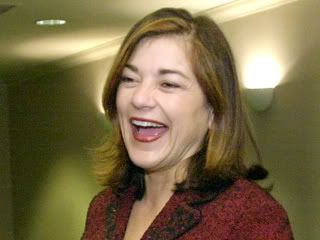
Democratic Representative Linda Sanchez has military constituents arrested for staging an anti-war sit-in at her office.

U.S. Representative Linda Sanchez, Democrat from California, up for reelection in 2008

From the LATimes:
Six antiwar demonstrators were arrested Wednesday at the Garden Grove office of Rep. Loretta Sanchez (D-Santa Ana) after camping there overnight and telling her they wouldn't leave unless she promised not to approve more funding for the war in Iraq.

Most of the protesters are members of the group Military Families Speak Out, and some have relatives in the armed forces. They entered the office about 7 p.m. Tuesday during an open house. They sat on the floor in the lobby and refused to leave unless the congresswoman made the statement they wanted. Sanchez, who opposes the war, refused.
According to other news accounts, the group Iraq Veterans Against the War was also involved in the protest.
The lawmaker's staff initially chose not to call police and allowed the group to stay overnight. Police removed the protesters in handcuffs about 8:15 a.m. Wednesday, while Sanchez was attending a meeting of Orange County Latino leaders.

The protesters were taken to the Garden Grove Police Department, where they were issued misdemeanor citations for trespassing. Five were released pending an October court hearing, but Robert Dietrich was being held because he refused to sign a document promising to appear in court.

Sanchez, Orange County's only Democratic member of Congress, voted in 2002 against giving President Bush authorization to invade Iraq. More recently she voted to begin pulling troops out within 90 days.

Tuesday night Sanchez said she could not support the protesters because the $145 billion in Iraq war funding was in the same bill that would provide money to build the C-17 aircraft in California.

"I never voted for this war," she said. But "I'm not going to vote against $2.1 billion for C-17 production, which is in California. That is just not going to happen."

Protesters did not accept Sanchez's argument.

There's just no way around it, Loretta: Voting for the funding is voting for the war.
"This is a war that was made up and people are dying, and there is no reason for it," said Ed Garza, who was one of those arrested and who has a nephew in the military.

Medea Benjamin, who was not at the protest, said, "It's quite immoral for Sanchez to say she is more concerned about jobs in her district than the lives of our soldiers." Benjamin is co-founder of the national women's peace group Code Pink.

Declaring the start of the sit-in, Patricia Alviso, whose son has served two tours in Iraq, said, "We risk arrest to demonstrate the level of our commitment to peace, and we risk arrest because our children risk far more."

Once seated on the lobby floor, Alviso began reading the names of Californians killed in Iraq.

"Jeromy D. West," she said.

"God forgive us," the others responded.

"Aaron Boyles."

"God forgive us."

Such sit-ins have become more popular in the last year because of war critics' desperation over the situation in Iraq, Benjamin said

Before Congress approved $95 billion for the Iraq war in March, protesters conducted sit-ins in the offices of several Democrats, including Sen. Hillary Rodham Clinton of New York and Rep. Edward J. Markey of Massachusetts. Also targeted were the offices of Republican critics of the war, such as Sen. Olympia J. Snowe of Maine.

Democrats have been targeted more than Republicans by the nonpartisan Military Families Speak Out because they control Congress, co-founder Nancy Lessin said. Code Pink is planning to camp out and conduct a hunger strike next week at the home of House Speaker Nancy Pelosi (D-San Francisco).

When protesters refused to leave Sanchez's office Wednesday, more than a dozen police officers surrounded it.

Those arrested were Garza, 60, of Santa Ana; Alviso, 55, of Huntington Beach; Dietrich, 61, of Los Angeles; Jarret Lovell, 34, of Costa Mesa; Abraham Ramirez, 23, of Fullerton; and Tutrang Tran, 25.

Residents in Ms. Sanchez's district need to find a candidate to run against her, in both the Democratic primary and then, should Sanchez win, another candidate to run against her as an Independent. Ideally, a hispanic veteran. The full force of dissatisfaction has to be brought to bear on Democratic incumbents.

Sunday, July 22, 2007

Director of Intelligence: "The U.S. Does NOT Engage in Torture....

....depending on what your definition of torture is."

On Meet the Press, Tim Russert talks with National Intelligence Director, Mike McConnell:


Part 1


Part 2


Part 3

Transcript:
RUSSERT: Our issues this Sunday -- what is the real terrorist threat to the United States homeland? How good is our intelligence gathering, and nearly six years after September 11th, why is Osama bin Laden still at large? With us -- the director of National Intelligence, Admiral Mike McConnell, in his first television interview.

Then -- briefings, debates, and votes -- the Iraq war front and center. With us, Democratic senator from Wisconsin, Russ Feingold. And in our roundtable, insight and analysis from New York Times Columnist, David Brooks; The Washington Post, Bob Woodward; and The Weekly Standard, Stephen Hayes, author of "Change, The Untold Story of America's Most Powerful and Controversial Vice President."

But, first, this week, this document, the National Intelligence Estimate entitled "The Terrorist Threat to the U.S. Homeland," was released. How serious is this threat and what can we do about it? Joining us for an exclusive interview is the director of National Intelligence, Admiral Mike McConnell -- welcome.

McCONNELL: Thank you.

RUSSERT: Let me show you a key judgment from this report, "We judge the U.S. homeland will face a persistent and evolving terrorist threat over the next three years."

In laymen's language, for the American viewers watching today, what is the most serious threat facing our country?

McCONNELL: Tim, the most serious threat is that the plotters that are being observed will be successful in penetrating our defenses and conducting an attack that would result in mass casualties. Their intent is to effect and attack with mass casualties. A secondary attempt would be a political or infrastructure targets to even include economic targets that would have long-lasting impact.

RUSSERT: Is it biological and chemical, or did they achieve nuclear?

McCONNELL: They have not achieved nuclear based on our current understanding. The intent is either chemical, biological, nuclear radiological, or even nuclear to include a nuclear yield. I would add what we see currently is primarily a focus on explosives -- explosives that can generate a large explosion, but they're put together with commercially available material.

RUSSERT: Why aren't we seeing more suicide bombers the way we see in the Middle East?

McCONNELL: In the United States, you mean? The efforts that the United States and our allies have gone through over the past five years have been significant in establishing barriers. So the terrorists perceive us as a much more difficult target, very different from what it was at 9/11.

So barriers have been established, databases have been established, the National Counterterrorism Center, which conducts three times a day a teleconference with all the players -- federal level, state level, international -- to try to coordinate these things, and if someone can be identified, they'll be taken out of the pipeline in their process to come into the United States.

RUSSERT: Let me read another key judgment, "Although we have discovered only a handful of individuals in the United States with ties to al Qaeda's senior leadership since September 11th, we judge that al Qaeda will intensify its efforts to put operatives here."

But there are people in the United States, you are saying, who have direct ties to al Qaeda senior leadership?

McCONNELL: The way we describe it is we have strategic warning, we know what al Qaeda and their safe haven in Pakistan intends to do. We're watching them train and recruit, and their effort is to put someone inside the United States.

There have been some clues in some cases where there would be attack, but we do not have tactical warning currently that there are sleeper cells tied directly to al Qaeda inside the United States. So we have the strategic warning not the specific tactical warning, but we know their intent.

RUSSERT: But you say there are handfuls of individuals in the United States with ties to al Qaeda senior leadership.

McCONNELL: That's correct, and that's in the form of raising money or being sympathetic to. But we haven't identified individuals who are actively plotting or planning. But there have been some that have been sympathetic to al Qaeda's cause.

RUSSERT: Do you believe there are sleeper cells in the U.S.?

McCONNELL: I worry that there are sleeper cells in the U.S. I do not know. There is no specific on a sleeper cell. There are some elements under surveillance because we're not sure, so it's warranted -- court-approved, warranted surveillance. We have some ties. This is what I meant when I said we've raised the barriers and made it more difficult.

RUSSERT: This intelligence report that came out this month raised a lot of concern and alarm in the U.S., and it seems to be in stark contrast to the National Intelligence Estimate from last April -- this one. Let me read that key judgment to you, "United States- led counterterrorism efforts have seriously damaged leadership of al Qaeda and disrupted its operations. We assess the global jihadist movement is decentralized; lacks a coherent global strategy; is becoming more diffuse.

That seems so different than your assessment in July of '07. What a difference a year makes. What changed? We were told that the al Qaeda had been, in many ways, close to being destroyed or dismantled.

McCONNELL: Following the invasion of Afghanistan in 2001, about two-thirds of al Qaeda's not only leadership but their soldiers, the foot soldiers, had been eliminated. And at that point in time, that was an accurate assessment of where we were.

Now, what happened? What's different? What changed? In Pakistan, where they're enjoying a safe haven -- the government of Pakistan chose to try a political solution. A political solution meant a peace treaty with the region that's never been governed -- not governed from the outside, not governed by Pakistan. The opposite occurred. Instead of pushing al Qaeda out, the people who live in these federally administered travel areas, rather than pushing al Qaeda out, they made a safe haven for training and recruiting.

And so in that period of time, al Qaeda has been able to regain some of its momentum. The leadership is intact, they have operational planners, and they have safe haven. The thing they're missing are operatives inside the United States. So that's the difference between last year and this year in our assessment.

RUSSERT: Why haven't we captured Osama bin Laden?

McCONNELL: Think about attempting to capture a single human being whose primary purpose and emphasis is to remain unobserved or hidden. It's a very difficult challenge. From having been in intelligence for most of my professional life, it's not difficult to find something large -- an armored division, ships that are being built or airplanes or whatever, but a single human being that wants to be unobserved, who is being assisted in that process, it just makes it very, very difficult.

RUSSERT: If we captured Osama bin Laden, we might lose General Musharraf and Pakistan because of unrest such apprehension might create in his country. Would it be worth losing Musharraf but apprehending Osama bin Laden?

McCONNELL: Well, first, I wouldn't agree that if we capture or kill Osama bin Laden it would be a particularly increased or direct threat to President Musharraf. President Musharraf is one of our strongest allies. He agrees with capturing or killing Osama bin Laden, and while he tried the political arrangement, the peace agreement, last fall, he has made decisions over the last few weeks -- you are aware of the Red Mosque and cleaning that out -- and he's gone on the offensive to go back into this federally administered travel area, FATA, is the shorthand we use to refer to it.

Now, in doing that, there's been a price. He has lost already, I would say, 100 troops. Broadly, across Pakistan, the number is probably approaching 300 from suicide bombs and roadside attacks. So there is a price to pay, but President Musharraf is a moderate, he has a moderate view, and he is attempting to cause the nation of Pakistan to rally around a moderate's view to eliminate the extremists.

RUSSERT: If his government fell, how detrimental would it be to the U.S.?

McCONNELL: It would have severe impact. It would depend -- if it fell, it depends on who would replace him. It's a democratic nation, if they continue down this current path, so if the process of turnover happens in a democratic way, it may not have severe impact.

One of the things that I would like to highlight, however, is President Musharraf is one of our most valued allies, and let me just highlight this -- Probably, the majority of the senior leadership have been captured or killed or is the direct result of assistance and cooperation and participation by the Pakistanis.

RUSSERT: Are you convinced Osama bin Laden is alive?

McCONNELL: We have not heard from Osama bin Laden for over a year. There's a recent video where he appeared. Many people thought that was current. That was actually old videotape. So it's been a year. There are rumors about his illness. My personal view is that he's alive, but we don't know because we can't confirm it for over a year.

RUSSERT: And living in Pakistan?

McCONNELL: I believe he is in the tribal region of Pakistan, and how he conducts his affairs, only speaking to a courier, staying complete removed from anything we could exploit to find him, I think he's in that region.

RUSSERT: Let me ask you about the executive order the president issued about enhanced interrogation measures. What does that allow a CIA-held target? What kind of measures can you use to get information from them?

McCONNELL: Well, Tim, as you know, I can't discuss specific measures. There's a variety of reasons for that. One, if I announce what the specific measures are, it would aid those who want to resist those measures to train, to understand it, and so on, so I won't be too specific.

Let me go back to a higher calling in this context. The United States does not engage in torture. The president has been very clear about that. The executive order spells it out. There are means and methods to conduct interrogation that will result in information that we need, and what I would highlight -- I was concerned and worried and, quite frankly, appalled by Abu Ghraib. My view is America risked losing the moral high ground, and so I focused on this when I came back.

What I can report to you is that was an aberration. The people who were responsible for the atrocities at Abu Ghraib have been held accountable, and they're serving a sentence for that. That is not the program the CIA was administering. It is not the program that the president approved in the recent executive order.

RUSSERT: But by use of the term "enhanced interrogation measures," there clearly are things that are used to elicit information. Have we eliminated water-boarding? Can you confirm that?

McCONNELL: I would rather not be specific on eliminating exactly what the techniques are with regard to any specific. When I was in a situation where I had to sign off, as a member of the process, my name to this executive order, I sat down with those who have been trained to do it, doctors who monitor it, understanding that no one is subjected to torture. They are treated in a way that they have adequate diet and not exposed to heat or cold, they are not abused in any way, but I did understand when exposed to the techniques how they work and why they work -- all under medical supervision, and one of the things that's very important, I think, for the American public to know -- in the history of this program it's been fewer than 100 people.

And so this is a program where we capture someone known to be a terrorist, we need information that they possess, and it has saved countless lives because they believe these techniques might involve torture, and they don't understand them, they tend to speak to us, talk to us in a very candid way.

RUSSERT: Does this new executive order allow measures that if were used against a U.S. citizen who was apprehended by the enemy would be troubling to the American people?

McCONNELL: I can report to you that it's not torture.

RUSSERT: How do you define torture?

McCONNELL: Well, torture is -- an attempt to define torture in the executive order gives examples of mutilation or murder or rape or physical pain, those kinds of things.

Let me just leave it by saying the techniques work. It's not torture, you're not subjected to heat or cold, but it is effective, and it's a psychological approach to causing someone to have uncertainty and, in a situation where they will feel compelled to talk to you about what you're asking on that.

RUSSERT: Then you would find it acceptable if a U.S. citizen experienced the same kind of enhanced interrogation measures?

McCONNELL: Tim, it's not torture. I would not want a U.S. citizen to go through the process, but it is not torture, and there would be no permanent damage to that citizen.

RUSSERT: Let me turn to Iraq, another key judgment from the National Intelligence Estimate, "We assess that its association with AQI, al Qaeda in Iraq, helps al Qaeda to energize the broader Sunni extremist community, raise resources and recruit and indoctrinate operatives including for homeland attacks."

That seems to suggest that the Iraq War has been a very effective recruiting tool for al Qaeda.

McCONNELL: It has served as a recruiting tool to draw additional terrorists into Iraq, but it's a mutually beneficial situation for both organizations.

Now, the debate often is -- was al Qaeda in Iraq prior to the U.S.-led coalition invasion? Some members of those who associate with al Qaeda were there -- Zarqawi, who had served in Pakistan with Osama bin Laden, was the principal lead. In 2004 he swore allegiance to Osama bin Laden. As you know, he was subsequently killed about a year ago -- June 2006. The person that replaced him as sworn allegiance to Osama bin Laden.

So al Qaeda finds it beneficial in that it's in the press. It draws in recruits, and al Qaeda in Iraq found it beneficial because it unites in a broader context.

There's one thing I think is very important is in the NIE that's often overlooked -- there is an element of extremism in the Middle East that runs from North Africa down into South Africa into the Levant, Syria, into Iraq and over to Afghanistan, even Pakistan. What al Qaeda has done is find a method for uniting those extremist views, and so what we see now is groups who are predisposed to extremism and terrorism are uniting under the al Qaeda banner.

RUSSERT: But al Qaeda is a much more robust and larger presence in Iraq now than it was before the war?

McCONNELL: That's fair to say, that's fair to say. Now, but, let me just highlight one thing that's also important -- At one point in the war, al Qaeda controlled the huge expanse to the west, it's called Anbar Province. What's happened is because of the atrocities in their approach that leadership, tribal sheikhs in that region, collaborated with the coalition and turned on al Qaeda.

So has al Qaeda defeated in Iraq -- no. But in some areas, they're back on their heels for two reasons. The local citizens have turned against -- Iraqi citizens have turned against al Qaeda, and the coalition has been much more effective. As you know, the troops in this surge arrived in about the middle of June, and so the effort has been to take the fight to al Qaeda, and they have a very high level of success in doing that.

RUSSERT: In terms of the balance in Iraq, which creates more of the violence? Which is the greater cause for violence? The sectarian conflict or al Qaeda?

McCONNELL: I think it is both. In some cases, we even have Shi'a on Shi'a sectarian violence. But, for the most part, it is Sunni versus Shi'a, and al Qaeda is the one that takes -- is the organization that attempts purposefully to serve as an accelerant attacking things like the mosque, the Grand Mosque that was destroyed over a year ago, and then revisiting with attacking the two minarets that were still up.

The whole purpose is something massive against the Shi'a or against something Shi'a holds sacred to act as an accelerant to stimulate the violence.

RUSSERT: But there seems to be, Admiral, a coordinated campaign by the administration to elevate al Qaeda is the threat in Iraq, and yet the Pentagon quarterly report, which came out in March, said this, "The conflict in Iraq has changed from a predominantly Sunni-led insurgency against foreign occupation to a struggle for the division of political and economic influence among sectarian groups and organized criminal activity," the Pentagon quarterly report on Iraq to Congress.

The Pentagon report also said sectarian violence has become "the greatest impediment to the establishment of security and effective governance in Iraq." Do you agree with that?

McCONNELL: I agree with that, it's true. But what I would highlight is al Qaeda is part of that sectarian violence, al Qaeda is part of that crime. In some neighborhoods, it would be a classic shakedown -- "We will provide security if you give us money and resources." So al Qaeda is a major portion -- not the only. It's had significant impact, but there are other sectarian disagreements and criminal activity going on, as I mentioned, even Shi'a on Shi'a in some cases.

RUSSERT: Stephen Hayes has written his book on Vice President Cheney, and as I was reading it, I found an interview with you about your views of the administration and some of their methods of gathering intelligence, and I want to share that with you and have a chance to talk about it.

It says here, "In November of 2006, Michael McConnell, who had been working on intelligence issues in the private sector since resigning from the NSA in '96 was asked to consider joining the Bush administration as the nation's top intelligence official. McConnell was honored to be asked but had serious reservations. He had been unimpressed with many aspects of the Bush administration and its conduct of the war on terror, particularly what he felt was a politicized use of intelligence and lead-up to the war.

All of these current players, Secretary Rumsfeld, Vice President Cheney, and the president,' McConnell said in an interview in late November '06, 'must come through from me as a citizen. I am no longer on active duty, so I can say these things. They had, first and foremost, very strong political convictions. My sense of it is their political faith and convictions influence how they took information and interpreted it, how they picked up and interpreted outside events. As a former intel pro, when you don't like the answer, and you set up your own thing, you tend to get the answer you want. You hire people that think like you do or want to satisfy the boss. I've read much more about the current set of players, and they did set up a whole new interpretation because they didn't like the answers. They got results that, in my view, now have been disastrous.'"

That's pretty harsh.

McCONNELL: We're all influenced by what we see and hear and read. I am a concerned citizen. I read those things and read those accounts. What I was taking greatest exception to was to have a secondary unit established in the Pentagon to reinterpret information.

The problem I have with that is the way you do intelligence is all sources considered. You have to factor one issue against another and balance it. If you start an independent effort with a point of view, it's not infrequent that you would take a single piece of data to make a point as opposed to consider everything.

So what I was referring to and talking about at that time is I was worried that in the Pentagon there had been established this separate unit, and I thought it would have been too influential. Now, you can imagine, I consider myself an intelligence professional, I've been doing this either on active duty or serving this community for 40 years. The first responsibility of an intelligence professional is ground truth, and the second responsibility is to speak truth to power.

So when I was asked to consider this nomination, that was the condition under which I would consider it, and I focused on it very intently once I came back. What I found, or what I discovered, was quite refreshing. As you know, I meet with the president and vice president six days and, on occasion, seven days a week. That dialog is open and frank and direct, and the thing that the president and the vice president frequently will do, whether they're talking to me or one of the analysts that go in with me, is that we're not telling you what to think or how to think or what your conclusion should be. We need your information. We can challenge your assumptions or your assessment, but we want to know what your opinion is.

RUSSERT: But leading up to the war in Iraq, you strongly suggest that many Americans believe that we went to war on Iraq on faulty intelligence, skewed intelligence, or cherry-picked intelligence.

McCONNELL: I would just report what came out of the WMD commission and even the 9/11 commission, to some extent, the assessment that was concluded, I think it was October 2002, determined or made an assessment that Saddam had weapons of mass destruction. I believed it at the time, and I mostly believed it because of my experience as intelligence officer for General Powell in the first Gulf War. I knew they had them, I knew Saddam had killed 300,000 of his own countrymen. He had engaged in two wars. He had those weapons, so I believed it.

What I believe happened is that the community allowed itself to be lulled into making the call on information, in some cases, from people who thought they had them -- even Saddam's generals thought they had weapons of mass destruction. So those threads took us to a place that turned out to be not valid.

RUSSERT: But did the policymakers hype the intelligence?

McCONNELL: That's a judgment that I think the American people will have to make. I have paid very close attention to hyping of intelligence, and what I can tell you from personal experience is the decision-makers are making every attempt to call it straightforward based on the information that we provide to them, and we are not being asked to cherry-pick or to go down one path or another path but to give them complete information or the best assessments we can.

RUSSERT: Admiral Mike McConnell, we thank you very much for coming here and sharing your views this morning.

McCONNELL: Thank you so much.

I saw Road To Guantanamo on Dishnet (the Sundance channel) last week:
...the terrifying, first-hand account of three British citizens who were held for two years without charges in the American military prison at Guantanamo Bay, Cuba. Known as the "Tipton Three," in reference to their home town in Britain, the three were eventually returned to Britain and released, still having had no formal charges ever made against them at any time during their ordeal.

Part documentary, part dramatization, the film chronicles the sequence of events that led from the trio setting out from Tipton in the British Midlands for a wedding in Pakistan, to their crossing the Afghanistan border just as the U.S. began their invasion, to their eventual capture by the Northern Alliance and their imprisonment in Camp X-Ray and later at Camp Delta in Guantanamo.


A clip from Road To Guantanamo
Mixing documentary footage, interviews and dramatic recreations, filmmakers Michael Winterbottom (IN THIS WORLD) and Mat Whitecross reveal the harsh realities of the American detention facility in Guantanamo Bay. THE ROAD TO GUANTANAMO tells the story of the "Tipton Three," a trio of young British citizens of Pakistani heritage who naively ventured into Afghanistan in the fall of 2001 and were eventually rounded up in a sweep of terrorist suspects. "A wrenching and dismaying account of cruelty and bureaucratic indifference" - New York Times.

The horror and abuse begin long before the three arrive in Guantanamo. If this account is anything close to what actually happened, we are seriously off the path of what the United States is all about, and what most Americans believe our government should be doing in our names.

Tuesday, July 03, 2007

Dial 1-202-456-1414


UPDATE: Forget about calling the White House. Call these folks:


It was phone calls overloading and breaking down the switchboards at the U.S. Capitol that ended the immigration legislation debate last week. When Americans realize the power they have and the changes that their involvement in government can bring, the whole world will look bright again.

Call your senators and representatives, and tell them to investigate whether Bush is himself a participant in the obstruction of justice.
Now.

[Find your representative's number here, and your senators' phone numbers here. If you aren't sure who represents you (and we're going to have a serious heart-to-heart about that one day soon), go here and type in your zip code. Double-click on the 'info'-link under your representatives' photos for their phone numbers.]

Wednesday, April 18, 2007

Secret Hold Placed on Senate Disclosures


From the Sunlight Foundation:
Yet again an anonymous Senator has placed a secret hold on legislation that would increase transparency. This time a secret hold has been placed on a bill, S. 223, that would mandate that Senators file their campaign finance reports electronically. This process would not only make these reports more readily available to the public but would also save money and resources.
Yesterday this bill was blocked by an anonymous Senator who placed a secret hold on the bill. Secret holds are so looked down on these days that earlier this year the Senate itself banned the practice, although the bill containing that provision has yet to become law. But until secret holds are banished forever, we need your help in exposing the culprit who is blocking consideration of the electronic filing requirement for Senate campaign finance reports.

We need your help to find out who placed this secret hold! Call your Senators and ask them if they are the one with the secret hold on S. 223. Then report back here in the comments with your findings or contact us using this contact form. Below is a list of Senators, organized by state, and their contact info. If a Senator issues a denial we will indicate that next to their name.

So far, the tally sheet looks like this (bold indicates "response unknown"):

Senator Contact Secret Hold?
Richard Shelby (R-Alabama) (202) 224-5744 NO
Jeff Sessions (R-Alabama) (202) 224-4124 NO
Ted Stevens (R-Alaska) (202) 224-3004 NO
Lisa Murkowski (R-Alaska) (202) 224-6665 NO
John McCain (R-Arizona) (202) 224-2235 NO
Jon Kyl (R-Arizona) (202) 224-4521
Blanche Lincoln (D-Arkansas) (202) 224-4843 NO
Mark Pryor (D-Arkansas) (202) 224-2353
Dianne Feinstein (D-California) (202) 224-3841 NO
Barbara Boxer (D-California) (202) 224-3553
Wayne Allard (R-Colorado) (202) 224-5941 NO
Ken Salazar (D-Colorado) (202) 224-5852 NO
Christopher Dodd (D-Connecticut) (202) 224-2823
Joseph Lieberman (I-Connecticut) (202) 224-4041
Joseph Biden (D-Delaware) (202) 224-5042
Thomas Carper (D-Delaware) (202) 224-2441 NO
Bill Nelson (D-Florida) (202) 224-5274 NO
Mel Martinez (R-Florida) (202) 224-3041
Saxby Chambliss (R-Georgia) (202) 224-3521 NO
Johnny Isakson (R-Georgia) (202) 224-3643 NO
Daniel Inouye (D-Hawaii) (202) 224-3934
Daniel Akaka (D-Hawaii) (202) 224-6361
Larry Craig (R-Idaho) (202) 224-2752 NO
Mike Crapo (R-Idaho) (202) 224-6142
Richard Durbin (D-Illinois) (202) 224-2152 NO
Barack Obama (D-Illinois) (202) 224-2854 NO
Richard Lugar (R-Indiana) (202) 224-4814 NO
Evan Bayh (D-Indiana) (202) 224-5623 NO
Chuck Grassley (R-Iowa) (202) 224-3744 NO
Tom Harkin (D-Iowa) (202) 224-3254
Sam Brownback (R-Kansas) (202) 224-6521 NO
Pat Roberts (R-Kansas) (202) 224-4774
Mitch McConnell (R-Kentucky) (202) 224-2541 NO
Jim Bunning (R-Kentucky) (202) 224-4343 NO
Mary Landrieu (D-Louisiana) (202) 224-5824 NO
David Vitter (R-Louisiana) (202) 224-4623
Olympia Snowe (R-Maine) (202) 224-5344
Susan Collins(R-Maine) (202) 224-2523 NO
Barbara Mikulski (D-Maryland) (202) 224-4654 NO
Ben Cardin (D-Maryland) (202) 224-4524
Edward Kennedy (D-Massachusetts) (202) 224-4543 NO
John Kerry (D-Massachusetts) (202) 224-2742 NO
Carl Levin (D-Michigan) (202) 224-6221
Debbie Stabenow (D-Michigan) (202) 224-4822
Norm Coleman (R-Minnesota) (202) 224-5641 NO
Amy Klobuchar (D-Minnesota) (202) 224-3244 NO
Thad Cochran (R-Mississippi) (202) 224-5054
Trent Lott (R-Mississippi) (202) 224-6253
Christopher S. Bond (R-Missouri) (202) 224-5721 NO
Claire McCaskill (D-Missouri) (202) 224-6154 NO
Max Baucus (D-Montana) (202) 224-2651
Jon Tester (D-Montana) (202) 224-2644 NO
Chuck Hagel (R-Nebraska) (202) 224-4224
Ben Nelson (D-Nebraska) (202) 224-6551 NO
Harry Reid (D-Nevada) (202) 224-3542
John Ensign (R-Nevada) (202) 224-6244
Judd Gregg (R-New Hampshire) (202) 224-3324
John E. Sununu (R-New Hampshire) (202) 224-2841 NO
Frank Lautenberg (D-New Jersey) (202) 224-3224 NO
Robert Menendez (D-New Jersey) (202) 224-4744 NO
Pete Domenici (R-New Mexico) (202) 224-6621 NO
Jeff Bingaman (D-New Mexico) (202) 224-5521
Charles Schumer (D-New York) (202) 224-6542
Hillary Clinton (D-New York) (202) 224-4451
Elizabeth Dole (R-North Carolina) (202) 224-6342 NO
Richard Burr (R-North Carolina) (202) 224-3154 NO
Kent Conrad (D-North Dakota) (202) 224-2043
Byron Dorgan (D-North Dakota) (202) 224-2551
George Voinovich (R-Ohio) (202) 224-3353 NO
Sherrod Brown (D-Ohio) (202) 224-2315 NO
James Inhofe (R-Oklahoma) (202) 224-4721 NO
Tom Coburn (R-Oklahoma) (202) 224-5754 NO
Ron Wyden (D-Oregon) (202) 224-5244 NO
Gordon Smith (R-Oregon) (202) 224-3753 NO
Arlen Specter (R-Pennsylvania) (202) 224-4254 NO
Bob Casey, Jr. (D-Pennsylvania) (202) 224-6324 NO
Jack Reed (D-Rhode Island) (202) 224-4642
Sheldon Whitehouse (D-Rhode Island) (202) 224-2921
Lindsey Graham (R-South Carolina) (202) 224-5972 NO
Jim DeMint (R-South Carolina) (202) 224-6121 NO
Tim Johnson (D-South Dakota) (202) 224-5842 NO
John Thune (R-South Dakota) (202) 224-2321
Lamar Alexander (R-Tennessee) (202) 224-4944 NO
Bob Corker (R-Tennessee) (202) 224-3344 NO
Kay Bailey Hutchison (R-Texas) (202) 224-5922 NO
John Cornyn (R-Texas) (202) 224-2934 NO
Orrin Hatch (R-Utah) (202) 224-5251 NO
Robert Bennett (R-Utah) (202) 224-5444 NO
Patrick Leahy (D-Vermont) (202) 224-4242 NO
Bernie Sanders (I-Vermont) (202) 224-5141 NO
John Warner (R-Virginia) (202) 224-2023
Jim Webb (D-Virginia) (202) 224-4024 NO
Patty Murray (D-Washington) (202) 224-2621
Maria Cantwell (D-Washington) (202) 224-3441
Robert Byrd (D-West Virginia) (202) 224-3954 NO
Jay Rockefeller (D-West Virginia)(202) 224-6472 NO
Herbert Kohl (D-Wisconsin) (202) 224-5653 NO
Russ Feingold (D-Wisconsin) (202) 224-5323 NO
Craig Thomas (R-Wyoming) (202) 224-6441 NO
Michael Enzi (R-Wyoming) (202) 224-3424 NO

Kate Phillips at the NYT reports:
According to a transcript, Senator Dianne Feinstein, Democrat of California, explained why the current practice is cumbersome, at least, on the Senate floor on Tuesday as she sought to get unanimous consent for the bill to be adopted:

Currently, House candidates, Presidential candidates, political action committees, and party committees are all required to file electronically, and they do. But Senators, Senate candidates, authorized campaign committees, and the Democratic and Republican Senate campaign committees are exempt.

As a result, we have a very cumbersome system in which paper copies of disclosure reports are filed with the Senate Office of Public Records, which then scans them, makes an electronic copy of them, and sends that copy to the F.E.C. (Federal Election Commission) on a dedicated communications line. The F.E.C. then prints the report and sends it to a vendor in Fredericksburg, Va., where the information is keyed in by hand and transferred back to the F.E.C. database. All of this costs about $250,000, and it is a waste of money, a waste of staff, and a waste of time.


At the very end of the floor discussion between Senator Feinstein and Senator Russell Feingold, Democrat of Wisconsin, an objection was raised by Senator Lamar Alexander, Republican of Tennessee.

It is unknown who placed the secret hold. But our chief congressional correspondent, Carl Hulse, has confirmed that a Republican senator placed one on the bill. Who placed the hold? We’ll find out soon.

That leaves Jon Kyl, Mel Martinez, Mike Crapo, Pat Roberts, David Vitter, Olympia Snowe, Thad Cochran, Trent Lott, Chuck Hagel, John Ensign, Judd Gregg, John Thune or John Warner.

Thursday, April 05, 2007

Protest Without Having To Leave The Comfort Of Your Armchair

Top California Democrat seeks to put war in Iraq on the ballot in the state's 2008 primary election.


Reuters reports:
California's top Democratic legislator called on Thursday for voters to call for an immediate withdrawal of U.S. troops from Iraq in a ballot measure for the state's 2008 presidential primary election.

"We do not have to be on the streets of Berkeley or on the streets of Oakland," state Senate President Pro Tem Don Perata said. "We can now use the ballot box."
"With the possible exception of George Bush, we all know it's time to go," said Perata. "If the biggest state in the nation says 'end the war now,' maybe it will start to sink in."

During the Vietnam War, both Northern Californian cities hosted frequent anti-war demonstrations, but with students today not threatened by a draft as they were in the 1960s, the Iraq war has not sparked the same level of public response.

Polls suggest, however, that a growing percentage of the public favors an end to the U.S. involvement in Iraq.

A Field Poll report released on Thursday said disenchantment with President George W. Bush's handling of the war has pushed his approval rating among California voters to its lowest level since he assumed office and near a record low scored by President Richard Nixon in August 1974 shortly before he resigned from office in the Watergate scandal.
Perata said he would introduce his bring-the-troops-home measure on Monday. To make the ballot, the measure requires a majority vote in the state Senate and Assembly, each controlled by Democrats, and Republican Gov. Arnold Schwarzenegger's signature.

State Senate Republican Leader Dick Ackerman said Perata should not expect Republican support. "California doesn't have any claim to establishing what the foreign policy should be for the United States," he said.

Ackerman said he expects Schwarzenegger would veto the bill: "I'd say it's dead on arrival."

Spokesman Aaron McLear said Schwarzenegger had no comment on the bill but said the governor supports a timeline for U.S. troops to withdraw from Iraq and "believes we need to do all we can to be successful in Iraq."

The advisory measure, mirroring a similar item passed by voters in San Francisco, comes as Bush and Democrats in Congress brace for a showdown over legislation to fund U.S. troops in Iraq.

"With the possible exception of George Bush, we all know it's time to go," said Perata. "If the biggest state in the nation says 'end the war now,' maybe it will start to sink in."

Tuesday, March 27, 2007

You Can Be A Banker To The World's Poor

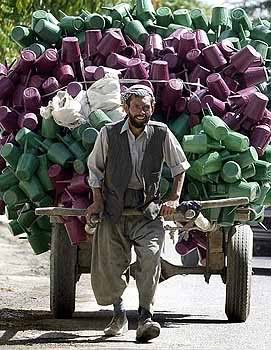
Alijan, 35, pulls a cart loaded with plastic pots on a street in Kabul, Afghanistan. The pots were imported from Pakistan and sold at 10 Afghanis ($US 11 cents) a piece.
(ASSOCIATED PRESS)

Nick Kristof, from Kabul, Afghanistan, writes:
For those readers who ask me what they can do to help fight poverty, one option is to sit down at your computer and become a microfinancier.

That’s what I did recently. From my laptop in New York, I lent $25 each to the owner of a TV repair shop in Afghanistan, a baker in Afghanistan, and a single mother running a clothing shop in the Dominican Republic. I did this through www.kiva.org, a Web site that provides information about entrepreneurs in poor countries — their photos, loan proposals and credit history — and allows people to make direct loans to them.

So on my arrival here in Afghanistan, I visited my new business partners to see how they were doing.
On a muddy street in Kabul, Abdul Satar, a bushy-bearded man of 64, was sitting in the window of his bakery selling loaves for 12 cents each. He was astonished when I introduced myself as his banker, but he allowed me to analyze his business plan by sampling his bread: It was delicious.

Abdul Satar had borrowed a total of $425 from a variety of lenders on Kiva.org, who besides me included Nathan in San Francisco, David in Rochester, N.Y., Sarah in Waltham, Mass., Nate in Fort Collins, Colo.; Cindy in Houston, and “Emily’s family” in Santa Barbara, Calif.

With the loan, Abdul Satar opened a second bakery nearby, with four employees, and he now benefits from economies of scale when he buys flour and firewood for his oven. “If you come back in 10 years, maybe I will have six more bakeries,” he said.

Abdul Satar said he didn’t know what the Internet was, and he had certainly never been online. But Kiva works with a local lender affiliated with Mercy Corps, and that group finds borrowers and vets them.

The local group, Ariana Financial Services, has only Afghan employees and is run by Storai Sadat, a dynamic young woman who was in her second year of medical school when the Taliban came to power and ended education for women. She ended up working for Mercy Corps and becoming a first-rate financier; some day she may take over Citigroup.

“Being a finance person is better than being a doctor,” Sadat said. “You can cure the whole family, not just one person. And it’s good medicine — you can see them get better day by day.”

Small loans to entrepreneurs are now widely recognized as an important tool against poverty. Muhammad Yunus won the Nobel Peace Prize last year for his pioneering work with microfinance in Bangladesh.

In poor countries, commercial money lenders routinely charge interest rates of several hundred percent per year. Thus people tend to borrow for health emergencies rather than to finance a new business. And partly because poor people tend to have no access to banks, they also often can’t save money securely.

Microfinance institutions typically focusing on lending to women, to give them more status and more opportunities. Sadat’s group does lend mostly to women, but it’s been difficult to connect some female borrowers with donors on Kiva — because many Afghans would be horrified at the thought of taking a woman’s photograph, let alone posting on the Internet.

My other partner in Kabul is Abdul Saboor, who runs a small TV repair business. He used the loan to open a second shop, employing two people, and to increase his inventory of spare parts. “I used to have to go to the market every day to buy parts,” he said, adding that it was a two-and-a-half-hour round trip. “Now I go once every two weeks.”

Web sites like Kiva are useful partly because they connect the donor directly to the beneficiary, without going through a bureaucratic and expensive layer of aid groups in between. Another terrific Web site in this area is www.globalgiving.com, which connects donors to would-be recipients. The main difference is that GlobalGiving is for donations, while Kiva is for loans.

A young American couple, Matthew and Jessica Flannery, founded Kiva after they worked in Africa and realized that a major impediment to economic development was the unavailability of credit at any reasonable cost.

“I believe the real solutions to poverty alleviation hinge on bringing capitalism and business to areas where there wasn’t business or where it wasn’t efficient,” Flannery said. He added: “This doesn’t have to be charity. You can partner with someone who’s halfway around the world.”

Another organization that gets you and your money closer to the source of suffering and poverty is Oxfam International.

Wednesday, February 14, 2007

Everyday Acts of Resistance, Rebellion & Revolution

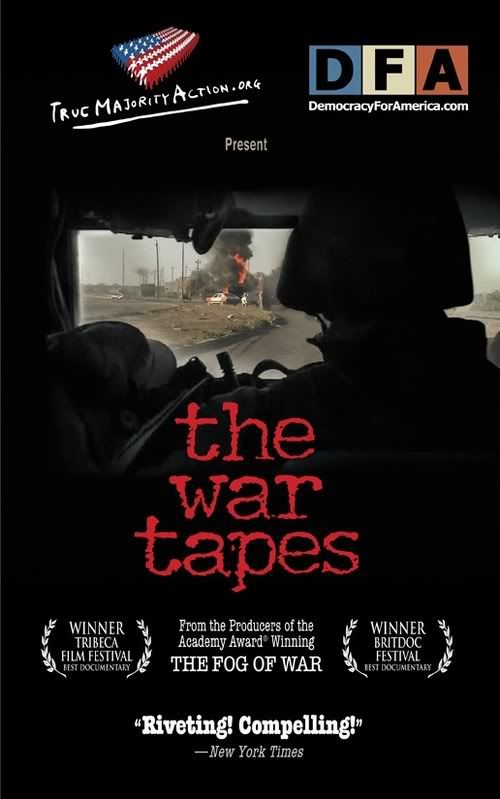
The War Tapes Screenings


Democracy for America and TrueMajority Action have united to keep the pressure on the President and Congress to not only stop the escalation, but end the occupation and bring our brave men and women home. Attend a screening of The War Tapes and after the movie we'll send postcards to our senators demanding action.
Straight from the front lines in Iraq, The War Tapes is the first war movie filmed by soldiers themselves. You have never seen film like this before. The film is powerful and moving conveying both the passion and mindset of American soldiers and the incredible human and community cost of war. There is little wonder why the film won Best Documentary at the Tribeca Film Festival. You will leave this movie more motivated than ever to end the occupation and bring our troops home.


Find a screening near you.

Sunday, February 11, 2007

Agents of Change

The Dixie Chicks had the last laugh at the 49th Annual Grammy Awards.

After a boycott by corporate radio stations nationwide, death threats, CD burnings, and the loss of a lucrative country music career after lead singer Natalie Maines told an audience in London on the eve of the U.S. invasion of Iraq: "We're ashamed that the President of the United States is from Texas," the Dixie Chicks won 5 Grammy awards for an album they produced after the controversy in response to their critics, including awards for the top 3 categories - Album of the Year, Song of the Year, Record of the Year. The last artist who won the top 3 awards was Eric Clapton in 1993. They performed their biggest hit song from the album, "I'm Not Ready to Make Nice":


The Dixie Chick accept the award for 'Best Country Album' of the year:


The Dixie Chicks accept the award for 'Best Song of the Year':


Tonight we celebrate what is all right with the world, for tomorrow, it is back to the trenches: The House of Representatives debates Bush's splurge in Iraq.


,

Monday, January 29, 2007

Tim Robbins Speaks at March in Washington Against the War


Transcript:
TIM ROBBINS: I don’t know if you heard the most recent news, just came over the wire: Karl Rove has been subpoenaed. Some have said recently that impeachment is off the table.

AUDIENCE: No!

TIM ROBBINS: What was that?

AUDIENCE: No!

TIM ROBBINS: On the train coming down here today, I talked to a young woman whose brother has just been deployed. Due to the recent Bush escalation, her brother is being rushed into action. Instead of the proper twelve-week training period, this young 20-year-old serviceman will hit the ground in a hostile land with two weeks’ training. Is impeachment still off the table?

AUDIENCE: No!

TIM ROBBINS: This past November, the American people sent a resounding message to Washington, D.C. and the world: we want change. We want this war to end. And how did Bush respond? 21,500 more will risk their lives for his misguided war. Is impeachment still off the table?

AUDIENCE: No!

TIM ROBBINS: Let's get him out of office! Let's get him out of office before --

AUDIENCE: Impeach Bush! Impeach Bush! Impeach Bush! Impeach Bush! Impeach Bush! Impeach Bush!

TIM ROBBINS: Let's get hem out of office before he starts ruling from a bunker. Let's get him out of office before the only one on his side is his dog Barney. Nixon, Richard Nixon, talked to the walls. Bush is talking to God. But it's not a god I recognize. This god seems to be giving George a pass on some of his major commandments. This god seems to be OK with lying or bearing witness, as he puts it, against the US Congress, against the United States people, against the world, bearing false witness on weapons of mass destruction, bearing false witness on nuclear capability, bearing false witness on the imminent threat of Saddam, bearing false witness on the links between al-Qaeda and Iraq.

This god seems to be giving George a pass on stealing, stealing the resources of the Iraqi people, on squandering the hard-earned tax dollars of United States citizens for an unnecessary war! Money that could be used to intelligently fight against terrorism is squandered in a way and in a war that creates more terrorists. Money that could be helping the elderly, the poor, the infirm here at home is instead lining the pockets of war profiteers from Halliburton and private mercenary militias like Blackwater. But George's god says, "That's cool, George." His god tells him to honor his father and mother, but when his father tells him not to occupy Iraq, George's god counsels him to ignore his father.

Well, I think we have a different understanding of those commandments here. And let's not forget that most important one: thou shalt not kill. Thou shalt not kill or recklessly risk the lives of our brave men and women overseas. Over 3,000 dead. Over 50,000 wounded. Thou shalt not kill or needlessly risk the lives of Iraqi civilians. How many? 50,000? 200,000? 400,000? 650,000? Only God knows, George. Only God knows.


Filed under: , , , , , , , , , , , , , , , ,

Susan Sarandon Speaks at March in Washington Against the War


Transcript:
SUSAN SARANDON: ”Imagine you are in constant danger from hidden roadside bombs and exposed to ambushes and sniper fire. Imagine that your home is constantly harassed with mortar explosions and rocket attacks while you try to sleep. Imagine you witness your closest friend being torn apart by enemy fire. Imagine you discover that the person you thought was an insurgent that you killed turns out to be an innocent child or someone who looks similar to your mother. Now imagine you lost a limb, you lost your eyesight, you lost a friend, you lost your sanity and you lost your innocence for an unappreciative society and an unconcerned elected government.” This is the testimony of Garrett Reppenhagen, who spoke earlier, cavalry scout and sniper in the US Army First Division from 2004 to 2005.

He continues. “I didn't expect to come home to find there's no plan for addressing the needs of veterans like myself. I don't understand how, despite being in the middle of not one but two wars, our government is actually scaling back on services that are critical for men and women trying to re-enter civilian society.”

Here are some staggering facts. One in three homeless Americans are military vets, and that is rising. One in four vets with PTSD sought medical care from the VA, where they experienced a two to three month wait to see a doctor. Over 53,000 are wounded. The ratio of doctors to patients is one doctor for every 500 patients. Veteran males aged 20 to 24 have twice the unemployment rate. 40% of troops currently being rotated are National Guard or reservists. 95% of them are experiencing problems getting their pay. Many are being sent back are on potent anti-depressants, anti-anxiety drugs with little or no counseling or supervision or screening. Over 200 have committed suicide. There's a 70% divorce rate for returning soldiers. The GOP plan for 2007 drops $65 billion in benefits over the next five years.

There was not a mention of this crisis in the State of the Union address, as if the war only exists over there and not here. And there was not an ounce of criticism from any of our presidential hopefuls. I say to those who tell me that we are fighting this war over there so that it doesn't come here: listen to the sons and daughters who are returning and their families, and you will know that the war is being fought here in the hearts and minds and bodies of those that are returning and have already sacrificed so much. Shame on you! We are here today to say it is time to remove the burden of the political crisis of the Iraq war from our soldiers and commit to caring for a new generation of Americans who are grieving, severely wounded and mentally troubled. Thank you.


Jane Fonda Speaks at March in Washington Against the War


Transcript:
JANE FONDA: I’m really here because I want to thank you all. I want to thank you from the bottom of my heart for being here today. So many of you, so many of today's speakers, including my fellow actors up here, were here at the beginning, before we went into Iraq, because you knew and they knew what was in store. Thank you so much for the courage to stand up against this mean-spirited, vengeful administration. Your actions are proof that the most precious part of this country, its soul, is alive and well. So thank you. Your ongoing commitment to ending this war allows people in other parts of the world to remain hopeful that America has the stuff to become again a country that they can love and respect. Thank you. I especially want to thank and acknowledge the servicemen and women and the military families and Gold Star mothers that are here.

A lot of press people have been asking me today, “What's the difference between now and during the Vietnam war?” And I’ll tell you one huge crucial difference: it took six years for Vietnam veterans, active-duty servicemen, Gold Star mothers and military families to come out against the war. It has happened now within three years of the war. Their presence here is critical, and we should acknowledge their courage.

I haven't spoken at an antiwar rally in 34 years, because I’ve been afraid that because of the lies that have been and continue to be spread about me and that war, that they would be used to hurt this new antiwar movement, but silence is no longer an option. My daughter, who is here with me today -- come here -- she was a little girl when she would come with me to the anti-Vietnam War protests. She's here today with her two little children, my grandchildren. I’m very proud that they're here, but I’m so sad that we still have to do this; that we did not learn the lessons from the Vietnam War; that we've made the same mistakes, blindness to the realities on the ground, hubris and arrogance in dealing with a people and culture far older than we are; and that we understand so little, carelessness and thoughtlessness in our approach to rebuilding a country we've destroyed, allowing billions of dollars to be stolen, squandered at the hands of private contractors, just as this administration has done in our own gulf in the post-Katrina era.

So, thank you. Thank you for being here, and we'll continue to be here for as long as necessary. God bless.


Filed under: , , , , , , , , , , , , , ,

Sean Penn Speaks at March in Washington Against the War


Transcript:
SEAN PENN: What’s Hollywood doing here today? We're here, because it’s our job, just like it’s yours. We’re Americans, and our fellow Americans are dying as we're standing here today. We are dependent on our congress, but our congress is dependent on us, and we're going to come out here in these numbers and in doubled numbers, and we're going to send our congress this message. We've heard the excuse, “if I had known then what I know now.” Well, we're here to tell them now what they have to know in 2008. And if they don't stand up and make a resolution as binding as the death toll, we're not going to be behind those politicians. We're here, and we’re going to be in local districts, and we’re going to push this until this resolution is binding, the money stops and the troops come home.


Filed under: , , , , , , , , , , , , , , , , ,