Showing posts with label torture. Show all posts

Monday, April 27, 2009

New Evidence of Torture Prison in Poland

The control tower in Szymany, Poland. Journalist Mariusz Kowalweski with the newspaper Rzeczpospolita claims he is certain there was a CIA prison near the airport. The paper also reported that the Polish intelligence agency made 20 of its agents available to the CIA, something that a former CIA operative has confirmed to SPIEGEL.

Der Spiegel reports:
The current debate in the US on the "special interrogation methods" sanctioned by the Bush administration could soon reach Europe. It has long been clear that the CIA used the Szymany military airbase in Poland for extraordinary renditions. Now there is evidence of a secret prison nearby.

Only a smattering of clouds dotted the sky over Szymany on March 7, 2003, and visibility was good. A light breeze blew from the southeast as a plane approached the small military airfield in northeastern Poland, and the temperature outside was 2 degrees Celsius (36 degrees Fahrenheit). At around 4:00 p.m., the Gulfstream N379P -- known among investigators as the "torture taxi" -- touched down on the landing strip.

On board was the most important prisoner the US had been able to produce in the war on terror: Khalid Sheikh Mohammed, the architect of the 9/11 attacks on New York and Washington, also known as "the brains" behind al-Qaida. This was the man who had presented Osama bin Laden with plans to attack the US with commercial jets. He personally selected the pilots and supervised preparations for the attacks. Eighteen months later, on March 1, 2003, Sheikh Mohammed was captured in Rawalpindi, Pakistan by US Special Forces and brought to Afghanistan two days later. Now the CIA was flying him to a remote area in Poland's Masuria region. The prisoner slept during the flight from Kabul to Szymany, for the first time in days, as he later recounted:
"My eyes were covered with a cloth tied around my head. A cloth bag was then pulled over my head. … I fell asleep. ... I therefore don't know how long the journey lasted."

Jerry M., age 56 at the time, probably sat at the controls of the plane chartered by the CIA. The trained airplane and helicopter pilot had been hired by Aero Contractors, a company that transferred prisoners around the world for US intelligence agencies. According to documents from the European aviation safety agency Eurocontrol, Jerry M. had taken off from Kabul at 8:51 a.m. that morning. Only hours after landing in Poland, at 7:16 p.m., he took off again, headed for Washington.

A large number of Polish and American intelligence operatives have since gone on record that the CIA maintained a prison in northeastern Poland. Independent of these sources, Polish government officials from the Justice and Defense Ministry have also reported that the Americans had a secret base near Szymany airport. And so began on March 7, 2003 one of the darkest chapters of recent American -- and European -- history.

Obama Under Pressure

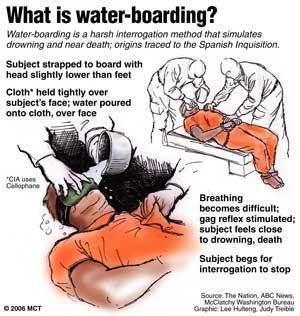
It was apparently here, just under an hour's drive from Szymany airport, that Sheikh Mohammed was tortured, exactly 183 times with waterboarding -- an interrogation technique that simulates the sensation of drowning -- in March, 2003 alone. That averages out to eight times a day. And all of this happened right here in Europe.

Over six years later, these acts of torture are putting the new US president, Barack Obama, under intense pressure. On the one hand, he released four memos in which his predecessor George W. Bush had legalized such interrogation methods. On the other hand, he decided not to prosecute the torturers. And he initially neglected to launch investigations into these "special interrogation methods."

It is the decision that has earned Obama the harshest criticism during the first 100 days of his presidency. Democrats from the Senate and the House of Representatives announced last week that they would form a truth commission, essentially putting them at odds with their own president. Obama quickly realized that he had apparently underestimated the volatile nature of the issue. So he had US Attorney General Eric Holder announce that no one stood above the law. Holder promised that an investigation would be conducted to find out who in the White House and the Justice Department had declared these methods legal.

What the CIA did back then to prisoners in the Polish military airbase of Stare Kiejkuty, north of Szymany, had been authorized by the president. According to witnesses, Stare Kiejkuty housed a secret CIA prison for "high value detainees" -- for the most prominent prisoners of the war on terror.

There is now no doubt that the Gulfstream N379P landed at least five times at Szymany between February and July, 2003. Flight routes were manipulated and falsified for this purpose and, with the knowledge of the Polish government, the European aviation safety agency Eurocontrol was deliberately deceived.

The public prosecutor's office in Warsaw has the statement of a witness who described how people wearing handcuffs and blindfolds were led from the aircraft at Szymany. He said that this happened far away from the control tower. According to the witness, it was always the same individuals and the same civilian vehicles that stood waiting on the landing field.

If we are to believe the statements of Sheikh Mohammed, a large number of those present at the small airfield wore ski masks. This is what he told a delegation from the International Committee of the Red Cross that questioned him in the US military prison at Guantanamo, Cuba in late 2006:

"On arrival the transfer from the airport to the next place of detention took about one hour. I was transported sitting on the floor of a vehicle. I could see at one point that there was snow on the ground. Everybody was wearing black, with masks and army boots, like Planet-X people."

Just under an hour's drive corresponds roughly to the distance from Szymany to the Stare Kiejkuty military base, known as a training camp for Polish intelligence agents. The route there passes for two kilometers through a fenced-off military zone, past dense pine forests, then heads northeast for 20 minutes, and finally leads over an unpaved road alongside a lake. The entrance to the base is at the end of this road.

'I Was Never Threatened with Death'

Sheikh Mohammed said that they cut the clothes from his body, photographed him naked and threw him in a three-by-four-meter (10 x 13 ft) cell with wooden walls. That was when the hardest phase of the interrogating began, he claims. According to Sheikh Mohammed, one of his interrogators told him that they had received the green light from Washington to give him a "hard time":

"They never used the word 'torture' and never referred to 'physical pressure,' only to 'a hard time.' I was never threatened with death, in fact I was told that they would not allow me to die, but that I would be brought to the 'verge of death and back again.'"

He says he was questioned roughly eight hours a day. He spent the first month naked and standing, with his hands chained to the ceiling of the cell, even at night. They led them into another room for questioning, he says. That's where the bed stood that he says he was strapped to for waterboarding. The mastermind behind the 9/11 attacks told members of the Red Cross that he eventually realized where he was being held:
"I think the country was Poland. I think this because on one occasion a water bottle was brought to me without the label removed. It had an e-mail address ending in '.pl'. The central-heating system was an old-style one that I would expect only to see in countries of the former communist system."
Thereafter, the al-Qaida operative described how he was strapped to a special bed and submitted to waterboarding:

"Cold water from a bottle that had been kept in the fridge was then poured onto the cloth by one of the guards so that I could not breathe. This obviously could only be done for one or two minutes at a time. The cloth was then removed and the bed put into a vertical position. The whole process was then repeated during about an hour. Injuries to my ankles and wrists also occurred during the waterboarding as I struggled in the panic of not being able to breathe."

Part 2: Investigations across Europe

For more than a year now, Warsaw public prosecutor Robert Majewski has been investigating former Polish Prime Minister Leszek Miller's government on allegations of abuse of office. At issue is whether sovereignty over Polish territory was relinquished, and whether former Polish President Aleksander Kwasniewski and his left-leaning Social Democratic government gave the CIA free reign over sections of the Stare Kiejkuty military base for the agency's extraterritorial torture interrogations.

Majewski has questioned a large number of witnesses who worked in the former government, and this year his team even plans to fly to Guantanamo. "No European country is so sincerely and vigorously investigating former members of the government as is currently the case in Poland," says Wolfgang Kaleck from the European Center for Constitutional and Human Rights in Berlin, which supports the investigations.

The public prosecutor's office has also launched a probe to determine whether the Polish intelligence agency made 20 of its agents available to the CIA, as was recently reported by the conservative Polish daily newspaper Rzeczpospolita. A former CIA official confirmed this information to SPIEGEL. There was reportedly a document issued by the intelligence agency that mentioned both the 20 Polish agents and the transfer of the military base to the Americans. Two members of a parliamentary investigative committee in Warsaw had an opportunity to view this document in late 2005, but it has since disappeared.

The Missing Piece of Evidence

Journalist Mariusz Kowalewski at Rzeczpospolita and two colleagues have been searching for months now for proof of the existence of a secret CIA base in Poland. The journalists have discovered flight record books from Szymany that had been declared lost, and based on refueling receipts and currency exchange rates, they have reconstructed flights and routes, and spoken with informants. Over the past few weeks, their newspaper and the television network TVP Info have revealed new details on an almost daily basis.

Kowalewski has collected a wide range of documents on his white Apple laptop. He is convinced, though, that he only knows "a fraction of what actually happened." He is certain that there was a CIA base in the Masuria region, where high-ranking al-Qaida prisoners were brought. All that is missing is the final piece of evidence. There are rumors circulating that one of the most important interrogators of Sheikh Mohammed, an American named Deuce Martinez -- the man who didn't torture him, but rather had the task of gently coaxing information out of him -- was in Poland at the time. That is the proof that's still missing.

Similar conclusions were reached by the second investigative report on CIA kidnappings in Europe, which was submitted two years ago by the special investigator of the Council of Europe, Dick Marty. (Eds: The Council of Europe is an international organization and watchdog for human rights in a total of 47 states in the European region.) According to Marty's report, members of the former Polish military intelligence and counterintelligence agency, WSI, were given positions with the border police, customs and airport administration to safeguard the activities of the CIA. "The latest revelations in Poland fully corroborate my evidence, which is based on testimony by insiders and documents that have been leaked to me," says the investigator today. Now, under the "dynamic force of the truth" that Obama has unleashed, Marty says that Europeans must finally reveal "which governments tolerated and supported the illegal practices of the CIA."

All that remains is the question of who in Poland at the time approved the collaboration with the CIA and gave the Americans unencumbered use of sections of Stare Kiejkuty.

"The order to give the CIA everything they needed came from the very top, from the president," a member of the Polish military intelligence agency told the Marty team in 2007. Kwasniewski denies this. He says that there was close intelligence corporation with the US, but no prisons on Polish soil. When asked to comment on the reports, former Prime Minister Miller said: "All of this is just another opportunity for me to say that I have nothing to say."

It's very possible that the debate on torture and responsibility which is currently being conducted in the US will soon also reach Europe. After all, Germany granted the US flyover rights and dropped its bid to extradite 13 CIA operatives in the case of Khalid el-Masri, a German citizen who claims he was abducted by the Americans. The Italian intelligence agency allegedly assisted the CIA with the kidnapping in Milan of the Islamic cleric Abu Omar. Britain's intelligence agency, MI6, reportedly delivered information directly to CIA agents who were conducting interrogations in Morocco. And there are also reports of a secret prison in Romania. Investigations have been launched into these allegations in nearly all of these countries.

Jerry M., the pilot who flew Sheikh Mohammed from Kabul to Szymany in March, 2003, now lives in Birmingham, Alabama, in a brick house with white shutters and box trees planted in front of the door. Two stone lions guard the path that leads to the entrance. For two years, Jerry M. only had a post box address, like everyone else who flew CIA prisoners around the world: P.O. Box 22 99 43, code name Jerry Allen Bostick.

It appears the 62-year-old would rather deny all knowledge of this period in his life. When the SPIEGEL asked him over the phone if he had ever been to Poland, he said, "I have no idea what you're talking about. Really no idea." When he was asked if he had ever worked for a company named Aero Contractors, the line suddenly went dead. Jerry M. had hung up.

Friday, November 02, 2007

Leahy Says, "I Can't Vote For Mukasey"

The Associated Press reports:
The chairman of the Senate Judiciary Committee, Patrick Leahy of Vermont, says he won't support President Bush's nominee to be attorney general.

And that could be enough to derail Mukasey's confirmation.

Democrats are concerned that the nominee hasn't taken a full enough stand against torture. He hasn't said whether he believes the practice of waterboarding amounts to torture.

Leahy thinks that's unacceptable. He says, "No American should need a classified briefing to determine whether waterboarding is torture."

Four other Democrats on Leahy's panel have already said they won't support him. The committee decides Tuesday whether to approve the confirmation.

It's presumed that all of the Republicans on the Senate Judiciary Committee will vote to send the Mukasey nomination out of committee and to the floor of the Senate for a full vote. All then that would be needed is one yes vote on the Democrat's side of the committee. It's now all up to Chuck Schumer (who recommended Mukasey as a good bipartisan choice for Attorney General to Bush) and Dianne Feinstein (two Democrats on the committee who consistently have had trouble working on behalf of the people who elected them), Russ Feingold (who said today that he was undecided, that Mukasey "may be the best nominee we can get from this administration," and "a marked improvement over former Attorney General Alberto Gonzales"), Herb Kohl and Ben Cardin.

On the issue of torture, Schumer is, himself, 'tortured':
Schumer, who has remained uncharacteristically quiet throughout the furor, said in an interview yesterday that he is now "wrestling" with whether to vote against a nomination that he was instrumental in bringing about. He compared the controversy to the 2005 nomination battle over Chief Justice John G. Roberts Jr.

"From this administration, we will never get somebody who agrees with us on issues like torture and wiretapping," Schumer said at one point, suggesting an argument in favor of Mukasey, who faces a Senate Judiciary Committee vote on Tuesday. "The best thing we can hope for is someone who will depoliticize the Justice Department and put rule of law first."

But Schumer said minutes later that his mind is not made up: "He's the best we can get, but that doesn't necessarily ensure a yes vote. I thought John Roberts was the best we could get, but I voted no."

Mukasey may not be the only one who needs to be pressed for his opinion on waterboarding as torture, or if torture has any place at all in U.S. policy and practice. A little over three years ago, Schumer was a defender of its use:
"...I'd like to interject a note of balance here. There are times when we all get in high dudgeon. We ought to be reasonable about this. I think there are probably very few people in this room or in America who would say that torture should never, ever be used, particularly if thousands of lives are at stake.

Take the hypothetical: If we knew that there was a nuclear bomb hidden in an American city and we believed that some kind of torture, fairly severe maybe, would give us a chance of finding that bomb before it went off, my guess is most Americans and most senators, maybe all, would say, "Do what you have to do."

So it's easy to sit back in the armchair and say that torture can never be used. But when you're in the foxhole, it's a very different deal.

And I respect -- I think we all respect the fact that the president's in the foxhole every day. So he can hardly be blamed for asking you or his White House counsel or the Department of Defense to figure out when it comes to torture, what the law allows and when the law allows it and what there is permission to do..."

~Senator Chuck Schumer to witness Attorney General John Ashcroft at Senate Judiciary Committee hearing about the Bush administration's anti-terror policy, June 8, 2004.

Thursday, November 01, 2007

Bush says, "No Attorney General If Not Mukasey"


The LA Times reports:
President Bush sought to save Michael Mukasey's troubled nomination for attorney general Thursday, defending the retired judge's refusal to say whether he considers waterboarding torture and warning of a leaderless Justice Department if Democrats don't confirm him.

"If the Senate Judiciary Committee were to block Judge Mukasey on these grounds, they would set a new standard for confirmation that could not be met by any responsible nominee for attorney general," Bush said in a speech at the Heritage Foundation, a conservative think tank.

"That would guarantee that America would have no attorney general during this time of war," the president said.
Nonetheless, opposition continued to grow. Sen. Edward M. Kennedy, D-Mass., became the fourth of 10 Democrats on the 19-member Judiciary Committee to declare he will vote against Mukasey when the panel decides Tuesday whether to endorse or reject his nomination.

Kennedy said Mukasey's unwillingness to say that waterboarding, an interrogation technique that simulates drowning, is torture increases the chances that it will be used against U.S. troops.

"Judge Mukasey appears to be a careful, conscientious and intelligent lawyer and he has served our country honorably for many years," Kennedy said in a Senate speech announcing his opposition. "But those qualities are not enough for this critical position at this critical time."

Judiciary Committee Chairman Patrick Leahy, D-Vt., planned to announce Friday in his state how he will vote next week.

Bush framed Mukasey's nomination with the familiar theme of national security and the attorney general's role in it.

"It's important for Congress to pass laws and/or confirm nominees that will enable this government to more effectively defend the country and pursue terrorists and radicals that would like to do us harm," the president said earlier Thursday during a rare Oval Office session with reporters.

The comments raised questions about whether Bush would nominate anyone else to succeed Alberto Gonzales as the nation's top law enforcer. Bush could bypass Congress by filling the job with someone serving in an acting capacity or appointing someone while lawmakers are in recess to serve out the last 14 months of his administration.

Asked if Bush was saying he would not nominate anyone if Mukasey is rejected, White House spokeswoman Dana Perino said: "We don't believe it would come to that. No nominee could meet the test they've presented."

There is a way for Mukasey to get a full Senate vote even if committee Democrats are united in opposing him. The Senate Judiciary Committee could agree to advance the nomination with "no recommendation," allowing Mukasey the chance to be confirmed by a majority of the 100-member Senate. Several vote-counters in each party said Mukasey probably would get 70 "yes" votes.

Despite that prospect, opposition to Mukasey was growing among Senate Democrats. Most cited his refusal to say whether waterboarding is torture and thus illegal under U.S. and international law.

In a letter to Senate Democrats this week, Mukasey said waterboarding is "repugnant to me" but added he wanted to review legal and other issues surrounding it before saying whether it is torture.

Democratic Sens. Joe Biden of Delaware, Sheldon Whitehouse of Rhode Island and Dick Durbin of Illinois said this week they will vote "no" in committee. Assuming all nine of the panel's Republicans vote for Mukasey, only one Democrat would have to side with the president for the nomination to move to the full Senate with a favorable recommendation.

So far, the committee's other Democrats have declined to announce their positions. That includes Mukasey's chief Democratic sponsor, Sen. Chuck Schumer, D-N.Y.

Majority Leader Harry Reid, D-Nev., told reporters he could not guarantee a full Senate vote if the nomination fails in committee.

"I really believe in the committee process," said Reid, who has not said how he would vote. "If I'm asked by members of the committee to stay out of the fray, I am willing to do that."

Two Republicans troubled by Mukasey's initial answers said they would vote for him in the full Senate.

But in a letter to Mukasey, GOP Sens. John McCain of Arizona and Lindsey Graham of South Carolina urged the nominee never to let waterboarding be used if he were to become attorney general.

What's For Schumer To Be Undecided About?

Judiciary Chairman Endorsed Justice Nominee but Says He, Like Other Democrats, Is Concerned About Torture Question

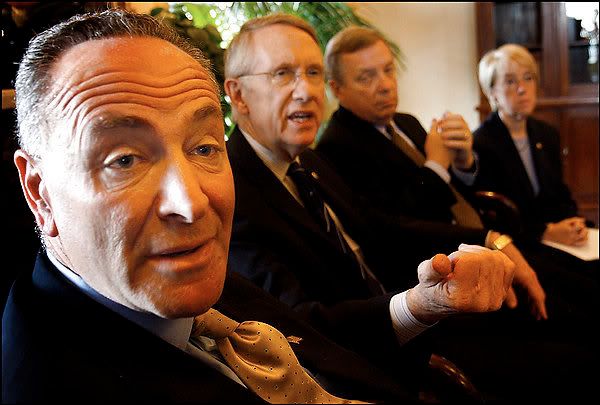
Sen. Charles Schumer, foreground, said he is "wrestling" with the decision of whether to recommend a full Senate confirmation vote for Michael Mukasey. Schumer talked to reporters about Mukasey and other topics yesterday with fellow Senate Democrats, from left, Harry Reid, Richard Durbin and Patty Murray. (By Melina Mara -- The Washington Post)

The Washington Post reports:
As Democratic opposition builds over attorney general nominee Michael B. Mukasey, no Democratic lawmaker has found himself in a tighter spot than Sen. Charles E. Schumer (N.Y.), who had eagerly recommended the former federal judge as a consensus candidate.

After Mukasey refused to say whether an interrogation technique called waterboarding amounts to illegal torture, Schumer has watched a growing number of his colleagues announce their opposition to the judge.
Schumer, who has remained uncharacteristically quiet throughout the furor, said in an interview yesterday that he is now "wrestling" with whether to vote against a nomination that he was instrumental in bringing about. He compared the controversy to the 2005 nomination battle over Chief Justice John G. Roberts Jr.

"From this administration, we will never get somebody who agrees with us on issues like torture and wiretapping," Schumer said at one point, suggesting an argument in favor of Mukasey, who faces a Senate Judiciary Committee vote on Tuesday. "The best thing we can hope for is someone who will depoliticize the Justice Department and put rule of law first."

But Schumer said minutes later that his mind is not made up: "He's the best we can get, but that doesn't necessarily ensure a yes vote. I thought John Roberts was the best we could get, but I voted no."

The outcome of Schumer's internal struggle could prove pivotal to Mukasey's chances, as a growing number of Democrats, including four other members of the Judiciary Committee, have announced their opposition to the nominee, as have all four senators who are seeking the Democratic presidential nomination.

The deteriorating political situation led President Bush yesterday to mount a vigorous defense of Mukasey, saying that Democrats are subjecting the former federal judge to standards that no candidate for attorney general could meet.

"It's wrong for congressional leaders to make Judge Mukasey's confirmation dependent on his willingness to go on the record about details of a classified program he has not been briefed on," Bush said in a speech at the Heritage Foundation in Washington. "If the Senate Judiciary Committee were to block Judge Mukasey on these grounds, they would set a new standard for confirmation that could not be met by any responsible nominee for attorney general. That would guarantee that America would have no attorney general during this time of war."

But key Democrats continued to signal opposition to the suddenly controversial nominee. Senate Majority Leader Harry M. Reid (D-Nev.) said his position is not "much of a secret," saying Mukasey's attempt at explaining his view on waterboarding has left his nomination in doubt.

Sen. Edward M. Kennedy (D-Mass.) announced his opposition yesterday, becoming the fourth Democrat on the Judiciary Committee to promise a no vote. Judiciary Chairman Patrick J. Leahy (D-Vt.), who originally predicted easy confirmation but has since become deeply critical of Mukasey, is expected to announce his position today in Vermont.

All nine Republicans on the committee are likely to support Mukasey, but if all 10 Democrats oppose the nominee, the confirmation would die in committee.

Republicans privately say that the nominee's prospects hang on a few votes, particularly those of Schumer and Sen. Dianne Feinstein (D-Calif.), who has broken ranks with her party in the past. Should Schumer and Feinstein side with other Democrats in opposition, Judiciary Republicans are likely to seek to forward the nomination with a neutral or negative recommendation to the full Senate for a confirmation vote.

Schumer originally suggested Mukasey to head the Justice Department eight months ago, after the senator became the first Democrat to call for the resignation of then-Attorney General Alberto R. Gonzales over his handling of the firings of nine U.S. attorneys. Schumer, whose chief counsel is a former federal prosecutor in the Manhattan courts that were overseen by Mukasey, had also recommended him as a worthy Supreme Court candidate in 2005.

But Mukasey, who was sailing to an easy confirmation, alarmed many Democrats on Oct. 18 when he repeatedly refused to say whether waterboarding is torture. The technique, which simulates drowning, has been used by the CIA but is barred by the U.S. military and has been widely condemned as torture by human rights groups.

Mukasey tried to mollify Democrats by saying in a letter earlier this week that he found the technique personally "repugnant," but he reiterated that he could not determine whether it is illegal without being privy to classified details.

Mukasey's response has been deemed insufficient by many Democrats and sparked an outcry among antiwar liberals who provided much of the political energy -- and financial contributions -- that propelled Democrats to the majority. Schumer, who chairs the Democratic Senatorial Campaign Committee, needs those supporters as he tries to expand the majority next year. One group, Democrats.com, began an e-mail campaign last night urging its supporters to withhold donations to Schumer if he votes for Mukasey.

During yesterday's telephone interview, Schumer said that his decision will hinge largely on whether he believes Mukasey would be independent of the White House. He said that was "called into question" by some of Mukasey's views.

"The question is whether he will show the requisite independence," Schumer said. "That's what I want to clear in my own head. . . . If Congress passes a law forbidding waterboarding, would he enforce that?"

Schumer's colleagues are keenly aware of his awkward position. In announcing his opposition to Mukasey on Wednesday, Majority Whip Richard J. Durbin (D-Ill.) said he could not predict the outcome of the close vote and noted the undecided posture of Schumer, with whom Durbin lives in a group house of Democrats. "I haven't polled my colleagues, including the one I live with," Durbin said.

Some Republicans, meanwhile, are openly chortling at Schumer's dilemma.

"Mukasey and Schumer, aren't they partners? Wasn't that the Schumer pick?" Sen. Trent Lott (R-Miss.) said yesterday. "It's become a problem for him."

Thursday, October 18, 2007

How Difficult Is It To Answer?

Democrats on Senate Judiciary committee ask Michael Mukasey, "Is this torture?"


The Associated Press reports:
In an intense exchange Thursday with three Democrats, President Bush's nominee for attorney general left the door open for allowing a terrorism-era interrogation technique that simulates drowning.

Michael Mukasey, a retired federal judge, issued highly-conditioned statements that so-called waterboarding violates the Constitution only if it is defined as torture.

The answer is unclear.
In an executive order this summer, Bush allowed the use of some harsh interrogation techniques but his administration refused to say whether waterboarding was among them. Congress has banned waterboarding as part of a detainee treatment law.

During Thursday's proceedings, Senate Democratic Whip Dick Durbin probed for Mukasey's opinion.

"I'm hoping that you can at least look at this one technique and say: that clearly constitutes torture, it should not be the policy of the United States to engage in waterboarding," said the Illinois Democrat.

"It is not constitutional for the United States to engage in torture in any form, be it waterboarding or anything else," Mukasey replied.
That sounds clear, doesn't it? But wait...
Under subsequent questioning by Chairman Patrick Leahy, D-Vt., Mukasey said the practice of waterboarding, if defined as torture, can't be permitted by the president.

"If it is torture as defined by the Constitution, or defined by constitutional standards, it can't be authorized," Mukasey said.
Okay, now you've lost me. And apparently, the member of the committee as well...
Judiciary Committee members, most lawyers themselves, have little tolerance for parsing after earlier hearings in which then-Attorney General Alberto Gonzales on dozens of occasions either did not answer questions or blamed a faulty memory for not answering them.

"Is waterboarding constitutional?" pressed Sen. Sheldon Whitehouse, D-R.I. "It either is or it isn't."

Mukasey again demurred, saying he doesn't know what's involved in the technique.

"If it amounts to torture, it is not constitutional," the nominee replied.

"I'm very disappointed in that answer," Whitehouse said. "I think it's purely semantics."

The president himself has repeatedly said "We don't torture" and argued that intense interrogations are sometimes necessary to elicit information about terrorist plots.

The White House suggested Thursday that Mukasey's answers were vague because he does not know the specifics of the program.

"Judge Mukasey is not in a position to discuss interrogation techniques which are necessarily classified," said White House spokesman Tony Fratto. "He would only be read-in to classified programs after being confirmed."

So far, Mukasey has told senators he will reject any White House meddling in Justice Department matters and resign if his legal or ethical concerns about administration policy are ignored. He also said he's resistant to passing a law shielding reporters from being forced to reveal their sources, saying it would be much easier to fix internal Justice Department practice if need be.

Majority Democrats, aided by some Republicans, have urged passage of a media shield because they say it would protect reporters and government whistleblowers who reveal improper or illegal official activity. Fifty news outlets, including The Associated Press, support the legislation.

The Bush administration has issued a veto threat, saying that subpoenas for reporters are relatively rare and that a shield would make it harder to track down leakers of classified information.

Mukasey said that he has reservations about the legislation because it sets too high a legal threshold for prosecutors to meet to overcome the shield. Proving that the disclosure is needed to prevent an attack is difficult in advance, the nominee said Wednesday.

The measure also pending defines a journalist too broadly and might inadvertently protect, for example, bloggers who are also spies or terrorists, Mukasey said.

And yet when all is said and done, apparently Mukasey is a "shoo-in."

Friday, October 05, 2007

Bush Defends Interrogations, Saying Methods Aren't Torture

Dear President Bush,
If are being waterboarded, stripped naked and left in freezing cells, 'head-slapped, they are being tortured.

The New York Times reports:
President Bush, reacting to a Congressional uproar over the disclosure of secret Justice Department legal opinions permitting the harsh interrogation of terrorism suspects, defended the methods on Friday, declaring, “This government does not torture people.”

The remarks, Mr. Bush’s first public comments on the memorandums, came at a hastily arranged Oval Office appearance before reporters. It was billed as a talk on the economy, but after heralding new job statistics, Mr. Bush shifted course to a subject he does not often publicly discuss: a once-secret Central Intelligence Agency program to detain and interrogate high-profile terror suspects.
“I have put this program in place for a reason, and that is to better protect the American people,” the president said, without mentioning the C.I.A. by name. “And when we find somebody who may have information regarding a potential attack on America, you bet we’re going to detain them, and you bet we’re going to question them, because the American people expect us to find out information — actionable intelligence so we can help protect them. That’s our job.”

Without confirming the existence of the memorandums or discussing the explicit techniques they authorized, Mr. Bush said the interrogation methods had been “fully disclosed to appropriate members of Congress.”

But his comments only provoked another round of recriminations on Capitol Hill, as Democrats ratcheted up their demands to see the classified memorandums, first reported Thursday by The New York Times.

“The administration can’t have it both ways,” Senator John D. Rockefeller IV, the West Virginia Democrat who is chairman of the Senate Intelligence Committee, said in a statement after the president’s remarks. “I’m tired of these games. They can’t say that Congress has been fully briefed while refusing to turn over key documents used to justify the legality of the program.”

In two separate legal opinions written in 2005, the Justice Department authorized the C.I.A. to barrage terror suspects with a combination of painful physical and psychological tactics, including head-slapping, simulated drowning and frigid temperatures.

The memorandums were written just months after a Justice Department opinion in December 2004 declared torture “abhorrent.”

Administration officials have confirmed the existence of the classified opinions, but will not make them public, saying only that they approved techniques that were “tough, safe, necessary and lawful.”

On Friday, the deputy White House press secretary, Tony Fratto, took The Times to task for publishing the information, saying the newspaper had compromised America’s security.

“I’ve had the awful responsibility to have to work with The New York Times and other news organizations on stories that involve the release of classified information,” Mr. Fratto said. “And I could tell you that every time I’ve dealt with any of these stories, I have felt that we have chipped away at the safety and security of America with the publication of this kind of information.”

The memorandums, and the ensuing debate over them, go to the core of a central theme of the Bush administration: the expansive use of executive power in pursuit of terror suspects.

That theme has been a running controversy on Capitol Hill, where Democrats, and some Republicans, have been furious at the way the administration has kept them out of the loop.

The clash colored Congressional relations with Alberto R. Gonzales, the former attorney general. And by Friday, it was clear that the controversy would now spill over into the confirmation hearings for Michael B. Mukasey, the retired federal judge whom Mr. Bush has nominated to succeed Mr. Gonzales in running the Justice Department.

Senator Carl Levin, the Michigan Democrat who is chairman of the Senate Armed Services Committee, sent a letter to Mr. Mukasey asking him whether, if confirmed, he would provide lawmakers with the Justice Department memorandums.

And Senator Charles E. Schumer, the New York Democrat and Judiciary Committee member, said he expected the memorandums would become a central point in the Mukasey confirmation debate.

“When the president says the Justice Department says it’s O.K., he means Alberto Gonzales said it was O.K.,” Mr. Schumer, who has been a vocal backer of Mr. Mukasey, said in an interview.

“Very few people are going to have much faith in that, and we do need to explore that.”

The administration has been extremely careful with information about the C.I.A. program, which had been reported in the news media but was, officially at least, a secret until Mr. Bush himself publicly disclosed its existence in September 2006.

At the time, the president confirmed that the C.I.A. had held 14 high-profile terrorism suspects — including the man thought to be the mastermind of the Sept. 11 terrorist attacks — in secret prisons, but said the detainees had been transferred to Guantánamo Bay, Cuba.

The 2005 Justice Department opinions form the legal underpinning for the program. On Friday, the director of the C.I.A., Gen. Michael V. Hayden also defended the program, in an e-mail message to agency employees.

“The story has sparked considerable comment,” General Hayden wrote, referring to the account in The Times, “including claims that the opinion opened the door to more harsh interrogation tactics and that information about the interrogation methods we actually have used has been withheld from our oversight committees in Congress. Neither assertion is true.”

Someone needs to teach English to these stupid sonsofbitches.

Thursday, October 04, 2007

Congress Seeks Justice Department Documents on Interrogation

The New York Times reports:

The Democratic chairmen of the Senate and House Judiciary Committees asked the Justice Department today to turn over secret legal opinions issued in 2005 that authorized the use of harsh interrogation techniques against terrorism suspects after the Department publicly repudiated torture as “abhorrent” in a 2004 opinion.

The 2005 legal opinions, disclosed for the first time by The New York Times, remain in effect, according to officials familiar with the Bush administration’s policy on interrogation. One provided legal justification for the use of a battery of aggressive tactics and a second said the techniques did not amount to “cruel, inhuman, or degrading” practices under international agreements.

Senator Patrick J. Leahy, the Vermont Democrat who heads the Senate Judiciary Committee, said it appeared that the Justice Department lawyers had “reversed themselves and reinstated a secret regime, in essence reinterpreting the law in secret.” He said his committee had been seeking information about the Justice Department’s legal interpretations of the law for two years without success and urged the administration to cooperate.

Representative John Conyers Jr. of Michigan, who heads the House Judiciary Committee, requested that the Justice Department’s opinions be turned over to the House panel as well and asked the department to make available for a hearing Steven G. Bradbury, of the department’s office of legal counsel, who signed the 2005 opinions.

Mr. Leahy also said his committee would hold confirmation hearings on the nomination of Michael B. Mukasey to be attorney general on Oct. 17.

Officials at the White House and the Justice Department said the 2005 legal memorandum did not change the administration’s statement in 2004 that publicly renounced torture as “abhorrent.”

“The policy of the United States is not to torture,” said Dana Perino, the White House press secretary. “The president has not authorized it, he will not authorize it.”

“But he had done everything within the corners of the law to make sure that we prevent another attack on this country,” she said at a news briefing today.

“I am not going to comment on any specific alleged techniques,” Ms. Perino said. “It is not appropriate for me to do so. And to do so would provide the enemy with more information for how to train against these techniques.”

Asked whether the disclosure of the 2005 memorandum could harm national security, Ms. Perino said. “You know, it’s secret for a reason. It’s not secret just because we want it to be a secret. It’s secret because it is classified, and classified for the reasons to protect the country from terrorists who are determined to attack us.”

The Justice Department’s spokesman, Brian Roehrkasse, said in a statement that he could not comment on classified legal advice, but he reiterated that any opinions by the department were consistent with the public 2004 memorandum on interrogations. He said the Bush administration’s “strong opposition to torture” had been consistent.

He expressed the department’s support for Mr. Bradbury, whose nomination to be permanent head of legal counsel’s office has been blocked by Senate Democrats. Mr. Roehrkasse said Mr. Bradbury “has worked diligently to ensure that the authority of the office is employed in a careful and prudent manner.”

In the areas of domestic surveillance and detainee issues, Mr. Roehrkasse said Mr. Bradbury’s “efforts have strengthened cooperation among the branches in these key national security areas.”

Monday, October 01, 2007

Germans Relying on Pakistani Torture Interrogation Methods

Aleem Nasir was interrogated in Pakistan and then picked up by the German police when he landed in Frankfurt.

Der Spiegel reports:
German prosecutors attempting to prove a salesman guilty of al-Qaida membership have been relying on the results of his interrogation in Pakistan. He says his testimony was extracted by means of torture.

When Aleem Nasir returned from Pakistan on Aug. 25, an unusual VIP service was waiting for him at Frankfurt Airport: A police car took the dealer in semi-precious stones directly to a clinic in Mainz, where he was given a blood test and his hand and arm were photographed. The 45-year-old, who lives in Germersheim in the German state of Rhineland-Palatinate, was far from overjoyed about this unexpected medical examination. After all, the investigators were hoping for a diagnosis that would hardly be favorable to him: They were hoping to prove him a terrorist.
The enforced medical examination had been requested by the Office of the Federal Prosecutor, which had been given carte blanche by Ulrich Hebenstreit, an investigative judge at Germany's Federal Court, in early August. According to a court order written with apparent haste, the examination was intended to prove that Nasir had spent time in an al-Qaida training camp in northern Pakistan. It was alleged that he had attempted to mix "250 grams (8.8 ounces) of potassium nitrate with red phosphorus" and "injured his right hand and arm" when the dangerous concoction exploded.

But so far, the attempt to secure evidence from Nasir's body has not yielded the unambiguous results that had been hoped for. And now the investigators face another problem: The tip-off about Nasir's alleged handling of explosives came from the notorious Pakistani intelligence agency Inter-Services Intelligence (ISI) who interrogated him in Islamabad in June. Nasir says the ISI men, some of them masked, beat him "until I could no longer stand it." The interrogations would routinely begin with between three and five punches and slaps. He was held in an ice-cold cell in a special prison with just five cells run by Americans, Nasir says. In the end, he says, he gave a false testimony just to get out of there.

The allegations are explosive -- particularly in Germany. It is the first time since the Sept. 11, 2001 attacks that German authorities have based the core part of an ongoing terrorism case on the results of questionable interrogation methods. The evidence comes from a country that Amnesty International accuses of carrying out "arbitrary arrests" and of not paying much heed to suspects' basic human rights, particularly terror suspects. Former inmates report having been tortured, says Amnesty. And the German Foreign Ministry also calls the human rights situation in Pakistan "as problematic as ever."

'Forbidden Fruits Marked with Blood'

The case is adding fire to a debate in Berlin about where exactly the line should be drawn in the fight against terrorism, and about whether German authorities "profited from forbidden fruits still marked with dried blood," as Wolfgang Wieland, a member of the opposition Green Party, puts it. A parliamentary commission is currently exploring this question in the Bundestag. In 2006 the chancellery already prohibited Germany's foreign intelligence agency, the Federal Intelligence Service (BND), from carrying out interrogations in countries such as Syria and Pakistan.

Has Germany's Chief Federal Prosecutor Monika Harms tolerated her staff making use of testimonies extracted by torture?

Since then investigators have continued to evaluate information coming from dubious sources. But using such information in preliminary proceedings was considered taboo -- even for officials working for Germany's Chief Federal Prosecutor Monika Harms. This led the prosecutors to shred US files containing interrogation statements by Ramzi Binalshibh -- the alleged chief logistician behind the Sept. 11, 2001 terror attacks -- when it transpired the CIA sometimes uses interrogation techniques such as "waterboarding," which involves submerging the prisoner in water. The transcripts of a visit German investigators paid the Syrian-born German citizen Mohammed Haydar Zammar in Damascus were also not used in German proceedings -- because Zammar, another al-Qaida member, had been interrogated in Syrian prisons.

The federal prosecutors have strayed from this clear principle in the case of Nasir, even if Justice Minister Brigitte Zypries from the Social Democrat Party (SPD) presents sophisticated arguments to show it is all just a matter of following an "investigative lead." Zypries does not believe a precedent has been set.

The behavior of the investigators also reveals how much they suspect Nasir -- and how difficult it would be to prove him guilty. The father of four was born in Pakistan, is married to a German and has been a German citizen since 1992. The German authorities have considered him a "danger" for some time. Indeed, federal prosecutors had already investigated Nasir once before when he allegedly remarked, after the Sept. 11, 2001 terrorist attacks, that such attacks would now occur "everywhere, including Germany." The investigation didn't lead to a conviction.

So the Germans were of course excited when they heard about Nasir's arrest in Pakistan on June 18, 2007. He simply corresponds too well to the image German Interior Minister Wolfgang Schäuble of the Christian Democrat Party (CDU) has been conjuring up for months: that of German Islamists' Pakistan connection.

While Nasir himself admits to having been in Wana, a city in the lawless region of Pakistan widely held to be an al-Qaida stronghold, he also says all he did there was purchase lapis lazuli. And in fact he was carrying 25 kilograms (55 lbs) of the semi-precious stones when he was arrested.

The ISI reports, on the other hand, state that Nasir admitted to having been invited to a training camp by an al-Qaida functionary, Abdul Rehman, and that while there he mixed the explosives correctly the first time around, and injured himself during his second attempt. According to the ISI, Nasir also provided al-Qaida with binoculars and night vision devices in addition to transporting money for the group.

Another statement by Nasir illustrates just how closely Germany and Pakistan have cooperated on this case -- if the statement is true. Nasir says that his Pakistani interrogators repeatedly showed him photographs of Fritz Gelowicz. The German convert to Islam was part of the Islamist cell recently discovered (more...) in Germany's Sauerland region, which is accused of planning terror attacks in the country. The images of Gelowicz -- mostly photos taken while he was under observation -- come from the German prosecutors' files. Nasir says he did not encounter German investigators in the prison where he was held. "But," he adds, "my interrogators had been fully briefed by the German authorities."

Thursday, August 16, 2007

The Caged Life

For a nation that prides itself on freedom, the United States has among the highest incarceration rates in the world.

More people are behind bars in the United States than any other country. As of 2006, a record 7 million people were behind bars, on probation or on parole. Of the total, 2.2 million were incarcerated. The People's Republic of China ranks second with 1.5 million. The United States has 5% of the world's population and 25% of the world's incarcerated population.

The U.S. has a high amount of non-violent and victimless offenders incarcerated; half of all persons incarcerated under state jurisdiction are for non-violent offenses, and 20% are incarcerated for drug offences. 270,000 illegal immigrants served jail time in 2003, representing 21% of the federal prison population. It is estimated that currently 27% of federal prison inmates are criminal aliens, noncitizens convicted of crimes while in this country legally or illegally. Criminal justice policy in the United States has also been criticized for the disproportionate representation of blacks and other minorities.

The U.S. spends an estimated $60 billion each year on corrections. The population of inmates housed in prisons and jails in the United States exceeds 2 million, with the per capita incarceration population higher than that officially reported by any other country. Prisons are an industry in America, and growing annually.

Like everything else in America, the prison industrial complex is going privatized. The argument for privatization stresses cost reduction, whereas the arguments against it focus on standards of care, and the question of whether a market economy for prisons might not also lead to a market demand for prisoners (tougher sentencing for cheap labor). There is also the problem of a lack of oversight.

While privatized prisons have only a short history, there is a long tradition of inmates in state and federal-run prisons undertaking active employment in prison for low pay. Three of the leading corporations in the private prison business in the U.S. are the Corrections Corporation of America, the GEO Group, and Cornell Companies. Private companies which provide services to prisons combine in the American Correctional Association, which advocates legislation favorable to the industry.

This is the story of one prisoner in the U.S. prison system.

Is Thomas Silverstein a prisoner of his own deadly past — or the first in a new wave of locked-down lifer?

For Denver's Westword News, Alan Prendergast writes:
When the goon squad showed up at his place at five in the morning, Tommy Silverstein knew something was up. He wasn't accustomed to greeting guests at such an ungodly hour — much less a team of corrections officers, helmeted and suited up for action.

In fact, Silverstein wasn't used to company at any hour. His home was a remote cell, known as the Silverstein Suite, in the special housing unit of the federal penitentiary at Leavenworth, Kansas. He'd been cut off from other inmates and all but a few emissaries from the outside world for more than two decades.

He stayed in the Silverstein Suite 23 hours a day. His interactions with staff typically amounted to some tight-lipped turnkey delivering his food through a slot in the cell door. The only change of scenery came when an electronic door slid open, allowing him an hour's solitary exercise in an adjoining recreation cage. Visitors were rarely permitted, and entire years had gone by during which he never left the cell.

But this day was different. Silverstein could think of only a couple of reasons why so many well-padded, well-equipped officers would be at his door, ordering him to strip for a search. Cell shakedown? Time for a game of hockey, with Tommy as the puck? No, that was a captain leading the squad. Something big.

A transfer.

So it came to pass that on July 12, 2005, U.S. Bureau of Prisons inmate #14634-116 left his cage in Kansas for one in Colorado. Security for the move was tighter than Borat's Speedo — about what you'd expect for a former Aryan Brotherhood leader convicted of killing four men behind prison walls. (One conviction was later overturned; Silverstein disputes the second slaying but admits the other two.) The object of all this fuss didn't mind the goon squad. He was enjoying the view — and hoping that the move signaled the end to his eight-thousand-plus days of solitary confinement. Maybe, just maybe, his decades of uneventful good behavior had paid off.

"They said for me to keep my nose clean, and maybe one day it'd happen," he recalled recently. "So I foolishly thought this was it. If you saw me in that van, you'd think I was Disneyland-bound, smiling all the way."

But the smile vanished after Silverstein reached his destination: the U.S. Penitentiary Administrative Maximum, better known as ADX. Located two miles outside of the high-desert town of Florence, ADX is the most secure prison in the country, a hunkered-down maze of locks, alarms and electronic surveillance, designed to house gang leaders, terrorists, drug lords and other high-risk prisoners in profound isolation. Its current guest list is a who's who of enemies of the state, including Unabomber Ted Kaczynski, shoe bomber Richard Reid, plane bomber Dandenis Muñoz Mosquera, abortion clinic bomber Eric Rudolph and double-agent Robert Hanssen.

When it opened in 1994, ADX was hailed as the solution to security flaws at even the highest levels of the federal prison system. Much of the justification for building the place stemmed from official outrage at the brutal murders of two guards in the control unit of the federal pen in Marion, Illinois, during a single 24-hour period in 1983. The first of those killings was committed by Thomas Silverstein, who was already facing multiple life sentences for previous bloodshed at Marion. The slaying of corrections officer Merle Clutts placed Silverstein under a "no human contact" order that's prevailed ever since, and it gave the Bureau of Prisons the perfect rationale for building its high-tech supermax. Although he never bunked there until 2005, you could call ADX the House that Tommy Built.

What greeted Silverstein two years ago was nothing like Disneyland. His hosts hustled him down long, sterile corridors with gleaming black-and-white checkerboard floors that reminded him of A Clockwork Orange or some other cinematic acid trip. One set of doors, then another and another, until he finally arrived at the ass-end of Z Unit, on a special range with only four cells, each double-doored. His new home was less than half the size of the Silverstein Suite and consisted of a steel slab with a thin mattress, a steel stool and desk, a steel sink-and-toilet combination, a steel shower and a small black-and-white TV.

Stripped of most of his small store of personal belongings, Silverstein had little to do besides take stock of his eighty-square-foot digs. The Silverstein Suite was a penthouse at the Plaza compared to this place. There were steel rings on the sides of the bed platform, ready for "four-pointing" difficult inmates. A camera mounted on the ceiling to record his every move. If he stood on the stool and peered out the heavily meshed window, he could get a glimpse of a concrete recreation cage and something like sky. So this was his reward for all those years of following the rules — 24-hour surveillance in his own desolate corner of the Alcatraz of the Rockies. He was no longer simply in the belly of the beast. He was, he would later write, "stuck in its bowels, with no end/exit in sight."

The double doors muffled sound from outside. But over time, Silverstein realized that there was one other prisoner on the range. He shouted greetings. The man shouted back. He asked the man how long he'd been in the unit. Four years, the man said.

Silverstein told the man his name. His neighbor introduced himself: Yousef. Ramzi Yousef. Convicted of the 1993 World Trade Center bombing, the one that killed six people and injured a thousand. Nephew of Khalid Sheikh Mohammed, the al-Qaeda leader who recently confessed to planning that failed effort to bring down the towers as well as the 9/11 attacks.

His keepers had put Silverstein in the beast's bowels, all right — right next to the one man in the entire federal system more loathed than he was. Still, it was somebody to talk to. Shouting to Yousef was the first conversation with another inmate that Silverstein had managed in almost twenty years.

But talking wasn't allowed. Within days, a new barrier was erected in the corridor outside his cell, preventing any further communication between the two residents of the range. Inmate #14634-116's transfer to ADX was now complete.

Entombed, Terrible Tommy was alone again. Naturally.

In the late 1980s, Pete Earley, a former Washington Post reporter, persuaded Bureau of Prison officials to grant him an unprecedented degree of access to inmates and staff at the Leavenworth penitentiary. Earley was allowed to walk the yard without an escort, to interview inmates without official monitoring, to talk candidly with veteran corrections officers about the dangers and frustrations of their work.

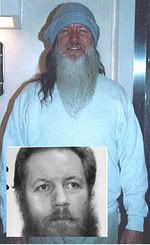
The resulting book, The Hot House: Life Inside Leavenworth Prison, is one of the most vivid works of prison reportage ever published. Among several unsettling portraits of career criminals and their keepers, the most memorable character is probably one Thomas Silverstein, who was then being housed, a la Hannibal Lecter, in a zoo-like cage in Leavenworth's basement, where the fluorescent lights stayed on around the clock to make it easier to watch him. Wild-haired and bearded — the BOP would not allow him a razor or a comb — Silverstein spent hours talking into Earley's tape recorder, describing his violent past and the petty torments he claimed the guards were putting him through in an effort to drive him insane.

Earley's book made Leavenworth's dungeon monster seem not only rational but quite possibly human. Granting a journalist unfettered access to him was a public relations blunder the BOP has been unwilling to repeat. Silverstein hasn't been allowed to have a face-to-face interview with a reporter for the past fifteen years. When Westword recently asked to visit him, ADX warden Ron Wiley promptly denied the request, citing "continued security concerns." But then, Wiley and his predecessors haven't let any journalist inside ADX to interview any inmate since 2001 because of "continued security concerns" (see related story).

Although he readily agreed to an interview with Westword, Silverstein isn't a huge fan of the press, either. He remains friendly with Earley, but he's learned to be wary of hit-and-run tabloid writers following in his wake, eager to write about "the most dangerous prisoner in America." Most of what the outside world knows about him, if it pays any attention at all, is the fragmentary image presented in The Hot House; he's a captive of his own legend, like some prehistoric insect trapped in amber. His letters seethe with contempt for lazy "plagiarists" who have simply appropriated snatches of Earley's account as well as for those who've produced long magazine pieces or cheeseball cable programs about the Aryan Brotherhood that largely rely on the lurid tales of government snitches.

"For some odd reason the media pees when Master snaps his fingers," he wrote recently. "I wouldn't call 'em 'mainstream' any more cuz there isn't anything mainstream about 'em. They're just lackeys for the powers that be."

Silverstein's response to the "injurious lies" spread about him has been to launch his own information campaign at www.tommysilverstein.com. That's right — America's most solitary prisoner, a man who's been inside since before the personal computer was invented and has never been allowed near one, has his own website, maintained by outside supporters who forward messages to him and post his responses.

"He's got a pretty impressive network," says Terry Rearick, a California private investigator who has communicated with Silverstein by letter and phone over several years. After the two lost touch for a time, Rearick got a call from a woman in England on Silverstein's behalf.

The same woman posts regularly on the website, where Silverstein himself duels at length with his detractors. (A similarly heated debate has ignited over the wording of Silverstein's entry on Wikipedia; his defenders and his critics alternately revise the account to suit their competing versions of his crimes.) Some visitors to his site dismiss him as a textbook psychopath. But Silverstein contends that if people understood the grim context in which the killings at Marion took place, the snitch games and psychological warfare and organized violence of prison life, they wouldn't be so quick to demonize him.

It's a strangely disconnected argument — a garbled dialogue between cultures on different planets. Most of the visitors to his website know little about Silverstein's world, just as he knows little about theirs. He's been in prison for the past 32 years, and much of what he's learned about life on the street since he was put in solitary in 1983 has come from reading or watching television. No American prisoner, not even Robert Stroud, the Birdman of Alcatraz, has ever been condemned to such a walled-off existence for such a long period of time. Many of Stroud's years of solitary confinement were spent in relative ease at Leavenworth; he had not only frequent visitors, but also a full-time secretary. Even his seventeen-year stretch in Alcatraz allowed for much more daily communication with others than Silverstein has had.

"I'm amazed that he's not stark, raving mad," says Paul Wright, the editor of Prison Legal News, who's corresponded with Silverstein for years and published some of his writing. "He's been in total isolation for almost 25 years. The only people I can think of that have been held in anything remotely like this in modern times are some of the North Korean spies held in South Korea."

Yet the no-contact conditions imposed on Silverstein are becoming less unique by the day. There are now 31 supermax prisons in the country, with more under construction, including Colorado's own 948-bed sequel to the current state supermax, known as Colorado State Penitentiary II. They are costly on several levels — the operational expense per cell can be double that of a less-secure prison, and the rate of mental illness in solitary confinement far exceeds that of the general prison population — but lockdown prisons are all the rage with a vengeful public. Increasingly, they are being used not for short-term punishment (disciplinary segregation) but for long-term confinement of hard-to-manage inmates (administrative segregation), whose privileges keep shrinking. Colorado, for example, no longer allows journalists to interview its supermax inmates except by mail.

"The phenomenon is disturbingly common," says David Fathi, a staff attorney for the ACLU's National Prison Project. "If it's disciplinary confinement, it's finite — when you're done, you're done. But with administrative segregation, there's a real lack of transparency about what a prisoner can do to earn his way out."

In the federal system, the past decade has seen the rise of "special administrative measures," or SAMs, which are imposed on terrorists or other inmates whose communications with the outside world "could result in death or serious bodily injury to persons." There are now at least two dozen SAMs cases in federal prisons, including Yousef and Zacarias Moussaoui, whose access to mail, phone calls, media interviews or other visits are extremely limited or banned outright. At present the restrictions must be approved by the U.S. Attorney General, but the Bush administration is considering changes that would allow wardens at ADX or other high-security prisons to designate inmates as terror threats and thus ban them from all media contact — even if they haven't been convicted on terrorism charges yet, Fathi notes.

Silverstein isn't a SAMs case. He still has his website and his mail (although he claims it's frequently withheld or "messed with" in other ways). But he may be the prototype of what the government has in mind for other infamous prisoners — to bury them in strata of supermax security to the point of oblivion.

Responding in letters to questions about the psychological impact of his isolation, Silverstein struggles to find the right words. "Trying to explain it is like trying to explain what an endless toothache feels like," he writes. "I wish I could paint what it's like."

In an article a few years ago, he called solitary confinement "a slow constant peeling of the skin, stripping of the flesh, the nerve-wracking sound of water dripping from a leaky faucet in the still of the night while you're trying to sleep. Drip, drip, drip, the minutes, hours, days, weeks, months, years, constantly drip away with no end or relief in sight."

In a Darwinian world, predators have to adapt or die, just like their prey. Tommy Silverstein arrived in the federal prison system at a critical phase of its evolution, when the number of inmate assaults on other inmates and staff was rising sharply and officials were looking at the idea of control units as a way to neutralize the growing threat posed by prison gangs. Silverstein quickly became a symbol of the problem — and the inadequacy of the proposed solution. It's not a stretch to say that the Marion control unit helped to make him what he became, just as the mayhem that erupted there helped to reshape the American prison system.

Before he reached the nether regions of the BOP, Silverstein's criminal career had been thoroughly unremarkable. Born in 1952 in California, he'd grown up in a middle-class neighborhood in Long Beach, but he was bullied by other kids who thought he was Jewish. (According to The Hot House, Silverstein's biological father was a man named Thomas Conway, whom his mother divorced when Tommy was four years old; she later married a man named Silverstein.) As a teenager, he ripped off houses for money to buy drugs; his sister, Sydney McMurray, says he was battling a heroin addiction and problems with his volatile, controlling mother.

"We were taught never to throw the first punch, but never to walk away from a fight," McMurray recalls. "My brother started getting into trouble because he was running away from a violent environment at home. Then he got into drugs, and he became a brother I never knew."

At nineteen, Silverstein landed in San Quentin for armed robbery. Paroled, he was soon arrested again for series of robberies — pulled with Conway and another relative — that yielded less than $1,400. This time, he went into the federal system on a fifteen-year jolt. He was 23 years old, and his life on the streets was already over.

At Leavenworth Silverstein became closely associated with Aryan Brotherhood members who allegedly controlled the heroin trade inside the prison — close enough that when convict Danny Atwell was found stabbed to death, supposedly because he'd refused to be a mule for the heroin business, Silverstein and two other AB members were charged with the murder. In 1980, he was convicted at trial on the basis of shifting testimony from other inmates and sentenced to life in prison. A federal appeals court later ruled that much of the testimony should never have been allowed and threw out the conviction. But by that time, Silverstein was in the Marion penitentiary and facing more murder charges.

Marion opened in 1963, the same year that Alcatraz closed. It was intended to be not just a replacement for the Rock but an improvement, with a more open design and modern rehabilitation programs. Yet by the late 1970s, it had the most restrictive segregation unit in the BOP; not coincidentally, it was also the most violent prison in America, a dumping ground for gang leaders and crazies. Between 1979 and 1983, the prison logged 81 inmate assaults on other inmates and 44 on staff; 13 prisoners were killed. BOP reports issued in 1979 and 1981 proposed turning the entire facility into a "closed-unit operation."

Confined to a one-man cell in the control unit 23 hours a day, Silverstein says he spent much of his time learning how to draw and paint. [Silverstein's artwork.] "I could hardly read, write or draw when I first fell," he explains. "But most of us lifers are down for so long and have so much time to kill that we actually fool around and discover our niche in life, often in ways we never even dreamt possible on the streets. We not only find our niche, we excel."

Prison officials worried that Silverstein was finding his niche in other areas, too. Long-simmering disputes between white and black gangs had a way of coming to a boil in the control unit. In 1981, D.C. Blacks member Robert Chappelle was found dead in his cell. He'd apparently been sleeping with his head close to the bars and had been strangled with a wire slipped around his neck, plied by someone exercising on the tier. Silverstein and another convicted killer, Clayton Fountain, received life sentences for the crime; inmates who testified for the prosecution claimed the two had boasted of it.

Silverstein has always denied killing Chappelle. (Another inmate later claimed to have done the deed, but investigators found his confession at odds with the facts.) Yet even if he hadn't been convicted in court, the suspicion that he was responsible was sufficient to trigger more violence. Shortly after the slaying, the BOP saw fit to transfer one of Chappelle's closest friends, D.C. Blacks leader Raymond "Cadillac" Smith, to the Marion control unit from another prison. Within days, Smith had tried to stab Silverstein and shoot him with a zip gun. Silverstein and Fountain responded by cutting their way out of an exercise cage with a piece of hacksaw blade and paying a visit to Smith while he was in the shower. Smith was stabbed 67 times, in what Silverstein still describes as an act of convict self-defense.

"Everyone knew what was going on and no one did anything to keep us apart," he told Earley. "The guards wanted one of us to kill the other."

At the time, there was no federal death penalty for inmate homicides — and not much the system could do to Silverstein, who was already serving multiple life sentences in the worst unit of the worst prison the BOP had to offer. But some staffers, concerned about Silverstein's outsized rep among white inmates, apparently did their best to keep him in check. In the months that followed Cadillac's death, Silverstein began to regard Officer Merle Clutts, a bull-headed regular of the control unit, as his chief tormentor.

Silverstein has given different explanations about what Clutts did to deserve such attention. Clutts trashed his cell during shakedowns and withheld mail; he smudged his artwork and taunted him; he even tried to set him up for attack by other inmates, Silverstein has suggested. Silverstein claims he told Earley "the whole story," but only pieces made it into The Hot House. Earley won't comment, saying he no longer discusses Silverstein with other reporters because of past misunderstandings.

The BOP has denied that Clutts harassed Silverstein. Whatever the source of the feud might have been, there's no question that Silverstein became fixated on Clutts. One study by Harvard psychiatrist Stuart Grassian suggests that prisoners in control units sometimes experience "the emergence of primitive, aggressive fantasies of revenge, torture, and mutilation" of the guards who watch over them.

Silverstein thought about Clutts, and he thought about the difficulties involved in getting to his enemy when he was allowed out of his cell only one hour a day, shackled, escorted by three guards.

Locked down for life, he had a mountain of time to consider the problem.

One day in solitary is pretty much like another. Prisoners have different strategies for filling up their days, but there are always more days to come.

In his cell at Florence, 54-year-old Tom Silverstein usually rises before dawn, catches up on letters and reads, waiting for the grand event that is the delivery of his breakfast. He goes to rec for an hour, comes back to the grand event that is lunch, showers and cleans his cell. Time for some channel-flipping on the small black-and-white TV, in search of something fresh amid the religious chatter and educational programs he's watched over and over. More reading, some yoga. Then dinner, more TV - he's a sucker for Survivor, Big Brother and other "reality-type shows" — and so to bed.

When he was in the Silverstein Suite at Leavenworth, Silverstein had access to paintbrushes, pens and other art supplies. At ADX, he's only permitted pastels, colored pencils and "cheap-ass paper," he reports; consequently, he hasn't drawn a lick since he's been there. He says that every few weeks, he's moved from the cell with the heavily meshed window to one with no window at all, then back again a few weeks later. There are rare, glorious interruptions in the routine — a visit with sister Sydney last May, an occasional lawyer checking in. Visitors sit in a booth outside the cell and talk to him on a phone; he sits shackled on the other side of a glass partition and talks back. But these dazzling bursts of conversation quickly fade into a muddle. Did the last lawyers come before or after his sister? Silverstein isn't sure.

"It's all a blur, a dream state of mind," he writes. "Like my memories. When I venture back to my yesterdays, it's hard to distinguish fact from fiction."

Yet there is one memory, one day that stands out from all the rest — the day that started it all. Twenty-four years later, Silverstein is still in the position of analyzing, defending and regretting the act that has defined his fate. But nothing can explain away the act itself, a murder that was meticulously planned and ruthlessly executed.

Marion wasn't designed to be a supermax. Control unit prisoners had to be shackled and escorted to the shower every day, and the guards permitted them to have brief conversations with other inmates in cells along the way. On October 22, 1983, Silverstein was on his way back from his shower when another inmate in a rec cage called over one of his three escorts — Merle Clutts. Now flanked by only two guards, Silverstein paused at the cell of one of his buddies, Randy Gometz, and struck up a conversation.

Before the guards knew what was happening, Gometz had reached through the bars, uncuffed Silverstein with a hidden key — and supplied him with a shank. Silverstein broke away from the guards and headed toward Clutts, now isolated at the far end of the tier. "This is between me and Clutts!" he shouted.

He stabbed the officer forty times before the dying Clutts could make it off the tier. Hours later, Silverstein's friend Clayton Fountain pulled the same handcuff trick and attacked three more guards in the control unit, fatally wounding Robert L. Hoffman Sr.

Two federal officers slaughtered in one day, on what was supposed to be the most secure unit in the entire BOP, sent the system into shock. The bureau's response was to forge ahead with the long-considered plan to turn all of Marion into a control unit while whisking Silverstein and Fountain into even more restricted quarters. (Fountain died in 2004 at the age of 48).

For years prison activists attempted to challenge the Marion lockdown in court, charging that the prison staff set about beating other prisoners and subjecting them to "forced rectal searches" as payback for the deaths of Clutts and Hoffman. In 1988, a federal judge ruled that the inmate accounts of staff brutality were simply not credible.

By that point, Silverstein and the bureau were already on the road that would lead to ADX — a place where communication among inmates, and physical contact between inmates and staff, could be strictly controlled and all but eliminated.

If the guard killings in Marion happened at any federal prison today, the perpetrators would almost certainly face the death penalty. Silverstein has suggested more than once that death would have been a more merciful option in his case.

"Even though we may not execute people by the masses, as they do in other countries, our government leaders bury people alive for life in cement tombs," he writes. "It's actually more human to execute someone than it is to torture them, year, after year, after year."

Silverstein's last taste of some kind of freedom came in the fall of 1987. Rioting Cuban prisoners broke into his special cell in the Atlanta federal penitentiary and set him loose. For one surreal week, he was able to roam the yard while the riot leaders dickered with federal negotiators over the release of more than a hundred prison staffers who'd been taken hostage.

Then the Cubans jumped him, shackled him and turned him over to the feds. Surrendering Silverstein had been high on the BOP's list of demands for resolving the situation, right up there with releasing all hostages unharmed.

Contrary to the bureau's expectations, Silverstein didn't butcher any guards during his precious days of liberty. He didn't harm anyone. He suggests the episode shows that he's not the killing machine the BOP says he is, and that he could exist in a less restrictive prison without resorting to violence.

The bureau isn't convinced. He killed Clutts.

Terrible Tommy says he's changed. He claims to have gone 21 years without a disciplinary writeup. Other long-term solitaries go berserk, smearing their cells with feces and "gassing" their captors with shit-piss cocktails. Not him.

"The BOP shrinks chalk it up as me being so isolated I haven't anyone to fight with," he writes, "but they're totally oblivious to all the petty BS that I could go off on if I chose to. I can toss a turd and cup of piss with the best of 'em if I desired. What are they going to do, lock me up?

"But I just have more self-control now, after 25 years of yoga, meditation, studying Buddhism and taking some anger-management courses. All that goes unacknowledged."

McMurray says her brother has learned a great deal about patience and suffering over the years. "He's more like the brother I knew on the outside years ago," she says. "I have spoken with the guards who deal with him every day, and they don't have a bad thing to say about him. It's the ones in administration who are trying to make it as difficult as they can for him.

"But my brother has a spirit that is unbreakable. In Leavenworth, at least he could draw. It's been more of a challenge for him in this situation, but he hasn't let it break his spirit."

The bureau doesn't care about his spiritual progress. He killed Clutts.

Silverstein has told reporters that he wants to apologize to the families of the men he killed, "even though it was in self-defense." He has recanted some oft-quoted lines from his interviews with Earley about "smiling at the thought of killing Clutts" and feeling the hatred grow every time he was denied a phone call or a visit. He says he regrets the grief he's caused and no longer seethes with hatred.

The bureau is unmoved by his repentance. He killed Clutts.

Silverstein has been cut off from the operations of the Aryan Brotherhood for decades. His story is still told among the faithful, in an effort to keep his memory alive among the younger members, but he disputes that the group is a white supremacist organization. His own paintings include an ethnically diverse array of portraits. "I think it's worth noting that Tommy is no longer a racist, if he ever was," says Prison Legal News editor Wright.

The bureau could give fuck-all. He killed Clutts.

Twice a year, prison officials hold a brief hearing to review Silverstein's placement in administrative segregation. For many years, the hearings were held in the corridor outside the Silverstein Suite in Leavenworth. Silverstein stopped attending because the result was always the same: no change. At ADX, he's taken to filing grievances, claiming that the move has left him more isolated, with fewer privileges than ever before.

"I am being punished for good conduct under ploy of security reasons," he wrote last year in a formal appeal of his situation. "The goal of these units is clearly to disable prisoners through spiritual, psychological and/or physical breakdown."

In his response, Warden Wiley pointed out that Silverstein is provided with food and medical care, "daily contact with staff members" and access to television, radio and reading materials.

"It's ridiculous to call a nameless guard that shoves a food tray through the hole in the door...a source of meaningful 'human contact,'" Silverstein fired back. "I request placement in general population."

He took his appeal to the regional office, then to headquarters, where it was swiftly denied. "You are serving three consecutive life terms plus 45 years for bank robbery and murder, including the murder of Bureau of Prisons staff," an administrator noted. "You are a member of a disruptive group and an escape risk. Your heinous criminal and institutional behavior warrant a highly individualized and restrictive environment."

Wiley declines to comment on Silverstein's treatment at his prison. Last spring, a group from Human Rights Watch was allowed to tour certain areas of ADX. The group wasn't let in Z-Unit, where Silverstein lives, or anywhere near A-Unit — the "hole," where most disciplinary cases are housed. But they saw enough to realize that the staffers who bring meals "do not converse regularly, if at all, with the inmates." Despite claims that clinical psychologists checked on prisoners every other week, "several inmates said they had not spoken to a psychologist in many months," and such conversations tended to be brief.

The group also reported that many ADX prisoners are trapped in a catch-22 predicament — they've been sent there directly after sentencing but have never been provided any opportunity to "progress" to a less restrictive setting because of the nature of their crime. Every placement review finds that the "reason for placement at ADX has not been sufficiently mitigated."

"No matter how well they behave in prison, they cannot undo the past crimes that landed them in prison, generally, and then ADX, specifically," Human Rights Watch director Jamie Fellner wrote to BOP director Harley Lapin.

Some crimes, it seems, are beyond redemption.

Silverstein got a copy of the do-gooders' report and immediately fired off a letter to the group, suggesting that they come see him in Z-Unit if they want the real story about the government's "failed and draconian penal system."

No one from the group has come to see him yet. Silverstein waits for them in his box within a box. He knows that the bureau just wants to bury him and that he turned the key himself. But he also knows he didn't build that box all on his own.

His earliest possible date of release is eighty-eight years away. He has nothing but time.

The American prison system is a product of our culture.

Sunday, July 22, 2007

Director of Intelligence: "The U.S. Does NOT Engage in Torture....

....depending on what your definition of torture is."

On Meet the Press, Tim Russert talks with National Intelligence Director, Mike McConnell:


Part 1


Part 2


Part 3

Transcript:
RUSSERT: Our issues this Sunday -- what is the real terrorist threat to the United States homeland? How good is our intelligence gathering, and nearly six years after September 11th, why is Osama bin Laden still at large? With us -- the director of National Intelligence, Admiral Mike McConnell, in his first television interview.

Then -- briefings, debates, and votes -- the Iraq war front and center. With us, Democratic senator from Wisconsin, Russ Feingold. And in our roundtable, insight and analysis from New York Times Columnist, David Brooks; The Washington Post, Bob Woodward; and The Weekly Standard, Stephen Hayes, author of "Change, The Untold Story of America's Most Powerful and Controversial Vice President."

But, first, this week, this document, the National Intelligence Estimate entitled "The Terrorist Threat to the U.S. Homeland," was released. How serious is this threat and what can we do about it? Joining us for an exclusive interview is the director of National Intelligence, Admiral Mike McConnell -- welcome.

McCONNELL: Thank you.

RUSSERT: Let me show you a key judgment from this report, "We judge the U.S. homeland will face a persistent and evolving terrorist threat over the next three years."

In laymen's language, for the American viewers watching today, what is the most serious threat facing our country?

McCONNELL: Tim, the most serious threat is that the plotters that are being observed will be successful in penetrating our defenses and conducting an attack that would result in mass casualties. Their intent is to effect and attack with mass casualties. A secondary attempt would be a political or infrastructure targets to even include economic targets that would have long-lasting impact.

RUSSERT: Is it biological and chemical, or did they achieve nuclear?

McCONNELL: They have not achieved nuclear based on our current understanding. The intent is either chemical, biological, nuclear radiological, or even nuclear to include a nuclear yield. I would add what we see currently is primarily a focus on explosives -- explosives that can generate a large explosion, but they're put together with commercially available material.

RUSSERT: Why aren't we seeing more suicide bombers the way we see in the Middle East?

McCONNELL: In the United States, you mean? The efforts that the United States and our allies have gone through over the past five years have been significant in establishing barriers. So the terrorists perceive us as a much more difficult target, very different from what it was at 9/11.

So barriers have been established, databases have been established, the National Counterterrorism Center, which conducts three times a day a teleconference with all the players -- federal level, state level, international -- to try to coordinate these things, and if someone can be identified, they'll be taken out of the pipeline in their process to come into the United States.

RUSSERT: Let me read another key judgment, "Although we have discovered only a handful of individuals in the United States with ties to al Qaeda's senior leadership since September 11th, we judge that al Qaeda will intensify its efforts to put operatives here."

But there are people in the United States, you are saying, who have direct ties to al Qaeda senior leadership?

McCONNELL: The way we describe it is we have strategic warning, we know what al Qaeda and their safe haven in Pakistan intends to do. We're watching them train and recruit, and their effort is to put someone inside the United States.

There have been some clues in some cases where there would be attack, but we do not have tactical warning currently that there are sleeper cells tied directly to al Qaeda inside the United States. So we have the strategic warning not the specific tactical warning, but we know their intent.

RUSSERT: But you say there are handfuls of individuals in the United States with ties to al Qaeda senior leadership.

McCONNELL: That's correct, and that's in the form of raising money or being sympathetic to. But we haven't identified individuals who are actively plotting or planning. But there have been some that have been sympathetic to al Qaeda's cause.

RUSSERT: Do you believe there are sleeper cells in the U.S.?

McCONNELL: I worry that there are sleeper cells in the U.S. I do not know. There is no specific on a sleeper cell. There are some elements under surveillance because we're not sure, so it's warranted -- court-approved, warranted surveillance. We have some ties. This is what I meant when I said we've raised the barriers and made it more difficult.

RUSSERT: This intelligence report that came out this month raised a lot of concern and alarm in the U.S., and it seems to be in stark contrast to the National Intelligence Estimate from last April -- this one. Let me read that key judgment to you, "United States- led counterterrorism efforts have seriously damaged leadership of al Qaeda and disrupted its operations. We assess the global jihadist movement is decentralized; lacks a coherent global strategy; is becoming more diffuse.

That seems so different than your assessment in July of '07. What a difference a year makes. What changed? We were told that the al Qaeda had been, in many ways, close to being destroyed or dismantled.

McCONNELL: Following the invasion of Afghanistan in 2001, about two-thirds of al Qaeda's not only leadership but their soldiers, the foot soldiers, had been eliminated. And at that point in time, that was an accurate assessment of where we were.

Now, what happened? What's different? What changed? In Pakistan, where they're enjoying a safe haven -- the government of Pakistan chose to try a political solution. A political solution meant a peace treaty with the region that's never been governed -- not governed from the outside, not governed by Pakistan. The opposite occurred. Instead of pushing al Qaeda out, the people who live in these federally administered travel areas, rather than pushing al Qaeda out, they made a safe haven for training and recruiting.

And so in that period of time, al Qaeda has been able to regain some of its momentum. The leadership is intact, they have operational planners, and they have safe haven. The thing they're missing are operatives inside the United States. So that's the difference between last year and this year in our assessment.

RUSSERT: Why haven't we captured Osama bin Laden?

McCONNELL: Think about attempting to capture a single human being whose primary purpose and emphasis is to remain unobserved or hidden. It's a very difficult challenge. From having been in intelligence for most of my professional life, it's not difficult to find something large -- an armored division, ships that are being built or airplanes or whatever, but a single human being that wants to be unobserved, who is being assisted in that process, it just makes it very, very difficult.

RUSSERT: If we captured Osama bin Laden, we might lose General Musharraf and Pakistan because of unrest such apprehension might create in his country. Would it be worth losing Musharraf but apprehending Osama bin Laden?

McCONNELL: Well, first, I wouldn't agree that if we capture or kill Osama bin Laden it would be a particularly increased or direct threat to President Musharraf. President Musharraf is one of our strongest allies. He agrees with capturing or killing Osama bin Laden, and while he tried the political arrangement, the peace agreement, last fall, he has made decisions over the last few weeks -- you are aware of the Red Mosque and cleaning that out -- and he's gone on the offensive to go back into this federally administered travel area, FATA, is the shorthand we use to refer to it.

Now, in doing that, there's been a price. He has lost already, I would say, 100 troops. Broadly, across Pakistan, the number is probably approaching 300 from suicide bombs and roadside attacks. So there is a price to pay, but President Musharraf is a moderate, he has a moderate view, and he is attempting to cause the nation of Pakistan to rally around a moderate's view to eliminate the extremists.

RUSSERT: If his government fell, how detrimental would it be to the U.S.?

McCONNELL: It would have severe impact. It would depend -- if it fell, it depends on who would replace him. It's a democratic nation, if they continue down this current path, so if the process of turnover happens in a democratic way, it may not have severe impact.

One of the things that I would like to highlight, however, is President Musharraf is one of our most valued allies, and let me just highlight this -- Probably, the majority of the senior leadership have been captured or killed or is the direct result of assistance and cooperation and participation by the Pakistanis.

RUSSERT: Are you convinced Osama bin Laden is alive?

McCONNELL: We have not heard from Osama bin Laden for over a year. There's a recent video where he appeared. Many people thought that was current. That was actually old videotape. So it's been a year. There are rumors about his illness. My personal view is that he's alive, but we don't know because we can't confirm it for over a year.

RUSSERT: And living in Pakistan?

McCONNELL: I believe he is in the tribal region of Pakistan, and how he conducts his affairs, only speaking to a courier, staying complete removed from anything we could exploit to find him, I think he's in that region.

RUSSERT: Let me ask you about the executive order the president issued about enhanced interrogation measures. What does that allow a CIA-held target? What kind of measures can you use to get information from them?

McCONNELL: Well, Tim, as you know, I can't discuss specific measures. There's a variety of reasons for that. One, if I announce what the specific measures are, it would aid those who want to resist those measures to train, to understand it, and so on, so I won't be too specific.

Let me go back to a higher calling in this context. The United States does not engage in torture. The president has been very clear about that. The executive order spells it out. There are means and methods to conduct interrogation that will result in information that we need, and what I would highlight -- I was concerned and worried and, quite frankly, appalled by Abu Ghraib. My view is America risked losing the moral high ground, and so I focused on this when I came back.

What I can report to you is that was an aberration. The people who were responsible for the atrocities at Abu Ghraib have been held accountable, and they're serving a sentence for that. That is not the program the CIA was administering. It is not the program that the president approved in the recent executive order.

RUSSERT: But by use of the term "enhanced interrogation measures," there clearly are things that are used to elicit information. Have we eliminated water-boarding? Can you confirm that?

McCONNELL: I would rather not be specific on eliminating exactly what the techniques are with regard to any specific. When I was in a situation where I had to sign off, as a member of the process, my name to this executive order, I sat down with those who have been trained to do it, doctors who monitor it, understanding that no one is subjected to torture. They are treated in a way that they have adequate diet and not exposed to heat or cold, they are not abused in any way, but I did understand when exposed to the techniques how they work and why they work -- all under medical supervision, and one of the things that's very important, I think, for the American public to know -- in the history of this program it's been fewer than 100 people.

And so this is a program where we capture someone known to be a terrorist, we need information that they possess, and it has saved countless lives because they believe these techniques might involve torture, and they don't understand them, they tend to speak to us, talk to us in a very candid way.

RUSSERT: Does this new executive order allow measures that if were used against a U.S. citizen who was apprehended by the enemy would be troubling to the American people?

McCONNELL: I can report to you that it's not torture.

RUSSERT: How do you define torture?

McCONNELL: Well, torture is -- an attempt to define torture in the executive order gives examples of mutilation or murder or rape or physical pain, those kinds of things.

Let me just leave it by saying the techniques work. It's not torture, you're not subjected to heat or cold, but it is effective, and it's a psychological approach to causing someone to have uncertainty and, in a situation where they will feel compelled to talk to you about what you're asking on that.

RUSSERT: Then you would find it acceptable if a U.S. citizen experienced the same kind of enhanced interrogation measures?

McCONNELL: Tim, it's not torture. I would not want a U.S. citizen to go through the process, but it is not torture, and there would be no permanent damage to that citizen.

RUSSERT: Let me turn to Iraq, another key judgment from the National Intelligence Estimate, "We assess that its association with AQI, al Qaeda in Iraq, helps al Qaeda to energize the broader Sunni extremist community, raise resources and recruit and indoctrinate operatives including for homeland attacks."

That seems to suggest that the Iraq War has been a very effective recruiting tool for al Qaeda.

McCONNELL: It has served as a recruiting tool to draw additional terrorists into Iraq, but it's a mutually beneficial situation for both organizations.

Now, the debate often is -- was al Qaeda in Iraq prior to the U.S.-led coalition invasion? Some members of those who associate with al Qaeda were there -- Zarqawi, who had served in Pakistan with Osama bin Laden, was the principal lead. In 2004 he swore allegiance to Osama bin Laden. As you know, he was subsequently killed about a year ago -- June 2006. The person that replaced him as sworn allegiance to Osama bin Laden.

So al Qaeda finds it beneficial in that it's in the press. It draws in recruits, and al Qaeda in Iraq found it beneficial because it unites in a broader context.

There's one thing I think is very important is in the NIE that's often overlooked -- there is an element of extremism in the Middle East that runs from North Africa down into South Africa into the Levant, Syria, into Iraq and over to Afghanistan, even Pakistan. What al Qaeda has done is find a method for uniting those extremist views, and so what we see now is groups who are predisposed to extremism and terrorism are uniting under the al Qaeda banner.

RUSSERT: But al Qaeda is a much more robust and larger presence in Iraq now than it was before the war?

McCONNELL: That's fair to say, that's fair to say. Now, but, let me just highlight one thing that's also important -- At one point in the war, al Qaeda controlled the huge expanse to the west, it's called Anbar Province. What's happened is because of the atrocities in their approach that leadership, tribal sheikhs in that region, collaborated with the coalition and turned on al Qaeda.

So has al Qaeda defeated in Iraq -- no. But in some areas, they're back on their heels for two reasons. The local citizens have turned against -- Iraqi citizens have turned against al Qaeda, and the coalition has been much more effective. As you know, the troops in this surge arrived in about the middle of June, and so the effort has been to take the fight to al Qaeda, and they have a very high level of success in doing that.

RUSSERT: In terms of the balance in Iraq, which creates more of the violence? Which is the greater cause for violence? The sectarian conflict or al Qaeda?

McCONNELL: I think it is both. In some cases, we even have Shi'a on Shi'a sectarian violence. But, for the most part, it is Sunni versus Shi'a, and al Qaeda is the one that takes -- is the organization that attempts purposefully to serve as an accelerant attacking things like the mosque, the Grand Mosque that was destroyed over a year ago, and then revisiting with attacking the two minarets that were still up.

The whole purpose is something massive against the Shi'a or against something Shi'a holds sacred to act as an accelerant to stimulate the violence.

RUSSERT: But there seems to be, Admiral, a coordinated campaign by the administration to elevate al Qaeda is the threat in Iraq, and yet the Pentagon quarterly report, which came out in March, said this, "The conflict in Iraq has changed from a predominantly Sunni-led insurgency against foreign occupation to a struggle for the division of political and economic influence among sectarian groups and organized criminal activity," the Pentagon quarterly report on Iraq to Congress.

The Pentagon report also said sectarian violence has become "the greatest impediment to the establishment of security and effective governance in Iraq." Do you agree with that?

McCONNELL: I agree with that, it's true. But what I would highlight is al Qaeda is part of that sectarian violence, al Qaeda is part of that crime. In some neighborhoods, it would be a classic shakedown -- "We will provide security if you give us money and resources." So al Qaeda is a major portion -- not the only. It's had significant impact, but there are other sectarian disagreements and criminal activity going on, as I mentioned, even Shi'a on Shi'a in some cases.

RUSSERT: Stephen Hayes has written his book on Vice President Cheney, and as I was reading it, I found an interview with you about your views of the administration and some of their methods of gathering intelligence, and I want to share that with you and have a chance to talk about it.

It says here, "In November of 2006, Michael McConnell, who had been working on intelligence issues in the private sector since resigning from the NSA in '96 was asked to consider joining the Bush administration as the nation's top intelligence official. McConnell was honored to be asked but had serious reservations. He had been unimpressed with many aspects of the Bush administration and its conduct of the war on terror, particularly what he felt was a politicized use of intelligence and lead-up to the war.

All of these current players, Secretary Rumsfeld, Vice President Cheney, and the president,' McConnell said in an interview in late November '06, 'must come through from me as a citizen. I am no longer on active duty, so I can say these things. They had, first and foremost, very strong political convictions. My sense of it is their political faith and convictions influence how they took information and interpreted it, how they picked up and interpreted outside events. As a former intel pro, when you don't like the answer, and you set up your own thing, you tend to get the answer you want. You hire people that think like you do or want to satisfy the boss. I've read much more about the current set of players, and they did set up a whole new interpretation because they didn't like the answers. They got results that, in my view, now have been disastrous.'"

That's pretty harsh.

McCONNELL: We're all influenced by what we see and hear and read. I am a concerned citizen. I read those things and read those accounts. What I was taking greatest exception to was to have a secondary unit established in the Pentagon to reinterpret information.

The problem I have with that is the way you do intelligence is all sources considered. You have to factor one issue against another and balance it. If you start an independent effort with a point of view, it's not infrequent that you would take a single piece of data to make a point as opposed to consider everything.

So what I was referring to and talking about at that time is I was worried that in the Pentagon there had been established this separate unit, and I thought it would have been too influential. Now, you can imagine, I consider myself an intelligence professional, I've been doing this either on active duty or serving this community for 40 years. The first responsibility of an intelligence professional is ground truth, and the second responsibility is to speak truth to power.

So when I was asked to consider this nomination, that was the condition under which I would consider it, and I focused on it very intently once I came back. What I found, or what I discovered, was quite refreshing. As you know, I meet with the president and vice president six days and, on occasion, seven days a week. That dialog is open and frank and direct, and the thing that the president and the vice president frequently will do, whether they're talking to me or one of the analysts that go in with me, is that we're not telling you what to think or how to think or what your conclusion should be. We need your information. We can challenge your assumptions or your assessment, but we want to know what your opinion is.

RUSSERT: But leading up to the war in Iraq, you strongly suggest that many Americans believe that we went to war on Iraq on faulty intelligence, skewed intelligence, or cherry-picked intelligence.

McCONNELL: I would just report what came out of the WMD commission and even the 9/11 commission, to some extent, the assessment that was concluded, I think it was October 2002, determined or made an assessment that Saddam had weapons of mass destruction. I believed it at the time, and I mostly believed it because of my experience as intelligence officer for General Powell in the first Gulf War. I knew they had them, I knew Saddam had killed 300,000 of his own countrymen. He had engaged in two wars. He had those weapons, so I believed it.

What I believe happened is that the community allowed itself to be lulled into making the call on information, in some cases, from people who thought they had them -- even Saddam's generals thought they had weapons of mass destruction. So those threads took us to a place that turned out to be not valid.

RUSSERT: But did the policymakers hype the intelligence?

McCONNELL: That's a judgment that I think the American people will have to make. I have paid very close attention to hyping of intelligence, and what I can tell you from personal experience is the decision-makers are making every attempt to call it straightforward based on the information that we provide to them, and we are not being asked to cherry-pick or to go down one path or another path but to give them complete information or the best assessments we can.

RUSSERT: Admiral Mike McConnell, we thank you very much for coming here and sharing your views this morning.

McCONNELL: Thank you so much.

I saw Road To Guantanamo on Dishnet (the Sundance channel) last week:
...the terrifying, first-hand account of three British citizens who were held for two years without charges in the American military prison at Guantanamo Bay, Cuba. Known as the "Tipton Three," in reference to their home town in Britain, the three were eventually returned to Britain and released, still having had no formal charges ever made against them at any time during their ordeal.

Part documentary, part dramatization, the film chronicles the sequence of events that led from the trio setting out from Tipton in the British Midlands for a wedding in Pakistan, to their crossing the Afghanistan border just as the U.S. began their invasion, to their eventual capture by the Northern Alliance and their imprisonment in Camp X-Ray and later at Camp Delta in Guantanamo.


A clip from Road To Guantanamo
Mixing documentary footage, interviews and dramatic recreations, filmmakers Michael Winterbottom (IN THIS WORLD) and Mat Whitecross reveal the harsh realities of the American detention facility in Guantanamo Bay. THE ROAD TO GUANTANAMO tells the story of the "Tipton Three," a trio of young British citizens of Pakistani heritage who naively ventured into Afghanistan in the fall of 2001 and were eventually rounded up in a sweep of terrorist suspects. "A wrenching and dismaying account of cruelty and bureaucratic indifference" - New York Times.

The horror and abuse begin long before the three arrive in Guantanamo. If this account is anything close to what actually happened, we are seriously off the path of what the United States is all about, and what most Americans believe our government should be doing in our names.