Showing posts with label Bush. Show all posts

Tuesday, May 20, 2008

Could This Be Why Hillary Won't Leave?

U.S. to Attack Iran; Bush and Cheney Plan to Solve Disputes with Iran "radically and resolutely"

ShortNews.com reports:
The Israeli Army Radio and the Israeli daily The Jerusalem Post have both quoted unnamed Israeli officials today as saying that the US President George W Bush plans to launch an attack on Iran within the next few months.

According to officials a senior member of the Bush entourage on his recent trip to Israel said that both Bush and his Vice president, Dick Cheney planned to solve disputes with Iran “radically and resolutely”.

The unnamed sources claim the only reason the US Administration has not attacked Iran earlier is because of reservations expressed from Defense Secretary Robert Gates and Secretary of State Condoleezza Rice.
The sources of this report is PressTV:
Israeli officials claim that US president George W. Bush intends to launch a military attack against Iran before the end of his term.

"George W. Bush intends to attack Iran within the next few months, before the end of his term", The Israeli Army Radio and the Jerusalem Post quoted unnamed Israeli officials as saying on Tuesday.

The officials claimed that a senior member of the president's entourage during Bush's trip to the occupied Palestine last week said that Bush and Vice President Dick Cheney believed they should solve the issue of Iran 'radically and resolutely'.

They, however, claimed that Defense Secretary Robert Gates' and Secretary of State Condoleezza Rice's reservations had so far prevented the administration from launching an attack on Iran.

Earlier, a news website close the Israeli intelligence agency revealed that during his visit to al-Quds Bush criticized Israeli prime minister Ehud Olmert for not attacking Lebanon after the political defeat of Fuad Siniora's government in the recent crisis in Lebanon.
A "Clinton cohort" reports to Huffington Post that Hillary Clinton is asking key supporters (superdelegates) not to desert her during the next two weeks of campaigning, assuring them that she "won't embarrass them".

Could her subtext be, "You'll see why I haven't gotten out of the race (war with Iran), and I'll make the case that I'm the experienced 'war president', not Obama".

If true, how could she know?

Bill Clinton, as a former president, gets the same daily intelligence briefing that Bush gets. We've heard about plans for an imminent strike against Iran for a while, but what isn't available to the public, but is in daily briefings, is the most up-to-date information on U.S. military placement. If it was happening, if a military strike against Iran was operational, the Clintons would know about it.


Monday, May 05, 2008

White House Press Secretary Laura Bush?


Why was Laura Bush doing (Stepford press secretary) Dana Perino's job in the first place? Where was the State Department's usual spokesman, Sean McCormack? Where are the paid employees of our government? Have Bush and Grover Norquist succeeded, bankrupted the U.S. government and drowned it in the bathtub? Has everybody left and the First Family is running the show from the residence upstairs?

I had C-Span on in real time when the First Lady walked in to the Press Room, and my second thought was, "It's a sad indictment of the voters when the wife of the President is more articulate and knowledgeable than he is", and then I realized that you can't blame the voters completely (only 49% of them) when it was a coup d'etat that put him into office. But still.

Where is everybody?

Thursday, March 06, 2008

The George W. Bush Lieberry

The Chronicle of Higher Education asked readers to submit their designs for the George W. Bush Library:


Cast your vote for the best design.

Friday, December 14, 2007

Representative Robert Wexler Makes The Case For Impeachment Hearings


U.S. Congressman Robert Wexler [D-FL] writes:
I was serving in Congress and on the Judiciary Committee for the ridiculous and politically motivated impeachment hearings of President Clinton. During that witch hunt Newt Gingrich, Tom DeLay, and Ken Starr wasted a year and a half on investigations and hearings about President Clinton's personal relations. However, this attempted coup d'etat by Republicans against President Clinton was not and should not be the standard of impeachment that was enshrined by the Founders in our Constitution.
First, impeachment hearings are only proper when significant allegations exist that the President or Vice-President, or others civil officers, committed actions - within their official duties - that constitute 'High Crimes and Misdemeanors.' The allegations against Clinton - involving a personal affair - never reached this threshold. The serious charges against Cheney involve alleged crimes that are central to his duties of Vice-President; namely war and peace, the widespread violations of civil liberties, and the security of the United States and our covert agents.

Unlike the show trial put on by Republicans against President Clinton, a proper impeachment hearing would involve a fair and objective presentation of the facts without hyperbole or political gamesmanship. The hard evidence that is presented at the hearings will be judged fully both by Congress and the American people. The evidence alone will determine the outcome, and if it is determined that Vice President Cheney committed "High Crimes and Misdemeanors" he should be properly impeached and put on trial before the Senate.

After the Democratic Party regained control of Congress, many - myself included - thought that it might be possible to meet President Bush half-way on the large issues facing our nation. Unfortunately, Bush has been nothing more than an ideological obstacle. He has vetoed stem cell research. He has vetoed efforts to bring our troops home from Iraq. He vetoed children's health care. So, the idea that we are somehow inhibiting Congress from passing our agenda by holding impeachment hearings - unfortunately - is a false argument.

Instead, I believe that we can both live up to our Constitutional obligation by holding hearings and pass a Democratic agenda. If President Bush perceives that the Democratic Congress is weak and unwilling to aggressively push our agenda - he will continue to veto legislation, such as children's health care - that is supported by a majority of Americans. The only way to move a progressive Democratic agenda is by acting through strength and following through on our core principles. A Congress willing to stand up to the abuses of the Bush Administration through impeachment hearings will demonstrate a strength of will that will more likely convince Bush to accommodate on issues such as Iraq, health care, and energy and environmental issues.

Today, I was joined by two other members of the House Judiciary Committee, Reps. Luis Gutierrez and Tammy Baldwin, who penned an online editorial with me calling for these impeachment hearings. In support of this effort I am releasing a call to action on video and launched WexlerWantsHearings.com. The full op-ed from the three Judiciary Committee Members can be read at this site. If we can get 50,000 or even more people to sign up in support of this effort I will report back to each and every Democratic colleague of mine the true power that exists behind this movement.

Wednesday, November 21, 2007

The Manchurian Senator

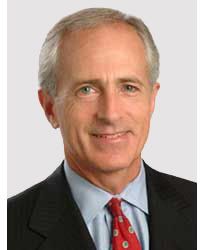
Bob Corker

Local news in Chattanooga reports:
Tennessee Senator Bob Corker raised some eyebrows at a luncheon at the Chattanoogan hotel Tuesday with remarks about President Bush.

Speaking to a crowd of about 500 supporters, led by Hamilton County Mayor Claude Ramsey, Corker spoke about a range of issues, including energy, healthcare, and his experiences during his first year as a Senator.

But his remarks about his experiences with the White House during meetings on the war in Iraq left some in the crowd befuddled.

"I was in the White House a number of times to talk about the issue, and I may rankle some in the room saying this, but I was very underwhelmed with what discussions took place at the White House," Corker said.
A few minutes later during a question and answer session a man in the audience asked him to clarify his statement.

"I was concerned about your statement that you were underwhelmed with what was going on in the White House. Did you mean with him or with his staff?"

In response, Corker said, "Let me say this. George Bush is a very compassionate person. He's a very good person. And a lot of people don't see that in him, and there's many people in this room who might disagree with that.... I just felt a little bit underwhelmed by our discussions, the complexity of them, the depth of them. And yet in spite of that, I do believe that the most recent course of action we've pursued is a good one. I feel like what we've lack in our country is a coherent effort that really links together the Treasury Department, all the various departments of our government in a way that really focuses not just on the hard military side of things, but also the soft effort that it takes to build good will among people. I really think much of that has righted itself, I'm just telling you that at that moment in time I felt very underwhelmed, and I'm just being honest. I've said that to them, and to him, and to others. I kind of in a way wish I hadn't said it today." The last comment was greeted with laughter in the crowd.

Corker is a member of the Foreign Relations Committee. He told the audience that before the end of the year he plans to travel to Pakistan, Afghanistan and India to meet with leaders of those countries.

"George Bush is a very compassionate person. He's a very good person."

"Raymond Shaw is the kindest, bravest, warmest, most wonderful human being I've ever known in my life."

For more than six years, people who have met Bush a total of one or two times (and in controlled settings orchestrated by the White House), exit their meetings with him and repeat these same words. One after another. I think it's quite remarkable.

I don't think Corker has been in the same room with Bush (and never alone with him) any more times than I can count on one hand.

What is it that Bush said or did in his meeting with Corker that convinced Corker that Bush is a "very compassionate" and "good person"? For that matter, what has Bush ever done to be singled out as a "very compassionate" and "good person"?
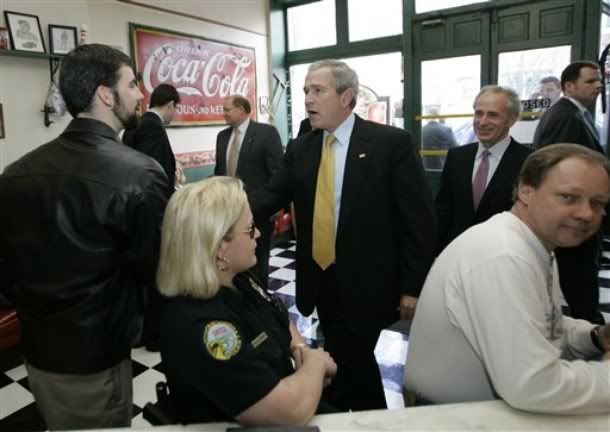
Bush and Bob Corker at Porker's BBQ, Chattanooga, TN, February 22, 2007

Friday, November 02, 2007

"I Sold My Soul For the Company Store"

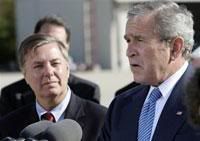
Lindsey Graham's big photo op, two days after backing down on his oh so principled stand against torture, agreeing to support Bush's nominee for Attorney General, Michael Mukasey, despite Mukasey's failure to declare waterboarding torture.


The State reports:
It has taken a few years to get Columbia’s white house ready — more than 120 years all told — but Kirkman Finlay believes his home is ready for the resident of the most famous White House.

Today, Finlay, his wife, Kathleen, and three children will host President George W. Bush and more than 500 others at a campaign fundraiser for U.S. Sen. Lindsey Graham at the Finlay home.

Planning Southern hospitality on a presidential scale has not been easy, Finlay said.

“It’s all about trying to make it as presentable as you can. To have your home look as good as possible for what I consider a historic event.”

Finlay is a Columbia City Council member and the son of former Columbia Mayor Kirkman Finlay Jr. He is also advising former U.S. Sen. Fred Thompson’s S.C. presidential campaign.

Thursday morning, workers were adjusting the tents set up in the backyard for the lunchtime visit. Elsewhere, landscapers spruced up the lawn and shrubbery and tidied mulch.

Stage set for Lindsey Graham fundraiser with Bush as the centerpiece: "Finlay has polished mansion for president’s fundraising visit today." Ronnie Monts rakes the driveway Thursday at Columbia City Councilman Kirkman Finlay’s home in preparation for today’s visit by President Bush.

Finlay declined to discuss much of the preparation for security reasons, and did not allow a tour of the property. Likewise, neither the White House nor the Graham campaign would confirm the event’s location, though Finlay’s home is listed on invitations sent out last month.
According to the invitation, the minimum donation to attend was $250, while those giving or raising $10,000 could have a photo taken with Graham and Bush.

Bush has headlined fundraisers in Charleston, Myrtle Beach and Greenville, but Friday’s event is his first fundraiser in Columbia since becoming president in 2001.

Supporters “have been really excited about this event,” said Scott Farmer, Graham’s campaign spokesman. “People from all over the state are coming to attend.”

Farmer said Bush’s visit is a “seminal moment” for the re-election campaign.

Planning has been stressful, but the staffs of the White House and Graham’s campaign have smoothed the logistics.

Finlay admitted he has made a few trips to home improvement stores during the month since he was asked to host.

“We’ve done everything from mulching to putting in rye seed,” Finlay said. The benefit, he said, is that he has knocked out a number of long-needed home improvement projects.

“That ‘to do’ list has been whittled down,” he said.

The home off Garners Ferry Road, known as Millwood Plantation, was formerly the three-bedroom homestead of Finlay’s Hampton family ancestors. The columns of Confederate Gen. Wade Hampton’s burned home still stand on the property.

The house has been expanded “three or four times,” Finlay said. According to property records, the 5-bedroom home is 7,100 square feet.

Finlay also has stables on the property, but expected Bush’s schedule would be too tight to ride with the Texas rancher.

Apparently, Finlay has no idea that Bush is a 'windshield cowboy', doesn't ride horses, nor that his home in Crawford, Texas is only a ranch in the colloquial sense. The 1600 acre property was purchased in anticipation of Bush's 2000 presidential run, a house was built and a barn constructed like a set for a western movie. Bush has never ranched, nor farmed, nor struck oil.
Much easier was planning lunch, which will be catered by Doc’s Barbecue and Southern Buffet, of which Finlay is a co-owner. Dessert will be petit fours (small cakes).

“A nice meal with a Southern flair,” Finlay said.

Elsewhere in S. Carolina:
President Bush said Friday that U.S. military deaths have fallen to their lowest levels in 19 months and the Iraqi people are slowly "taking back their country“ in the wake of the American troop buildup there.

U.S. military deaths have fallen, due to the U.S. changing tactics in both Iraq and Afghanistan by increasing the air bombing campaigns. The numbers of Iraqi civilians killed has increased.
Speaking at a graduation ceremony for new soldiers at Fort Jackson, Bush said that parts of Iraq continue to be violent and that terrorists remain determined.

"But what they have learned about the United States of America is that we are more determined,“ Bush said. "We are more determined to protect ourselves and to help people realize the blessings of freedom."

Bush said corruption remains a problem and unemployment remains high, but that Iraqi forces have now assumed responsibility in security in eight of Iraq’s 18 provinces.

"With our help, the Iraqi people are going on the offense against the enemy. They’re confronting the terrorists and they’re are taking their country back."

Before he spoke, he took a tour of the school’s "fit-to-win course,“ which requires recruits to negotiate up to twenty obstacles. He addressed about 180 soldiers at the site deep in the piney woods, telling them he was proud of their efforts and that they would help secure a peaceful future for America.

Thursday, November 01, 2007

Bush says, "No Attorney General If Not Mukasey"


The LA Times reports:
President Bush sought to save Michael Mukasey's troubled nomination for attorney general Thursday, defending the retired judge's refusal to say whether he considers waterboarding torture and warning of a leaderless Justice Department if Democrats don't confirm him.

"If the Senate Judiciary Committee were to block Judge Mukasey on these grounds, they would set a new standard for confirmation that could not be met by any responsible nominee for attorney general," Bush said in a speech at the Heritage Foundation, a conservative think tank.

"That would guarantee that America would have no attorney general during this time of war," the president said.
Nonetheless, opposition continued to grow. Sen. Edward M. Kennedy, D-Mass., became the fourth of 10 Democrats on the 19-member Judiciary Committee to declare he will vote against Mukasey when the panel decides Tuesday whether to endorse or reject his nomination.

Kennedy said Mukasey's unwillingness to say that waterboarding, an interrogation technique that simulates drowning, is torture increases the chances that it will be used against U.S. troops.

"Judge Mukasey appears to be a careful, conscientious and intelligent lawyer and he has served our country honorably for many years," Kennedy said in a Senate speech announcing his opposition. "But those qualities are not enough for this critical position at this critical time."

Judiciary Committee Chairman Patrick Leahy, D-Vt., planned to announce Friday in his state how he will vote next week.

Bush framed Mukasey's nomination with the familiar theme of national security and the attorney general's role in it.

"It's important for Congress to pass laws and/or confirm nominees that will enable this government to more effectively defend the country and pursue terrorists and radicals that would like to do us harm," the president said earlier Thursday during a rare Oval Office session with reporters.

The comments raised questions about whether Bush would nominate anyone else to succeed Alberto Gonzales as the nation's top law enforcer. Bush could bypass Congress by filling the job with someone serving in an acting capacity or appointing someone while lawmakers are in recess to serve out the last 14 months of his administration.

Asked if Bush was saying he would not nominate anyone if Mukasey is rejected, White House spokeswoman Dana Perino said: "We don't believe it would come to that. No nominee could meet the test they've presented."

There is a way for Mukasey to get a full Senate vote even if committee Democrats are united in opposing him. The Senate Judiciary Committee could agree to advance the nomination with "no recommendation," allowing Mukasey the chance to be confirmed by a majority of the 100-member Senate. Several vote-counters in each party said Mukasey probably would get 70 "yes" votes.

Despite that prospect, opposition to Mukasey was growing among Senate Democrats. Most cited his refusal to say whether waterboarding is torture and thus illegal under U.S. and international law.

In a letter to Senate Democrats this week, Mukasey said waterboarding is "repugnant to me" but added he wanted to review legal and other issues surrounding it before saying whether it is torture.

Democratic Sens. Joe Biden of Delaware, Sheldon Whitehouse of Rhode Island and Dick Durbin of Illinois said this week they will vote "no" in committee. Assuming all nine of the panel's Republicans vote for Mukasey, only one Democrat would have to side with the president for the nomination to move to the full Senate with a favorable recommendation.

So far, the committee's other Democrats have declined to announce their positions. That includes Mukasey's chief Democratic sponsor, Sen. Chuck Schumer, D-N.Y.

Majority Leader Harry Reid, D-Nev., told reporters he could not guarantee a full Senate vote if the nomination fails in committee.

"I really believe in the committee process," said Reid, who has not said how he would vote. "If I'm asked by members of the committee to stay out of the fray, I am willing to do that."

Two Republicans troubled by Mukasey's initial answers said they would vote for him in the full Senate.

But in a letter to Mukasey, GOP Sens. John McCain of Arizona and Lindsey Graham of South Carolina urged the nominee never to let waterboarding be used if he were to become attorney general.

A Friendly Reminder

Just six months after 9/11/01, Bush says he's "truly not concerned about bin Laden"

Friday, October 05, 2007

Bush Defends Interrogations, Saying Methods Aren't Torture

Dear President Bush,
If are being waterboarded, stripped naked and left in freezing cells, 'head-slapped, they are being tortured.

The New York Times reports:
President Bush, reacting to a Congressional uproar over the disclosure of secret Justice Department legal opinions permitting the harsh interrogation of terrorism suspects, defended the methods on Friday, declaring, “This government does not torture people.”

The remarks, Mr. Bush’s first public comments on the memorandums, came at a hastily arranged Oval Office appearance before reporters. It was billed as a talk on the economy, but after heralding new job statistics, Mr. Bush shifted course to a subject he does not often publicly discuss: a once-secret Central Intelligence Agency program to detain and interrogate high-profile terror suspects.
“I have put this program in place for a reason, and that is to better protect the American people,” the president said, without mentioning the C.I.A. by name. “And when we find somebody who may have information regarding a potential attack on America, you bet we’re going to detain them, and you bet we’re going to question them, because the American people expect us to find out information — actionable intelligence so we can help protect them. That’s our job.”

Without confirming the existence of the memorandums or discussing the explicit techniques they authorized, Mr. Bush said the interrogation methods had been “fully disclosed to appropriate members of Congress.”

But his comments only provoked another round of recriminations on Capitol Hill, as Democrats ratcheted up their demands to see the classified memorandums, first reported Thursday by The New York Times.

“The administration can’t have it both ways,” Senator John D. Rockefeller IV, the West Virginia Democrat who is chairman of the Senate Intelligence Committee, said in a statement after the president’s remarks. “I’m tired of these games. They can’t say that Congress has been fully briefed while refusing to turn over key documents used to justify the legality of the program.”

In two separate legal opinions written in 2005, the Justice Department authorized the C.I.A. to barrage terror suspects with a combination of painful physical and psychological tactics, including head-slapping, simulated drowning and frigid temperatures.

The memorandums were written just months after a Justice Department opinion in December 2004 declared torture “abhorrent.”

Administration officials have confirmed the existence of the classified opinions, but will not make them public, saying only that they approved techniques that were “tough, safe, necessary and lawful.”

On Friday, the deputy White House press secretary, Tony Fratto, took The Times to task for publishing the information, saying the newspaper had compromised America’s security.

“I’ve had the awful responsibility to have to work with The New York Times and other news organizations on stories that involve the release of classified information,” Mr. Fratto said. “And I could tell you that every time I’ve dealt with any of these stories, I have felt that we have chipped away at the safety and security of America with the publication of this kind of information.”

The memorandums, and the ensuing debate over them, go to the core of a central theme of the Bush administration: the expansive use of executive power in pursuit of terror suspects.

That theme has been a running controversy on Capitol Hill, where Democrats, and some Republicans, have been furious at the way the administration has kept them out of the loop.

The clash colored Congressional relations with Alberto R. Gonzales, the former attorney general. And by Friday, it was clear that the controversy would now spill over into the confirmation hearings for Michael B. Mukasey, the retired federal judge whom Mr. Bush has nominated to succeed Mr. Gonzales in running the Justice Department.

Senator Carl Levin, the Michigan Democrat who is chairman of the Senate Armed Services Committee, sent a letter to Mr. Mukasey asking him whether, if confirmed, he would provide lawmakers with the Justice Department memorandums.

And Senator Charles E. Schumer, the New York Democrat and Judiciary Committee member, said he expected the memorandums would become a central point in the Mukasey confirmation debate.

“When the president says the Justice Department says it’s O.K., he means Alberto Gonzales said it was O.K.,” Mr. Schumer, who has been a vocal backer of Mr. Mukasey, said in an interview.

“Very few people are going to have much faith in that, and we do need to explore that.”

The administration has been extremely careful with information about the C.I.A. program, which had been reported in the news media but was, officially at least, a secret until Mr. Bush himself publicly disclosed its existence in September 2006.

At the time, the president confirmed that the C.I.A. had held 14 high-profile terrorism suspects — including the man thought to be the mastermind of the Sept. 11 terrorist attacks — in secret prisons, but said the detainees had been transferred to Guantánamo Bay, Cuba.

The 2005 Justice Department opinions form the legal underpinning for the program. On Friday, the director of the C.I.A., Gen. Michael V. Hayden also defended the program, in an e-mail message to agency employees.

“The story has sparked considerable comment,” General Hayden wrote, referring to the account in The Times, “including claims that the opinion opened the door to more harsh interrogation tactics and that information about the interrogation methods we actually have used has been withheld from our oversight committees in Congress. Neither assertion is true.”

Someone needs to teach English to these stupid sonsofbitches.

Monday, September 03, 2007

Paul Bremer Produces Letter Countering Bush's Claim About Dissolving Iraqi Army

From Robert Draper's book, Dead Certain,:
Mr. Bush acknowledged one major failing of the early occupation of Iraq when he said of disbanding the Saddam Hussein-era military, “The policy was to keep the army intact; didn’t happen.”

But when Mr. Draper pointed out that Mr. Bush’s former Iraq administrator, L. Paul Bremer III, had gone ahead and forced the army’s dissolution and then asked Mr. Bush how he reacted to that, Mr. Bush said, “Yeah, I can’t remember, I’m sure I said, ‘This is the policy, what happened?’ ” But, he added, “Again, Hadley’s got notes on all of this stuff,” referring to Stephen J. Hadley, his national security adviser.

Today's NY Times reports:
A previously undisclosed exchange of letters shows that President Bush was told in advance by his top Iraq envoy in May 2003 of a plan to “dissolve Saddam’s military and intelligence structures,” a plan that the envoy, L. Paul Bremer, said referred to dismantling the Iraqi Army.

Mr. Bremer provided the letters to The New York Times on Monday after reading that Mr. Bush was quoted in a new book as saying that American policy had been “to keep the army intact” but that it “didn’t happen.”
The dismantling of the Iraqi Army in the aftermath of the American invasion is now widely regarded as a mistake that stoked rebellion among hundreds of thousands of former Iraqi soldiers and made it more difficult to reduce sectarian bloodshed and attacks by insurgents. In releasing the letters, Mr. Bremer said he wanted to refute the suggestion in Mr. Bush’s comment that Mr. Bremer had acted to disband the army without the knowledge and concurrence of the White House.

“We must make it clear to everyone that we mean business: that Saddam and the Baathists are finished,” Mr. Bremer wrote in a letter that was drafted on May 20, 2003, and sent to the president on May 22 through Donald H. Rumsfeld, then secretary of defense.

After recounting American efforts to remove members of the Baath Party of Saddam Hussein from civilian agencies, Mr. Bremer told Mr. Bush that he would “parallel this step with an even more robust measure” to dismantle the Iraq military.

One day later, Mr. Bush wrote back a short thank you letter. “Your leadership is apparent,” the president wrote. “You have quickly made a positive and significant impact. You have my full support and confidence.”

On the same day, Mr. Bremer, in Baghdad, had issued the order disbanding the Iraqi military. Mr. Bush did not mention the order to abolish the military, and the letters do not show that he approved the order or even knew much about it. Mr. Bremer referred only fleetingly to his plan midway through his three-page letter and offered no details.

In an interview with Robert Draper, author of the new book, “Dead Certain,” Mr. Bush sounded as if he had been taken aback by the decision, or at least by the need to abandon the original plan to keep the army together.

“The policy had been to keep the army intact; didn’t happen,” Mr. Bush told the interviewer. When Mr. Draper asked the president how he had reacted when he learned that the policy was being reversed, Mr. Bush replied, “Yeah, I can’t remember, I’m sure I said, “This is the policy, what happened?’ ”

Mr. Bremer indicated that he had been smoldering for months as other administration officials had distanced themselves from his order. “This didn’t just pop out of my head,” he said in a telephone interview on Monday, adding that he had sent a draft of the order to top Pentagon officials and discussed it “several times” with Mr. Rumsfeld.

A White House official, who spoke on the condition of anonymity because the White House is not commenting on Mr. Draper’s book, said Mr. Bush indeed understood the order and was acknowledging in the interview with Mr. Draper that the original plan had proved unworkable.

“The plan was to keep the Iraqi Army intact, and that’s accurate,” the official said. “But by the time Jerry Bremer announced the order, it was fairly clear that the Iraqi Army could not be reconstituted, and the president understood that. He was acknowledging that that was something that did not go as planned.”

But the letters, combined with Mr. Bush’s comments, suggest confusion within the administration about what quickly proved to be a decision with explosive repercussions.

Indeed, Mr. Bremer’s letter to Mr. Bush is striking in its almost nonchalant reference to a major decision that a number of American military officials in Iraq strongly opposed. Some senior administration officials, including the secretary of state at the time, Colin L. Powell, have reportedly said subsequently that they did not know about the decision ahead of time.

Gen. Peter Pace, then the vice chairman of the Joint Chiefs of Staff, said at a meeting of the Council on Foreign Relations in February 2004 that the decision to disband the Iraqi Army was made without the input of the joint chiefs. “We were not asked for a recommendation or for advice,” he said.

The reference from Mr. Bremer’s note to Mr. Bush is limited to one sentence at the end of a lengthy paragraph in a three-page letter. The letter devoted much more space to recounting what Mr. Bremer described as “an almost universal expression of thanks” from the Iraqi people “to the U.S. and to you in particular for freeing Iraq from Saddam’s tyranny.” It went on to recall how Mr. Bremer had been kissed by an old Iraqi man who was under the impression that Mr. Bremer was Mr. Bush. In his 2006 memoir, Mr. Bremer said he had briefed senior officials in Washington on the plan, but he did not mention the exchange of letters with Mr. Bush.

On Monday, Mr. Bremer made it clear that he was unhappy about being portrayed as a renegade of sorts by a variety of former administration officials.

Mr. Bremer said he sent a draft of the proposed order on May 9, shortly before he departed for his new post in Baghdad, to Mr. Rumsfeld and other top Pentagon officials.

Among others who received the draft order, he said, were Paul D. Wolfowitz, then the deputy secretary of defense; Douglas J. Feith, then under secretary of defense for policy; Lt. Gen. David D. McKiernan, then head of the American-led coalition forces in Iraq; and the Joint Chiefs of Staff.

Mr. Bremer said that he had briefed Mr. Rumsfeld on the plan “several times,” and that his top security adviser in Baghdad, Walter B. Slocombe, had discussed it in detail with senior Pentagon officials as well as with senior British military officials. He said he received detailed comments back from the joint chiefs, leaving no doubt in his mind that they understood the plan.

“I might add that it was not a controversial decision,” Mr. Bremer said. “The Iraqi Army had disappeared and the only question was whether you were going to recall the army. Recalling the army would have had very practical difficulties, and it would have political consequences. The army had been the main instrument of repression under Saddam Hussein. I would go on to argue that it was the right decision. I’m not second-guessing it.”

General McKiernan reportedly felt unhappy with Mr. Bremer’s plan to slowly build a new Iraqi Army from scratch, as were other American officers. In his farewell meeting with Mr. Bremer in June 2003, he urged him to “go bigger and faster” in fielding a new military.

Saturday, September 01, 2007

All Indicators Point To Bush Moving Fast Toward Attacking Iran

Pentagon 'three-day blitz' plan for Iran

Times Online reports:
The Pentagon has drawn up plans for massive airstrikes against 1,200 targets in Iran, designed to annihilate the Iranians’ military capability in three days, according to a national security expert.

Alexis Debat, director of terrorism and national security at the Nixon Center, said last week that US military planners were not preparing for “pinprick strikes” against Iran’s nuclear facilities. “They’re about taking out the entire Iranian military,” he said.
Debat was speaking at a meeting organised by The National Interest, a conservative foreign policy journal. He told The Sunday Times that the US military had concluded: “Whether you go for pinprick strikes or all-out military action, the reaction from the Iranians will be the same.” It was, he added, a “very legitimate strategic calculus”.

President George Bush intensified the rhetoric against Iran last week, accusing Tehran of putting the Middle East “under the shadow of a nuclear holocaust”. He warned that the US and its allies would confront Iran “before it is too late”.

One Washington source said the “temperature was rising” inside the administration. Bush was “sending a message to a number of audiences”, he said to the Iranians and to members of the United Nations security council who are trying to weaken a tough third resolution on sanctions against Iran for flouting a UN ban on uranium enrichment.

The International Atomic Energy Agency (IAEA) last week reported “significant” cooperation with Iran over its nuclear programme and said that uranium enrichment had slowed. Tehran has promised to answer most questions from the agency by November, but Washington fears it is stalling to prevent further sanctions. Iran continues to maintain it is merely developing civilian nuclear power.

Bush is committed for now to the diplomatic route but thinks Iran is moving towards acquiring a nuclear weapon. According to one well placed source, Washington believes it would be prudent to use rapid, overwhelming force, should military action become necessary.

Israel, which has warned it will not allow Iran to acquire nuclear weapons, has made its own preparations for airstrikes and is said to be ready to attack if the Americans back down.

Alireza Jafarzadeh, a spokesman for the National Council of Resistance of Iran, which uncovered the existence of Iran’s uranium enrichment plant at Natanz, said the IAEA was being strung along. “A number of nuclear sites have not even been visited by the IAEA,” he said. “They’re giving a clean bill of health to a regime that is known to have practised deception.”

Mahmoud Ahmadinejad, the Iranian president, irritated the Bush administration last week by vowing to fill a “power vacuum” in Iraq. But Washington believes Iran is already fighting a proxy war with the Americans in Iraq.

The Institute for the Study of War last week released a report by Kimberly Kagan that explicitly uses the term “proxy war” and claims that with the Sunni insurgency and Al-Qaeda in Iraq “increasingly under control”, Iranian intervention is the “next major problem the coalition must tackle”.

Bush noted that the number of attacks on US bases and troops by Iranian-supplied munitions had increased in recent months “despite pledges by Iran to help stabilise the security situation in Iraq”.

It explains, in part, his lack of faith in diplomacy with the Iranians. But Debat believes the Pentagon’s plans for military action involve the use of so much force that they are unlikely to be used and would seriously stretch resources in Afghanistan and Iraq.

Zogby Poll: 54% Lack Confidence in Bush's Ability As Commander-in-Chief

Survey shows just 3% of Americans approve of how Congress is handling the war in Iraq; 24% say the same for the President


Zogby International latest polling numbers:
A majority of American adults (54%) lack confidence in President Bush’s ability as Commander in Chief of the U.S. military, a new UPI/Zogby Interactive poll shows. A majority (60%) said they do not trust the president’s judgment when it comes to the war, while 38% say they have faith in his military decisions.

Just 24% give the president favorable ratings of his performance in handling the war in Iraq, but confidence in Congress is significantly worse – only 3% give Congress positive marks for how it has handled the war. This lack of confidence in Congress cuts across all ideologies. Democrats – some of whom had hoped the now Democrat-led Congress would bring an end to the war in Iraq – expressed overwhelming displeasure with how Congress has handled the war, with 94% giving Congress a negative rating in its handling specifically of that issue.
The online survey was conducted July 13–16, 2007, and included 7,590 respondents. It carries a margin of error of +/– 1.1 percentage points.

To best show support for the troops, 42% believe Congress should fully fund the war in Iraq to maintain current troop levels, while 34% would favor attaching requirements for phased withdrawal to Iraq war funding. Just 18% said cutting all funding for the war in Iraq to bring troops home would be the best showing of Congressional support. Congress has proposed a bill continuing funding the war in Iraq, but that would require the withdrawal of the majority of troops there by Spring of 2008 – a plan favored by 49% of Americans. But nearly as many (45%) are opposed to this plan.

Slightly more than half (54%) believe the U.S. should set a timeline for the withdrawal of U.S. troops from Iraq, and 55% believe the U.S. should begin the phased withdrawal of U.S. troops from Iraq by the end of this year. President Bush has threatened to veto any bill that funds the war in Iraq that also sets a date to begin withdrawing U.S. troops, but 52% would disagree with a presidential veto, while 44% would approve.

More than half (55%) believe if the U.S. withdraws from Iraq that it will be considered a defeat, while 41% disagree.

Half of Americans (51%) believe the presence of U.S. troops in Iraq incites anti-U.S. sentiment and creates a greater likelihood of a terrorist attack within the United States. But 44% believe the U.S. troops in Iraq are fighting terrorists within Iraq so that the U.S. does not have to fight terrorists here at home.

Overall, slightly more than half (55%) said they oppose the war while 44% say they support it. While the vast majority of Democrats are in opposition to the war (93%), slightly more than half of independents (55%) and just 14% of Republicans take the same stance. Self-described conservatives (87%) and very conservatives (93%) show strong support for the war, but support among moderates (25%) is significantly less.

Dissatisfaction with how the war in Iraq is being handled is also considerable among past or current members of the military and their families – nearly three in four (71%) give the president negative ratings on his handling of the war and than half (54%) said they don’t trust the President’s judgment when it comes to the Iraq war. Nearly half (47%) say they lack confidence in Bush’s ability as Commander in Chief – 41% said they have no confidence in him at all. The vast majority (96%) also have a negative view of how Congress has handled the war, but there is disagreement about what Congress should do to support the troops. While half said Congress should fully fund the war in Iraq to maintain current troop levels, 29% would favor attaching requirements for phased withdrawal to Iraq war funding and 16% believe Congress should cut all funding for the war in Iraq and bring the troops home.

Those with military ties are split over setting a timeline for withdrawal – 48% would favor withdrawal but 50% would oppose such a plan. There is a similar split when asked if the U.S. should begin the phased withdrawal of U.S. troops from Iraq by the end of the year – 50% agree while 46% disagree. Slightly more than half (57%) believe withdrawal from Iraq would be considered a defeat, but 38% disagree with that perspective. Two in five (40%) favor a proposal by Congress to continue finding the war in Iraq, but that would require the withdrawal of the majority of troops by the spring of 2008. Half (51%) would support a Presidential veto of a bill that funds the war by sets a timeline for withdrawing U.S. troops, although nearly as many (46%) would oppose a veto.

Those with military ties mirror the feelings of Americans overall. While half (51%) believe U.S. troops in Iraq are fighting terrorists within Iraq so that the U.S. does not have to fight the terrorists domestically, nearly as many (45%) believe the presence of U.S. troops in Iraq incites anti-U.S. sentiment and creates a greater likelihood of a terrorist attack here at home.

Bush also gets low ratings in dealing with veterans – two-thirds (67%) give Bush negative ratings for his performance in providing adequate health care for the veterans who have returned home from the ward in Afghanistan and Iraq. Among those who have or are currently serving in the military and their families, nearly as many agree (62%), while just 30% believe Bush has done a favorable job of providing health care for veterans.

For a complete methodological statement and a list of the questions asked on this survey, please visit: http://www.zogby.com/methodology/readmeth.dbm?ID=1203

What are the odds this will make any difference to Congress, and that now it will do everything it can to block Bush's legislation, override his vetoes, cut off funding for the war?

Bush Snubs Wiccan War Widow

Roberta Stewart, widow of Sgt. Patrick Stewart, was not invited to a meeting President Bush held with families of soldiers killed in combat. (By Nikki Kahn -- The Washington Post)

The Washington Post reports:
President Bush has apologized to the widow of a Wiccan soldier after she was excluded from a Nevada meeting this week that the president held with the families of soldiers killed in combat.

Roberta Stewart, whose husband, Sgt. Patrick Stewart, was killed in Afghanistan in 2005, was left off the invitation list for the private meeting Tuesday even though other members of her husband's family were invited.

When she heard about the exclusion from her mother-in-law, Stewart said, she concluded that it was done because of her public fight to force the federal government to engrave the symbol for the Wiccan faith on her husband's marker on a memorial.

"I was devastated," Stewart said. "I was crying and upset. I couldn't believe that my country would continue this discrimination."
On Thursday, after publicity about the omission, the White House and the military scrambled to put things right. Stewart said she received phone calls from Department of Defense officials, who told her that her name was inadvertently left off a list of guests they forwarded to the White House.

Bush, who had been in Nevada for a speech to the American Legion's national convention, also called Stewart and, in a conversation that she said lasted about five minutes, expressed regret over her exclusion. She said she told the president about the Wiccan faith.

" 'I don't know whether you believe me or not, but I hope you know that this president would not dishonor a soldier,' " she said Bush told her.

Scott Stanzel of the White House press office confirmed the president's call to Stewart.

Stewart, also a Wiccan, fought an 18-month battle to get the Wiccan symbol -- a five-pointed star within a circle -- engraved on a brass plaque for war heroes at the veterans cemetery in Fernley, Nev. Patrick Stewart, who was in the Nevada Army National Guard, is believed to be the first Wiccan killed in combat. The helicopter he was riding in was shot down.

The Wiccan faith is based on nature and emphasizes respect for the earth. Some Wiccans call themselves witches or pagans.

The Department of Veterans Affairs turned down Roberta Stewart's request because the Wiccan symbol was not among the 38 emblems, including ones for atheism and humanism, allowed for inscription on military memorials or grave markers.

Americans United for the Separation of Church and State sued the department on behalf of Stewart and other Wiccan spouses, and in April, the VA agreed to add the symbol to its approved list.

It's Deja Vu All Over Again

Bush Puts Iran in Crosshairs

Not another warning about war with Iran! Well, suck it up. President George W. Bush’s speech Tuesday makes clear his plan to attack Iran, and how the intelligence, as was the case before the attack on Iraq, is being “fixed around the policy.”

At ConsortiumNews.com, Ray McGovern writes:
It’s not about putative Iranian “weapons of mass destruction” — not even ostensibly. It is about the requirement for a scapegoat for U.S. reverses in Iraq, and the felt need to create a casus belli by provoking Iran in such a way as to “justify” armed retaliation — perhaps extending to an attempt to destroy its nuclear-related facilities.

Bush’s Aug. 28 speech to the American Legion came five years after a very similar presentation by Vice President Dick Cheney. Addressing the Veterans of Foreign Wars on Aug. 26, 2002, Cheney set the meretricious terms of reference for war on Iraq.
Sitting on the same stage that evening was former CENTCOM commander Marine Gen. Anthony Zinni, who was being honored at the VFW convention. Zinni later said he was shocked to hear a depiction of intelligence (Iraq has WMD and is amassing them to use against us) that did not square with what he knew. Although Zinni had retired two years before, his role as consultant had enabled him to stay up to date on key intelligence findings.

“There was no solid proof that Saddam had WMD...I heard a case being made to go to war,” Zinni told Meet the Press three and a half years later.

(Zinni is a straight shooter with considerable courage, and so the question lingers: why did he not go public? It is all too familiar a conundrum at senior levels and, almost always, the result comes out badly. It is a safe bet he regrets letting himself be guided by a misguided professional courtesy and/or slavish adherence to classification restrictions, when he might have prevented our country from starting the kind of war of aggression branded at Nuremberg as the “supreme international crime.”)

Zinni was not the only one taken aback by Cheney’s words. Then-CIA Director George Tenet says Cheney’s speech took him completely by surprise. In his memoir, Tenet wrote, “I had the impression that the president wasn’t any more aware than we were of what his number-two was going to say to the VFW until he said it.”

Yet, it could have been anticipated. Just five weeks before, Tenet himself had told his British counterpart that the president had decided to make war on Iraq for regime change and that “the intelligence and facts were being fixed around the policy.”

When Bush’s senior advisers came back to town after Labor Day, 2002, the next five weeks were devoted to selling the war, a major “new product” of the kind that, as then-White House chief of staff Andy Card explained, no one would introduce in the month of August.

After assuring themselves that Tenet was a reliable salesman, Cheney and then-Defense Secretary Donald Rumsfeld allowed him to play a supporting role in advertising bogus yellowcake uranium from Niger, aluminum tubes for uranium enrichment, and mobile trailers for manufacturing biological warfare agents, in order to scare Congress into voting for war. It did on Oct. 10 and 11, 2002.

Well, this week, aware or not, it was the president himself who mouthed the “new product”—war with Iran—and, in the process, made clear how “fixed” intelligence is being arrayed to “justify” it.

The case is too clever by half, but the Bush/Cheney team is clearly hoping the product will sell.

Iran’s Nuclear Plans

It has been like waiting for Godot...the endless wait for the latest National Intelligence Estimate on Iran’s nuclear plans.

That NIE turns out to be the quintessential dog that didn’t bark. The most recent published NIE on the subject was issued two-and-a-half years ago and concluded that Iran could not have a nuclear weapon until “early- to mid-next decade.”

That estimate followed a string of NIEs dating back to 1995, which predicted, with embarrassing consistency, that Iran was “within five years” of having a nuclear weapon.

The most recent NIE, published in early 2005, extended the timeline and provided still more margin for error. Basically, the timeline was moved 10 years out to 2015, but a fit of caution yielded the words “early-to-mid next decade.”

On Feb. 27, 2007, at his confirmation hearings to be Director of National Intelligence, Michael McConnell repeated that formulation verbatim.

A “final” draft of the follow-up NIE mentioned above had been completed in February 2007, and McConnell no doubt was briefed on its findings prior to his testimony.

The fact that that this draft has been sent back for revision every other month since February speaks volumes. Judging from McConnell’s testimony based on the NIE draft of February, its judgments are probably not alarmist enough for Vice President Dick Cheney. (Shades of Iraq.)

It is also a safe bet that last December the newly confirmed defense secretary, Robert Gates, was taken to the woodshed by the avuncular Cheney, when Gates suggested to Congress that Iran’s motivation in seeking a nuclear weapon would be deterrence:

“While they [the Iranians] are certainly pressing, in my opinion, for a nuclear capability, I think they would see it in the first instance as a deterrent. They are surrounded by powers with nuclear weapons—Pakistan to the east, the Russians to the north, the Israelis to the west, and us in the Persian Gulf.”

Apparently, the newly minted secretary of defense hadn’t gotten Cheney’s memo.

Unwelcome News (to the White House)

There they go again—those bureaucrats at the International Atomic Energy Agency. On Aug. 28, the very day Bush was playing up the dangers from Iran, the IAEA released a note of understanding between the IAEA and Iran on the key issue of inspection. The IAEA declared:

“The agency has been able to verify the non-diversion of the declared nuclear materials at the enrichment facilities in Iran and has therefore concluded that it remains in peaceful use.”

The IAEA deputy director announced that the plan just agreed to by the IAEA and Iran will enable closure by December on the nuclear issues that the IAEA began investigating in 2003.

Other IAEA officials now express confidence that they will be able to detect any military diversion or any uranium enrichment above a low grade, as long as the Iran-IAEA safeguard agreement remains intact.

Shades of the preliminary findings of the very intrusive U.N. inspections conducted in Iraq in early 2003 before the U.S. warned the U.N. in mid-March to withdraw its inspectors, lest they be shocked-and-awed.

Vice President Cheney can claim, as he did three days before the attack on Iraq, that the IAEA is simply “wrong.” But Cheney’s credibility has sunk to prehistoric levels; witness the fact that the president himself was enlisted to address the Iranian nuclear threat this time around. And he did it with new words.

President’s New Formulation

Did you notice the care that President Bush took to read the exact words of the new formulation on Iran’s nuclear intentions? Not only did he pronounce “nuclear” correctly, he faithfully articulated an altered formula (see below).

The wording suggests to me that the White House has concluded that the “nuclear threat” from Iran is “a dog that won’t hunt,” as Lyndon Johnson might have put it.

The latest news from the IAEA is, for the White House, an extra hurdle. And there is always the possibility that some patriotic truth-teller will make available to the press the judgments of the latest draft NIE on Iran’s nuclear capability.

Or a new Gen. Zinni-type figure might decide to speak out from the Pentagon to head off another unnecessary war.

It is just too much of a stretch to suggest that Iran could be a nuclear threat to the United States within the next 17 months, and that’s all the time Bush and Cheney have got to honor their open pledge to Israel to eliminate Iran’s nuclear potential.

Besides, some American Jewish groups, increasingly concerned over a backlash if young Americans are seen to have been asked to fight and die to eliminate perceived threats to Israel (but not to the U.S.), have been urging the White House to back off the nuclear-threat rationale for war on Iran.

This is how the president put it on Aug. 28:

“Iran’s active pursuit of technology that could lead to nuclear weapons threatens to put a region already known for instability and violence under the shadow of a nuclear holocaust.”

Press reporting has focused on the rhetorical flourish “under the shadow of a nuclear holocaust.” But, in my view, it is the earlier part of the sentence that is most significant.

It is quite a different formulation from earlier Bush rhetoric charging categorically that Iran is “pursuing nuclear weapons,” including this (erroneous) comment at a joint press conference with Afghan President Hamid Karzai in early August:

“This [Iran] is a government that has proclaimed its desire to build a nuclear weapon.”

The (Very) Bad News

Bush and Cheney have clearly decided to use alleged Iranian interference in Iraq as the preferred casus belli. And the charges, whether they have merit or not, have become much more bellicose. Thus, Bush on Aug. 28:

“Iran’s leaders...cannot escape responsibility for aiding attacks against coalition forces...The Iranian regime must halt these actions. And until it does, I will take actions necessary to protect our troops. I have authorized our military commanders in Iraq to confront Tehran’s murderous activities.”

How convenient: two birds with one stone. Someone to blame for our losses in Iraq, and “justification” to confront the ostensible source of the problem.

Vice President Cheney has reportedly been pushing for military retaliation against Iran if the U.S. finds hard evidence of Iranian complicity in supporting the “insurgents” in Iraq.

Again, President Bush on Aug. 28:

“Recently, coalition forces seized 240-millimeter rockets that had been manufactured in Iran this year and that had been provided to Iraqi extremist groups by Iranian agents. The attacks on our bases and our troops by Iranian-supplied munitions have increased in the last few months...” QED

Recent U.S. actions, like arresting Iranian officials in Iraq—eight were abruptly kidnapped and held briefly in Baghdad on Aug. 28, the day Bush addressed the American Legion—suggest an intention to provoke Iran into some kind of action that would justify “coalition” retaliation.

The evolving rhetoric suggests that the most likely targets at this point would be training facilities inside Iran—some 20 targets that are within range of U.S. cruise missiles already in place.

Iranian retaliation would be inevitable, and escalation likely.

It strikes me as shamelessly ironic that the likes of our current ambassador at the U.N., Zalmay Khalilizad, one of the architects of U.S. policy toward the area, is now warning publicly that the current upheaval in the Middle East could bring another world war.

Bottom Line

In my view, air strikes on Iran are inevitable, unless grassroots America can arrange a backbone transplant for Congress.

The House needs to begin impeachment proceedings without delay. These, in turn, could possibly give our senior military leaders second thoughts about unleashing the dogs of wider war.

Rabies shots recommended: for this time those dogs can, and will, come back and bite us.

Yes, some of us have been saying that for many months. The deterioration of the U.S. position in Iraq; the perceived need for a scapegoat; the continuing deference given to perceived Israeli security concerns; and the fact that time is running out for the Bush/Cheney administration to end Iran’s nuclear program together make a volatile mix.

While Pelosi and Democrats say that they've taken impeachment off the table, and I believe they have (for reasons that may never be entirely clear), it's possible that they threaten Bush and Cheney with it should Bush move forward and expand the war with an attack on Iran. In that case, I suspect that Bush's move against Iran will be as fast as the final days before the war began in Iraq, with the UN scrambling to move its inspectors out of Iraq and harm's way.

Unfortunately, Congress is "built for comfort, not for speed."

Thursday, August 09, 2007

MIA - The White House Press Corps

Video & Transcript of Bush's Press Conference - 8-9-07

This had to have been the most dissociative, the squirrelist, of all of Bush's press conferences. Combined.

The White House press corps.

Talk about going through the motions. The White House press corps looks like they'd been roughed up, threatened, and told not to ask Bush anything challenging or provocative (or, "I'll get you, my little pretty...and your little dog/wife/kids, too!"). I don't think I've ever seen them more demoralized or defensive.

We join Bush's press conference already in progress, the first time Bush has faced the White House press corps before the cameras since Valentine's Day, 2007:


First question:
QUESTION: Mr. President, former Chairman of the House Transportation Committee, Republican Don Young, says there are about 500 bridges around the country like the one that collapsed in Minneapolis last week. And Young and other Transportation Committee members are recommending an increase in federal gasoline taxes to pay for repairs. Would you be willing to go along with an increase in gasoline taxes of five cents a gallon or more?

BUSH: First of all, Secretary Peters is gathering information and will report to the White House and report to the nation about what she finds about whether there are any structural design flaws that may be applicable to other bridges. She's in the process of gathering this information now.

The American people need to know that we're working hard to find out why the bridge did what it did so that we can assure people that the bridges over which they will be traveling will be safe. That's step one.

You know, it's an interesting question about how Congress spends and prioritizes highway money. My suggestion would be that they revisit the process by which they spend gasoline money in the first place.

As you probably know, the Public Works Committee is the largest committee -- one of the largest committees in the House of Representatives. From my perspective, the way it seems to have worked is that each member on that committee gets to set his or her own priority first, and then whatever is left over is spent through a funding formula. That's not the right way to prioritize the people's money. So before we raise taxes which could affect economic growth, I would strongly urge the Congress to examine how they set priorities. And if bridges are a priority, let's make sure we set that priority first and foremost before we raise taxes.


Second question:
QUESTION: Thank you, Mr. President. One of your chief allies in the war on terrorism, President Musharraf of Pakistan, has faced so much instability and civil strife recently that there has been talk of declaring a state of emergency. How concerned are you about President Musharraf's situation and whether this might undermine Pakistani efforts against the Taliban and al Qaeda elements in the bordering areas of his country, which have been roundly criticized recently?

BUSH: You know, I've seen the reports of what they call an emergency declaration. I have seen no such evidence that he's made that decision. In my discussions with President Musharraf, I have reminded him that we share a common enemy: extremists and radicals who would like to do harm to our respective societies -- in his case, they would like to kill him, and they've tried.

I have made it clear to him that I would expect there to be full cooperation in sharing intelligence, and I believe we've got good intelligence sharing. I have indicated to him that the American people would expect there to be swift action taken if there is actionable intelligence on high-value targets inside his country. Now, I recognize Pakistan is a sovereign nation, and that's important for Americans to recognize that. But it's also important for Americans to understand that he shares the same concern about radicals and extremists as I do and as the American people do.

So my focus in terms of the domestic scene there is that he have a free and fair election. And that's what we have been talking to him about and I'm hopeful they will.

Yes, we'll just go down the line here.


Third question:
QUESTION: Thank you, Mr. President. You speak often about taking care of the troops and honoring their sacrifice. But the family of Corporal Pat Tillman believes there was a cover up regarding his death, and some say perhaps he was even murdered, instead of just friendly fire. At a hearing last week on Capitol Hill your former Defense Secretary, Donald Rumsfeld, other officials used some version of "I don't recall" 82 times. When it was his term to step up, Pat Tillman gave up a lucrative NFL career, served his country and paid the ultimate sacrifice. Now you have a chance to pledge to the family that your government, your administration will finally get to the bottom of it. Can you make that pledge to the family today, that you'll finally, after seven investigations, find out what really happened?

BUSH: Well, first of all, I can understand why Pat Tillman's family, you know, has got significant emotions, because a man they loved and respected was killed while he was serving his country. I always admired the fact that a person who was relatively comfortable in life would be willing to take off one uniform and put on another to defend America. And the best way to honor that commitment of his is to find out the truth. And I'm confident the Defense Department wants to find out the truth, too, and we'll lay it out for the Tillman family to know.

QUESTION But, Mr. President, there have been seven investigations and the Pentagon has not gotten to the bottom of it. Can you also tell us when you, personally, found out that it was not enemy fire, that it was friendly fire?

BUSH: I can't give you the precise moment. But obviously the minute I heard that the facts that people believed were true were not true, that I expect there to be a full investigation and get to the bottom of it.


Fourth question:
QUESTION: Sir, on Monday, at Camp David, when you met with President Karzai from Afghanistan, you were asked if you had actionable intelligence in Pakistan of top al Qaeda leaders; would you take action unilaterally, if in fact you felt that President Musharraf simply, for one reason or another, just simply couldn't get his people there in time, would you move in? And you said, if we had actionable -- good, actionable intelligence, we would get the job done.

My question, one, is, who is "we"? Does that we include the Pakistanis, or -- because the question says, Musharraf wouldn't be able to be in -- would you do it unilaterally? And one reason this is a hot question this week is that one of the Democratic presidential candidates, Barack Obama, talked about taking unilateral action. He kind of got beaten up by people in the Democratic Party, and by Mitt Romney in your party, Romney comparing him to Dr. Strangelove. I don't know if you would agree with that, or if you would feel --

BUSH: John, I suspect that over the course of the next months, when I hold a press conference, you'll be trying to get me to engage in presidential politics; trying to get me to opine about what candidates are saying, whether they be Republicans or Democrats. And hopefully I'll be disciplined enough not to fall prey to your question, not to fall into that trap.

To the question you asked, and to my answer in Camp David, I said I'm confident that we -- both the Paks and the Americans -- will be able to work up a plan, based upon actionable intelligence, that will bring the top al Qaeda targets to justice. I meant what I said. We spend a lot of time with the leadership in Pakistan, talking about what we will do with actionable intelligence. And the question was, am I confident that they will be brought to justice, and my answer to you is, yes, I am confident.

QUESTION:Are you confident -- permit me to have one follow-up, sir?

BUSH: Sure. We're getting into kind of a relaxed period here. I'll try to be more accommodating to fellows like you.

QUESTION: It's widely assumed that the CIA operatives are in Pakistan, cooperating with the Pakistanis and that they're sharing everything with you, and vice versa. Is that a fair assumption?

BUSH: John, what's fair is -- what you must assume is that I'm not going to talk about ongoing intelligence matters.


Fifth question:
QUESTION: Mr. President, I was talking with a journalist about an hour ago in Baghdad who says to be a cynic in Iraq is to be naive at this point; that there is discernable progress, undeniable progress on the battlefield, but there is just as discernable and undeniable lack of progress on political reconciliation. Given the premise of the surge is to give the Iraqi government breathing space to gets its business done, given that they're not getting their business done, are the American people entitled to hear from you more than, I've told Prime Minister Maliki he's got to do better?

BUSH: As you know, General Petraeus and Ambassador Crocker will be coming back to report on the findings of the success of the surge. The surge success will not only include military successes and military failures, but also political successes and political failures. And my own perspective is, is that they have made some progress, but not enough. I fully recognize this is a difficult assignment. One of the things that -- it's difficult because of years of tyrannical rule that have created a lot of suspicions. And there's a lot of -- these folks need to trust each other more.

Secondly, from my perspective, we're watching leaders learn how to be leaders. This is a new process for people to be democratic leaders. Now, no question they haven't passed some of the law we expected them to pass up to now. That's where a lot of people will focus their attention. On the other hand, there is a presidency council, with people from different political parties, trying to work through some of these difficult issues, trying to work through the distrust that has caused them not to be able to pass some of the law we expect.

And the July 15th report that I submitted to Congress, there were indications that they had met about half the benchmarks, and some of the political benchmarks they were falling short. One of the things I found interesting is that the assembly -- elected parliament has passed about 60 pieces of legislation this year, some of which are directly relevant to reconciliations, like judicial reform; some of which were unwinding Saddam's laws in the past.

One of the questions I recently asked about, is there a functioning government, is there -- a lot of Americans look at it and say, there's nothing happening there; there's, like, no government at all, I expect they're saying. So I asked about the budgeting process -- in other words, is there a centralized budgeting system that takes the oil revenues? I understand about 97 percent of the Iraqi revenues to date come from oil. And do they have a rational way of spending that money for the good of society? Now most of the money, it turns out, is going into their military operations -- operating expenses and capital expenses.

But one of the things I found interesting in my questions was there is revenue sharing -- in other words, a central government revenue sharing to provincial governments. It surprised me, frankly, because the impression you get from people who are reporting out of Iraq is that it's like totally dysfunctional -- that's what your -- I guess your kind of -- your friend or whoever you talked to is implying.

In 2006, the central government allocated $2.3 billion to the provinces. You know, I'm not exactly sure how the funding formula worked, but a quick analysis, there is no question that Shia and Sunni provinces and Kurdish provinces were receiving money. Of the $2.3 billion, $1.9 billion had been obligated or spent. Now, some of that money is being better spent now because of bottom up reconciliation that's taken place in places like Anbar, particularly with the help of our provincial reconstruction teams. The PRTs are helping. That's not to say what -- my point to you there is that there needs still to be work in making sure that the provincial governments are functioning well, to earn the trust of the people -- it's not just the central government that we're working with, we're also working with provincial governments to make sure that people have -- are inspired to believe that the state is in their interest.

The point I'm making to you on this, Jim, is that there is a lot of work left to be done, don't get me wrong. If one were to look hard, they could find indications that -- more than indications, facts that show the government is learning how to function. People say we need an oil revenue sharing law. I agree with that, that needs to be codified. However, there is oil revenue sharing taking place, is my point. There's a lot of work to be done, and the fundamental question facing America is, is it worth it, does it matter whether or not we stay long enough for an ally in this war against radicals and extremists to emerge? And my answer is it does matter. Long-term consequences will face our country if we leave before the job is done. How the troops are configured, what the deployment looks like will depend upon the recommendations of David Petraeus.


Sixth question:
QUESTION: Mr. President, I want to get your thoughts about the volatility in the financial markets, but specifically, a series of questions. Do you think that housing prices will continue to fall? Do you think that the inability of people to borrow money the way they used to is going to spillover into economy generally? And what are you prepared to do about it? And, specifically, are you considering some kind of government bailout for people who might lose their homes?

BUSH: David, I'm wise enough to remind you that I'm not an economist, and that I would ask you direct predictions and forecasts about economic matters to those who make a living making forecasts and predictions. I suspect you'll find on the one hand, on the other hand, in how they predict. (Laughter.)

Now, what I focus on are the fundamentals of our economy. My belief is that people will make rational decision based upon facts. And the fundamentals of our economy are strong. I mentioned some of them before. Job creation is strong. Real after-tax wages are on the rise. Inflation is low. Interestingly enough, the global economy is strong, which has enabled us to gain more exports, which helped the second quarter growth numbers to be robust, at 3.4 percent.

Another factor one has got to look at is the amount of liquidity in the system. In other words, is there enough liquidity to enable markets to be able to correct? And I am told there is enough liquidity in the system to enable markets to correct. One area where we can help consumer -- and obviously anybody who loses their home is somebody with whom we must show enormous empathy.

The word "bailout," I'm not exactly sure what you mean. If you mean direct grants to homeowners, the answer would be no, I don't support that. If you mean making sure that financial institutions like the FHA have got flexibility to help these folks refinance their homes, the answer is yes, I support that.

One thing is for certain, is that there needs to be more transparency in the -- in financial documents. In other words, a lot of people sign up to something they're not exactly sure what they're signing up for. More financial literacy, I guess, is the best way to put it. We've had a lot of really hardworking Americans sign up for loans, and the truth of the matter is they probably didn't fully understand what they were signing up for. And therefore, I do believe it's a proper role for government to enhance financial education initiatives, and we're doing that, we've got money in the budget to do that.

Let's see here --

QUESTION: Can I just ask one follow up, sir? Come on. (Laughter.)

BUSH: Sure.

QUESTION: Because you weren't this circumspect when you were talking to reporters yesterday about the economy.

BUSH: How do you know? You weren't there, David.

QUESTION: Well, you're right, I wasn't, but --

BUSH: I'm curious to know why you weren't there. Ask Baker, he was there. (Laughter.)

QUESTION: Only economics reporters were allowed.

BUSH: I think I pretty much said the same thing yesterday, in all due respect.

QUESTION: What's going on in the housing market, is it a correction or a crisis, in your view? Can you assess that?

BUSH: Yesterday I did comment upon that, that there was a -- I talked about the different scenarios that I had been briefed on about whether or not there would be a precipitous decline in housing or whether it would be what one would call a soft landing, and it appeared at this point that it looks we're headed for a soft landing. And that's what the facts say.


Seventh question:
QUESTION: Mr. President, thank you. There is more evidence of Iranian weapons ending up in Iraq and ultimately killing U.S. troops. And I'm wondering today, sir, if you have a message to the regime in Tehran about these weapons ending up in Iraq and obviously doing harm to American citizens?

BUSH: One of the main reasons that I asked Ambassador Crocker to meet with Iranians inside Iraq was to send the message that there will be consequences for people transporting, delivering EFPs, highly sophisticated IEDs that kill Americans in Iraq. Prime Minister Maliki is visiting in Tehran today. His message, I'm confident will be, stabilize, don't destabilize. And the sending of weapons into Iraq is a destabilizing factor. That's why we -- yes, we've sent the message, Peter, and in that meeting.


Eighth question:
QUESTION: Sir, getting back to the credit crunch caused by defaults in sub-prime mortgages, should Fannie Mae and Freddie Mac be allowed to buy mortgages beyond their current limits, or play any additional role that could help revive mortgage finance?

BUSH: As you know, we put up a robust reform package for these two institutions, a reform package that will cause them to focus on their core mission, first and foremost; a reform package that says like other lending institutions, there ought to be regulatory oversight. And therefore, first things first when it comes to those two institutions. Congress needs to get them reformed, get them streamlined, get them focused, and then I will consider other options.


Ninth question:
QUESTION: Thank you, sir. A two-part question. The New Yorker reports that the Red Cross has found the interrogation program in the CIA detention facilities use interrogation techniques that were tantamount to torture. I'm wondering if you have read that report and what your reaction to it is? And the second part of the question is, more than a year ago you said that you wanted to close the detention facility at Guantanamo, and a year later nothing has actually happened in that regard. And the Vice President, Attorney General and Homeland Security Secretary are reported to be resisting such a move. I wonder if you could tell us who's really in charge on this issue, are you doing anything about it, do you expect Guantanamo to be open or closed when you leave office?

BUSH: I did say it should be a goal of the nation to shut down Guantanamo. I also made it clear that part of the delay was the reluctance of some nations to take back some of the people being held there. In other words, in order to make it work, we've got to have a place for these people to go. I don't know if you noticed a resolution of the Senate the other day, where all but three senators said we don't want these prisoners in the country. I don't know if it was a 97-3 vote, but it was something-to-three vote. In other words, part of the issue, Peter, is the practical issue of, what do we do with the people. And you say nothing has taken place. I strongly disagree with that. First of all, we are working with other nations to send folks back. Again, it's a fairly steep order. A lot of people don't want killers in their midst, and a lot of these people are killers.

Secondly, of course, we want to make sure that when we do send them back, they're treated as humanely as possible. The other issue was whether or not we can get people to be tried. One of the things I'm anxious about, want to see happen, is that there to be trials. Courts have been involved with deciding how to do this, and Defense is trying to work out mechanisms to get the trials up and running. And the sooner we can get that up and running, the better it is, as far as I'm concerned. I don't want to make any predictions about whether Guantanamo will be available or not. I'm just telling you it's a very complicated subject.

And I laid out an aspiration. Whether or not we can achieve that or not, we'll try to. But it is not as easy a subject as some may think on the surface. Again, I refer to you to the Senate vote. When asked whether or not you want to shut down Guantanamo, and therefore receive some of those prisoners in your home state, there didn't seem to be a lot of support for it. Like, three people said, it's okay by me, in the Senate.

Your other question, sir?

QUESTION: Red Cross report?

BUSH: I haven't seen it. We don't torture.


Tenth question:
QUESTION: Thank you, Mr. President. I'd like to pivot off of what you were talking about earlier, with Prime Minister Maliki's visit to Iran. Reports out of Iran today, out of Iran, say that Prime Minister Maliki told President Ahmadinejad that he appreciated Iran's positive and constructive stance. The pictures from the visit are very warm. I'm wondering, do you and your Iraqi counterparts see eye-to-eye on Iran, and what kind of message do those images send to your allies in the region and Americans who are skeptical about the Prime Minister's role?

BUSH: Jim, I haven't seen the reports. Before I would like to comment upon how their meetings went, I would like to get a readout from our embassy, who of course will be in touch with the Prime Minister, and get his readout. And so it's a -- you're asking me to be a little speculative on the subject. I haven't seen the picture.

Look, generally the way these things work is you try to be cordial to the person you're with, and so you don't want the picture to be kind of, you know, ducking it out. Okay, put up your dukes. That's an old boxing expression. (Laughter.)

QUESTION: Once more, please?

BUSH: And so, I don't know, Jim. You've obviously followed this a lot -- you've seen the reports. I'm sure you're confident that what you've asked me is verifiable. I'm not surprised that there's a picture showing people smiling.

QUESTION: However --

BUSH: Let me finish, please. And so it's a -- anyway, let me get the facts on what happened. Now if the signal is that Iran is constructive, I will have to have a heart-to-heart with my friend, the Prime Minister, because I don't believe they are constructive. I don't think he, in his heart of heart, thinks they're constructive, either. Now maybe he's hopeful in trying to get them to be constructive by laying out a positive picture. You're asking me to speculate.

Should I be concerned of a picture -- should the American people be concerned about Iran? Yes, we ought to be very concerned about Iran. They're a destabilizing influence. They are a government that has -- its declared policy is very troubling, obviously, when they announce -- when Ahmadinejad has announced that the destruction of Israel is part of its foreign policy.

That's something, obviously, we cannot live with. They have expressed their desire to be able to enrich uranium, which we believe is a step toward having a nuclear weapons program. That, in itself, coupled with their stated foreign policy, is very dangerous for world stability. They are funders of Hezbollah. Hezbollah is intent upon battling forces of moderation. It's a very troubling nation right now.

Iran can do better. The government is isolating its people. The government has caused America and other nations, rational nations, to say, we will work together to do everything we can to deny you economic opportunity because of the decisions you are making. My message to the Iranian people is, you can do better than this current government; you don't have to be isolated; you don't have to be in a position where you can't realize your full economic potential. And the United States of America will continue to work with our friends and allies in the Security Council and elsewhere to put you in a position to deny you your rightful place in the world, not because of our intention, because of your government's intention.

So it is a very -- it's a difficult issue, Jim. And the American people should be concerned about Iran. They should be concerned about Iran's activity in Iraq, and they ought to be concerned about Iran's activity around the world.


QUESTION: In your previous conversations with Prime Minister Maliki, have you been confident that he shares your view on Iraq [sic]?

BUSH: On Iran?

QUESTION Yes.

BUSH: Yes. He knows that weaponry being smuggled into Iraq from Iran and placed in the hands of extremists over which the government has no control, all aimed at killing innocent life, is a destabilizing factor. He absolutely understands that.

I don't know if you saw yesterday, there was a -- we talked to General Petraeus, or I talked to General Petraeus and Ambassador Crocker yesterday. I noticed in the papers today there was a description of a military operation that took place in Sadr City. The military operation in Sadr City was going after extremist elements, Shia extremist elements. And it was a very robust operation. Obviously, it -- well, I shouldn't say "obviously" -- it was done with the full understanding of the Maliki government.

Now, I don't know whether this extremist element had been fueled by Iran, but I do know that Maliki is committed against extremist elements who are trying to create enough chaos and confusion that this young government and young democracy is not able to progress. So the first thing I looked for was commitment against the extremists. The second thing is does he understand with some extremist groups there is connections with Iran, and he does. And I'm confident.

Now, is he trying to get Iran to play a more constructive role? I presume he is. But that doesn't -- what my question is -- well, what my message to him is, is that when we catch you playing a non-constructive role there will be a price to pay.


Eleventh question:
QUESTION: Mr. President, are you considering a plan to cut corporate taxes? Do you believe America's corporations are not making enough money these days?

BUSH: Actually, we had an interesting discussion on this subject. And if you read carefully the penetrating report by the financial reporter -- kind of like semi-financial reporter -- (laughter) -- you'll find that it was -- I was talking about an idea that has begun to surface as a result of meetings being held at the Treasury Department.

And the whole reason to look at corporate rates is to determine whether or not they make us less competitive in a global economy. And if so -- in other words, if the conclusion is, is that our tax structure makes it harder for businesses to compete, therefore making it harder for people to find work over time, then we need to address the competitive imbalance in our tax code.

I also made it clear that we're at the very early stages of discussion and that in my own judgment, anything that would be submitted to Congress -- if submitted at all -- would have to be revenue neutral. And therefore, what we'd really be talking about is a simplification of a very complex tax code that might be able to lower rates and at the same time simplify the code, which is like shorthand for certain deductions would be taken away -- in other words, certain tax preferences in the code.

My view all along has been the more simple the code, the better -- whether it be in the individual income tax side or the corporate tax side. However, I would readily concede to you this is a difficult issue because the reason there is tax preferences in the first place are there are powerful interests that have worked to get the preference in the code. And as I remarked to the distinguished group of writers I was talking to yesterday, it's much easier to get something in the code than get it out of the code.

But I do think it's in the interests to constantly evaluate our competitive advantages and disadvantages. And what Hank Paulson told me was that there's a lot of folks who really believe the tax code creates a competitive disadvantage and therefore it's certainly worth looking at.

QUESTION: On the subject of tax preferences, what about carried interest? Do you think that taxing those at capital gains rates is fair? A lot of people think it's not.

BUSH: First of all, I think, Mark, that what ends up happening is that in trying to deal with one particular aspect of partnerships is that you end up affecting all partnerships. And partnerships are an important vehicle to encourage investment and capital flows. They've been important vehicles to encourage the entrepreneurial spirit -- in other words, small businesses have been organized as limited partnerships. So we're very, very hesitant about trying to target one aspect of limited partnerships for fear of the spillover it'll have in affecting small business growth. So we don't support that.


Twelfth question:
QUESTION: You've been clear about saying that you will veto overspending by Congress when they come back next month to do appropriations bills. You've also been clear you don't want to raise taxes. Can you do justice to the kind of programs the government needs for bridges, for housing, and also continue to spend as much as you do in the war in Iraq?

BUSH: One can meet priorities if they set priorities. The problem in Congress is they have trouble actually focusing on priorities. Appropriators take their title seriously and they all feel like they got to appropriate, which means there's a myriad of priorities. So the role of the President, it seems to me, is to help Congress focus on that which is important. We have a debate over that which is important, of course, but one thing that we shouldn't have a debate over is whether or not it's important to fund our troops in this war against radicals, extremists, the war on terror. And I think we'll be able to get that kind of cooperation. I would hope that they would get the defense bill to my desk as quickly as possible.

Part of my concerns, of course, is that there are different sets of priorities in both bodies. And it seems like to me that the Congress needs to come together, solve their differences -- solve their differences first, and then bring them to the White House and see if we can find accommodation. I have proven in the past though, Ann, that one is able to set priorities -- keep taxes low, grow the economy and reduce the deficit. In other words, we have cut taxes, causing economic growth, which caused there to be this year alone $187 billion more tax dollars coming into the Treasury; the deficit is reduced to 1.5 percent of GDP, which on a 40-year historical average is very low, or is low, below the average. And we've proven that you can set priorities and meet obligations. And so the Congress needs to learn to do that itself.

QUESTION: But you're confident that you can continue to sustain the kind of level of spending that you've invested in, in Iraq?

BUSH: I would certainly hope so, because when you say, sustain the level of spending, you're mainly talking about making sure our troops have what it takes to do the job we've asked them to do. I know there's a lot of members who don't agree with the decisions I've made; I would certainly hope they would agree, however, that once someone is in combat or in harm's way, that they get the full support of the federal government. That's exactly what their families expect and that's what the Commander-in-Chief expects, as well.


Thirteenth question:
QUESTION: Mr. President, I wanted to ask you about accountability. You're a big believer in it, you've talked about it with regard to the public schools. But given the performance of Iraqi leaders, given your decision to commute the sentence of Lewis Libby, you've also stood by the Attorney General recently -- there have been a lot of questions about your commitment to accountability. And I'm wondering if you could give the American people some clear examples of how you've held people accountable during your presidency?

BUSH: Lewis Libby was held accountable. He was declared guilty by a jury and he's paid a high price for it.

Al Gonzales -- implicit in your questions is that Al Gonzales did something wrong. I haven't seen Congress say he's done anything wrong. As a matter of fact, I believe, David, we're watching a political exercise. I mean, this is a man who has testified, he's sent thousands of papers up there. There's no proof of wrong. Why would I hold somebody accountable who has done nothing wrong? I mean, frankly, I think that's a typical Washington, D.C. assumption -- not to be accusatory, I know you're a kind, open-minded fellow, but you suggested holding the Attorney General accountable for something he did wrong.

And as a matter of fact, I would hope Congress would become more prone to deliver pieces of legislation that matter, as opposed to being the investigative body. I mean, there have been over 600 different hearings and, yet, they're struggling with getting appropriations bills to my desk.

QUESTION: If I could follow -- sorry. Given the decision to commute the sentence of Libby and given the performance of Iraqi leaders, is it fair for people to ask questions about your commitment to accountability?

BUSH: I would hope people would say that I am deliberate in my decision-making; I think about all aspects of the decisions I make; and I'm a fair person.

Back to Iraq, no question they haven't made as much progress as I would have hoped. But I also recognize how difficult the task is. And I repeat to you the fundamental question is, does it matter whether or not there is a self-governing entity that's an ally in the war on terror in Iraq? Does it matter? Does it matter to a guy living in Crawford, Texas? Does it matter to your children? As you know from these press conferences, I have come to the conclusion that it does matter. And it does matter because enemies that would like to do harm to the American people would be emboldened by failure.

I recognize there's a debate here in America as to whether or not failure in Iraq would cause there to be more danger here in America. I strongly believe that's the case. It matters if the United States does not believe in the universality of freedom. It matters to the security of people here at home if we don't work to change the conditions that cause 19 kids to be lured onto airplanes to come and murder our citizens.

The first question one has to ask on Iraq is, is it worth it? I could not send a mother's child into combat if I did not believe it was necessary for our short-term and long-term security to succeed in Iraq. Once you come to the conclusion that it's worth it, then the question you must ask is, how difficult is the task of a young democracy emerging? Those who study the Articles of Confederation would recognize that there are difficult moments in young democracies emerging, particularly after, in this case, tyrannical rule.

That's not to say that, Dave, we shouldn't be pushing hard for all opportunities for reconciliation. But for those of us who believe it's worth it, we'll see progress. For those who believe it's not worth it, there is no progress. And that's going to be the interesting debate. And what it's going to come down to is whether or not the United States should be in Iraq and in the region in a position to enable societies to begin to embrace liberty for the long-term. This is an ideological struggle.

Now, I recognize some don't view it as an ideological struggle, but I firmly believe it is an ideological struggle. And I believe it's a struggle between the forces of moderation and reasonableness and good, and the forces of murder and intolerance. And what has made the stakes so high is that those forces of murder and intolerance have shown they have the capacity to murder innocent people in our own country. I put that in the context of accountability.

In the case of Iraq, it's a lot more complicated than just the passage of four laws, even though I would hope they would get the four laws passed. But again, I repeat, the threshold question, does it matter, does it matter to our security here at home? And the answer is, absolutely, it does. It does. And then the second question really for a lot of Americans is, can we succeed? And in my mind, the answer to that is absolutely, not only we must succeed, we can succeed.

Listen, thank you all for your time. I appreciate it.

By the end of this press conference, Bush is posing the questions to himself.