Showing posts with label separation of church and state. Show all posts

Monday, November 12, 2007

A Cautionary Tale

Baghdad's Oasis of Tolerance

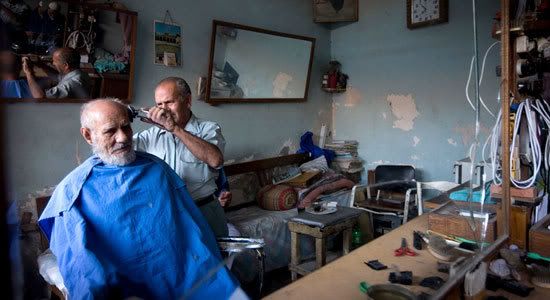
Abu Zeinab's barber shop is in the Bab al-Sheikh district of Baghdad, where Sunnis, Shiites, Kurds and Christians live together with unusual ease. (Johan Spanner for The New York Times)

The International Herald Tribune reports:
BAGHDAD: At its oldest spot, a small dusty strip of dirt road near a mosque, the neighborhood of Bab al-Sheik - a maze of snaking streets too narrow for cars - dates from a time, more than a thousand years ago, when Baghdad ruled the Islamic world.

At that time, orchards and palaces of Abbasid princes unfolded in stately splendor not far away.

Ten centuries later, Bab al-Sheik is less grand, but still extraordinary: It has been spared the sectarian killing that has gutted other neighborhoods, and Sunnis, Shiites, Kurds and Christians live together here with unusual ease. It has been battered by bombings around its edges, but the war has been kept from its heart, largely because of its ancient, shared past, bound by trust and generations of intermarriage.
"All of these people grew up here together," said Monther, a suitcase seller. "From the time of our grandfathers, same place, same food, same everything."

Much of today's Baghdad sprang into existence in the 1970s, when oil nationalization drew Iraqis from all over the country to work. The city's population more than tripled over the course of 20 years and new neighborhoods sprawled east and west.

The war and civil conflict have seemed to take a heavier toll in those areas than in some of the older neighborhoods.

No one knows this better that Waleed, a rail-thin Bab al-Sheik native who 10 years ago moved his family to Dora, a newly built middle-class neighborhood in southern Baghdad.

In Dora, residents were from all over. That never seemed to matter until the basic rules of society fell away after the U.S. occupation began. The only bulwark left against complete chaos was trust between families, and in Dora there was not enough.

"We didn't know each other's backgrounds," said Waleed, sitting with Monther in a barbershop in Bab al-Sheik, rain spitting on the street outside. Neither man wanted to be identified by their last names out of concern for their safety.

"Here, he can't lie to me," he said, jabbing a finger in Monther's direction. "He can't say, 'I'm this, I'm that,' because I know it's not true."

In Dora, he said, he did not have those powers of discernment. And he paid the price: His son was shot and killed on Oct. 9, 2006, while trying to get a copy of his high school diploma. Waleed moved his family out of the area immediately. "My first thought was this neighborhood," he said. "My grandfather is from here. I always felt safe here."

So did two reporters, who made six visits to the area over two months. It was safe enough, in fact, to walk through the warren of narrow streets, nod at elderly women sitting at street-level windows, linger in a barbershop and make long visits to Sunni, Shiite and Kurdish homes.

On a recent Friday, an extended Kurdish family relaxed at home. The living room was dark and cool, tucked in an alley away from the afternoon sun. Abu Nawal, the father, recounted how a group of men from the office of the Shiite cleric Moktada al-Sadr came to a local café, proposing to set up shop in the area.

The café owner pointed to a sign, which stated in dark script that all discussions of politics and religion were prohibited. The men were then asked to leave.

"The guys in the neighborhood said, 'If you try to make an office here, we will explode it,' " said Abu Nawal, a shoemaker whose family has lived in the neighborhood for four generations.

Some time later, Sunni Arab political party members came and were similarly rebuffed. "They wanted to put their foot in this neighborhood, but they couldn't," said Abu Nawal, who asked to be identified by his nickname for the safety of his family.

He said he despised the poisonous mix of religion and politics that has strangled Iraqi society, and he enjoyed cracking wry jokes at politicians' expense. Playing off the names for extremist militias, which call themselves names like the Islamic Army, he refers to his group of friends as the Arak Army, righteous defenders of an anise-flavored alcoholic drink.

The neighborhood has another rare asset: moderate religious men. Sheik Muhammad Wehiab, a 30-year-old Shiite imam whose family has lived in Bab al-Sheik for seven generations, was jailed for 14 months under Saddam Hussein, a biographical fact that should have opened doors for him in the new Shiite-dominated power hierarchy. But his moderate views were unpopular in elite circles and he has remained in the neighborhood.

He feels connected. So much so that while talking on the phone one night this autumn, he walked out into the tiny alley outside his door, lay down and watched the stars in the night sky.

"I think Maliki right now is envying me," Wehiab said to himself. "No bodyguards. Just free. This is the blessing."

He has some radical views. One of them is that Muslims have behaved terribly toward one another in the war here and have given Islam a bad name in using it to gain power. "I don't blame those guys who drew the cartoons," Wehiab said, referring to the Danish caricatures of the Prophet Muhammad that sparked riots and protests across the Islamic world last year.

"Muslims are the ones to be blamed," he said, sitting in an armchair in his quiet living room. "They have given them this picture." An ice-cream seller walked past his window, hawking in a loud voice.

Wehiab's friend, a Sunni cleric, holds a similar view. "The greatest jihad is the jihad of yourself," said the cleric, whose smooth voice echoes through the neighborhood as he calls worshipers to prayer every day at Qailani Mosque, the neighborhood's anchor.

The cleric, who asked that his name not be published out of concern for his safety, because of the high profile of the mosque, lovingly ticks off qualities of the 12th-century Sufi sheik Abdel Qadr Qailani, who gave the mosque its name: Intellectual. Scholar. Moral teacher.

But moderate religion is not drawing an audience on a national scale, and the mosque, one of Baghdad's most important Sunni institutions, has fallen on hard times.

Donations are down. Its long-running soup kitchen serves one meal a day instead of three. Sufi clerics cannot perform their rituals. A bomb sheared off part of a minaret in February.

"Please, please, write as much as you can that we don't want war," the cleric said.

We like to think that ethnic cleansing and the wholesale slaughter of innocent civilians that has taken place in lands exotic and far away to Americans, such as Iraq, the Balkans, and Rwanda, could never happen here. But it can, and more easily than we'd like to think.


Monday, September 10, 2007

Mission Creep

Kathy Griffin's Emmy Remarks to Be Censored


The AP reports:
Before Kathy Griffin won a creative arts Emmy last weekend for her reality show, 'My Life on the D-List,' she joked that an award would move her to the C-list. She was right: 'C' as in censored. The TV academy said her raucous acceptance speech will be edited when the event, which was taped, is shown Saturday on the E! channel.

The main prime-time Emmy Awards air the next night on Fox.

'Kathy Griffin's offensive remarks will not be part of the E! telecast on Saturday night,' the Academy of Television Arts & Sciences said in a statement Monday.
In her speech, Griffin said that 'a lot of people come up here and thank Jesus for this award. I want you to know that no one had less to do with this award than Jesus.'

She went on to hold up her Emmy, make an off-color remark about Christ and proclaim, 'This award is my god now!'

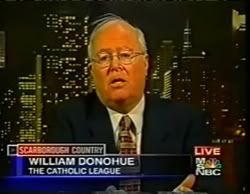
The comedian's remarks were condemned Monday by Catholic League President Bill Donohue, who called them a 'vulgar, in-your-face brand of hate speech.'

Bill Donohue, president of the Catholic League

According to the TV academy and E!, when the four hour-plus ceremony is edited into a two-hour program, Griffin's remarks will be shown in 'an abbreviated version' in which some language may be bleeped.

The program was in production and unfinished, an E! spokeswoman said Monday.
Requests for comment were left Monday evening by phone and e-mail with Griffin's publicist. They were not immediately returned.

The Catholic League, an anti-defamation group, called on the TV academy to 'denounce Griffin's obscene and blasphemous comment' at Sunday's ceremony.

The academy said Monday it had no plans to address the issue in the prime-time broadcast.

The organization may have another delicate issue to consider, this one involving an off-color fake music video that aired last December on 'Saturday Night Live' and won a creative arts Emmy for best song.

Andy Samberg of 'SNL' said Saturday that he had yet to be asked by the TV academy to perform the tune with Timberlake on the Fox broadcast, but he was willing.

Timberlake, on a concert tour, is scheduled to be in Los Angeles next weekend.
The subject of their '(Blank) in a Box' video: wrapping a certain part of the male anatomy and presenting it to a loved one as a holiday present.

The academy has said that 'show elements are in the process of being worked out.'

Had Kathy Griffin not been Catholic, but had she been born into a Presbyterian family, would Donohue have launched his attack? How is it that Donohue and the Catholic League can own 'Jesus Christ' and dictate what can be said about him? Do they hold a trademark (Jesus Christ®)?

This is a typical example of what evangelical Christians mean when they say that "there is an attack on Christians" - the free speech rights of a private citizen.

P.S. Way to go on the Emmy, Kathy Griffin!

Saturday, September 01, 2007

Bush Snubs Wiccan War Widow

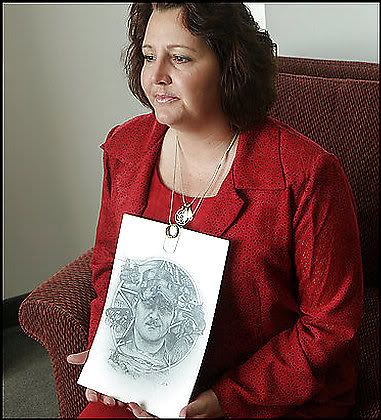
Roberta Stewart, widow of Sgt. Patrick Stewart, was not invited to a meeting President Bush held with families of soldiers killed in combat. (By Nikki Kahn -- The Washington Post)

The Washington Post reports:
President Bush has apologized to the widow of a Wiccan soldier after she was excluded from a Nevada meeting this week that the president held with the families of soldiers killed in combat.

Roberta Stewart, whose husband, Sgt. Patrick Stewart, was killed in Afghanistan in 2005, was left off the invitation list for the private meeting Tuesday even though other members of her husband's family were invited.

When she heard about the exclusion from her mother-in-law, Stewart said, she concluded that it was done because of her public fight to force the federal government to engrave the symbol for the Wiccan faith on her husband's marker on a memorial.

"I was devastated," Stewart said. "I was crying and upset. I couldn't believe that my country would continue this discrimination."
On Thursday, after publicity about the omission, the White House and the military scrambled to put things right. Stewart said she received phone calls from Department of Defense officials, who told her that her name was inadvertently left off a list of guests they forwarded to the White House.

Bush, who had been in Nevada for a speech to the American Legion's national convention, also called Stewart and, in a conversation that she said lasted about five minutes, expressed regret over her exclusion. She said she told the president about the Wiccan faith.

" 'I don't know whether you believe me or not, but I hope you know that this president would not dishonor a soldier,' " she said Bush told her.

Scott Stanzel of the White House press office confirmed the president's call to Stewart.

Stewart, also a Wiccan, fought an 18-month battle to get the Wiccan symbol -- a five-pointed star within a circle -- engraved on a brass plaque for war heroes at the veterans cemetery in Fernley, Nev. Patrick Stewart, who was in the Nevada Army National Guard, is believed to be the first Wiccan killed in combat. The helicopter he was riding in was shot down.

The Wiccan faith is based on nature and emphasizes respect for the earth. Some Wiccans call themselves witches or pagans.

The Department of Veterans Affairs turned down Roberta Stewart's request because the Wiccan symbol was not among the 38 emblems, including ones for atheism and humanism, allowed for inscription on military memorials or grave markers.

Americans United for the Separation of Church and State sued the department on behalf of Stewart and other Wiccan spouses, and in April, the VA agreed to add the symbol to its approved list.

Thursday, August 23, 2007

U.S. Judge Rules Public Funds Can Be Used For Church Renovations

The Federal district court ruling in Michigan highlights a shift away from strict church-state separation.

The Christian Science Monitor reports:
Should citizens' tax dollars be spent to renovate houses of worship?

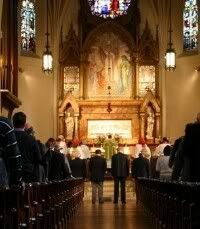
St. Johns Episcopal Church, Detroit Michigan, one of three churches that received public monies.

The answer to that question used to be a resounding "No, it's unconstitutional." But Aug. 8, a federal judge broke new ground. He ruled that the city of Detroit could partially reimburse three churches for renovations they made to their buildings to make the downtown area more attractive before the 2006 Super Bowl. (The city paid numerous property owners for renovations.)
Public funds can go to churches for improvements that serve a civic purpose, but not to promote religion, ruled Judge Avern Cohn of the US District Court of Eastern Michigan. In practical terms, that meant the churches could be reimbursed for repairs to their buildings and parking lots, which "convey no religious message," he said, but not for new signs or stained-glass windows.

Judge Avern Cohn, appointed to the U.S. District Court for the Eastern District of Michigan by Jimmy Carter in 1979.

"This is the first time we've gotten a court decision on government bricks-and-mortar spending in a very long time," says Robert Tuttle, a law professor at George Washington University. And it's likely to capture the attention of states and cities across the United States as they consider similar church-state matters.

The ruling troubles those who hold to a strict separation of church and state, including the group that brought the case against Detroit's downtown development agency.

"If it's OK for the government to pay for bricks and mortar, what's to stop it from out and out building churches?" asks Ellen Johnson, president of American Atheists Inc. (AAI) "The ramifications are tremendous."

The ruling represents an attempt to grapple seriously with a changing legal landscape, says Mr. Tuttle, who codirects legal research for the Roundtable on Religion and Social Welfare Policy based in Albany, N.Y. Pressures have grown in recent years to move away from the idea of a strict separation between church and state. Proponents in legal and religious circles have called for government neutrality toward religion – providing a level playing field where religious and secular entities can compete for public funds. This issue remains highly contentious.

Not long ago, it was deemed unconstitutional for public money to go to groups whose mission was "pervasively sectarian," in the language of the US Supreme Court. (The First Amendment to the US Constitution prohibits any government "establishment of religion.")

In 1973, the Supreme Court stated in regard to religious structures that government "may not maintain such buildings or renovate them when they fall into disrepair." That decision has never been repudiated, but in 2000, the Court ruled (in Mitchell v. Helms) that government can provide funds to religious groups as long as the money does not support religious activities. Parsing that in practice becomes the challenge.

President Bush's faith-based initiative made funding of religious organizations for a variety of social services a prime goal. Some of those projects have been challenged in court, a few successfully, for promoting a particular religion.

In 2003, the administration announced it was opening the door to direct funding for renovations to religious buildings through the Save America's Treasures program to preserve cultural landmarks. (The Department of Justice later issued legal opinions that could allow funding religious structures under other federal programs.)

The first grant, for $317,000, was given to restore the windows in Boston's Old North Church, made famous by Paul Revere. Later that year, $375,000 went to Touro Synagogue in Newport, R.I., the nation's oldest synagogue. Both are active houses of worship, but they are also historical landmarks that draw visitors in large numbers. No challenge has been mounted to those grants.

"We have well over half a million visitors each year, including some 70,000 school kids," says Ed Pignone, director of Old North Foundation. The 1723 church is "Boston's most visited historic site," he says.

Other instances of direct government aid are being challenged, however. When Congress passed a bill specifically to fund the restoration of California missions, 19 of which are active Catholic churches, Americans United for Separation of Church and State said it would sue. The missions have yet to raise the matching money that would trigger the grant.

And last week, the American Civil Liberties Union filed a suit in Louisiana to halt the payment of $120,000 in state money to two churches. The funds were earmarked in an appropriations bill, without any purpose or justification given.

AAI is considering whether to appeal the Michigan ruling. Although they had a partial victory (some church expenses were not reimbursed), they say they can't let the bricks-and-mortar argument stand.

"You could easily build a megachurch and avoid the religion iconography," Ms. Johnson says. "Then the church could later say, 'Now we'll put in the religious symbols ourselves.' " There's nothing secular about a church, she adds.

Others argue that religious groups frequently provide a secular service that makes them worthy of public support, even without setting up a separate 501(c)3 nonprofit to ensure no funds go to religious activities. This is the thinking behind Mr. Bush's faith-based initiative.

Partners for Sacred Places (PSP), a nonprofit, nonsectarian organization founded in 1989 to help preserve older and historic houses of worship, seeks contributions from private and public sources to help congregations repair their buildings.

Partners conducted a study of 100 congregations in six cities. It found that, on average, each maintained four community service programs. And 80 percent of the people who entered the buildings in a given week were nonmembers – people receiving those community services.

To donors, "we say it isn't supporting a religion, but supporting everybody – they don't make distinctions between kids or seniors of one faith or another," says Bob Jaeger, PSP executive director. "The other argument is that these are historic buildings ... that are an important part of a community's heritage."

PSP set up a fund in Pennsylvania and raised $2 million in donations from the William Penn Foundation, the state government (three different sources), and individuals to restore buildings in southeastern counties. The goal is to help congregations across the state.

One beneficiary is St. Francis de Sales Catholic Church in west Philadelphia. "It's an enormous building ... and they've been struggling for 20 years with how to fix the [three] domes which have water leaks," says Mr. Jaeger. "The church has an amazing physical presence and a cluster of programs for the community – we gave them $100,000."

For strict separationists like Johnson, no tax money should help a church – "religion should be doing that themselves."

For Tuttle, the Michigan decision seriously tackles the changes that have gone on in the law: the shift from barring any funding to religious institutions to barring funding for any religious activities. It comes down neither on the strict separationists side nor on the blanket neutrality approach of the Bush administration.

Instead, it says that "when a government makes a grant for secular purposes to a broad set of grantees, it can include churches," Tuttle adds. "But it has to be careful it is not directly supporting the religious mission or ministry."

Churches already have non-profit status and do not pay taxes, precisely so they can pay their own way and keep the wall of separation clear and distinct. Now they can get public money?

How about churches that have seen their heyday, the children and grandchildren of their followers having moved to the suburbs or out of state and don't have much of a population anymore? That's what the Catholic Churches in inner cities are experiencing. Can the Vatican now expect municipalities in the U.S., already operating on strapped budgets, cutting public services to its citizens, to pick up the tab for keeping them in good repair?

Given the fact that Detroit is in severe financial crisis, with rampant unemployment, property values that have nose-dived, and a shrinking tax base, I'm shocked that the citizens haven't taken to the streets in protest over the outlay of their scarce public resources to attract tourists for one weekend.

Wednesday, June 13, 2007

Earmarks Gone Wild!

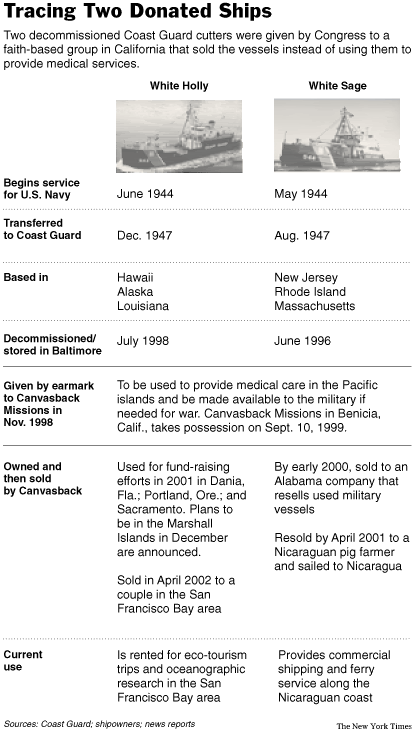
Two Coast Guard cutters were gifted to a Christian missionary group, which then resold them and deposited the money in its general revenue account which supports the group's evangelical activities.

The White Holly cutter approaching the Golden Gate Bridge.

The New York Times reports:
In theory, it was simple: Congress gave two decommissioned Coast Guard cutters to a faith-based group in California, directing that the ships be used only to provide medical services to islands in the South Pacific.

Coast Guard records show that the ships have been providing those services in the South Pacific since the medical mission took possession of them in 1999.

In reality, the ships never got any closer to the South Pacific islands than the San Francisco Bay. The mission group quickly sold one to a maritime equipment company, which sold it for substantially more to a pig farmer who uses it as a commercial ferry off Nicaragua. The group sold the other ship to a Bay Area couple who rent it for eco-tours and marine research.

The gift of the two cutters was one of almost 900 grants Congress has made to faith-based organizations since 1987 through the use of provisions, called earmarks, that are tucked into bills to bypass normal government review and bidding procedures.
Skipping those safeguards can generate more than accusations of political favoritism. As the case of the Coast Guard cutters shows, it also can give rise to grants that never achieve their intended purpose, with the government never even realizing it.

Canvasback Missions, in Benicia, Calif., took ownership of the cutters, the White Sage and the White Holly, in Baltimore in September 1999. This was the first time such ships had been given away through an earmark, the Coast Guard said.

Pressed for cash, Canvasback sold the White Sage a few months later for about $85,000. Two years later, the struggling mission sold the White Holly to the Bay Area couple for $330,000. The mission did not inform the Coast Guard property office about the sales.

Typically, decommissioned Coast Guard vessels are sold at auction, are included in foreign aid packages or are added to the nation’s mothball fleet.

If the two cutters had been sold at auction, the General Services Administration would have monitored their use for five years. But the Canvasback earmark required no such monitoring, and Coast Guard officials said they did not know about the sales until The New York Times asked about them.

The fate of the White Holly and the White Sage comes as a surprise to people who supported the Canvasback earmark.

Former Representative Frank D. Riggs, Republican of California, whose staff drafted the earmark, said it “would raise concerns” if the ships were “not used as intended.”Former California Congressman Frank Riggs

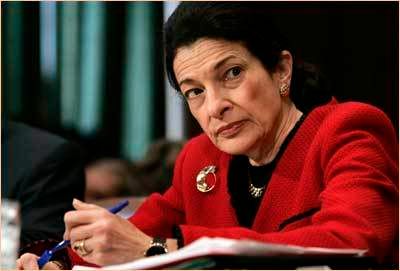
Senator Olympia J. Snowe, Republican of Maine, was also credited by Canvasback with working on the earmark. But David Snepp, Ms. Snowe’s spokesman, said she had merely voted for it. Mr. Snepp called Canvasback’s actions troubling and said the senator had asked her staff to research what is now a gray area: whether selling the two ships was legal.

Maine Senator Olympia Snowe

“If they were not used in Micronesia, they were definitely not used in the spirit of the way this was written,” Mr. Snepp said. The text of the earmark gave the government the right to reclaim the ships, he added. While that was perhaps unlikely, he continued: “They were supposed to retain the vessels in case the Coast Guard needed them back. The charity does not have the option to sell.”

A harsher assessment came from Steve Ellis, vice president of Taxpayers for Common Sense, a watchdog group that opposes earmarks, and a former Coast Guard officer. “They are flipping the property,” Mr. Ellis said.

Jamie W. Spence, president and founder of Canvasback Missions, said all the sales proceeds supported the organization’s work in the Marshall Islands, where it has provided eye and dental care and counseling on diabetes prevention to thousands of people since it was founded in 1981.

Jacque Spence, left, and her husband, Jamie, at their Canvasback Missions office in Benicia, Calif.

“We did everything in our power to put these ships into service,” Mr. Spence said. But when the group could not raise the money to repair and maintain the vessels, it sold them instead, using the proceeds to cope with its financial difficulties, he said.

Mr. Spence said he had consulted with Canvasback’s legal advisers and was confident the sales were ethical and legal.

Coast Guard officials were surprised at the cutters’ fate. “The White Holly and the White Sage are in the South Pacific,” Lynn Brown, the personal property manager in the decommissioning office, said in March. She affirmed recently that her office had not known that Canvasback sold the ships.

Mr. Spence acknowledged that he did not give notice to Ms. Brown’s office. But he said he told Coast Guard employees in the Bay Area about the White Holly sale and mentioned the White Sage sale to the Coast Guard officer in charge of the Baltimore yard before the deal and to civilian Coast Guard officials afterward. He did not respond to requests to identify those people.

While all earmarks are troublesome to critics like Mr. Ellis, who called the Canvasback gift an “utter indictment of earmarks,” those made for faith-based groups involve special questions about the constitutional borders between church and state.

Vince Backen with students and teachers after giving them a cruise on the White Holly, a former Coast Guard cutter sold to him by Canvasback Missions.
[photo: Jim Wilson/NYT]


The Coast Guard ships were given to Canvasback for a secular purpose, providing medical services. But Mr. Spence said Canvasback did not isolate the sales proceeds; instead it mingled them with its general revenues, which also cover activities that include evangelism. And under most court decisions, evangelism cannot be paid for with federal grants.

Mr. Spence said no constitutional violations occurred. “I’m very certain that the proceeds were used for supporting our medical program,” he said, “and I’m absolutely sure they were not used for evangelism.” He said Canvasback, a nondenominational Christian mission, raises donations separately for its evangelism activities, which included donating Bibles translated into local languages and constructing a chapel.

Mr. Spence and his wife, Jacque, established their medical mission 26 years ago, using a 71-foot catamaran, the Canvasback, to navigate the shallow coasts of the poorer, more remote islands of Micronesia. As the ministry grew, it mobilized medical professionals to volunteer for short stints in the islands and delivered donated medical equipment and supplies.

When they sought the Congressional earmark, the Spences were hoping the two cutters would allow them to expand their medical ministry, Mr. Spence said. But the mission acquired and then sold those vessels, and a third vessel that was privately donated, because Canvasback determined that maintaining and operating the ships was too big a financial burden, he explained. But few of these details can be found in the annual statements Canvasback files with the Internal Revenue Service. Two leading nonprofit accounting experts examined the statements and found them to be incomplete and internally inconsistent.

“There is no clear audit trail for the boats,” said Julie L. Floch of Eisner L.L.P. in Manhattan, a member of the I.R.S.’s national advisory panel on nonprofits. Her view was echoed by Jody Blazek of Blazek & Vetterling L.L.P. in Houston, the author of six books on nonprofit tax law and accounting.

William J. MacLean, the accountant in Seaside, Ore., who prepared the filings, declined to comment.


These days, Canvasback has redirected its efforts from ship-based medical care in the remote islands to land-based clinics on the more populated islands, Mr. Spence said.

That work has won praise from health officials in the Marshall Islands — and fresh support from Congress. The tiny mission is now the lead contractor on a diabetes research program being financed through two $1 million Defense Department contracts. Those grants were directed to Canvasback by Congress through a pair of earmarks.

See the NYTimes video report:


Tuesday, May 15, 2007

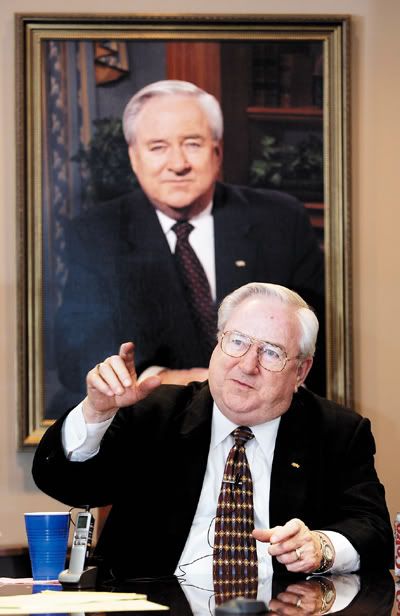
Jerry Falwell is Dead, Let the Pandering Begin . . . .

. . . . But not here.


At On Faith (the fledgling enterprise by Jon Meacham and Washington Post VP Ben Bradlee's wife, Sally Quinn), R. Albert Mohler, Jr., President, The Southern Baptist Theological Seminary, prostrates himself before the memory of one of the most hateful, ignorant, divisive, un-Christlike unAmericans who ever lived. Mohler writes, "The death of Dr. Jerry Falwell..."

Wait a minute, Dr Jerry Falwell?? Already the lies begin.

Falwell held no earned doctorate. He held three honorary degrees: an honorary Doctor of Divinity from Tennessee Temple Theological Seminary (now known as Tennessee Baptist Seminary), an honorary Doctor of Letters from California Graduate School of Theology (an unaccredited institution), and an honorary Doctor of Laws from Central University in Seoul, South Korea (an unaccredited institution).1
Undoubtedly the media will fall into ecstasy for the next couple of days, waxing eloquent about Falwell's life, but here readers get the spit-varnished Falwell.


Monday, December 11, 2006

Religion for Captive Audiences, With Taxpayers Footing the Bill


The NYT reports:
Life was different in Unit E at the state prison outside Newton, Iowa.

The toilets and sinks — white porcelain ones, like at home — were in a separate bathroom with partitions for privacy. In many Iowa prisons, metal toilet-and-sink combinations squat beside the bunks, to be used without privacy, a few feet from cellmates.

The cells in Unit E had real wooden doors and doorknobs, with locks. More books and computers were available, and inmates were kept busy with classes, chores, music practice and discussions. There were occasional movies and events with live bands and real-world food, like pizza or sandwiches from Subway. Best of all, there were opportunities to see loved ones in an environment quieter and more intimate than the typical visiting rooms.

But the only way an inmate could qualify for this kinder mutation of prison life was to enter an intensely religious rehabilitation program and satisfy the evangelical Christians running it that he was making acceptable spiritual progress. The program — which grew from a project started in 1997 at a Texas prison with the support of George W. Bush, who was governor at the time — says on its Web site that it seeks “to ‘cure’ prisoners by identifying sin as the root of their problems” and showing inmates “how God can heal them permanently, if they turn from their sinful past.”

One Roman Catholic inmate, Michael A. Bauer, left the program after a year, mostly because he felt the program staff and volunteers were hostile toward his faith.

“My No. 1 reason for leaving the program was that I personally felt spiritually crushed,” he testified at a court hearing last year. “I just didn’t feel good about where I was and what was going on.”
For Robert W. Pratt, chief judge of the federal courts in the Southern District of Iowa, this all added up to an unconstitutional use of taxpayer money for religious indoctrination, as he ruled in June in a lawsuit challenging the arrangement. [Americans United for Separation of Church and State against the Iowa Department of Corrections and InnerChange Freedom Initiative, an organization affiliated with Prison Fellowship Ministries. Prison Fellowship was founded by Charles W. Colson, a close ally of President Bush and an influential evangelical who went to prison for his role in the Watergate cover-up.]

The Iowa prison program is not unique. Since 2000, courts have cited more than a dozen programs for having unconstitutionally used taxpayer money to pay for religious activities or evangelism aimed at prisoners, recovering addicts, job seekers, teenagers and children.

Nevertheless, the programs are proliferating. For example, the Corrections Corporation of America, the nation’s largest prison management company, with 65 facilities and 71,000 inmates under its control, is substantially expanding its religion-based curriculum and now has 22 institutions offering residential programs similar to the one in Iowa. And the federal Bureau of Prisons, which runs at least five multifaith programs at its facilities, is preparing to seek bids for a single-faith prison program as well.

Government agencies have been repeatedly cited by judges and government auditors for not doing enough to guard against taxpayer-financed evangelism. But some constitutional lawyers say new federal rules may bar the government from imposing any special requirements for how faith-based programs are audited.

And, typically, the only penalty imposed when constitutional violations are detected is the cancellation of future financing — with no requirement that money improperly used for religious purposes be repaid.

But in a move that some constitutional lawyers found surprising, Judge Pratt ordered the prison ministry in the Iowa case to repay more than $1.5 million in government money, saying the constitutional violations were serious and clearly foreseeable.

His decision has been appealed by the prison ministry to a federal appeals court and fiercely protested by the attorneys general of nine states and lawyers for a number of groups advocating greater government accommodation of religious groups. The ministry’s allies in court include the Bush administration, which argued that the repayment order could derail its efforts to draw more religious groups into taxpayer-financed programs.

Officials of the Iowa program said that any anti-Catholic comments made to inmates did not reflect the program’s philosophy, and are not condoned by its leadership.

Jay Hein, director of the White House Office of Faith-Based and Community Initiatives, said the Iowa decision was unfair to the ministry and reflects an “overreaching” at odds with legal developments that increasingly “show favor to religion in the public square.”

And while he acknowledged the need for vigilance, he said he did not think the constitutional risks outweighed the benefits of inviting “faith-infused” ministries, like the one in Iowa, to provide government-financed services to “people of faith who seek to be served in this ‘full-person’ concept.”

Crossing a Bright Line

Over the last two decades, legislatures, government agencies and the courts have provided religious organizations with a widening range of regulatory and tax exemptions. And in the last decade religious institutions have also been granted access to public money once denied on constitutional grounds, including historic preservation grants and emergency reconstruction funds.

In 2002, the Supreme Court ruled that public money could be used for religious instruction or indoctrination, but only when the intended beneficiaries made the choice themselves between religious and secular programs — as when parents decide whether to use tuition vouchers at religious schools or secular ones. The court emphasized the difference between such “indirect” financing, in which the money flows through beneficiaries who choose that program, and “direct” funding, where the government chooses the programs that receive money.

But even in today’s more accommodating environment, constitutional scholars agree that one line between church and state has remained fairly bright: The government cannot directly finance or support religious evangelism or indoctrination. That restriction typically has not loomed large when public money goes to religious charities providing essentially secular services, like job training, after-school tutoring, child care or food banks. In such cases, the beneficiaries need not accept the charity’s religious beliefs to get the secular benefits the government is financing.

The courts have taken a different view, however, when public money goes directly to groups, like the Iowa ministry, whose method of helping others is to introduce them to a specific set of religious beliefs — and whose success depends on the beneficiary accepting those core beliefs. In those cases, most of the challenged grants have been struck down as unconstitutional.

Those who see faith-based groups as exceptionally effective allies in the battle against criminal recidivism, teen pregnancy, addiction and other social ills say these cases are rare, compared with the number of programs receiving funds, and should not tarnish the concept of bringing more religious groups into publicly financed programs, so long as any direct financing is used only for secular expenses.

That concept has been embodied most prominently since 2001 in the Bush administration’s Faith-Based and Community Initiative, a high-profile effort to encourage religious and community groups to participate in government programs. More than 100 cities and 33 states have established similar initiatives, according to Mr. Hein.

The basic architecture of these initiatives has so far withstood constitutional challenge, although the Supreme Court agreed on Dec. 1 to consider a case on whether taxpayers have legal standing to bring such challenges against the Bush administration’s program.

Defenders of these initiatives say they are necessary to eliminate longstanding government policies that discriminated against religious groups — to provide a level playing field, as one White House study put it.

But critics say the “level playing field” argument ignores the fact that giving public money directly to ministries that aim at religious conversion poses constitutional problems that simply do not arise when the money goes elsewhere.

Who's getting the money?

Converting Young People

Those constitutional problems sharpen when young people are the intended beneficiaries of these transformational ministries. In recent years, several judges have concluded that children and teenagers, like prisoners, have too few options and too little power to make the voluntary choices the Supreme Court requires when public money flows to programs involving religious instruction or indoctrination.

That was the conclusion last year of a federal judge in Michigan, in a case filed by Teen Ranch, a nonprofit Christian facility that provides residential care for troubled or abused children ages 11 to 17.

In 2003, state officials imposed a moratorium on placements of children there, primarily because of its intensively religious programming. Lawyers for the ranch went to court to challenge that moratorium.

“Teen Ranch acknowledges that it is overtly and unapologetically a Christian facility with a Christian worldview that hopes to touch and improve the lives of the youth served by encouraging their conversion to faith in Christ, or assisting them in deepening their pre-existing Christian faith,” observed a United States District judge, Robert Holmes Bell, in a decision released in September 2005.

Although youngsters in state custody could not choose where to be placed, they could refuse to go to the ranch if they objected to its religious character. As a result, the ranch’s lawyers argued, the state money was constitutionally permissible.

The state contended that the children in its care were “too young, vulnerable and traumatized” to make genuine choices. The ranch disputed that and added that the children had case workers and other adults to guide them. Judge Bell rejected Teen Ranch’s arguments. “Regardless of whether state wards are particularly vulnerable, they are children,” he wrote.

The ranch in Michigan has discontinued operations pending the outcome of its appeal, said Mitchell E. Koster, who was its chief operating officer. “We are confident that our argument will win,” Mr. Koster said. “It’s just a question of at what level.”

In another case early last year, a federal judge struck down a federal grant in 2003 to MentorKids USA, a ministry based in Phoenix, to provide mentors for the children of prisoners. In a case filed by the Freedom From Religion Foundation in Madison, Wis., the judge noted that the exclusively Christian mentors had to regularly assess whether the young people in their care seemed “to be progressing in relationship with God.” In a program newsletter offered as evidence, its director said, “Our goal is to see every young adult choose Christ.”

The federal government had been clearly informed in advance of the nature of the MentorKids ministry, said Jon Gibson, chairman of the group’s board. “The court’s decision meant that there were 50 kids we could have served that we were not able to serve.”

In another case, more than $1 million in federal funds went to the Alaska Christian College in Soldotna, Alaska, which says it provides “a theologically based post-secondary education” to teenage Native Americans from isolated villages. But an investigator from the Education Department who visited the school last year found a first-year curriculum “that is almost entirely religious in nature.”

The Freedom From Religion Foundation sued to block the financing. The school promised to use government money only for secular expenses, and federal financing resumed last May, according to Derek Gaubatz, of the Becket Fund for Religious Liberty, which represents the college.

A number of government grants to finance sexual abstinence education have been successfully challenged. For example, the Louisiana Governor’s Program on Abstinence gave federal money to several religious groups that used it for clearly unconstitutional purposes, a federal judge ruled in 2002, in a case filed by the American Civil Liberties Union.

One grant went to a theater company that toured high schools performing a skit called “Just Say Whoa.” The script contained many religious references including one in which a character called Bible Guy tells teenagers in the cast: “As Christians, our bodies belong to the Lord, not to us.”

The federal judge said the grants were so poorly monitored that the state missed other clear signs of unconstitutional activity — as when one Catholic diocese sent monthly reports showing that it had used federal money “to support prayer at abortion clinics, pro-life marches and pro-life rallies.” Gail Dignam, director of the abstinence program, said that state contracts now emphasize more clearly that no grant money may be used for religious activities.

The Programs in Prisons

Programs like the one at the Iowa prison are a rare ray of hope for American prisoners, and governments should encourage them, their supporters say.

“We have 2.3 million Americans in prison today; 700,000 of them will get out of prison this coming year,” said Mark L. Earley, a former attorney general of Virginia. Many inmates come out of prison “much more antisocial than when they came in,” he added. He said he saw faith-based groups as essential partners in any effective rehabilitation efforts.

Mr. Earley is the president and chief executive of Prison Fellowship Ministries, based in Lansdowne, Va. With almost $56 million a year in revenue, the ministry oversees the InnerChange Freedom Initiative, which operates the Iowa program.

Since its birth in 1976, Prison Fellowship has been most closely associated with one of its founders, Charles W. Colson, who said in a 2002 newsletter that the InnerChange program demonstrates “that Christ changes lives, and that changing prisoners from the inside out is the only crime-prevention program that really works.”

In early 2003, Americans United for Separation of Church and State joined with a group of Iowa taxpayers and inmates to challenge the InnerChange program in federal court.

In ruling on that case, Judge Pratt noted that the born-again Christian staff was the sole judge of an inmate’s spiritual transformation. If an inmate did not join in the religious activities that were part of his “treatment,” the staff could write up disciplinary reports, generating demerits the inmate’s parole board might see. Or they could expel the inmate.

And while the program was supposedly open to all, in practice its content was “a substantial disincentive” for inmates of other faiths to join, the judge noted. Although the ministry itself does not condone hostility toward Catholics, Roman Catholic inmates heard their faith criticized by staff members and volunteers from local evangelical churches, the judge found. And Jews and Muslims in the program would have been required to participate in Christian worship services even if that deeply offended their own religious beliefs.

Mr. Earley said Judge Pratt’s decision was sharply inconsistent with current law and his standard for separating secular from religious expenses was so extreme that it would disqualify almost any faith-based program. He acknowledged that inmates, whatever their own faith, are required to participate in all program activities, including worship, but he insisted that a religious conversion is not required for success. InnerChange uses biblical references only to illustrate a set of universal values, such as integrity and responsibility, and not to exclude those of other faiths, he said, adding that it was “unfortunate” if any inmates felt the program denigrated Catholicism or any other Christian faith. Corrections officials in Iowa declined to comment on the case.

Not all programs in prisons are so narrowly focused. Florida now has three prisons that offer inmates, who must ask to be housed there, more than two dozen offerings ranging from various Christian denominations to Orthodox Judaism to Scientology. But at Newton, Judge Pratt found, there were few options — and no equivalent programs — without religious indoctrination.

“The state has literally established an Evangelical Christian congregation within the walls of one of its penal institutions, giving the leaders of that congregation, i.e., InnerChange employees, authority to control the spiritual, emotional and physical lives of hundreds of Iowa inmates,” Judge Pratt wrote. “There are no adequate safeguards present, nor could there be, to ensure that state funds are not being directly spent to indoctrinate Iowa inmates.”

InnerChange, which has been widely praised by corrections officials and politicians, operates similar programs at prisons in Texas, Minnesota, Kansas, Arkansas and, by next spring, Missouri. Officials in those states are monitoring the Iowa case, but several said they believed their programs were sufficiently different to survive a similar challenge.

A government-financed religious education program at a county jail in Fort Worth was struck down by the Texas Supreme Court more than five years ago, and more lawsuits are pending. Corrections Corporation was among those sued last year by the Freedom From Religion Foundation, which is challenging a Christian residential program at a women’s prison in Grant, N.M. The foundation has also sued the federal Bureau of Prisons over its faith-based rehabilitation programs. And Americans United, the Iowa plaintiff, and the American Civil Liberties Union have sued a job-training program run by a religious group at the Bradford County Jail near Troy, Pa.

Prison Fellowship Ministries is one of about a half-dozen Christian groups that operate programs at jails and prisons run by the Corrections Corporation. The company’s lawyers are studying the Iowa decision, said a spokeswoman, Louise Grant. “But we are not, at this time, changing or altering any of our programming based on that, or any other ruling.”

Inadequate Monitoring

Government agencies have been criticized repeatedly for inadequately watching these programs. Besides the criticism in various court decisions, the Government Accountability Office has twice raised questions about cloudy guidelines and inadequate safeguards against government-financed evangelism.

In its most recent audit released in June, the G.A.O., which examined faith-based organizations in four states, found that some were violating federal rules against proselytizing and that government agencies did not have adequate safeguards against such violations.

The problem is not that none of these programs are audited. Every group that gets a federal grant worth more than $500,000 has to pay a private auditor to examine its books and report to the government. Many federal programs, like those that provide Medicaid services or help the government allocate arts grants, require additional audits.

But no supplemental audits are required under the faith-based initiative — indeed, it would probably violate the Bush administration’s new regulations to do so, said Robert W. Tuttle, a professor of law and religion at George Washington University and co-director of legal research, along with Ira C. Lupu, for the Roundtable on Religion and Social Welfare Policy, a project of the Rockefeller Institute.

“The rules can be read to prohibit special audit requirements because that would be considered a stigma, which would be discriminatory,” Professor Tuttle said. “But that flies in the face of constitutional logic, because religion is special, and that special quality has to be reflected in program guidelines and audit rules.”

The G.A.O. also says the government cannot easily or accurately track either how much money is flowing to groups or whether they are using the funds in unconstitutional ways.

The Bush administration is already studying whether these constitutional problems can be resolved by reshaping many government grants into voucher programs under which the beneficiary decides where the money goes. But vouchers are a limited solution because most social service agencies need to know that a certain amount of money is assured before they can begin operations.

Mr. Hein, the White House official, agreed that vouchers could clarify the legal landscape. But even where they are not practical, he said, the Bush administration remains committed to keeping the doors to government financing open for as many religious groups as possible.

And The Constant American administration remains committed to eliminating religious groups' tax exempt status.