Showing posts with label war in Iraq. Show all posts

Wednesday, May 27, 2009

Army chief: U.S. troops could be in Iraq for 10 years

Despite the agreement to bring them home by 2012, the Pentagon is prepared for things to change, Gen. George Casey says.

Who didn't see this coming?

The Associated Press report in the LA Times:
The Pentagon is prepared to leave fighting forces in Iraq for as long as a decade despite an agreement between the United States and Iraq that would bring all American troops home by 2012, the top U.S. Army officer said Tuesday.

Gen. George W. Casey Jr., the Army chief of staff, said the world remains dangerous, and the Pentagon must plan for extended U.S. combat and stability operations in two wars. "Global trends are pushing in the wrong direction," Casey said. "They fundamentally will change how the Army works."

He spoke at an invitation-only briefing to a dozen journalists and policy analysts from Washington-based think tanks. He said his planning envisions combat troops in Iraq and Afghanistan for a decade as part of a U.S. commitment to fighting extremism in the Middle East.

Casey's calculations about force levels are related to his attempt to ease the brutal deployment calendar that he said would "bring the Army to its knees."

Casey said his comments were not meant to conflict with administration policies.

CBS News's version adds:
Casey would not specify how many combat units would be split between Iraq and Afghanistan. He said U.S. ground commander Gen. Ray Odierno is leading a study to determine how far U.S. forces could be cut back in Iraq and still be effective.

Back to the LA Times:
President Obama plans to bring U.S. combat forces home from Iraq in 2010, and the United States and Iraq have agreed that all American forces would leave by 2012.

This isn't exactly true.

To begin with, it's disingenuous to suggest the U.S. is ending the occupation of Iraq because troops remaining aren't combat troops.

All troops are trained combat troops.

The distinction relates to current assignment. Combat troops (tens of thousands of them) assigned to duty in Iraq, which will include training, advising, and protecting "U.S. interests in Iraq", including but not limited to the U.S. embassy in Baghdad (U.S. Marine Security Guards), a 104-acre compound where 5,500 people (non-diplomats, U.S. government personnel of all kinds, and who knows how many spooks) live/work/play in a city within a city (a de facto military base) as large as Vatican City, six times larger than the United Nations compound in New York, two-thirds the acreage of Washington’s National Mall. It has its own area code, power station, water wells, waste treatment facilities, apartment buildings, fire department, shopping mall, restaurants, cinema, country-club recreational center, and more. It is the largest (at least ten times the size of new U.S. embassies elsewhere) and most expensive U.S. embassy in the world ($736 million to build, $1.2 billion a year to operate).
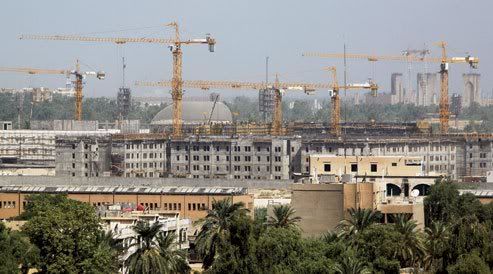
The new United States Embassy rises above Baghdad.
[Daniel Berehulak/Getty Images.]
Several senior U.S. officials have suggested Iraq could request an extension, but the legal agreement that the two countries signed last year would have to be amended [for any significant U.S. presence to remain.

As recently as February, Defense Secretary Robert Gates reiterated the U.S. commitment to the agreement worked out with Iraqi Prime Minister Nouri al-Maliki.

"Under the Status of Forces Agreement with the Iraqi government, I intend to remove all U.S. troops from Iraq by the end of 2011," Gates said during an address at Camp Lejeune in North Carolina. "We will complete this transition to Iraqi responsibility, and we will bring our troops home with the honor that they have earned."
]

The United States has about 139,000 troops in Iraq and 52,000 in Afghanistan.

Obama campaigned on ending the Iraq war quickly and refocusing U.S. resources on what he called the more important fight in Afghanistan.

[That will not mean a major influx of U.S. fighting forces on the model of the Iraq "surge," however. Obama has agreed to send about 21,000 combat forces and trainers to Afghanistan this year. Combined with additional forces approved before former President George W. Bush left office,] the United States is expected to have about 68,000 troops in Afghanistan by the end of this year. That's about double the total at the end of 2008, but Obama's top military and civilian advisors have indicated the number is unlikely to grow much beyond that.

CBS News's version continued with:
Casey said several times that he wasn't the person making policy, but the military was preparing to have a fighting force deployed in Iraq and Afghanistan for years to come. Casey said his planning envisions 10 combat brigades plus command and support forces committed to the two wars.

When asked whether the Army had any measurement for knowing how big it should be, Casey responded, "How about the reality scenario?"

This scenario, he said, must take into account that "we're going to have 10 Army and Marine units deployed for a decade in Iraq and Afghanistan."

Casey stressed that the United States must be ready to take on sustained fights in the Middle East while meeting other commitments.

Casey reiterated statements made by civilian and military leaders that the situation in Afghanistan would get worse before it gets better. "There's going to be a big fight in the South," he said.

Casey added that training of local police and military in Afghanistan was at least a couple years behind the pace in Iraq, and it would be months before the U.S. deployed enough trainers. There's a steeper curve before training could be effective in Afghanistan, requiring three to five years before Afghanis could reach the "tipping point" of control.

He also said the U.S. had to be careful about what assets get deployed to Afghanistan. "Anything you put in there would be in there for a decade," he said.

As Army chief of staff, Casey is primarily responsible for assembling the manpower and determining assignments. He insisted the Army's 1.1-million size was sufficient even to handle the extended Mideast conflicts.

"We ought to build a pretty effective Army with 1.1 million strength," Casey said. He also noted that the Army's budget had grown to $220 billion from $68 billion before the Sept. 11, 2001, terrorist attacks.

He said the Army is two-thirds of the way through a complete overhaul from the Cold War-era force built around tanks and artillery to today's terrorist-driven realities. The Army has become more versatile and quicker by switching from division-led units to brigade-level command.

Casey said the Army has moved from 15-month battlefield deployments to 12 months. His goal is to move rotations by 2011 to one year in the battlefield and two years out for regular Army troops, and one year in the battlefield and three years out for reserves. He called the current one-year-in-one-year-out cycle "unsustainable."

So there you have it. A meme which will slowly seep sideways into the minds of Americans (journalists' minds, in particular), so that as we get closer to the target dates for withdrawal of troops, Americans will have adjusted to the United States's continued occupation of Iraq.

C'est la guerre.

Monday, December 03, 2007

Is Paul Wolfowitz Coming Back To Government?


The Bush administration has offered the former World Bank president a new public service position. Newsweek's Mike Isikoff reports:
Don't ever say the Bush administration doesn't take care of its own. Nearly three years after Paul Wolfowitz resigned as deputy Defense secretary and six months after his stormy departure as president of the World Bank—amid allegations that he improperly awarded a raise to his girlfriend—he's in line to return to public service. Secretary of State Condoleezza Rice has offered Wolfowitz, a prime architect of the Iraq War, a position as chairman of the International Security Advisory Board, a prestigious State Department panel, according to two department sources who declined to be identified discussing personnel matters. The 18-member panel, which has access to highly classified intelligence, advises Rice on disarmament, nuclear proliferation, WMD issues and other matters. "We think he is well suited and will do an excellent job," said one senior official.
Wolfowitz, now a visiting scholar at the conservative American Enterprise Institute, will replace former senator Fred Thompson, who quit over the summer to run for president. Although officials declined to say how Rice came to choose him, Wolfowitz began his government career in the 1970s in the State Department as an arms-control expert; he forged a relationship with Rice during the 2000 presidential campaign, when they both served as top foreign-policy advisers to the then candidate Bush. But his selection has raised more than a few eyebrows within State because he'll be providing advice on some of the same issues that critics say the administration got spectacularly wrong when Wolfowitz was pushing the case for the Iraq War at the Pentagon. (One of the department sources called the appointment "amazing.") At least Wolfowitz, who did not return calls seeking comment, will have like-minded company: other panel members include Robert Joseph, the former National Security Council official in charge of Iraq WMD intelligence, and ex-CIA director James Woolsey, both strong allies during the Iraq debate.

The sources said Wolfowitz has already accepted Rice's offer to fill the part-time position, though it won't be announced until the completion of a standard check for conflicts of interest. But he won't have to worry about any complaints from pesky Democrats. The position doesn't require Senate confirmation.

Whatever the reason, when Democrats took over control of Congress after the 2006 elections, they made a conscious decision not to impeach Bush and Cheney and not to hold vigorous hearings and oversight of the executive branch's activities. Undaunted, Bush, Cheney and Republicans have proceeded to rip off opponents' soft body parts, Mike Tyson style, while Democrats have played according to Marquess of Queensbury rules. The entire neocon and conservative crowd that gave us these wars and economic policies which are destroying the country (and beyond) are still in position, working to fend off opposition and their critics. Democrats are looking like co-conspirators, refusing to end this abominable administration and blocking others (the liberal base) who try.

Friday, November 23, 2007

Al Qaeda 'Rolodex' Found in Iraq Raid

And it's mostly Saudi and Libyan names.

UPI reports:
A September raid near the Syrian border uncovered what U.S. military officials term "an al-Qaida Rolodex" of hundreds of foreign fighters in Iraq.

A senior U.S. military official in Baghdad has confirmed to CNN that the raid netted documents listing the identities of more than 700 foreign fighters believed to have entered the country in the past year.

The official said the documents, along with other intelligence, indicated that as many as 60 percent of the foreign fighters were from Saudi Arabia and Libya, CNN reported.
White House spokeswoman Nikki McArthur said the United States continued to work with countries in the region to stem the flow of foreign fighters into Iraq.

"These statistics remind us that extremists continue to go to Iraq because they do not want the United States nor the Iraqis to succeed in establishing a democracy there that is an ally in the way on terror," McArthur told CNN.

These statistics remind us that Bush-Cheney and conservatives' foreign policy and strategy is an utter total failure.

Betrayed

Democrats' Iraq pullout plan allows for long-term presence.

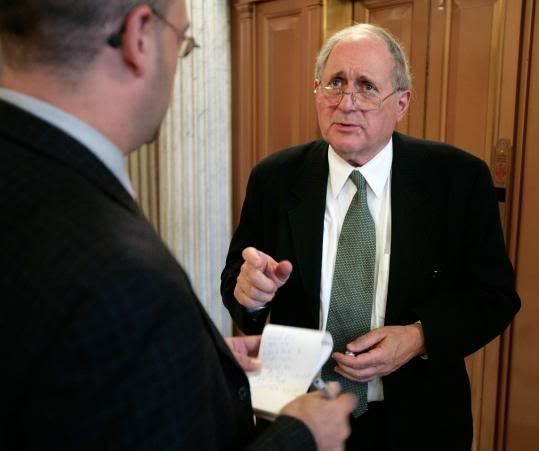
According to Senator Carl Levin of Michigan, discussing an Iraq troop-cut plan last month, US policymakers must consider a multitude of variables when planning reductions. (Alex Wong/Getty Images)

Will we now believe Ralph Nader when he says that there's not a dime's worth of difference between Democrats and Republicans?

The Boston Globe reports:
The Democrats' flagship proposal on Iraq is aimed at bringing most troops home. Yet if enacted, the law would still allow for tens of thousands of US troops to stay deployed for years to come.

This reality - readily acknowledged by Democrats, who say it's still their best shot at curbing the nearly five-year war - has drawn the ire of antiwar groups and bolstered President Bush's prediction that the United States will probably wind up maintaining a hefty long-term presence in Iraq, much as it does in South Korea.

For those who want troops out, "you've got more holes in here than Swiss cheese," said Tom Andrews, national director of the war protest group Win Without War and a former congressman from Maine.
The Democratic proposal would order troops to begin leaving Iraq within 30 days, a requirement Bush is already on track to meet as he begins reversing this year's 30,000 troop buildup. The proposal also sets a goal of ending combat by Dec. 15, 2008.

After that, troops remaining in Iraq would be restricted to three missions: counterterrorism, training Iraqi security forces, and protecting US assets, including diplomats.

This month, Senate Republicans blocked the measure, even though it was tied to $50 billion needed by the military, because they said it would impose an artificial timetable on a war that has been showing signs of progress.

Despite the GOP's fierce opposition and a White House veto threat, military officials and analysts say the proposal leaves open the door for a substantial force to remain behind. Estimates range from as few as 2,000 troops to as many as 70,000 or more to accomplish those three missions.

There are about 164,000 troops in Iraq now.

Major General Michael Barbero, deputy chief of staff for operations in Iraq, declined to estimate how many troops might be needed under the Democrats' plan but said it would be hard to accomplish any of the stated missions without a significant force.

"It's a combination of all of our resources and capabilities to be able to execute these missions the way that we are," Barbero said in a recent phone interview from Baghdad.

For example, Barbero said that "several thousand" troops are assigned to specialized antiterrorism units focused on capturing high-profile terrorist targets. But they often rely on the logistics, security, and intelligence provided by conventional troops, he said.

"When a brigade is operating in a village, meeting with locals, asking questions, collecting human intelligence on these very same [terrorist] organizations, that intelligence comes back and is merged and fed into this counterterrorism unit," Barbero said. "So are they doing counterterrorism operations?

"It's all linked and simultaneous. You can't separate it cleanly like that."

It's also difficult to say precisely how many US troops are tasked with training the Iraqi security forces.

Christine Wormuth, who served as staff director of General James Jones's commission on training Iraqi security forces, said she estimates some 8,000 to 10,000 troops are dedicated to training. These "transition teams" are tasked solely with training and equipping Iraqi police, army, air force, maritime, and intelligence forces.

But an undetermined number of additional troops provide "on the job" training for Iraqi security forces by conducting daily patrols and other combat missions alongside them, she said.

Last year, the Iraq Study Group, a bipartisan commission whose findings were the basis for the Democratic proposal, recommended that 10,000 to 20,000 troops should be embedded with Iraqi combat units.

Senate Democrats who championed the party's proposal say it was written deliberately to give the military flexibility and not cap force levels. Unlike their counterparts in the House, many Senate Democrats have opposed stronger measures that would set firm deadlines on troop withdrawals or effectively force an end to the war by cutting off money for combat.

"There's no way to say down the line how many insurgency threats there will be, how many militia threats there will be, how many Al Qaeda and other terrorist threats there will be," said Senator Carl Levin, Democrat of Michigan, chairman of the Armed Services Committee.

Still, Levin and other Democrats say the United States could still launch effective antiterrorism strikes in Iraq using elite special operations forces without the massive footprint of conventional forces.

"We've been told now that 90 percent of the Iraqi units are capable of taking the lead, so six or nine months from now we would expect those units would not only be taking the lead, they would be handling those missions," he said.

Thursday, November 15, 2007

Basra Militants Targeting Women

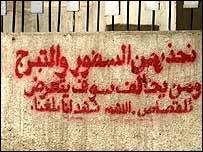
"We warn against immodest dress. Violators will be punished. God is witness that we have conveyed the message"
-Message written on a Basra wall

The BBC reports:
The chief of police in the southern Iraqi city of Basra has warned of a campaign of violence against women carried out by religious extremists.

It has, Maj-Gen Abdul Jalil Khalaf said, included threats, intimidation and even murder.

Some victims were dressed in indecent clothes by their killers or had notices attached to them, he said.

Women interviewed by the BBC said they no longer dared venture on to Basra's streets without strict Islamic attire.

"There is a terrible repression against women in Basra," Maj-Gen Khalaf told the BBC.

"They kill women, leave a piece of paper on her or dress her in indecent clothes so as to justify their horrible crimes."

Forty-two women were killed between July and September this year, although the number dropped slightly in October, he said.

In one case, he added, a woman was killed in her home along with her six-year-old son, who was rumoured to have been conceived in an adulterous relationship.
Maj-Gen Khalaf, sent to Basra this year by Iraqi Prime Minister Nouri Maliki to impose order in the city, said the police were often too scared to conduct proper investigations into the killings.

"The relatives are reluctant to report the crimes for fear of a scandal or because they despair of the police's ability to solve them," he added.

Women are being targeted amid a local power struggle

'Shot in the legs'

A female lawyer in Basra contacted by the BBC by phone from London, who asked not to be named for fear of reprisals, said attacks on women in the city were occurring "every two or three days".

She told the BBC about a university student who had been shot in the legs for not wearing an Islamic headscarf, or hijab.

The lawyer also said that graffiti was painted on walls warning women to cover their heads or "be punished".

She said she had been told by a group of men that she should be at home and get married instead of working.

"They said to me: 'If anyone's willing to offer a good price for you, we wouldn't think twice about selling you'," she said.

"When they see a woman going out to work and being successful, I'm sorry, but they feel inferior to her."

'Killed before their kids'

A mother-of-six and government employee in Basra, who wished to be identified only as Um Zeinab, told the BBC she had almost been run down by a motorcyclist one day while waiting for her bus to work.

"I was wearing a shirt with a skirt and some make-up, as I usually do," she said.

"I was waiting at the bus stop when the motorbike headed straight at me, full speed."

Luckily, the motorcyclist skidded and fell before reaching her.

She said she had heard of other women attacked but who had not been as lucky.

"Two women were killed in al-Makal district two days ago. People said they had received warnings before and then gunmen came to their homes and killed them, one in front of their kids."

Warring factions

Given the continuing power struggle in Basra between rival Shia militias, it was perhaps understandable that Gen Khalaf would not be drawn into naming names.

He blamed "dangerous criminals" trying to undermine stability in the city.

He also said that repression against women had been going on while British forces were still in the city, prior to their withdrawal to Basra airport in September.

Others were more direct in pointing the finger of blame at the rival Shia militias, known to have infiltrated the police and vying for control of Basra.

Um Zeinab called them "dark, fundamentalist extremists".

A spokesman for one of the largest Shia groups, the Sadrists of the radical cleric Moqtada Sadr, told the BBC that its members did not attack women or try to enforce Islamic law on women by violence.

But he did not rule out that others were doing so.

The next time some bullying neocon, like Sean Hannity or Clifford May, defends Bush and this war in Iraq by saying something as stupid as what Bush's father said just last week:
""Do they want to bring back Saddam Hussein, these critics (of Bush and the war)? Do they want to go back to the status quo ante? I don't know what they are talking about here. Do they think life would be better in the Middle East if Saddam were still there?"

...tell them, "You bet!"

Life was better in the Middle East, in the U.S., and everywhere else. More than a million Iraqis would still be alive, several million more would be at home in their country instead of living out of suitcases as refugees, looking for a nation that will take them so they can get on with their lives. Still millions more that have been left in Iraq would have food, water, electricity, streets without raw sewage, medicine and medical care, jobs, classes, gas, and hope for a future free from western occupation, curfews, blockades that have turned their neighborhoods into ghettos and the threat of being tortured and/or murdered at any time.

Americans would certainly sure be better off. Gas would be a whole lot cheaper, we'd have a trillion-and-half dollars less debt, several thousand U.S. soldiers would still be alive, and many thousand U.S. soldiers' would still have arms and legs and minds and homes and families. And there would be a whole lot less animosity towards us in the world.

Monday, November 12, 2007

A Cautionary Tale

Baghdad's Oasis of Tolerance

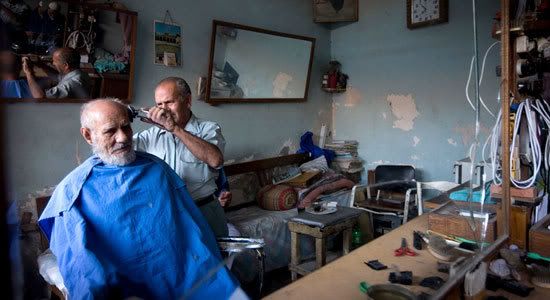
Abu Zeinab's barber shop is in the Bab al-Sheikh district of Baghdad, where Sunnis, Shiites, Kurds and Christians live together with unusual ease. (Johan Spanner for The New York Times)

The International Herald Tribune reports:
BAGHDAD: At its oldest spot, a small dusty strip of dirt road near a mosque, the neighborhood of Bab al-Sheik - a maze of snaking streets too narrow for cars - dates from a time, more than a thousand years ago, when Baghdad ruled the Islamic world.

At that time, orchards and palaces of Abbasid princes unfolded in stately splendor not far away.

Ten centuries later, Bab al-Sheik is less grand, but still extraordinary: It has been spared the sectarian killing that has gutted other neighborhoods, and Sunnis, Shiites, Kurds and Christians live together here with unusual ease. It has been battered by bombings around its edges, but the war has been kept from its heart, largely because of its ancient, shared past, bound by trust and generations of intermarriage.
"All of these people grew up here together," said Monther, a suitcase seller. "From the time of our grandfathers, same place, same food, same everything."

Much of today's Baghdad sprang into existence in the 1970s, when oil nationalization drew Iraqis from all over the country to work. The city's population more than tripled over the course of 20 years and new neighborhoods sprawled east and west.

The war and civil conflict have seemed to take a heavier toll in those areas than in some of the older neighborhoods.

No one knows this better that Waleed, a rail-thin Bab al-Sheik native who 10 years ago moved his family to Dora, a newly built middle-class neighborhood in southern Baghdad.

In Dora, residents were from all over. That never seemed to matter until the basic rules of society fell away after the U.S. occupation began. The only bulwark left against complete chaos was trust between families, and in Dora there was not enough.

"We didn't know each other's backgrounds," said Waleed, sitting with Monther in a barbershop in Bab al-Sheik, rain spitting on the street outside. Neither man wanted to be identified by their last names out of concern for their safety.

"Here, he can't lie to me," he said, jabbing a finger in Monther's direction. "He can't say, 'I'm this, I'm that,' because I know it's not true."

In Dora, he said, he did not have those powers of discernment. And he paid the price: His son was shot and killed on Oct. 9, 2006, while trying to get a copy of his high school diploma. Waleed moved his family out of the area immediately. "My first thought was this neighborhood," he said. "My grandfather is from here. I always felt safe here."

So did two reporters, who made six visits to the area over two months. It was safe enough, in fact, to walk through the warren of narrow streets, nod at elderly women sitting at street-level windows, linger in a barbershop and make long visits to Sunni, Shiite and Kurdish homes.

On a recent Friday, an extended Kurdish family relaxed at home. The living room was dark and cool, tucked in an alley away from the afternoon sun. Abu Nawal, the father, recounted how a group of men from the office of the Shiite cleric Moktada al-Sadr came to a local café, proposing to set up shop in the area.

The café owner pointed to a sign, which stated in dark script that all discussions of politics and religion were prohibited. The men were then asked to leave.

"The guys in the neighborhood said, 'If you try to make an office here, we will explode it,' " said Abu Nawal, a shoemaker whose family has lived in the neighborhood for four generations.

Some time later, Sunni Arab political party members came and were similarly rebuffed. "They wanted to put their foot in this neighborhood, but they couldn't," said Abu Nawal, who asked to be identified by his nickname for the safety of his family.

He said he despised the poisonous mix of religion and politics that has strangled Iraqi society, and he enjoyed cracking wry jokes at politicians' expense. Playing off the names for extremist militias, which call themselves names like the Islamic Army, he refers to his group of friends as the Arak Army, righteous defenders of an anise-flavored alcoholic drink.

The neighborhood has another rare asset: moderate religious men. Sheik Muhammad Wehiab, a 30-year-old Shiite imam whose family has lived in Bab al-Sheik for seven generations, was jailed for 14 months under Saddam Hussein, a biographical fact that should have opened doors for him in the new Shiite-dominated power hierarchy. But his moderate views were unpopular in elite circles and he has remained in the neighborhood.

He feels connected. So much so that while talking on the phone one night this autumn, he walked out into the tiny alley outside his door, lay down and watched the stars in the night sky.

"I think Maliki right now is envying me," Wehiab said to himself. "No bodyguards. Just free. This is the blessing."

He has some radical views. One of them is that Muslims have behaved terribly toward one another in the war here and have given Islam a bad name in using it to gain power. "I don't blame those guys who drew the cartoons," Wehiab said, referring to the Danish caricatures of the Prophet Muhammad that sparked riots and protests across the Islamic world last year.

"Muslims are the ones to be blamed," he said, sitting in an armchair in his quiet living room. "They have given them this picture." An ice-cream seller walked past his window, hawking in a loud voice.

Wehiab's friend, a Sunni cleric, holds a similar view. "The greatest jihad is the jihad of yourself," said the cleric, whose smooth voice echoes through the neighborhood as he calls worshipers to prayer every day at Qailani Mosque, the neighborhood's anchor.

The cleric, who asked that his name not be published out of concern for his safety, because of the high profile of the mosque, lovingly ticks off qualities of the 12th-century Sufi sheik Abdel Qadr Qailani, who gave the mosque its name: Intellectual. Scholar. Moral teacher.

But moderate religion is not drawing an audience on a national scale, and the mosque, one of Baghdad's most important Sunni institutions, has fallen on hard times.

Donations are down. Its long-running soup kitchen serves one meal a day instead of three. Sufi clerics cannot perform their rituals. A bomb sheared off part of a minaret in February.

"Please, please, write as much as you can that we don't want war," the cleric said.

We like to think that ethnic cleansing and the wholesale slaughter of innocent civilians that has taken place in lands exotic and far away to Americans, such as Iraq, the Balkans, and Rwanda, could never happen here. But it can, and more easily than we'd like to think.

IRAQ: Fewer Deaths Bring No Reassurance

Despite claims by Iraqi Prime Minister Nouri al-Maliki and Bush administration officials that violence in Iraq is decreasing, residents in the capital tell a different story.

At IPS News, Ali al-Fadhily writes:
Attacks by Iraqi resistance groups against the U.S. military continue in Baghdad and Iraq's al-Anbar province, despite U.S. military support for certain Sunni militias in the areas.

According to the U.S. Department of Defence, 18 U.S. soldiers were killed in Baghdad and al-Anbar in October. In all 39 U.S. soldiers were reported killed in Iraq for the month, making it the lowest monthly total since March 2006.

Despite the relatively low October numbers, 2007 is on pace to be the deadliest year on record for U.S. troops since the invasion of March 2003. At least 847 U.S. military personnel have been reported killed this year in Iraq, making it the second highest toll yet.

The deadliest year was 2004, when 849 U.S. military members were killed.
But many Iraqis say that violence elsewhere continues unreported - and that where there is calm, it is hardly for reassuring reasons.

"Sectarian killings are less because all the Sunnis have been evicted from mixed areas in Baghdad," Salman Hameed, a teacher who was evicted from the al-Hurriya area west of Baghdad eight months ago told IPS. "All my relatives and Sunni neighbours who survived the killing campaign led by the militias under the eyes of American and Iraqi forces have fled either to Syria or to other Sunni cities."

On Nov. 5 Iraqi Prime Minister Nouri al-Maliki declared victory during a rare walkabout in Baghdad as night fell. "We have achieved victory against terrorist groups and militias," Maliki told reporters. "Things will not return to the way they were."

Many Iraqis feel that the reason for the relative calm is that many people have either fled, or been killed.

"There is no one left for them to kill," 55-year-old retired teacher Nathum Taha told IPS in Baghdad. "The Americans continue to use Arab Shia Iraqi militias to kill Sunnis, but most people have left by now."

Others blamed the media for lack of adequate reportage.

"Attacks against U.S. forces are not much less than they were last month, but media coverage has almost disappeared," Muhammad Younis from Mosul, in Baghdad on a business trip, told IPS. "The resistance is moving fast and changing locations in order to avoid intelligence provided by collaborators. Most Iraqis hate the Americans more than ever after the death and destruction caused by their occupation."

There was a reported five-fold increase in the number of bombs dropped on Iraq during the first six months of 2007 compared to the same period in 2006. Over 30 tonnes of these were cluster weapons, which take a particularly heavy toll on civilians.

"American air raids are increasing in a way that shows a total failure on the ground," a retired general of the dissolved Iraqi army told IPS. "A whole family was killed near Madayin, southeast Baghdad on Saturday (Nov. 3) just after the tragic bombing of houses south of Tikrit (about 100 km north of Baghdad) where more than 10 civilians were killed."

On Nov. 4, Iraqi army personnel backed by U.S. soldiers detained 12 people during a raid on the Sunni Abu Hanifa mosque in the Adhamiyah district of northern Baghad.

"Those American and government forces could not face the resistance fighters, so they arrest innocent people," Aziz Thafir, a lawyer who witnessed the arrests, told IPS. "They started their raid with nasty sectarian words against Sunnis, and then arrested every one who was around in the mosque."

Sectarian violence, which many Iraqis believe to be backed by the U.S., continues at many places where there are still mixed communities left.

In Duluiya, 150 km north of Baghdad, a U.S. army unit raided a house last week and killed a young man inside. Witnesses who arrived in Baghdad from the Sunni town complained that the media is not covering either the resistance activity there or the regular "crimes" committed by U.S. and Iraqi government forces against innocent civilians.

"They are more vicious than they were before," 44-year-old Abu Ahmed told IPS in the capital. "This is a religious war against Sunnis, who would not accept the occupation and division of the country."

IRAQ: A Tale of One City, Now Two

The separation of religious groups in the face of sectarian violence has brought some semblance of relative calm to Baghdad. But many Iraqis see this as the uncertain consequence of a divide and rule policy.

At IPS News, Ali al-Fadhily writes:
Claims are going the rounds that sectarian violence in Iraq has fallen, and that the U.S. military "surge" has succeeded in reducing attacks against civilians. Baghdad residents speak of the other side of the coin – that they live now in a largely divided city that has brought this uneasy calm.

"I would like to agree with the idea that violence in Iraq has decreased and that everything is fine," retired general Waleed al-Ubaidy told IPS in Baghdad. "But the truth is far more bitter. All that has happened is a dramatic change in the demographic map of Iraq."
And as with Baquba and other violence-hit areas of Iraq, he says a part of the story in Baghdad is that there is nobody left to tell it. "Most of the honest journalists have left."

"Baghdad has been torn into two cities and many towns and neighbourhoods," Ahmad Ali, chief engineer from one of Baghdad's municipalities told IPS. "There is now the Shia Baghdad and the Sunni Baghdad to start with. Then, each is divided into little town-like pieces of the hundreds of thousands who had to leave their homes."

Many Baghdad residents say that the claims of reduced violence can be tested only when refugees go back home.

Many areas of Baghdad that were previously mixed are now totally Shia or totally Sunni. This follows the sectarian cleansing in mixed neighbourhoods by militias and death squads.

On the Russafa side of Tigris River, al-Adhamiya is now fully Sunni; the other areas are all Shia. The al-Karkh side of the river is purely Sunni except for Shula, Hurriya and small strips of Aamil which are dominated by Shia militias.

"If the situation is good, why are five million Iraqis living in exile," says 55- year-old Abu Mohammad who was evicted from Shula in West Baghdad to become a refugee in Amiriya, a few miles from his lost home.

"Americans and Iranians have succeeded in realising their old dream of dividing the Iraqi people into sects. That is the only success they can talk about."

Violence is no more hitting the headlines, but it clearly continues. Bodies of Iraqis killed after being tortured are still found in garbage dumps, although fewer than a few months ago.

"Iraqi and American officials should be ashamed of talking of 'unidentified bodies'," Haja Fadhila from the Ghazaliya area of western Baghdad told IPS. "These are the bodies of Iraqis who had families to support, and names to be proud of. But nobody talks about them, there is no media. It is as if it is all taking place on Mars."

The Iraqi ministries for health and interior have said that they are finding on average five to ten "unidentified bodies" on the streets of Baghdad every day.

"Those Americans and their Iraqi collaborators in the Green Zone talk of five or ten bodies being found everyday as if they were talking of insects," Thamir Aziz, a teacher in Adhamiya told IPS. "We know they are lying about the real number of martyrs, but even if it's true, is it not a disaster that so many innocent Iraqis are found dead every day?"

Most people blame the Iraqi police for the sectarian assassinations, and the U.S. military for doing little to stop them.

"The Americans ask (Prime Minister Nouri al) Maliki to stop the sectarian assassinations when they know very well that his ministers are ordering the sectarian cleansing," Mahmood Farhan from the Muslim Scholars Association, a leading Sunni group, told IPS.

A UN report released September 2005 held interior ministry forces responsible for an organised campaign of detentions, torture and killings. It said special police commando units accused of carrying out the killings were recruited from the Shia Badr and Mehdi militias.

Retired Col. James Steele, who served as advisor to Iraqi security forces under former U.S. ambassador John Negroponte, supervised the training of these forces.

Steele had been commander of the U.S. military advisors group in El Salvador in 1984-86; Negroponte was U.S. ambassador to neighbouring Honduras 1981-85. Negroponte was accused of widespread human rights violations by the Honduras Commission on Human Rights in 1994. The Commission reported the torture and disappearance of at least 184 political workers.

The violations Negroponte oversaw in Honduras were carried out by operatives trained by the CIA, according to a CIA working group set up in 1996 to look into the U.S. role in Honduras.

The CIA records document that "special intelligence units", better known as "death squads", comprised CIA-trained Honduran armed units which kidnapped, tortured and killed thousands of people suspected of supporting leftist guerrillas.

Negroponte was ambassador to Iraq for close to a year from June 2004.

Friday, November 09, 2007

No Patriot, He

Ex-President George H.W. Bush, tries to have it all ways.


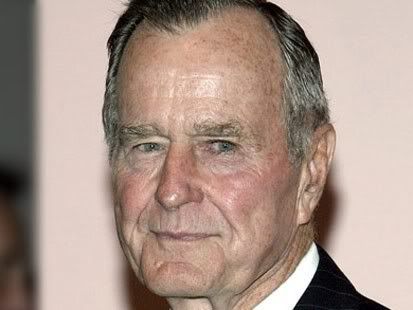
Ever since Brent Scowcroft wrote an op-ed in the WSJ recommending that Bush the Lesser not attack Iraq, political pundits and journalists have been putting forth that it was the elder Bush's way to broadcast that he was opposed to it and to try to talk his son out of taking the nation to war in Iraq.

Not so.

Pundits seemed to base their belief about the elder Bush's opposition to his son's plans on the fact that Scowcroft was, after all, the elder Bush's national security adviser and one of his closest friends for decades, as well as on the elder Bush's own defense of his controversial decision not to attack Baghdad and topple Saddam in 1991:
"Trying to eliminate Saddam ... would have incurred incalculable human and political costs ... Had we gone the invasion route, the United States could conceivably still be an occupying power in a bitterly hostile land"

To be fair to the pundits and journalists, Bush 41 went to great lengths to create the impression that he was conflicted, at the least, about his son's plans. In a book that was published in the spring of 2004 (The Bushes: Portrait of a Dynasty), the authors cite an interview they had in the summer of 2002 with the elder Bush's sister. She said her brother had expressed his "anguish" about the administration's preparations for war:
"But do they have an exit strategy?" the former President is quoted as worrying.

"Although he never went public with them," the authors assert, "the President's own father shared many of [the] concerns" of Brent Scowcroft, his national security adviser and a leading war opponent.

Yet close friends and associates said the older Bush, while fiercely proud and protective of his son, nevertheless harbors concerns about the war and its aftermath.

The New York Daily News reported:
"'Although he never went public with them,' the authors assert, 'the President's own father shared many of [the] concerns' of Brent Scowcroft, his national security adviser and a leading war opponent. Close friends and associates said the older Bush, while fiercely proud and protective of his son, nevertheless harbors concerns about the war and its aftermath. These sources told The News that aside from his 'exit-strategy' fears of a prolonged, bloody conflict, the ex-President is troubled that the war fractured the international coalition he painstakingly assembled to expel deposed Iraqi dictator Saddam Hussein from Kuwait in 1991. One close associate said the older Bush feels Vice President Cheney and Secretary of Defense Donald Rumsfeld may have pushed President Bush too hard for a preemptive strike. One well-placed Bush colleague said the older Bush recently acknowledged, 'I'm having trouble with my boy,' referring to Iraq."

At the time, a top Bush aide denied the allegations in the Schweizer book to the NY Daily News, saying that Bush the elder supported his son on the war in Iraq without reservations "from the very first day." The book is hardly a hit piece. The authors, Peter and Rochelle Schweitzer, were given unprecedented access to and enjoyed the cooperation of the Bush family and their friends; the history of the family is presented in a positive light.

Pundits and journalists embraced the denied version, ignoring what the elder Bush and his closest aides were saying publicly (that he supported his son's decision), even during the campaign for the 2004 election when, (Emotional Elder Bush Attacks Son's Critics):
An emotional former President George H.W. Bush Tuesday defended his son's Iraq war and lashed out at White House critics.

It is "deeply offensive and contemptible" to hear "elites and intellectuals on the campaign trail" dismiss progress in Iraq since last year's overthrow of Iraqi leader Saddam Hussein, the elder Bush said in a speech to the National Petrochemical and Refiners Association annual convention.

"There is something ignorant in the way they dismiss the overthrow of a brutal dictator and the sowing of the seeds of basic human freedom in that troubled part of the world," he said.

The former president appeared to fight back tears as he complained about media coverage of the younger Bush that he called "something short of fair and balanced."

"It hurts an awful lot more when it's your son that is being criticized than when they used to get all over my case," said Bush, who has often complained about media coverage of both Bush presidencies.

Iraq has been torn by violence and instability since a U.S.-led invasion last year toppled Saddam in the hunt for his alleged weapons of mass destruction. No such weapons have been found but the Bush administration says progress toward a stable democracy is being made.

The former president, who waged the first Gulf War against Saddam in 1991, described progress in Iraq as "a miracle."

"Iraq is moving forward in hope and not sliding back into despair and terrorism," he said.

I never bought the 'kinder, gentler' George H.W. Bush (not when he was in office or after he was ousted in the 1992 election), nor that he was ever not completely on board with his son's aggression on Iraq. Just as I've never bought that Hillary Clinton was deceived by Bush and Cheney before voting to authorize the war in Iraq. She is a careful and deliberate taskmaster, married to a former president who was getting daily briefings by the CIA. I do not believe that she didn't discuss the situation thoroughly with her husband (who is also her chief advisor) before casting the most important vote of her political career.

In the years since this war has gone south and has proven to be the worst mistake probably ever undertaken by an American president, the elder Bush has encouraged the pundits to believe he wasn't for the war by insinuating that he's "a father first, who loves and supports his son," hence, "don't expect (as you would from former presidents) any sense of patriotism, duty and loyalty first to the country and Constitution" from him. The media laid off former President Bush, as well as his BBF ('Best Friend Forever'), former President Clinton.


So again, back declaring his unabashed love for his son and "his president," ABC News reports:
Former president George H.W. Bush forcefully defended his son's handling of the Iraq war Thursday, saying critics of the current president have forgotten the "extraordinary brutality" of deposed Iraqi leader Saddam Hussein.

"Do they want to bring back Saddam Hussein, these critics?" the elder Bush told USA TODAY in a rare interview. "Do they want to go back to the status quo ante? I don't know what they are talking about here. Do they think life would be better in the Middle East if Saddam were still there?"
Bush, 83, was interviewed in a replica of the White House Situation Room at his remodeled presidential library. The Bush Presidential Library and Museum, on the grounds of Texas A&M, is reopening Saturday after an $8.3 million renovation. The added features include the Situation Room and an interactive computer program that allows visitors to consider options Bush weighed during the Gulf War.

In one key decision, Bush rejected calls to topple Saddam, instead declaring the war over after Iraqi forces withdrew from Kuwait. The program calls the idea of going to Baghdad "very tempting" but says it "would have been a disastrous decision," splintering the international coalition and leaving U.S. and possibly British troops on their own in Iraq.

"It's not second-guessed quite so much today, but it was second-guessed" at the time, Bush said of his judgment that combat should end. "But the coalition was formed with my word to the various international leaders, 'The objective is to kick Saddam Hussein out of Kuwait,' " not some further-reaching goal.

Bush dismissed a question about whether his son should have used similar reasoning before invading Iraq in 2003. Saddam fled into hiding, was captured and executed after a trial. About 165,000 U.S. troops remain deployed there during the war's fifth year.

Other analysts have made the comparison, however. "Historians, I believe, will say he made a wise judgment on what could be expected if we went into Iraq," presidential historian Robert Dallek says. "By contrast, Bush 43 has found his presidency ruined, one might say, by this Iraq war."

The elder Bush reacted testily when asked about criticism of his son. "I don't reminisce with … my friends like you about what my son does or doesn't do," Bush said. But "I think we forget even today the extraordinary brutality of Saddam Hussein."

Including his plans to assassinate the elder Bush?

"Well, that didn't endear him to me at all," he said.

Reporters are still fixated on this story, debunked years ago and written about by Seymour Hersh in the November 1, 1993 edition of the New Yorker, "A Case Not Closed":

“A senior White House official recently told me that one of the seemingly most persuasive elements of the report had been overstated and was essentially incorrect. And none of the Clinton Administration officials I interviewed over a ten-week period this summer claimed that there was any empirical evidence -- a “smoking gun” -- directly linking Saddam or any of his senior advisers to the alleged assassination attempt. . . ."

This did not stop President Bill Clinton from using the story of an attempt on ex-President Bush's life as an opportunity to whittle down Saddam Hussein's operations:
On Saturday, June 26, 1993, twenty-three Tomahawk guided missiles, each loaded with a thousand pounds of high explosives, were fired from American Navy warships in the Persian Gulf and the Red Sea at the headquarters complex of the Mukhabarat, the Iraqi intelligence service, in downtown Baghdad....

Three of the million-dollar missiles missed their target and landed on nearby homes, killing eight civilians, including Layla al-Attar, one of Iraq’s most gifted artists. The death toll was considered acceptable by the White House; after all, scores of civilians had been killed in the Reagan Administration’s F-111 bombing attack on Muammar Qaddafi’s house-and-office complex in Tripoli Libya, in 1986....

We responded with an over-the-top reaction to a, basically, unfounded claim.
The former president rarely agrees to interviews, although he appeared on Fox News Sunday this week and taped an interview with C-SPAN Thursday to talk about his revamped library. Questions like those raised by USA TODAY are one reason he generally eschews the press, he said.

"You're here to talk about the library," he said, not about the current president. "He has my full, unequivocal support. I feel about him great respect for what he's doing and tries to do, and I think much of the criticism is grossly unfair. … That's a father caring about his son and his president."

Say what you will about Jimmy Carter, he's got the courage of his convictions (Jimmy Carter Slams Iraq War, Sees Gitmo Trials As An 'Impetus' For Terrorism).

Wednesday, November 07, 2007

Another Day, Another War Crime Swept Under a Rug

UPI reports:
The U.S. Army does not have enough evidence for murder charges against a U.S. soldier accused of killing a wounded Iraqi near Kirkuk, a military official ruled.

Lt. Col. Raul Gonzalez has recommended aggravated assault instead of murder charges be lodged against Spc. Christopher P. Shore, the Atlanta Journal-Constitution reported Wednesday.

During a hearing in Hawaii, Shore said his commanding officer, Sgt. 1st Class Trey A. Corrales, ordered him to "finish" a detainee who was on the ground bleeding, the newspaper said. The man died two days later.

Gonzalez, the presiding officer investigating the case, said evidence indicated Corrales -- not Shore -- shot and hit the victim multiple times with an M-4 rifle and displayed intent to kill.

Furthermore, Gonzalez said Corrales created an "unhealthy environment" for his platoon via his "abusive" and "unlawful" behavior, the newspaper said.

Shore, home in Winder, Ga., on leave, told the Journal-Constitution he was relieved by the decision.

"I think the man did the right thing," he said.

Tuesday, November 06, 2007

Destroy Or Investigate? Commanders Pushed To Make Bomb Disposal Choices

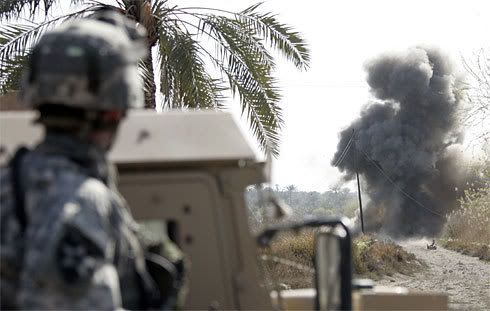
A U.S. soldier takes cover as an improvised explosive device is detonated near Baghdad. A new order lets officers decide whether to blow up IEDs or have technicians dismantle them.

USA Today reports:
During their last six months in Baghdad last year, Navy Lt. Sarah Wilson and her team of explosive ordnance disposal technicians said goodbye to each other more than 70 times.

Each time they were called to dismantle a roadside bomb, they'd bump fists. Then, Wilson says, "we'd all say we love each other because if we never got to say anything else" — if the bomb ended up exploding — "we wanted to be able to say goodbye."

After they arrived at the scene, they would often begin a perilous, painstaking task: taking apart the bombs, bagging the components and sending the parts back to a unit that analyzes them, much as investigators do on the television show CSI.
They were willing to take such risks, Wilson says, because "it's the best shot our guys on the ground have of … catching the bad guys." If forensic teams can lift a fingerprint or identify materials used in a series of bombs, "we can connect him," says Wilson, 27. "We know he's a bombmaker."

When roadside bombs became the insurgency's weapon of choice in Iraq, explosives disposal teams became increasingly important in efforts to protect U.S. troops and crack the bombmaking networks. But now, top military officials appear to be compromising efforts to catch bombmakers in favor of expedience and mobility, a USA TODAY investigation shows.

U.S. Marine Sgt. Raphael Hernandez, an explosives technician, examines a device that was fired from an improvised rocket launcher near a bridge in Habaniyah, Iraq, last January.

A classified order, issued May 30 and reviewed by USA TODAY, gives commanders the authority to forgo calling in explosives technicians like Wilson to glean intelligence from improvised explosive devices, or IEDs. Instead, commanders may use engineers traveling with their regular units to simply detonate the bombs — without gathering evidence from them. Engineers receive about 10% of the explosives training of technicians, and they're not allowed to dismantle bombs.

Commanders and others see the process, dubbed "blow and go," as a way to keep convoys and combat teams moving and safe from snipers and ambushes. But the Army's new approach also runs counter to military doctrine — and to the Pentagon's long-term goal of getting one step ahead of the insurgency by learning about the networks that build, plant and trigger IEDs. The weapon is responsible for at least 60% of U.S. casualties in Iraq.

"The blow-and-go strategy undermines and compromises those overall efforts by losing key biometrics and evidence needed to identify and capture the network of insurgents," says Rep. Solomon Ortiz, D-Texas, a senior member of the House Armed Services Committee and chairman of the subcommittee on military readiness.

"This is a huge step backward in the long-term effort to prevent IED attacks from occurring in the first place," Ortiz says, "and puts the troops at risk of facing more IED attacks for a long time to come."

The head of the Army Asymmetric Warfare Office, which helps combat forces counter IEDs, also is concerned. "What are we accomplishing by blowing and going?" asks Col. Dick Larry. "You rid yourself of that one device, but the problem is … you have not gotten any kind of exploitative information off it."

In July, a USA TODAY investigation showed that, until last year, the Pentagon balked at pleas from officers in the field for safer vehicles to protect against IEDs. One of the explanations offered by Defense officials for not spending more money on the life-saving armor: that the military's focus was on stopping bombmaking networks before they planted the explosives.

In its annual report last year, the military's Joint IED Defeat Organization (JIEDDO), called attacking the networks "the lynchpin of our success." Its deputy director, Robin Keesee, estimated last month that as many as 160 such insurgent cells have been identified in Iraq.

And the organization's report listed forensic analysis of bombs — determining how the devices were manufactured, and what parts and types of explosives were used — among the efforts that were providing "unprecedented" intelligence capability.

Among the successes touted by the Pentagon: linking Iran to a particularly dangerous incarnation of the IED, the explosively formed penetrator. "Iranian TNT blocks removed from their packages have been seen on numerous occasions as IED components," according to a Feb. 11 Pentagon PowerPoint presentation in Baghdad.

"I don't want to give away the king's secrets here, but yes, (forensic analysis) was fruitful," says Paul Plemmons, a retired Army colonel who used to command a task force that dismantled bombs. "A bomber is a bomber, and they leave signatures. We saw patterns. We could track patterns."

"We know the engineers are not going to collect forensic data, and the way you defeat that weapon is getting at the forensics," Plemmons says. "We may lose the one device that will lead us to take a whole cell down if you blow and go."

JIEDDO spokeswoman Christine DeVries would not characterize the importance of such analysis, saying that the group is wary about giving too much information to the enemy. But she did say it is "one of the tools that have enabled forces in theater to eliminate a significant number of IED cells."

The need for mobility

When U.S. forces invaded Iraq in March 2003, few foresaw how prevalent or deadly roadside bombs would become. But by that fall, IEDs had emerged as the biggest threat to troops, and the teams that would dismantle the bombs — the explosives technicians — were stretched thin.

In the first months of the war, only a few dozen technicians were in Iraq. Today, including commanders, more than 500 are deployed, many embedded within units.

"When we were first there, the rules of engagement were, 'Let's just destroy all these IEDs,' " recalls Marine Master Sgt. Michael Burghardt, an explosives technician.

During the past two years, Burghardt says, that approach changed. When he was working in Ramadi, Burghardt says, he was collecting intelligence from about 90% of the IEDs he handled.

Today, explosives technician teams try to collect evidence from "every scene," says Army Col. Karl Reinhard, who commands the Army, Navy and Air Force explosives disposal teams in Iraq. From December 2006 through September 2007, he says technicians have handled more than 6,000 IEDs. Since the war began, he says, records show about 80,000 such bombs were planted.

"Some of the information we would glean would be negligible. Other times, it would be important," Reinhard says. The danger of blowing and going, he says, is that "you never know which needle in the haystack is going to be an important needle."

Military doctrine — specifically, a publication titled Barriers, Obstacles and Mine Warfare for Joint Operations and prepared by the Joint Chiefs of Staff — reinforces the unique role of explosives disposal teams. The document, dated April 26, characterizes the work of those teams as "an essential part of the overall effort to develop a detailed forensic database to target centers of gravity in the IED system."

"In addition to developing actionable intelligence to support future operations," the document says, reports from explosives disposal teams have "an immediate impact on refining unit level force protection-related tactics, techniques and procedures."

A U.S. Humvee burns in April near Samarra, about 60 miles north of Baghdad, after an improvised explosive device detonated near its convoy. Roadside bombs account for more than half of the U.S. combat deaths in Iraq.

Since 2006, the military has taken significant steps to get more explosives disposal teams throughout the war zone.

Col. Kevin Lutz, an explosives technician set to replace Reinhard next year, says the military has tripled the number of explosives disposal teams in Iraq during the past 18 months — going from about 50 to about 150 three-person teams. Even so, when the tech teams are called to an IED, getting them to the site and letting them gather the intelligence often takes time. Sometimes, the delay is 30 minutes. Occasionally, it extends for hours.

Engineers have been lobbying to take a more active approach in destroying roadside bombs for the past few years, Lutz and others say. The engineers' traditional mission — to breach obstacles to keep units mobile — was arguably more important during the invasion of Iraq than it is now, given the military's current role policing the country.

Nevertheless, officials set up a training course, taught by explosives technicians, to help prepare engineers to detonate IEDs. Reinhard says those engineers receive less than 100 hours of training. Explosives technicians train for more than 1,100 hours, he says.

On May 30, Lt. Gen. Raymond Odierno, the second-ranking U.S. commander in Iraq, issued the order that empowers commanders to let engineers blow and go.

"The intent of the order was to allow qualified individuals to detonate explosives rather than waiting for others who may not be readily available," explains Brig. Gen. Michael Silva, an Army engineer who says he lobbied Odierno for the change. "It was a way to improve the efficiency of the route clearing team operations so we were actually enabling the soldiers to do the job that they needed to get done."

IEDs 'just an obstacle'

An instructor who teaches engineers at Fort Leonard Wood in Missouri says the order makes sense.

"If you look at IEDs as just an obstacle, one of the engineer functions is just to remove obstacles," says Maj. Eric Goser, executive officer of the Counter Explosive Hazard Center. "Bottom line: The IED to an engineer is no different than a log obstacle," Goser says. "A log … is an obstacle. You deal with that obstacle in a certain way."

Goser's logic troubles explosives technicians. "The difference is, the log obstacle won't kill you," says Reynold Hoover, a former explosives technician who worked as a special agent with the Bureau of Alcohol, Tobacco and Firearms and served in the first Gulf War.

"You're gaining mobility," Hoover says, "but what you're losing is the ability to find the bombmaker and the supply chain."

Moreover, the amount of time saved by blowing and going may not be much, Reinhard says. He says a study done this year by his task force estimates "the expected value of the time they could save would be 20 minutes, on average."

"Nobody wants to sit out on the battlefield for three to four hours," he says. "Two or three years ago, they were waiting that long. It's definitely not like that any more."

Statistics on response times are classified, but Reinhard says explosives technicians are now able to arrive relatively quickly at IED sites. "For instance, in the north, 85% of the responses in the last week of September were 90 minutes or less," he says. Lutz says a long wait for explosives technicians today is "an outlier."

Engineer Silva, who is no longer on active duty, is skeptical. He believes information released by the explosives technicians may be "skewed" against giving engineers more of a role.

"My belief is that there was a parochialism engaged there — parochial in the fact that they want to be the only ones … blowing" IEDs, Silva says of explosives technicians.

Do risks outweigh benefits?

It's unclear how often commanders have used the blow-and-go approach. Reinhard says records he reviewed showed engineers detonated "approximately 120" IEDs from June through mid-October — about one a day.

But Army Col. Peter DeLuca, commander of the 20th Engineering Brigade, estimates engineers he oversees blow and go at least three or four IEDs each day — far more than the records reviewed by Reinhard indicate.

"There's been a ramp-up," Reinhard explains. "They may both be true" he says of the figures.

Others aren't certain. "No one is keeping good track of that," says Larry, who heads the Army's anti-IED efforts. "How do we know what they're doing," he says of engineers, "if they don't report it?"

Odierno's order specifies that engineers can only detonate relatively simple IEDs, using devices such as robots and the robotic arm of Mine Resistant Ambush Protected vehicles — machines that keep troops out of harm's way.

"We have very, very strict limitations about what we are and what we're not supposed to blow up," says Army Spc. Walter Hayden, the 1st Platoon team leader with the 1203rd Engineer Battalion. "If I ever have any kind of doubt," he says, he calls in explosives technicians.

Silva says he can see the amount handled by engineers growing — and the limitations on engineers being lifted as training improves. To date, neither DeLuca nor Reinhard believes any engineers have been hurt while blowing and going.

Despite reservations, Reinhard says he doesn't "object to the engineers doing this provided that they can live within the bounds that sometimes you need to pause and take the time to exploit."

But some explosives technicians fear that engineers will overstep their mission — and make deadly mistakes. Burghardt says he and his team dismantled more than 900 IEDs during his three tours in Iraq. The one that detonated — the one that left six holes in his body, cracked his tailbone, threw him 10 feet and knocked him unconscious in September 2005, despite the protective gear he wore — was unlike any he had seen.

"It was the first time we saw the tactic of where they double stacked it," says Burghardt, 37, now stationed at Camp Fuji, Japan. "I was standing on top of the device when I was clearing it … and they just leave enough earth in between" that the device beneath the other IED was difficult to spot.

Burghardt's experience is what makes explosives technicians wary of the new order — particularly, the idea that engineers will be able to discern a simple IED from a more sophisticated one. "What's simple?" Burghardt asks rhetorically. "You're not going to know that until it's too late."

Such mistakes put troops and civilians at risk. In a 2005 paper for the Marine Corps War College, Lutz chronicled cases in which mistakes by engineers cost lives.

Two different cases during the first Gulf War in 1991 "led to the massive chemical exposure and contamination of thousands of coalition forces and non-combatants, and the loss of seven United States soldiers," Lutz wrote. The reason for one of the mishaps at As Salman Airfield in Iraq: "Engineers were clearing munitions they were unfamiliar with and that turned out to be some of the most deadly unexploded ordnance our inventory can produce."

He wrote that, "buried within the … investigations, point papers, after-action reports, lessons learned from the various units (now in Iraq) … one can find repetitive incidents where the improper destruction of (explosives) led to severe contamination of the surrounding area and caused injury, death and destruction of equipment and facilities to both United States Armed Forces and to the local Iraqi civilian population."

Explosives technician Plemmons put it more tersely. He says the difference between an engineer and an explosives technician handling an IED is like the difference between "your physician's assistant" and "an orthopedic surgeon."

Friday, November 02, 2007

"I Sold My Soul For the Company Store"

Lindsey Graham's big photo op, two days after backing down on his oh so principled stand against torture, agreeing to support Bush's nominee for Attorney General, Michael Mukasey, despite Mukasey's failure to declare waterboarding torture.


The State reports:
It has taken a few years to get Columbia’s white house ready — more than 120 years all told — but Kirkman Finlay believes his home is ready for the resident of the most famous White House.

Today, Finlay, his wife, Kathleen, and three children will host President George W. Bush and more than 500 others at a campaign fundraiser for U.S. Sen. Lindsey Graham at the Finlay home.

Planning Southern hospitality on a presidential scale has not been easy, Finlay said.

“It’s all about trying to make it as presentable as you can. To have your home look as good as possible for what I consider a historic event.”

Finlay is a Columbia City Council member and the son of former Columbia Mayor Kirkman Finlay Jr. He is also advising former U.S. Sen. Fred Thompson’s S.C. presidential campaign.

Thursday morning, workers were adjusting the tents set up in the backyard for the lunchtime visit. Elsewhere, landscapers spruced up the lawn and shrubbery and tidied mulch.

Stage set for Lindsey Graham fundraiser with Bush as the centerpiece: "Finlay has polished mansion for president’s fundraising visit today." Ronnie Monts rakes the driveway Thursday at Columbia City Councilman Kirkman Finlay’s home in preparation for today’s visit by President Bush.

Finlay declined to discuss much of the preparation for security reasons, and did not allow a tour of the property. Likewise, neither the White House nor the Graham campaign would confirm the event’s location, though Finlay’s home is listed on invitations sent out last month.
According to the invitation, the minimum donation to attend was $250, while those giving or raising $10,000 could have a photo taken with Graham and Bush.

Bush has headlined fundraisers in Charleston, Myrtle Beach and Greenville, but Friday’s event is his first fundraiser in Columbia since becoming president in 2001.

Supporters “have been really excited about this event,” said Scott Farmer, Graham’s campaign spokesman. “People from all over the state are coming to attend.”

Farmer said Bush’s visit is a “seminal moment” for the re-election campaign.

Planning has been stressful, but the staffs of the White House and Graham’s campaign have smoothed the logistics.

Finlay admitted he has made a few trips to home improvement stores during the month since he was asked to host.

“We’ve done everything from mulching to putting in rye seed,” Finlay said. The benefit, he said, is that he has knocked out a number of long-needed home improvement projects.

“That ‘to do’ list has been whittled down,” he said.

The home off Garners Ferry Road, known as Millwood Plantation, was formerly the three-bedroom homestead of Finlay’s Hampton family ancestors. The columns of Confederate Gen. Wade Hampton’s burned home still stand on the property.

The house has been expanded “three or four times,” Finlay said. According to property records, the 5-bedroom home is 7,100 square feet.

Finlay also has stables on the property, but expected Bush’s schedule would be too tight to ride with the Texas rancher.

Apparently, Finlay has no idea that Bush is a 'windshield cowboy', doesn't ride horses, nor that his home in Crawford, Texas is only a ranch in the colloquial sense. The 1600 acre property was purchased in anticipation of Bush's 2000 presidential run, a house was built and a barn constructed like a set for a western movie. Bush has never ranched, nor farmed, nor struck oil.
Much easier was planning lunch, which will be catered by Doc’s Barbecue and Southern Buffet, of which Finlay is a co-owner. Dessert will be petit fours (small cakes).

“A nice meal with a Southern flair,” Finlay said.

Elsewhere in S. Carolina:
President Bush said Friday that U.S. military deaths have fallen to their lowest levels in 19 months and the Iraqi people are slowly "taking back their country“ in the wake of the American troop buildup there.

U.S. military deaths have fallen, due to the U.S. changing tactics in both Iraq and Afghanistan by increasing the air bombing campaigns. The numbers of Iraqi civilians killed has increased.
Speaking at a graduation ceremony for new soldiers at Fort Jackson, Bush said that parts of Iraq continue to be violent and that terrorists remain determined.

"But what they have learned about the United States of America is that we are more determined,“ Bush said. "We are more determined to protect ourselves and to help people realize the blessings of freedom."

Bush said corruption remains a problem and unemployment remains high, but that Iraqi forces have now assumed responsibility in security in eight of Iraq’s 18 provinces.

"With our help, the Iraqi people are going on the offense against the enemy. They’re confronting the terrorists and they’re are taking their country back."

Before he spoke, he took a tour of the school’s "fit-to-win course,“ which requires recruits to negotiate up to twenty obstacles. He addressed about 180 soldiers at the site deep in the piney woods, telling them he was proud of their efforts and that they would help secure a peaceful future for America.

Thursday, November 01, 2007

Blackwater Sneaks Silencers into Iraq?

Security firm under investigation for allegedly sidestepping export controls

A Blackwater employee shows off a silencer-equipped rifle in Iraq in a photo obtained by NBC News. The picture has been digitally altered to protect the identity of the subject.

MSNBC.com reports:
Federal agents are investigating allegations that the Blackwater USA security firm illegally exported dozens of firearms sound suppressors — commonly known as silencers — to Iraq and other countries for use by company operatives, sources close to the investigation tell NBC News.

Investigators from various federal agencies, including the Bureau of Alcohol, Tobacco and Firearms, Immigration and Customs Enforcement, the State Department and the Commerce Department, are digging into the allegations that the company exported the silencers without getting necessary export approval, according to law enforcement sources, who spoke to NBC News on condition of anonymity. The sources said the investigation is part of a broader examination of potential firearms and export violations.
Coincidentally, the company’s main responsibility in Iraq is protecting officials of the State Department, the agency that regulates exports of arms. The firm had more than $500 million in federal contracts in 2006.

Anne Tyrrell, a Blackwater spokeswoman, refused to comment on any specific allegations of the firearms investigation but said that “of course we would cooperate as we do in any investigation.”

The company has come under intense scrutiny since the Sept. 16 shooting deaths of 17 Iraqi civilians by Blackwater employees in an attack the Iraqi government contends was unjustified. Since then, other instances where company employees appeared to operate outside the law — including an incident in which a Blackwater employee allegedly killed a guard to Iraqi Vice President Adel Abdul Mahdi and was removed from the country with the help of the U.S. Embassy — have surfaced

The sources tell NBC News that Blackwater purchased the silencers legally from SWR Manufacturing, formerly of Georgia and now located in Pickens, S.C. SWR manufactures the devices for pistols, rifles and machine guns. The purchases took place over several years, the sources say.

Ex-official confirms Blackwater a customer
A former official at SWR Manufacturing of South Carolina, also speaking on condition of anonymity, confirmed that Blackwater had been a customer. The former SWR official would not say how many suppressors Blackwater purchased, but another source said law-enforcement officials have been told that the number was more than 100.

The former SWR official said he faxed copies of all paperwork relating to Blackwater’s business with SWR to the ATF more than a year ago after federal investigators contacted him. The former official said investigators told him that Blackwater sent the silencers overseas with its employees without getting the necessary export approval.

Maarten Sengers, an expert on arms export compliance in Washington, who is not involved in the investigation, said the criminal penalties for exporting silencers without proper paperwork can be stiff — up to 10 years in prison and fines up to $1 million per count.

While silencers are rare in America because their possession is highly restricted, they are common props in movies and television programs, used by actors playing hit men or members of the special forces. The military uses them for covert action and nighttime tactical assaults where stealth and surprise are required, but experts say it is not clear why Blackwater guards would need them for missions such as personal protection of diplomats.

Details of case slow to emerge
It has been reported that two former Blackwater employees who pleaded guilty to firearms violations earlier this year are cooperating with federal investigators in a firearms investigation, but the specifics of the case, including the details about the silencers, have not previously been disclosed.

Getting permission from the State Department to export such items is extremely difficult. Several sources involved in the investigation said that in the rush to prepare for war and execute federal contracts, private security companies sometimes have overlooked the requirements for their licenses.

Controversy over Blackwater's overseas operations erupted after a major shootout in Iraq on Sept. 16 that left 17 Iraqis dead. The company claimed its guards were fired on first, but witnesses and the Iraqi government say that Blackwater operatives fired without provocation. That incident is now under FBI investigation.

The export investigation is separate from that case. A spokeswoman for the U.S. Attorney’s Office for the Eastern District of North Carolina, the district where Blackwater is based, refused to comment on the matter.

Wednesday, October 17, 2007

As The Pieces Come Together, A Picture Emerges

From early on in Bush's Iraq war (actually, as soon as it got out that Bush eschewed General Shinseki's plan for a ground force exceeding 300,000 troops, intending instead to do it "on the cheap,"), I knew (and wrote) that the plan was a permanent occupation of Iraq. And the only way for the U.S. to remain in Iraq would be if Iraq remained in chaos.

After 9/11, Congress gave Bush everything that he asked for - there was no need to do it "on the cheap." And if anybody were to complain about what it was costing, Bush and Cheney had the ready answer that "Iraq's oil would pay for it all, as well as Iraq's reconstruction." Bush and Cheney set out to keep the Sunnis, Shi'ia and Kurds at war with each other, and within their numbers Bush would claim Al Qaeda's presence (despite the fact that AQ1, as they are called, are teenagers from neighboring states), numbering fewer than 1500, to justify to the American people the ongoing war on terror.


At Asia Times Online, Pepe Escobar writes:
The ultimate nightmare for White House/Pentagon designs on Middle East energy resources is not Iran after all: it's a unified Iraqi resistance, comprising not only Sunnis but also Shi'ites.

"It's the resistance, stupid" - along with "it's the oil, stupid". The intimate connection means there's no way for Washington to control Iraq's oil without protecting it with a string of sprawling military "super-bases".

The ultimate, unspoken taboo of the Iraq tragedy is that the US will never leave Iraq, unless, of course, it is kicked out. And that's exactly what the makings of a unified Sunni-Shi'ite resistance is set to accomplish.
Papa's got a brand new bag

At this critical juncture, it's as if the overwhelming majority of Sunnis and Shi'ites are uttering a collective cry of "we're mad as hell, and we won't take it anymore". The US Senate "suggests" that the solution is to break up the country. Blackwater and assorted mercenaries kill Iraqi civilians with impunity. Iraqi oil is being privatized via shady deals - like Hunt Oil with the Kurdistan regional government; Ray Hunt is a close pal of George W Bush.

Political deals in the Green Zone are just a detail in the big picture. On the surface the new configuration spells that the US-supported Shi'ite/Kurdish coalition in power is now challenged by an Iraqi nationalist bloc. This new bloc groups the Sadrists, the (Shi'ite) Fadhila party, all Sunni parties, the partisans of former interim prime minister Iyad Allawi, and the partisans of former prime minister Ibrahim al-Jaafari. This bloc might even summon enough votes to dethrone the current, wobbly Maliki government.

But what's more important is that a true Iraqi national pact is in the making - coordinated by VicePresident Tariq al-Hashimi, a Sunni, and blessed by Grand Ayatollah Ali al-Sistani himself. The key points of this pact are, no more sectarianism (thus undermining US strategy of divide and rule); no foreign interference (thus no following of US, Iran, or Saudi agendas); no support for al-Qaeda in the Land of the Two Rivers; and the right to armed resistance against the occupation.

Last Friday Grand Ayatollah Sistani finally confronted the occupation in no uncertain terms. Via Abdul Mahdi al-Karbala'i, his representative in the holy city of Karbala, Sistani called for the Iraqi parliament to rein in Blackwater et al, and most of all the "occupation forces". He has never spoken out in such blunt language before.

For his part Abdul Aziz al-Hakim, the leader of the Supreme Islamic Iraqi Council (SIIC), one of the two key, US-supported Shi'ite parties in government, is back in Baghdad after four months of chemotherapy in Tehran. But it's his son, the affable Ammar al-Hakim - who was the acting SIIC leader while his father was away - who's been stealing the limelight, promising that the party will do everything in its power to prevent those US super-bases being set up in Iraq. Up to now SIIC's official position has been to support the US military presence.

Ammar al-Hakim even went to Ramadi on Sunday to talk to Sheikh Ahmed Abu Risha, brother of the late Abdul Sattar Abu Risha, the former leader of the tribal coalition Anbar Awakening Council who was killed by a bomb last month. It was the first time since the invasion and occupation that a SIIC leader went to hardcore Sunni Anbar province. Ammar al-Hakim glowingly described the dead sheikh as "a national hero".

Most interesting is that Ammar al-Hakim was flanked by none other than feared Hadi al-Amri, the leader of the Badr Brigades - the SIIC militia trained by Iran's Revolutionary Guards, that in fact comprises the bulk of death squads involved in the avalanche of sectarian killings.

Ammar al-Hakim may now be against permanent US bases and in favor of Sunni-Shi'ite union. But although he now says he is against federalism, he's actually in favor of "self-governing regions". That makes him for many Iraqis a partisan of "soft partition" –- just like US congressmen. He qualifies the central government in Baghdad as "tyrannical".

For their part the Sunni Arab sheikhs in Anbar are totally against what would be a Western Iraq provincial government - possibly encompassing three, majority-Sunni provinces, Anbar, Salahuddin and Nineveh.

If on one Shi'ite side we have Ammar al-Hakim from SIIC, on the other side - literally - we have Muqtada al-Sadr. The same day Ammar al-Hakim was courting the tribal sheikhs, pan-Islamic Muqtada was saying he was against any soft partition or provincial governments. That's exactly what the sheikhs like to hear.

So now, in theory, everyone in the Shi'ite galaxy seems to want (more or less) the same thing. Tehran worked very hard to forge the recent peace pact between the al-Hakim family and the Sadrists. SIIC and Sistani are now explicitly saying that a unified Iraq must rein in the Pentagon and throw out the occupation - that's what Muqtada had been saying all along. Tehran and Tehran-supported SIIC must obviously have seen which way the Shi'ite street wind was blowing, so now we have a new, anti-sectarian, anti-occupation SIIC.

But it will require concentric halos of forgiveness for Sunnis to forget that the Badr Brigades have been responsible for a great deal of the ethnic cleansing of Baghdad, have cynically collaborated in synch with both the US and Iran, and have been focused on building a virtually independent "Shi'iteistan" in southern Iraq.

'We want you out'

Away from the Anbar sheikhs, the Sunni front is also moving fast. Last week six key, non-Salafi jihadist resistance groups, on a video on al-Jazeera, officially announced their union under the "Political Council of the Iraqi Resistance". They are the Islamic Army in Iraq, the al-Mujahideen Army, Ansar al-Sunna, al-Fatiheen Army, the Islamic Front for the Iraqi Resistance (JAMI), and Iraqi Hamas.

The whole process has been on the move since early summer. The council has a 14-point program. The key point is of course guerrilla warfare as the means to throw the occupiers out. A very important point - deriding the usual Pentagon rhetoric - is that the council is fiercely against al-Qaeda in the Land of the Two Rivers. The council also rejects all laws and the constitution passed under the occupation; calls for an interim government; defends Iraq's territorial integrity and rejects sectarianism.

It has been the Sunni Arab guerrillas that have virtually defeated the US in Iraq. And what's even more remarkable is that, unlike Vietnam, this has not been a unified resistance of Sunnis and Shi'ites.

A very important issue concerns a group that decided not to be part of the council: the 1920 Revolution Brigades. The brigades are basically Iraqi nationalist, anti-capitalist and anti-imperialist. They totally reject any sort of collaboration with the US.

But they may join the council in the near future. In a statement released in early September, the brigades stressed what an overwhelming majority of Sunnis agree on: "The democrats have a chance to end this conflict in a face-saving solution for the US, by first declaring that they recognize the factions of the Iraqi resistance as the representatives of the Iraqi people and the Iraqi Republic. After which a negotiating team would be arranged to negotiate your troop withdrawal, compensation for Iraq, and matters of future interest. It is only through the Iraqi resistance that a solution may be born."

Or else, it's "variable, adaptable and reversible asymmetric warfare that will set the standard for years and years to come".

And there's still more - the coordinated, "new Ba'ath" front: 22 resistance groups, under the command of former Saddam star Izaat al-Douri, already seriously talking with the Iyad Allawi bloc - thus part of the nationalist front - and dictating their conditions, which include a resistance ceasefire in exchange for a precise US timetable for withdrawal.

As far as all the key Sunni and Shi'ite factions in Iraq are concerned, they all agree on the basics. Iraq won't be occupied. Iraq won't hold permanent US military bases. Iraq won't give up its oil wealth. And Iraq won't be a toothless pro-Israel puppet regime.

As far as a concerted Iraqi resistance is concerned, the only way is up. What a historic irony that would be - before the Bush administration is finally tempted to attack Iran, it may have to face a true benchmark imposed on it in Iraq.