Showing posts with label contractors. Show all posts

Thursday, November 01, 2007

Blackwater Sneaks Silencers into Iraq?

Security firm under investigation for allegedly sidestepping export controls

A Blackwater employee shows off a silencer-equipped rifle in Iraq in a photo obtained by NBC News. The picture has been digitally altered to protect the identity of the subject.

MSNBC.com reports:
Federal agents are investigating allegations that the Blackwater USA security firm illegally exported dozens of firearms sound suppressors — commonly known as silencers — to Iraq and other countries for use by company operatives, sources close to the investigation tell NBC News.

Investigators from various federal agencies, including the Bureau of Alcohol, Tobacco and Firearms, Immigration and Customs Enforcement, the State Department and the Commerce Department, are digging into the allegations that the company exported the silencers without getting necessary export approval, according to law enforcement sources, who spoke to NBC News on condition of anonymity. The sources said the investigation is part of a broader examination of potential firearms and export violations.
Coincidentally, the company’s main responsibility in Iraq is protecting officials of the State Department, the agency that regulates exports of arms. The firm had more than $500 million in federal contracts in 2006.

Anne Tyrrell, a Blackwater spokeswoman, refused to comment on any specific allegations of the firearms investigation but said that “of course we would cooperate as we do in any investigation.”

The company has come under intense scrutiny since the Sept. 16 shooting deaths of 17 Iraqi civilians by Blackwater employees in an attack the Iraqi government contends was unjustified. Since then, other instances where company employees appeared to operate outside the law — including an incident in which a Blackwater employee allegedly killed a guard to Iraqi Vice President Adel Abdul Mahdi and was removed from the country with the help of the U.S. Embassy — have surfaced

The sources tell NBC News that Blackwater purchased the silencers legally from SWR Manufacturing, formerly of Georgia and now located in Pickens, S.C. SWR manufactures the devices for pistols, rifles and machine guns. The purchases took place over several years, the sources say.

Ex-official confirms Blackwater a customer
A former official at SWR Manufacturing of South Carolina, also speaking on condition of anonymity, confirmed that Blackwater had been a customer. The former SWR official would not say how many suppressors Blackwater purchased, but another source said law-enforcement officials have been told that the number was more than 100.

The former SWR official said he faxed copies of all paperwork relating to Blackwater’s business with SWR to the ATF more than a year ago after federal investigators contacted him. The former official said investigators told him that Blackwater sent the silencers overseas with its employees without getting the necessary export approval.

Maarten Sengers, an expert on arms export compliance in Washington, who is not involved in the investigation, said the criminal penalties for exporting silencers without proper paperwork can be stiff — up to 10 years in prison and fines up to $1 million per count.

While silencers are rare in America because their possession is highly restricted, they are common props in movies and television programs, used by actors playing hit men or members of the special forces. The military uses them for covert action and nighttime tactical assaults where stealth and surprise are required, but experts say it is not clear why Blackwater guards would need them for missions such as personal protection of diplomats.

Details of case slow to emerge
It has been reported that two former Blackwater employees who pleaded guilty to firearms violations earlier this year are cooperating with federal investigators in a firearms investigation, but the specifics of the case, including the details about the silencers, have not previously been disclosed.

Getting permission from the State Department to export such items is extremely difficult. Several sources involved in the investigation said that in the rush to prepare for war and execute federal contracts, private security companies sometimes have overlooked the requirements for their licenses.

Controversy over Blackwater's overseas operations erupted after a major shootout in Iraq on Sept. 16 that left 17 Iraqis dead. The company claimed its guards were fired on first, but witnesses and the Iraqi government say that Blackwater operatives fired without provocation. That incident is now under FBI investigation.

The export investigation is separate from that case. A spokeswoman for the U.S. Attorney’s Office for the Eastern District of North Carolina, the district where Blackwater is based, refused to comment on the matter.


Wednesday, October 17, 2007

Blackwater's Eric Prince "Won't Allow Arrests"

The Washington Times reports:
A defiant Blackwater Chairman Erik Prince said yesterday he will not allow Iraqi authorities to arrest his contractors and try them in Iraq's faulty justice system.

"We will not let our people be taken by the Iraqis," Mr. Prince told editors and reporters at The Washington Times. At least 17 of 20 Blackwater guards being investigated for their roles in a Sept. 16 shooting incident are still in a secure compound in Baghdad's Green Zone and carrying out limited duties.
Two or three others have been allowed by the State Department to leave the country as part of their scheduled rotation out of Iraq and are expected to return.

"In an ideal sense, if there was wrongdoing, there could be a trial brought in the Iraqi court system. But that would imply that there is a valid Iraqi court system where Westerners could get a fair trial. That is not the case right now," said Mr. Prince.
Yet Saddam Hussein could get a fair trial under this system.
Mr. Prince also expressed his disappointment that the State Department has not come to the company's defense, even though it has never lost a State Department client in years of protecting them.

"For the last week and a half, we have heard nothing from the State Department," said Mr. Prince. "From their senior levels, their PR folks, we've heard nothing — radio silence.

"It is disappointing for us. We have performed to the line, letter and verse of their 1,000-page contract," he said. "Our guys take significant risk for them. They've taken a pounding these last three years."

A number of Blackwater contractors, most of whom come from military and law-enforcement backgrounds, have been killed in action or grievously wounded in Iraq while running more than 16,500 security missions in the past three years.

Iraq's government, outraged by the Sept. 16 incident in which up to 17 Iraqis were killed as Blackwater staff tried to clear a crowded traffic circle, has accused the U.S. firm of unprovoked and random killings. Blackwater says its men were defending themselves after coming under fire.

The State Department has since ordered that cameras be placed in Blackwater security vehicles and that Diplomatic Security agents accompany Blackwater staff on missions. Mr. Prince said his company had recommended both those steps in 2005 and that the proposals were "buried" by the department.

Iraqi Prime Minister Nouri al-Maliki demanded yesterday that Blackwater leave Iraq and pay $8 million to the family of each of the 17 victims. Iraqi Human Rights Minister Wijdan Salim said the American guards responsible should stand trial in Iraq, the British Broadcasting Corp. reported.

Mr. Prince, a 38-year-old former Navy SEAL, said if there was any evidence of wrongdoing, his employees could be tried in the United States by a jury of their peers under the Uniform Code of Military Justice.

He said the hostility toward Blackwater was partly driven by partisan politics from the Democrat-led Congress and the news media.

"The far left was unsuccessful in attacking [Army Gen. David H.] Petraeus and defunding the war, forcing a pullback of the U.S. troops," he said. "I think part of the strategy might be to undermine some other part of the support infrastructure, and that would be contractors that are an important part of the supporting package there in Iraq."

He said the scrutiny by Congress, which Democrats say is aimed at better oversight, may have backfired.

"What has happened in the last six to nine months is we've seen the U.S. government, [Department of Defense] in particular, awarding a lot more work to non-U.S. companies ... because it is harder to drag those guys before Congress," Mr. Prince said.

"And there is less oversight, there is less accountability, there is less visibility into those operations."

Mr. Prince has been caught in a partisan crossfire since shortly after last year's election, when a trial lawyer targeting Blackwater lobbied then-House Speaker-elect Nancy Pelosi, California Democrat, for hearings on the "extremely Republican" company.

Mr. Prince emphasized that his guards are proven professionals, recruited on the basis of their prior military, special operations and law-enforcement experiences.

"They go through extensive vetting, training, 160 plus hours of security training, psychological evaluations, security clearances, background checks" and cultural training, he said.

Iraqis and other expatriate security companies on the ground in Iraq have complained that Blackwater guards have been overly and unnecessarily aggressive in their attitudes.

O, to have a boss who wouldn't allow me to get arrested.

Friday, August 31, 2007

We've Met The Enemy & It's Our Own Ignorant Fellow Americans

Iraqi-Americans Removed From Flight For Speaking Arabic

The Iraqi-Americans grounded for speaking Arabic on an American Airlines plane.

Two of the six Iraqi-Americans on the American Airlines plane exhibiting "strange behavior."

This story, at this time, strikes me as suspicious. Six years later and an American woman passenger, terrified by the Bush-Cheney renewed fear campaign, is able to ground a plane due to her own irrational fear and ignorance. To believe that this was on the level, you have to accept that after billions have been squandered not securing the homeland from terrorist attacks, the airlines still have no method for assuring the safety of airline travel and will ground a plane overnight, put all of the passengers up at hotels, because one woman was frightened because of Arabic speakers on her plane.

I'd like to know the identity of the woman who reported these men as exhibiting "strange behavior."

At a time when Bush-Cheney are racheting up the fear card again in order to pressure Congrees into supporting the continuation of the war in Iraq (and, according to the latest reports, expand it to Iran), it wouldn't surprise me to learn that the woman who complained was a Republican operative.

News.com.au reports:
An American Airlines flight from San Diego to Chicago was delayed when passengers complained about a group of Iraqi men speaking Arabic, US media reported today.

The flight was supposed to leave about 11pm on Tuesday when a woman boarding the plane complained about the other passengers, airline spokeswoman Mary Francis Fagan said.

The dispute delayed the plane which was then forced to cancel when it fell under the curfew at San Diego airport, Ms Fagan said, acccording to the Daily Herald online.

According to media reports, the woman complained because the men were speaking Arabic.

Irene McCormack, a spokeswoman for the San Diego Unified Port District said the woman expressed concerns to the flight crew before boarding that six men were speaking a foreign language and exhibiting “strange behaviour”.
The passenger continued telling the crew her concerns, within earshot of the men, after the jet taxied from the gate, Ms McCormack said yesterday.

She said the pilot decided to return to the gate and police were called.

An Associated Press report said the six Iraqi men had been training Marines at Camp Pendleton and worked for Defense Training Systems, a unit of International Logistics Services.

The six Iraqis had been training US Marines at Camp Pendleton and worked for Defence Training Systems, a unit of the Alaska-based International Logistics Services Corp, said the company's chief executive R David Stephens.

“They did nothing wrong,” he said.


A company news release called it “an unfortunate situation for all flight passengers.”

"We were hired for this Government. We can prove ourselves. We are good people, not a bad people," said one of the men involved, Dave Alwatan, who is a US citizen.

"How can we be bad if we are helping our people here - American people? Why are we getting treated like that?" he was quoted as saying by ABC7 Chicago.

All 126 passengers had to be acccommodated overnight and put on other flights on Wednesday.

Ahmed Rehab, executive director of the Council on American-Islamic Relations in Chicago, was upset about the airline's actions.

"It is one thing to flag suspicious behavior, but to flag a global language? We are deplaning people for who they are, not what they do," Mr Rehab said.

Perhaps the way to put an end to the Bush-Cheney fear campaign is for Americans to turn in Arab-speaking passengers on all domestic flights, and report that they are exhibiting "strange behavior."

If enough planes are grounded and travel was brought to a halt, maybe big business would pressure Bush-Cheney that it's time they stopped their nonsensical "war on terror" and get us back to a time of real life in the real world.

Thursday, August 23, 2007

The Great Iraq Swindle

How Bush Allowed an Army of For-Profit Contractors to Invade the U.S. Treasury

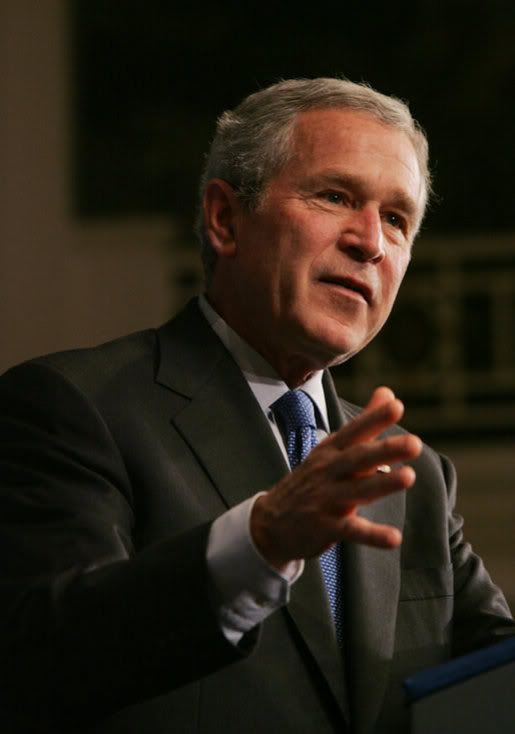
Bush gestures as he addresses his remarks on the U.S. economy and national security to the Associated General Contractors of America Wednesday, May 2, 2007, at the Willard Hotel in Washington, D.C. White House photo by Joyce Boghosian


In the next few weeks, as the Pentagon churns out propaganda from its "24-hour Iraq info desk" to hard sell the Bush/Petraeus military progress report, post and email this article from the Rolling Stone to MSM sites and websites which are allowing themselves to be a tool for the Bush administration:
How is it done? How do you screw the taxpayer for millions, get away with it and then ride off into the sunset with one middle finger extended, the other wrapped around a chilled martini? Ask Earnest O. Robbins -- he knows all about being a successful contractor in Iraq.
You start off as a well-connected bureaucrat: in this case, as an Air Force civil engineer, a post from which Robbins was responsible for overseeing 70,000 servicemen and contractors, with an annual budget of $8 billion. You serve with distinction for thirty-four years, becoming such a military all-star that the Air Force frequently sends you to the Hill to testify before Congress -- until one day in the summer of 2003, when you retire to take a job as an executive for Parsons, a private construction company looking to do work in Iraq.

Now you can finally move out of your dull government housing on Bolling Air Force Base and get your wife that dream home you've been promising her all these years. The place on Park Street in Dunn Loring, Virginia, looks pretty good -- four bedrooms, fireplace, garage, 2,900 square feet, a nice starter home in a high-end neighborhood full of spooks, think-tankers and ex-apparatchiks moved on to the nest-egg phase of their faceless careers. On October 20th, 2003, you close the deal for $775,000 and start living that private-sector good life.

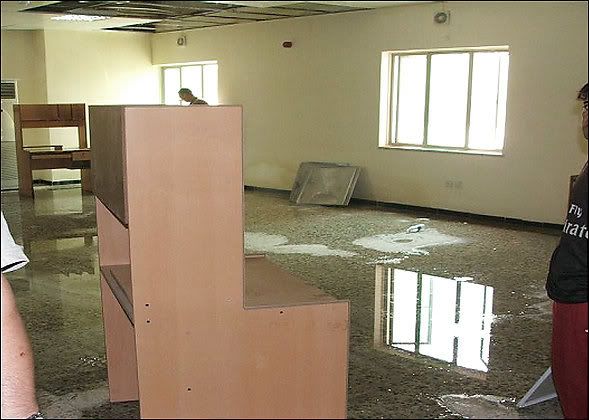
A few months later, in March 2004, your company magically wins a contract from the Coalition Provisional Authority in Iraq to design and build the Baghdad Police College, a facility that's supposed to house and train at least 4,000 police recruits. But two years and $72 million later, you deliver not a functioning police academy but one of the great engineering clusterfucks of all time, a practically useless pile of rubble so badly constructed that its walls and ceilings are literally caked in shit and piss, a result of subpar plumbing in the upper floors.

You've done such a terrible job, in fact, that when auditors from the Special Inspector General for Iraq Reconstruction visit the college in the summer of 2006, their report sounds like something out of one of the Saw movies: "We witnessed a light fixture so full of diluted urine and feces that it would not operate," they write, adding that "the urine was so pervasive that it had permanently stained the ceiling tiles" and that "during our visit, a substance dripped from the ceiling onto an assessment team member's shirt." The final report helpfully includes a photo of a sloppy brown splotch on the outstretched arm of the unlucky auditor.

The Baghdad Police College was built so poorly that feces and urine trickle from the ceilings, and floors rise inches off the ground and crack apart.

When Congress gets wind of the fiasco, a few members on the House Oversight Committee demand a hearing. To placate them, your company decides to send you to the Hill -- after all, you're a former Air Force major general who used to oversee this kind of contracting operation for the government. So you take your twenty-minute ride in from the suburbs, sit down before the learned gentlemen of the committee and promptly get asked by an irritatingly eager Maryland congressman named Chris Van Hollen how you managed to spend $72 million on a pile of shit.

You blink. Fuck if you know. "I have some conjecture, but that's all it would be" is your deadpan answer.

The room twitters in amazement. It's hard not to applaud the balls of a man who walks into Congress short $72 million in taxpayer money and offers to guess where it all might have gone.

Next thing you know, the congressman is asking you about your company's compensation. Touchy subject -- you've got a "cost-plus" contract, which means you're guaranteed a base-line profit of three percent of your total costs on the deal. The more you spend, the more you make -- and you certainly spent a hell of a lot. But before this milk-faced congressman can even think about suggesting that you give these millions back, you've got to cut him off. "So you won't voluntarily look at this," Van Hollen is mumbling, "and say, given what has happened in this project . . . "

"No, sir, I will not," you snap.

". . . 'We will return the profits.' . . ."

"No, sir, I will not," you repeat.

Your testimony over, you wait out the rest of the hearing, go home, take a bath in one of your four bathrooms, jump into bed with the little woman. . . . A year later, Iraq is still in flames, and your president's administration is safely focused on reclaiming $485 million in aid money from a bunch of toothless black survivors of Hurricane Katrina. But the house you bought for $775K is now assessed at $929,974, and you're sure as hell not giving it back to anyone.

"Yeah, I don't know what I expected him to say," Van Hollen says now about the way Robbins responded to being asked to give the money back. "It just shows the contempt they have for us, for the taxpayer, for everything."

Operation Iraqi Freedom, it turns out, was never a war against Saddam Hussein's Iraq. It was an invasion of the federal budget, and no occupying force in history has ever been this efficient. George W. Bush's war in the Mesopotamian desert was an experiment of sorts, a crude first take at his vision of a fully privatized American government. In Iraq the lines between essential government services and for-profit enterprises have been blurred to the point of absurdity -- to the point where wounded soldiers have to pay retail prices for fresh underwear, where modern-day chattel are imported from the Third World at slave wages to peel the potatoes we once assigned to grunts in KP, where private companies are guaranteed huge profits no matter how badly they fuck things up.

And just maybe, reviewing this appalling history of invoicing orgies and million-dollar boondoggles, it's not so far-fetched to think that this is the way someone up there would like things run all over -- not just in Iraq but in Iowa, too, with the state police working for Corrections Corporation of America, and DHL with the contract to deliver every Christmas card. And why not? What the Bush administration has created in Iraq is a sort of paradise of perverted capitalism, where revenues are forcibly extracted from the customer by the state, and obscene profits are handed out not by the market but by an unaccountable government bureaucracy. This is the triumphant culmination of two centuries of flawed white-people thinking, a preposterous mix of authoritarian socialism and laissez-faire profiteering, with all the worst aspects of both ideologies rolled up into one pointless, supremely idiotic military adventure -- American men and women dying by the thousands, so that Karl Marx and Adam Smith can blow each other in a Middle Eastern glory hole.

It was an awful idea, perhaps the worst America has ever tried on foreign soil. But if you were in on it, it was great work while it lasted.

Since time immemorial, the distribution of government largesse had followed a staid, paper-laden procedure in which the federal government would post the details of a contract in periodicals like Commerce Business Daily or, more recently, on the FedBizOpps Website. Competitive bids were solicited and contracts were awarded in accordance with the labyrinthine print of the U.S. Code, a straightforward system that worked well enough before the Bush years that, as one lawyer puts it, you could "count the number of cases of criminal fraud on the fingers of one hand."
There were exceptions to the rule, of course -- emergencies that required immediate awards, contracts where there was only one available source of materials or labor, classified deals that involved national security. What no one knew at the beginning of the war was that the Bush administration had essentially decided to treat the entire Iraqi theater as an exception to the rules. All you had to do was get to Iraq and the game was on.

But getting there wasn't easy. To travel to Iraq, would-be contractors needed permission from the Bush administration, which was far from blind in its appraisal of applicants. In a much-ballyhooed example of favoritism, the White House originally installed a clown named Jim O'Beirne [husband of rightwing journalist Kate O'Beirne] at the relevant evaluation desk in the Department of Defense. O'Beirne proved to be a classic Bush villain, a moron's moron who judged applicants not on their Arabic skills or their relevant expertise but on their Republican bona fides; he sent a twenty-four-year-old who had never worked in finance to manage the reopening of the Iraqi stock exchange, and appointed a recent graduate of an evangelical university for home-schooled kids who had no accounting experience to manage Iraq's $13 billion budget. James K. Haveman, who had served as Michigan's community-health director under a GOP governor, was put in charge of rehabilitating Iraq's health-care system and decided that what this war-ravaged, malnourished, sanitation-deficient country most urgently needed was . . . an anti-smoking campaign.

Town-selectmen types like Haveman weren't the only people who got passes to enter Iraq in the first few years. The administration also greenlighted brash, modern-day forty-niners like Scott Custer and Mike Battles, a pair of ex-Army officers and bottom-rank Republican pols (Battles had run for Congress in Rhode Island and had been a Fox News commentator) who had decided to form a security company called Custer Battles and make it big in Iraq. "Battles knew some people from his congressional run, and that's how they got there," says Alan Grayson, an attorney who led a whistle-blower lawsuit against the pair for defrauding the government.

Before coming to Iraq, Custer Battles hadn't done even a million dollars in business. The company's own Website brags that Battles had to borrow cab fare from Jordan to Iraq and arrived in Baghdad with less than $500 in his pocket. But he had good timing, arriving just as a security contract for Baghdad International Airport was being "put up" for bid. The company site raves that Custer spent "three sleepless nights" penning an offer that impressed the CPA enough to hand the partners $2 million in cash, which Battles promptly stuffed into a duffel bag and drove to deposit in a Lebanese bank.

Custer Battles had lucked into a sort of Willy Wonka's paradise for contractors, where a small pool of Republican-friendly businessmen would basically hang around the Green Zone waiting for a contracting agency to come up with a work order. In the early days of the war, the idea of "competition" was a farce, with deals handed out so quickly that there was no possibility of making rational or fairly priced estimates. According to those familiar with the process, contracting agencies would request phony "bids" from several contractors, even though the winner had been picked in advance. "The losers would play ball because they knew that eventually it would be their turn to be the winner," says Grayson.

To make such deals legal, someone in the military would simply sign a piece of paper invoking an exception. "I know one guy whose business was buying weapons on the black market for contractors," says Pratap Chatterjee, a writer who has spent months in the Mideast researching a forthcoming book on Iraq contracts. "It's illegal -- but he got military people to sign papers allowing him to do it."

The system not only had the advantage of eliminating red tape in a war zone, it also encouraged the "entrepreneurship" of patriots like Custer and Battles, who went from bumming cab fare to doing $100 million in government contracts practically overnight. And what business they did! The bid that Custer claimed to have spent "three sleepless nights" putting together was later described by Col. Richard Ballard, then the inspector general of the Army, as looking "like something that you and I would write over a bottle of vodka, complete with all the spelling and syntax errors and annexes to be filled in later." The two simply "presented it the next day and then got awarded about a $15 million contract."

The deal charged Custer Battles with the responsibility to perform airport security for civilian flights. But there were never any civilian flights into Baghdad's airport during the life of their contract, so the CPA gave them a job managing an airport checkpoint, which they failed miserably. They were also given scads of money to buy expensive X-ray equipment and set up an advanced canine bomb-sniffing system, but they never bought the equipment. As for the dog, Ballard reported, "I eventually saw one dog. The dog did not appear to be a certified, trained dog." When the dog was brought to the checkpoint, he added, it would lie down and "refuse to sniff the vehicles" -- as outstanding a metaphor for U.S. contractor performance in Iraq as has yet been produced.

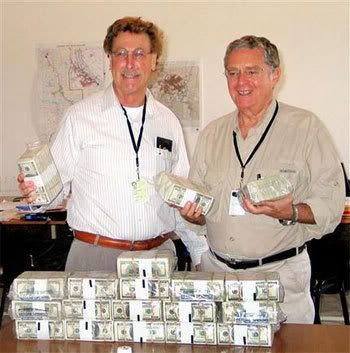
Like most contractors, Custer Battles was on a cost-plus arrangement, which means its profits were guaranteed to rise with its spending. But according to testimony by officials and former employees, the partners also charged the government millions by making out phony invoices to shell companies they controlled. In another stroke of genius, they found a bunch of abandoned Iraqi Airways forklifts on airport property, repainted them to disguise the company markings and billed them to U.S. taxpayers as new equipment. Every time they scratched their asses, they earned; there was so much money around for contractors, officials literally used $100,000 wads of cash as toys. "Yes -- $100 bills in plastic wrap," Frank Willis, a former CPA official, acknowledged in Senate testimony about Custer Battles. "We played football with the plastic-wrapped bricks for a little while."

Frank Willis (left)

The Custer Battles show only ended when the pair left a spreadsheet behind after a meeting with CPA officials -- a spreadsheet that scrupulously detailed the pair's phony invoicing. "It was the worst case of fraud I've ever seen, hands down," says Grayson. "But it's also got to be the first instance in history of a defendant leaving behind a spreadsheet full of evidence of the crime."

But even being the clumsiest war profiteers of all time was not enough to bring swift justice upon the heads of Mr. Custer and Mr. Battles -- and this is where the story of America's reconstruction effort gets really interesting. The Bush administration not only refused to prosecute the pair -- it actually tried to stop a lawsuit filed against the contractors by whistle-blowers hoping to recover the stolen money. The administration argued that Custer Battles could not be found guilty of defrauding the U.S. government because the CPA was not part of the U.S. government. When the lawsuit went forward despite the administration's objections, Custer and Battles mounted a defense that recalled Nuremberg and Lt. Calley, arguing that they could not be guilty of theft since it was done with the government's approval.

The jury disagreed, finding Custer Battles guilty of ripping off taxpayers. But the verdict was set aside by T.S. Ellis III, a federal judge who cited the administration's "the CPA is not us" argument. The very fact that private contractors, aided by the government itself, could evade conviction for what even Ellis, a Reagan-appointed judge, called "significant" evidence of fraud, says everything you need to know about the true nature of the war we are fighting in Iraq. Is it really possible to bilk American taxpayers for repainted forklifts stolen from Iraqi Airways and claim that you were just following orders? It is, when your commander in chief is George W. Bush.

There isn't a brazen, two-bit, purse-snatching money caper you can think of that didn't happen at least 10,000 times with your tax dollars in Iraq. At the very outset of the occupation, when L. Paul Bremer was installed as head of the CPA, one of his first brilliant ideas for managing the country was to have $12 billion in cash flown into Baghdad on huge wooden pallets and stored in palaces and government buildings. To pay contractors, he'd have agents go to the various stashes -- a pile of $200 million in one of Saddam's former palaces was watched by a single soldier, who left the key to the vault in a backpack on his desk when he went out to lunch -- withdraw the money, then crisscross the country to pay the bills. When desperate auditors later tried to trace the paths of the money, one agent could account for only $6,306,836 of some $23 million he'd withdrawn. Bremer's office "acknowledged not having any supporting documentation" for $25 million given to a different agent. A ministry that claimed to have paid 8,206 guards was able to document payouts to only 602. An agent who was told by auditors that he still owed $1,878,870 magically produced exactly that amount, which, as the auditors dryly noted, "suggests that the agent had a reserve of cash."

In short, some $8.8 billion of the $12 billion proved impossible to find. "Who in their right mind would send 360 tons of cash into a war zone?" asked Rep. Henry Waxman, chairman of the House Oversight Committee. "But that's exactly what our government did."

Because contractors were paid on cost-plus arrangements, they had a powerful incentive to spend to the hilt. The undisputed master of milking the system is KBR, the former Halliburton subsidiary so ubiquitous in Iraq that soldiers even encounter its customer-survey sheets in outhouses. The company has been exposed by whistle-blowers in numerous Senate hearings for everything from double-charging taxpayers for $617,000 worth of sodas to overcharging the government 600 percent for fuel shipments. When things went wrong, KBR simply scrapped expensive gear: The company dumped 50,000 pounds of nails in the desert because they were too short, and left the Army no choice but to set fire to a supply truck that had a flat tire. "They did not have the proper wrench to change the tire," an Iraq vet named Richard Murphy told investigators, "so the decision was made to torch the truck."

In perhaps the ultimate example of military capitalism, KBR reportedly ran convoys of empty trucks back and forth across the insurgent-laden desert, pointlessly risking the lives of soldiers and drivers so the company could charge the taxpayer for its phantom deliveries. Truckers for KBR, knowing full well that the trips were bullshit, derisively referred to their cargo as "sailboat fuel."

In Fallujah, where the company was paid based on how many soldiers used the base rec center, KBR supervisors ordered employees to juke the head count by taking an hourly tally of every soldier in the facility. "They were counting the same soldier five, six, seven times," says Linda Warren, a former postal worker who was employed by KBR in Fallujah. "I was even directed to count every empty bottle of water left behind in the facility as though they were troops who had been there."

Yet for all the money KBR charged taxpayers for the rec center, it didn't provide much in the way of services to the soldiers engaged in the heaviest fighting of the war. When Warren ordered a karaoke machine, the company gave her a cardboard box stuffed with jumbled-up electronic components. "We had to borrow laptops from the troops to set up a music night," says Warren, who had a son serving in Fallujah at the time. "These boys needed R&R more than anything, but the company wouldn't spend a dime." (KBR refused requests for an interview, but has denied that it inflated troop counts or committed other wrongdoing in Iraq.)

One of the most dependable methods for burning taxpayer funds was simply to do nothing. After securing a contract in Iraq, companies would mobilize their teams, rush them into the war zone and then wait, citing the security situation or delayed paperwork -- all the while charging the government for housing, meals and other expenses. Last year, a government audit of twelve major contracts awarded to KBR, Parsons and other companies found that idle time often accounted for more than half of a contract's total costs. In one deal awarded to KBR, the company's "indirect" administrative costs were $52.7 million, and its direct costs -- the costs associated with the actual job -- were only $13.4 million.

Companies jacked up the costs even higher by hiring out layers of subcontractors to do their work for them. In some cases, each subcontractor had its own cost-plus arrangement. "We called those 'cascading contracts,' " says Rep. Van Hollen. "Each subcontractor piles on a lot of costs, and eventually they would snowball into a huge payout. It was a green light for waste."

In March 2004, Parsons -- the firm represented by Earnest O. Robbins -- was given nearly $1 million to build a fire station in Ainkawa, a small Christian community in one of the safest parts of Iraq. Parsons subcontracted the design to a British company called TPS Consult and the construction to a California firm called Innovative Technical Solutions Inc. ITSI, in turn, hired an Iraqi outfit called Zozik to do the actual labor.

A year and a half later, government auditors visited the site and found that the fire station was less than half finished. What little had been built was marred by serious design flaws, including concrete columns so shoddily constructed that they were riddled with holes that looked like "honeycombing." But getting the fuck-ups fixed proved problematic. The auditors "made a request that was sent to the Army Corps, which delivered it to Parsons, who then asked ITSI, which asked TPS Consult to check on the work done by Zozik," writes Chatterjee, who describes the mess in his forthcoming book, Baghdad Bonanza. The multiple layers of subcontractors made it almost impossible to resolve the issue -- and every day the delays dragged on meant more money for the companies.

Sometimes the government simply handed out money to companies it made up out of thin air. In 2006, the Army Corps of Engineers found itself unable to award contracts by the September deadline imposed by Congress, meaning it would have to "de-obligate" the money and return it to the government. Rather than suffer that awful fate, the corps obligated $362 million -- spread out over ninety-six different contracts -- to "Dummy Vendor." In their report on the mess, auditors noted that money to nobody "does not constitute proper obligations."

But even obligating money to no one was better than what sometimes happened in Iraq: handing out U.S. funds to the enemy. Since the beginning of the war, rumors have abounded about contractors paying protection money to insurgents to avoid attacks. No less an authority than Ahmed Chalabi, the head of the Iraqi National Congress, claimed that such payoffs are a "significant source" of income for Al Qaeda. Moreover, when things go missing in Iraq -- like bricks of $100 bills, or weapons, or trucks -- it is a fair assumption that some of the wayward booty ends up in the wrong hands. In July, a federal audit found that 190,000 weapons are missing in Iraq -- nearly one out of every three arms supplied by the United States. "These weapons almost certainly ended up on the black market, where they are repurchased by insurgents," says Chatterjee.

Basra's Children's Hospital

For all the creative ways that contractors came up with to waste, mismanage and steal public money in Iraq, the standard remained good old-fashioned fucking up. Take the case of the Basra Children's Hospital, a much-ballyhooed "do-gooder" project championed by Laura Bush and Condi Rice. This was exactly the sort of grandstanding, self-serving, indulgent and ultimately useless project that tended to get the go-ahead under reconstruction. Like the expensive telephone-based disease-notification database approved for use in hospitals without telephones, or the natural-gas-powered electricity turbines green lighted for installation in a country without ready sources of natural gas, the Basra Children's Hospital was a state-of-the-art medical facility set to be built in a town without safe drinking water. "Why build a hospital for kids, when the kids have no clean water?" said Rep. Jim Kolbe, a Republican from Arizona.

Bechtel was given $50 million to build the hospital -- but a year later, with the price tag soaring to $169 million, the company was pulled off the project without a single bed being ready for use. The government was unfazed: Bechtel, explained USAID spokesman David Snider, was "under a 'term contract,' which means their job is over when their money ends."


Their job is over when their money ends. When I call Snider to clarify this amazing statement, he declines to discuss the matter further. But if you look over the history of the Iraqi reconstruction effort, you will find versions of this excuse everywhere. When Custer Battles was caught delivering broken trucks to the Army, a military official says the company told him, "We were only told we had to deliver the trucks. The contract doesn't say they had to work."

Such excuses speak to a monstrous vacuum of patriotism; it would be hard to imagine contractors being so blithely disinterested in results during World War II, where every wasted dollar might mean another American boy dead from gangrene in the Ardennes. But the rampant waste of money and resources also suggests a widespread contempt for the ostensible "purpose" of our presence in Iraq. Asked to cast a vote for the war effort, contractors responded by swiping everything they could get their hands on -- and the administration's acquiescence in their thievery suggests that it, too, saw making a buck as the true mission of the war. Two witnesses scheduled to testify before Congress against Custer Battles ultimately declined not only because they had received death threats but because they, too, were contractors and feared that they would be shut out of future government deals. To repeat: Witnesses were afraid to testify in an effort to ­recover government funds because they feared reprisal from the government.

The Bush administration's lack of interest in recovering stolen funds is one of the great scandals of the war. The White House has failed to litigate a single case against a contractor under the False Claims Act and has not sued anybody for breach of contract. It even declined to join in a lawsuit filed by whistle-blowers who are accusing KBR of improper invoicing in Fallujah. "For all the Bush administration claims to do in the war against terrorism," Grayson said in congressional testimony, "it is a no-show in the war against war profiteers." In nearly five years of some of the worst graft and looting in American history, the administration has recovered less than $6 million.

What's more, when anyone in the government tried to question what contractors were up to with taxpayer money, they were immediately blackballed and treated like an enemy. Take the case of Bunnatine "Bunny" Greenhouse, an outspoken and energetic woman of sixty-three who served as the chief procurement executive for the Army Corps of Engineers. In her position, Greenhouse was responsible for signing off on sole-source contracts -- those awarded without competitive bids and thus most prone to corruption. Long before Iraq, she had begun to notice favoritism in the awarding of contracts to KBR, which was careful to recruit executives who had served in the military. "That was why I joined the corps: to stop this kind of clubby contracting," she says.

A few weeks before the Iraq War started, Greenhouse was asked to sign off on the contract to restore Iraqi oil. The deal, she noticed, was suspicious on a number of fronts. For one thing, the company that had designed the project, KBR, was the same company that was being awarded the contract -- a highly unusual and improper situation. For another, the corps wanted to award a massive "emergency" contract to KBR with no competition for up to five years, which Greenhouse thought was crazy. Who ever heard of a five-year emergency? After auditing the deal, the Pentagon found that KBR had overcharged the government $61 million for fuel. "The abuse related to contracts awarded to KBR," Greenhouse testified before the Senate, "represents the most blatant and improper contract abuse I have witnessed during the course of my professional career."

And how did her superiors in the Pentagon respond to the wrongdoing highlighted by their own chief procurement officer? First they gave KBR a waiver for the overbilling, blaming the problem on an Iraqi subcontractor. Then they dealt with Greenhouse by demoting her and cutting her salary, citing a negative performance review. The retaliation sent a clear message to any would-be whistle-blowers. "It puts a chill on you," Greenhouse says. "People are scared stiff."

They were scared stiff in Iraq, too, and for good reason. When civilian employees complained about looting or other improprieties, contractors sometimes threatened to throw them outside the gates of their bases -- a life-threatening situation for any American. Robert Isakson, a former FBI agent who worked for Custer Battles, says that when he refused to go along with one scam involving a dummy company in Lebanon, he was detained by company security guards, who seized his ID badge and barred him from the base in Baghdad. He eventually had to make a hazardous, Papillon-esque journey across hostile Iraq to Jordan just to survive. (Custer Battles denies the charge.)

James Garrison, who worked at a KBR ice plant in Al Asad, recalls an incident when Indian employees threatened to go on strike: "They pulled a bus up, got them in there and said, 'We'll ship you outside the front gate if you want to go on strike.' " Not surprisingly, the workers changed their mind about a work stoppage.

You know the old adage: You don't pay a hooker to spend the night, you pay her to leave in the morning. That maxim also applies to civilian workers in Iraq. A soldier is a citizen with rights, a man to be treated with honor and respect as a protector of us all; if one loses a limb, you've got to take care of him, in theory for his whole life. But a mercenary is just another piece of equipment you can bill to the taxpayer: If one is hurt on the job, you can just throw it away and buy another one. Today there are more civilians working for private contractors in Iraq than there are troops on the ground. The totality of the thievery in Iraq is such that even the honor of patriotic service has been stolen -- we've replaced soldiers and heroes with disposable commodities, men we expected to give us a big bang for a buck and to never call us again.

Russell Skoug, who worked as a refrigeration technician for a contractor called Wolfpack, found that out the hard way. These days Skoug is back home in Diboll, Texas, and he doesn't move around much; he considers it a big accomplishment if he can make it to his mailbox and back once a day. "I'm doing a lot if I can do that much," he says, laughing a little.

A year ago, on September 11th, Skoug was working for Wolfpack at a base in Heet, Iraq. It was a convoy day -- trucks braved the trip in and out of the base every third day -- and Skoug had a generator he needed to fix. So he agreed to make a run to Al Asad. "If I would've realized that it was September 11th, I never would've went out," he says. It would turn out to be the last run he would ever make in Iraq.

An Air Force vet, Skoug had come to Iraq as a civilian to repair refrigeration units and air conditioners for a KBR subcontractor called LSI. But when he arrived, he discovered that LSI had hired him to fix Humvees. "I didn't know jack-squat about Humvees," he says. "I could maybe change the oil, that was it." (Asked about Skoug's additional assignment, KBR boasted: "Part of the reason for our success is our ability to employ individuals with multiple capabilities.")

Working with him on his crew were two other refrigeration technicians, neither of whom knew anything about fixing Humvees. Since Skoug and most of his co-workers had worked for KBR in Afghanistan, they were familiar with cost-plus contracting. The buzz around the base was that cost-plus was the reason LSI was hiring air-conditioning guys to work on unfamiliar military equipment at a cost to the taxpayer of $80,000 a year. "They was doing the same thing as KBR: just filling the body count," says Skoug.

Thanks to low troop levels, all the military repair guys had been pressed into service to fight the war, so Skoug was forced to sit in the military storeroom on the base and study vehicle manuals that, as a civilian, he wasn't allowed to check out of the building. That was how America fought terrorism in Iraq: It hired civilian air-conditioning techs to fix Humvees using the instruction manual while the real Humvee repairmen, earning a third of what the helpless civilians were paid, drove around in circles outside the wire waiting to get blown up by insurgents.

After much pleading and cajoling, Skoug managed to convince LSI to let him repair some refrigeration units. But it turned out that the company didn't have any tools for the job. "They gave me a screwdriver and a Leatherman, and that's it," he recalls. "We didn't even have freon gauges." When Skoug managed to scrounge and cannibalize parts to get the job done, he impressed the executives at Wolfpack enough to hire him away from LSI for $10,000 a month. The job required Skoug, who had been given no formal security training, to travel regularly on dangerous convoys between bases. Wolfpack issued him an armored vehicle, a Yugoslav-made AK-47 and a handgun, and wished him luck.

For nearly a year, Skoug did the job, trying at each stop to overcome the hostility that many troops felt for civilian contractors who surfed the Internet and played pool and watched movies all day for big dollars while soldiers carrying seventy-pound packs of gear labored in huts with broken air conditioning the civilian techs couldn't be bothered to repair. "They'd have the easiest thing to fix, and they wouldn't do it," Skoug says. "They'd write that they'd fixed it or that they just needed a part and then just leave it." At Haditha Dam, Skoug witnessed a near-brawl after some Marines, trying to get some sleep after returning from patrol, couldn't get a group of "KBR dudes" to turn down the television in a common area late at night.

Toward the end of Skoug's stay, insurgent activity in his area increased to the point where the soldiers leading his convoys would often drive only at night and without lights. Skoug and his co-workers asked Wolfpack to provide them with night-vision goggles that cost as little as $1,000 a pair, but the company refused. "Their attitude was, we don't need 'em and we're not buying 'em," says Thomas Lane, a Wolfpack employee who served as Skoug's security man on the night of September 11th.

On that evening, the soldiers leading the convoy refused to let Skoug drive his own vehicle back to Heet without night-vision goggles. So a soldier took Skoug's car, and Skoug was forced to be a passenger in a military vehicle. "We start out the front gate, and I find out that the truck that I was in was the frickin' lead truck," he recalls. "And I'm going, 'Oh, great.' "

The bomb went off about a half-hour later, ripping through the truck floor and destroying four inches of Skoug's left femur. "The windshield looked like there was a film on it," he says. "I find out later it was a film -- it was blood and meat and stuff all over the windshield on the inside." Skoug was loaded into the back of a Humvee, his legs hanging out, and evacuated to an Army hospital in Germany before being airlifted back to the States.

When Skoug arrived, it was his wife, Linda, who had to handle all his affairs. She was the one who arranged for an air ambulance to take him to Houston, where she had persuaded an orthopedic hospital to admit him as a patient. She had to do this because almost right from the start, Wolfpack washed its hands of Russell Skoug. The insurance policy he had been given turned out to be useless -- the company denied all coverage, beginning with a $72,597 bill for his stay in the German hospital. Despite assurances from Wolfpack chief Mark Atwood that he would cover all Skoug's expenses, neither he nor the insurance company would pay for the $16,000 trip in the air ambulance. Nobody paid for the operations Skoug had in Houston -- as many as three a day, every day for a month. And nobody paid for his subsequent rehab stint in another Houston hospital -- despite the fact that military law requires every company contracting with the government to fully insure all of its employees in the war zone.

Now that he's out, sitting at home on his couch with only partial use of his left hand and left leg, Skoug has a stack of unpaid medical bills almost three inches tall. As he speaks, he keeps fidgeting. He apologizes, explaining that he can't sit still for very long. Why? Because Skoug can no longer afford pain medication. "I take ibuprofen sometimes," he says, "but basically I just grin and bear it."

And here's where this story turns into something perfectly symbolic of everything that the war in Iraq stands for, a window into the soul of for-profit contractors who not only left behind a breathtaking legacy of fraud, waste and corruption but, through their calculating, greed-fueled hijacking of this generation's broadest and most far-reaching foreign-policy initiative, pushed America into previously unknown realms of moral insanity. When I contact Mark Atwood and ask him to explain how he could watch one of his best employees get blown up and crippled for life, and then cut him loose with debts totaling well over half a million dollars, Atwood, safe in his office in Kuwait City and contentedly suckling at the taxpayer teat, decides that answering this one question is just too much to ask of poor old him.

"Right now," Atwood says, "I just want some peace."

When Linda Skoug petitioned Atwood for help, he refused, pointing out that he had kept his now-useless employee on the payroll for four whole months before firing him. "After I have put forth to help you all out," he wrote in an e-mail, "you are going to get on me for your husband not having insurance." He even implied that Skoug had brought the accident upon himself by allowing the Army to place him at the head of the convoy: "He was not even suppose [sic] to be in the lead vehicle to begin with."

And that, ladies and gentlemen, is the story of the Iraq War in a nutshell. In the history of balls, the world has never seen anything like the private contractors George W. Bush summoned to serve in Operation Iraqi Freedom. Collectively, they are the final, polished result of 231 years of natural selection in the crucible of American capitalism: a bureaucrat class capable of stealing the same dollar twice -- once from the taxpayer and once from a veteran in a wheelchair.

The explanations that contractors offer for all the missing dollars, all the myriad ways they looted the treasury and screwed guys like Russell Skoug, rank among the most diabolical, shameless, tongue-twisting bullshit in history. Going back over the various congres­sional hearings and trying to decipher the corporate responses to the mountains of thefts and fuck-ups is a thrilling intellectual journey, not unlike tackling the Pharaonic hieroglyphs or the mating chatter of colobus monkeys. Standing before Congress, contractors and the officials who are supposed to monitor them say things like "As long as we have the undefinitized contract issue that we have . . . we will continue to see the same kinds of sustension rates" (translation: We can't get back any of the fucking money) and "The need for to-fitnessization was viewed as voluntary, and that was inaccurate as the general counsel to the Army observed in a June opinion" (translation: The contractor wasn't aware that he was required to keep costs down) and "If we don't know where we're trying to go and don't have measures, then we won't know how much longer it's going to take us to get there" (translation: There never was a plan in place, other than to let contractors rip off every dollar they could).

According to the most reliable estimates, we have doled out more than $500 billion for the war, as well as $44 billion for the Iraqi reconstruction effort. And what did America's contractors give us for that money? They built big steaming shit piles, set brand-new trucks on fire, drove back and forth across the desert for no reason at all and dumped bags of nails in ditches. For the most part, nobody at home cared, because war on some level is always a waste. But what happened in Iraq went beyond inefficiency, beyond fraud even. This was about the business of government being corrupted by the profit motive to such an extraordinary degree that now we all have to wonder how we will ever be able to depend on the state to do its job in the future. If catastrophic failure is worth billions, where's the incentive to deliver success? There's no profit in patriotism, no cost-plus angle on common decency. Sixty years after America liberated Europe, those are just words, and words don't pay the bills.

Rolling Stone focused on the corruption of the Bushies, and not the cronyism that Bush and Cheney are legend for. In Iraq, Bush's and Cheney's aides and cronies brought their cronies into Iraq to feast. One example, Ari Fleischer's brother:


Wikipedia: Michael Fleischer is a United States businessman from the state of New Jersey and on March 13, 2004, took over the post of Director of Private Sector Development for the Coalition Provisional Authority in Iraq from Thomas Foley, a Connecticut businessman with multiple ties to Bush and other top-tier Republicans.

Foley was former Harvard business school classmate of Bush's, as well as a major fundraiser for the Bush-Cheney campaigns. Foley was appointed by Bush to the board of the Kennedy Center for the Performing Arts in 2002. Foley's sister-in-law April Foley, who also was a Harvard colleague of Bush's, holds a presidential appointment as vice president of the Export-Import Bank. With no foreign policy experience, Foley said that his business problem-solving skills qualified him for the Iraq post.

What skill set qualifies Fleischer to be in charge of reviving the Iraqi economy?

Fleischer took a leave from the presidency of Bogen Communications International, a New Jersey-based maker and distributor of electronics equipment that has about $60 million in annual sales and has had an up-and-down financial performance in recent years. Earlier this year, Bogen delisted itself from the Nasdaq stock market and now trades only on the Pink Sheets, an electronic exchange with fewer public reporting requirements. Fleischer said Bogen delisted because most of the company stock is owned by a handful of investors and there is little trading activity in it.

Bogen lost money in two of the past six years, and Fleischer acknowledged that "we did struggle in some years." But, he added, "On the whole, the business is very satisfactory to the owners."

Fleischer said he wanted to serve in Iraq because he believes Bush had embarked on "a noble path" in freeing and democratizing the country and he believed he had skills that would be helpful. He said that from his Foreign Service stint, he was already acquainted with Paul Bremer, the presidential envoy who heads the CPA. With an assist from his brother, Ari, who "got my resume to Bremer," Fleischer landed interviews that led to his appointment. Among Fleischer's key tasks was training more Iraqi businessmen in the ways of U.S.-style procurement so they can land part of the $18.4 billion in reconstruction aid the U.S. has earmarked for Iraq.

Competitive bidding "is a new world for the Iraqis," Fleischer said. Under Saddam Hussein, "it was all done by cronies. The only paradigm they know is cronyism. We are teaching them that there is an alternative system with built-in checks and built-in review." The broad goal, said Fleischer, is to nurture a system that is "friendly to a free market, friendly to private property rights and . . . limited government."

Foley and Fleischer emphasized the need for Iraqis to strengthen the private sector and wean themselves from a system of government ownership of nearly 200 businesses employing hundreds of thousands of people. Their office has set up business loan programs, helped design laws for private property ownership, commercial transactions, bankruptcy and other business-related activity, and worked to drum up investment in private Iraqi business ventures.

In separate interviews, they offered a common observation about the reconstruction: Media coverage seems fixed on violence and other setbacks and does not sufficiently report progress. "I think there's a lot more good going on than we will ever get credit for," Fleischer said. It hasn't been for lack of effort by the coalition's office of strategic communications, which is dominated by former Republican staffers.

In June, 2004, GlobalPolicy.org reported:
Since the CPA ramped up its operations last summer, Stratcom, as it is known, has churned out news releases about repairs, beautification projects, new construction, charitable donations, training programs and administrative milestones leading to the planned June 30 change in governance. In at least one case, the upbeat tone of a statement differed from the facts. On March 23, the CPA issued a news release claiming a dramatic advance in the struggle to lure private capital to Iraq.

Under a headline reading "Iraq Joint Venture Conference Attracts $Billions in Private Sector Investment," the CPA declared that a recent conference had "successfully attracted billions of dollars in private sector investment capital from international enterprises eager to invest in Iraq's burgeoning construction market." A few weeks later, CPA spokesman Brian Leventhal acknowledged that he could not identify any investment resulting from the conference and issued "a clarification." "The clarification on that was that the companies represented here have billions of dollars (in assets) globally and potentially could be investing billions of dollars in Iraq," Leventhal said.

It's been more than three years since Paul Krugman noted in his op-ed article, Who Lost Iraq?:
By making Iraq a playground for right-wing economic theorists, an employment agency for friends and family, and a source of lucrative contracts for corporate donors, the administration did terrorist recruiters a very big favor.

Wednesday, August 22, 2007

Pentagon Missing Goal of Delivering Armored Vehicles To Iraq


On December 7, 1941, the Japanese pretty much destroyed the U.S. Navy.

Within one decade, Americans rebuilt the Navy's arsenal, won the war in the European and Pacific theaters, and went on to rebuild all of Europe and a good part of Japan and the Phillipines.

George W. Bush was given an unlimited budget to go to war in Iraq and Afghanistan. What is so difficult about getting U.S. troops the equipment they need and in a timely manner?

Reuters reports:
U.S. troops in Iraq will receive at least 1,000 fewer special armored vehicles than expected this year due to the amount of time needed for shipment, the Pentagon said on Wednesday.

Pentagon spokesman Geoff Morrell said the Defense Department expected defense contractors to produce 3,900 Mine Resistant Ambush Protected (MRAP) vehicles this year. But only 1,500 would make it to the war zone -- down from the Pentagon's previous shipment target of 2,500 to 3,000.

"If we could get 1,500 to theater by the end of this year, that would be a positive development," Morrell said.
The new goal of 1,500 was first reported by Stars & Stripes, the newspaper for troops overseas that is partially funded by the Defense Department.

The MRAP vehicle is one of the Pentagon's top acquisition priorities and the Defense Department's aim has been to buy as many as can be produced. It follows years of criticism directed at the Pentagon for not providing adequate armor to troops.

MRAPs have a special V-shaped hull that provide greater protection against roadside bombs, the number one killer and maimer of the troops. According to the military, no troops have been killed while riding in one.

Once the MRAPs are built, the military installs necessary military equipment - such as radios and radar - then sends them to Iraq. Right now that process is taking about 50 days, but officials hope to shorten that to a little more than a month.

Still, [Pentagon press secretary Geoff] Morrell said that many of the MRAPs produced in November and December won’t get to Iraq before the end of the year. He said getting 3,500 to the forces in Iraq by year’s end was an “ambitious goal” but the revised estimate of 1,500 is more realistic now.
Morrell said it takes about 50 days to equip and ship a finished MRAP into the war zone. That includes 15 days for equipping and 35 for transport by ship.

The Pentagon was already flying some MRAPs to the war zone, Morrell said.

But given the numbers to be produced, it will quickly become more cost effective to send them by ship, he said, noting November and December would be the highest production months to date.

Morrell said he did not know which units in Iraq would be affected by the production shortfall this year.

MRAP contractors include:

-- Navistar International Corp.'s International Military and Government LLC;

-- Force Protection Inc., which is partnered with General Dynamics Corp.'s Land Systems business arm;

-- a General Dynamics Canadian unit;

-- BAE Systems Plc;

-- Oshkosh Truck Corp.;

-- closely held Protected Vehicles Inc. of North Charleston, South Carolina

As I'm putting this piece together, the television is on and I'm watching the latest episode of Top Chef in the background. On last week's episode, the contestants were divided into two teams of four chefs each and each team created a restaurant and menu. Both teams performed badly, and nobody was eliminated. This week, they were to do it all over again with some small changes in the rules, and were guaranteed that "somebody is going home."

It's the last ten minutes of tonight's episode and the panel of judges are talking about who on each of the teams of chefs is responsible for the overall failure of this latest mission. Because that's the person that's getting sent home.

How many years is it going to take to properly outfit our troops and send them into Iraq with the equipment that they need to get the job done and keep them protected? You can only say that it's Bremer's fault, or Rumsfeld's fault, or the Pentagon's fault, or Cheney's fault for so long. This is totally and completely the fault of the Commander-in-Chief, George W. Bush, a man with no experience or know-how about getting anything done, except ripping off the U.S. Treasury.

In less than a month, Bush is going to kick-off a campaign to pressure the U.S. Congress into keeping the war in Iraq going. One would think he'd have gotten his act together on something that is so simple (getting 3,500 MRAPs to Iraq) before asking Congress and the American people to trust again in his leadership and ability to get the job done.

If only life was like these reality shows, and we can convene a panel of citizen judges to tell Bush and Cheney, "Pack up your Diebold machines and wiretaps and leave."

If only.

Saturday, August 04, 2007

Iraq Bleeds U.S. Treasury, Enriches Contractors

At Asia Times Online, Eli Clifton writes:
In a report to US lawmakers this week, the non-partisan Congressional Budget Office found that the war in Iraq could cost US taxpayers more than a trillion dollars when the long-term costs of caring for soldiers wounded in action, military and economic aid for the Iraqi government, and ongoing costs associated with the 190,000 troops stationed in Iraq are totaled up.

White House Office of Management and Budget director Mitch Daniels' 2003 estimate that the war in Iraq could cost US$50 billion to $60 billion stands in stark contrast to the $500 billion already allocated to the conflict in Iraq and reconstruction projects.

"We are now spending on these activities more than 10% of all the government's annually appropriated funds," said Robert A Sunshine, the assistant director for budget analysis.
In Sunshine's report to Congress, he showed that in an optimistic scenario - the United States reduces its troop levels in Iraq to 30,000 by 2010 - the war will still cost taxpayers an additional $500 billion.

In a less optimistic scenario in which 75,000 US troops remain in Iraq over the next five years, the cost to the US government would total an additional $900 billion.

"This is the consequence of going to war haphazardly and without a plan," Brian Katulis, senior fellow at the Center for American Progress, told Inter Press Service (IPS). "We're at a point where we look at how much is approved by Congress, we're at $450 billion. Then the $116 billion requested by the [George W] Bush administration puts the total at over $556 billion.

"The Vietnam War, when inflation-adjusted, cost $652 billion," he added.

While Congressional Budget Office reports showed a gloomy outlook for US costs in Iraq, last week several of Washington's biggest defense contractors released profit reports disclosing huge growth in divisions benefiting from military contracts in Iraq and Afghanistan.

Northrop Grumman's information and services division showed 15% growth and its electronics division 7% for the second quarter compared with the same fiscal quarter last year.

General Dynamics' combat-systems unit experienced 19% growth in sales due to continued demand for tanks and armored vehicles, while Lockheed Martin announced a 34% rise in profits to $778 million.

Lockheed's newest revenue projections are now as high as $41.75 billion.

Miriam Pemberton, research fellow at the Institute for Policy Studies, told IPS that 2008 military-related appropriations are the highest they've ever been. The year 2007 was the highest before that.

"War spending continues to go on. In addition, [contractors] are cashing in on increasing military budgets that have nothing to do with the war, such as the F-22 Raptor and large-scale weapon systems. Not only has this recent quarter been profitable, they have now locked in spending that will keep those profits going," she said.

The increase in profits by defense contractors can be correlated to only a portion of the current and predicted spending associated with the war in Iraq.

The Congressional Budget Office's report estimated that medical costs will exceed $9 billion if the US stations 30,000 troops in Iraq, but could exceed $13 billion if 75,000 troops remain in Iraq over the next several years.

Training of police and soldiers in Iraq and Afghanistan over the next decade is estimated to cost at least $50 billion.

Estimates for rebuilding and diplomatic expenses suggest that the US government will need to spend at least $20 billion through 2017, outside of military expenses.

Costs in coming months may continue to rise as the military will require funding for the troop "surge" and for the purchase of armored vehicles for the additional troops and to replace vehicles unsafe because of the threat posed by roadside bombs.

In January 2006, Joseph Stiglitz, a Columbia University professor who won the Nobel Prize for economics in 2001, and Linda Bilmes, a Harvard University budget expert, released a report estimating that the cost of the war in Iraq may come to more than $2 trillion when costs associated with lifetime disability and health care for injured soldiers and the overall effect on the economy are taken into account.

Friday, August 03, 2007

We're Going Backwards, In Every Way

At U.S. Base, Iraqis Must Use Separate Latrine

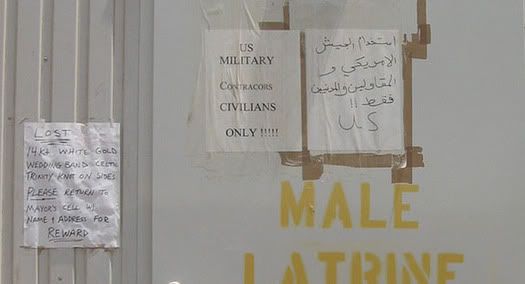
FORWARD OPERATING BASE WARHORSE, Iraq — The sign taped to the men's latrine is just five lines:

"US MILITARY CONTRACTORS CIVILIANS ONLY!!!!!"

It needed only one: "NO IRAQIS."

McClatchy reports:
Here at this searing, dusty U.S. military base about four miles west of Baqouba, Iraqis — including interpreters who walk the same foot patrols and sleep in the same tents as U.S. troops — must use segregated bathrooms.

Another sign, in a dining hall, warns Iraqis and "third-country nationals" that they have just one hour for breakfast, lunch or dinner. American troops get three hours. Iraqis say they sometimes wait as long as 45 minutes in hot lines to get inside the chow hall, leaving just 15 minutes to get their food and eat it.

It's been nearly 60 years since President Harry Truman ended racial segregation in the U.S. military. But at Forward Operating Base Warhorse it's alive and well, perhaps the only U.S. military facility with such rules, Iraqi interpreters here say.

It's unclear precisely who ordered the rules. "The rule separating local national latrines from soldiers was enacted about two to three rotations ago," Maj. Raul Marquez, a spokesman for the 3rd Brigade Combat Team of the 1st Cavalry Division, from Fort Hood, Texas, wrote in an e-mail. That was before his brigade or the 3rd Stryker Combat Brigade of the 2nd Infantry Division, from Fort Lewis, Wash., the other major combat force here, was based at Warhorse.

There's also disagreement on the reason.

Marquez cited security. "We are at war, and operational security (OPSEC) and force protection are critical in this environment," Marquez wrote. "We screen all our local nationals working and living in the FOB, however, you can never know what's in their mind."

Other soldiers traced the regulations to what they called cultural differences between the Iraqis and the Americans.

"We've had issues with locals," said Staff Sgt. Oscar Garcia, who mans Warhorse's administrative hub. "It's not because we're segregating."

Garcia said some Iraqis squatted on the rims of unfamiliar American-style toilets or had used showers as toilets, forcing private contractors who maintain the facilities to clean up after them.

Another soldier at the administrative hub who declined to give his name or rank cited conflicts over hygiene habits. "We can't accept people washing their feet where I brush my teeth," he said.

"It's to keep problems from happening," said Army Capt. Janet Herrick, a public affairs officer. "It's a preventive measure . . . so no one gets belittled."

But the Iraqis who're paid $80,000 to $120,000 a year for their interpreting services are offended.

"It sucks," Ahmed Mohammed, 30, said of the latrine policy. He called the signs — in English and Arabic — "racist."

He's worked as an interpreter for the U.S. military since 2004. He's college educated and well versed in the ways of Western plumbing. He said Warhorse was the only American base where he'd encountered U.S.-only signs on latrines and country-of-origin restrictions on dining hours.

"I live in the same tent with 80 Americans," he said.

Mohammed works for L-3 Titan Group, a unit of New York-based L-3 Communications. He declined to have his picture taken for publication. He fears for his life. He said his brother was killed last year in Baghdad for working for an American company.

Mohammed has sold his house and has squirreled away enough money to buy visas for his family of four. He said he intended to quit soon and emigrate to Germany. The latrine policy is part of the reason, he said.

L-3 officials didn't respond to a request for comment.

"On one hand we're asking Iraqis to help us," often at great risk, said Laila al Qatami, spokeswoman for the American-Arab Anti-Discrimination Committee in Washington. "But at the same time we're saying, 'We want to keep you at a distance.' It's a mixed message we're sending.

"I don't understand having separate bathrooms. It seems to go against everything that the United States stands for."

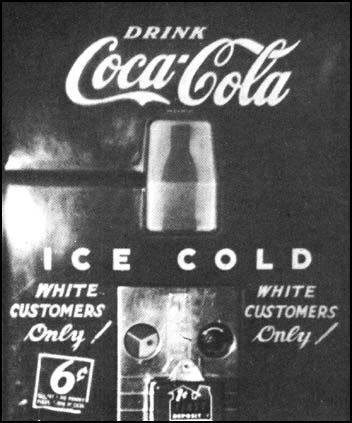
You'd think so, but it's as American as...Coca Cola.


During World War II, the Germans blamed outbreaks of typhus in the ghettoes and camps on the Jews, because "they were dirty people who didn't like to bathe." The truth was that the Germans controlled everything that went into the ghettoes and camps, including water and soap. And neither was "to be wasted on Juden vermin."

American personnel working abroad, be they contractors or soldiers, are our ambassadors. They are the first Americans that many Iraqis will ever meet.
U.S. troops need to leave Iraq, but as that's not going to happen for many years because of our Congress (spineless and gutless no longer explains it - they're now as criminally responsible as Bush and Cheney), the policies at Warhorse should not be allowed to continue. Every day that the occupation continues, our 'ambassadors' make new enemies for us.

The buck stops at our Secretary of Defense, Robert Gates. Given all the change that hasn't happened since Democrats won the midterm elections in 2006, Rumsfeld might as well have retained the job.


Friday, January 26, 2007

Our Mercenaries in Iraq: Blackwater Inc and Bush's Undeclared Surge

Is Bush out to further outsource war?

The private security firm Blackwater USA is back in the news again. On Tuesday, hours before President Bush’s State of the Union address, one of the Blackwater’s helicopters was brought down in a violent Baghdad neighborhood. Five Blackwater troops - all Americans - were killed. Reports say the men’s bodies show signs of execution-style deaths with bullet wounds to the back off the head.

Blackwater provided no identities or details of those killed. They did release a statement saying the deaths “are a reminder of the extraordinary circumstances under which our professionals voluntarily serve to bring freedom and democracy to the Iraqi people.”

President Bush made no mention of the incident during his State of the Union. But he did address the very issue that has brought dozens of private security companies like Blackwater to Iraq in the first place: the need for more troops.

Amy Goodman of Democracy Now! talks with Jeremy Scahill, a Puffin Foundation Writing Fellow at The Nation Institute and author of, “Blackwater: The Rise of the World’s Most Powerful Mercenary Army”:
AMY GOODMAN: President Bush made no mention of the incident during his State of the Union, but he did address the very issue that’s brought dozens of private security companies like Blackwater to Iraq in the first place: the need for more troops.

PRESIDENT GEORGE W. BUSH: Tonight, I ask the Congress to authorize an increase in the size of our active Army and Marine Corps by 92,000 in the next five years. A second task we can take on together is to design and establish a volunteer civilian reserve corps. Such a corps would function much like our military reserve. It would ease the burden on the Armed Forces by allowing us to hire civilians with critical skills to serve on missions abroad when America needs them.

AMY GOODMAN: Is the President looking to further outsource war? My next guest writes, “Blackwater is a reminder of just how privatized the Iraq war has become.” Jeremy Scahill is a Puffin Foundation Writing Fellow at the Nation Institute. He’s author of the forthcoming book Blackwater: The Rise of the World's Most Powerful Mercenary Army. He has an op-ed piece in yesterday's Los Angeles Times, entitled "Are Mercenaries in Iraq?" Joining us now in the firehouse studio, welcome to Democracy Now!, Jeremy.

JEREMY SCAHILL: It’s good to be home.

AMY GOODMAN: We invited Blackwater on; they refused. But, Jeremy, let's talk fist about Blackwater. What is it?

JEREMY SCAHILL: Blackwater is a company that began in 1996 as a private military training facility in -- it was built near the Great Dismal Swamp of North Carolina. And visionary executives, all of them former Navy Seals or other Elite Special Forces people, envisioned it as a project that would take advantage of the anticipated government outsourcing.

Well, here we are a decade later, and it’s the most powerful mercenary firm in the world. It has 20,000 soldiers on the ready, the world’s largest private military base, a fleet of twenty aircraft, including helicopter gunships. It’s become nothing short of the Praetorian Guard for the Bush administration's so-called global war on terror. And it’s headed by a very rightwing Christian activist, ex-Navy Seal named Erik Prince, whose family was one of the major bankrollers of the Republican Revolution of the 1990s. He, himself, is a significant funder of President Bush and his allies.

And what they’ve done is they have built a very frightening empire near the Great Dismal Swamp in North Carolina. They’ve got about 2,300 men actively deployed around the world. They provide the security for the US diplomats in Iraq. They’ve guarded everyone, from Paul Bremer and John Negroponte to the current US ambassador, Zalmay Khalilzad. They’re training troops in Afghanistan. They have been active in the Caspian Sea, where they set up a Special Forces base miles from the Iranian border. They really are the frontline in what the Bush administration viewed as a necessary revolution in military affairs. In fact, they represent the life's work of Dick Cheney and Donald Rumsfeld.

AMY GOODMAN: What do you mean, the “life's work”?

JEREMY SCAHILL: Well, Dick Cheney, when he was Defense Secretary under George H.W. Bush during the Gulf War, one of the last things he did before leaving office was to create an unprecedented lucrative market for the firm that he would go on to head, Halliburton. He commissioned [a] Halliburton [division] to do a study on how to privatize the military bureaucracy. That effectively created the groundwork for the absolute war profiteer bonanza that we’ve seen unfold in the aftermath of 9/11. I mean, Clinton was totally on board with all of this, but it has exploded since 9/11. And so, Cheney, after he left office, when the first Bush was the president, went on to work at the neoconservative American Enterprise Institute, which really led the push for privatization of the government, not just the military.

And then, when these guys took office, Rumsfeld's first real major address, delivered on September 10, 2001, he literally declared war on the Pentagon bureaucracy and said he had come to liberate the Pentagon. And what he meant by that -- and he wrote this in an article in Foreign Affairs -- was that governments, unlike companies, can't die. He literally said that. So you have to figure out new incentives for competition, and Rumsfeld said that it should be run more like a corporation than a bureaucracy. And so, the company that most embodies that vision -- and they call it a revolutionary in military affairs. It’s a total part of the Project for a New American Century and the neoconservative movement. The company that most embodies that is not Halliburton; it’s Blackwater.

AMY GOODMAN: Explain what you understand happened on Tuesday: President Bush giving his address, the Blackwater helicopter crashing.

JEREMY SCAHILL: Well, I think a lot of people -- even though I think there’s been a lot of reporting on it and it’s been out in the public sphere, I think a lot of people still would be surprised to know that the US ambassador in Iraq and US diplomats throughout Iraq and US diplomatic facilities and regional occupational offices are actually guarded by mercenaries. And Blackwater has a $300 million contract to provide diplomatic security. And so, they guard Zalmay Khalilzad and other US diplomats in Iraq.

While what we understand -- and, of course, as you know, reports are always very shaky in the early stages -- is that a US diplomatic convoy came under fire in a Sunni neighborhood of Baghdad, and a Blackwater helicopter apparently landed to try to respond to that attack, because Blackwater and its “Little Bird” helicopters provide the security for diplomatic convoys, and they got engaged in some kind of a firefight on the ground, and four men from one helicopter were killed. Then another helicopter responded and was brought down, either by fire or it got tangled in some wires.

Four of the five men who worked for Blackwater that were killed were shot in the back of the head, according to reports. And what’s interesting about this is that Zalmay Khalilzad said that he had traveled with the men and then said that he had gone to the morgue to view their bodies. And he said that the circumstances of their death were unclear, because of what he called the “fog of war.” But I think it’s very possible that they were guarding a very senior diplomat, if not Zalmay Khalilzad himself. I mean, we don't have evidence to suggest that, but the fact that Khalilzad really came out forward and said, These were fine men. I was with them and visited them in the morgue, indicates that it could have been a very serious attack on a senior official.

AMY GOODMAN: What do you think is the actual body count in Iraq of US soldiers? I mean, we count them very carefully, you know, when it surpassed 3,000. This was extremely significant. What really is the number of US military dead?

JEREMY SCAHILL: Military dead is -- I mean, I think it’s interesting, because the lines have totally been erased. I would say that we should be counting the deaths of Blackwater soldiers in the total troop count. I mean, I filed over the last year a lot of Freedom of Information Act requests, and one of the ways that we have found to discover the deaths of the number of contractors that have been killed is actually through the Department of Labor, because the government has a federal insurance scheme that’s been set up, which is actually very controversial -- grew out of something called the Defense Base Act -- and it’s insurance provided to contractors who service the US military abroad. And so, as of late last year, more than 600 families of contractors in Iraq had filed for those benefits.

So I think we’re talking somewhere in the realm of -- and these are just US contractors that have rights to federal benefits inside of the United States. Remember, it’s not necessarily Americans that make up the majority of these 100,000 -- 100,000 -- contractors that are operating in Iraq right now, 48,000 of whom are mercenaries, according to the GAO. So I don't think it’s possible to put a fine point on the number of troops killed, because the Bush administration has found a backdoor way to engage in an undeclared expansion of the occupation by deploying these private armies.

And at the State of the Union address the other night, Bush announces this civilian reserve corps, which is gaining momentum among Democrats and others. Wesley Clark has talked about it, the former presidential candidate and Supreme Allied NATO Commander. But what that is is another Frankenstein scheme that Cheney and these guys cooked up in their outsourcing laboratory to engage in an undeclared expansion. I mean, on the one hand, we have Bush talking about an official US troop surge. The Army said -- a few months ago, when Colin Powell said that the active-duty Army is basically broken, the Army was calling for 30,000 troops over ten years. Bush then announces in his State of the Union 92,000 active-duty troops over five years, and at the same time, they're increasing the presence of the mercenaries, increasing the presence of the other contractors, talking about some privatized or civilian reserve corps. This is all an undeclared expansion of the US occupation, totally against the will of the American people and the world.

AMY GOODMAN: Civilian reserve corps?

JEREMY SCAHILL: Right. That's what they're calling it. And, you know, I mean, a lot of what has been tossed around about this since 2002 has been envisioning a sort of disaster response, international aid. You know, it’s all very benign-sounding, but the context of it, when Bush announced it the other night, he said we need 92,000 troops and we should develop a civilian reserve corps to supplement the work of the military.

Now, what’s interesting, Amy, is that two years ago Erik Prince, the head of Blackwater USA, was speaking at a military conference. He only comes out of his headquarters to speak in front of military audiences. He does not speak in front of civilians. He's on panels with top brass and others. He’s very secretive. He gave a major address in which he called for the creation of what he called a “contractor brigade.” And I actually -- I can read you what he said. He said -- this is two years ago, before Bush called for his civilian reserve corps. Erik Prince, head of Blackwater USA: “There’s consternation in the [Pentagon] about increasing the permanent size of the Army. We want to add 30,000 people.” And they talked about costs of anywhere from $3.6 billion to $4 billion to do that. Well, by my math, that comes out to about $135,000 per soldier. And then, Prince added, “We could do it certainly cheaper.”

And so, now you have Blackwater, the Praetorian Guard for the war on terror, itching to get into Sudan. You know, something happened last year that got no attention whatsoever. In October, President Bush lifted sanctions on Christian Southern Sudan, and there have been reports now that Blackwater has been negotiating directly with the Southern Sudanese regional government to come in and start training the Christian forces of the south of Sudan. Blackwater has been itching to get into Sudan, and Erik Prince is on the board of Christian Freedom International, which is an evangelical missionary organization that has been targeting Sudan for many years. And there is a political agenda that Blackwater fits perfectly into, whether it’s Iraq and Afghanistan or Sudan.

AMY GOODMAN: And the other connections, Jeremy Scahill, between Blackwater and the Bush administration and the Republican Party?

JEREMY SCAHILL: The most recent one is that President Bush hired Blackwater's lawyer -- Blackwater’s former lawyer to be his lawyer. He replaced Harriet Miers. His name is Fred Fielding, of course, a man who goes back many decades to the Reagan administration, the Nixon administration. He is now going to be Bush's top lawyer, and he was Blackwater's lawyer.

Joseph Schmitz, who was the former Pentagon Inspector General, whose job it was to police the war contractor bonanza, then goes on to work for one of the most profitable of them, is the vice chairman of the Prince Group, Blackwater’s parent company, and the general counsel for Blackwater.

Ken Starr, who’s the former Whitewater prosecutor, the man who led the impeachment charge against President Clinton, Kenneth Starr is now Blackwater's counsel of record and has filed briefs for them at the Supreme Court, in fighting against wrongful death lawsuits filed against Blackwater for the deaths of its people and US soldiers in the war zones.

And then, perhaps the most frightening employee of Blackwater is Cofer Black. This is the man who was head of the CIA’s counterterrorism center at the time of 9/11, the man who promised President Bush that he was going to bring bin Laden's head back in a box on dry ice and talked about having his men chop bin Laden’s head off with a machete, told the Russians that he was going to bring the heads of the Mujahideen back on sticks, said there were going to be flies crawling across their eyeballs. Cofer Black is a 30-year veteran of the CIA, the man who many credit with really spearheading the extraordinary rendition program after 9/11, the man who told Congress that there was a “before 9/11” and an “after 9/11,” and that after 9/11, the gloves come off. He is now a senior executive at Blackwater and perhaps their most powerful behind-the-scenes operative.

AMY GOODMAN: And electoral politics?

JEREMY SCAHILL: Well, Erik Prince, the head of Blackwater, and other Blackwater executives are major bankrollers of the President, of Tom DeLay, of Santorum. They really were -- when those guys were running Congress, Amy, Blackwater had just a revolving door there. They were really welcomed in as heroes. Senator John Warner, the former head of the Senate Armed Services Committee, called them “our silent partner in the global war on terror.” Erik Prince’s sister, Betsy DeVos, is married to Dick Devos, who recently lost the gubernatorial race in Michigan.

But also, Amy, this is a family, the Prince family, that really was one of the primary funders. It was Amway and Dick DeVos in the 1990s, and it was Edgar Prince and his network -- Erik Prince's father -- that really created James Dobson, Focus on the Family -- they gave them the seed money to start it -- Gary Bauer, who was one of the original signers to the Project for a New American Century, a major anti-choice leader in this country, former presidential candidate, founder of the Family Research Council. He credits Edgar Prince, Erik’s father, with giving him the money to start the Family Research Council. We’re talking about people who were at the forefront of the rightwing Christian revolution in this country that really is gaining steam, despite recent electoral defeats.

And what’s really frightening is that you have a man in Erik Prince, who is a neo-crusader, a Christian supremacist, who has been given over a half a billion dollars in federal contracts, and that's not to mention his black contracts, his secret contracts, his contracts with foreign friendly governments like Jordan. This is a man who espouses Christian supremacy, and he has been given, essentially, allowed to create a private army to defend Christendom around the world against secularists and Muslims and others, and has really been brought into the fold. He refers to Blackwater as the sort of FedEx of the Pentagon. He says if you really want a package to get somewhere, do you go with the postal service or do you go with FedEx? This is how these people view themselves. And it embodies everything that President Eisenhower prophesied would happen with the rise of an unchecked military-industrial complex. You have it all in Blackwater.

AMY GOODMAN: Jeremy Scahill, thanks very much for joining us, and I look forward to seeing your book when it comes out. Jeremy Scahill's forthcoming book is Blackwater: The Rise of the World's Most Powerful Mercenary Army. Thanks for joining us.