Showing posts with label Robert Gates. Show all posts

Tuesday, May 20, 2008

Could This Be Why Hillary Won't Leave?

U.S. to Attack Iran; Bush and Cheney Plan to Solve Disputes with Iran "radically and resolutely"

ShortNews.com reports:
The Israeli Army Radio and the Israeli daily The Jerusalem Post have both quoted unnamed Israeli officials today as saying that the US President George W Bush plans to launch an attack on Iran within the next few months.

According to officials a senior member of the Bush entourage on his recent trip to Israel said that both Bush and his Vice president, Dick Cheney planned to solve disputes with Iran “radically and resolutely”.

The unnamed sources claim the only reason the US Administration has not attacked Iran earlier is because of reservations expressed from Defense Secretary Robert Gates and Secretary of State Condoleezza Rice.
The sources of this report is PressTV:
Israeli officials claim that US president George W. Bush intends to launch a military attack against Iran before the end of his term.

"George W. Bush intends to attack Iran within the next few months, before the end of his term", The Israeli Army Radio and the Jerusalem Post quoted unnamed Israeli officials as saying on Tuesday.

The officials claimed that a senior member of the president's entourage during Bush's trip to the occupied Palestine last week said that Bush and Vice President Dick Cheney believed they should solve the issue of Iran 'radically and resolutely'.

They, however, claimed that Defense Secretary Robert Gates' and Secretary of State Condoleezza Rice's reservations had so far prevented the administration from launching an attack on Iran.

Earlier, a news website close the Israeli intelligence agency revealed that during his visit to al-Quds Bush criticized Israeli prime minister Ehud Olmert for not attacking Lebanon after the political defeat of Fuad Siniora's government in the recent crisis in Lebanon.
A "Clinton cohort" reports to Huffington Post that Hillary Clinton is asking key supporters (superdelegates) not to desert her during the next two weeks of campaigning, assuring them that she "won't embarrass them".

Could her subtext be, "You'll see why I haven't gotten out of the race (war with Iran), and I'll make the case that I'm the experienced 'war president', not Obama".

If true, how could she know?

Bill Clinton, as a former president, gets the same daily intelligence briefing that Bush gets. We've heard about plans for an imminent strike against Iran for a while, but what isn't available to the public, but is in daily briefings, is the most up-to-date information on U.S. military placement. If it was happening, if a military strike against Iran was operational, the Clintons would know about it.

Friday, August 03, 2007

We're Going Backwards, In Every Way

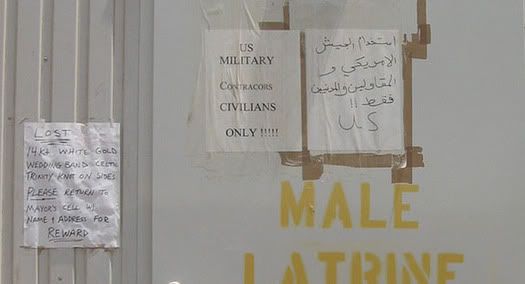
At U.S. Base, Iraqis Must Use Separate Latrine

FORWARD OPERATING BASE WARHORSE, Iraq — The sign taped to the men's latrine is just five lines:

"US MILITARY CONTRACTORS CIVILIANS ONLY!!!!!"

It needed only one: "NO IRAQIS."

McClatchy reports:
Here at this searing, dusty U.S. military base about four miles west of Baqouba, Iraqis — including interpreters who walk the same foot patrols and sleep in the same tents as U.S. troops — must use segregated bathrooms.

Another sign, in a dining hall, warns Iraqis and "third-country nationals" that they have just one hour for breakfast, lunch or dinner. American troops get three hours. Iraqis say they sometimes wait as long as 45 minutes in hot lines to get inside the chow hall, leaving just 15 minutes to get their food and eat it.

It's been nearly 60 years since President Harry Truman ended racial segregation in the U.S. military. But at Forward Operating Base Warhorse it's alive and well, perhaps the only U.S. military facility with such rules, Iraqi interpreters here say.

It's unclear precisely who ordered the rules. "The rule separating local national latrines from soldiers was enacted about two to three rotations ago," Maj. Raul Marquez, a spokesman for the 3rd Brigade Combat Team of the 1st Cavalry Division, from Fort Hood, Texas, wrote in an e-mail. That was before his brigade or the 3rd Stryker Combat Brigade of the 2nd Infantry Division, from Fort Lewis, Wash., the other major combat force here, was based at Warhorse.

There's also disagreement on the reason.

Marquez cited security. "We are at war, and operational security (OPSEC) and force protection are critical in this environment," Marquez wrote. "We screen all our local nationals working and living in the FOB, however, you can never know what's in their mind."

Other soldiers traced the regulations to what they called cultural differences between the Iraqis and the Americans.

"We've had issues with locals," said Staff Sgt. Oscar Garcia, who mans Warhorse's administrative hub. "It's not because we're segregating."

Garcia said some Iraqis squatted on the rims of unfamiliar American-style toilets or had used showers as toilets, forcing private contractors who maintain the facilities to clean up after them.

Another soldier at the administrative hub who declined to give his name or rank cited conflicts over hygiene habits. "We can't accept people washing their feet where I brush my teeth," he said.

"It's to keep problems from happening," said Army Capt. Janet Herrick, a public affairs officer. "It's a preventive measure . . . so no one gets belittled."

But the Iraqis who're paid $80,000 to $120,000 a year for their interpreting services are offended.

"It sucks," Ahmed Mohammed, 30, said of the latrine policy. He called the signs — in English and Arabic — "racist."

He's worked as an interpreter for the U.S. military since 2004. He's college educated and well versed in the ways of Western plumbing. He said Warhorse was the only American base where he'd encountered U.S.-only signs on latrines and country-of-origin restrictions on dining hours.

"I live in the same tent with 80 Americans," he said.

Mohammed works for L-3 Titan Group, a unit of New York-based L-3 Communications. He declined to have his picture taken for publication. He fears for his life. He said his brother was killed last year in Baghdad for working for an American company.

Mohammed has sold his house and has squirreled away enough money to buy visas for his family of four. He said he intended to quit soon and emigrate to Germany. The latrine policy is part of the reason, he said.

L-3 officials didn't respond to a request for comment.

"On one hand we're asking Iraqis to help us," often at great risk, said Laila al Qatami, spokeswoman for the American-Arab Anti-Discrimination Committee in Washington. "But at the same time we're saying, 'We want to keep you at a distance.' It's a mixed message we're sending.

"I don't understand having separate bathrooms. It seems to go against everything that the United States stands for."

You'd think so, but it's as American as...Coca Cola.


During World War II, the Germans blamed outbreaks of typhus in the ghettoes and camps on the Jews, because "they were dirty people who didn't like to bathe." The truth was that the Germans controlled everything that went into the ghettoes and camps, including water and soap. And neither was "to be wasted on Juden vermin."

American personnel working abroad, be they contractors or soldiers, are our ambassadors. They are the first Americans that many Iraqis will ever meet.
U.S. troops need to leave Iraq, but as that's not going to happen for many years because of our Congress (spineless and gutless no longer explains it - they're now as criminally responsible as Bush and Cheney), the policies at Warhorse should not be allowed to continue. Every day that the occupation continues, our 'ambassadors' make new enemies for us.

The buck stops at our Secretary of Defense, Robert Gates. Given all the change that hasn't happened since Democrats won the midterm elections in 2006, Rumsfeld might as well have retained the job.


Thursday, August 02, 2007

Robert Gates: "Bush Administration May Have Misjudged The Difficulty In Iraq..."

. . . . of achieving reconciliation among Iraq's sectarian factions."

Ya think?

Psssst....the lede is buried in the last graf . . .

The NYTimes reports:
Defense Secretary Robert M. Gates said today that he was discouraged by the departure of the major Sunni Arab bloc from Iraq’s coalition government, and noted that the Bush administration may have misjudged the difficulty of achieving reconciliation among Iraq’s sectarian factions.

In one of his bluntest assessments of the progress of the administration’s Iraq strategy, Mr. Gates said: “I think the developments on political side are somewhat discouraging at the national level. And clearly the withdrawal of the Sunnis from the government is discouraging. My hope is that it can all be patched back together.”
He made the remarks to reporters traveling on his plane as he returned to Washington after a three-day trip to the Middle East, which included stops in Egypt, Saudi Arabia, Kuwait and the United Arab Emirates but not to Iraq.

Mr. Gates said little to indicate whether he would recommend a shift in the administration’s strategy next month, when officials are planning to review the results achieved by sending nearly 30,000 additional American troops to Iraq in an effort to secure Baghdad.

When the Bush administration decided to send the additional troops, he said, “we probably all underestimated the depth of the mistrust, and how difficult it would be for these guys to come together on legislation, which, let’s face it, is not some kind of secondary issue.”

He was referring to the failure of Iraq’s parliament to pass legislation governing the distribution of oil revenue, to set a timetable for provincial elections or to ease work restrictions on former Baath party members — measures that the Bush administration considers crucial for reconciliation between Sunni and Shiite Arabs in Iraq.

While he was critical of the government led by Prime Minister Nuri Kamal al-Maliki, a Shiite Arab, Mr. Gates’s view was not wholly gloomy. The security situation in the country, he said, was “more encouraging than I would have expected three or four months ago.”

He said there had been progress in reducing violence in Anbar Province, and in persuading Sunni tribal sheikhs in some areas of the country to cooperate in security operations against Sunni Arab insurgents, a development he called “in some respects unexpected.”

He said the administration would have to balance the relative lack of progress on the political front with the somewhat encouraging trends in the security realm when it prepares its review in September, which will include reports from Gen. David Petraeus, the top American commander in Iraq, and from Ambassador Ryan Crocker.

Several American military commanders in Iraq have said that the additional troops will be needed in Iraq into next year. Some critics of the Iraq policy, including several Democrats running for president, have called instead for beginning to withdraw troops and shifting to a strategy that focuses more on counterterrorism than on protecting Iraqis.

One of the arguments administration officials made earlier this year for the increase in troop strength and the new emphasis on securing Baghdad was that it would give Mr. Maliki’s government “breathing room” to achieve the political reconciliation and progress on legislation.

But Mr. Gates offered a slightly different formulation today, arguing that political progress would come when Iraqi police and army units proved themselves able to take over primary responsibility for maintaining security in areas now largely patrolled by American troops.

“I think the key is, not only establishing the security, but being able to hold on to those areas, and for Iraqi Army and police to be able to provide the continuity of security over time,” Mr. Gates said. “It’s under that umbrella I think progress will be made at the national level.”

He did not say how long that would take.

As he has traveled around the Middle East this week, Mr. Gates has stressed that whenever the United States begins drawing down its troops in Iraq, it must be careful not to leave the country in chaos, which he warned could spread throughout the region.

Mr. Gates stopped briefly in Abu Dhabi today for talks with Mohammed bin Zayeed al Nahyan, the emirate’s crown prince. On Wednesday, he toured the port in Kuwait City by helicopter; that port would be vital for shipping American military equipment home whenever troops begin to withdraw.

Earlier on his four-day journey, he visited Egypt and Saudi Arabia.

Mr. Gates asked the United States’s Arab allies to help stabilize Iraq and to toughen their enforcement of United Nations sanctions against Iran. He discussed proposed arms sales with each of the countries.

According to a senior Defense Department official, Mr. Gates and Secretary of State Condoleezza Rice, who joined him in Egypt and Saudi Arabia, stressed the need for Arab regimes in the region to support the administration’s effort to isolate Iran, diplomatically and economically.

“There’s not really room for bystanders here,” Mr. Gates said.

But he also tried to put to rest a persistent concern that the Bush administration is preparing to attack Iran, the Defense official said: Mr. Gates was asked why the United States had four aircraft carriers in the Persian Gulf if no attack was planned, and had to explain that, in fact, there was only one American carrier in the area, the Defense official said.

Saturday, July 21, 2007

Gates Steps In To Defuse Clinton-Pentagon Dispute

Not really.

The Washington Post reports:
Defense Secretary Robert M. Gates sought to defuse a row between a top Pentagon aide and Sen. Hillary Rodham Clinton yesterday over her request for details of plans to withdraw U.S. troops from Iraq.

In May, the New York Democrat sought information about the Pentagon's plans for pulling troops out of the war zone. In response to her inquiry, Undersecretary Eric S. Edelman dispatched a letter accusing her of reinforcing "enemy propaganda that the United States will abandon its allies" by discussing a timetable, an answer that Clinton deplored yesterday as "an unacceptable and outrageous political attack."
Clinton, the front-runner for the Democratic presidential nomination, capitalized on the contretemps all day, announcing that she will introduce legislation with Sen. John F. Kerry (D-Mass.) that would require the military to plan for a troop withdrawal from Iraq and issuing a letter to Gates demanding further answers about the military's exit strategy. Though Clinton voted for the war and has never apologized for her vote, she has sharpened her criticism of its execution while playing catch-up on the issue with Democratic rivals, particularly Sen. Barack Obama (Ill.), who opposed the invasion from the start.

In a statement, Gates said that he had not seen Clinton's original letter, but he added that he welcomes congressional involvement.

"I have long been a staunch advocate of Congressional oversight, first at the CIA and now at the Defense Department," Gates said. "I have said on several occasions in recent months that I believe that Congressional debate on Iraq has been constructive and appropriate. I had not seen Senator Clinton's reply to Ambassador Edelman's letter until today. I am looking into the issues she raised and will respond to them early next week."

"Redeploying out of Iraq will be difficult and requires careful planning," Clinton said. "I continue to call on the Bush administration to immediately provide a redeployment strategy that will keep our brave men and women safe as they leave Iraq -- instead of adhering to a political strategy to attack those who rightfully question their competence and preparedness after years of mistakes and misjudgments."

Bob Gates is a tool. He just bought Bush and Cheney one week, in which time it's hoped that everyone will forget the Bush administration's blowing off of a United States' Senator on the Armed Services Committee (Hillary Clinton) and the Constitutionally required role of oversight of this administration by that Senator, on that committee, of the Congress of the United States.

Friday, March 23, 2007

Rumsfeld Might As Well Have Remained As Secretary of Defense . . . .

. . . . For all the change that putting Gates in the job has made.

We're still in this never-ending, money-pit of a war, hundreds of detainees are still in Guantanamo and CIA secret prisons. Robert Gates allegedly lobbied Bush for closing Guantanamo, but Alberto Gonzales and Dick Cheney wouldn't go along. Apparently, elections don't have consequences.

The NYT reports:
In his first weeks as defense secretary, Robert M. Gates repeatedly argued that the detention facility at Guantánamo Bay, Cuba, had become so tainted abroad that legal proceedings at Guantánamo would be viewed as illegitimate, according to senior administration officials. He told President Bush and others that it should be shut down as quickly as possible.

Mr. Gates’s appeal was an effort to turn Mr. Bush’s publicly stated desire to close Guantánamo into a specific plan for action, the officials said. In particular, Mr. Gates urged that trials of terrorism suspects be moved to the United States, both to make them more credible and because Guantánamo’s continued existence hampered the broader war effort, administration officials said.

Mr. Gates’s arguments were rejected after Attorney General Alberto R. Gonzales and some other government lawyers expressed strong objections to moving detainees to the United States, a stance that was backed by the office of Vice President Dick Cheney, administration officials said.

As Mr. Gates was making his case, Secretary of State Condoleezza Rice joined him in urging that the detention facility be shut down, administration officials said. But the high-level discussions about closing Guantánamo came to a halt after Mr. Bush rejected the approach, although officials at the National Security Council, the Pentagon and the State Department continue to analyze options for the detention of terrorism suspects.

So much for the latest round of myth put forth in the media that Bush is "disappointed" with Cheney and that Cheney has lost ground as Bush's most trusted advisor.
The base at Guantánamo holds about 385 prisoners, among them 14 senior leaders of Al Qaeda, including Khalid Shaikh Mohammed, who were transferred to it last year from secret prisons run by the Central Intelligence Agency. Under the Pentagon’s current plans, some prisoners, including Mr. Mohammed, will face war crimes charges under military trials that could begin later this year.

“The policy remains unchanged,” said Gordon D. Johndroe, a spokesman for the National Security Council.

Even so, one senior administration official who favors the closing of the facility said the battle might be renewed.

“Let’s see what happens to Gonzales,” that official said, referring to speculation that Mr. Gonzales will be forced to step down, or at least is significantly weakened, because of the political uproar over the dismissal of United States attorneys. “I suspect this one isn’t over yet.”

Details of the internal discussions on Guantánamo were described by senior officials from three departments or agencies of the executive branch, including officials who support moving rapidly to close Guantánamo and those who do not. One official made it clear that he was willing to discuss the internal deliberations in part because of Mr. Gonzales’s current political weakness. The senior officials discussed the issue on ground rules of anonymity because it entailed confidential conversations.

The officials said Mr. Gates and Ms. Rice expressed their concerns about Guantánamo in conversations with Mr. Bush and others, including Mr. Gonzales, beginning in January and onward. One widely discussed alternative would move the prisoners to military brigs in the United States, where they would remain in the custody of the Pentagon and would be subject to trial under military proceedings. There is widespread agreement, however, that moving any detainees or legal proceedings to American territory could bring significant complications.

Some administration lawyers are deeply reluctant to move terrorism suspects to American soil because it could increase their constitutional and statutory rights — and invite an explosion of civil litigation. Guantánamo was chosen because it was an American military facility but not on American soil.

Placing the detainees in military brigs on United States territory might fend off some of those challenges. The solution may eventually require a new act of Congress establishing legal standing for the detainees and new rules for their trial and incarceration if brought to the United States.

Mr. Gates’s criticism of Guantánamo marks a sharply different approach than the one taken by his predecessor, Donald H. Rumsfeld. It also demonstrated a new dynamic in the administration, in which Mr. Gates was teaming up with Ms. Rice, who often was at loggerheads with Mr. Rumsfeld. The State Department has long been concerned about the adverse foreign-policy impact of housing prisoners at Guantánamo.

In the end, Mr. Gates did succeed in killing plans to build a $100 million courthouse and detention complex at Guantánamo, after he argued that the large and expensive project would leave the impression of a long-lasting American detainee operation there and that the money could be more effectively spent elsewhere by the Pentagon. Mr. Gates approved a far more modest facility at one-tenth of the cost.

The setback in his effort to close Guantánamo was described by senior Pentagon officials as Mr. Gates’s only significant failure during an effort in his first three months in office to shift course from policies pursued by Mr. Rumsfeld. The outcome suggests that Mr. Bush, Mr. Cheney and Mr. Gonzales remain committed to a detention plan that has become one of the most controversial elements of the administration’s counterterrorism program.

Mr. Cheney’s spokeswoman, Lee Anne McBride, said via e-mail that “we don’t discuss internal deliberations.”

Mr. Bush has repeatedly said he ultimately wants to shutter the detention operations at Guantánamo. But he has also said it is not possible to do so any time soon.

State Department and Pentagon officials have said that even close allies are uncomfortable with American policies toward Guantánamo, making it more difficult in some cases to coordinate efforts in counterterrorism, intelligence and law enforcement.

More than 390 detainees have been transferred abroad from the Guantánamo facility since it was opened amid global controversy in 2002. Last year, 111 detainees were transferred out, and 12 more have been this year. About 20 of those repatriated to home countries have been picked up again in sweeps of terrorism suspects or have been killed or captured in battle, Pentagon officials say.

Many countries do not want to take back the detainees held at Guantánamo. Some home nations will not guarantee that returning detainees would be assured humane treatment and fair trials, while others will not guarantee that detainees viewed by American officials as still dangerous would not be set free.

Mr. Gates’s challenge has sent a ripple through the White House, because it forced officials to confront the question of whether Mr. Bush was actually moving to fulfill his stated desire to close the detention facility. Officials who advocate shutting down Guantánamo, including some at the Pentagon and the State Department, said an underlying motivation of those who want to keep the center open is that closing it would be seen as a public admission of an incorrect policy — something the Bush administration is loath to do.

Neither Mr. Gates nor Ms. Rice have made public their comments to Mr. Bush. “Nobody is going to be insubordinate with the president,” said one senior administration official involved in the discussions. “You know the saying: ‘One war, one team.’”

But in a recent Pentagon news conference, Mr. Gates did speak about his concerns over Guantánamo in general terms.

“I think that Guantánamo has become symbolic, whether we like it or not, for many around the world,” Mr. Gates said at the time. “The problem is that we have a certain number of the detainees there who often by their own confessions are people who if released would come back to attack the United States. There are others that we would like to turn back to their home countries, but their home countries don’t want them.”

He said officials “are trying to address the problem of how do we reduce the numbers at Guantánamo and then what do you do with the relatively limited number that would be irresponsible to release.”

“And I would tell you that we’re wrestling with those questions right now,” he continued.

In an interview on Thursday, Gordon England, the deputy secretary of defense who is Mr. Gates’s point man on detention issues, suggested that the long-term answer to Guantánamo might be creating some new international legal structure or set of multilateral agreements to manage captured members of global terrorist organizations.

“I don’t know the alternative unless the international community, frankly, develops an alternative,” Mr. England said. “It is not a U.S. problem. It is an international problem to be dealt with.”

Mr. England said American government officials had “an extraordinarily high degree of confidence from the information available” that many Guantánamo detainees were “going to damage the country, so you just can’t let them go.”

“So,” he added, “this is difficult. I know it’s onerous. I know there are a lot of questions about it. We deal with it the best we can. But at the end of the day, we are not going to put the country or our citizens in jeopardy.”

The only consequences of the midterm elections has been more misdirection by the Bush administration, and democratic constituents having to breathe down the necks of their representatives and senators and get them to fulfill their campaign pledges.

Saturday, January 13, 2007

Is Joe Lieberman Laying the Foundation to Break with the Democratic Caucus . . . .

. . . . And give control of the Senate to the Republicans?

Joe Lieberman questions Secretary of Defense Robert Gates and Chairman of the Joint Chiefs, Peter Pace, during the Senate Armed Services Committee hearing on Bush's plan to escalate the war in Iraq:


Lieberman doesn't exactly question these men, but rather asks leading questions that are supportive of Bush's rhetoric about the planned increase of troops to Iraq and dismissive of some Democrats' proposals for the war in Iraq. Lieberman skates along the edge of acceptable party etiquette when talking about policies coming from members of his own party -- but then Lieberman is no longer a Democrat, and owes them no loyalty. The loyalty he shows to Bush, however, is palpable.

If Democrats introduce legislation to stop Bush from escalating the war in Iraq, will Joe bolt from the Democratic Caucus and hand control over the Senate to the Republicans? It's not like this wasn't predictable.


Filed under: , , , , , , , , , , , , , , , , , , , ,