Showing posts with label Condoleeza Rice. Show all posts

Monday, May 04, 2009

Did Somebody Torture Condi?

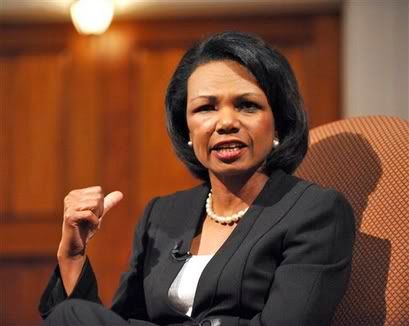
What happened to Condoleeza Rice's face?

Condoleeza Rice on April 23, 2009:


Then on Sunday, May 3, 2009:


In this photograph provided by Rabinowitz-Dorf, former Secretary of State Condoleezza Rice speaks to supporters of the Jewish Primary Day School in Washington. (AP Photo/Rabinowitz-Dorf, Ron Sachs)

Tuesday, May 20, 2008

Could This Be Why Hillary Won't Leave?

U.S. to Attack Iran; Bush and Cheney Plan to Solve Disputes with Iran "radically and resolutely"

ShortNews.com reports:
The Israeli Army Radio and the Israeli daily The Jerusalem Post have both quoted unnamed Israeli officials today as saying that the US President George W Bush plans to launch an attack on Iran within the next few months.

According to officials a senior member of the Bush entourage on his recent trip to Israel said that both Bush and his Vice president, Dick Cheney planned to solve disputes with Iran “radically and resolutely”.

The unnamed sources claim the only reason the US Administration has not attacked Iran earlier is because of reservations expressed from Defense Secretary Robert Gates and Secretary of State Condoleezza Rice.
The sources of this report is PressTV:
Israeli officials claim that US president George W. Bush intends to launch a military attack against Iran before the end of his term.

"George W. Bush intends to attack Iran within the next few months, before the end of his term", The Israeli Army Radio and the Jerusalem Post quoted unnamed Israeli officials as saying on Tuesday.

The officials claimed that a senior member of the president's entourage during Bush's trip to the occupied Palestine last week said that Bush and Vice President Dick Cheney believed they should solve the issue of Iran 'radically and resolutely'.

They, however, claimed that Defense Secretary Robert Gates' and Secretary of State Condoleezza Rice's reservations had so far prevented the administration from launching an attack on Iran.

Earlier, a news website close the Israeli intelligence agency revealed that during his visit to al-Quds Bush criticized Israeli prime minister Ehud Olmert for not attacking Lebanon after the political defeat of Fuad Siniora's government in the recent crisis in Lebanon.
A "Clinton cohort" reports to Huffington Post that Hillary Clinton is asking key supporters (superdelegates) not to desert her during the next two weeks of campaigning, assuring them that she "won't embarrass them".

Could her subtext be, "You'll see why I haven't gotten out of the race (war with Iran), and I'll make the case that I'm the experienced 'war president', not Obama".

If true, how could she know?

Bill Clinton, as a former president, gets the same daily intelligence briefing that Bush gets. We've heard about plans for an imminent strike against Iran for a while, but what isn't available to the public, but is in daily briefings, is the most up-to-date information on U.S. military placement. If it was happening, if a military strike against Iran was operational, the Clintons would know about it.

Thursday, May 03, 2007

Republicans Conflicted, Moving Toward Benchmarks

The LATimes reports that Republicans say a new spending bill should include benchmarks for the Iraqi government to meet:
Distressed by the violence in Iraq and worried about tying their political fate to an unpopular president, some Republicans on Capitol Hill are beginning to move away from the White House to stake out a more critical position on the U.S. role in the war.

These lawmakers are advocating proposals that would tie the U.S. commitment in the war to the Iraqi government's ability to demonstrate that it is working to quell the sectarian conflict.

One of my favorite comments comes from Senator Susan Collins (R-Maine):
"Obviously, the president would prefer a straight funding bill with no benchmarks, no conditions, no reports. Many of us, on both sides of the aisle, don't see that as viable."

The fact is that even when conditions have been put into legislation, Republicans have ignored them, and enabled Bush make Iraq into a hell on earth.

From AUMF or HJ resolution 114 (the Authorization for Use of Military Force Against Iraq that Congress gave Bush on October 16, 2002):
SEC. 4. REPORTS TO CONGRESS.
(a) REPORTS.—The President shall, at least once every 60 days,
submit to the Congress a report on matters relevant to this joint
resolution, including actions taken pursuant to the exercise of
authority granted in section 3 and the status of planning for efforts
that are expected to be required after such actions are completed,
including those actions described in section 7 of the Iraq Liberation
Act of 1998 (Public Law 105–338).

You can read the rest (AUMF) here to learn what else was required of Bush that he has never complied with.

The Republican-controlled Congress let it slide. There have been none of these required reports to Congress in the more than 4 years of this war in Iraq.

If you've read any of the books that have detailed what's been going on in the Bush administration and how it's conducted the war, I think you'd notice exactly what the problem is. Aside, of course, from the fact that the war never should have happened in the first place, or that neocons like Douglas Feith, Paul Wolfowitz and Stephen Hadley had an impossible ideological dream of Iraq as their incubator for conservatives' economic theories (privatization). What is the problem?

It's that everyone in the Bush administration is a dilettante. They're all big on theory, but they haven't any practical experience actually working.

It's a pattern that's evident from all of the accounts of this administration. You can even pick it up in the 9/11 Commission's Report. The ordinary people doing the work in government, career workers, civil servants (and in Iraq, the troops), all did (and are doing) their jobs superbly. It's that middle level, the appointees, the political players right up through Bush, that have failed miserably.

Some of the books published so far make for extremely frustrating reading for people trained and experienced in breaking down tasks and communications to their most basic, direct and efficient steps. I don't think that the authors themselves realize that what they have revealed in their books, of the failures of the Bush administration, all have this common thread.

Bob Woodward goes into some detail in "State of Denial" about some of the efforts undertaken to identify why the invasion of Iraq wasn't going as had been sold to Congress and the American people. Woodward describes Condoleeza Rice at loggerheads with Rumsfeld. In March, 2004, Rice sends her senior director for defense at the NSC, Frank Miller, to Iraq to find out what's really going on. Miller headed the Executive Steering Group which was to coordinate Iraq issues among the different federal agencies.

On one trip, Miller spent a week traveling all over Iraq and seemed to get a sense of the problem: "Bremer didn't delegate and he doesn't have time to do everything."
Though Bremer tried to control things, on so many issues, Miller said, the staff at CPA was playing to run out of the clock. They kept deferring to the iraqi Governing Council, which was slow or stagnant in making decisions-communications, regulatory policy, police code of conduct, hiring former officers, firing the Kirkuk teachers. It was always the same story. People in the CPA are tired, bitter and defeatist. There are few problem-solvers there, and the Iraqi ministries aren't much help.

"We need to pick our top 10 issues," he advised, things that needed to be accomplished before the handover of sovereignty was schedule to take place.

Miller listed the top 10 issues, and included five more - all general complaints, with no concrete recommendations:
First they shouldn't underestimate how many Iraqis were watching Al Jazeera on satellite TV. Electricity is a problem, he added, not just because they didn't have enough of it, but because to Iraqis it was seen as something that should be free.

Second, Sanchez and Bremer aren't talking. And Sanchez and his division commanders aren't communicating effectively enough.

Third, CPA never leaves the Green Zone. Their regional offices in all 18 provinces outside Baghdad are worth their weight in gold, but the folks in the green Zone were not doing anything

Fourth, de-Baathification is a mess. There are some good people with only tenuous Baathist connections who are not being allowed in, Miller said. He wasn't sure whether it was the CPA or the de-Baathification group run by the nephew of Ahmed Chalabi who was responsible, but Chalabi was hoarding files from the old iraqi intelligence service-a prime source of information on who had been a true-believer Baathist under Saddam-making it almost impossible to determine levels of involvement.

Fifth, they needed to put contracts on a wartime footing. CPA was sending out requests for proposals with 90-day timelines. That was pointless, bureaucratic busywork. In 90 days, CPA would be nearly extinct.

On page 294, Woodward writes:
Miller repeated his briefing to most of the deputies on the NSC, including Armitage and Pace. He talked with Scooter Libby, hoping his most salient points would make their way to the vice president.

At the Pentagon briefing for Wolfowitz, it was standing room only, with lots of straphangers from Feith's policy shop and the CPA-Washington liaison. There's not a single person in this room who will do a thing about what I have to say, Miller thought, even if they believe it. The problem as always was implementation.

He started putting these items on the deputies committee agendas. How do we cut contracting time? How do we get more CERP funds for military commanders? Can't we standardize the training for the Iraqi Civil Defense Corps? How do we weed out the bad apples so we have a better, saner, quicker de-Baathification process?

"I will fix it," Rice told Miller. She called Bremer. "You will give the division commanders more money." The division commanders got another billion dollars in CERP funds.

This story continues with success in Iraq being no closer, actually getting worse, and repeats itself just about every six months to a year. Rice sends Miller to find out "What's really going on in Iraq?", Miller returns, reports, more money is sent, lather, rinse, repeat. Reading this, I became increasingly annoyed that at no point did anybody with authority actually hand-carry the money through, find out just what and where the bottlenecks are, and make on-the-spot decisions to break through them. There are no Lt. General Russel Honores involved anywhere in this quagmire of Iraq.

And after four years of it, I believe that it's by design.

Monday, March 05, 2007

Proving Ann Coulter Wrong


It's remarkably easy, but irritating. Because nobody should have to waste their time doing it. And if anyone has to do it more than once, you have to ask yourself why Coulter, a known fabricator, is given air time to lie and confuse people.

Knowing Coulter's casual relationship with facts and truth, could there be any other reason for Republicans and Corporate Media to keep putting her (and Limbaugh and Drudge and Hannity) on the air and in print if not to keep us on the left occupied, correcting the record?

When it comes to appointing minorities (women, blacks, hispanics, asians of either gender) to government posts, Democrats have been responsible for the "mosts" and most of the "firsts" - But specifically with regard to black people in general, and black women specifically:
Patricia Roberts Harris, appointed Ambassador to Luxembourg (first black woman to serve as ambassador) by Lyndon B. Johnson; appointed Secretary of Housing and Urban Development, Secretary of Health, Education and Welfare, and Secretary of Health and Human Services by Jimmy Carter.

Robert C. Weaver, appointed Secretary of Housing and Urban Development (first black ever to serve in a Presidential cabinet) by Lyndon B. Johnson.

Thurgood Marshall, appointed to the U.S. Supreme Court (first black ever to serve on the USSC) by Lyndon B. Johnson.

Rodney Slater, appointed Secretary of Transportation by Bill Clinton.

Ron Brown, appointed Secretary of Commerce by Bill Clinton.

Hazel O'Leary, appointed Secretary of Energy (first woman, first black, to hold the post) by Bill Clinton.

Jesse Brown, appointed Secretary of Veterans Affairs by Bill Clinton.

Mike Espy, appointed Secretary of Agriculture by Bill Clinton.

Lee Brown, appointed Drug Policy Coordinator and elevated to a cabinet post by Bill Clinton.

Togo D. West, Jr., appointed first as Secretary of the Army by Bill Clinton and then Secretary of Veterans Affairs by Bill Clinton.

With the exception of two 'tokens' in the current Bush administration (Powell and Rice, one moderate and one neocon who are used by Bush as window-dressing and whose counsel was and is ignored in matters of policy) and Bush41's appointment of Clarence Thomas and elevation of Colin Powell to chair the Joint Chiefs, Republican administrations are remarkably absent of 'color.'

Thursday, February 08, 2007

Blown Chance For Peace With Iran?

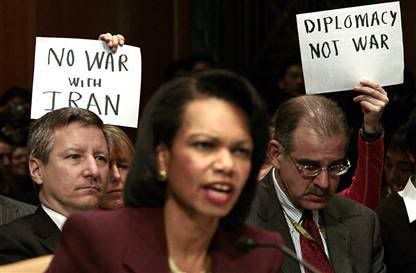
Did the Bush hard-liners blow a shot at meaningful diplomacy with Iran in 2003 so that they could go to war?


Newsweek reports:
Did the Bush administration pass up a chance for meaningful diplomacy with Iran before its radical president, Mahmoud Ahmadinejad, took over? The question has taken on particular urgency in recent days, as the Bush administration has appeared to lay the legal groundwork for war, even while denying it has any intention of attacking Iran. On Jan. 10, in his speech to the nation announcing his “surge” plan for Iraq, Bush declared that “Iran is providing material support for attacks on American troops.” Such a statement is considered a traditional justification for war under international law. And The Washington Post recently reported that the president has given orders allowing U.S. troops in Iraq to capture or kill suspect Iranian operatives. Then, last week, Under Secretary of State Nicholas Burns, speaking on National Public Radio, invoked Article 51 of the U.N. Charter, which has been used by member states in the past to justify unilateral military action. At the same time the president is moving more U.S. naval forces to the Persian Gulf.
In the view of some critics, who include former senior members of the administration, the Bush team may believe that war with a clerical regime they consider to be illegitimate and dangerous is still likely, or even inevitable. But Bush and his senior aides, recognizing they have little public or allied support, seem to be putting in place a policy that incites the Iranians to act first, these critics say. They compare the current Iran policy to past pretexts for war that later proved ill-founded, like the Gulf of Tonkin resolution authorizing large-scale military intervention in Vietnam. The Bush administration intends “to be as provocative as possible and make the Iranians do something they would be forced to retaliate for,” says Hillary Mann, the former director for Iran and Persian Gulf Affairs on the National Security Council under Condoleezza Rice during Bush’s first term. “When they state that the Iranians are building support networks to kill U.S. soldiers—I mean, I went to Harvard Law School, and that’s a casus belli. Nick Burns recently invoked Article 51 of U.N. charter. That’s the right to self-defense. That means you don’t need another U.N. Security Council resolution to go to war.”

Burns, in an interview with NEWSWEEK on Thursday, said his invocation of Article 51 was not directed toward justifying war in any way, but was merely a general statement of any state's right to self-defense. "We are not planning offensive military operations against Iran. We are definitely on a diplomatic path," he said. "I do not believe that military conflict with Iran is inevitable or desirable."

Secretary of State Rice has also vehemently denied that the administration is looking for a way to go to war. In congressional testimony on Wednesday, she repeated that “the president [has] made very clear that we’re not planning or intending an attack on Iran.” She added: “When we have a carrier strike group into the gulf, or provide PAC-3 [the latest version of the Patriot antimissile system], which is a defensive system, it’s simply to demonstrate that the United States remains determined to defend its interests in the gulf and the interests of its allies.” Some defenders of the Bush “realignment” plan toward Iran—in which the administration is seeking to get friendly Sunni Arab states and Israel, along with Europe, Russia and Asia, to form a united front and isolate Tehran—say it has begun to work. They point to fresh signals from the Iranian government that it may be willing to talk. “All across the region, the aggressors are stepping back,” a Western diplomat in Washington told NEWSWEEK.

Still, “not planning or intending an attack” isn’t exactly the same thing as embracing diplomacy with Tehran. In fact, Bush has specifically rejected that idea unless Iran acts first to suspend its uranium-enrichment program. Mann, as well as former senior administration officials such as former secretary of State Colin Powell and his then-top deputy, Richard Armitage, say the president has ignored or played down a number of opportunities to negotiate—especially in the era before Ahmadinejad was elected in 2005. As Powell told NEWSWEEK in an interview this week: “You can’t negotiate when you tell the other side, ‘Give us what a negotiation would produce before the negotiations start.’”

Rice was asked again this week about a dramatic opening for such a negotiation that took place in late April and May of 2003, when Iranian officials, using their regular Swiss intermediary, faxed a two-page proposal for comprehensive talks to the State Department. According to the document, a copy of which was obtained by NEWSWEEK, Tehran plainly laid out the two countries’ “aims” and proposed “steps” to resolve them “in mutual respect.” The document, believed to reflect the views of Iran’s president at the time, the moderate Mohammad Khatami, proposes negotiations on most of the main outstanding issues of interest to Washington—including Iran’s nuclear program, its support for Hizbullah and Hamas and terrorism in general, and stabilizing Iraq. Some officials who saw the proposal at the time, including Hillary Mann and her husband, Flynt Leverett, the former National Security Council (NSC) senior director for Mideast under Rice, have angrily criticized Rice and the administration for not taking it seriously.

Asked about that proposal in House testimony this week, Rice fudged. Democratic Rep. Robert Wexler queried her on it during a hearing Wednesday, though he mistakenly summed up its contents by suggesting that it proposed the “acceptance” of Israel (the document doesn’t say that explicitly, though it does refer to a “two-state approach” to the Palestinian conflict). Rice’s initial reply: “I just don’t remember ever seeing any such thing.” Wexler asked her again, “So you did not see that supposed fax?” Rice said: “I just have to tell you that perhaps somebody saw something of the like, but I can tell you I would have noticed if the Iranians had offered to recognize Israel.” Then she added: “I don’t know what Flynt Leverett’s talking about, quite frankly. Maybe I should ask him when he came to me and said, ‘We have a proposal from Iran and we really ought to take it.’ I have read about this so-called proposal from Iran. We had people who said, ‘The Iranians went to talk to you,’ lots of people who said, ‘The Iranians want to talk to you.’” Asked about her comments later by NEWSWEEK, Leverett shot back: “If I had been in such a position I certainly would have done that. The two people who were in that position then were Elliott Abrams and Zal Khalilzad.” A spokeswoman for Abrams, who is currently the deputy national-security adviser for democracy promotion—but was then in charge of Mideast affairs—told NEWSWEEK on Thursday: “He has absolutely no recollection of getting any sort of fax at all.” (Khalilzad, soon to be the next ambassador to the U.N., was traveling abroad as special envoy to Afghanistan at the time, and is unlikely to have been in Washington when the fax came through.)

Such a proposal did find its way to the State Department in 2003, via Swiss ambassador Tim Guldimann. But a lot of questions remain about its origins and importance. Iranian officials insist that the document began as a U.S. trial balloon, possibly developed out of the office of former deputy secretary of State Armitage. But Armitage, in an interview this week, said he had nothing to do with creating the document and saw it for the first time as an Iranian fax. At the time, Armitage said, he thought it might have represented some creative diplomacy by Guldimann (who would not comment on the proposal to NEWSWEEK). “We couldn’t determine what was the Iranians’ and what was the Swiss ambassador’s,” Armitage said. His impression at the time was that the Iranians “were trying to put too much on the table,” Armitage added.

However, Powell’s former chief of staff, Larry Wilkerson, said in an e-mail that it was a significant proposal for beginning “meaningful talks” between the U.S. and Iran. Wilkerson added that it “was a non-starter so long as [Dick] Cheney was VP and the principal influence on Bush.” The hardline vice president has long been known as an opponent of diplomatic engagement. Mann and Leverett say it was a historic missed opportunity. “I don’t care if it originally came from Mars,” says Mann. “If the Iranians said it was fully vetted and cleared, then it could have been as important” as the two-page document that Richard Nixon and Henry Kissinger received from Beijing in 1971, indicating Mao Zedong’s interest in talks.

Mann says Bush and other senior officials, including Cheney and former Defense secretary Donald Rumsfeld, were simply not interested in broad-based talks with Iran. "I think the president does believe the Iranian government is fundamentally illegitimate, and as long as Iran stays that way there will never be the freedom that needs to be brought to the Middle East,” Mann said. “I attended meeting after meeting on Iran for years. This was the tenor of the discussions, that the Iranian government was shaky, a ripe apple on the tree.… And I don’t think war fever has ever abated.”

Others also continue to question the administration’s commitment to real negotiation with Tehran—even if its nuclear concerns are met. “If there is a coherent strategy in place to deal with Iran, I’d like to hear more about it,” Democratic Sen. Joe Biden, chairman of the Senate Foreign Relations Committee, told Rice at another hearing on Thursday. “Maybe the strategy is this: by increasing pressure on Iran across the board, we put Tehran on the defensive and strengthen our hands in any future negotiations. That makes sense—provided we’re serious about talking.”

We may know soon. A senior administration official says that, after four months of silence, the chief Iranian nuclear negotiator, Ali Larijani, is expected to meet within days in Munich with his European counterpart, Javier Solana, who is representing Germany, France and Great Britain in talks backed by the United States. Says Burns: “We have the sense that there's a turbulent environment inside Iran itself. There's a great deal of opposition to Ahmadinejad's failed policies, and a lot of Iranians seem to understand that they're being isolated." We can only hope that if a conversation starts, both sides listen.


,