Showing posts with label Robert Wexler. Show all posts

Friday, December 21, 2007

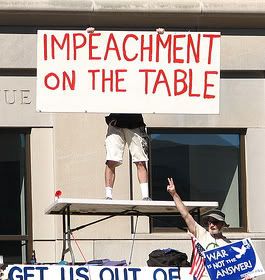
Representative Wexler Wants Cheney Impeachment Hearings . . . .

. . . . And He Wants You To Sign Another Petition For Them [http://wexlerwantshearings.com/]

I can't help but get the feeling that this is yet another in a long line of the Democrats' bums' rush tactics.

In the last few years, I've signed at least a half a dozen petitions urging Congress to begin impeachment proceedings against Bush and Cheney, and hold more investigations that would compel evidence of what this administration has been up to, with absolutely no results. And I vaguely recall the American people throwing Republicans out of office in the 2006 elections, replacing them with Democrats because (according to the exit polling), "Voters had had enough of Bush, Cheney, Republicans, the war in Iraq, and wanted change and out of Iraq."

So much for "Elections have results".

Why does a U.S. States congressman need yet another petition before holding hearings? Have the others gone astray? To the wrong address? Are members of Congress unaware of the polls which support, by a majority, removing both Bush and Cheney from office?

Wexler isn't without some seniority and power in Congress. He's on the House Judiciary Committee (he sits on the Courts, the Internet, and Intellectual Property Subcommittee), the Committee on Financial Services (he sits on the Oversight and Investigations Subcommittee, and the Domestic and International Monetary Policy, Trade, and Technology Subcommittee, and the Capital Markets, Insurance, and Government Sponsored Enterprises Subcommittee), the Foreign Affairs Committee (of which he chairs the Europe Subcommittee and sits on the Middle East and South Asia Subcommittee).

So what is this petition for and who needs to be convinced? How many signatures will be enough? Last week, Wexler wrote on Huffington Post:
If we can get 50,000 or even more people to sign up in support of this effort I will report back to each and every Democratic colleague of mine the true power that exists behind this movement.
I don't know what the magic is in the 50,000 number, but it's been met and ignored before. One petition calling for impeachment at ImpeachBush.org has 985,871 signatures. If that hasn't been enough (as well as all of the other petitions and polls) to move Congress to get this show on the road, it's a mystery what Wexler's petition can accomplish.

But I guess we'll see very shortly what Wexler can do with it, because last I looked, more than 123,000 people had signed Wexler's petition.

Friday, December 14, 2007

Representative Robert Wexler Makes The Case For Impeachment Hearings


U.S. Congressman Robert Wexler [D-FL] writes:
I was serving in Congress and on the Judiciary Committee for the ridiculous and politically motivated impeachment hearings of President Clinton. During that witch hunt Newt Gingrich, Tom DeLay, and Ken Starr wasted a year and a half on investigations and hearings about President Clinton's personal relations. However, this attempted coup d'etat by Republicans against President Clinton was not and should not be the standard of impeachment that was enshrined by the Founders in our Constitution.
First, impeachment hearings are only proper when significant allegations exist that the President or Vice-President, or others civil officers, committed actions - within their official duties - that constitute 'High Crimes and Misdemeanors.' The allegations against Clinton - involving a personal affair - never reached this threshold. The serious charges against Cheney involve alleged crimes that are central to his duties of Vice-President; namely war and peace, the widespread violations of civil liberties, and the security of the United States and our covert agents.

Unlike the show trial put on by Republicans against President Clinton, a proper impeachment hearing would involve a fair and objective presentation of the facts without hyperbole or political gamesmanship. The hard evidence that is presented at the hearings will be judged fully both by Congress and the American people. The evidence alone will determine the outcome, and if it is determined that Vice President Cheney committed "High Crimes and Misdemeanors" he should be properly impeached and put on trial before the Senate.

After the Democratic Party regained control of Congress, many - myself included - thought that it might be possible to meet President Bush half-way on the large issues facing our nation. Unfortunately, Bush has been nothing more than an ideological obstacle. He has vetoed stem cell research. He has vetoed efforts to bring our troops home from Iraq. He vetoed children's health care. So, the idea that we are somehow inhibiting Congress from passing our agenda by holding impeachment hearings - unfortunately - is a false argument.

Instead, I believe that we can both live up to our Constitutional obligation by holding hearings and pass a Democratic agenda. If President Bush perceives that the Democratic Congress is weak and unwilling to aggressively push our agenda - he will continue to veto legislation, such as children's health care - that is supported by a majority of Americans. The only way to move a progressive Democratic agenda is by acting through strength and following through on our core principles. A Congress willing to stand up to the abuses of the Bush Administration through impeachment hearings will demonstrate a strength of will that will more likely convince Bush to accommodate on issues such as Iraq, health care, and energy and environmental issues.

Today, I was joined by two other members of the House Judiciary Committee, Reps. Luis Gutierrez and Tammy Baldwin, who penned an online editorial with me calling for these impeachment hearings. In support of this effort I am releasing a call to action on video and launched WexlerWantsHearings.com. The full op-ed from the three Judiciary Committee Members can be read at this site. If we can get 50,000 or even more people to sign up in support of this effort I will report back to each and every Democratic colleague of mine the true power that exists behind this movement.

Thursday, February 08, 2007

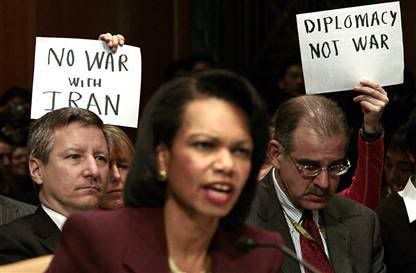
Blown Chance For Peace With Iran?

Did the Bush hard-liners blow a shot at meaningful diplomacy with Iran in 2003 so that they could go to war?


Newsweek reports:
Did the Bush administration pass up a chance for meaningful diplomacy with Iran before its radical president, Mahmoud Ahmadinejad, took over? The question has taken on particular urgency in recent days, as the Bush administration has appeared to lay the legal groundwork for war, even while denying it has any intention of attacking Iran. On Jan. 10, in his speech to the nation announcing his “surge” plan for Iraq, Bush declared that “Iran is providing material support for attacks on American troops.” Such a statement is considered a traditional justification for war under international law. And The Washington Post recently reported that the president has given orders allowing U.S. troops in Iraq to capture or kill suspect Iranian operatives. Then, last week, Under Secretary of State Nicholas Burns, speaking on National Public Radio, invoked Article 51 of the U.N. Charter, which has been used by member states in the past to justify unilateral military action. At the same time the president is moving more U.S. naval forces to the Persian Gulf.
In the view of some critics, who include former senior members of the administration, the Bush team may believe that war with a clerical regime they consider to be illegitimate and dangerous is still likely, or even inevitable. But Bush and his senior aides, recognizing they have little public or allied support, seem to be putting in place a policy that incites the Iranians to act first, these critics say. They compare the current Iran policy to past pretexts for war that later proved ill-founded, like the Gulf of Tonkin resolution authorizing large-scale military intervention in Vietnam. The Bush administration intends “to be as provocative as possible and make the Iranians do something they would be forced to retaliate for,” says Hillary Mann, the former director for Iran and Persian Gulf Affairs on the National Security Council under Condoleezza Rice during Bush’s first term. “When they state that the Iranians are building support networks to kill U.S. soldiers—I mean, I went to Harvard Law School, and that’s a casus belli. Nick Burns recently invoked Article 51 of U.N. charter. That’s the right to self-defense. That means you don’t need another U.N. Security Council resolution to go to war.”

Burns, in an interview with NEWSWEEK on Thursday, said his invocation of Article 51 was not directed toward justifying war in any way, but was merely a general statement of any state's right to self-defense. "We are not planning offensive military operations against Iran. We are definitely on a diplomatic path," he said. "I do not believe that military conflict with Iran is inevitable or desirable."

Secretary of State Rice has also vehemently denied that the administration is looking for a way to go to war. In congressional testimony on Wednesday, she repeated that “the president [has] made very clear that we’re not planning or intending an attack on Iran.” She added: “When we have a carrier strike group into the gulf, or provide PAC-3 [the latest version of the Patriot antimissile system], which is a defensive system, it’s simply to demonstrate that the United States remains determined to defend its interests in the gulf and the interests of its allies.” Some defenders of the Bush “realignment” plan toward Iran—in which the administration is seeking to get friendly Sunni Arab states and Israel, along with Europe, Russia and Asia, to form a united front and isolate Tehran—say it has begun to work. They point to fresh signals from the Iranian government that it may be willing to talk. “All across the region, the aggressors are stepping back,” a Western diplomat in Washington told NEWSWEEK.

Still, “not planning or intending an attack” isn’t exactly the same thing as embracing diplomacy with Tehran. In fact, Bush has specifically rejected that idea unless Iran acts first to suspend its uranium-enrichment program. Mann, as well as former senior administration officials such as former secretary of State Colin Powell and his then-top deputy, Richard Armitage, say the president has ignored or played down a number of opportunities to negotiate—especially in the era before Ahmadinejad was elected in 2005. As Powell told NEWSWEEK in an interview this week: “You can’t negotiate when you tell the other side, ‘Give us what a negotiation would produce before the negotiations start.’”

Rice was asked again this week about a dramatic opening for such a negotiation that took place in late April and May of 2003, when Iranian officials, using their regular Swiss intermediary, faxed a two-page proposal for comprehensive talks to the State Department. According to the document, a copy of which was obtained by NEWSWEEK, Tehran plainly laid out the two countries’ “aims” and proposed “steps” to resolve them “in mutual respect.” The document, believed to reflect the views of Iran’s president at the time, the moderate Mohammad Khatami, proposes negotiations on most of the main outstanding issues of interest to Washington—including Iran’s nuclear program, its support for Hizbullah and Hamas and terrorism in general, and stabilizing Iraq. Some officials who saw the proposal at the time, including Hillary Mann and her husband, Flynt Leverett, the former National Security Council (NSC) senior director for Mideast under Rice, have angrily criticized Rice and the administration for not taking it seriously.

Asked about that proposal in House testimony this week, Rice fudged. Democratic Rep. Robert Wexler queried her on it during a hearing Wednesday, though he mistakenly summed up its contents by suggesting that it proposed the “acceptance” of Israel (the document doesn’t say that explicitly, though it does refer to a “two-state approach” to the Palestinian conflict). Rice’s initial reply: “I just don’t remember ever seeing any such thing.” Wexler asked her again, “So you did not see that supposed fax?” Rice said: “I just have to tell you that perhaps somebody saw something of the like, but I can tell you I would have noticed if the Iranians had offered to recognize Israel.” Then she added: “I don’t know what Flynt Leverett’s talking about, quite frankly. Maybe I should ask him when he came to me and said, ‘We have a proposal from Iran and we really ought to take it.’ I have read about this so-called proposal from Iran. We had people who said, ‘The Iranians went to talk to you,’ lots of people who said, ‘The Iranians want to talk to you.’” Asked about her comments later by NEWSWEEK, Leverett shot back: “If I had been in such a position I certainly would have done that. The two people who were in that position then were Elliott Abrams and Zal Khalilzad.” A spokeswoman for Abrams, who is currently the deputy national-security adviser for democracy promotion—but was then in charge of Mideast affairs—told NEWSWEEK on Thursday: “He has absolutely no recollection of getting any sort of fax at all.” (Khalilzad, soon to be the next ambassador to the U.N., was traveling abroad as special envoy to Afghanistan at the time, and is unlikely to have been in Washington when the fax came through.)

Such a proposal did find its way to the State Department in 2003, via Swiss ambassador Tim Guldimann. But a lot of questions remain about its origins and importance. Iranian officials insist that the document began as a U.S. trial balloon, possibly developed out of the office of former deputy secretary of State Armitage. But Armitage, in an interview this week, said he had nothing to do with creating the document and saw it for the first time as an Iranian fax. At the time, Armitage said, he thought it might have represented some creative diplomacy by Guldimann (who would not comment on the proposal to NEWSWEEK). “We couldn’t determine what was the Iranians’ and what was the Swiss ambassador’s,” Armitage said. His impression at the time was that the Iranians “were trying to put too much on the table,” Armitage added.

However, Powell’s former chief of staff, Larry Wilkerson, said in an e-mail that it was a significant proposal for beginning “meaningful talks” between the U.S. and Iran. Wilkerson added that it “was a non-starter so long as [Dick] Cheney was VP and the principal influence on Bush.” The hardline vice president has long been known as an opponent of diplomatic engagement. Mann and Leverett say it was a historic missed opportunity. “I don’t care if it originally came from Mars,” says Mann. “If the Iranians said it was fully vetted and cleared, then it could have been as important” as the two-page document that Richard Nixon and Henry Kissinger received from Beijing in 1971, indicating Mao Zedong’s interest in talks.

Mann says Bush and other senior officials, including Cheney and former Defense secretary Donald Rumsfeld, were simply not interested in broad-based talks with Iran. "I think the president does believe the Iranian government is fundamentally illegitimate, and as long as Iran stays that way there will never be the freedom that needs to be brought to the Middle East,” Mann said. “I attended meeting after meeting on Iran for years. This was the tenor of the discussions, that the Iranian government was shaky, a ripe apple on the tree.… And I don’t think war fever has ever abated.”

Others also continue to question the administration’s commitment to real negotiation with Tehran—even if its nuclear concerns are met. “If there is a coherent strategy in place to deal with Iran, I’d like to hear more about it,” Democratic Sen. Joe Biden, chairman of the Senate Foreign Relations Committee, told Rice at another hearing on Thursday. “Maybe the strategy is this: by increasing pressure on Iran across the board, we put Tehran on the defensive and strengthen our hands in any future negotiations. That makes sense—provided we’re serious about talking.”

We may know soon. A senior administration official says that, after four months of silence, the chief Iranian nuclear negotiator, Ali Larijani, is expected to meet within days in Munich with his European counterpart, Javier Solana, who is representing Germany, France and Great Britain in talks backed by the United States. Says Burns: “We have the sense that there's a turbulent environment inside Iran itself. There's a great deal of opposition to Ahmadinejad's failed policies, and a lot of Iranians seem to understand that they're being isolated." We can only hope that if a conversation starts, both sides listen.


,