Showing posts with label Iran. Show all posts

Tuesday, May 20, 2008

Could This Be Why Hillary Won't Leave?

U.S. to Attack Iran; Bush and Cheney Plan to Solve Disputes with Iran "radically and resolutely"

ShortNews.com reports:
The Israeli Army Radio and the Israeli daily The Jerusalem Post have both quoted unnamed Israeli officials today as saying that the US President George W Bush plans to launch an attack on Iran within the next few months.

According to officials a senior member of the Bush entourage on his recent trip to Israel said that both Bush and his Vice president, Dick Cheney planned to solve disputes with Iran “radically and resolutely”.

The unnamed sources claim the only reason the US Administration has not attacked Iran earlier is because of reservations expressed from Defense Secretary Robert Gates and Secretary of State Condoleezza Rice.
The sources of this report is PressTV:
Israeli officials claim that US president George W. Bush intends to launch a military attack against Iran before the end of his term.

"George W. Bush intends to attack Iran within the next few months, before the end of his term", The Israeli Army Radio and the Jerusalem Post quoted unnamed Israeli officials as saying on Tuesday.

The officials claimed that a senior member of the president's entourage during Bush's trip to the occupied Palestine last week said that Bush and Vice President Dick Cheney believed they should solve the issue of Iran 'radically and resolutely'.

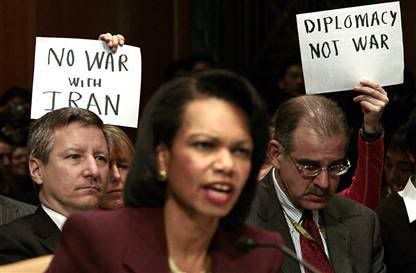
They, however, claimed that Defense Secretary Robert Gates' and Secretary of State Condoleezza Rice's reservations had so far prevented the administration from launching an attack on Iran.

Earlier, a news website close the Israeli intelligence agency revealed that during his visit to al-Quds Bush criticized Israeli prime minister Ehud Olmert for not attacking Lebanon after the political defeat of Fuad Siniora's government in the recent crisis in Lebanon.
A "Clinton cohort" reports to Huffington Post that Hillary Clinton is asking key supporters (superdelegates) not to desert her during the next two weeks of campaigning, assuring them that she "won't embarrass them".

Could her subtext be, "You'll see why I haven't gotten out of the race (war with Iran), and I'll make the case that I'm the experienced 'war president', not Obama".

If true, how could she know?

Bill Clinton, as a former president, gets the same daily intelligence briefing that Bush gets. We've heard about plans for an imminent strike against Iran for a while, but what isn't available to the public, but is in daily briefings, is the most up-to-date information on U.S. military placement. If it was happening, if a military strike against Iran was operational, the Clintons would know about it.

Wednesday, November 21, 2007

"But Once The Bombing Starts & We Invade Iran, The Nuts Will Have Been Destroyed!"

U.S. officials demanding halt to indirect Israel imports of Iranian pistachio nuts

The International Herald Tribune reports:

It's not just Iran's nuclear program that's causing problems for Israel and the U.S. — it's also Iran's pistachio nuts.

The reddish nuts are landing in Israeli shops after funneling through Turkey, violating Israeli law that bans all Iranian imports and angering American officials who are urging Israel to crack down as part of their attempt to keep Iran from acquiring nuclear weapons.
U.S. Undersecretary of Agriculture Mark Keenum said in a meeting with Israeli officials in Rome on Monday that the pistachio imports must stop, a U.S. official confirmed Wednesday. Both the U.S. and Israel have been pushing for new U.N. sanctions to persuade Iran to abandon its nuclear program. Iran insists its ambitions are peaceful.

"This causes great anger, especially since pistachios succeed in coming in through a third country," Israeli Agriculture Minister Shalom Simchon told Israeli Radio. "This has to do with the sanctions but also with the competition between American farmers and Iranian farmers, and we are trying to deal with this."

Simchon said a recent meeting with a senior U.S. agriculture official focused on using technology to detect the origin of pistachios. He said that would involve chemical testing to determine the climate and soil of where the nuts were grown.

In the mid 1990s U.S. officials pressured Israel to block the import of Iranian nuts coming through E.U. member states and winding up in Israel.

The United States has had few diplomatic and economic ties with Iran since a group of Iranian students besieged the American embassy in Tehran in 1979, holding diplomats hostage for 444 days.

Tensions since Iran started pursuing nuclear technology have only heightened, with the U.S. pushing the U.N. to enact new economic sanctions against the country until it gives up the program.

California is the second largest producer of pistachios in the world, according to the former California Pistachio Coalition. Iran is first.

"As a proud native of the golden state (California), I think Israelis should eat American pistachios, not Iranian ones," said Stewart Tuttle, spokesman for the U.S. Embassy in Tel Aviv.

Sunday, September 09, 2007

An Unlikely Hit on Iranian TV

Show Sympathetic to Plight Of Jews During the Holocaust Draws Millions Each Week


Zero Degree Orbit, Part 1 of Episode 1


Zero Degree Orbit, Part 2 of Episode 1

The Wall Street Journal reports:
Every Monday night at 10 o'clock, Iranians by the millions tune into Channel One to watch the most expensive show ever aired on the Islamic republic's state-owned television. Its elaborate 1940s costumes and European locations are a far cry from the typical Iranian TV fare of scarf-clad women and gray-suited men.

But the most surprising thing about the wildly popular show is that it is a heart-wrenching tale of European Jews during World War II.
The hour-long drama, "Zero Degree Turn," centers on a love story between an Iranian-Palestinian Muslim man and a French Jewish woman. Over the course of the 22 episodes, the hero saves his love from Nazi detention camps, and Iranian diplomats in France forge passports for the woman and her family to sneak on to airplanes carrying Iranian Jews to their homeland.

On the surface, the message of the lavish, state-funded production appears sharply at odds with that sent out by Iranian President Mahmoud Ahmadinejad, who has repeatedly called the Holocaust a myth.

In fact, the government's spending on the show underscores the subtle and often sophisticated way in which the Iranian state uses its TV empire to send out political messages. The aim of the show, according to many inside and outside the country, is to draw a clear distinction between the government's views about Judaism -- which is accepted across Iranian society -- and its stance on Israel -- which the leadership denounces every chance it gets.

"Iranians have always differentiated between ordinary Jews and a minority of Zionists," says Hassan Fatthi, the show's writer and director. "The murder of innocent Jews during World War II is just as despicable, sad and shocking as the killing of innocent Palestinian women and children by racist Zionist soldiers," he says.

Mr. Fatthi, 48 years old, is a well-known director of historical fiction for television. In the past, his work has focused on Iranian history. But he also dabbles in comedy, winning international critical acclaim two years ago for a hit feature, "Marriage, Iranian Style."

He says he came up with the idea for "Zero Degree Turn" four years ago as he was reading books about World War II and stumbled across literature about charge d'affaires at the Iranian embassy in Paris. Abdol Hussein Sardari saved over a thousand European Jews by forging Iranian passports and claiming they belonged to an Iranian tribe.

Mr. Fatthi says he chose the title because the world at the time was in dire circumstances, offering few options for avoiding the terrors to come. Shot on location in Paris and Budapest, the show stars Iranian heartthrob Shahab Husseini and is so popular that its theme song -- an ode to getting lost in love -- is a hit, too.

"It's captivating. No matter where I am or what I'm doing, on Monday nights I find a television set and watch the show. So does every Jewish person I know here," says Morris Motamed, the lone Jew in parliament.

Shahab Husseini stars in 'Zero Degree Orbit.'

Mr. Fatthi enlisted the help of Iran's Jewish Association, an independent body that safeguards the community's culture and heritage. The association has criticized Mr. Ahmadinejad's comments about the Holocaust but has praised Mr. Fatthi's show.

Iran is home to some 25,000 Jews, the largest population in the Middle East outside of Israel. Iran's Jews -- along with Christians and Zorastrians -- are guaranteed equal rights in the country's constitution. Iran's Jews are guaranteed one member of parliament and are free to study Hebrew in school, pray in synagogues and shop at kosher supermarkets. Despite Mr. Ahmadinejad's statements, it isn't government policy to question the Holocaust, and the country's supreme leader, Ayatollah Ali Khamenei, hasn't endorsed those views.

While Iran makes it no secret that it considers Israel an enemy, it has been extremely touchy about criticism of its treatment of Jewish citizens. The show is seen as an effort by the government to erase the image that it may be anti-Semitic -- both at home among Jews and non-Jews, and abroad.

"In this show, you notice that a new method of political dialogue is being promoted that is more in line with the modern world," says Mohammad Ali Abtahi, a reformist cleric and former Iranian vice president.

The message appears to be grabbing the public. Sara Khatibi, a 35-year-old mother and chemist in Tehran, says she and her husband never miss an episode. "All we ever hear about Jews is rants from the government about Israel," she says. "This is the first time we are seeing another side of the story and learning about their plight."

The show also pushes Iran's political line regarding the legitimacy of Israel: The Jewish state was conceived in modern times by Western powers rather than as part of a centuries-old desire of Jews for a return to their ancestral homeland. In one scene, a rabbi declares it a bad idea for Jews to resettle in Arab lands. In another, the French Jewish protagonist refuses a marriage offer by a cousin, who is advocating the creation of Israel.

Iran has long used TV to shape public opinion, where newspapers and the Internet are seen as media for the elite. The state's control over radio and television is enshrined in the constitution. Ayatollah Khamenei, the supreme leader, is not only head of the armed forces and the judiciary, but also the national broadcast authority.

"The regime appreciates the fact that to appeal to the masses, both in Iran and the Muslim world, television is the most important outlet," says Karim Sadjadpour, an expert on Iran at the Carnegie Endowment for International Peace in Washington.

On any given day, the country's seven state-run channels broadcast a mostly drab offering of news, sports, cooking shows, soap operas and religious sermons. Political propaganda is constantly fed into the mix. Dissidents such as students or reformers are routinely paraded before cameras to read confessions after stints of solitary imprisonment.

A slick documentary-style program recently aired long interviews with two Iranian-Americans who were detained on allegations of working to overthrow the regime. The interviews -- in which the pair blandly admitted to meeting with Iranian scholars and dissidents, but not to attempting to topple the government -- were intercut with provocative scenes of demonstrations in Ukraine, where the U.S. encouraged groups that eventually staged the successful Orange Revolution in late 2004.

In July, Iran launched a 24-hour English-language satellite news channel called Press TV, joining the ranks of the BBC, CNN and Al Jazeera. Its Arabic news channel, Al Alam, has been broadcasting news with an Iranian slant in the Arab world for several years.

Episodes of "Zero Degree Turn," broadcast in Farsi, can be seen outside of Iran on the Internet, either streaming live or downloaded at tv1.irib.ir/barnameha/sharhefilm.asp?code=0011109036106. It is also broadcast with English subtitles on the state-controlled Jameh Jam satellite channel, which is available on Europe's Hot Bird satellite network. Mr. Fatthi also says Islamic Republic of Iran Broadcasting has been contacted about selling the show to networks in other countries, but he doesn't know which ones.

Saturday, August 18, 2007

Bush Administration Insider: "There Will Be An Attack On Iran"

For TIME.com, former CIA field officer assigned to the Middle East, Bob Baer, writes:
Reports that the Bush Administration will put Iran's Islamic Revolutionary Guard Corps on the terrorism list can be read in one of two ways: it's either more bluster or, ominously, a wind-up for a strike on Iran. Officials I talk to in Washington vote for a hit on the IRGC, maybe within the next six months. And they think that as long as we have bombers and missiles in the air, we will hit Iran's nuclear facilities. An awe and shock campaign, lite, if you will. But frankly they're guessing; after Iraq the White House trusts no one, especially the bureaucracy.
As with Saddam and his imagined WMD, the Administration's case against the IRGC is circumstantial. The U.S. military suspects but cannot prove that the IRGC is the main supplier of sophisticated improvised explosive devices to insurgents killing our forces in Iraq and Afghanistan. The most sophisticated version, explosive formed projectiles or shape charges, are capable of penetrating the armor of an Abrams tank, disabling the tank and killing the crew.

A former CIA explosives expert who still works in Iraq told me: "The Iranians are making them. End of story." His argument is only a state is capable of manufacturing the EFP's, which involves a complicated annealing process. Incidentally, he also is convinced the IRGC is helping Iraqi Shi'a militias sight in their mortars on the Green Zone. "The way they're dropping them in, in neat grids, tells me all I need to know that the Shi'a are getting help. And there's no doubt it's Iranian, the IRGC's," he said.

A second part of the Administration's case against the IRGC is that the IRGC has had a long, established history of killing Americans, starting with the attack on the Marines in Beirut in 1983. And that's not to mention it was the IRGC that backed Hizballah in its thirty-four day war against Israel last year. The feeling in the Administration is that we should have taken care of the IRGC a long, long time ago.

Strengthening the Administration's case for a strike on Iran, there's a belief among neo-cons that the IRGC is the one obstacle to a democratic and friendly Iran. They believe that if we were to get rid of the IRGC, the clerics would fall, and our thirty-years war with Iran over. It's another neo-con delusion, but still it informs White House thinking.

And what do we do if just the opposite happens — a strike on Iran unifies Iranians behind the regime? An Administration official told me it's not even a consideration. "IRGC IED's are a casus belli for this Administration. There will be an attack on Iran."

Bush and Cheney have made it clear that they don't believe they need to consult with Congress about attacking Iran or any other nation they decide is a terrorist state. Congress has, in turn, taken the only tool that Congress has (impeachment) off the table.

It's now a waiting game.

Tuesday, June 12, 2007

The Case For Impeachment 'Is Even More Truthful Today' . . . .

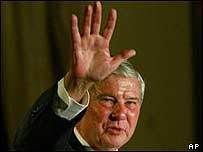
. . . . Says Former Senate Intelligence Chairman Bob Graham


From ThinkProgress.org:
Former Senate Intelligence Committee Chairman Bob Graham (D-FL) was one of 23 Senators to have voted against the Iraq war resolution in October 2002. “With sadness,” he told his colleagues, “I predict we will live to regret this day, Oct. 10, 2002, the day we stood by and we allowed these terrorist organizations to continue growing in the shadows.”

Just four months after Bush launched the Iraq war, Graham floated the idea of impeachment. “Clearly, if the standard is now what the House of Representatives did in the impeachment of Bill Clinton, the actions of this president [are] much more serious in terms of dereliction of duty,” he said. In an interview this week with ThinkProgress, Graham said he stood by his 2003 statement:

How many Americans would say that it is a greater dereliction of duty as President of the United States to have a consensual sexual affair or to take the country to war under manipulated, fabricated, and largely untruthful representations which the President knew or should have known. I think the answer to that question is clear.

Graham added that it’s unlikely Bush would be impeached, explaining that he learned the word impeachment is an “incendiary word” that Americans shy away from. “Americans don’t like impeachment because it connotes the kind of instability that so many other countries around the world have known.” But he added that his original remark regarding impeachment “was a truthful statement at the time and it’s even more truthful today.”

CLICK HERE TO LISTEN

Right before the Senate vote on the Iraq resolution, the mild-mannered Graham sounded the alarms in unusually stark language. “If you believe that the American people are not going to be at additional threat,” he said, “then, frankly, my friends — to use a blunt term — blood is going to be on your hands.”

Asked to reflect on that statement today, Graham said, “There are 3,500 fewer American servicemen alive today in the world since the day I made that statement. There are tens of thousands of civilians who’ve lost their lives. The United States is at dramatically greater risk of terrorism… So I’m afraid that the blood has flown fuller, deeper, and redder that I thought it was going to.”

Graham also ridiculed Sen. Joseph Lieberman’s (I-CT) calls for taking “aggressive military action” against Iran:

I don’t know where we’re going to get the troops to take aggressive offensive action against Iran. Iran’s a country that’s approximately 2.5 times the population of Iraq. It has a GDP that’s twice that of Iraq. It is a much more significant force in the world. And we see how bogged down we are in Iraq, how in the world are we going to even consider using massive military force against Iran?

'Impeachment' is an incendiary word that Americans shy away from because of the way that Republicans used it against Clinton - as a device to stop legislation by Democrats from going forward and becoming law.

Before the midterm elections, polls indicated that the majority of Americans favored impeaching Bush. I haven't seen any polling on that question since the elections, but Bush's approval ratings haven't improved - they've sunk to Nixon's lowest numbers. I think it's a safe bet to conclude that even more people support impeachment.

The only thing preventing impeachment is Congress. The question then becomes, "Why?" Are they lazy? Are they being blackmailed by information culled from one of the many secret surveillance programs that Bush-Cheney are operating outside of the law and judicial oversight?

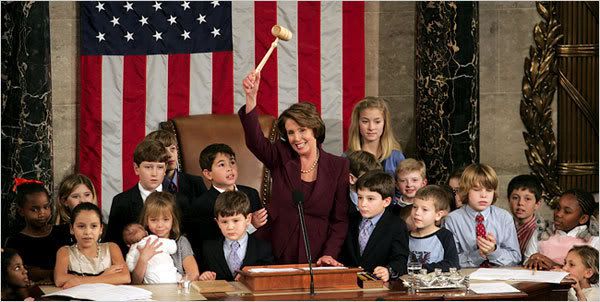
Could it also be that a deal was made last year? That if the Democrats prevailed in the midterm elections and became the majority in the House, Republicans and Democrats would agree to a woman (Pelosi) becoming the first woman Speaker if Democrats dropped all plans to impeach Bush and Cheney? Because if both the President and Vice President were impeached, the Speaker of the House (Pelosi) would be next in line to become President. And that if a woman is to ever become President of the United States, it must be through a direct vote of the people.

What else could explain Pelosi's announcement ("taking impeachment off the table") before the midterm elections?


If I'm right, we traded letting Nancy Pelosi become the first woman Speaker of the House of Representatives for allowing the most corrupt, thieving, murderous administration in the history of the nation remain in power, so that they could continue their assault on the Constitution, on civil liberties, rendition, torture, promote their preemptive war policies (for oil and other profiteering), attack Iran and expand the hostilities in the Middle East and around the world.

I can't think of any other reasons to explain all that this Democratic Congress has failed to do. How many times must Rove and Gonzales and Rice (and Bush, Cheney, Secret Service) ignore subpoenas, refuse to appear or produce documents before you go to court to compel compliance? How can anyone explain a Democratic Congress allowing the Bush administration's failure during Hurricane Katrina to go uninvestigated?

If Congress did proper oversight, all investigations of everything that Bush-Cheney have been up to these last six+years lead to misfeasance, malfeasance, corruption and impeachment. Why wouldn't the Democrats (who are not stupid and just as politically motivated as Republicans) jump at these opportunities to score points at Republicans' expense?

Something is preventing the Democrats. What?

Tuesday, May 22, 2007

More Indications That Bush's Surge Is Actually An Escalation & Another Step On The Way To War In Iraq

On the day when Democrats should have been putting the screws to Bush by returning a supplemental appropriations bill with exact language by which progress in Iraq can be measured as well as dates certain for withdrawing U.S. troops, Democrats caved and agreed to all of Bush's terms for an unending war in Iraq and a blank check by which to wage it

Bush is making sure that not only won't he bring this war in Iraq to an end by the end of his term in office, his successor won't be able to either - Bush will have us in war with Iran before he's out of the White House.

SFgate.com reports:
The Bush administration is quietly on track to nearly double the number of combat troops in Iraq this year, an analysis of Pentagon deployment orders showed Monday.

The little-noticed second surge, designed to reinforce U.S. troops in Iraq, is being executed by sending more combat brigades and extending tours of duty for troops already there.

The actions could boost the number of combat soldiers from 52,500 in early January to as many as 98,000 by the end of this year if the Pentagon overlaps arriving and departing combat brigades.

Separately, when additional support troops are included in this second troop increase, the total number of U.S. troops in Iraq could increase from 162,000 now to more than 200,000 -- a record-high number -- by the end of the year.

The numbers were arrived at by an analysis of deployment orders by Hearst Newspapers.
"It doesn't surprise me that they're not talking about it," said retired Army Maj. Gen. William Nash, a former U.S. commander of NATO troops in Bosnia, referring to the Bush administration. "I think they would be very happy not to have any more attention paid to this."

The first surge was prominently announced by President Bush in a nationally televised address on Jan. 10, when he ordered five more combat brigades to join 15 brigades already in Iraq.

The buildup was designed to give commanders the 20 combat brigades Pentagon planners said were needed to provide security in Baghdad and western Anbar province.

Since then, the Pentagon has extended combat tours for units in Iraq from 12 months to 15 months and announced the deployment of additional brigades.

Taken together, the steps could put elements of as many as 28 combat brigades in Iraq by Christmas, according the deployment orders examined by Hearst Newspapers.

Army spokesman Lt. Col. Carl S. Ey said there was no effort by the Army to carry out "a secret surge" beyond the 20 combat brigades ordered by Defense Secretary Robert Gates.

"There isn't a second surge going on; we've got what we've got," Ey said. "The idea that there are ever going to be more combat brigades in theater in the future than the secretary of defense has authorized is pure speculation."

Ey attributed the increase in troops to "temporary increases that typically occur during the crossover period" as arriving combat brigades move into position to replace departing combat brigades.

He said that only elements of the eight additional combat brigades beyond the 20 already authorized would actually be in Iraq in December.

The U.S. Joint Forces Command, based in Norfolk, Va., that tracks combat forces heading to and returning from Iraq, declined to discuss unit-by-unit deployments.
"Due to operational security, we cannot confirm or discuss military unit movements or schedules," Navy Lt. Jereal Dorsey said in an e-mail.

The Pentagon has repeatedly extended unit tours in Iraq during the past four years to achieve temporary increases in combat power. For example, three combat brigades were extended up to three months in November 2004 to boost the number of U.S. troops from 138,000 to 150,000 before, during and after the Jan. 30, 2005, Iraqi national elections.

Lawrence Korb, an assistant defense secretary for manpower during the Reagan administration, said the Pentagon deployment schedule enables the Bush administration to achieve quick increases in combat forces in the future by delaying units' scheduled departures from Iraq and overlapping them with arriving replacement forces.

"The administration is giving itself the capability to increase the number of troops in Iraq," Korb said. "It remains to be seen whether they actually choose to do that."
Nash said the capability could reflect an effort by the Bush administration to "get the number of troops into Iraq that we've needed there all along."

Meanwhile, ABCnews.com reports:
The CIA has received secret presidential approval to mount a covert "black" operation to destabilize the Iranian government, current and former officials in the intelligence community tell the Blotter on ABCNews.com.

The sources, who spoke on the condition of anonymity because of the sensitive nature of the subject, say President Bush has signed a "nonlethal presidential finding" that puts into motion a CIA plan that reportedly includes a coordinated campaign of propaganda, disinformation and manipulation of Iran's currency and international financial transactions.

"I can't confirm or deny whether such a program exists or whether the president signed it, but it would be consistent with an overall American approach trying to find ways to put pressure on the regime," said Bruce Riedel, a recently retired CIA senior official who dealt with Iran and other countries in the region.

A National Security Council spokesperson, Gordon Johndroe, said, "The White House does not comment on intelligence matters." A CIA spokesperson said, "As a matter of course, we do not comment on allegations of covert activity."

The sources say the CIA developed the covert plan over the last year and received approval from White House officials and other officials in the intelligence community.

Officials say the covert plan is designed to pressure Iran to stop its nuclear enrichment program and end aid to insurgents in Iraq.

"There are some channels where the United States government may want to do things without its hand showing, and legally, therefore, the administration would, if it's doing that, need an intelligence finding and would need to tell the Congress," said ABC News consultant Richard Clarke, a former White House counterterrorism official.

Current and former intelligence officials say the approval of the covert action means the Bush administration, for the time being, has decided not to pursue a military option against Iran.

Monday, March 12, 2007

Democrats Drop Iran War Authority Provision


The Associated Press reports:
Top House Democrats retreated Monday from an attempt to limit President Bush's authority for taking military action against Iran as the leadership concentrated on a looming confrontation with the White House over the Iraq war.

Officials said Speaker Nancy Pelosi and other members of the leadership had decided to strip from a major military spending bill a requirement for Bush to gain approval from Congress before moving against Iran.

Conservative Democrats as well as lawmakers concerned about the possible impact on Israel had argued for the change in strategy.

The developments occurred as Democrats pointed toward an initial test vote in the House Appropriations Committee on Thursday on the overall bill, which would require the withdrawal of U.S. combat troops from Iraq by Sept. 1, 2008, if not earlier. The measure provides nearly $100 billion to pay for fighting in two wars, and includes more money than the president requested for operations in Afghanistan and what Democrats called training and equipment shortages.

The White House has issued a veto threat against the bill, and Vice President Dick Cheney attacked its supporters in a speech, declaring they "are telling the enemy simply to watch the clock and wait us out."

House GOP Leader John Boehner of Ohio issued a statement that said Democrats shouldn't count on any help passing their legislation.

"Republicans will continue to stand united in this debate, and will oppose efforts by Democrats to undermine the ability of General Petraeus and our troops to achieve victory in the Global War on Terror," he said.

Top Democrats had a different perspective.

Pelosi issued a written statement that said the vice president's remarks prove that "the administration's answer to continuing violence in Iraq is more troops and more treasure from the American people."

Senate Majority Leader Harry Reid, D-Nev., said in a statement that America was less safe today because of the war. The president "must change course, and it's time for the Senate to demand he do it," he added.

The Iran-related proposal stemmed from a desire to make sure Bush did not launch an attack without going to Congress for approval, but drew opposition from numerous members of the rank and file in a series of closed-door sessions last week.

Rep. Shelley Berkley, D-Nev., said in an interview there is widespread fear in Israel about Iran, which is believed to be seeking nuclear weapons and has expressed unremitting hostility about the Jewish state.

"It would take away perhaps the most important negotiating tool that the U.S. has when it comes to Iran," she said of the now-abandoned provision.

Widespread fear in...Israel? Representative Berkley seems confused about who voted for her and whom she represents: She isn't a member of the Knesset, but a member of the United States Congress.

Whatever delusions Shelley Berkley is suffering from, apparently she's not the only one:
"I didn't think it was a very wise idea to take things off the table if you're trying to get people to modify their behavior and normalize it in a civilized way," said Rep. Gary Ackerman of New York.

Several officials said there was widespread opposition to the proposal at a closed-door meeting last week of conservative and moderate Democrats, who said they feared tying the hands of the administration when dealing with an unpredictable and potentially hostile regime in Tehran.

Public opinion has swung the way of Democrats on the issue of the war. More than six in 10 Americans think the conflict was a mistake — the largest number yet found in AP-Ipsos polling.

But Democrats have struggled to find a compromise that can satisfy both liberals who oppose any funding for the military effort and conservatives who do not want to unduly restrict the commander in chief.

"This supplemental should be about supporting the troops and providing what they need," said Rep. Dan Boren, D-Okla., on Monday upon returning from a trip to Iraq. Boren said he plans to oppose any legislation setting a clear deadline for troops to leave.

In his speech, Cheney chided lawmakers who are pressing for tougher action on Iran to oppose the president on the Iraq War.

"It is simply not consistent for anyone to demand aggressive action against the menace posed by the Iranian regime while at the same time acquiescing in a retreat from Iraq that would leave our worst enemies dramatically emboldened and Israel's best friend, the United States, dangerously weakened," he said.

I think this story may just put the romance that the media has for reporting every few months that "Cheney is losing influence with Bush" to rest once and for all.

Cheney's got 'em (our Democratic representatives in Congress) right where he wants 'em. And unless we replace the dead wood Democrats in the 2008 elections (along with Republicans) we're going to be in Iraq, in Afghanistan, Iran (and probably Syria, too, before long) for years and years and years to come.


TECHNICAL DIFFICULTIES - A little firewall problem, YouTube tells me. I'm working on it now, and hope to have it fixed shortly. In the meantime, this is a transcript of the video, Chris Matthews interview with Tina Roberts, activist and mother of a U.S. soldier about to return to Iraq for a third tour of duty:

MATTHEWS: Tempers flared during an argument between House Appropriations Committee chairman David Obey of Wisconsin and a woman whose son is a Marine. It was all caught on videotape. Here‘s an excerpt of what happened outside the congressman‘s Capitol Hill office.

(BEGIN VIDEO CLIP)

REP. DAVID OBEY (D-WI), APPROPRIATIONS COMMITTEE CHAIRMAN:

(INAUDIBLE) understand (INAUDIBLE) difference between defunding the troops and ending the war. I hate the war. I voted against it to start with. I was the first guy in Congress to call for Rumsfeld‘s resignation. But we don‘t have the votes to defund the war, and we shouldn‘t because that also means defunding everything (INAUDIBLE) guys who are victims of the war.

(END VIDEO CLIP)

MATTHEWS: Well, Tina Richards of Grassroots America is the woman in that videotape, as you can see, and she‘s right here with us this evening. Thank you for coming on. You‘ve earned your spurs. You took on David Obey, chairman of the Appropriations Committee. What did you make of his response to your concern about ending the war?

TINA RICHARDS, GRASSROOTS AMERICA: Well, one thing that I found is that there‘s a lot of frustration on Capitol Hill about how to end the war in Iraq. The one thing that I‘ve heard that really concerns me, though, since I‘ve started from January 29, when I found out my son was being recalled by the Marine mobilization unit to be possibly redeployed for his third tour in Iraq, was that the staffers and aides—when I hear them talking, I listen in to what they‘re saying and I overhear them. They seem to be more concerned about what is going to guarantee a presidential election and an expanse of their majority than they are about the lives that are being lost every day over in Iraq.

MATTHEWS: How do you figure that out? I mean, that‘s a legitimate concern, obviously, that they‘re playing politics. But how can you tell? There‘s Obey. He said—I watched that tape two or three times (INAUDIBLE) out there and he said he voted against the resolution for war back in 2002. He said he‘s trying to pass a supplemental appropriation with language in it which cuts off this war next year sometime. What do you make of his position? Do you think he‘s not telling the truth or what?

RICHARDS: No. There are some really sincere people on that Hill. That I do not doubt. John Murtha—I met with him for over an hour. He is the most sincere man. We really disagree on how we‘re going to get out of Iraq, but he is absolutely very sincere. Lynn Woolsey (ph), Jan Schakowsky (ph) -- I could name...

MATTHEWS: What‘s your position on...

RICHARDS: ... John Conyers...

MATTHEWS: ... how we should get out?

RICHARDS: Well, truly, when it goes back, that the power of the purse is what Congress has. That is the one thing that they do have, is to stop the funding for the war. I was listening to hearings...

MATTHEWS: That means cutting off the money, period.

RICHARDS: That means cutting off the money, which the generals have testified on the Hill, which—I‘ve been personally at those hearings where they said that they would have to reduce forward combat operations.

It does not mean that our troops and our—will not have their armor or not have their bullets or not have their food. It means that they‘ll have to cease forward combat operations, which means that it will then start to we can start the withdrawal. And there‘s...

MATTHEWS: If you had a son in the field right now, would you want to hear that Congress had cut off some of the funding for the war?

RICHARDS: My son...

MATTHEWS: While he‘s in the field.

RICHARDS: My son may be in the field...

MATTHEWS: No, but if he‘s in that field, would you have the same point of view.

RICHARDS: Yes. Absolutely. My son—March 24, he has to report in, and he may very well be over there when this goes through. Yes, absolutely, I am saying that. We have to stop funding this war. I keep hearing politicians saying that they‘re against the war, that they originally voted against it, yet year after year, they will continue to fund this war, to...

MATTHEWS: You know why, though. Tell me why. Why do you think?

RICHARDS: I think a lot...

MATTHEWS: You‘re smart. You‘re lobbying this issue. Why do you think a guy like Obey—he said it to you. I heard him say that. I watched the tape two or three times. He said, We can‘t cut off the funding because if we cut off the funding, we will be accused of cutting off armor and equipment for the soldiers fighting in the field.

RICHARDS: Exactly. And then he says that we can‘t get the votes. Yet you have the leadership of the Democratic Party, you have Nancy Pelosi, you have Steny Hoyer, you have Chris Van Holland (ph) all saying that, We can‘t get the votes, and then they use the Republican talking points as to what is happening if they do stop the funding. And it makes no sense. If they...

MATTHEWS: Well, they‘re saying two things. They‘re saying they don‘t have the 218 to pass the majority, and then they‘re saying, But if we do pass the majority, they‘ll kill us politically by saying, They‘ve cut off reinforcements to our troops in the field. You know that‘s what they‘re going to say.

RICHARDS: You know what? Yes. And I understand that the Republican talking points are exactly that. And the point is, is that our sons and daughters are dying over there every day. By the tens of thousands they‘re coming back, and they‘re not getting their treatment. The VA has been horrible towards the treatment of my son. You saw Walter Reed recently...

MATTHEWS: Obey said that they put an extra billion in, in this appropriation, the supplemental, to make sure the medical treatment of people like your son is better. He says you have to fund this military in order to get better treatment for the wounded. What do you make of that?

RICHARDS: Well, the point is, is that they said that—the generals have testified that they‘ll have to reduce their forward combat operations, and that‘s what‘s going to change if they don‘t do the supplemental. The extra money is something that they can appropriate through this next coming budget or appropriate from somewhere else, but I just don‘t see that as an alternative to justify...

(CROSSTALK)

MATTHEWS: How do you think...

RICHARDS: ... justify maybe treating a few soldiers better, but at the same time, they‘re going to have three soldiers a day dying over in Iraq.

MATTHEWS: How do we—how do you achieve your goal of ending this war in Iraq? How do you do it?

RICHARDS: There is the Lee amendment that asked for the fully funded withdrawal of the troops, which Obey had responded as a dismissal, not even to consider it, that I didn‘t know what I was talking about, without even looking...

(CROSSTALK)

MATTHEWS: ... Barbara Lee of Oakland and Berkeley, yes.

RICHARDS: Yes. And he didn‘t even want to discuss that. And that was partly why I‘ve been on the Hill every single day...

MATTHEWS: But how many votes...

RICHARDS: ... trying to lobby Congress.

MATTHEWS: ... do you think Barbara Lee‘s proposal would do, where it says, We‘ll spend enough money to bring the troops home but not to keep them there? How many votes do you think that would get in the Congress?

RICHARDS: I think that if Nancy Pelosi...

MATTHEWS: Fifty?

RICHARDS: ... and Steny Hoyer and the Democrat leadership stopped exerting pressure to hush everybody that is coming out against it and started to support it, I think that they would have the votes to pass it.

MATTHEWS: But they don‘t think so.

RICHARDS: Because they‘re not trying. They‘re using the Republican talking points. As long as they‘re using the Republican talking points...

MATTHEWS: Are you saying that they‘re really for the war?

RICHARDS: I‘m saying that they‘re trying to do what‘s politically savvy and not what‘s best for our troops.

MATTHEWS: How do you think they can actually get the 218 votes that are necessary to pass a majority and cut off the money?

RICHARDS: Well, I think...

MATTHEWS: They say they can‘t find those votes. I heard Obey yelling at you. He got overwrought there. You got him excited.

RICHARDS: I was hearing that, and then...

MATTHEWS: And he was saying, We just—I don‘t have a magic wand. He opened up his coat like this, he says, I don‘t have a magic wand in here. Where‘s my 218 votes? Could you help him do it? Would you have—do you have enough power in your group, or anybody in the anti-war forces, to get 218 Democrats to end this war?

MATTHEWS: I‘m just one person. I‘m a mother.

MATTHEWS: I know. You got...

RICHARDS: And I spoke with Reverend Nearwood (ph) the other day, and he said the power of a mother‘s love can bring down nations.

MATTHEWS: But can it get 218 votes in the House of Representatives?

RICHARDS: I think if Nancy Pelosi would actually start listening to the people and to the public—I mean, the nation has been against this war. The nation did not vote for a new direction, the nation voted for us to get out of Iraq. And they need to catch up with what the American public wants, which is to get us out of Iraq, to get our soldiers out of the middle of a civil war. There is no “winning” something when you‘re in a civil war, in an occupation.

We won the war. We won the war back in the very first few months of the war. It‘s time to take our sons and daughters out of Iraq and return them home. And if they start working together, instead of using their leadership powers to hush everybody and to quiet the anti-war and started working with us and figuring out a way, they would have the votes.

MATTHEWS: Good luck.

RICHARDS: Thank you very much.

MATTHEWS: I think you‘re going to need it, though. Thank you very much, Tina Richards, fighting very much against this war in Iraq.
If Democrats can't do it, can't get legislation through Congress to end the war in Iraq now when they have a certain majority, they won't do it later when they have either won the White House in 2008 and more seats in Congress, or they haven't won the White House and more seats.

In the case of the former, if they aren't taking the chance now, why would they after having failed to deliver on the mandate they got from the 2006 elections (to end the Iraq war)? And if it's the latter (if they lose control over Congress and fail to take the White House), they won't get the opportunity to end the war - Republicans will control business on the floor of both houses, they'll keep the war going and clamp down further on any dissent and opposition to their money-making (for them, the Halliburton class) cash-cow.

This is the time to shut this war operation down, turn our attention to Afghanistan and push a sane foreign policy that treats all people equitably and distributes the wealth.

Monday, February 19, 2007

War Jitters

Newsweek reports, "America's Hidden War With Iran":
Jalal Sharafi was carrying a videogame, a gift for his daughter, when he found himself surrounded. On that chilly Sunday morning, the second secretary at the Iranian Embassy in Baghdad had driven himself to the commercial district of Arasat Hindi to checkout the site for a new Iranian bank. He had ducked into a nearby electronics store with his bodyguards, and as they emerged four armored cars roared up and disgorged at least 20 gunmen wearing bulletproof vests and Iraqi National Guard uniforms. They flashed official IDs, and manhandled Sharafi into one car. Iraqi police gave chase, guns blazing. They shot up one of the other vehicles, capturing four assailants who by late last week had yet to be publicly identified. Sharafi and the others disappeared.
At the embassy, the diplomat's colleagues were furious. "This was a group directly under American supervision," said one distraught Iranian official, who was not authorized to speak on the record. Abdul Karim Inizi, a former Iraqi Security minister close to the Iranians, pointed the finger at an Iraqi black-ops unit based out at the Baghdad airport, who answer to American Special Forces officers. "It's plausible," says a senior Coalition adviser who is also not authorized to speak on the record. The unit does exist—and does specialize in snatch operations.

The Iranians have reason to feel paranoid. In recent weeks senior American officers have condemned Tehran for providing training and deadly explosives to insurgents. In a predawn raid on Dec. 21, U.S. troops barged into the compound of the most powerful political party in the country, the Supreme Council for the Islamic Revolution in Iraq, and grabbed two men they claimed were officers in Iran's Revolutionary Guards. Three weeks later U.S. troops stormed an Iranian diplomatic office in Irbil, arresting five more Iranians. The Americans have hinted that as part of an escalating tit-for-tat, Iranians may have had a hand in a spectacular raid in Karbala on Jan. 20, in which four American soldiers were kidnapped and later found shot, execution style, in the head. U.S. forces promised to defend themselves.

Some view the spiraling attacks as a strand in a worrisome pattern. At least one former White House official contends that some Bush advisers secretly want an excuse to attack Iran. "They intend to be as provocative as possible and make the Iranians do something [America] would be forced to retaliate for," says Hillary Mann, the administration's former National Security Council director for Iran and Persian Gulf Affairs. U.S. officials insist they have no intention of provoking or otherwise starting a war with Iran, and they were also quick to deny any link to Sharafi's kidnapping. But the fact remains that the longstanding war of words between Washington and Tehran is edging toward something more dangerous. A second Navy carrier group is steaming toward the Persian Gulf, and NEWSWEEK has learned that a third carrier will likely follow. Iran shot off a few missiles in those same tense waters last week, in a highly publicized test. With Americans and Iranians jousting on the chaotic battleground of Iraq, the chances of a small incident's spiraling into a crisis are higher than they've been in years.

Sometimes it seems as if a state of conflict is natural to the U.S.-Iranian relationship—troubled since the CIA-backed coup that restored the shah to power in 1953, tortured since Ayatollah Khomeini's triumph in 1979. With the election of George W. Bush on the one hand, and Iranian President Mahmoud Ahmadinejad on the other, the two countries are now led by men who deeply mistrust the intentions and indeed doubt the sanity of the other. Tehran insists that U.S. policy is aimed at toppling the regime and subjugating Iran. The White House charges that Iran is violently sabotaging U.S. efforts to stabilize the Middle East while not so secretly developing nuclear weapons. As the raids and skirmishes in Iraq underscore, a hidden war is already unfolding.

Yet a NEWSWEEK investigation has also found periods of marked cooperation and even tentative steps toward possible reconciliation in recent years—far more than is commonly realized. After September 11 in particular, relations grew warmer than at any time since the fall of the shah. America wanted Iran's help in Afghanistan, and Iran gave it, partly out of fear of an angry superpower and partly in order to be rid of its troublesome Taliban neighbors. In time, hard-liners on both sides were able to undo the efforts of diplomats to build on that foundation. The damage only worsened as those hawks became intoxicated with their own success. The secret history of the Bush administration's dealings with Iran is one of arrogance, mistrust and failure. But it is also a history that offers some hope.

For Iran's reformists, 9/11 was a blessing in disguise. Previous attempts to reach out to America had been stymied by conservative mullahs. But the fear that an enraged superpower would blindly lash out focused minds in Tehran. Mohammad Hossein Adeli was one of only two deputies on duty at the Foreign Ministry when the attacks took place, late on a sweltering summer afternoon. He immediately began contacting top officials, insisting that Iran respond quickly. "We wanted to truly condemn the attacks but we also wished to offer an olive branch to the United States, showing we were interested in peace," says Adeli. To his relief, Iran's top official, Ayatollah Ali Khameini, quickly agreed. "The Supreme Leader was deeply suspicious of the American government," says a Khameini aide whose position does not allow him to be named. "But [he] was repulsed by these terrorist acts and was truly sad about the loss of the civilian lives in America." For two weeks worshipers at Friday prayers even stopped chanting "Death to America."

The fear dissipated after Sept. 20, when the FBI announced that Al Qaeda was behind the attacks. But there was new reason for cooperation: for years Tehran had been backing the Afghan guerrillas fighting the Taliban, Osama bin Laden's hosts. Suddenly, having U.S. troops next door in Afghanistan didn't seem like a bad idea. American and Iranian officials met repeatedly in Geneva in the days before the Oct. 7 U.S. invasion. The Iranians were more than supportive. "In fact, they were impatient," says a U.S. official involved in the talks, who asked not to be named speaking about topics that remain sensitive. "They'd ask, 'When's the military action going to start? Let's get going!' "

Opinions differ wildly over how much help the Iranians actually were on the ground. But what is beyond doubt is how critical they were to stabilizing the country after the fall of Kabul. In late November 2001, the leaders of Afghanistan's triumphant anti-Taliban factions flew to Bonn, Germany, to map out an interim Afghan government with the help of representatives from 18 Coalition countries. It was rainy and unseasonably cold, and the penitential month of Ramadan was in full sway, but a carnival mood prevailed. The setting was a splendid hotel on the Rhine, and after sunset the German hosts laid on generous buffet meals under a big sign promising that everything was pork-free.

The Iranian team's leader, Javad Zarif, was a good-humored University of Denver alumnus with a deep, measured voice, who would later become U.N. ambassador. Jim Dobbins, Bush's first envoy to the Afghans, recalls sharing coffee with Zarif in one of the sitting rooms, poring over a draft of the agreement laying out the new Afghan government. "Zarif asked me, 'Have you looked at it?' I said, 'Yes, I read it over once'," Dobbins recalls. "Then he said, with a certain twinkle in his eye: 'I don't think there's anything in it that mentions democracy. Don't you think there could be some commitment to democratization?' This was before the Bush administration had discovered democracy as a panacea for the Middle East. I said that's a good idea."

Toward the end of the Bonn talks, Dobbins says, "we reached a pivotal moment." The various parties had decided that the suave, American-backed Hamid Karzai would lead the new Afghan government. But he was a Pashtun tribal leader from the south, and rivals from the north had actually won the capital. In the brutal world of Afghan power politics, that was a recipe for conflict. At 2 a.m. on the night before the deal was meant to be signed, the Northern Alliance delegate Yunus Qanooni was stubbornly demanding 18 out of 24 new ministries. Frantic negotiators gathered in the suite of United Nations envoy Lakhdar Brahimi. A sleepy Zarif translated for Qanooni. Finally, at close to 4 a.m., he leaned over to whisper in the Afghan's ear: " 'This is the best deal you're going to get'." Qanooni said, " 'OK'."

That moment, Dobbins says now, was critical. "The Russians and the Indians had been making similar points," he says. "But it wasn't until Zarif took him aside that it was settled ... We might have had a situation like we had in Iraq, where we were never able to settle on a single leader and government." A month later Tehran backed up the political support with financial muscle: at a donor's conference in Tokyo, Iran pledged $500 million (at the time, more than double the Americans') to help rebuild Afghanistan.

In a pattern that would become familiar, however, a chill quickly followed the warming in relations. Barely a week after the Tokyo meeting, Iran was included with Iraq and North Korea in the "Axis of Evil." Michael Gerson, now a NEWSWEEK contributor, headed the White House speechwriting shop at the time. He says Iran and North Korea were inserted into Bush's controversial State of the Union address in order to avoid focusing solely on Iraq. At the time, Bush was already making plans to topple Saddam Hussein, but he wasn't ready to say so. Gerson says it was Condoleezza Rice, then national-security adviser, who told him which two countries to include along with Iraq. But the phrase also appealed to a president who felt himself thrust into a grand struggle. Senior aides say it reminded him of Ronald Reagan's ringing denunciations of the "evil empire."

Once again, Iran's reformists were knocked back on their heels. "Those who were in favor of a rapprochement with the United States were marginalized," says Adeli. "The speech somehow exonerated those who had always doubted America's intentions." The Khameini aide concurs: "The Axis of Evil speech did not surprise the Supreme Leader. He never trusted the Americans."

It would be another war that nudged the two countries together again. At the beginning of 2003, as the Pentagon readied for battle against Iraq, the Americans wanted Tehran's help in case a flood of refugees headed for the border, or if U.S. pilots were downed inside Iran. After U.S. tanks thundered into Baghdad, those worries eased. "We had the strong hand at that point," recalls Colin Powell, who was secretary of State at the time. If anything, though, America's lightning campaign made the Iranians even more eager to deal. Low-level meetings between the two sides had continued even after the Axis of Evil speech. At one of them that spring, Zarif raised the question of the Mujahedin-e Khalq (MEK), a rabidly anti-Iranian militant group based in Iraq. Iran had detained a number of senior Qaeda operatives after 9/11. Zarif floated the possibility of "reciprocity"—your terrorists for ours.

The idea was brought up at a mid-May meeting between Bush and his chief advisers in the wood-paneled Situation Room in the White House basement. Riding high, Bush seemed to like the idea of a swap, says a participant who asked to remain anonymous because the meeting was classified. Some in the room argued that designating the militants as terrorists had been a mistake, others that they might prove useful against Iran someday. Powell opposed the handover for a different reason: he worried that the captives might be tortured. The vice president, silent through most of the meeting as was his wont, muttered something about "preserving all our options." (Cheney declined to comment.) The MEK's status remains unresolved.

Around this time what struck some in the U.S. government as an even more dramatic offer arrived in Washington—a faxed two-page proposal for comprehensive bilateral talks. To the NSC's Mann, among others, the Iranians seemed willing to discuss, at least, cracking down on Hizbullah and Hamas (or turning them into peaceful political organizations) and "full transparency" on Iran's nuclear program. In return, the Iranian "aims" in the document called for a "halt in U.S. hostile behavior and rectification of the status of Iran in the U.S. and abolishing sanctions," as well as pursuit of the MEK.

An Iranian diplomat admits to NEWSWEEK that he had a hand in preparing the proposal, but denies that he was its original author. Asking not to be named because the topic is politically sensitive, he says he got the rough draft from an intermediary with connections at the White House and the State Department. He suggested some relatively minor revisions in ballpoint pen and dispatched the working draft to Tehran, where it was shown to only the top ranks of the regime. "We didn't want to have an 'Irangate 2'," the diplomat says, referring to the secret negotiations to trade weapons for hostages that ended in scandal during Reagan's administration. After Iran's National Security Council approved the document (under orders from Khameini), a final copy was produced and sent to Washington, according to the diplomat.

The letter received a mixed reception. Powell and his deputy Richard Armitage were suspicious. Armitage says he thinks the letter represented creative diplomacy by the Swiss ambassador, Tim Guldimann, who was serving as a go-between. "We couldn't determine what [in the proposal] was the Iranians' and what was the Swiss ambassador's," he says. He added that his impression at the time was that the Iranians "were trying to put too much on the table." Quizzed about the letter in front of Congress last week, Rice denied ever seeing it. "I don't care if it originally came from Mars," Mann says now. "If the Iranians said it was fully vetted and cleared, then it could have been as important as the two-page document" that Richard Nixon and Henry Kissinger received from Beijing in 1971, indicating Mao Zedong's interest in opening China.

A few days later bombs tore through three housing complexes in Saudi Arabia and killed 29 people, including seven Americans. Furious administration hard-liners blamed Tehran. Citing telephone intercepts, they claimed the bombings had been ordered by Saif al-Adel, a senior Qaeda leader supposedly imprisoned in Iran. "There's no question but that there have been and are today senior Al Qaeda leaders in Iran, and they are busy," Defense Secretary Donald Rumsfeld growled. Although there was no evidence the Iranian government knew of Adel's activities, his presence in the country was enough to undermine those who wanted to reach out.

Powell, for one, thinks Bush simply wasn't prepared to deal with a regime he thought should not be in power. As secretary of State he met fierce resistance to any diplomatic overtures to Iran and its ally Syria. "My position in the remaining year and a half was that we ought to find ways to restart talks with Iran," he says of the end of his term. "But there was a reluctance on the part of the president to do that." The former secretary of State angrily rejects the administration's characterization of efforts by him and his top aides to deal with Tehran and Damascus as failures. "I don't like the administration saying, 'Powell went, Armitage went ... and [they] got nothing.' We got plenty," he says. "You can't negotiate when you tell the other side, 'Give us what a negotiation would produce before the negotiations start'."

Terrorism wasn't the only concern when it came to Iran. For decades, Washington's abiding fear has been that Iran might pick up where the shah's nuclear program (initially U.S.-backed) left off, and make the Great Satan the target of its atomic weapons. The Iranians, who were signatories to the Nuclear Non-Proliferation Treaty, insisted they had nothing to hide. They lied. In August 2002, a group affiliated with the MEK revealed the extent of nuclear activities at a facility in Isfahan, where the Iranians had been converting yellowcake to uranium gas, and in Natanz, where the infrastructure needed to enrich that material to weapons-grade uranium was being built. A year later Pakistani scientist AQ Khan's covert nuclear-technology network unraveled, bringing further embarrassments and investigations.

For months, European negotiators worked to get Tehran to formalize a temporary and tenuous deal to freeze its nuclear fuel-development program. In May 2005, they met with Iran's chief nuclear negotiator, Hassan Rowhani, at the Iranian ambassador's opulent Geneva residence. There was some reason to be optimistic: in Washington, Rice had announced that the United States would not block Iran's bid to join the World Trade Organization. Yet a sense of enormous tension filled the room, according to a diplomat who was there but asked not to be identified revealing official discussions. The Europeans told Rowhani they hadn't nailed down exactly what they could offer in return for a freeze, and the Americans still weren't fully onboard. Iran would have to wait for the details for a few more months. But in the meantime, the program had to remain suspended.

Rowhani, in full clerical robes and turban, obviously was not authorized to make any such deal. "The man was in front of us sweating," says the European diplomat. "He was trapped: he couldn't go further ... I realized very clearly that he couldn't deliver, that he was not allowed to deliver. Psychologically he was broken. Physically he was almost broken."

Part of the problem was that elections in Iran were only a few days away. They brought to power a man who satisfied the darkest stereotypes of Iran's fervid leaders. Mahmoud Ahmadinejad publicly renounced the freeze on Iran's nuclear fuel-development program, broke the seals the International Atomic Energy Agency had placed on Iran's conversion facilities at Isfahan and pushed ahead with work at Natanz. In the span of no more than a month or two, nuclear enrichment had become a symbol of national pride for a much wider spectrum of Iranian society than the voters who elected Ahmadinejad. In a warped parallel to Bush, who found his voice after 9/11 rallying Americans to the struggle against a vast and unforgiving enemy, the Iranian president rose in stature throughout the Middle East as he railed against America. The one problem U.S. negotiators had always had with Iran was determining who in the byzantine regime to talk to, and whether they could deliver anything. Now they faced another: the Iranians had almost no incentive to talk. With the United States bogged down in Iraq, Iran now had the leverage—roles had reversed.

In its second term the Bush administration, despite Powell's sour memories, has supported European efforts to resolve the nuclear impasse diplomatically. Rice has offered to meet her Iranian counterpart "any time, anywhere." "What has blocked such contact is the refusal of Iran to meet the demands of the entire international community," says a White House official, who could not be named discussing Iran. The official expressed deep frustration with critics. He argued they were naive about Tehran's intentions, and "parroting Iranian propaganda."

By last summer Iran seemed ascendant. Hizbullah's performance in the Lebanon war had rallied support for Ahmadinejad, one of the group's loudest proponents, across the Arab world. In a series of meetings in New York in September the Iranian president was defiant, almost giddy. (A senior British official who would only speak anonymously about deliberations with the Americans describes Tehran's mood around this time as "cock-a-hoop.") He would not back down when grilled about his dismissals of the Holocaust, and scoffed at the threat of U.N. sanctions over Iran's nuclear defiance.

The West's patience was running out. In Baghdad, American troops seemed powerless to stop a wave of gruesome sectarian killings that they claimed were fueled by Iran. In Amman and Riyadh, Arab leaders warned darkly of a rising "Shia crescent." After Bush's defeat in the midterm elections, Israeli officials began wondering aloud if they would have to deal with the Iranian threat on their own. Partly in consultation with the British, U.S. officials began to map out a broader strategy to fight back. "We felt we needed to have a much more knitted-together policy, with a number of different strands working, to hit different parts of the Iranian system," says the senior British official.

Critics have questioned how much of that plan is military—whether the administration is secretly setting a course for war as it did back in 2002. Last week officials were at great pains to deny that scenario. "We are not planning offensive military operations against Iran," said Under Secretary of State Nicholas Burns. The Pentagon does have contingency plans for all-out war with Iran, on which Bush was briefed last summer. The targets would include Iran's air-defense systems, its nuclear- and chemical-weapons facilities, ballistic missile sites, naval and Revolutionary Guard bases in the gulf, and intelligence headquarters. But generals are convinced that no amount of firepower could do more than delay Tehran's nuclear program. U.S. military analysts have concluded that nothing short of regime change would completely eliminate the threat—and America simply doesn't have the troops needed.

Iraq is another story. American military officials and politicians accuse the Iranian government of providing Iraqis with an new arsenal of advanced rocket-propelled-grenade launchers, heavy-duty mortars and the newest armor-piercing technology for roadside bombs—explosively formed projectiles (EFPs), said to have been developed by Hizbullah. Military security experts are especially worried by "passive infrared sensors," readily available devices that are often used for burglar alarms or automatic light switches but increasingly seen as triggers for improvised explosive devices (IEDs). Unlike cell phones, remote-control systems and garage-door openers, the sensors emit no signal, making them that much tougher to spot before they detonate.

What's scant is hard evidence that the weapons are provided by the Iranian government, rather than arms dealers or rogue Revolutionary Guard elements. "Iranian lethal support for select groups of Iraqi Shia militants clearly intensifies the conflict in Iraq," says the latest National Intelligence Estimate on Iraq. But the most that can be said with certainty is that Tehran is failing to stop the traffic. The Iranians themselves admit they're not trying as hard as they could. "I can give you my word that we don't give IEDs to the Mahdi Army," says an Iranian intelligence official who asked not to be named because secrecy is his business. "But if you asked me if we could control our borders better if we wanted to, I would say: 'Yes, if we knew that the Americans would not use Iraq as a base to attack Iran'."

The real thrust of Washington's multipronged attack is political. Banking restrictions levied by the U.S. Treasury have begun to pinch the Iranian economy. Voters angry about rising prices dealt Ahmadinejad an embarrassing blow in municipal elections in December, when his supporters were trounced. That wouldn't much matter if he still retained Khameini's support. But that may no longer be the case. The Khameini aide says the Supreme Leader blames Ahmadinejad's overheated rhetoric about Israel and the Holocaust for the unanimous Security Council resolution that passed in late December, demanding that Tehran suspend its nuclear program.

Every time America or Iran has gained an advantage over the other in the last five years, however, they've overplayed their hand. More pressure on Ahmadinejad could well make him popular again—the chief martyr in a martyr culture. Sunni insurgents in Iraq need only kill some Americans and plant Iranian IDs nearby to start a full-scale war. Like so many times in this complicated relationship, this is a moment of opportunity. And one of equally great danger.


Thursday, February 08, 2007

Blown Chance For Peace With Iran?

Did the Bush hard-liners blow a shot at meaningful diplomacy with Iran in 2003 so that they could go to war?


Newsweek reports:
Did the Bush administration pass up a chance for meaningful diplomacy with Iran before its radical president, Mahmoud Ahmadinejad, took over? The question has taken on particular urgency in recent days, as the Bush administration has appeared to lay the legal groundwork for war, even while denying it has any intention of attacking Iran. On Jan. 10, in his speech to the nation announcing his “surge” plan for Iraq, Bush declared that “Iran is providing material support for attacks on American troops.” Such a statement is considered a traditional justification for war under international law. And The Washington Post recently reported that the president has given orders allowing U.S. troops in Iraq to capture or kill suspect Iranian operatives. Then, last week, Under Secretary of State Nicholas Burns, speaking on National Public Radio, invoked Article 51 of the U.N. Charter, which has been used by member states in the past to justify unilateral military action. At the same time the president is moving more U.S. naval forces to the Persian Gulf.
In the view of some critics, who include former senior members of the administration, the Bush team may believe that war with a clerical regime they consider to be illegitimate and dangerous is still likely, or even inevitable. But Bush and his senior aides, recognizing they have little public or allied support, seem to be putting in place a policy that incites the Iranians to act first, these critics say. They compare the current Iran policy to past pretexts for war that later proved ill-founded, like the Gulf of Tonkin resolution authorizing large-scale military intervention in Vietnam. The Bush administration intends “to be as provocative as possible and make the Iranians do something they would be forced to retaliate for,” says Hillary Mann, the former director for Iran and Persian Gulf Affairs on the National Security Council under Condoleezza Rice during Bush’s first term. “When they state that the Iranians are building support networks to kill U.S. soldiers—I mean, I went to Harvard Law School, and that’s a casus belli. Nick Burns recently invoked Article 51 of U.N. charter. That’s the right to self-defense. That means you don’t need another U.N. Security Council resolution to go to war.”

Burns, in an interview with NEWSWEEK on Thursday, said his invocation of Article 51 was not directed toward justifying war in any way, but was merely a general statement of any state's right to self-defense. "We are not planning offensive military operations against Iran. We are definitely on a diplomatic path," he said. "I do not believe that military conflict with Iran is inevitable or desirable."

Secretary of State Rice has also vehemently denied that the administration is looking for a way to go to war. In congressional testimony on Wednesday, she repeated that “the president [has] made very clear that we’re not planning or intending an attack on Iran.” She added: “When we have a carrier strike group into the gulf, or provide PAC-3 [the latest version of the Patriot antimissile system], which is a defensive system, it’s simply to demonstrate that the United States remains determined to defend its interests in the gulf and the interests of its allies.” Some defenders of the Bush “realignment” plan toward Iran—in which the administration is seeking to get friendly Sunni Arab states and Israel, along with Europe, Russia and Asia, to form a united front and isolate Tehran—say it has begun to work. They point to fresh signals from the Iranian government that it may be willing to talk. “All across the region, the aggressors are stepping back,” a Western diplomat in Washington told NEWSWEEK.

Still, “not planning or intending an attack” isn’t exactly the same thing as embracing diplomacy with Tehran. In fact, Bush has specifically rejected that idea unless Iran acts first to suspend its uranium-enrichment program. Mann, as well as former senior administration officials such as former secretary of State Colin Powell and his then-top deputy, Richard Armitage, say the president has ignored or played down a number of opportunities to negotiate—especially in the era before Ahmadinejad was elected in 2005. As Powell told NEWSWEEK in an interview this week: “You can’t negotiate when you tell the other side, ‘Give us what a negotiation would produce before the negotiations start.’”

Rice was asked again this week about a dramatic opening for such a negotiation that took place in late April and May of 2003, when Iranian officials, using their regular Swiss intermediary, faxed a two-page proposal for comprehensive talks to the State Department. According to the document, a copy of which was obtained by NEWSWEEK, Tehran plainly laid out the two countries’ “aims” and proposed “steps” to resolve them “in mutual respect.” The document, believed to reflect the views of Iran’s president at the time, the moderate Mohammad Khatami, proposes negotiations on most of the main outstanding issues of interest to Washington—including Iran’s nuclear program, its support for Hizbullah and Hamas and terrorism in general, and stabilizing Iraq. Some officials who saw the proposal at the time, including Hillary Mann and her husband, Flynt Leverett, the former National Security Council (NSC) senior director for Mideast under Rice, have angrily criticized Rice and the administration for not taking it seriously.

Asked about that proposal in House testimony this week, Rice fudged. Democratic Rep. Robert Wexler queried her on it during a hearing Wednesday, though he mistakenly summed up its contents by suggesting that it proposed the “acceptance” of Israel (the document doesn’t say that explicitly, though it does refer to a “two-state approach” to the Palestinian conflict). Rice’s initial reply: “I just don’t remember ever seeing any such thing.” Wexler asked her again, “So you did not see that supposed fax?” Rice said: “I just have to tell you that perhaps somebody saw something of the like, but I can tell you I would have noticed if the Iranians had offered to recognize Israel.” Then she added: “I don’t know what Flynt Leverett’s talking about, quite frankly. Maybe I should ask him when he came to me and said, ‘We have a proposal from Iran and we really ought to take it.’ I have read about this so-called proposal from Iran. We had people who said, ‘The Iranians went to talk to you,’ lots of people who said, ‘The Iranians want to talk to you.’” Asked about her comments later by NEWSWEEK, Leverett shot back: “If I had been in such a position I certainly would have done that. The two people who were in that position then were Elliott Abrams and Zal Khalilzad.” A spokeswoman for Abrams, who is currently the deputy national-security adviser for democracy promotion—but was then in charge of Mideast affairs—told NEWSWEEK on Thursday: “He has absolutely no recollection of getting any sort of fax at all.” (Khalilzad, soon to be the next ambassador to the U.N., was traveling abroad as special envoy to Afghanistan at the time, and is unlikely to have been in Washington when the fax came through.)

Such a proposal did find its way to the State Department in 2003, via Swiss ambassador Tim Guldimann. But a lot of questions remain about its origins and importance. Iranian officials insist that the document began as a U.S. trial balloon, possibly developed out of the office of former deputy secretary of State Armitage. But Armitage, in an interview this week, said he had nothing to do with creating the document and saw it for the first time as an Iranian fax. At the time, Armitage said, he thought it might have represented some creative diplomacy by Guldimann (who would not comment on the proposal to NEWSWEEK). “We couldn’t determine what was the Iranians’ and what was the Swiss ambassador’s,” Armitage said. His impression at the time was that the Iranians “were trying to put too much on the table,” Armitage added.

However, Powell’s former chief of staff, Larry Wilkerson, said in an e-mail that it was a significant proposal for beginning “meaningful talks” between the U.S. and Iran. Wilkerson added that it “was a non-starter so long as [Dick] Cheney was VP and the principal influence on Bush.” The hardline vice president has long been known as an opponent of diplomatic engagement. Mann and Leverett say it was a historic missed opportunity. “I don’t care if it originally came from Mars,” says Mann. “If the Iranians said it was fully vetted and cleared, then it could have been as important” as the two-page document that Richard Nixon and Henry Kissinger received from Beijing in 1971, indicating Mao Zedong’s interest in talks.

Mann says Bush and other senior officials, including Cheney and former Defense secretary Donald Rumsfeld, were simply not interested in broad-based talks with Iran. "I think the president does believe the Iranian government is fundamentally illegitimate, and as long as Iran stays that way there will never be the freedom that needs to be brought to the Middle East,” Mann said. “I attended meeting after meeting on Iran for years. This was the tenor of the discussions, that the Iranian government was shaky, a ripe apple on the tree.… And I don’t think war fever has ever abated.”

Others also continue to question the administration’s commitment to real negotiation with Tehran—even if its nuclear concerns are met. “If there is a coherent strategy in place to deal with Iran, I’d like to hear more about it,” Democratic Sen. Joe Biden, chairman of the Senate Foreign Relations Committee, told Rice at another hearing on Thursday. “Maybe the strategy is this: by increasing pressure on Iran across the board, we put Tehran on the defensive and strengthen our hands in any future negotiations. That makes sense—provided we’re serious about talking.”

We may know soon. A senior administration official says that, after four months of silence, the chief Iranian nuclear negotiator, Ali Larijani, is expected to meet within days in Munich with his European counterpart, Javier Solana, who is representing Germany, France and Great Britain in talks backed by the United States. Says Burns: “We have the sense that there's a turbulent environment inside Iran itself. There's a great deal of opposition to Ahmadinejad's failed policies, and a lot of Iranians seem to understand that they're being isolated." We can only hope that if a conversation starts, both sides listen.


,

Thursday, February 01, 2007

The Clinton Administration's Top Yenta Has Something to Say About Libby & Cheney


At Salon.com, Sidney Blumenthal writes, "How Libby became Cheney's bitch pawn."


Ok, try as I might to hide it, I'm not a big Sidney Blumenthal fan. It may be why I find his contribution to the Libby trial gabfest so deliciously ironic:
"The vice president knew the intelligence for the Iraq war was cooked. So he launched his aide to smear the man who took the information public."

Isn't that exactly what Sidney did to the women in boss Bill Clinton's life? Characterizing them as "bimbos," "trailer park trash," and "crazed stalkers" for key members of the media? To hear Sidney tell it, poor Bill was an innocent victim of "Girls Gone Wild."

But that was then, this is now, and while what Sidney Blumenthal has to say about the Cheney-Libby-Wilson-Plame affair has merit, I can't help but wonder where Sidney has been all these years. Come to think of it, where have all of the Democrats been?

Sidney isn't saying anything new or that hasn't been known and written about (by me and many others) since the story first broke over three years ago. But even more importantly than where have Sidney and Democrats been, where are the Democrats now?

Yes, Bush and Cheney pulled a scam on the American people that escaped the notice of the Republican-controlled Congress. But there is more than enough blame to go around for failing to smell the fishy intelligence that Cheney and Bush based taking the nation to war.

The intelligence was cooked, but where were our Democrats in exposing that fact?

Yes, Bush and Cheney made getting to the facts difficult and confusing, but not impossible. The same classified intelligence that Bush saw was made available to all members of Congress, according to Bob Woodward in "State of Denial." Very few members of Congress took advantage of that opportunity, according to Woodward, and actually went to the secured room where the intelligence was available. I'd like to know which ones did and which ones didn't. I'd like to know why they didn't and why they haven't been confronted in their home districts with that revelation.

I also find it impossible to believe that Hillary Clinton wasn't aware of the facts before she voted yes to authorize Bush to use military force in Iraq. As a former president, her husband gets daily classified intelligence briefings. Would Bill Clinton have let his wife cast the most important vote of her short Senate life without the benefit of that intelligence and his counsel?

I didn't get to see any classified information, yet what I did see (news in alternative media, UN weapons' inspectors' interviews, reports, broadcasting from international news organizations, etc.) led me to distrust the Bush-Cheney basis for a preemptive war. I was hardly alone in that distrust. While mainstream media in the U.S. was beating the drums for war, hiring retired generals, preparing martial art and music, alternative media provided forums for those who had been in positions to know the truth of Saddam Hussein's WMD capabilities.

Those who have followed alternative media are about three years ahead of where mainstream media is today. We knew that once Bush started the war, WMD wouldn't be found and a civil war was inevitable. We knew that as the war got out of control, all calls for reevaluating U.S. involvement in Iraq would be met with "Maybe we shouldn't have gone in, but we're there now." We knew that Bush wouldn't be pulling American troops out of Iraq, that he never had any intention of leaving Iraq as a sovereign nation (as evidenced by the U.S. dictating to the Iraqis the terms of their constitution and the building of permanent U.S. military bases in Iraq), and that his plan is to expand the war to Iran and Syria.

Why weren't Democrats asking questions?

Democrats have failed the American people almost as badly as Bush-Cheney and the GOP have. As the minority party, their power was in asking questions that would have framed Bush's true intentions for all to see. Democrats should have been asking the questions that the media weren't.

And now, on the eve of yet another "war of choice," the majority party Democrats have fallen silent again.

There seems to be a casual 'gentlemen's agreement' around this upcoming non-binding resolution. Senate Republicans (I've taken to calling them 'Reluctantcans') don't really want to be bothered with this headache, and are approaching it as something of an ultimatum to Bush: Bush's 'surge' would be his last chance to make good in Iraq. But Republicans are stuck on how much time they will give him, and therein lies the slippery slope: "Another 3-months 6-months 18-months, oh what the hell, we'll be in another campaign season soon enough and nobody wants to talk about bringing troops home in a campaign season....Bush will be gone in two years, let's just let it ride and the next president will figure it out."

Republicans are living in a dream world and hoping for a miracle that is never going to happen. Each day that they delay acting like clear-thinking non-partisan adults, bringing the troops home, is another day closer to Bush's certain escalation and expansion of the war to Iran, Syria and beyond. Bush has been planning this war with Iran for years, another fact from Woodward's book.

If a non-binding resolution is the best we can hope for from any of our Senators and Congressmen and -women, to keep Bush-Cheney from escalating and expanding this war throughout the region, we had better start looking now for new candidates in both parties for 2008.