Showing posts with label war in Afghanistan. Show all posts

Wednesday, October 10, 2007

The Discount War

ISAF Is Failing in Effort to Secure Afghanistan on the Cheap


Der Spiegel reports:
Germany's parliament votes this Friday on whether to extend Berlin's participation in the military mission in Afghanistan. The country is on the brink of disaster, but German politicians have chosen to ignore Afghanistan's real problems.

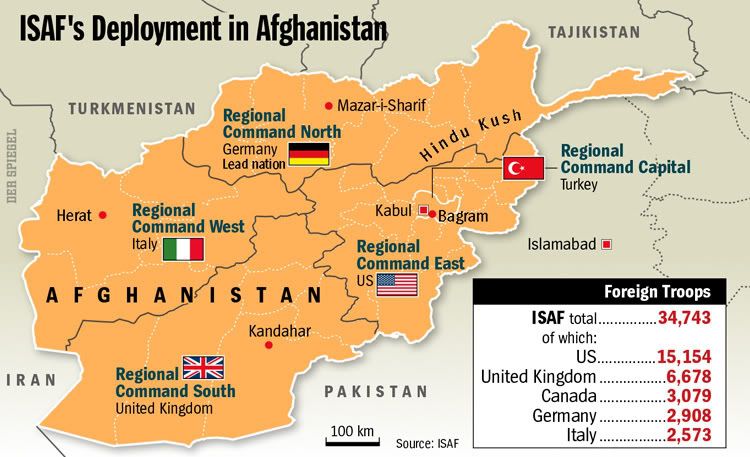
Italian Brigadier General Fausto Macor is the ideal star witness to make the situation in Afghanistan dramatically clear to German politicians. The wiry general from the northern Italian city of Turin has been in charge of the Regional Command West of the NATO-led International Security Assistance Force (ISAF) in Afghanistan since July. He and his men are deployed in what is considered the quietest and safest part of the country.
Macor and his men are barricaded into an area near the airport in Herat, an old trading city of 250,000 inhabitants that has long served as a gateway to nearby Iran. Heavily armed Albanian soldiers guard the entrance to the camp, which is protected against enemy fire by a 1-meter-thick wall of boulders.

On Tuesday of last week, the general met with Eckart von Klaeden, the foreign policy spokesman of Germany's Christian Democratic Union (CDU). Von Klaeden had traveled to the city with the German ambassador to Afghanistan, Hans-Ulrich Seidt.

The general is slightly delayed, having attended a memorial service for two Spanish soldiers who were killed the day before in a bomb attack 80 kilometers (50 miles) to the south. The service was broadcast live on Italian television to a distressed nation. NATO troops have just liberated two kidnapped Italian intelligence officers from Macor's contingent. One of the Italians suffered serious injuries during the raid.

The commander sits in a chair, his back to the television set, and points to a military map on the wall. "You see," he says, "I am responsible for an area half the size of Italy." Then he rattles off the relevant statistics. Of the 1,800 soldiers under his command, only 270 can go on patrol. If he sends two units out on patrol, they can easily find themselves operating 400 kilometers (249 miles) apart. "It's as if one of them were in Turin and the other in Venice," says the general.

He can expect little support from the Afghan army, which has only 400 armed troops in the western sector. As a result, the general is left to his own resources as far as entire regions are concerned. He has no illusions. There is no power vacuum in Afghanistan: Taliban fundamentalists, armed tribal warlords or criminal gangs control the areas where there are no international troops.

In fact, the rule of law ends only a few hundred meters from Macor's headquarters, where the commander of the Herat airport complains about his situation. Outside, the warm late autumn sun shines on the Italians' gray Hercules transport aircraft. The mustachioed police colonel keeps his office cooled to a chilly 19 degrees Celsius (61 degrees Fahrenheit). The law requires that no armed soldiers be allowed on the airport grounds. The police colonel complains that his men, armed with only 30 old Kalashnikov automatic rifles, are poorly equipped to uphold the law at the airport.

This isn't nearly enough firepower to deter the city's powerful men, who often appear on the tarmac with scores of bodyguards armed with pistols, rifles and mobile grenade launchers. In front of the parked aircraft, rival private armies occasionally engage in violent gun battles, while the airport commander's men are forced to look on helplessly.

Welcome to Afghanistan in the sixth year following the Western intervention. Welcome to a country that ranks, sadly, in eighth place in the 2007 edition of the "Failed States Index" compiled by the US magazine Foreign Policy -- just behind Sudan, Iraq, Somalia and Zimbabwe. Welcome to Afghanistan, the country NATO Secretary General Jaap de Hoop Scheffer has proclaimed a test case for the future operability of the world's most powerful military alliance.

A troop withdrawal would be a "serious defeat for international law and the international community," warns Peter Struck, the floor leader of Germany's Social Democratic Party (SPD), while German Chancellor Angela Merkel believes that her country's commitment to the operation in Afghanistan is "the only way to demonstrate that we fight terrorists, and that we do so with great resolve." Welcome to one of the most controversial issues in German foreign policy.

This Friday, Germany's parliament, the Bundestag, will vote on whether to extend two of the three German military mandates in Afghanistan, currently the Bundeswehr's most dangerous mission. Twenty-one German soldiers have already lost their lives in Afghanistan, and last Friday three Germans were lucky to escape from a suicide attack with only minor injuries. The Bundestag will decide the fate of up to 3,500 soldiers and six Tornado reconnaissance aircraft operating in Afghanistan under the auspices of NATO's ISAF force.

Parliament's approval of the mission is considered a done deal, with a broad majority in both the ruling grand coalition and the liberal Free Democratic Party (FDP) likely to vote in favor of keeping the troops in Afghanistan. Even a number of Green parliamentarians intend to support the measure, despite the party's recent decision not to. Only the Left Party is strictly opposed to the Bundeswehr's Afghanistan mission.

The future of Germany's more controversial involvement in the US-led antiterrorism Operation Enduring Freedom (OEF) will not be decided until November, after the SPD convention in Hamburg.

Part 2: An Unpopular Issue

Relatively few members of parliament have traveled to Afghanistan in recent months to get a first-hand impression of the situation in the war-torn country, despite the fact that members of the German Bundestag are normally known for their love of travel. Apparently only very few of Germany's elected representatives feel that Afghanistan is worth a visit.

The ones who choose to stay at home are acutely aware of why they do not want to be associated with the country. The mood among the German public has changed dramatically since the grand coalition took office two years ago. Whereas 60 percent of poll respondents approved of the Bundeswehr's Afghanistan mission in the past, considerably more than half are openly pushing for a withdrawal today.

Although officials at the Chancellery insist that the country is at the top of the chancellor's agenda, Angela Merkel studiously avoids being tainted by unpopular issues like Afghanistan. She expresses her support for Germany's commitment to the shattered country from time to time, perhaps out of a sense of duty, but she has already withdrawn to the sidelines of the debate.

Her predecessor, former Chancellor Gerhard Schröder, made two trips to the crisis-plagued region. Photo ops from Afghanistan were still considered desirable at the time. Merkel, on the other hand, prefers being portrayed as a climate change crusader, posing for the cameras in front of a glacier in Greenland or visiting a school in Ethiopia. But she has yet to make an appearance in Afghanistan. There have been many excuses for her apparent decision to shun the country, ranging from kidnappings to SPD conventions to a busy schedule.

The news that reaches Berlin from Afghanistan these days is simply too horrific. Members of parliament who have visited the country describe a place on the verge of collapse. Instead of declining, the problems of poverty, corruption, violence and sheer hopelessness are on the rise. Government institutions are virtually nonexistent in many parts of the country, the police are corrupt and overworked and the military isn't in much better shape. The effects of Western development aid go largely unnoticed by much of the population.

The security situation is also becoming more and more precarious. More than 5,000 people were killed in attacks or combat during the first nine months of this year alone. According to a United Nations report, acts of violence have increased by close to 30 percent this year. Three-quarters of the attacks are directed against Afghan soldiers, police officers and foreign troops, "in a deliberate and calculated effort to impede the establishment of legitimate government institutions," the UN report states.

The situation on the military front is unclear. In a Sep. 18 classified report labeled "Urgent" to the governments of European Union member states, the EU's special envoy in Kabul, Spain's Francesc Vendrell, identifies a "paradoxical trend." "While ISAF is achieving significant military successes against the insurgents, especially as a result of targeted attacks on Taliban commanders," Vendrell writes, "the unsafe zone in which the insurgents operate is growing." Even a weak Taliban presence is sufficient, Vendrell continues, to bring "normal government activities to an end" and to bring large segments of the population under the influence of the insurgents.

Vendrell's conclusions coincide with the results of a study by the Senlis Council, an international think tank, which conducted a survey in March of 12,000 Afghan men in the southern and eastern sections of the country, regions which have seen fierce fighting. The study's conclusions were devastating. In late 2001, the vast majority of Afghans believed that the Taliban had been defeated once and for all. Today only half of those surveyed are convinced that international forces will win the war against the insurgents in southern Afghanistan. It appears that although the Taliban is unlikely to win the war militarily, it is increasingly emerging victorious in the battle for public opinion.

The loss of confidence in and respect for the international community has political consequences. EU envoy Vendrell reports, with some concern, on a written memo from the Afghan interior minister to all provincial governors and police commanders, in which they were instructed to refrain from visiting international aid organizations and civilian and military reconstruction teams in the future.

Although the consequences of the order would not be significant in practice, writes Vendrell, many of his Afghan contacts are concerned about the impression it conveys, namely that the level of trust between the government and the international community is declining. They also fear that "officials with connections to organized crime could gather incriminating material against non-corrupt officials because of harmless contacts."

There is an odd disparity between the reality in Afghanistan and the political debate in Germany. Seemingly oblivious to the information coming from the country, both the Bundestag and the political parties become embroiled in heated debates over technical details that are in fact irrelevant in Afghanistan. The Green Party and the SPD, in particular, spent weeks in an enthusiastic debate about OEF, ISAF and the Tornado jets.

For many Greens and Social Democrats, the OEF anti-terrorism operation is the epitome of a merciless US-led bombing war that they claim is practically driving Afghans into the arms of the Taliban. At the Green Party convention in the central German city of Göttingen, the party base decided that it would no longer vote in favor of extending the Bundeswehr's Afghanistan mission. The SPD's leadership has scheduled the discussion of Afghanistan at its upcoming convention in Hamburg in late October for Saturday evening, timed to coincide with the popular sports broadcast "Sportschau" -- apparently in an attempt to divert delegates' attention away from the debate over OEF and the ISAF.

The debates being conducted in Berlin are essentially ersatz discussions -- a not-uncommon tactic among German politicians. Last year, a swarm of self-proclaimed naval experts spent weeks debating the marginal issue of whether the German navy's deployment off the Lebanese coast should remain outside a three-mile or a six-mile zone.

Part 3: Redefining Goals

The important questions in the Afghanistan debate are also being ignored. For instance, how does one define success for the mission? Can a discount war -- one that is being waged with a relatively minimal financial commitment -- succeed in the long run? Shouldn't the West, including Germany, increase its commitment to the mission? Should its goals be redefined? Or is it enough to provide the Afghan people with electricity, running water and a little freedom of opinion?

At least some politicians -- those who focus on foreign affairs -- are offering clear answers to many of these questions. Foreign Minister Frank-Walter Steinmeier, for example, says that the goal in Afghanistan is, of course, not to establish a "Westminster democracy" with the corresponding benefits of a social welfare state. Christian Democratic parliamentarian Ruprecht Polenz, the chairman of the Bundestag's Committee on Foreign Affairs, consciously sets the bar low when he says: "The goal is to ensure that no more threats originate from within the Afghan state."

In truth, this objective would represent a dramatic reversal of German policy. In 2002, then Chancellor Schröder insisted that the Afghans ought to be compensated for their "return to the civilized world" by providing them with an adequate "prosperity dividend." The goal of the intervention, the Schröder administration explained, was to achieve human rights, democracy and prosperity for Afghanistan.

These noble objectives are rarely mentioned today. But which criteria must be fulfilled before the mission can be considered a success and the German troops and their allies can return home? No one knows. An exit strategy is "currently not in sight," says one German NATO general.

"We won't let the foreigners leave until our roads are built, our schools, electricity are built, until our police and army are better," Afghan President Hamid Karzai said recently. Some at NATO perceive this statement as a threat. "Our assistance ends," says German Defense Minister Franz Josef Jung, "when Afghanistan can find its way to a positive future on its own two feet."

"NATO will have successfully completed its mission when the Afghan government and its security forces can take responsibility throughout the entire country," NATO Secretary General Jaap de Hoop Scheffer told SPIEGEL in a recent interview (more...). But Scheffer is unwilling to make any predictions, except to say: "NATO will have to stay for the foreseeable future."

Faced with a difficult situation, the allies are now placing their hopes on the plan to train 70,000 soldiers and 82,000 police officers by the next parliamentary election, in three years. The new mantra of the NATO member states, says Scheffer, is "training, training, training." "Those who do not invest in training now," says German General Egon Ramms, who runs the ISAF mission from the NATO command center in the Dutch town of Brunssum, "will have to stay that much longer."

The Germans are eager to distance themselves from the United States in public debates, insisting that, unlike the Americans, the Germans are mainly involved in civilian reconstruction assistance. But this is precisely where Germany has failed miserably -- in developing the Afghan police force (more...), for example, for which Berlin has assumed primary responsibility. After visiting Afghanistan in the summer, a delegation of members of the Bundestag concluded that the work of the German contingent has been disastrous.

Germany, supposedly a "lead nation" in ISAF, has taken a leisurely approach to the Afghanistan effort. In January 2002, a team of high-ranking experts traveled to Afghanistan and recommended sending three German officials to Kabul to serve as advisors to the Afghan interior ministry. The German team, apparently convinced that this would be sufficient, envisioned the trio developing courses for senior bureaucrats and helping the Afghans improve their police academy. It recommended a one-year stint for the three officials. Aside from that, the experts concluded, the Afghans lacked equipment, cars and, most of all, weapons.

But weapons were precisely what the Afghans eventually acquired in abundance. It was an "absurdity," said FDP parliamentarian Elke Hoff, that Berlin planned to supply Afghanistan with up to 100,000 firearms while denying the Afghan police simple equipment like handcuffs. Germany's interior and foreign ministries refused to provide countries that fail to fully satisfy German constitutional standards with equipment designed to "exercise direct coercion."

This defect is only being remedied now -- a full five years after Germany launched its Afghan police training program. According to an internal report by the German foreign ministry, "500 officers of the Kabul riot police will soon be equipped with body armor, helmets, shields, gloves, batons and pepper spray."

Even when the German team of advisors was later expanded to include 60 officials, generally only 40 of them were actually at work at any one time. In the wake of this embarrassing staffing debacle, officials at the interior ministry and chancellery are now quietly examining the possibility of developing a permanent team of specially trained police officers, federal prosecutors and administrative experts that could quickly be deployed to failed states to deal with similar crises. But this is little more than a pipe dream at this point.

Besides, the Americans aren't interested in waiting for Germany to get its act together and have already taken over from the Germans in many respects. While Berlin agonized over the "further training of mid-level and senior officials" and "salary and rank reforms," Washington deployed 2,500 troops as police trainers, backed up with hundreds of contractors working for DynCorp, a private security firm.

Managed by retired US generals, the DynCorp employees are training illiterate Afghans to work as police deputies in paramilitary crash courses. Their goal is to ensure that the men will be passable marksmen by the end of the training. The fact that many desert as soon as they complete the courses is seen as an unpleasant fact of life -- but not as a blemish on DynCorp's training statistics.

Part 4: 'Like a Band-Aid on a Chest Wound'

In the wake of their failures, the Germans are now trying to shift the responsibility for police training to the EU and distribute it among more countries. In May the EU formed its own police training mission, dubbed EUPOL, which has been managed so far by Friedrich Eichele, a German police general. Eichele, the former head of GSG 9, the counterterrorism unit of the German federal police, is a man of few words. His command of the English language is rudimentary and his diplomatic skills are considered limited.

Given such leadership, within only a few months EUPOL has already deteriorated into a directionless tangle of bureaucracy and financial weakness. EUPOL's 195 EU police officers from 17 countries are not even scheduled to assume their new posts until next March. According to officials, this is the earliest possible date, since the group must first build new, and appropriately comfortable, lodgings for its officers.

All of two German police officers are currently assigned to assist the German reconstruction team in the provincial city of Kunduz, which includes more than 400 soldiers. EUPOL plans to replace the pair with five of its team members soon. The new team will be responsible for the training of 7,500 Afghan police officers in two provinces. In the face of such realities, Guido Westerwelle, the head of the FDP, couldn't help but comment sarcastically on the program while visiting Afghanistan two weeks ago: "Well, that certainly takes care of police development."

Despite the efforts of German and British advisors, the interior ministry in Kabul is considered a hotbed of corruption. It costs up to $150,000 in bribes to secure a position as a district police chief. But the investment is worthwhile. Once on the job, a police chief can easily recoup the money from his subordinates.

General Dan McNeill (more...), the American commander of ISAF, likes to entertain visitors to his headquarters in Kabul with small anecdotes from the everyday lives of the Afghan police. He recently instructed his Afghan underlings to set up 20 checkpoints along the road between Kabul and Kandahar. "Which police checkpoints?" a wide-eyed Afghan asked McNeill a few weeks after the initial order. "Oh," the Afghan quickly realized, "you mean the new tollbooths."

Wherever one looks in Afghanistan, officials are busy skimming off their cuts. In fact, police officers often exist only on paper. Local police chiefs line their pockets by collecting funds from the international community's coffers to pay the salaries of nonexistent officers. To add insult to injury, the officers that do exist are paid miserably to perform their life-threatening jobs. At the paltry salary of $70 a month, many police officers complete basic training and then promptly desert to join the private militias of wealthy warlords and drug barons, or even the Taliban. At $400 to $600 a month, the competition pays a lot more than the police.

The situation is hardly any better in the military. According to NATO statistics, 38,000 soldiers have already been trained with Western assistance, a process that will take years and is expected to eventually produce 70,000 soldiers. But these figures do not reflect the real situation.

Last Wednesday, for example, the US commander in charge of training gave a memorable performance at the NATO Council in Brussels. The NATO ambassadors attending the meeting asked Major General Robert Cone, who was in Kabul but was taking part in the session via videoconference, how many men in the Afghan army are now ready for combat.

The general responded that while the goal was to train 70,000 men, 50,000 are already being paid. But, he added, many of these men are simply AWOL ("absent without leave"). In other words, they are either deserters or men who occasionally choose to stay at home instead of appearing for duty. Besides, Cone added, he is having trouble retaining the men who have been trained. The actual force, he told the NATO officials, presumably consists of about 30,000 men, but he was unable to provide them with a more precise figure.

But the ambassadors were insistent. How many of those men are ready for combat? "I really can't say," the general said. Finally he admitted the truth: "To be perfectly honest -- zero."

In fact, Cone continued, not a single Afghan unit is capable of independently running an operation. According to Cone, the Afghan military lacks everything from artillery to helicopters, military hospitals, reconnaissance equipment and support personnel.

This explains why Afghan Defense Minister Abdul Rahim Wardak tells every Western visitor that what he needs most are weapons. A few Leopard 1 tanks would be nice, the portly general told CDU parliamentarian von Klaeden two weeks ago in an effort to solicit more German support, but the modern Leopard 2 wouldn't be so bad, either.

For NATO officers, Wardak's tank fantasies are nothing short of ridiculous. The general, they complain, only wants the expensive combat machinery so that he can stage an impressive military parade. Besides, they add, experience has shown that most Western weapons deliveries to the Afghan army quickly end up on the black market.

The results of the international community's reconstruction efforts have been so sobering that many, including Foreign Minister Steinmeier, are calling for a rethink of Germany's commitment in Afghanistan. Berlin cannot afford to continue its current policy, he explained in the summer. He called for a stronger German commitment, saying that more troops, more police officers and more development aid are necessary.

But such calls for action have done nothing to change the situation. The state of the police training effort remains miserable, while Defense Minister Jung is obstructing efforts to increase the Bundeswehr contingent from 4,000 to 5,000 men -- a move both the Foreign Ministry and the Chancellery have endorsed. The team of 400 military trainers Steinmeier wants to see sent to Afghanistan will likely be reduced to no more than 180. But he does see progress in reconstruction aid: The German government has increased its annual funding of the program from €80 million to €125 million.

For Bruce Riedel, a member of the National Security Council at the White House until 2002, all of these efforts, including those of other Western nations, are a disgrace. "We have tried to rebuild a country devastated by a quarter century of wars, invasion and terror on the cheap," he said in a recent interview. "Instead of a massive economic reconstruction effort akin to the Marshall Plan of the 1940s, Afghans have gotten less economic aid on a per capita basis than Haitians or Bosnians."

His verdict on the Bush administration's approach? "Like trying to put a Band-Aid on a chest wound."

And American media remains silent.

Thursday, August 23, 2007

New Weapon Based on Mass-Killing Technology

Parliament not told, minister says

How can this not possibly be a war crime?

Raw Story reports:
A new 'super-weapon' being supplied to British soldiers in Afghanistan employs technology based on the "thermobaric" principle which uses heat and pressure to kill people targeted across a wide air by sucking the air out of lungs and rupturing internal organs.

The so-called "enhanced blast" weapon uses similar technology used in the US "bunker busting" bombs and the devastating bombs dropped by the Russians to destroy the Chechen capital, Grozny.

Such weapons are brutally effective because they first disperse a gas or chemical agent which is lit at a second stage, allowing the blast to fill the spaces of a building or the crevices of a cave. When the US military deployed a version of these weapons in 2005, DefenseTech wrote an article titled, "Marines Quiet About Brutal New Weapon."
According to the US Defense Intelligence Agency, which released a study on thermobaric weapons in 1993, "The [blast] kill mechanism against living targets is unique--and unpleasant.... What kills is the pressure wave, and more importantly, the subsequent rarefaction [vacuum], which ruptures the lungs.… If the fuel deflagrates but does not detonate, victims will be severely burned and will probably also inhale the burning fuel. Since the most common FAE fuels, ethylene oxide and propylene oxide, are highly toxic, undetonated FAE should prove as lethal to personnel caught within the cloud as most chemical agents."

A second DIA study said, "shock and pressure waves cause minimal damage to brain tissue... it is possible that victims of FAEs are not rendered unconscious by the blast, but instead suffer for several seconds or minutes while they suffocate."

"The effect of an FAE explosion within confined spaces is immense," said a CIA study of the weapons. "Those near the ignition point are obliterated. Those at the fringe are likely to suffer many internal, and thus invisible injuries, including burst eardrums and crushed inner ear organs, severe concussions, ruptured lungs and internal organs, and possibly blindness."

British defense officials told the UK Guardian that British bombs were "different."

"They are optimized to create blast [rather than heat]", one said, speaking on the standard condition of anonymity in Britain. The official added that it would be misleading to call them "thermobaric."

Officials told the Guardian the new weapon was classified as a soldier launched "light anti-structure munition" and that the bombs would be more effective because "even when they hit the damage is limited to a confined area."

"The continuing issue of civilian casualties in Afghanistan has enormous importance in the battle for hearts and minds," said Liberal Democrat leader Sir Menzies Campbell in the article. "If these weapons contribute to the deaths of civilians then a primary purpose of the British deployment is going to be made yet more difficult."

According to Campbell, the deployment of the weapons was not announced to Parliament.

Friday, May 18, 2007

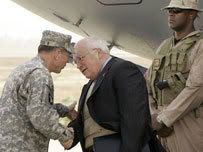
Is This Man Wearing Army-Issue 'Interceptor' Body Armor?

Dick Cheney on his recent tour of Iraq

Or is he wearing 'Dragon skin, banned by the Army?


NBC's news investigative unit, Lisa Myers and Adam Ciralsky, reports:

For troops in the line of fire, body armor can spell the difference between life and death.

Brig. Gen. Mark Brown, who oversees body armor for the Army, told NBC, “The body armor that we issue to our soldiers today is the best in the world. Bar none. It’s proven by live-fire testing, and it’s proven in combat.”

But is it really the best?

An NBC News investigation — including independent ballistics tests — suggests there may be something better called Dragon Skin. Military families and soldiers have tried to buy Dragon Skin believing it offers better protection. But the Army banned the armor last year even before formally testing it.

The Army’s current body armor is called Interceptor. NBC News tracked down the man who helped design Interceptor a decade ago, Jim Magee, a retired Marine colonel:
LISA MYERS: What is the best body armor available today in your view?

JIM MAGEE: Dragon Skin is the best out there, hands down. It's better than the Interceptor. It is state of the art. In some cases, it’s two steps ahead of anything I’ve ever seen.

MYERS: You developed the body armor that the Army is using today.

MAGEE: That's correct.

MYERS: And you say Dragon Skin is better?

MAGEE: Yes. And I think anybody in my industry would say the same thing were they to be perfectly honest about it.
Why? He says more stopping power and more coverage.

According to Magee, the Army’s Interceptor uses four rigid plates to stop the most lethal bullets, leaving some vital organs unprotected. Dragon Skin — with discs that interconnect like Medieval chainmail — can wrap most of a soldier’s torso, providing a greater area of maximum protection.

Magee, who has no financial stake whatsoever in Dragon Skin, told us, “If you would ask me today, ‘Jim we’re sending you to Iraq tomorrow. What would you wear?’ I would buy Dragon Skin and I would wear it.”

But Brown says the Army conducted its own tests of Dragon Skin last year.
BRIG. GEN. BROWN: Thirteen of 48 shots that were taken at Dragon Skin were penetrating, full penetrating shots.

MYERS: So that’s a catastrophic failure.

BROWN: Correct.

MYERS: So Dragon Skin failed?

BROWN: Dragon Skin failed miserably.
Brown suggested those tests led the Army to issue a “Safety of Use Message,” warning soldiers of “death or serious injury.”

There’s just one problem: the Army banned Dragon Skin in March, almost two months before that testing began in May.
MYERS: General, the Army banned Dragon Skin before the Army even tested it.

BROWN: Lisa, I’m — I’m not aware of that… I don’t know that it had not been tested at that time. I wasn’t here.
Nevin Rupert, a mechanical engineer and ballistics expert, was for seven years the Army’s leading authority on Dragon Skin. Now a whistleblower, he says the Army’s timing wasn’t coincidental.
RUPERT: I believe there are some Army officials at the lower levels that deliberately tried to sabotage it.

MYERS: What possible motive would Army officials have for blocking a technology that could save lives?

RUPERT: Their loyalty is to their organization and maintaining funds.
He says that because Dragon Skin was not developed by the Army, some officials considered it a threat to funding of Interceptor and other Army programs.
RUPERT: It wasn’t their program. It threatened their program and mission funding.
Rupert also says he was ordered not to attend the tests of Dragon Skin.
MYERS: You spent seven years evaluating Dragon Skin. And the Army goes to test it. And you're told not to attend?

RUPERT: Yes.

MYERS: They didn't want you there?

RUPERT: They didn't want a lot of people there.
Rupert was recently fired by the Army, he says, for supporting Dragon Skin. When questioned about Rupert by NBC News, the Army said in a statement:
“Mr. Nevin Rupert was employed by the Army Research Laboratory for more than 33 years as a mechanical engineer in the Weapons & Materials Research Directorate, located at Aberdeen Proving Grounds, Md. Mr. Nevin left federal service on February 24, 2007. He has a June 2007 appeal before the Merit System Protection Board.”
NBC News also has learned that, well after the Army ban, select soldiers assigned to protect generals and VIPs in Iraq and Afghanistan wore Dragon Skin.

An active duty soldier, who asked us to conceal his identity, told NBC he wore Dragon Skin on certain missions, with the full knowledge of his commanders.
“I wore it and I saw other people wearing it… It conforms to your body, it gives you more mobility,” he said.

LISA MYERS: Does the ban on Dragon Skin apply equally to everyone in the Army?

BRIG. GEN. MARK BROWN: Lisa, yes it does.
However, sources and documents obtained by NBC News reveal that a top general’s security detail in Iraq bought and wore Dragon Skin.
MYERS: If Dragon Skin is good enough for a 3-star general, shouldn’t it be good enough for other soldiers?

BROWN: Lisa, even 3-star generals make mistakes.
A Pentagon spokesman says that Gen. Peter Chiarelli, once the top ground commander in Iraq, “had no knowledge that Dragon Skin was prohibited” and “never wore Dragon Skin,” though it’s possible his staff ordered it for him. The spokesman went on to say that Chiarelli acknowledges that his bodyguards ordered and received concealed body armor, but that Chiarelli “didn't know the armor was Dragon Skin.”

Given the controversy over body armor, NBC News commissioned an independent, side-by-side test of Dragon Skin and the Army’s Interceptor vest. In that testing, Dragon Skin outperformed the Army’s body armor in stopping the most lethal threats. Retired four-star Army Gen. Wayne Downing, now an NBC news analyst, observed the tests.
“What we saw today, Lisa, and again it’s a limited number of trials, Dragon Skin was significantly better,” he said.
These independent, limited tests raise serious questions about the Army’s claim that Dragon Skin doesn’t work. NBC News will report on the specific results of that testing on Dateline NBC Sunday. Critics tell NBC they’d like to see the Army re-test and re-evaluate Dragon Skin.

Editor's note: NBC's Brian Williams reported the following update on "NBC Nighty News" Fri., May 18:
We have a follow up on our report last night, the results of an NBC News investigation that questioned whether the body armor issued to every soldier in the US Army is really the best available. It focused on a a kind of armor called Dragon Skin, which had been banned by the Army, but, as we reported, was still being used by some of the elite forces in Iraq and Afghanistan. Today, three prominent US senators, all Democrats, called for an investigation. The government accountability office is expected to examine this issue.

We also heard today from the Pentagon, including a call from General Peter Chiarelli, who reiterated what we reported last night, that he never wore Dragon Skin but that some members of his staff did wear a lighter version of the banned armor on certain limited occasions, despite the Army ban. General Chiarelli said his biggest concern was that our story may have left the impression that he and his staff were issued better equipment somehow and therefore were more secure than other soldiers throughout the US Army. That, he said, is not the case.

Tuesday, March 13, 2007

Halliburton's Move To The UAE Is More Than Just For The Tax Breaks


Wayne Madsen
has a couple of interesting and dishy items today:
The actual reason Halliburton and its chairman David Lesar are moving their corporate digs to Dubai is that the UAE's lax laws on corporate record keeping and the opaqueness of business transactions in the emirates will allow the firm to avoid responding to congressional subpoenas for its scandalous war profiteering in Iraq, Afghanistan, and other locations. A source with extensive ties in Dubai also reports that after leaving office, Dick Cheney will be spending "a lot of time in Dubai." WMR was told that Cheney will likely start looking for property in the emirate -- there are a number of highly-secured gated communities springing up in Dubai, which is fast becoming the "Hong Kong" of the Middle East.

Halliburton will also be able to avoid paying U.S. corporate taxes as a UAE-headquartered corporation.

And on the homefront, Madsen reports:
March 13, 2007 --Our White House Press Corps sources report further disturbing news about President George W. Bush. Our sources have witnessed a clearly inebriated Bush approaching members of the press corps and making rude comments, including one particularly crude remark about First Lady Laura Bush. In that case, Bush, nodding toward Laura, called her a "c**t." While Bush's drinking is no secret to the White House press contingent, that particular comment was reportedly the worst they have heard uttered by Bush. Our sources also report that Laura Bush's stays at the White House are less frequent and that her overnight trips to the Mayflower Hotel often coincide with the president's drunken binges.

Note: Some of our female readers were shocked to see the "C" word in the above news item. This editor wants to make it clear that word was used by George W. Bush to denigrate his wife. It was his word, not mine. It is important that the public knows what kind of person Mr. Bush is by the offensive words he uses. The editor also wants to make clear that the President chose a public press gaggle to use this word -- that is not a private moment between him and his wife. If Mrs. Bush feels her privacy has been violated, she must understand that it is her responsibility to herself, her children, and the nation to end this abusive relationship by legally separating from the President and becoming a role model for other women around the country and the world who find themselves locked into similar abusive marriages.

Nevertheless, we have "asterisked" the word in question. However, Mr. Bush cannot asterisk his own vile words.

Or his actions.

Friday, March 02, 2007

Ex Post Facto

Guantanamo prisoner charged after five years in detention for things that weren't crimes when he did them - It doesn't get any more un-American than that.


Even Iran has a Constitutional prohibition against it.

The Guardian reports:
Lawyers and the family of the first Guantánamo Bay inmate likely to face a US military tribunal for alleged terrorism said today that he would not get a fair trial.

More than five years after he was first jailed at Guantánamo Bay, David Hicks, an Australian, was yesterday charged by the Pentagon with providing material support for terrorism,.

Mr Hicks was not charged with attempted murder, as had earlier been recommended by US military prosecutors.

His family and lawyers claimed today that the charges he does face have been tailored to fit his actions and guaranteed he would not get a fair trial.

Mr Hicks's lawyers also confirmed today that he is continuing his attempts to obtain British citizenship - his mother is British - which arguably represents his best chance of getting out of US custody. The Australian government has not pressed for his release.

Stephen Grosz, a British lawyer working on Mr Hicks's case in the UK, told Guardian Unlimited that a document outlining allegations of abuse against his client by US troops had been lodged with a court to try and help his case.

Mr Hicks has claimed he was the victim of torture and brutality at the hands of US troops after he was captured in Afghanistan in late 2001, allegedly while fighting for the Taliban. He claims he was repeatedly beaten and threatened, deprived of sleep and drugged.

He has fought a long legal battle in the UK courts, which ended with senior judges ordering the home secretary to grant Mr Hicks citizenship. However it emerged in January this year that the home secretary, John Reid, had revoked his British citizenship.

Mr Grosz said an appeal against the government's move to deny him citizenship had been lodged with the Special Immigration Appeals Commission (Siac). A two-week hearing will start on May 8, before the US military tribunal begins.

Mr Grosz said the abuse allegations could undermine the US military prosecution because it was based, in part, on admissions Mr Hicks made under interrogation.

Speaking in Australia, Major Michael Mori, Mr Hicks's Pentagon-appointed lawyer, said the decision to drop the attempted murder charge indicated a lack of evidence against his client. The lawyer said the charge against Mr Hicks was unfair because it did not exist at the time of his capture.

"The United States administration - this military commission - is fabricating offences, they're trying to apply them retroactively to David," Maj Mori told Australian television. "It's disgusting that he has spent five years in Guantánamo for made-up charges," he said.

US prosecutors argued the offence did exist at the time of Mr Hicks's capture, though not as a military crime. They said the charge was modified so that Mr Hicks could be charged with it before the military tribunal system.

The argument over the charge underscores a broader debate about the legality of the military tribunal system. Critics claim the system, among other things, denies defendants many legal rights guaranteed under the US constitution.

Mr Hicks's father, Terry Hicks, said the military commission process was unfair because it allowed hearsay evidence and statements made under coercion. "The thing that annoys me is when you have people commit murders, they're out in about eight years, and David could have ... life imprisonment," Terry Hicks said. [see Fair Go For David-website]

Maj Mori said the Australian government, which today expressed confidence in the US military tribunal system, should recognise the process was unfair and demand he be returned home.

The Australian prime minister, John Howard, has refused to ask Washington to repatriate Mr Hicks, saying Australia would have to pass retrospective laws to charge him for alleged terrorist associations.

However, Mr Howard, a staunch US ally and facing elections later this year, has been under increasing political pressure over alleged inaction on Mr Hicks's detention. "We remain very unhappy that it's taken so long for Hicks to be fully charged," Mr Howard told an Australian radio station.

According to the Pentagon, for about a year starting around December 2000, Mr Hicks provided "support or resources to be used in preparation for, or in carrying out, an act of terrorism" and that he "knew or intended" for the support to be used for terrorism.

When it comes to what the Bush administration is doing in our names, nothing has been more damaging to Americans' long and short term interests than the prosecution of the war on terror and the treatment of people caught up in the Bush-Cheney dragnet. Whatever David Hicks did or didn't do is less relevant than what the Bush administration has done with the awesome power that is the United States government.

For instance, would anybody argue that it wasn't a gross conflict of interest to put Ted Olson, then U.S. Solicitor General and husband of Barbara Olson (a passenger on American Airlines Flight 77 on September 11th), in charge of stymieing all challenges to the detentions-without-charge of hundreds of suspects held in Guantanamo Bay? And yet, that's exactly what happened.

The torture of detainees continues, we're no closer to ending the war in Iraq than we were before the midterm elections in November, Democrats are back to a 3-day work week in Congress, and the band plays on.

Tuesday, February 27, 2007

Dow Plunges 415.02 Points - Will U.S. Congress Stop Bush's Wars Now?

Another Leg Drops Out of the U.S. Economy as Stocks Fall on Weak Economic Data, Geopolitical Woes, Shanghai Tumble


With housing slowing down, retail sales not great, and a Fed that has been worried about inflation and raising interest rates when it should be lowering them, a recession isn't far behind. The WSJ reports:
Stocks plummeted Tuesday, with the Dow down as much as 545 after a nearly instantaneous drop of about 200 points right around 3 p.m. Eastern time, but then recovering some of the losses. Indexes declined amid a broad selloff encouraged by a confluence of factors including weakness on the Shanghai market, disappointing durable-goods data and uncertainty increased about Iran and Afghanistan.

Will the Fed lower interest rates when it next meets (March 20/21, 2007)?

Monday, February 19, 2007

War Jitters

Newsweek reports, "America's Hidden War With Iran":
Jalal Sharafi was carrying a videogame, a gift for his daughter, when he found himself surrounded. On that chilly Sunday morning, the second secretary at the Iranian Embassy in Baghdad had driven himself to the commercial district of Arasat Hindi to checkout the site for a new Iranian bank. He had ducked into a nearby electronics store with his bodyguards, and as they emerged four armored cars roared up and disgorged at least 20 gunmen wearing bulletproof vests and Iraqi National Guard uniforms. They flashed official IDs, and manhandled Sharafi into one car. Iraqi police gave chase, guns blazing. They shot up one of the other vehicles, capturing four assailants who by late last week had yet to be publicly identified. Sharafi and the others disappeared.
At the embassy, the diplomat's colleagues were furious. "This was a group directly under American supervision," said one distraught Iranian official, who was not authorized to speak on the record. Abdul Karim Inizi, a former Iraqi Security minister close to the Iranians, pointed the finger at an Iraqi black-ops unit based out at the Baghdad airport, who answer to American Special Forces officers. "It's plausible," says a senior Coalition adviser who is also not authorized to speak on the record. The unit does exist—and does specialize in snatch operations.

The Iranians have reason to feel paranoid. In recent weeks senior American officers have condemned Tehran for providing training and deadly explosives to insurgents. In a predawn raid on Dec. 21, U.S. troops barged into the compound of the most powerful political party in the country, the Supreme Council for the Islamic Revolution in Iraq, and grabbed two men they claimed were officers in Iran's Revolutionary Guards. Three weeks later U.S. troops stormed an Iranian diplomatic office in Irbil, arresting five more Iranians. The Americans have hinted that as part of an escalating tit-for-tat, Iranians may have had a hand in a spectacular raid in Karbala on Jan. 20, in which four American soldiers were kidnapped and later found shot, execution style, in the head. U.S. forces promised to defend themselves.

Some view the spiraling attacks as a strand in a worrisome pattern. At least one former White House official contends that some Bush advisers secretly want an excuse to attack Iran. "They intend to be as provocative as possible and make the Iranians do something [America] would be forced to retaliate for," says Hillary Mann, the administration's former National Security Council director for Iran and Persian Gulf Affairs. U.S. officials insist they have no intention of provoking or otherwise starting a war with Iran, and they were also quick to deny any link to Sharafi's kidnapping. But the fact remains that the longstanding war of words between Washington and Tehran is edging toward something more dangerous. A second Navy carrier group is steaming toward the Persian Gulf, and NEWSWEEK has learned that a third carrier will likely follow. Iran shot off a few missiles in those same tense waters last week, in a highly publicized test. With Americans and Iranians jousting on the chaotic battleground of Iraq, the chances of a small incident's spiraling into a crisis are higher than they've been in years.

Sometimes it seems as if a state of conflict is natural to the U.S.-Iranian relationship—troubled since the CIA-backed coup that restored the shah to power in 1953, tortured since Ayatollah Khomeini's triumph in 1979. With the election of George W. Bush on the one hand, and Iranian President Mahmoud Ahmadinejad on the other, the two countries are now led by men who deeply mistrust the intentions and indeed doubt the sanity of the other. Tehran insists that U.S. policy is aimed at toppling the regime and subjugating Iran. The White House charges that Iran is violently sabotaging U.S. efforts to stabilize the Middle East while not so secretly developing nuclear weapons. As the raids and skirmishes in Iraq underscore, a hidden war is already unfolding.

Yet a NEWSWEEK investigation has also found periods of marked cooperation and even tentative steps toward possible reconciliation in recent years—far more than is commonly realized. After September 11 in particular, relations grew warmer than at any time since the fall of the shah. America wanted Iran's help in Afghanistan, and Iran gave it, partly out of fear of an angry superpower and partly in order to be rid of its troublesome Taliban neighbors. In time, hard-liners on both sides were able to undo the efforts of diplomats to build on that foundation. The damage only worsened as those hawks became intoxicated with their own success. The secret history of the Bush administration's dealings with Iran is one of arrogance, mistrust and failure. But it is also a history that offers some hope.

For Iran's reformists, 9/11 was a blessing in disguise. Previous attempts to reach out to America had been stymied by conservative mullahs. But the fear that an enraged superpower would blindly lash out focused minds in Tehran. Mohammad Hossein Adeli was one of only two deputies on duty at the Foreign Ministry when the attacks took place, late on a sweltering summer afternoon. He immediately began contacting top officials, insisting that Iran respond quickly. "We wanted to truly condemn the attacks but we also wished to offer an olive branch to the United States, showing we were interested in peace," says Adeli. To his relief, Iran's top official, Ayatollah Ali Khameini, quickly agreed. "The Supreme Leader was deeply suspicious of the American government," says a Khameini aide whose position does not allow him to be named. "But [he] was repulsed by these terrorist acts and was truly sad about the loss of the civilian lives in America." For two weeks worshipers at Friday prayers even stopped chanting "Death to America."

The fear dissipated after Sept. 20, when the FBI announced that Al Qaeda was behind the attacks. But there was new reason for cooperation: for years Tehran had been backing the Afghan guerrillas fighting the Taliban, Osama bin Laden's hosts. Suddenly, having U.S. troops next door in Afghanistan didn't seem like a bad idea. American and Iranian officials met repeatedly in Geneva in the days before the Oct. 7 U.S. invasion. The Iranians were more than supportive. "In fact, they were impatient," says a U.S. official involved in the talks, who asked not to be named speaking about topics that remain sensitive. "They'd ask, 'When's the military action going to start? Let's get going!' "

Opinions differ wildly over how much help the Iranians actually were on the ground. But what is beyond doubt is how critical they were to stabilizing the country after the fall of Kabul. In late November 2001, the leaders of Afghanistan's triumphant anti-Taliban factions flew to Bonn, Germany, to map out an interim Afghan government with the help of representatives from 18 Coalition countries. It was rainy and unseasonably cold, and the penitential month of Ramadan was in full sway, but a carnival mood prevailed. The setting was a splendid hotel on the Rhine, and after sunset the German hosts laid on generous buffet meals under a big sign promising that everything was pork-free.

The Iranian team's leader, Javad Zarif, was a good-humored University of Denver alumnus with a deep, measured voice, who would later become U.N. ambassador. Jim Dobbins, Bush's first envoy to the Afghans, recalls sharing coffee with Zarif in one of the sitting rooms, poring over a draft of the agreement laying out the new Afghan government. "Zarif asked me, 'Have you looked at it?' I said, 'Yes, I read it over once'," Dobbins recalls. "Then he said, with a certain twinkle in his eye: 'I don't think there's anything in it that mentions democracy. Don't you think there could be some commitment to democratization?' This was before the Bush administration had discovered democracy as a panacea for the Middle East. I said that's a good idea."

Toward the end of the Bonn talks, Dobbins says, "we reached a pivotal moment." The various parties had decided that the suave, American-backed Hamid Karzai would lead the new Afghan government. But he was a Pashtun tribal leader from the south, and rivals from the north had actually won the capital. In the brutal world of Afghan power politics, that was a recipe for conflict. At 2 a.m. on the night before the deal was meant to be signed, the Northern Alliance delegate Yunus Qanooni was stubbornly demanding 18 out of 24 new ministries. Frantic negotiators gathered in the suite of United Nations envoy Lakhdar Brahimi. A sleepy Zarif translated for Qanooni. Finally, at close to 4 a.m., he leaned over to whisper in the Afghan's ear: " 'This is the best deal you're going to get'." Qanooni said, " 'OK'."

That moment, Dobbins says now, was critical. "The Russians and the Indians had been making similar points," he says. "But it wasn't until Zarif took him aside that it was settled ... We might have had a situation like we had in Iraq, where we were never able to settle on a single leader and government." A month later Tehran backed up the political support with financial muscle: at a donor's conference in Tokyo, Iran pledged $500 million (at the time, more than double the Americans') to help rebuild Afghanistan.

In a pattern that would become familiar, however, a chill quickly followed the warming in relations. Barely a week after the Tokyo meeting, Iran was included with Iraq and North Korea in the "Axis of Evil." Michael Gerson, now a NEWSWEEK contributor, headed the White House speechwriting shop at the time. He says Iran and North Korea were inserted into Bush's controversial State of the Union address in order to avoid focusing solely on Iraq. At the time, Bush was already making plans to topple Saddam Hussein, but he wasn't ready to say so. Gerson says it was Condoleezza Rice, then national-security adviser, who told him which two countries to include along with Iraq. But the phrase also appealed to a president who felt himself thrust into a grand struggle. Senior aides say it reminded him of Ronald Reagan's ringing denunciations of the "evil empire."

Once again, Iran's reformists were knocked back on their heels. "Those who were in favor of a rapprochement with the United States were marginalized," says Adeli. "The speech somehow exonerated those who had always doubted America's intentions." The Khameini aide concurs: "The Axis of Evil speech did not surprise the Supreme Leader. He never trusted the Americans."

It would be another war that nudged the two countries together again. At the beginning of 2003, as the Pentagon readied for battle against Iraq, the Americans wanted Tehran's help in case a flood of refugees headed for the border, or if U.S. pilots were downed inside Iran. After U.S. tanks thundered into Baghdad, those worries eased. "We had the strong hand at that point," recalls Colin Powell, who was secretary of State at the time. If anything, though, America's lightning campaign made the Iranians even more eager to deal. Low-level meetings between the two sides had continued even after the Axis of Evil speech. At one of them that spring, Zarif raised the question of the Mujahedin-e Khalq (MEK), a rabidly anti-Iranian militant group based in Iraq. Iran had detained a number of senior Qaeda operatives after 9/11. Zarif floated the possibility of "reciprocity"—your terrorists for ours.

The idea was brought up at a mid-May meeting between Bush and his chief advisers in the wood-paneled Situation Room in the White House basement. Riding high, Bush seemed to like the idea of a swap, says a participant who asked to remain anonymous because the meeting was classified. Some in the room argued that designating the militants as terrorists had been a mistake, others that they might prove useful against Iran someday. Powell opposed the handover for a different reason: he worried that the captives might be tortured. The vice president, silent through most of the meeting as was his wont, muttered something about "preserving all our options." (Cheney declined to comment.) The MEK's status remains unresolved.

Around this time what struck some in the U.S. government as an even more dramatic offer arrived in Washington—a faxed two-page proposal for comprehensive bilateral talks. To the NSC's Mann, among others, the Iranians seemed willing to discuss, at least, cracking down on Hizbullah and Hamas (or turning them into peaceful political organizations) and "full transparency" on Iran's nuclear program. In return, the Iranian "aims" in the document called for a "halt in U.S. hostile behavior and rectification of the status of Iran in the U.S. and abolishing sanctions," as well as pursuit of the MEK.

An Iranian diplomat admits to NEWSWEEK that he had a hand in preparing the proposal, but denies that he was its original author. Asking not to be named because the topic is politically sensitive, he says he got the rough draft from an intermediary with connections at the White House and the State Department. He suggested some relatively minor revisions in ballpoint pen and dispatched the working draft to Tehran, where it was shown to only the top ranks of the regime. "We didn't want to have an 'Irangate 2'," the diplomat says, referring to the secret negotiations to trade weapons for hostages that ended in scandal during Reagan's administration. After Iran's National Security Council approved the document (under orders from Khameini), a final copy was produced and sent to Washington, according to the diplomat.

The letter received a mixed reception. Powell and his deputy Richard Armitage were suspicious. Armitage says he thinks the letter represented creative diplomacy by the Swiss ambassador, Tim Guldimann, who was serving as a go-between. "We couldn't determine what [in the proposal] was the Iranians' and what was the Swiss ambassador's," he says. He added that his impression at the time was that the Iranians "were trying to put too much on the table." Quizzed about the letter in front of Congress last week, Rice denied ever seeing it. "I don't care if it originally came from Mars," Mann says now. "If the Iranians said it was fully vetted and cleared, then it could have been as important as the two-page document" that Richard Nixon and Henry Kissinger received from Beijing in 1971, indicating Mao Zedong's interest in opening China.

A few days later bombs tore through three housing complexes in Saudi Arabia and killed 29 people, including seven Americans. Furious administration hard-liners blamed Tehran. Citing telephone intercepts, they claimed the bombings had been ordered by Saif al-Adel, a senior Qaeda leader supposedly imprisoned in Iran. "There's no question but that there have been and are today senior Al Qaeda leaders in Iran, and they are busy," Defense Secretary Donald Rumsfeld growled. Although there was no evidence the Iranian government knew of Adel's activities, his presence in the country was enough to undermine those who wanted to reach out.

Powell, for one, thinks Bush simply wasn't prepared to deal with a regime he thought should not be in power. As secretary of State he met fierce resistance to any diplomatic overtures to Iran and its ally Syria. "My position in the remaining year and a half was that we ought to find ways to restart talks with Iran," he says of the end of his term. "But there was a reluctance on the part of the president to do that." The former secretary of State angrily rejects the administration's characterization of efforts by him and his top aides to deal with Tehran and Damascus as failures. "I don't like the administration saying, 'Powell went, Armitage went ... and [they] got nothing.' We got plenty," he says. "You can't negotiate when you tell the other side, 'Give us what a negotiation would produce before the negotiations start'."

Terrorism wasn't the only concern when it came to Iran. For decades, Washington's abiding fear has been that Iran might pick up where the shah's nuclear program (initially U.S.-backed) left off, and make the Great Satan the target of its atomic weapons. The Iranians, who were signatories to the Nuclear Non-Proliferation Treaty, insisted they had nothing to hide. They lied. In August 2002, a group affiliated with the MEK revealed the extent of nuclear activities at a facility in Isfahan, where the Iranians had been converting yellowcake to uranium gas, and in Natanz, where the infrastructure needed to enrich that material to weapons-grade uranium was being built. A year later Pakistani scientist AQ Khan's covert nuclear-technology network unraveled, bringing further embarrassments and investigations.

For months, European negotiators worked to get Tehran to formalize a temporary and tenuous deal to freeze its nuclear fuel-development program. In May 2005, they met with Iran's chief nuclear negotiator, Hassan Rowhani, at the Iranian ambassador's opulent Geneva residence. There was some reason to be optimistic: in Washington, Rice had announced that the United States would not block Iran's bid to join the World Trade Organization. Yet a sense of enormous tension filled the room, according to a diplomat who was there but asked not to be identified revealing official discussions. The Europeans told Rowhani they hadn't nailed down exactly what they could offer in return for a freeze, and the Americans still weren't fully onboard. Iran would have to wait for the details for a few more months. But in the meantime, the program had to remain suspended.

Rowhani, in full clerical robes and turban, obviously was not authorized to make any such deal. "The man was in front of us sweating," says the European diplomat. "He was trapped: he couldn't go further ... I realized very clearly that he couldn't deliver, that he was not allowed to deliver. Psychologically he was broken. Physically he was almost broken."

Part of the problem was that elections in Iran were only a few days away. They brought to power a man who satisfied the darkest stereotypes of Iran's fervid leaders. Mahmoud Ahmadinejad publicly renounced the freeze on Iran's nuclear fuel-development program, broke the seals the International Atomic Energy Agency had placed on Iran's conversion facilities at Isfahan and pushed ahead with work at Natanz. In the span of no more than a month or two, nuclear enrichment had become a symbol of national pride for a much wider spectrum of Iranian society than the voters who elected Ahmadinejad. In a warped parallel to Bush, who found his voice after 9/11 rallying Americans to the struggle against a vast and unforgiving enemy, the Iranian president rose in stature throughout the Middle East as he railed against America. The one problem U.S. negotiators had always had with Iran was determining who in the byzantine regime to talk to, and whether they could deliver anything. Now they faced another: the Iranians had almost no incentive to talk. With the United States bogged down in Iraq, Iran now had the leverage—roles had reversed.

In its second term the Bush administration, despite Powell's sour memories, has supported European efforts to resolve the nuclear impasse diplomatically. Rice has offered to meet her Iranian counterpart "any time, anywhere." "What has blocked such contact is the refusal of Iran to meet the demands of the entire international community," says a White House official, who could not be named discussing Iran. The official expressed deep frustration with critics. He argued they were naive about Tehran's intentions, and "parroting Iranian propaganda."

By last summer Iran seemed ascendant. Hizbullah's performance in the Lebanon war had rallied support for Ahmadinejad, one of the group's loudest proponents, across the Arab world. In a series of meetings in New York in September the Iranian president was defiant, almost giddy. (A senior British official who would only speak anonymously about deliberations with the Americans describes Tehran's mood around this time as "cock-a-hoop.") He would not back down when grilled about his dismissals of the Holocaust, and scoffed at the threat of U.N. sanctions over Iran's nuclear defiance.

The West's patience was running out. In Baghdad, American troops seemed powerless to stop a wave of gruesome sectarian killings that they claimed were fueled by Iran. In Amman and Riyadh, Arab leaders warned darkly of a rising "Shia crescent." After Bush's defeat in the midterm elections, Israeli officials began wondering aloud if they would have to deal with the Iranian threat on their own. Partly in consultation with the British, U.S. officials began to map out a broader strategy to fight back. "We felt we needed to have a much more knitted-together policy, with a number of different strands working, to hit different parts of the Iranian system," says the senior British official.

Critics have questioned how much of that plan is military—whether the administration is secretly setting a course for war as it did back in 2002. Last week officials were at great pains to deny that scenario. "We are not planning offensive military operations against Iran," said Under Secretary of State Nicholas Burns. The Pentagon does have contingency plans for all-out war with Iran, on which Bush was briefed last summer. The targets would include Iran's air-defense systems, its nuclear- and chemical-weapons facilities, ballistic missile sites, naval and Revolutionary Guard bases in the gulf, and intelligence headquarters. But generals are convinced that no amount of firepower could do more than delay Tehran's nuclear program. U.S. military analysts have concluded that nothing short of regime change would completely eliminate the threat—and America simply doesn't have the troops needed.

Iraq is another story. American military officials and politicians accuse the Iranian government of providing Iraqis with an new arsenal of advanced rocket-propelled-grenade launchers, heavy-duty mortars and the newest armor-piercing technology for roadside bombs—explosively formed projectiles (EFPs), said to have been developed by Hizbullah. Military security experts are especially worried by "passive infrared sensors," readily available devices that are often used for burglar alarms or automatic light switches but increasingly seen as triggers for improvised explosive devices (IEDs). Unlike cell phones, remote-control systems and garage-door openers, the sensors emit no signal, making them that much tougher to spot before they detonate.

What's scant is hard evidence that the weapons are provided by the Iranian government, rather than arms dealers or rogue Revolutionary Guard elements. "Iranian lethal support for select groups of Iraqi Shia militants clearly intensifies the conflict in Iraq," says the latest National Intelligence Estimate on Iraq. But the most that can be said with certainty is that Tehran is failing to stop the traffic. The Iranians themselves admit they're not trying as hard as they could. "I can give you my word that we don't give IEDs to the Mahdi Army," says an Iranian intelligence official who asked not to be named because secrecy is his business. "But if you asked me if we could control our borders better if we wanted to, I would say: 'Yes, if we knew that the Americans would not use Iraq as a base to attack Iran'."

The real thrust of Washington's multipronged attack is political. Banking restrictions levied by the U.S. Treasury have begun to pinch the Iranian economy. Voters angry about rising prices dealt Ahmadinejad an embarrassing blow in municipal elections in December, when his supporters were trounced. That wouldn't much matter if he still retained Khameini's support. But that may no longer be the case. The Khameini aide says the Supreme Leader blames Ahmadinejad's overheated rhetoric about Israel and the Holocaust for the unanimous Security Council resolution that passed in late December, demanding that Tehran suspend its nuclear program.

Every time America or Iran has gained an advantage over the other in the last five years, however, they've overplayed their hand. More pressure on Ahmadinejad could well make him popular again—the chief martyr in a martyr culture. Sunni insurgents in Iraq need only kill some Americans and plant Iranian IDs nearby to start a full-scale war. Like so many times in this complicated relationship, this is a moment of opportunity. And one of equally great danger.