Showing posts with label Pentagon. Show all posts

Tuesday, November 06, 2007

Destroy Or Investigate? Commanders Pushed To Make Bomb Disposal Choices

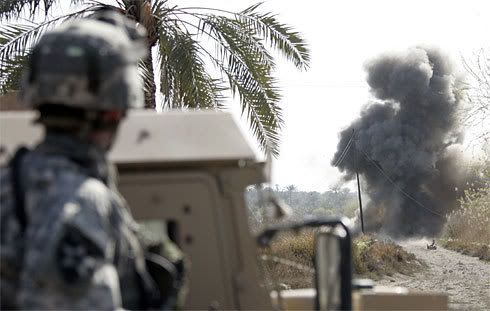
A U.S. soldier takes cover as an improvised explosive device is detonated near Baghdad. A new order lets officers decide whether to blow up IEDs or have technicians dismantle them.

USA Today reports:
During their last six months in Baghdad last year, Navy Lt. Sarah Wilson and her team of explosive ordnance disposal technicians said goodbye to each other more than 70 times.

Each time they were called to dismantle a roadside bomb, they'd bump fists. Then, Wilson says, "we'd all say we love each other because if we never got to say anything else" — if the bomb ended up exploding — "we wanted to be able to say goodbye."

After they arrived at the scene, they would often begin a perilous, painstaking task: taking apart the bombs, bagging the components and sending the parts back to a unit that analyzes them, much as investigators do on the television show CSI.
They were willing to take such risks, Wilson says, because "it's the best shot our guys on the ground have of … catching the bad guys." If forensic teams can lift a fingerprint or identify materials used in a series of bombs, "we can connect him," says Wilson, 27. "We know he's a bombmaker."

When roadside bombs became the insurgency's weapon of choice in Iraq, explosives disposal teams became increasingly important in efforts to protect U.S. troops and crack the bombmaking networks. But now, top military officials appear to be compromising efforts to catch bombmakers in favor of expedience and mobility, a USA TODAY investigation shows.

U.S. Marine Sgt. Raphael Hernandez, an explosives technician, examines a device that was fired from an improvised rocket launcher near a bridge in Habaniyah, Iraq, last January.

A classified order, issued May 30 and reviewed by USA TODAY, gives commanders the authority to forgo calling in explosives technicians like Wilson to glean intelligence from improvised explosive devices, or IEDs. Instead, commanders may use engineers traveling with their regular units to simply detonate the bombs — without gathering evidence from them. Engineers receive about 10% of the explosives training of technicians, and they're not allowed to dismantle bombs.

Commanders and others see the process, dubbed "blow and go," as a way to keep convoys and combat teams moving and safe from snipers and ambushes. But the Army's new approach also runs counter to military doctrine — and to the Pentagon's long-term goal of getting one step ahead of the insurgency by learning about the networks that build, plant and trigger IEDs. The weapon is responsible for at least 60% of U.S. casualties in Iraq.

"The blow-and-go strategy undermines and compromises those overall efforts by losing key biometrics and evidence needed to identify and capture the network of insurgents," says Rep. Solomon Ortiz, D-Texas, a senior member of the House Armed Services Committee and chairman of the subcommittee on military readiness.

"This is a huge step backward in the long-term effort to prevent IED attacks from occurring in the first place," Ortiz says, "and puts the troops at risk of facing more IED attacks for a long time to come."

The head of the Army Asymmetric Warfare Office, which helps combat forces counter IEDs, also is concerned. "What are we accomplishing by blowing and going?" asks Col. Dick Larry. "You rid yourself of that one device, but the problem is … you have not gotten any kind of exploitative information off it."

In July, a USA TODAY investigation showed that, until last year, the Pentagon balked at pleas from officers in the field for safer vehicles to protect against IEDs. One of the explanations offered by Defense officials for not spending more money on the life-saving armor: that the military's focus was on stopping bombmaking networks before they planted the explosives.

In its annual report last year, the military's Joint IED Defeat Organization (JIEDDO), called attacking the networks "the lynchpin of our success." Its deputy director, Robin Keesee, estimated last month that as many as 160 such insurgent cells have been identified in Iraq.

And the organization's report listed forensic analysis of bombs — determining how the devices were manufactured, and what parts and types of explosives were used — among the efforts that were providing "unprecedented" intelligence capability.

Among the successes touted by the Pentagon: linking Iran to a particularly dangerous incarnation of the IED, the explosively formed penetrator. "Iranian TNT blocks removed from their packages have been seen on numerous occasions as IED components," according to a Feb. 11 Pentagon PowerPoint presentation in Baghdad.

"I don't want to give away the king's secrets here, but yes, (forensic analysis) was fruitful," says Paul Plemmons, a retired Army colonel who used to command a task force that dismantled bombs. "A bomber is a bomber, and they leave signatures. We saw patterns. We could track patterns."

"We know the engineers are not going to collect forensic data, and the way you defeat that weapon is getting at the forensics," Plemmons says. "We may lose the one device that will lead us to take a whole cell down if you blow and go."

JIEDDO spokeswoman Christine DeVries would not characterize the importance of such analysis, saying that the group is wary about giving too much information to the enemy. But she did say it is "one of the tools that have enabled forces in theater to eliminate a significant number of IED cells."

The need for mobility

When U.S. forces invaded Iraq in March 2003, few foresaw how prevalent or deadly roadside bombs would become. But by that fall, IEDs had emerged as the biggest threat to troops, and the teams that would dismantle the bombs — the explosives technicians — were stretched thin.

In the first months of the war, only a few dozen technicians were in Iraq. Today, including commanders, more than 500 are deployed, many embedded within units.

"When we were first there, the rules of engagement were, 'Let's just destroy all these IEDs,' " recalls Marine Master Sgt. Michael Burghardt, an explosives technician.

During the past two years, Burghardt says, that approach changed. When he was working in Ramadi, Burghardt says, he was collecting intelligence from about 90% of the IEDs he handled.

Today, explosives technician teams try to collect evidence from "every scene," says Army Col. Karl Reinhard, who commands the Army, Navy and Air Force explosives disposal teams in Iraq. From December 2006 through September 2007, he says technicians have handled more than 6,000 IEDs. Since the war began, he says, records show about 80,000 such bombs were planted.

"Some of the information we would glean would be negligible. Other times, it would be important," Reinhard says. The danger of blowing and going, he says, is that "you never know which needle in the haystack is going to be an important needle."

Military doctrine — specifically, a publication titled Barriers, Obstacles and Mine Warfare for Joint Operations and prepared by the Joint Chiefs of Staff — reinforces the unique role of explosives disposal teams. The document, dated April 26, characterizes the work of those teams as "an essential part of the overall effort to develop a detailed forensic database to target centers of gravity in the IED system."

"In addition to developing actionable intelligence to support future operations," the document says, reports from explosives disposal teams have "an immediate impact on refining unit level force protection-related tactics, techniques and procedures."

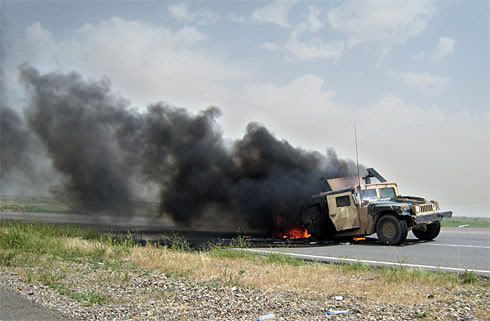
A U.S. Humvee burns in April near Samarra, about 60 miles north of Baghdad, after an improvised explosive device detonated near its convoy. Roadside bombs account for more than half of the U.S. combat deaths in Iraq.

Since 2006, the military has taken significant steps to get more explosives disposal teams throughout the war zone.

Col. Kevin Lutz, an explosives technician set to replace Reinhard next year, says the military has tripled the number of explosives disposal teams in Iraq during the past 18 months — going from about 50 to about 150 three-person teams. Even so, when the tech teams are called to an IED, getting them to the site and letting them gather the intelligence often takes time. Sometimes, the delay is 30 minutes. Occasionally, it extends for hours.

Engineers have been lobbying to take a more active approach in destroying roadside bombs for the past few years, Lutz and others say. The engineers' traditional mission — to breach obstacles to keep units mobile — was arguably more important during the invasion of Iraq than it is now, given the military's current role policing the country.

Nevertheless, officials set up a training course, taught by explosives technicians, to help prepare engineers to detonate IEDs. Reinhard says those engineers receive less than 100 hours of training. Explosives technicians train for more than 1,100 hours, he says.

On May 30, Lt. Gen. Raymond Odierno, the second-ranking U.S. commander in Iraq, issued the order that empowers commanders to let engineers blow and go.

"The intent of the order was to allow qualified individuals to detonate explosives rather than waiting for others who may not be readily available," explains Brig. Gen. Michael Silva, an Army engineer who says he lobbied Odierno for the change. "It was a way to improve the efficiency of the route clearing team operations so we were actually enabling the soldiers to do the job that they needed to get done."

IEDs 'just an obstacle'

An instructor who teaches engineers at Fort Leonard Wood in Missouri says the order makes sense.

"If you look at IEDs as just an obstacle, one of the engineer functions is just to remove obstacles," says Maj. Eric Goser, executive officer of the Counter Explosive Hazard Center. "Bottom line: The IED to an engineer is no different than a log obstacle," Goser says. "A log … is an obstacle. You deal with that obstacle in a certain way."

Goser's logic troubles explosives technicians. "The difference is, the log obstacle won't kill you," says Reynold Hoover, a former explosives technician who worked as a special agent with the Bureau of Alcohol, Tobacco and Firearms and served in the first Gulf War.

"You're gaining mobility," Hoover says, "but what you're losing is the ability to find the bombmaker and the supply chain."

Moreover, the amount of time saved by blowing and going may not be much, Reinhard says. He says a study done this year by his task force estimates "the expected value of the time they could save would be 20 minutes, on average."

"Nobody wants to sit out on the battlefield for three to four hours," he says. "Two or three years ago, they were waiting that long. It's definitely not like that any more."

Statistics on response times are classified, but Reinhard says explosives technicians are now able to arrive relatively quickly at IED sites. "For instance, in the north, 85% of the responses in the last week of September were 90 minutes or less," he says. Lutz says a long wait for explosives technicians today is "an outlier."

Engineer Silva, who is no longer on active duty, is skeptical. He believes information released by the explosives technicians may be "skewed" against giving engineers more of a role.

"My belief is that there was a parochialism engaged there — parochial in the fact that they want to be the only ones … blowing" IEDs, Silva says of explosives technicians.

Do risks outweigh benefits?

It's unclear how often commanders have used the blow-and-go approach. Reinhard says records he reviewed showed engineers detonated "approximately 120" IEDs from June through mid-October — about one a day.

But Army Col. Peter DeLuca, commander of the 20th Engineering Brigade, estimates engineers he oversees blow and go at least three or four IEDs each day — far more than the records reviewed by Reinhard indicate.

"There's been a ramp-up," Reinhard explains. "They may both be true" he says of the figures.

Others aren't certain. "No one is keeping good track of that," says Larry, who heads the Army's anti-IED efforts. "How do we know what they're doing," he says of engineers, "if they don't report it?"

Odierno's order specifies that engineers can only detonate relatively simple IEDs, using devices such as robots and the robotic arm of Mine Resistant Ambush Protected vehicles — machines that keep troops out of harm's way.

"We have very, very strict limitations about what we are and what we're not supposed to blow up," says Army Spc. Walter Hayden, the 1st Platoon team leader with the 1203rd Engineer Battalion. "If I ever have any kind of doubt," he says, he calls in explosives technicians.

Silva says he can see the amount handled by engineers growing — and the limitations on engineers being lifted as training improves. To date, neither DeLuca nor Reinhard believes any engineers have been hurt while blowing and going.

Despite reservations, Reinhard says he doesn't "object to the engineers doing this provided that they can live within the bounds that sometimes you need to pause and take the time to exploit."

But some explosives technicians fear that engineers will overstep their mission — and make deadly mistakes. Burghardt says he and his team dismantled more than 900 IEDs during his three tours in Iraq. The one that detonated — the one that left six holes in his body, cracked his tailbone, threw him 10 feet and knocked him unconscious in September 2005, despite the protective gear he wore — was unlike any he had seen.

"It was the first time we saw the tactic of where they double stacked it," says Burghardt, 37, now stationed at Camp Fuji, Japan. "I was standing on top of the device when I was clearing it … and they just leave enough earth in between" that the device beneath the other IED was difficult to spot.

Burghardt's experience is what makes explosives technicians wary of the new order — particularly, the idea that engineers will be able to discern a simple IED from a more sophisticated one. "What's simple?" Burghardt asks rhetorically. "You're not going to know that until it's too late."

Such mistakes put troops and civilians at risk. In a 2005 paper for the Marine Corps War College, Lutz chronicled cases in which mistakes by engineers cost lives.

Two different cases during the first Gulf War in 1991 "led to the massive chemical exposure and contamination of thousands of coalition forces and non-combatants, and the loss of seven United States soldiers," Lutz wrote. The reason for one of the mishaps at As Salman Airfield in Iraq: "Engineers were clearing munitions they were unfamiliar with and that turned out to be some of the most deadly unexploded ordnance our inventory can produce."

He wrote that, "buried within the … investigations, point papers, after-action reports, lessons learned from the various units (now in Iraq) … one can find repetitive incidents where the improper destruction of (explosives) led to severe contamination of the surrounding area and caused injury, death and destruction of equipment and facilities to both United States Armed Forces and to the local Iraqi civilian population."

Explosives technician Plemmons put it more tersely. He says the difference between an engineer and an explosives technician handling an IED is like the difference between "your physician's assistant" and "an orthopedic surgeon."

Saturday, September 01, 2007

All Indicators Point To Bush Moving Fast Toward Attacking Iran

Pentagon 'three-day blitz' plan for Iran

Times Online reports:
The Pentagon has drawn up plans for massive airstrikes against 1,200 targets in Iran, designed to annihilate the Iranians’ military capability in three days, according to a national security expert.

Alexis Debat, director of terrorism and national security at the Nixon Center, said last week that US military planners were not preparing for “pinprick strikes” against Iran’s nuclear facilities. “They’re about taking out the entire Iranian military,” he said.
Debat was speaking at a meeting organised by The National Interest, a conservative foreign policy journal. He told The Sunday Times that the US military had concluded: “Whether you go for pinprick strikes or all-out military action, the reaction from the Iranians will be the same.” It was, he added, a “very legitimate strategic calculus”.

President George Bush intensified the rhetoric against Iran last week, accusing Tehran of putting the Middle East “under the shadow of a nuclear holocaust”. He warned that the US and its allies would confront Iran “before it is too late”.

One Washington source said the “temperature was rising” inside the administration. Bush was “sending a message to a number of audiences”, he said to the Iranians and to members of the United Nations security council who are trying to weaken a tough third resolution on sanctions against Iran for flouting a UN ban on uranium enrichment.

The International Atomic Energy Agency (IAEA) last week reported “significant” cooperation with Iran over its nuclear programme and said that uranium enrichment had slowed. Tehran has promised to answer most questions from the agency by November, but Washington fears it is stalling to prevent further sanctions. Iran continues to maintain it is merely developing civilian nuclear power.

Bush is committed for now to the diplomatic route but thinks Iran is moving towards acquiring a nuclear weapon. According to one well placed source, Washington believes it would be prudent to use rapid, overwhelming force, should military action become necessary.

Israel, which has warned it will not allow Iran to acquire nuclear weapons, has made its own preparations for airstrikes and is said to be ready to attack if the Americans back down.

Alireza Jafarzadeh, a spokesman for the National Council of Resistance of Iran, which uncovered the existence of Iran’s uranium enrichment plant at Natanz, said the IAEA was being strung along. “A number of nuclear sites have not even been visited by the IAEA,” he said. “They’re giving a clean bill of health to a regime that is known to have practised deception.”

Mahmoud Ahmadinejad, the Iranian president, irritated the Bush administration last week by vowing to fill a “power vacuum” in Iraq. But Washington believes Iran is already fighting a proxy war with the Americans in Iraq.

The Institute for the Study of War last week released a report by Kimberly Kagan that explicitly uses the term “proxy war” and claims that with the Sunni insurgency and Al-Qaeda in Iraq “increasingly under control”, Iranian intervention is the “next major problem the coalition must tackle”.

Bush noted that the number of attacks on US bases and troops by Iranian-supplied munitions had increased in recent months “despite pledges by Iran to help stabilise the security situation in Iraq”.

It explains, in part, his lack of faith in diplomacy with the Iranians. But Debat believes the Pentagon’s plans for military action involve the use of so much force that they are unlikely to be used and would seriously stretch resources in Afghanistan and Iraq.

Wednesday, August 22, 2007

Pentagon Missing Goal of Delivering Armored Vehicles To Iraq


On December 7, 1941, the Japanese pretty much destroyed the U.S. Navy.

Within one decade, Americans rebuilt the Navy's arsenal, won the war in the European and Pacific theaters, and went on to rebuild all of Europe and a good part of Japan and the Phillipines.

George W. Bush was given an unlimited budget to go to war in Iraq and Afghanistan. What is so difficult about getting U.S. troops the equipment they need and in a timely manner?

Reuters reports:
U.S. troops in Iraq will receive at least 1,000 fewer special armored vehicles than expected this year due to the amount of time needed for shipment, the Pentagon said on Wednesday.

Pentagon spokesman Geoff Morrell said the Defense Department expected defense contractors to produce 3,900 Mine Resistant Ambush Protected (MRAP) vehicles this year. But only 1,500 would make it to the war zone -- down from the Pentagon's previous shipment target of 2,500 to 3,000.

"If we could get 1,500 to theater by the end of this year, that would be a positive development," Morrell said.
The new goal of 1,500 was first reported by Stars & Stripes, the newspaper for troops overseas that is partially funded by the Defense Department.

The MRAP vehicle is one of the Pentagon's top acquisition priorities and the Defense Department's aim has been to buy as many as can be produced. It follows years of criticism directed at the Pentagon for not providing adequate armor to troops.

MRAPs have a special V-shaped hull that provide greater protection against roadside bombs, the number one killer and maimer of the troops. According to the military, no troops have been killed while riding in one.

Once the MRAPs are built, the military installs necessary military equipment - such as radios and radar - then sends them to Iraq. Right now that process is taking about 50 days, but officials hope to shorten that to a little more than a month.

Still, [Pentagon press secretary Geoff] Morrell said that many of the MRAPs produced in November and December won’t get to Iraq before the end of the year. He said getting 3,500 to the forces in Iraq by year’s end was an “ambitious goal” but the revised estimate of 1,500 is more realistic now.
Morrell said it takes about 50 days to equip and ship a finished MRAP into the war zone. That includes 15 days for equipping and 35 for transport by ship.

The Pentagon was already flying some MRAPs to the war zone, Morrell said.

But given the numbers to be produced, it will quickly become more cost effective to send them by ship, he said, noting November and December would be the highest production months to date.

Morrell said he did not know which units in Iraq would be affected by the production shortfall this year.

MRAP contractors include:

-- Navistar International Corp.'s International Military and Government LLC;

-- Force Protection Inc., which is partnered with General Dynamics Corp.'s Land Systems business arm;

-- a General Dynamics Canadian unit;

-- BAE Systems Plc;

-- Oshkosh Truck Corp.;

-- closely held Protected Vehicles Inc. of North Charleston, South Carolina

As I'm putting this piece together, the television is on and I'm watching the latest episode of Top Chef in the background. On last week's episode, the contestants were divided into two teams of four chefs each and each team created a restaurant and menu. Both teams performed badly, and nobody was eliminated. This week, they were to do it all over again with some small changes in the rules, and were guaranteed that "somebody is going home."

It's the last ten minutes of tonight's episode and the panel of judges are talking about who on each of the teams of chefs is responsible for the overall failure of this latest mission. Because that's the person that's getting sent home.

How many years is it going to take to properly outfit our troops and send them into Iraq with the equipment that they need to get the job done and keep them protected? You can only say that it's Bremer's fault, or Rumsfeld's fault, or the Pentagon's fault, or Cheney's fault for so long. This is totally and completely the fault of the Commander-in-Chief, George W. Bush, a man with no experience or know-how about getting anything done, except ripping off the U.S. Treasury.

In less than a month, Bush is going to kick-off a campaign to pressure the U.S. Congress into keeping the war in Iraq going. One would think he'd have gotten his act together on something that is so simple (getting 3,500 MRAPs to Iraq) before asking Congress and the American people to trust again in his leadership and ability to get the job done.

If only life was like these reality shows, and we can convene a panel of citizen judges to tell Bush and Cheney, "Pack up your Diebold machines and wiretaps and leave."

If only.

Pentagon To Close TALON Reporting System


Xinhua.net reports:
The U.S. Defense Department will close its TALON Reporting System next month that contains intelligence gathered about war protestors in the country, the department announced Tuesday.

The reporting system on threats to the Defense Department and domestic military installations will be closed on Sept. 17.

Why the delay?
The department's counterintelligence office, however, will maintain a record copy of the collected data in the system, and the assistant secretary of defense for homeland defense and America's security affairs will propose a system to streamline such threat reporting and better meet the department's needs, the Pentagon said in a statement.

After the reporting system is closed, the department's agencies will send information concerning force protection threats to the Federal Bureau of Investigation until a system can be established by the Pentagon, the statement said.

The Defense Department cannot legally collect information in the United States about potential threats to its installations, but it was revealed in late 2005 that the Pentagon had kept initial reports in the TALON database about peaceful protesters who posed no apparent threat, according to a CNN report.

The system is being shut down because it is infrequently used, the CNN report said.

Not because it's wrong, or illegal, or because Quakers and other anti-war groups pose no threat and it's a waste of limited resources. No. It's because "it is infrequently used," which really means that they have some other system up and running to spy on citizens.

Friday, August 17, 2007

Missing U.S. Arms Probe Goes Global

At Asia Times Online, David Isenberg writes:
The issue of missing US weapons in Iraq is getting, as Alice said in Wonderland, curiouser and curiouser. What started out as a mere report documenting improper bookkeeping procedures for assault rifles and pistols given by the Pentagon to Iraqi security forces in 2004 and 2005 is turning into an international scandal.

It started on July 31, when the US Government Accountability Office (GAO) released a report "Stabilizing Iraq: DOD [Department of Defense] Cannot Ensure That US-Funded Equipment Has Reached Iraqi Security Forces". A classified version of the report will be submitted to Congress next month.

The report found that since 2003, the United States has provided about US$19.2 billion to develop Iraqi security forces. As part of that effort, components of the Multinational Force-Iraq (MNF-I), are responsible for implementing the US program to train and equip Iraqi forces. The report found that as of July, the DOD and MNF-I had not specified which DOD accountability procedures, if any, apply to the train-and-equip program for Iraq.
As Congress funded the train-and-equip program for Iraq outside traditional security assistance programs, the Pentagon had a large degree of flexibility in managing the program. Normally, the traditional security assistance programs are operated by the State Department. Since the funding did not go through traditional security assistance programs, the DOD accountability requirements normally applicable to these programs did not apply. Thus the DOD and MNF-I cannot fully account for Iraqi forces' receipt of US-funded equipment.

As a result, the GAO found a discrepancy of at least 190,000 weapons between data reported by the former commander of the Multinational Security Transition Command-Iraq (MNSTC-I) and the property books. The GAO report indicates that US military officials do not know what happened to 30% of the weapons the United States distributed to Iraqi forces from 2004 through early this year.

The highest previous estimate of unaccounted-for weapons was 14,000, in a report issued last year by the inspector general for Iraq reconstruction. According to that report, 13,180 Glock automatic pistols were unaccounted for. The more recent GAO study puts the total figure for missing pistols closer to 80,000. In addition, the report found that US officials in Iraq could not account for 751 M1F assault rifles and 99 MP5 machine-guns.

It seems a virtual certainty that many of the Glocks have been diverted to the black market. An article in the current issue of Newsweek magazine quotes a senior Turkish security official, who said his government estimates that some 20,000 US-bought Glock pistols have been brought from Iraq into his country over the past three years.

The GAO reached the estimate of 190,000 missing arms - 110,000 AK-47s and 80,000 pistols - by comparing the property records of the MNSTC-I against records US General David Petraeus maintained of the arms and equipment he had ordered, after he was brought in in June 2004 to build up Iraqi security forces.

The gaps between the two records are enormous. Petraeus reported that about 185,000 AK-47 rifles, 170,000 pistols, 215,000 pieces of body armor and 140,000 helmets were issued to Iraqi security forces from June 2004 through September 2005. But the property books contained records for 75,000 AK-47 rifles, 90,000 pistols, 80,000 pieces of body armor and 25,000 helmets.

The fact that the weapons are not fully accounted for does not necessarily mean they are all missing. It is possible that the US military simply does not have the supporting records confirming the dates the equipment was received, the quantities of equipment delivered, or the Iraqi units receiving the items.

On the other hand it seems fairly likely that some of the missing weapons are being used against US forces in Iraq. Given that the most readily accessible black market for those stolen weapons is in Iraq, some of those are going to be bought by the insurgents.

In fact, the problem could be considerably worse than the GAO report indicates.

According to Amnesty International research, additional hundreds of thousands of US-approved arms transfers from Bosnia-Herzegovina to Iraq could also be missing. In a May 2006 report, Amnesty revealed that Taos Inc, a US company with multiple DOD contracts, subcontracted to a Moldovan/Ukrainian company called Aerocom to transport hundreds of thousands of arms, more than 90 tonnes of AK-47s, and other weapons from Bosnia to Iraq between July 31, 2004, and June 31, 2005, for Iraqi security forces.

US military air-traffic controllers in Iraq, however, said Aerocom never requested landing slots to touch down in the country. Aerocom smuggled weapons to Liberia in 2002 and was operating without a valid license in 2004, according to the United Nations Security Council.

As of August, Amnesty was still awaiting a reply from the Pentagon regarding its investigation into the Bosnia-to-Iraq weapons shipments.

And, in a move that can only be likened to the fox guarding the hen-house, it turns out, as the Los Angeles Times reported on August 13, that there may have been another factor at work, namely the US government's use of Viktor Bout - a Russian air transporter who also happens to be the world's most notorious arms dealer.

When the US government needed to fly four planeloads of seized weapons from Bosnia to Iraqi security forces in Baghdad in August 2004, it used Aerocom. But Aerocom is tied to Bout's aviation empire. The problem is that the planes apparently never arrived. US officials admitted they had no record of the flights landing in Baghdad.

Why the US government would have used Bout-controlled Aerocom - which had already been linked to supplying arms to Liberia when it was ruled by Charles Taylor and to drug traffickers in Belize - is a mystery in and of itself, considering that by 2004 Bout was very well known to the US government as a global gun-runner whom they wanted to put out of business.

The latest development occurred this week when it was reported that that Italian anti-Mafia investigators had uncovered an alleged shipment of 105,000 rifles of which the US military command in Iraq was unaware. The Italian team, in an investigation code-named Operation Parabellum, stopped the $40 million sale and made four arrests. The consignment appears to have been ordered by the Iraqi Interior Ministry. The US high command in Baghdad admitted it had no knowledge of any such order, even though the ministry is supposed to inform the US before purchasing arms.

An Iraqi Interior Ministry official insisted the weapons were mostly for Iraqi police in al-Anbar province. But given the close relationship between the Shi'ite-led government and Shi'ite militias and the irregular nature of the arms order, the disclosure prompted suspicion that the eventual destination could have been the militias, or police units close to them.

Furthermore, why the police in Anbar would need more weapons raises more questions. The Pentagon has issued 169,280 AK-47s, 167,789 pistols and 16,398 machine-guns to the 161,000 police in Iraq and 28,000 border police.

Tuesday, August 07, 2007

Pentagon Admits 190,000 Weapons Missing In Iraq

The Independent reports:
Some 190,000 assault rifles and pistols supplied by the US to Iraqi security forces in 2004 and 2005 have gone missing, according to a report issued here yesterday, and may have fallen into the possession of insurgents.

The embarrassing disclosure, by the watchdog Government Accountability office (GAO), means that the Pentagon does not know what happened to roughly a third of the arms it has provided to train and equip Iraqi forces - an effort whose success is crucial to restoring some semblance of order in the country.
The "lost" arms include 80,000 pistols as well as an estimated 110,000 of the Soviet-made AK-47 assault rifles, many of them originating in eastern Europe, especially the former Yugoslavia. A recent Amnesty International report claims that, in 2004 and 2005, more than 350,000 AK-47s and similar weapons were removed from Bosnia and Serbia by private contractors working for the Pentagon and sent to Iraq, with the approval of local Nato and European commanders.

In addition, some 135,000 pieces of body armour and 115,000 helmets have also vanished, again perhaps to end up in the hands of insurgents. So far, the US has spent more than $19bn (£9.3bn) on developing Iraqi security forces, including almost $3bn on weapons.

According to the GAO, the distribution of the weaponry was "haphazard and rushed," and failed to follow established procedures - accusations the Pentagon does not dispute.

But the affair could be even more problematic for the White House, given that, during the two years under scrutiny, the programme was headed by General David Petraeus, now the top US commander in Iraq, in charge of the current troop "surge". President George Bush now lauds his talents on an almost daily basis, as the man who will finally give the US the upper hand against the insurgents.

The GAO arrived at its figures by comparing the property records of the Multi-National Security Transition Command for Iraq against records kept by General Petraeus of the arms and equipment he ordered. The Pentagon says it is now reviewing procedures "to ensure US-funded equipment reaches the intended Iraqi security forces."

But the controversy fits into a now familiar pattern of mistakes made by the US in Iraq, dating back to the initial failure to secure arms caches found in Iraq immediately after the 2003 invasion, and which merely fuel the insurgency the Americans are trying to stamp out. In this case, says the GAO, the military was "consistently unable" to collect supporting documents showing the weapons had been sent to and received by the intended parties.

There were also "numerous mistakes due to incorrect manual entries". But the military argues that the situation on the ground was so urgent, and the agency responsible for recording the transfers of arms so short staffed, that field commanders had little choice in the matter. "We could have held on to them until every bit of a logistical and property accountability system was in place," one unidentified officer told The Washington Post, which first reported on the missing arms yesterday. Or, he continued, "we could issue them in bulk on some occasions, to the US elements supporting Iraqi units who were needed in the battles." In Fallujah, the scene of fierce fighting in late 2004, one recently created Iraqi brigade dissolved and later used its weapons against American forces.

The GAO findings will be grist for the mill of opponents of the war, less than six weeks before the scheduled report to Congress by General Petraeus and Ryan Crocker, Washington's envoy in Baghdad, on whether the "surge" is succeeding.

That report may be a watershed moment for Iraq policy here. With public patience with the war all but exhausted, and elections barely a year away, many Republicans loyal to Mr Bush have hinted that, barring cast-iron evidence the "surge" is working, they will no longer support the war.

Monday, August 06, 2007

GAO Estimates 30% of Arms Are Unaccounted For

The Washington Post reports:
The Pentagon has lost track of about 190,000 AK-47 assault rifles and pistols given to Iraqi security forces in 2004 and 2005, according to a new government report, raising fears that some of those weapons have fallen into the hands of insurgents fighting U.S. forces in Iraq.

The author of the report from the Government Accountability Office says U.S. military officials do not know what happened to 30 percent of the weapons the United States distributed to Iraqi forces from 2004 through early this year as part of an effort to train and equip the troops. The highest previous estimate of unaccounted-for weapons was 14,000, in a report issued last year by the inspector general for Iraq reconstruction.
The United States has spent $19.2 billion trying to develop Iraqi security forces since 2003, the GAO said, including at least $2.8 billion to buy and deliver equipment. But the GAO said weapons distribution was haphazard and rushed and failed to follow established procedures, particularly from 2004 to 2005, when security training was led by Gen. David H. Petraeus, who now commands all U.S. forces in Iraq.

The Pentagon did not dispute the GAO findings, saying it has launched its own investigation and indicating it is working to improve tracking. Although controls have been tightened since 2005, the inability of the United States to track weapons with tools such as serial numbers makes it nearly impossible for the U.S. military to know whether it is battling an enemy equipped by American taxpayers.

"They really have no idea where they are," said Rachel Stohl, a senior analyst at the Center for Defense Information who has studied small-arms trade and received Pentagon briefings on the issue. "It likely means that the United States is unintentionally providing weapons to bad actors."

One senior Pentagon official acknowledged that some of the weapons probably are being used against U.S. forces. He cited the Iraqi brigade created at Fallujah that quickly dissolved in September 2004 and turned its weapons against the Americans.

Stohl said insurgents frequently use small-arms fire to force military convoys to move in a particular direction -- often toward roadside bombs. She noted that the Bush administration frequently complains that Iran and Syria are supplying insurgents but has paid little attention to whether U.S. military errors inadvertently play a role. "We know there is seepage and very little is being done to address the problem," she said.

Stohl noted that U.S. forces, focused on a fruitless search for weapons of mass destruction after Baghdad fell, did not secure massive weapons caches. The failure to track small arms given to Iraqi forces repeats that pattern of neglect, she added.

The GAO is studying the financing and weapons sources of insurgent groups, but that report will not be made public. "All of that information is classified," said Joseph A. Christoff, the GAO's director of international affairs and trade.

In an unusual move, the train-and-equip program for Iraqi forces is being managed by the Pentagon. Normally, the traditional security assistance programs are operated by the State Department, the GAO reported. The Defense Department said this change permitted greater flexibility, but as of last month it was unable to tell the GAO what accountability procedures, if any, apply to arms distributed to Iraqi forces, the report said.

Iraqi security forces were virtually nonexistent in early 2004, and in June of that year Petraeus was brought in to build them up. No central record of distributed equipment was kept for a year and a half, until December 2005, and even now the records are on a spreadsheet that requires three computer screens lined up side by side to view a single row, Christoff said.

The GAO found that the military was consistently unable to collect supporting documents to "confirm when the equipment was received, the quantities of equipment delivered, and the Iraqi units receiving the equipment." The agency also said there were "numerous mistakes due to incorrect manual entries" in the records that were maintained.

The GAO reached the estimate of 190,000 missing arms -- 110,000 AK-47s and 80,000 pistols -- by comparing the property records of the Multi-National Security Transition Command for Iraq against records Petraeus maintained of the arms and equipment he had ordered. Petraeus's figures were compared with classified data and other records to ensure that they were accurate enough to compare against the property books.

In all cases, the gaps between the two records were enormous. Petraeus reported that about 185,000 AK-47 rifles, 170,000 pistols, 215,000 pieces of body armor and 140,000 helmets were issued to Iraqi security forces from June 2004 through September 2005. But the property books contained records for 75,000 AK-47 rifles, 90,000 pistols, 80,000 pieces of body armor and 25,000 helmets.

A military commander involved in the program at the time, speaking on the condition of anonymity because he was not authorized to discuss the report, acknowledged in an e-mail, "We did issue some items, including weapons, body armor, etc. to new Iraqi units that were literally going into battle."

But, the commander argued, "there was, frankly, not much of a choice early on: We had very little staff and could have held the weapons until every piece of the logistical and property accountability system was in place, or we could issue them, in bulk on some occasions, to the U.S. elements supporting Iraqi units who were needed in the battles of Najaf, Fallujah, Mosul, Samarra, etc."

The GAO plans to look for similar problems in the training of Afghan security forces.

During the Bosnian conflict, the United States provided about $100 million in defense equipment to the Bosnian Federation Army, and the GAO found no problems in accounting for those weapons.

Much of the equipment provided to Iraqi troops, including the AK-47s, originates from countries in the former Soviet bloc. In a report last year, Amnesty International said that in 2004 and 2005 more than 350,000 AK-47 rifles and similar weapons were taken out of Bosnia and Serbia, for use in Iraq, by private contractors working for the Pentagon and with the approval of NATO and European security forces in Bosnia.
Even under the Democratically-controlled Congress, oversight by and bimonthly mandated reports to Congress on the progress of the war that were required when Congress gave Bush the authority to attack Iraq don't happen.

Saturday, July 21, 2007

Gates Steps In To Defuse Clinton-Pentagon Dispute

Not really.

The Washington Post reports:
Defense Secretary Robert M. Gates sought to defuse a row between a top Pentagon aide and Sen. Hillary Rodham Clinton yesterday over her request for details of plans to withdraw U.S. troops from Iraq.

In May, the New York Democrat sought information about the Pentagon's plans for pulling troops out of the war zone. In response to her inquiry, Undersecretary Eric S. Edelman dispatched a letter accusing her of reinforcing "enemy propaganda that the United States will abandon its allies" by discussing a timetable, an answer that Clinton deplored yesterday as "an unacceptable and outrageous political attack."
Clinton, the front-runner for the Democratic presidential nomination, capitalized on the contretemps all day, announcing that she will introduce legislation with Sen. John F. Kerry (D-Mass.) that would require the military to plan for a troop withdrawal from Iraq and issuing a letter to Gates demanding further answers about the military's exit strategy. Though Clinton voted for the war and has never apologized for her vote, she has sharpened her criticism of its execution while playing catch-up on the issue with Democratic rivals, particularly Sen. Barack Obama (Ill.), who opposed the invasion from the start.

In a statement, Gates said that he had not seen Clinton's original letter, but he added that he welcomes congressional involvement.

"I have long been a staunch advocate of Congressional oversight, first at the CIA and now at the Defense Department," Gates said. "I have said on several occasions in recent months that I believe that Congressional debate on Iraq has been constructive and appropriate. I had not seen Senator Clinton's reply to Ambassador Edelman's letter until today. I am looking into the issues she raised and will respond to them early next week."

"Redeploying out of Iraq will be difficult and requires careful planning," Clinton said. "I continue to call on the Bush administration to immediately provide a redeployment strategy that will keep our brave men and women safe as they leave Iraq -- instead of adhering to a political strategy to attack those who rightfully question their competence and preparedness after years of mistakes and misjudgments."

Bob Gates is a tool. He just bought Bush and Cheney one week, in which time it's hoped that everyone will forget the Bush administration's blowing off of a United States' Senator on the Armed Services Committee (Hillary Clinton) and the Constitutionally required role of oversight of this administration by that Senator, on that committee, of the Congress of the United States.