Showing posts with label Bringing democracy to the Middle East. Show all posts

Thursday, November 15, 2007

Basra Militants Targeting Women

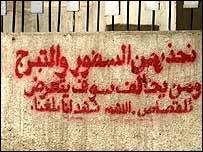
"We warn against immodest dress. Violators will be punished. God is witness that we have conveyed the message"
-Message written on a Basra wall

The BBC reports:
The chief of police in the southern Iraqi city of Basra has warned of a campaign of violence against women carried out by religious extremists.

It has, Maj-Gen Abdul Jalil Khalaf said, included threats, intimidation and even murder.

Some victims were dressed in indecent clothes by their killers or had notices attached to them, he said.

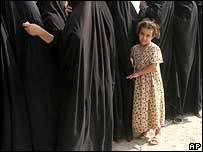
Women interviewed by the BBC said they no longer dared venture on to Basra's streets without strict Islamic attire.

"There is a terrible repression against women in Basra," Maj-Gen Khalaf told the BBC.

"They kill women, leave a piece of paper on her or dress her in indecent clothes so as to justify their horrible crimes."

Forty-two women were killed between July and September this year, although the number dropped slightly in October, he said.

In one case, he added, a woman was killed in her home along with her six-year-old son, who was rumoured to have been conceived in an adulterous relationship.
Maj-Gen Khalaf, sent to Basra this year by Iraqi Prime Minister Nouri Maliki to impose order in the city, said the police were often too scared to conduct proper investigations into the killings.

"The relatives are reluctant to report the crimes for fear of a scandal or because they despair of the police's ability to solve them," he added.

Women are being targeted amid a local power struggle

'Shot in the legs'

A female lawyer in Basra contacted by the BBC by phone from London, who asked not to be named for fear of reprisals, said attacks on women in the city were occurring "every two or three days".

She told the BBC about a university student who had been shot in the legs for not wearing an Islamic headscarf, or hijab.

The lawyer also said that graffiti was painted on walls warning women to cover their heads or "be punished".

She said she had been told by a group of men that she should be at home and get married instead of working.

"They said to me: 'If anyone's willing to offer a good price for you, we wouldn't think twice about selling you'," she said.

"When they see a woman going out to work and being successful, I'm sorry, but they feel inferior to her."

'Killed before their kids'

A mother-of-six and government employee in Basra, who wished to be identified only as Um Zeinab, told the BBC she had almost been run down by a motorcyclist one day while waiting for her bus to work.

"I was wearing a shirt with a skirt and some make-up, as I usually do," she said.

"I was waiting at the bus stop when the motorbike headed straight at me, full speed."

Luckily, the motorcyclist skidded and fell before reaching her.

She said she had heard of other women attacked but who had not been as lucky.

"Two women were killed in al-Makal district two days ago. People said they had received warnings before and then gunmen came to their homes and killed them, one in front of their kids."

Warring factions

Given the continuing power struggle in Basra between rival Shia militias, it was perhaps understandable that Gen Khalaf would not be drawn into naming names.

He blamed "dangerous criminals" trying to undermine stability in the city.

He also said that repression against women had been going on while British forces were still in the city, prior to their withdrawal to Basra airport in September.

Others were more direct in pointing the finger of blame at the rival Shia militias, known to have infiltrated the police and vying for control of Basra.

Um Zeinab called them "dark, fundamentalist extremists".

A spokesman for one of the largest Shia groups, the Sadrists of the radical cleric Moqtada Sadr, told the BBC that its members did not attack women or try to enforce Islamic law on women by violence.

But he did not rule out that others were doing so.
The next time some bullying neocon, like Sean Hannity or Clifford May, defends Bush and this war in Iraq by saying something as stupid as what Bush's father said just last week:
""Do they want to bring back Saddam Hussein, these critics (of Bush and the war)? Do they want to go back to the status quo ante? I don't know what they are talking about here. Do they think life would be better in the Middle East if Saddam were still there?"

...tell them, "You bet!"

Life was better in the Middle East, in the U.S., and everywhere else. More than a million Iraqis would still be alive, several million more would be at home in their country instead of living out of suitcases as refugees, looking for a nation that will take them so they can get on with their lives. Still millions more that have been left in Iraq would have food, water, electricity, streets without raw sewage, medicine and medical care, jobs, classes, gas, and hope for a future free from western occupation, curfews, blockades that have turned their neighborhoods into ghettos and the threat of being tortured and/or murdered at any time.

Americans would certainly sure be better off. Gas would be a whole lot cheaper, we'd have a trillion-and-half dollars less debt, several thousand U.S. soldiers would still be alive, and many thousand U.S. soldiers' would still have arms and legs and minds and homes and families. And there would be a whole lot less animosity towards us in the world.

Wednesday, August 08, 2007

Our Friends, The Saudis

Teenage Girl Faces Beheading in Saudi Arabia


ABC News reports:
The family of a 19-year-old Sri Lankan girl is pleading for her life after a Saudi Arabian court sentenced her to death by beheading.

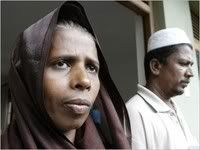
The court found Rizana Nafeek, 19, guilty of murdering a child in her care while working in the country. Her family (parents pictured above) has appealed the sentence, and human rights groups are calling for the Saudi government to overturn it.

At 17, Rizana Nafeek was sent to Saudi Arabia after the tsunami to work as a maid and make money for her family in Sri Lanka. But after only a few weeks and no child care training, her employers put her in charge of their 4-month-old baby. The baby died, and Nafeek was charged with murder, tried without an attorney and sentenced to death.
"This case raises many troubling questions about the treatment of children and foreigners in Saudi Arabia's criminal justice system," says Varia. "Foreigners simply do not receive the same treatment in the Saudi justice system. This includes having translation during the interrogation and during court proceedings and having an attorney."

About 1.5 million Sri Lankans work abroad, according to the country's labor statistics. Eighty percent of the women working abroad are employed as unskilled domestic workers, primarily in Saudi Arabia.

Varia says domestic workers are vulnerable to mistreatment. When Human Rights Watch sent a team of investigators to Saudi Arabia last year, Varia says the group found egregious abuse.

"The most commonly reported abuse is unpaid wages," she says. "It's routine for employers to take the passports of workers, and in order for the worker to leave the country, they have to get their employer to sign an exit visa."

Under Saudi Arabian law, employers have a heavy hand in how justice is served. After being charged and interrogated, Nafeek signed a guilty confession. If her former employers formally forgive her, she will be released, but they have so far refused to do so.

Nafeek's parents told local media outlets that their daughter was not trained in child care and that the baby "choked on milk." Human Rights Watch is calling for a new investigation into the case.

Varia says that because domestic workers in Saudi Arabia are not protected by labor laws, they don't have access to training, paid leave, reasonable hours or even one day off.

"They're not seen as real human beings," she says.

"It is socially accepted to lock your domestic worker inside the house. There are employers who forbid their workers to make phone calls home or write letters or talk to neighbors," says Varia, who interviewed domestic workers' employers in Saudi Arabia. "The reason they give is that, 'We paid a lot of money for this worker, and if I leave the door unlocked, she'll run away.'"

The problem is so severe that the embassies of Sri Lanka, Indonesia and the Philippines in Saudi Arabia can have as many as 150 women staying in embassy shelters because of abuse suffered at the hand of their employer, says Varia

The Saudi Arabia Embassy in the U.S. has not responded to calls and e-mails from ABCNews.com for this story, but Nafeek's case and other recent cases have drawn attention to the issue in Saudi Arabia. The Saudi government has made public statements condemning abuse of domestic workers. There also have been discussions to place domestic workers under separate labor laws.

Varia says discussions and rhetoric are not enough; the laws must change.

"There needs to be much greater efforts to punish abusive employers and to protect workers," she says. "What will really matter is if domestic workers get the same rights as all other workers in Saudi Arabia."

Tuesday, August 07, 2007

Pentagon Admits 190,000 Weapons Missing In Iraq

The Independent reports:
Some 190,000 assault rifles and pistols supplied by the US to Iraqi security forces in 2004 and 2005 have gone missing, according to a report issued here yesterday, and may have fallen into the possession of insurgents.

The embarrassing disclosure, by the watchdog Government Accountability office (GAO), means that the Pentagon does not know what happened to roughly a third of the arms it has provided to train and equip Iraqi forces - an effort whose success is crucial to restoring some semblance of order in the country.
The "lost" arms include 80,000 pistols as well as an estimated 110,000 of the Soviet-made AK-47 assault rifles, many of them originating in eastern Europe, especially the former Yugoslavia. A recent Amnesty International report claims that, in 2004 and 2005, more than 350,000 AK-47s and similar weapons were removed from Bosnia and Serbia by private contractors working for the Pentagon and sent to Iraq, with the approval of local Nato and European commanders.

In addition, some 135,000 pieces of body armour and 115,000 helmets have also vanished, again perhaps to end up in the hands of insurgents. So far, the US has spent more than $19bn (£9.3bn) on developing Iraqi security forces, including almost $3bn on weapons.

According to the GAO, the distribution of the weaponry was "haphazard and rushed," and failed to follow established procedures - accusations the Pentagon does not dispute.

But the affair could be even more problematic for the White House, given that, during the two years under scrutiny, the programme was headed by General David Petraeus, now the top US commander in Iraq, in charge of the current troop "surge". President George Bush now lauds his talents on an almost daily basis, as the man who will finally give the US the upper hand against the insurgents.

The GAO arrived at its figures by comparing the property records of the Multi-National Security Transition Command for Iraq against records kept by General Petraeus of the arms and equipment he ordered. The Pentagon says it is now reviewing procedures "to ensure US-funded equipment reaches the intended Iraqi security forces."

But the controversy fits into a now familiar pattern of mistakes made by the US in Iraq, dating back to the initial failure to secure arms caches found in Iraq immediately after the 2003 invasion, and which merely fuel the insurgency the Americans are trying to stamp out. In this case, says the GAO, the military was "consistently unable" to collect supporting documents showing the weapons had been sent to and received by the intended parties.

There were also "numerous mistakes due to incorrect manual entries". But the military argues that the situation on the ground was so urgent, and the agency responsible for recording the transfers of arms so short staffed, that field commanders had little choice in the matter. "We could have held on to them until every bit of a logistical and property accountability system was in place," one unidentified officer told The Washington Post, which first reported on the missing arms yesterday. Or, he continued, "we could issue them in bulk on some occasions, to the US elements supporting Iraqi units who were needed in the battles." In Fallujah, the scene of fierce fighting in late 2004, one recently created Iraqi brigade dissolved and later used its weapons against American forces.

The GAO findings will be grist for the mill of opponents of the war, less than six weeks before the scheduled report to Congress by General Petraeus and Ryan Crocker, Washington's envoy in Baghdad, on whether the "surge" is succeeding.

That report may be a watershed moment for Iraq policy here. With public patience with the war all but exhausted, and elections barely a year away, many Republicans loyal to Mr Bush have hinted that, barring cast-iron evidence the "surge" is working, they will no longer support the war.

Saturday, July 28, 2007

U.S. Plans New Arms Sales to Gulf Allies

$20 Billion Deal Includes Weapons For Saudi Arabia


The Washington Post reports:
The Bush administration will announce next week a series of arms deals worth at least $20 billion to Saudi Arabia and five other oil-rich Persian Gulf states as well as new 10-year military aid packages to Israel and Egypt, a move to shore up allies in the Middle East and counter Iran's rising influence, U.S. officials said yesterday.

The arms deals, which include the sales of a variety of sophisticated weaponry, would be the largest negotiated by this administration. The military assistance agreements would provide $30 billion in new U.S. aid to Israel and $13 billion to Egypt over 10 years, the officials said. Both figures represent significant increases in military support.
U.S. officials said the arms sales to Saudi Arabia are expected to include air-to-air missiles as well as Joint Direct Attack Munitions, which turn standard bombs into "smart" precision-guided bombs. Most, but not all, of the arms sales to the six Gulf Cooperation Council countries -- Saudi Arabia, the United Arab Emirates, Kuwait, Qatar, Bahrain and Oman -- will be defensive, the officials said.

U.S. officials said the common goal of the military aid packages and arms sales is to strengthen pro-Western countries against Iran at a time when the hard-line regime seeks to extend its power in the region.

"This is a big development, because it's part of a larger regional strategy and the maintenance of a strong U.S. presence in the region. We're paying attention to the needs of our allies and what everyone in the region believes is a flexing of muscles by a more aggressive Iran. One way to deal with that is to make our allies and friends strong," said a senior administration official involved in the negotiations.

The arms deals have quietly been under discussion for months despite U.S. disappointment over Saudi Arabia's failure to support the Iraqi government and to bring that country's Sunni Muslims into the reconciliation process.

The administration's plans will be announced Monday in advance of trips next week to the Middle East by Secretary of State Condoleezza Rice and Defense Secretary Robert M. Gates, and are expected to be on their agenda in Egypt and Saudi Arabia. The administration has a notional list of arms to sell to the Gulf states, but there are no final agreements on quantities and specific models, U.S. officials said.

State Department and Pentagon officials started briefing key members of Congress about their intentions over the past week, U.S. officials said. The initial reception has been positive, said officials involved in those briefings. They acknowledged, however, that some parts of the deal are supported more than others. Arms sales to Gulf countries have often been controversial.

The administration hopes to provide a full rundown this fall for congressional approval.

"We want to convince Congress to continue our tradition of military sales to all six" states, the senior administration official said. "We've been helping Gulf Arabs for years, and that needs to continue."

Sunni regimes in the Gulf region have felt particularly vulnerable since the election of a pro-Iranian Shiite government in neighboring Iraq last year. "There's a sense here and in the region of the need to build up defenses against Iranian encroachment," said a U.S. official familiar with the deals.

The aid packages to Israel and Egypt are further along. A U.S.-Israel agreement, to replace a 10-year arrangement that expires this year, has been under discussion since February, U.S. officials said. The new U.S. package will include strictly military aid and would expand the U.S. contribution 25 percent over the current $2.4 billion per year; economic assistance has been discontinued now that Israel is considered a developed economy, U.S. officials said.

President Bush said last month, after meeting with Israeli Prime Minister Ehud Olmert, that he was strongly committed to a new 10-year agreement that would increase U.S. assistance "to meet the new threats and challenges [Israel] faces." Washington has long promised to help Israel sustain a so-called "qualitative military edge" over other major powers in the region.

Rice is expected to announce Monday that, after her Middle East trip, Undersecretary of State R. Nicholas Burns will finalize the agreements with Israel and Egypt.