Who didn't see this coming?
The Associated Press report in the LA Times:
The Pentagon is prepared to leave fighting forces in Iraq for as long as a decade despite an agreement between the United States and Iraq that would bring all American troops home by 2012, the top U.S. Army officer said Tuesday.
Gen. George W. Casey Jr., the Army chief of staff, said the world remains dangerous, and the Pentagon must plan for extended U.S. combat and stability operations in two wars. "Global trends are pushing in the wrong direction," Casey said. "They fundamentally will change how the Army works."
He spoke at an invitation-only briefing to a dozen journalists and policy analysts from Washington-based think tanks. He said his planning envisions combat troops in Iraq and Afghanistan for a decade as part of a U.S. commitment to fighting extremism in the Middle East.
Casey's calculations about force levels are related to his attempt to ease the brutal deployment calendar that he said would "bring the Army to its knees."
Casey said his comments were not meant to conflict with administration policies.
CBS News's version adds:
Casey would not specify how many combat units would be split between Iraq and Afghanistan. He said U.S. ground commander Gen. Ray Odierno is leading a study to determine how far U.S. forces could be cut back in Iraq and still be effective.
Back to the LA Times:
President Obama plans to bring U.S. combat forces home from Iraq in 2010, and the United States and Iraq have agreed that all American forces would leave by 2012.
This isn't exactly true.
To begin with, it's disingenuous to suggest the U.S. is ending the occupation of Iraq because troops remaining aren't combat troops.
All troops are trained combat troops.
The distinction relates to current assignment. Combat troops (tens of thousands of them) assigned to duty in Iraq, which will include training, advising, and protecting "U.S. interests in Iraq", including but not limited to the U.S. embassy in Baghdad (U.S. Marine Security Guards), a 104-acre compound where 5,500 people (non-diplomats, U.S. government personnel of all kinds, and who knows how many spooks) live/work/play in a city within a city (a de facto military base) as large as Vatican City, six times larger than the United Nations compound in New York, two-thirds the acreage of Washington’s National Mall. It has its own area code, power station, water wells, waste treatment facilities, apartment buildings, fire department, shopping mall, restaurants, cinema, country-club recreational center, and more. It is the largest (at least ten times the size of new U.S. embassies elsewhere) and most expensive U.S. embassy in the world ($736 million to build, $1.2 billion a year to operate).
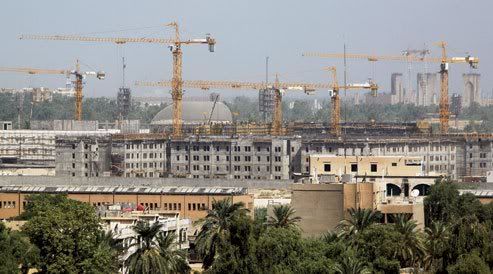
The new United States Embassy rises above Baghdad.
[Daniel Berehulak/Getty Images.]
[Daniel Berehulak/Getty Images.]
Several senior U.S. officials have suggested Iraq could request an extension, but the legal agreement that the two countries signed last year would have to be amended [for any significant U.S. presence to remain.
As recently as February, Defense Secretary Robert Gates reiterated the U.S. commitment to the agreement worked out with Iraqi Prime Minister Nouri al-Maliki.
"Under the Status of Forces Agreement with the Iraqi government, I intend to remove all U.S. troops from Iraq by the end of 2011," Gates said during an address at Camp Lejeune in North Carolina. "We will complete this transition to Iraqi responsibility, and we will bring our troops home with the honor that they have earned."]
The United States has about 139,000 troops in Iraq and 52,000 in Afghanistan.
Obama campaigned on ending the Iraq war quickly and refocusing U.S. resources on what he called the more important fight in Afghanistan.
[That will not mean a major influx of U.S. fighting forces on the model of the Iraq "surge," however. Obama has agreed to send about 21,000 combat forces and trainers to Afghanistan this year. Combined with additional forces approved before former President George W. Bush left office,] the United States is expected to have about 68,000 troops in Afghanistan by the end of this year. That's about double the total at the end of 2008, but Obama's top military and civilian advisors have indicated the number is unlikely to grow much beyond that.
CBS News's version continued with:
Casey said several times that he wasn't the person making policy, but the military was preparing to have a fighting force deployed in Iraq and Afghanistan for years to come. Casey said his planning envisions 10 combat brigades plus command and support forces committed to the two wars.
When asked whether the Army had any measurement for knowing how big it should be, Casey responded, "How about the reality scenario?"
This scenario, he said, must take into account that "we're going to have 10 Army and Marine units deployed for a decade in Iraq and Afghanistan."
Casey stressed that the United States must be ready to take on sustained fights in the Middle East while meeting other commitments.
Casey reiterated statements made by civilian and military leaders that the situation in Afghanistan would get worse before it gets better. "There's going to be a big fight in the South," he said.
Casey added that training of local police and military in Afghanistan was at least a couple years behind the pace in Iraq, and it would be months before the U.S. deployed enough trainers. There's a steeper curve before training could be effective in Afghanistan, requiring three to five years before Afghanis could reach the "tipping point" of control.
He also said the U.S. had to be careful about what assets get deployed to Afghanistan. "Anything you put in there would be in there for a decade," he said.
As Army chief of staff, Casey is primarily responsible for assembling the manpower and determining assignments. He insisted the Army's 1.1-million size was sufficient even to handle the extended Mideast conflicts.
"We ought to build a pretty effective Army with 1.1 million strength," Casey said. He also noted that the Army's budget had grown to $220 billion from $68 billion before the Sept. 11, 2001, terrorist attacks.
He said the Army is two-thirds of the way through a complete overhaul from the Cold War-era force built around tanks and artillery to today's terrorist-driven realities. The Army has become more versatile and quicker by switching from division-led units to brigade-level command.
Casey said the Army has moved from 15-month battlefield deployments to 12 months. His goal is to move rotations by 2011 to one year in the battlefield and two years out for regular Army troops, and one year in the battlefield and three years out for reserves. He called the current one-year-in-one-year-out cycle "unsustainable."
So there you have it. A meme which will slowly seep sideways into the minds of Americans (journalists' minds, in particular), so that as we get closer to the target dates for withdrawal of troops, Americans will have adjusted to the United States's continued occupation of Iraq.
C'est la guerre.