Showing posts with label Great Britain. Show all posts

Thursday, November 15, 2007

Random Bag Searches For Rail Passengers in Brown's Fortress Britain

The Daily Mail reports:
• Security will be upgraded at 250 train stations

• Anti-terror measures to be implemented at cinemas and shopping centres

• Bollards and concrete blocks to stop car bombers at 'vulnerable' buildings

• New buildings not allowed to have underground car parks
Britons face bag searches and airport-style scanners in railway stations, and the end of the underground car park in Gordon Brown's vision for Fortress Britain.

The Prime Minister yesterday told MPs that "terrorism can hit us anywhere" and the only solution is to strengthen security.

He called for anti-terror measures to be implemented in railway terminals, power stations and ports - and even cinemas and shopping centres.

Security will be upgraded at 250 train stations, with scanners and searches introduced at several of the biggest.

Exclusion zones could also be set up, preventing cars driving up to the entrances.

Mr Brown's comments came as he unveiled the results of two security reviews commissioned in the wake of the failed London and Glasgow car bomb attacks days after he came to power.

He said: "Just as the terrorists use every method and the very freedoms we enjoy to kill or maim people, so we must also adopt new tools to beat the terrorists, secure our borders and create a safe global society."

Protecting the public: Police on patrol at Heathrow

The plans raise the prospect of long and frustrating queues for rail travellers passing through major cities.

But the policy already seems in disarray after the Department of Transport said it did not believe airport scanners would be used.

Instead, officials said they expected to introduce hand-held devices, which are already used in some parts of the country.

There was also speculation that the speech was timed to bolster support for draconian new anti-terror powers.

The terror crackdown comes as the government is set to unveil new plans today to increase the length of time terror suspects can be detained, according to the BBC.
The new proposals would permit detainees to be held for up to maximum 58 days, 30 more days than the current limit of 28.

The new system would allow police to detain suspects for the extra 30 days, which they can already do under existing emergency powers, but without having to declare a state of emergency.

Mr Brown used the Queen's Speech last week to signal the Government would try to extend the existing 28-day limit for the detention of terror suspects.

He faces stiff opposition from the Conservatives and Liberal Democrats. Questions were also asked about the other major plank of his terror strategy - tightening up security at public venues such as shopping centres.

After a review by Security Minister Lord West, Mr Brown said that anti-terror measures would be increased at vulnerable buildings where large numbers of people gather.

The increased security is likely to include bollards and concrete blocks to stop car bombers, as well as new window designs to protect the public from splinters of glass.

New buildings will not be allowed to have underground car parks, which are vulnerable to explosive attacks.

But Mr Brown's official spokesman later admitted the Government would not fund the changes unless the buildings were publicly owned.

This cast huge doubts over whether the work would actually take place - and if it did, whether customers would foot the bill.

The shadow Home Secretary, David Davis, said: "The measures which Gordon Brown announced were long overdue but commonsense.

"However, we should know how these are to be paid for.

"The Government has a long track record of failing to deliver on pledges. Action against terror should not be an issue where the Prime Minister hides things in the fine print."

The new measures also include sending updated security advice to thousands of cinemas, theatres, restaurants hotels and sports stadiums.

Some 160 counter-terrorism advisers will train civilian staff to identify suspicious activity and ensure premises have adequate emergency facilities.

Architects will be encouraged to "design in" protective measures on new buildings, and greater protection will be given to power stations, which are attractive targets for Al Qaeda.

The forthcoming Counter Terrorism Bill will include tougher sentences for terrorists, new powers of post-sentence monitoring and additional measures to tackle those who fund them.

A senior judge would be appointed to manage all terrorism cases, while a single lead prosecutor would be appointed.

Mr Brown said: "Terrorism can hit us anywhere, from any place.

"It is a battle we will have to fight street by street, community by community and year by year."

The Prime Minister's urgent tone is likely to be seen as a "softening-up exercise" for the forthcoming battle over extending the 28-day detention limit for terror suspects to 56 days.

He will also be hoping to sway Parliament and the public over the introduction of unpopular policies such as ID cards.

Mr Brown again appeared to link immigration with terrorism, promising more agreementsto deport religious fanaticsas well as repeating a pledge to deport 4,000 overseas criminals each year.

The security budget, which is £2.5billion this year, will rise to £3.5billion in 2011, he said.

The size of the security service will also be increased - from 2,000 staff in 2001 to more than 4,000 within five years.

Mr Brown also said that a review of the use of intercept evidence in court cases - which is currently banned - would report back in January.

David Cameron said that despite being in agreement with parts of Mr Brown's proposals, he would like the Government to have gone further.

The Tory leader called for extremist groups to be banned and demanded that all Muslim preachers coming to Britain should be able to speak English.

He said: "Will the Government recognise that it has got to ban the extremist groups like Hizb ut-Tahrir, like Hezbollah, that do so much to foment violence?"

The Prime Minister said there were no plans to do so, but the matter was "under review".

How is it that we're so frightened and so eager to give up our privacy and Constitutional protections, for absolutely no reason. Nothing that's being done would have prevented 9/11/01 from happening.

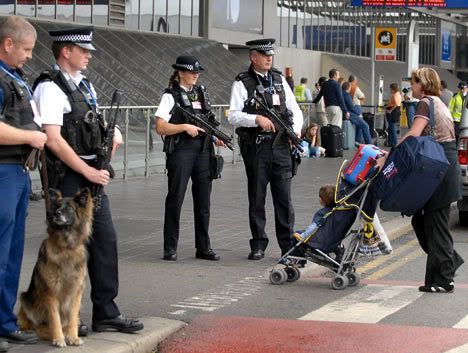
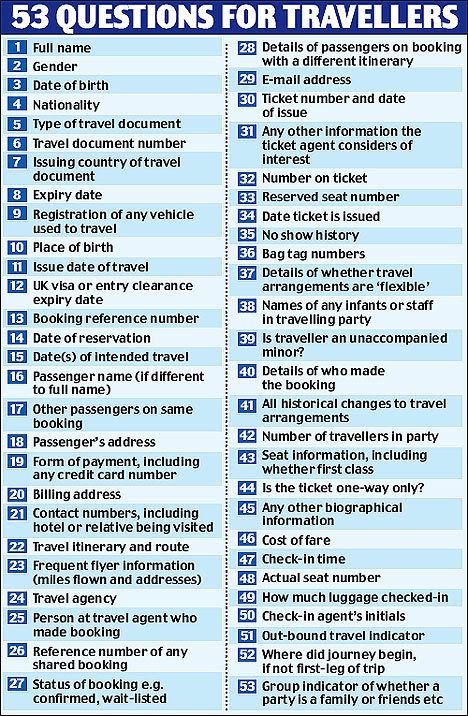
Terror crackdown: Passengers forced to answer 53 questions BEFORE they travel


Don't we define freedom by our ability to come and go as we please?

The Daily Mail reports:
Travellers face price hikes and confusion after the Government unveiled plans to take up to 53 pieces of information from anyone entering or leaving Britain.

For every journey, security officials will want credit card details, holiday contact numbers, travel plans, email addresses, car numbers and even any previous missed flights.
The information, taken when a ticket is bought, will be shared among police, customs, immigration and the security services for at least 24 hours before a journey is due to take place.

Anybody about whom the authorities are dubious can be turned away when they arrive at the airport or station with their baggage.

Those with outstanding court fines, such as a speeding penalty, could also be barred from leaving the country, even if they pose no security risk.

The information required under the "e-borders" system was revealed as Gordon Brown announced plans to tighten security at shopping centres, airports and ports.

This could mean additional screening of baggage and passenger searches, with resulting delays for travellers.

The e-borders scheme is expected to cost at least £1.2billion over the next decade.

Travel companies, which will run up a bill of £20million a year compiling the information, will pass on the cost to customers via ticket prices, and the Government is considering introducing its own charge on travellers to recoup costs.

Critics warned of mayhem at ports and airports when the system is introduced, beginning in earnest from mid-2009.

By 2014 every one of the predicted 305million passenger journeys in and out of the UK will be logged, with details stored about the passenger on every trip.

The scheme will apply to every way of leaving the country, whether by ferry, plane, or small aircraft. It would apply to a family having a day out in France by Eurotunnel, and even to a yachtsman leaving British waters during the day and returning to shore.

The measure applies equally to UK residents going abroad and foreigners travelling here.

The information will be stored for as long as the authorities believe it is useful, allowing them to build a complete picture of where a person has been over their lifetime, how they paid and the contact numbers of who they stayed with.

The Home Office, which yesterday signed a contract with U.S. company Raytheon Systems to run the computer system, said e-borders would help to keep terrorists and illegal immigrants out of the country.

For the first time since embarkation controls were scrapped in 1998, they will also have a more accurate picture of who is in the UK at any one time.

The personal information stored about every journey could prove vital in detecting a planned atrocity, officials insist.

But the majority - around 60 per cent - of the journeys logged will be made by Britons, mostly going on family holidays or business trips.

Ministers are also considering the creation of a list of "disruptive" passengers, so that authorities know in advance of any potential troublemaker, such as an abusive drunk.

David Marshall of the Association of British Travel Agents said: "We are staggered at the projected costs.

"It could also act as a disincentive to people wanting to travel, and we are sure that is not what the Government intends."

Phil Booth, of the NO2ID group, warned travellers would pay a "stealth tax" on travel to pay for the scheme.

He added: "This is a huge and utterly ridiculous quantity of personal information. This type of profiling will throw up many distressing errors and problems for innocent people.

"We have already seen planes turned around mid-flight because a passenger's surname matches that of somebody on a watch list.

"When the Government talks about e-borders, it gives the impression it is about keeping bad people out. In fact, it is a huge grab of personal information, and another move towards the database state."

A pilot of the "e-borders" technology, known as Project Semaphore, has already screened 29million passengers.

Immigration Minister Liam Byrne said: "Successful trials of the new system have already led to more than 1,000 criminals being caught and more than 15,000 people of concern being checked out by immigration, customs or the police."

But Nick Clegg, Liberal Democrat Home Affairs spokesman, said: "The Government must not use legitimate fears or dangers to crop vast amounts of private information without proper safeguards."

John Tincey, of the Immigration Service Union, said: "The question is are there going to be the staff to respond to the information that is produced?

"In reality people could be missed. Potential terrorists could be coming through if there are not enough staff to check them."

Shadow Home Secretary David Davis said: "While e-borders could be a useful tool to secure our borders it will not be up and running for at least another seven years.

"And given the Government's woeful record on delivering IT based projects, it may well be over budget and over time.

"In the meantime our borders remain porous. The Government should take practical measures to secure our borders, such as answering our call to establish a dedicated UK border police force."

• Restrictions on hand luggage carried on to passenger planes will be lifted from January.

"Starting with several airports in the New Year, we will work with airport operators to ensure all UK airports are in a position to allow passengers to fly with more than one item of hand luggage," Gordon Brown said.

The single bag rule was introduced in August last year after police said they foiled a plot to blow up U.S.-bound airliners.

It caused chaos at Heathrow Airport and drew complaints from airlines. Restrictions on carrying liquids are expected to continue.

How did we ever get to this point again?


How long before these restrictions are implemented in the U.S.?

Wednesday, August 08, 2007

Out of Sight, Out of Mind?

The Loss of Privacy in America


There are 4.2 million closed-circuit TV cameras spying on people as they go about their lives in Great Britain. Cities around America are following Great Britain's lead in watching people's every move. At what cost?

In The Washington Times, former Republican member of the U.S. House of Representatives from Georgia Bob Barr writes:
Though the lion's share of publicity surrounding Tony Blair's recent departure as Britain's prime minister focused on his legacy as George W. Bush's top foreign cheerleader, a more lasting legacy for Mr. Blair's lengthy tenure as Britain's chief "decider" will be that he greatly accelerated Great Britain's ascendancy to the position of the "most surveilled" society in the world. Still, Michael Bloomberg, the Democrat-turned-Republican-turned-independent mayor of New York is giving Mr. Blair a run for the money as the most surveillance-hungry public official in the world.

Even though officials in other cities are embracing and installing surveillance cameras in huge numbers — Chicago, Detroit and Washington, D.C., to name a few — the latest plan unveiled by Mr. Bloomberg and his equally surveillance-enamored police commissioner, Raymond Kelly, leaves these other American cities in the surveillance dust. Truly what we are witnessing being created here is a 21st-century Panopticon.
The Panopticon, as envisaged by British philosopher Jeremy Bentham (1748-1832), was a society (initially proposed as a prison) in which surreptitious surveillance of the citizenry was always possible and ever-known. Control was exercised not by being surveilled continuously but by each person knowing they might be under surveillance at any time, or all the time.

Bentham was a man ahead of his time. His pet project was never fully carried out because the technology available at the time, relying as it did on direct, physical surveillance (electricity as a harnessable force, with which Benjamin Franklin was just then beginning to experiment, was still more than a century away) made creation of a workable Panopticon infeasible. Were Bentham alive today, he probably would be the most sought-after consultant on the planet.

The key to the surveillance society foreseen by Bentham more than two centuries ago was control. Crime was rampant in late 18th-century and early 19th-century London. Controlling the populace by modifying behavior became the central problem for Bentham and other social scientists of the day.

Of course, the notion that surveillance is key to control was not new with Bentham; centuries before, the Greek philosopher Plato had mused about the power of the government to control through surveillance, when he raised the still-relevant question, "Who watches the watchers?"

More recently, of course, George Orwell gave voice to the innate fear that resides deep in many of our psyches against government surveillance, in his nightmare, "Big Brother is Watching You" world of the novel "1984."

Whether in Bentham's world, or Plato's or Orwell's, the central task is to modify behavior by convincing people that the government — that entity with power over their lives — may be watching them all the time or at any particular time. As 20th-century American philosopher and advocate of personal freedom Ayn Rand noted, taking away a person's privacy renders to the government the ability to control absolutely that person.

In fact, studies by Bentham and others have established that individuals do in fact modify their behavior if they believe they are being watched by authorities.

Whether learned of these philosophical treatises or not, Mayor Bloomberg and former Prime Minister Blair epitomize the almost mindless, unquestioning embrace of surveillance as the solution to problems — real, manufactured or exaggerated — that pervades government post-September 11, 2001. Fear of terrorism as much as fear of crime is the currency by which government at all levels convinces a fearful populace that a surveilled society is a safe society.

Of course, Messrs. Bloomberg and Blair have one benefit available to them that was largely denied Bentham — money. Lots of money. "Homeland security" money taken from the wallets of taxpayers, but treated by government appropriators as theirs by right, is eagerly ladled out for cameras to surveill all. Add the magic words "for fighting terrorism" to your request for federal money and the chances of securing those dollars are made many times greater.

Not only is money readily available for government agencies to install, monitor and expand surveillance systems, but the cameras themselves are magnificent generators of money. Already in London, vehicle owners are billed for using their cars and trucks in certain areas and at certain times, through use of surveillance cameras that photograph, record and track vehicle license plates. The multimillion-dollar system being set up by Mayor Bloomberg and Commissioner Kelly will almost certainly be similarly employed down the road.

With more than 4.2 million closed-circuit television surveillance cameras now operating in Great Britain (the vast majority in and around London), Mr. Bloomberg has a long way to catch up to his British counterparts. Yet the eagerness with which he is approaching this challenge, coupled with the easy money available to him and a largely ignorant and compliant citizenry willing to surrender their privacy in the vain hope that thousands of surveillance cameras will guarantee their safety, bodes well for the Gotham City to overtake London as the most surveilled city on the planet. Somewhere, Jeremy Bentham is smiling; and George Orwell is saying, "I told you so."

Jeffrey Rosen, an associate professor at GWU Law School and whom you also may recall from his testimony on one of the panels that testified at Clinton's impeachment, wrote a book entitled, "The Unwanted Gaze: The Destruction of Privacy in America."

In it, he talks about a doctrine in Jewish law, "hezzek re'iyyah," which means "the injury caused by seeing." He quotes the Encyclopedia Talmudit:
"Even the smallest intrusion into private space by the unwanted gaze causes damage, because the injury caused by seeing cannot be measured."

Jewish jurisprudence of the Middle Ages provided for a legal action to stop a neighbor from building a window from which he could peer into your courtyard.
The loss of privacy, our right to an interior experience where we rehearse ideas and innovation away from judgment and interference, has had a devastating impact on our culture.

Just because people don't want to be observed doesn't mean they are engaged in criminal acts or "wrongdoing." And a state that insists that it has the right to determine if that is so, loses the very traits that set the American people apart from others - Our creativity and ingenuity. Innovation requires being able to make mistakes, trial and error, practice, out of the watch of prying and judgmental eyes.


Friday, June 29, 2007

With Bush on Vacation in Kennebunkport, Cabinet Meets At White House . . . .

. . . . Who's presiding over Cabinet meeting? Cheney?

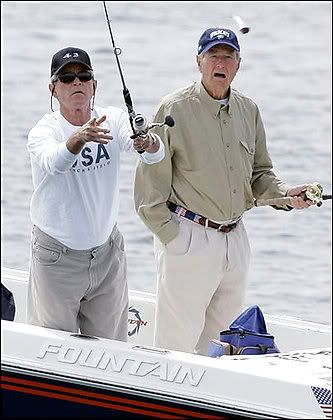
Bush, left, casts as his father former President George H.W. Bush watches as they fish near Kennebunk, Maine, Friday, June 29, 2007. (AP Photo/Robert F. Bukaty)

The AP reports:

In the aftermath of the London bomb discoveries, the U.S. government asked Americans to be vigilant about suspicious activities.

Officials on Friday said they don't see any specific signs of a terrorist threat in the U.S. ahead of the Fourth of July holiday.

Homeland Security Secretary Michael Chertoff said there are no plans to raise the U.S. national threat level, which was currently at yellow, or elevated.

A Cabinet-level meeting was called Friday at the White House to discuss the developments in London.

President Bush was briefed at his family home in Maine, where he'll meet Sunday with Russian President Vladimir Putin.

White House Homeland Security adviser Frances Townsend told Bush by phone what British officials had learned about the bombs.

Bush spokesman Tony Snow said officials with the CIA, the FBI and other agencies have been in touch with their counterparts in London.

Snow said British authorities haven't yet been able to determine if there's a link to any terrorist group.

Wednesday, March 28, 2007

Documents Uncovered: UK Govt Scientists told Blair & Ministers, "Lancet Study (655,000 Iraqi Civilians Killed) Is Accurate"

"Ministers were told not to rubbish Iraq deaths study" . . . .


. . . . But Tony Blair (and George W. Bush) chose to lie and said, "The study isn't accurate."

The Guardian reports:
Chief government advisers accepted as "robust" research that put the death toll from the Iraq war 10 times higher than any previous estimate, new documents have revealed.

The study, by the Johns Hopkins School of Public Health, prompted worldwide alarm when it was published in the Lancet medical journal in October last year.

It estimated that 655,000 Iraqis had died due to the violence in the country. It has now emerged chief advisers warned ministers not to "rubbish" the report.
At the time, both the British and US governments were quick to dismiss the peer reviewed study. The Foreign Office said it was based on a "fairly small sample ...extrapolated across the country". Iraqi government data was more likely to be accurate, it added.

The US was more blunt. President George Bush said: "I don't consider it a credible report."

However, according to papers obtained by the BBC World Service's Newshour programme under the Freedom of Information Act, senior officials warned the methods used in the survey were "robust" and "close to best practice".

The survey came up with its findings by comparing mortality rates before and after the invasion. Researchers surveyed 47 randomly-chosen areas across 16 provinces in Iraq, speaking to nearly 1,850 families, comprising more than 12,800 people.

One of the documents obtained by the BBC is a memo by the Ministry of Defence's chief scientific adviser, Sir Roy Anderson, dated October 13 2006, two days after the report was published.

"The study design is robust and employs methods that are regarded as close to 'best practice' in this area, given the difficulties of data collection and verification in the present circumstances in Iraq," he says.

Another item is an exchange of emails between officials in which one asks: "Are we really sure the report [in the Lancet] is likely to be right? That is certainly what the brief implies."

Another replies: "We do not accept the figures quoted in the Lancet survey as accurate." Later in the same email, the same official writes: "However, the survey methodology used here cannot be rubbished, it is a tried and tested way of measuring mortality in conflict zones."

In a statement issued to Newshour, the government said: "The methodology has been used in other conflict situations, notably the Democratic Republic of Congo.

"However, the Lancet figures are much higher than statistics from other sources, which only goes to show how estimates can vary enormously according to the method of collection.

"There is considerable debate amongst the scientific community over the accuracy of the figures."

Richard Horton, Lancet's editor, comments in The Guardian:
Our collective failure has been to take our political leaders at their word. This week, the BBC reported that the government's own scientists advised ministers that the Johns Hopkins study on Iraq civilian mortality was accurate and reliable. This paper was published in the Lancet last October. It estimated that 650,000 Iraqi civilians had died since the American- and British-led invasion in March 2003.

Immediately after publication, the prime minister's official spokesman said that The Lancet's study "was not one we believe to be anywhere near accurate". The foreign secretary, Margaret Beckett, said that the Lancet figures were "extrapolated" and a "leap". President Bush said: "I don't consider it a credible report".

Scientists at the UK's Department for International Development thought differently. They concluded that the study's methods were "tried and tested". Indeed, the Hopkins approach would likely lead to an "underestimation of mortality".

The Ministry of Defence's chief scientific advisor said the research was "robust", close to "best practice", and "balanced". He recommended "caution in publicly criticising the study".

When these recommendations went to the prime minister's advisers, they were horrified. One person briefing Tony Blair wrote: "are we really sure that the report is likely to be right? That is certainly what the brief implies?" A Foreign Office official was forced to conclude that the government "should not be rubbishing The Lancet".

The prime minister's adviser finally gave in. He wrote: "the survey methodology used here cannot be rubbished, it is a tried and tested way of measuring mortality in conflict zones".

How would the government respond?

Would it welcome the Hopkins study as an important contribution to understanding the military threat to Iraqi civilians? Would it ask for urgent independent verification? Would it invite the Iraqi government to upgrade civilian security?

Of course, our government did none of these things. Tony Blair was advised to say: "the overriding message is that there are no accurate or reliable figures of deaths in Iraq".

His official spokesman went further and rejected the Hopkins report entirely. It was a shameful and cowardly dissembling by a Labour - yes, by a Labour - prime minister.

Indeed, it was even contrary to the Americans' own Iraq Study Group report, which concluded last year that "there is significant underreporting of the violence in Iraq".

This Labour government, which includes Gordon Brown as much as it does Tony Blair, is party to a war crime of monstrous proportions. Yet our political consensus prevents any judicial or civil society response. Britain is paralysed by its own indifference.

At a time when we are celebrating our enlightened abolition of slavery 200 years ago, we are continuing to commit one of the worst international abuses of human rights of the past half-century. It is inexplicable how we allowed this to happen. It is inexplicable why we are not demanding this government's mass resignation.

Two hundred years from now, the Iraq war will be mourned as the moment when Britain violated its delicate democratic constitution and joined the ranks of nations that use extreme pre-emptive killing as a tactic of foreign policy. Some anniversary that will be.

Monday, March 26, 2007

UK FOIA Reveals Lancet Study of 655,000 Iraqi Civilians Killed "Accurate"


"Ministers were told not to rubbish Iraq deaths study"

The Guardian reports:
Chief government advisers accepted as "robust" research that put the death toll from the Iraq war 10 times higher than any previous estimate, new documents have revealed.

The study, by the Johns Hopkins School of Public Health, prompted worldwide alarm when it was published in the Lancet medical journal in October last year.

It estimated that 655,000 Iraqis had died due to the violence in the country. It has now emerged chief advisers warned ministers not to "rubbish" the report.
At the time, both the British and US governments were quick to dismiss the peer reviewed study. The Foreign Office said it was based on a "fairly small sample ...extrapolated across the country". Iraqi government data was more likely to be accurate, it added.

The US was more blunt. President George Bush said: "I don't consider it a credible report."

However, according to papers obtained by the BBC World Service's Newshour programme under the Freedom of Information Act, senior officials warned the methods used in the survey were "robust" and "close to best practice".

The survey came up with its findings by comparing mortality rates before and after the invasion. Researchers surveyed 47 randomly-chosen areas across 16 provinces in Iraq, speaking to nearly 1,850 families, comprising more than 12,800 people.

One of the documents obtained by the BBC is a memo by the Ministry of Defence's chief scientific adviser, Sir Roy Anderson, dated October 13 2006, two days after the report was published.

"The study design is robust and employs methods that are regarded as close to 'best practice' in this area, given the difficulties of data collection and verification in the present circumstances in Iraq," he says.

Another item is an exchange of emails between officials in which one asks: "Are we really sure the report [in the Lancet] is likely to be right? That is certainly what the brief implies."

Another replies: "We do not accept the figures quoted in the Lancet survey as accurate." Later in the same email, the same official writes: "However, the survey methodology used here cannot be rubbished, it is a tried and tested way of measuring mortality in conflict zones."

In a statement issued to Newshour, the government said: "The methodology has been used in other conflict situations, notably the Democratic Republic of Congo.

"However, the Lancet figures are much higher than statistics from other sources, which only goes to show how estimates can vary enormously according to the method of collection.

"There is considerable debate amongst the scientific community over the accuracy of the figures."


Monday, March 05, 2007

What's Next? A Whoopee!-Cushion in Her Throne?


Sky News reports:
Princely pranksters Wills and Harry have been accused of recording a bogus message on the Queen's answerphone.

The pair were asked for help by their regal gran when she was baffled by the technology.

But she was reported to be mortified when she heard the end result.
Their message said: "Hey wassup! This is Liz. Sorry I'm away from the throne."

The recording continued: "For a hotline to Philip, press one. For Charles, press two. And for the corgis, press three."

According to The Daily Star, the Queen saw the funny side later when she thought about which VIPs might have heard the message.

But her private secretary was not so amused.

The paper says he almost fell off his chair the first time one of his calls was put through to the voicemail.

The Queen, who is 80, has been taught by Prince William and Prince Harry how to send text messages on her mobile phone.

She was given her first mobile phone in 2001 by the Duke of York.

But she banned servants at the royal palaces from carrying phones on duty, after becoming annoyed at their ring tones.

The ban was reportedly prompted by several mobile phones ringing during a major banquet held for foreign dignitaries.


Wednesday, November 08, 2006

Something To Keep Your Eye On

A case being considered in the High Court wants ministers to lobby for the release of three London residents detained at Guantanamo Bay.

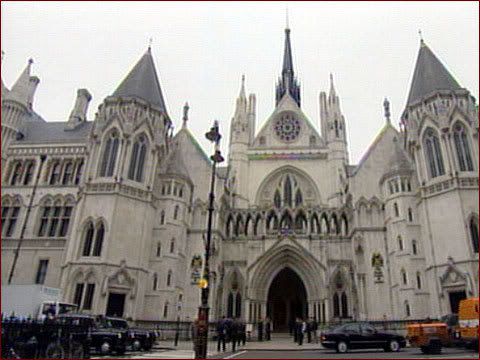
High Court, London, England

Kurt Barling with the BBC reports:
Last week, sitting in Court number 2 at the High Court on the Strand, I was reminded of a story my father told me when I was a young boy. Sixty years ago he was a teenage witness to the Allied war crimes trials at Nuremberg.

He lived and survived in the city which had been razed to the ground by allied bombing. Those responsible for unleashing war in Europe, bringing tragedy to their own people and millions of others across the continent, were tried in an international military tribunal which tried to avoid “victor’s justice”. The judgement of Nuremberg was just.

Even though there were critics of this process, like others in Germany at the time my father grew to understand and respect the significance of that process of justice which made the Nazi leaders account for their criminal behaviour.

The countless crimes the Nazi leadership committed were judged openly. The courts were presided over by allied civilian judges and then by the court of public opinion, both in Germany and the rest of the world via radio and newspaper reports. Most were sentenced to death, others like Goering cheated Albert Pierrepoint’s noose by committing suicide. Some like Albert Speer were given long prison sentences.

The message from these trials was a challenge to totalitarianism (not withstanding what was subsequently revealed about the Soviet Union). The net result was that the Allied powers were revered for their magnanimity in victory and the nobleness of their approach to meting out justice. Summary justice would have been far easier. These hideous men were allowed a defence and all the world could see how absolute power could corrupt and bring a great civilisation to its knees.

The legacy of the Nuremberg trials survived the Cold War. The United Nations used it to lay the foundations of international criminal law. It could be seen in the trials of Slobodan Milosevic and other offenders charged with war crimes resulting from the conflict after Yugoslavia broke up in the 1990s. In Rwanda in the trials of those responsible for the genocide and now in Baghdad with the trial of Saddam Hussein one imagines the echoes of open justice started at Nuremberg.

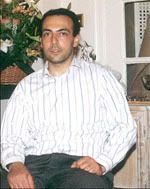
Bisher al-Rawi


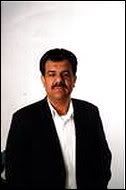
In a sense this legacy found itself in the dock in Court 2 last week. The families of Bisher al-Rawi, Jamil el-Banna and Omar Deghayes were seeking to convince two English judges that they should issue an order compelling the British government to intervene on their relatives’ behalf. None of the men are British nationals. Al-Rawi is Iraqi, el-Banna is Jordanian and Deghayes is Libyan.

All three men have been held since 2002 by the Americans, for the most part at the detention centre at Guantanamo Bay, Cuba. It is the families’ contention that the British government helped put them there. The government has consistently denied this.

The three men have not been charged and are therefore not to be put on trial for any specific offence by the Americans. It is not clear when and how they will be released.

Despite repeated requests by the families, the Foreign Office has refused to intervene over the past three and a bit years. Although not British the men were all long term residents in London and their families reside here. The government maintained it has not been their responsibility to assist them in any way.

The British government, remember, did lobby for the release of a number of British citizens. None were arrested or charged with an offence on their return to the UK.

Jamil el Banna

The government argued that as well as not having diplomatic responsibility for these men, they did not want to create a costly precedent for 2.6 million other British residents calling for government support at some future date. Curiously they also argued that having the men there enabled them to constructively engage with the US authorities over general detainee policy. Finally, all three men either pose or might pose unspecified risks to national security according to our intelligence services.

Bisher’s brother Wahad al-Rawi who lives in Leeds has been doggedly trying to get dribs and drabs of information about his brother for three years. His health has deteriorated since I first met him in 2003. The stress of trying to manage his mother’s expectations and that of the rest of his family has taken its toll.

On the first morning of the hearing last week the al-Rawi family and their lawyers were thrown into a state of confusion. A letter from Her Majesty’s Government said they would now make representations to seek Bisher’s release.

Unsure of whether to trust the government, they continued with their case to get the court to compel the government to act. There was no real explanation of why the government had changed its mind. The families remain in a state of confusion.

In a move which appeared on the surface to smack of state arbitrariness, the government made no such offer of help for the other two men at Guantanamo. Because there was no explanation, no-one quite understands on what basis the government is acting. To the advocates of the three men, it does not seem fair particularly as Jamil el-Banna has five children living in north London all of whom are British.

Omar Deghayes

It is a matter of public record that several ministers have expressed their disapproval of the continued detentions at Guantanamo. The court was told that the Americans and British governments are in discussions about how to effect the repatriation of detainees. Reading between the lines it seems clear that both administrations are beginning to recognise the stain that is rapidly sullying their international reputations.

Bisher al-Rawi and Jamil el-Banna say they were business partners back in 2002 along with Wahab. They had a plan to set up a factory in the Gambia producing peanut oil and as a consequence, say their relatives, they were on their way to the Gambia on peanut growing business when they were arrested by the Gambian police. The families assume their arrests were requested by the Americans.

Both men were among a small group of Muslims in 2000-2001 who were familiar with Abu Qatada. Qatada was a leading Islamic authority in Britain and as such was sought out for guidance on Islamic matters. Wahad says it was these links that made any information he or his brother had potentially useful to the intelligence services

It appears that this relationship exposed them not only to interest from the British intelligence services but also the CIA’s. Evidence before the judges clarified that the British government had passed information on these two men to a foreign intelligence service.

In court, lawyers for the family made it clear they believed the British information led to the seizure of the two men and their forcible removal to Bagram airbase in Afghanistan. The American military then moved the men to Guantanamo. The families maintain British intelligence officers interviewed the men face to face both in the Gambia and in Guantanamo. The episode so far wouldn’t be out of place in a Cold War spy novel.

The evidence in Court 2 suggested we are possibly entering some kind of end game at Guantanamo. For many Muslims around the world though, Guantanamo has undermined their faith in the values of International Criminal Justice so painstakingly nurtured after Nuremberg.

Unlike the legacy of Nuremberg it is doubtful detention at camp Delta will ever be seen as just. For a start there have been very few trials, precious little accountability and virtually no scrutiny. It will be very difficult for the allied powers to claim the high moral ground for the foreseeable future.

Muslims, both inside and outside the Muslim-majority world, will undoubtedly argue that whilst Britain and America may not be the worst human rights abusers, they can longer claim to be the best protectors of those human rights either. This is more likely to be the legacy of Guantanamo.

The High Court judges will give their written judgement in a few weeks time.


Tuesday, March 22, 2005

British Detainee At Guantanamo Claims He Spied For MI5

A democracy can't exist with the government operating in secret, without oversight, one branch overseeing another.

The Guardian reports:
A British man held in Guantánamo Bay because of his association with the alleged militant Abu Qatada says that MI5 urged him to remain friends with the cleric so he could inform on him, according to American military documents, details of which have been learned by the Guardian.

Bisher al-Rawi, originally from Kingston upon Thames in Surrey, says MI5 reassured him that he would not get into trouble for associating with Mr Qatada.

Abu Qatada, alleged militant cleric

Now Mr Qatada is accused of being a terrorist suspect and is subject to one of the government's new control orders.

Mr Rawi alleges that intelligence agents knew Mr Qatada's location when he was supposedly in hiding after the terrorist attacks of September 11 2001, because Mr Rawi had told them.

He also alleges that he acted as a "go-between" between the radical cleric and MI5 when the authorities were saying they did not know where the alleged militant was.

Mr Qatada has been branded as Osama bin Laden's right-hand man in Europe. A video of his sermons was found in the Hamburg flat of Mohammed Atta, the leader of the September 11 hijackings.

The startling claims from Mr Rawi came during a hearing at Guantánamo Bay last year. Key sections had been kept classified by the US military authorities, and are revealed here for the first time.

Mr Rawi was arrested in Gambia while on a business trip, before being interned in Guantánamo Bay without charge or trial.

The British government has refused to represent him, because he is an Iraqi citizen, despite his many years of residence in London. His family, who are British citizens, fear that he may be released from Guantánamo only to be sent to Iraq. His American lawyers have sought an injunction to stop this.

Mr Rawi told the US military panel that he had translated for Mr Qatada, a Palestinian refugee, when he had several meetings with officials from either the British Intelligence Service or the British police: "During a meeting with British Intelligence, I had asked if it was okay for me to continue to have a relationship with Abu Qatada? They assured me it was. They just wanted to understand more about Abu Qatada and the community."

In a letter to the US panel, Mr Rawi said MI5 agents had reassured him that his relationship with Mr Qatada would not get him into trouble. "[I asked] whether it is okay to have, and continue to have a relationship with Abu Qatada? The answer was always yes. The British authorities knew of my assistance to Abu Qatada ... and it was to their advantage."

Mr Rawi called three MI5 officers he said he had contacts with for his Guantánamo hearing. The chairman of the US military tribunal said the British government had refused to cooperate. "We have contacted the British government and at this time, they are not willing to provide the tribunal with that information," the chairman said.

After the September 11 attacks, the British government passed laws allowing it to detain foreign terror suspects without charge.

Mr Qatada, who feared that he would be a target, went on the run, with the British authorities supposedly unable to find him for 10 months.

But Mr Rawi claims that intelligence agents knew exactly where Mr Qatada was. "When he disappeared I received a call from the British Intelligence Agency asking if I knew where Abu was ... I told them I did.

"I took a role as a go-between for the British Intelligence Agency and Abu Qatada," Mr Rawi said. "During the time he was supposedly in hiding from them, the British authorities knew where Abu was and they used it to their advantage."

In a Guardian interview 18 months ago, Mr Rawi's brother Wahab freely admitted that he and Bisher had assisted Mr Qatada while he was on the run.

Wahab al-Rawi said that when they were being interrogated by US agents in Gambia after they were first arrested, one US agent asked if his brother worked for British intelligence.

A number of Muslims in London doubted that the UK authorities could not find Mr Qatada when he was supposedly on the run from December 2001 to October 2002, in part because so many Muslims here knew where he was.

According to one report, this was a view shared by French intelligence, which claimed that the British secret services were shielding the cleric.

Mr Rawi told the US military panel: "My relationship with MI5 ended some time mid-summer 2002. A few months had passed before Abu Qatada was arrested. During that time, I saw Abu Qatada on a regular basis. If Abu Qatada was such a danger, why wasn't he arrested before? I am positive the British Intelligence knew where he was, because I told them."

Asked about Mr Rawi's allegations, the Home Office said: "We would not be able to comment on security matters."

By turning the war on terror into a military operation (where those who are apprehended are tried by secret military tribunals) instead of a law enforcement operation (where those arrested are prosecuted in public trials), corrupt governments are able to railroad and frame innocents, bury evidence of their own wrongdoing, and keep the citizens of a democracy in the dark. The founders of the U.S. never intended this, and terrorism is no reason to dismantle the Constitution.


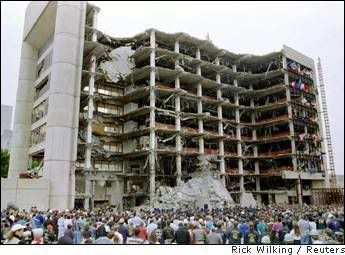
Terrorist acts are crimes. Investigatable and prosecutable, no different than any other crime. No different than the bombing of the Murrah federal building in Oklahoma City, which didn't require shredding the Constitution and holding secret tribunals offshore to bring those responsible to justice.