Showing posts with label Department of Homeland Security. Show all posts

Thursday, November 15, 2007

Random Bag Searches For Rail Passengers in Brown's Fortress Britain

The Daily Mail reports:
• Security will be upgraded at 250 train stations

• Anti-terror measures to be implemented at cinemas and shopping centres

• Bollards and concrete blocks to stop car bombers at 'vulnerable' buildings

• New buildings not allowed to have underground car parks
Britons face bag searches and airport-style scanners in railway stations, and the end of the underground car park in Gordon Brown's vision for Fortress Britain.

The Prime Minister yesterday told MPs that "terrorism can hit us anywhere" and the only solution is to strengthen security.

He called for anti-terror measures to be implemented in railway terminals, power stations and ports - and even cinemas and shopping centres.

Security will be upgraded at 250 train stations, with scanners and searches introduced at several of the biggest.

Exclusion zones could also be set up, preventing cars driving up to the entrances.

Mr Brown's comments came as he unveiled the results of two security reviews commissioned in the wake of the failed London and Glasgow car bomb attacks days after he came to power.

He said: "Just as the terrorists use every method and the very freedoms we enjoy to kill or maim people, so we must also adopt new tools to beat the terrorists, secure our borders and create a safe global society."

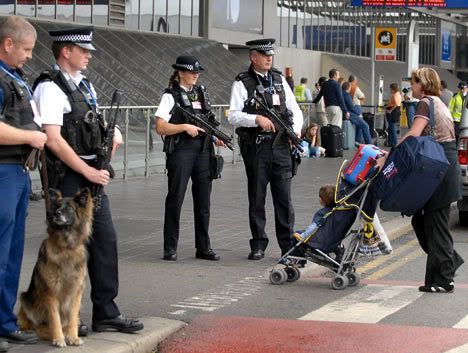
Protecting the public: Police on patrol at Heathrow

The plans raise the prospect of long and frustrating queues for rail travellers passing through major cities.

But the policy already seems in disarray after the Department of Transport said it did not believe airport scanners would be used.

Instead, officials said they expected to introduce hand-held devices, which are already used in some parts of the country.

There was also speculation that the speech was timed to bolster support for draconian new anti-terror powers.

The terror crackdown comes as the government is set to unveil new plans today to increase the length of time terror suspects can be detained, according to the BBC.
The new proposals would permit detainees to be held for up to maximum 58 days, 30 more days than the current limit of 28.

The new system would allow police to detain suspects for the extra 30 days, which they can already do under existing emergency powers, but without having to declare a state of emergency.

Mr Brown used the Queen's Speech last week to signal the Government would try to extend the existing 28-day limit for the detention of terror suspects.

He faces stiff opposition from the Conservatives and Liberal Democrats. Questions were also asked about the other major plank of his terror strategy - tightening up security at public venues such as shopping centres.

After a review by Security Minister Lord West, Mr Brown said that anti-terror measures would be increased at vulnerable buildings where large numbers of people gather.

The increased security is likely to include bollards and concrete blocks to stop car bombers, as well as new window designs to protect the public from splinters of glass.

New buildings will not be allowed to have underground car parks, which are vulnerable to explosive attacks.

But Mr Brown's official spokesman later admitted the Government would not fund the changes unless the buildings were publicly owned.

This cast huge doubts over whether the work would actually take place - and if it did, whether customers would foot the bill.

The shadow Home Secretary, David Davis, said: "The measures which Gordon Brown announced were long overdue but commonsense.

"However, we should know how these are to be paid for.

"The Government has a long track record of failing to deliver on pledges. Action against terror should not be an issue where the Prime Minister hides things in the fine print."

The new measures also include sending updated security advice to thousands of cinemas, theatres, restaurants hotels and sports stadiums.

Some 160 counter-terrorism advisers will train civilian staff to identify suspicious activity and ensure premises have adequate emergency facilities.

Architects will be encouraged to "design in" protective measures on new buildings, and greater protection will be given to power stations, which are attractive targets for Al Qaeda.

The forthcoming Counter Terrorism Bill will include tougher sentences for terrorists, new powers of post-sentence monitoring and additional measures to tackle those who fund them.

A senior judge would be appointed to manage all terrorism cases, while a single lead prosecutor would be appointed.

Mr Brown said: "Terrorism can hit us anywhere, from any place.

"It is a battle we will have to fight street by street, community by community and year by year."

The Prime Minister's urgent tone is likely to be seen as a "softening-up exercise" for the forthcoming battle over extending the 28-day detention limit for terror suspects to 56 days.

He will also be hoping to sway Parliament and the public over the introduction of unpopular policies such as ID cards.

Mr Brown again appeared to link immigration with terrorism, promising more agreementsto deport religious fanaticsas well as repeating a pledge to deport 4,000 overseas criminals each year.

The security budget, which is £2.5billion this year, will rise to £3.5billion in 2011, he said.

The size of the security service will also be increased - from 2,000 staff in 2001 to more than 4,000 within five years.

Mr Brown also said that a review of the use of intercept evidence in court cases - which is currently banned - would report back in January.

David Cameron said that despite being in agreement with parts of Mr Brown's proposals, he would like the Government to have gone further.

The Tory leader called for extremist groups to be banned and demanded that all Muslim preachers coming to Britain should be able to speak English.

He said: "Will the Government recognise that it has got to ban the extremist groups like Hizb ut-Tahrir, like Hezbollah, that do so much to foment violence?"

The Prime Minister said there were no plans to do so, but the matter was "under review".

How is it that we're so frightened and so eager to give up our privacy and Constitutional protections, for absolutely no reason. Nothing that's being done would have prevented 9/11/01 from happening.

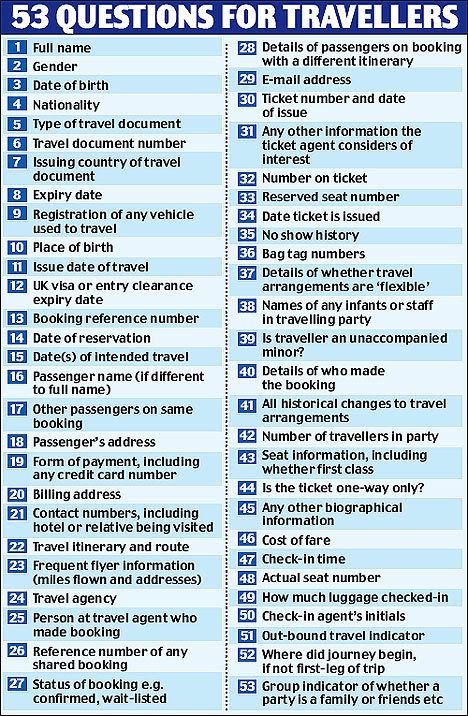
Terror crackdown: Passengers forced to answer 53 questions BEFORE they travel


Don't we define freedom by our ability to come and go as we please?

The Daily Mail reports:
Travellers face price hikes and confusion after the Government unveiled plans to take up to 53 pieces of information from anyone entering or leaving Britain.

For every journey, security officials will want credit card details, holiday contact numbers, travel plans, email addresses, car numbers and even any previous missed flights.
The information, taken when a ticket is bought, will be shared among police, customs, immigration and the security services for at least 24 hours before a journey is due to take place.

Anybody about whom the authorities are dubious can be turned away when they arrive at the airport or station with their baggage.

Those with outstanding court fines, such as a speeding penalty, could also be barred from leaving the country, even if they pose no security risk.

The information required under the "e-borders" system was revealed as Gordon Brown announced plans to tighten security at shopping centres, airports and ports.

This could mean additional screening of baggage and passenger searches, with resulting delays for travellers.

The e-borders scheme is expected to cost at least £1.2billion over the next decade.

Travel companies, which will run up a bill of £20million a year compiling the information, will pass on the cost to customers via ticket prices, and the Government is considering introducing its own charge on travellers to recoup costs.

Critics warned of mayhem at ports and airports when the system is introduced, beginning in earnest from mid-2009.

By 2014 every one of the predicted 305million passenger journeys in and out of the UK will be logged, with details stored about the passenger on every trip.

The scheme will apply to every way of leaving the country, whether by ferry, plane, or small aircraft. It would apply to a family having a day out in France by Eurotunnel, and even to a yachtsman leaving British waters during the day and returning to shore.

The measure applies equally to UK residents going abroad and foreigners travelling here.

The information will be stored for as long as the authorities believe it is useful, allowing them to build a complete picture of where a person has been over their lifetime, how they paid and the contact numbers of who they stayed with.

The Home Office, which yesterday signed a contract with U.S. company Raytheon Systems to run the computer system, said e-borders would help to keep terrorists and illegal immigrants out of the country.

For the first time since embarkation controls were scrapped in 1998, they will also have a more accurate picture of who is in the UK at any one time.

The personal information stored about every journey could prove vital in detecting a planned atrocity, officials insist.

But the majority - around 60 per cent - of the journeys logged will be made by Britons, mostly going on family holidays or business trips.

Ministers are also considering the creation of a list of "disruptive" passengers, so that authorities know in advance of any potential troublemaker, such as an abusive drunk.

David Marshall of the Association of British Travel Agents said: "We are staggered at the projected costs.

"It could also act as a disincentive to people wanting to travel, and we are sure that is not what the Government intends."

Phil Booth, of the NO2ID group, warned travellers would pay a "stealth tax" on travel to pay for the scheme.

He added: "This is a huge and utterly ridiculous quantity of personal information. This type of profiling will throw up many distressing errors and problems for innocent people.

"We have already seen planes turned around mid-flight because a passenger's surname matches that of somebody on a watch list.

"When the Government talks about e-borders, it gives the impression it is about keeping bad people out. In fact, it is a huge grab of personal information, and another move towards the database state."

A pilot of the "e-borders" technology, known as Project Semaphore, has already screened 29million passengers.

Immigration Minister Liam Byrne said: "Successful trials of the new system have already led to more than 1,000 criminals being caught and more than 15,000 people of concern being checked out by immigration, customs or the police."

But Nick Clegg, Liberal Democrat Home Affairs spokesman, said: "The Government must not use legitimate fears or dangers to crop vast amounts of private information without proper safeguards."

John Tincey, of the Immigration Service Union, said: "The question is are there going to be the staff to respond to the information that is produced?

"In reality people could be missed. Potential terrorists could be coming through if there are not enough staff to check them."

Shadow Home Secretary David Davis said: "While e-borders could be a useful tool to secure our borders it will not be up and running for at least another seven years.

"And given the Government's woeful record on delivering IT based projects, it may well be over budget and over time.

"In the meantime our borders remain porous. The Government should take practical measures to secure our borders, such as answering our call to establish a dedicated UK border police force."

• Restrictions on hand luggage carried on to passenger planes will be lifted from January.

"Starting with several airports in the New Year, we will work with airport operators to ensure all UK airports are in a position to allow passengers to fly with more than one item of hand luggage," Gordon Brown said.

The single bag rule was introduced in August last year after police said they foiled a plot to blow up U.S.-bound airliners.

It caused chaos at Heathrow Airport and drew complaints from airlines. Restrictions on carrying liquids are expected to continue.

How did we ever get to this point again?


How long before these restrictions are implemented in the U.S.?

Sunday, October 28, 2007

Another Indicator That Bush's War on Terror is Bogus

Auditors find Security Upgrades at Several Nuclear Sites Are Lagging

More than six years after 9/11, more than a year outraged American citizens said "no!" to the Bush administration's approval of the Dubai Ports International deal, after billions of dollars have been spent toward securing America from another terrorist attack, our airports are no safer, nor are our railways, bridges, highways, dams, water or food supplies, chemical plants, nor our nuclear power plants. The NY Times reports:
More than a year after Congress told the Energy Department to harden the nation’s nuclear bomb factories and laboratories against terrorist raids, at least 5 of the 11 sites are certain to miss their deadlines, some by many years.

The Energy Department has put off security improvements at some sites that store plutonium because it plans to consolidate the material at central locations, but the Government Accountability Office said in a Senate briefing that that project was also likely to lag. A copy of the briefing materials was provided to The New York Times by a private group, the Project on Government Oversight, which has long been pushing for better security at the weapons sites.
Danielle Brian, the group’s executive director, said that although the deadline set by Congress was tight, if the Energy Department “had taken seriously consolidating and making this an expedited effort, they wouldn’t be having these problems now.”

Robert Alvarez, an adviser to the energy secretary in the Clinton administration, said there was wide agreement that centralizing the fuel was a good idea. But Mr. Alvarez added, “There’s a lot of pushback about moving fissile materials from a site, because then you lose a portion of your budget and prestige.”

The Energy Department declined requests for an interview, but Michael Kilpatrick, a deputy chief at the department’s Office of Health, Safety and Security, said in a statement that the steps under way were “further enhancements and better protection to some of the most secure facilities in the country.”

But Representative Edward J. Markey, a Massachusetts Democrat who has taken a particular interest in nuclear security, said in a statement, “The department seems to think that the terrorist threat to its nuclear facilities is no more serious than a Halloween prank, as evidenced by its failure — more than six years after the 9/11 attacks — to do what it must to keep our stores of nuclear-weapons-grade materials secure.” Mr. Markey said the delay was unsurprising but unacceptable.

One site that will miss its deadline by years is the Oak Ridge National Laboratory in Tennessee, which holds a large stock of weapons-usable uranium. The laboratory plans to dilute the uranium, but that will take until 2015, the auditors found.

Two other sites that will miss their deadlines are operated by the National Nuclear Security Administration, which is responsible for weapons security. The agency was established in 1999 after a number of security breaches in the weapons complex, and in January its director was forced to resign because of other security lapses.

After the attacks of Sept. 11, 2001, the Energy Department changed its “design basis threat,” the description of the attacking force against which the weapons sites should prepare their defenses. The details of this design basis threat are classified, but the new definition specifies a larger and more capable group of attackers.

To emphasize the importance of the preparations, Congress wrote into law that the Energy Department sites should submit plans on how the department would meet the requirements. Recognizing that much of the department’s work runs far behind schedule, Congress specified that if a delay were necessary, it would have to be approved by the secretary or deputy secretary of energy.

An unclassified version of the Energy Department’s first report to Congress, in July 2006, said that more than $420 million had been spent in the previous three years in an “aggressive” program. Among the changes was giving security officers armored vehicles and large-caliber weapons. That change reduced “the need to hire more security officers to account for the expected attrition that would be a natural result of the increased adversary force.”

The department has rewritten its design basis threat several times. Mr. Kilpatrick said in his statement that all sites now met the 2003 version of the design basis threat and were working toward the current version, set in 2005.

The Energy Department told Congress in 2006 that six sites would meet the 2008 deadline. But the accountability office said that one of those, the Oak Ridge National Laboratory, would not make the deadline.

The Energy Department said work at the five other sites would be completed later; those are the Nevada Test Site, the Hanford nuclear reservation in Washington State, the Idaho National Laboratory, the Los Alamos National Laboratory and Y-12, a weapons site in Tennessee.

The G.A.O. said in July that the Idaho National Laboratory would not be done until 2013, four years later than the Energy Department’s estimate.

Americans authorized Congress and this president to spend our fortune shoring up our vulnerabilities to acts of terrorism, only to see the money spent on a war that makes more enemies for us with each passing day. It's hard to believe that the Bush administration has any concerns about terrorism when its chief objective has been to transfer America's wealth to its corporate cronies.
After learning that Bush had been illegally wiretapping prior to 9/11/01 and

Sunday, October 07, 2007

"Be Careful What You Wish For"

The Bush administration is quietly relaxing visa regulations because farmworkers are in critically short supply.


The Los Angeles Times reports:
With a nationwide farmworker shortage threatening to leave unharvested fruits and vegetables rotting in fields, the Bush administration has begun quietly rewriting federal regulations to eliminate barriers that restrict how foreign laborers can legally be brought into the country.

The effort, urgently underway at the departments of Homeland Security, State and Labor, is meant to rescue farm owners caught in a vise between a complex process to hire legal guest workers and stepped-up enforcement that has reduced the number of illegal planters, pickers and middle managers crossing the border.

"It is important for the farm sector to have access to labor to stay competitive," said White House spokesman Scott Stanzel. "As the southern border has tightened, some producers have a more difficult time finding a workforce, and that is a factor of what is going on today."
The push to speedily rewrite the regulations is also the Bush administration's attempt to step into a breach left when Congress did not pass an immigration overhaul in June that might have helped American farms. Almost three-quarters of farmworkers are thought to be illegal immigrants.

On all sides of the farm industry, the administration's behind-the-scenes initiative to revamp H-2A farmworker visas is fraught with anxiety. Advocates for immigrants fear the changes will come at the expense of worker protections because the administration has received and is reportedly acting on extensive input from farm lobbyists. And farmers in areas such as the San Joaquin Valley, which is experiencing a 20% labor shortfall, worry the administration's changes will not happen soon enough for the 2008 growing season.

"It's like a ticking time bomb that's going to go off," said Luawanna Hallstrom, chief operating officer of Harry Singh & Sons, a third-generation family farm in Oceanside that grows tomatoes. "I'm looking at my fellow farmers and saying, 'Oh my God, what's going on?' "

Officials at the three federal agencies are scrutinizing the regulations to see whether they can adjust the farmworker program, an unwieldy system used by less than 2% of American farms to bring in foreign workers. They are considering a series of changes, including lengthening the time workers can stay, expanding the types of work they can do, simplifying how their applications are processed, and redefining terms such as "temporary."

Administration sources said they were moving aggressively. They declined to discuss details of the proposals.

The agencies are also working on possible changes to a separate visa program, H-2B, which brings in seasonal workers for resorts, clam-shucking operations and horse stables, among other businesses.

The administration has pursued the project discreetly. The issue of immigration has generated friction between President Bush and the conservative wing of the Republican Party, which has strongly opposed many of the initiatives that Bush has pursued.

The changes to the H-2A visa program comprise one of more than two dozen initiatives the administration announced in August. Most of the initiatives dealt with increased enforcement, the most prominent being a measure that would force employers to either fire workers for whom they've received "no match" notification (indicating their W-2 data don't match Social Security Administration records) or face punitive action from the Department of Homeland Security. When Homeland Security Secretary Michael Chertoff announced the enforcement push, he also acknowledged the problems that agriculture reported.

"Even putting aside no-match letters, just our increased work at the border was actually causing a drop in the number of workers coming across," Chertoff said.

David James, an assistant secretary of Labor, said Bush asked his department, which has jurisdiction over most H-2A rules, to review the entire program. The agency "is now in the process of identifying ways the program can be improved to provide farmers with an orderly and timely flow of legal workers while protecting the rights of both U.S. workers and foreign temporary workers," James said.

The current program, managed by all three agencies, is famously dysfunctional.

Farmers have to apply for workers about a month in advance, but the agencies often fail to coordinate their response in time for the harvest, which farmers can't always predict. At Hallstrom's farm, where tidy rows of tomato plants run almost to the ocean's edge, half of the 1,000 workers are in the H-2A program. (Nationally, about 60,000 H-2A applications a year are usually filed, compared with more than 3 million farm jobs to be filled. There is no cap on the number of H-2A workers allowed into the U.S.)

She remembers submitting an emergency request for H-2A workers one year and getting the visas 60 days later. She said the laborers spent two weeks pulling rotten fruit off the vines, and the farm lost $2.5 million. "Devastating," Hallstrom said.

Growers also complain about paying for workers' housing, transportation, visas and other fees. Harry Yates, a North Carolina Christmas-tree grower, estimates that his labor costs for H-2A workers are $14 an hour, compared with a competitor whose illegal laborers cost about $7.50 an hour. Like other farmers, Yates said using the H-2A program was an invitation to lawsuits from worker advocates and frequent government investigations.

"I understand why so many growers are afraid to use this program. It is too expensive, too complicated, too slow and too likely to land you in court," Yates said.

Some advocates for workers fiercely dispute this. They say farmers just want to keep wages low.

"The employers want to be free of government oversight, legal-services representation for the guest workers, and other efforts to enforce the modest H-2A worker protections," said Bruce Goldstein, executive director of the advocacy group Farmworker Justice, which is affiliated with the nonprofit National Council of La Raza.

Industry lobbyists have sent the Bush administration a set of detailed suggestions for overhauling the H-2A program through administrative changes, which could take weeks to put in place, and through changes in the regulations, a process that takes months.

Some of the suggestions under consideration include changing the procedures farmers must use to try to hire U.S. citizens first. Currently farmers have to advertise the jobs, then submit applications to Labor and Homeland Security to bring in foreign workers. Growers would prefer to move to a system in which they pledged that they had done all they could to recruit U.S. workers, but no longer had to submit an application to Labor.

Other changes under consideration would simplify the detailed H-2A housing requirements, extend the definition of "temporary" beyond 10 months, and expand the definition of "agricultural" workers to include such industries as meatpacking and poultry processing.

The reasons for opposing Bush's and Democrats' legislation for overhauling immigration laws are wide-ranging. Democrats' constituents oppose it on the grounds that illegal immigrants drive down Americans' wages. Conservatives' opposition is racial bias, cloaked in patriotic fervor and 'war on terror'-fears. Conservatives are about to get a taste of what liberals have been swallowing for the last six years: Bush's sheer dogged determination to get what he wants, by any means. In this instance, it's 'backdoor amnesty.'

Before George W. Bush leaves office, he will have legalized, legitimized and made legal every last illegal immigrant in the U.S. He will have called the bluff of the xenophobes who hid behind the 'rule of law' and 'threats to national security' arguments. And once again, it's the American worker who gets the shaft and is left holding the bag. An empty bag.

Saturday, September 22, 2007

New Fascist World Order

They're watching what you read, they're watching what you write.

The Washington Post:
The U.S. government is collecting electronic records on the travel habits of millions of Americans who fly, drive or take cruises abroad, retaining data on the persons with whom they travel or plan to stay, the personal items they carry during their journeys, and even the books that travelers have carried, according to documents obtained by a group of civil liberties advocates and statements by government officials.

The personal travel records are meant to be stored for as long as 15 years, as part of the Department of Homeland Security's effort to assess the security threat posed by all travelers entering the country. Officials say the records, which are analyzed by the department's Automated Targeting System, help border officials distinguish potential terrorists from innocent people entering the country.

But new details about the information being retained suggest that the government is monitoring the personal habits of travelers more closely than it has previously acknowledged. The details were learned when a group of activists requested copies of official records on their own travel. Those records included a description of a book on marijuana that one of them carried and small flashlights bearing the symbol of a marijuana leaf.
The Automated Targeting System has been used to screen passengers since the mid-1990s, but the collection of data for it has been greatly expanded and automated since 2002, according to former DHS officials.

Officials yesterday defended the retention of highly personal data on travelers not involved in or linked to any violations of the law. But civil liberties advocates have alleged that the type of information preserved by the department raises alarms about the government's ability to intrude into the lives of ordinary people. The millions of travelers whose records are kept by the government are generally unaware of what their records say, and the government has not created an effective mechanism for reviewing the data and correcting any errors, activists said.

The activists alleged that the data collection effort, as carried out now, violates the Privacy Act, which bars the gathering of data related to Americans' exercise of their First Amendment rights, such as their choice of reading material or persons with whom to associate. They also expressed concern that such personal data could one day be used to impede their right to travel.

"The federal government is trying to build a surveillance society," said John Gilmore, a civil liberties activist in San Francisco whose records were requested by the Identity Project, an ad-hoc group of privacy advocates in California and Alaska. The government, he said, "may be doing it with the best or worst of intentions. . . . But the job of building a surveillance database and populating it with information about us is happening largely without our awareness and without our consent."

Gilmore's file, which he provided to The Washington Post, included a note from a Customs and Border Patrol officer that he carried the marijuana-related book "Drugs and Your Rights." "My first reaction was I kind of expected it," Gilmore said. "My second reaction was, that's illegal."

DHS officials said this week that the government is not interested in passengers' reading habits, that the program is transparent, and that it affords redress for travelers who are inappropriately stymied. "I flatly reject the premise that the department is interested in what travelers are reading," DHS spokesman Russ Knocke said. "We are completely uninterested in the latest Tom Clancy novel that the traveler may be reading."

But, Knocke said, "if there is some indication based upon the behavior or an item in the traveler's possession that leads the inspection officer to conclude there could be a possible violation of the law, it is the front-line officer's duty to further scrutinize the traveler." Once that happens, Knocke said, "it is not uncommon for the officer to document interactions with a traveler that merited additional scrutiny."

He said that he is not familiar with the file that mentions Gilmore's book about drug rights, but that generally "front-line officers have a duty to enforce all laws within our authority, for example, the counter-narcotics mission." Officers making a decision to admit someone at a port of entry have a duty to apply extra scrutiny if there is some indication of a violation of the law, he said.

The retention of information about Gilmore's book was first disclosed this week in Wired News. Details of how the ATS works were disclosed in a Federal Register notice last November. Although the screening has been in effect for more than a decade, data for the system in recent years have been collected by the government from more border points, and also provided by airlines -- under U.S. government mandates -- through direct electronic links that did not previously exist.

The DHS database generally includes "passenger name record" (PNR) information, as well as notes taken during secondary screenings of travelers. PNR data -- often provided to airlines and other companies when reservations are made -- routinely include names, addresses and credit-card information, as well as telephone and e-mail contact details, itineraries, hotel and rental car reservations, and even the type of bed requested in a hotel.

The records the Identity Project obtained confirmed that the government is receiving data directly from commercial reservation systems, such as Galileo and Sabre, but also showed that the data, in some cases, are more detailed than the information to which the airlines have access.

Ann Harrison, the communications director for a technology firm in Silicon Valley who was among those who obtained their personal files and provided them to The Post, said she was taken aback to see that her dossier contained data on her race and on a European flight that did not begin or end in the United States or connect to a U.S.-bound flight.

"It was surprising that they were gathering so much information without my knowledge on my travel activities, and it was distressing to me that this information was being gathered in violation of the law," she said.

James P. Harrison, director of the Identity Project and Ann Harrison's brother, obtained government records that contained another sister's phone number in Tokyo as an emergency contact. "So my sister's phone number ends up being in a government database," he said. "This is a lot more than just saying who you are, your date of birth."

Edward Hasbrouck, a civil liberties activist who was a travel agent for more than 15 years, said that his file contained coding that reflected his plan to fly with another individual. In fact, Hasbrouck wound up not flying with that person, but the record, which can be linked to the other passenger's name, remained in the system. "The Automated Targeting System," Hasbrouck alleged, "is the largest system of government dossiers of individual Americans' personal activities that the government has ever created."

He said that travel records are among the most potentially invasive of records because they can suggest links: They show who a traveler sat next to, where they stayed, when they left. "It's that lifetime log of everywhere you go that can be correlated with other people's movements that's most dangerous," he said. "If you sat next to someone once, that's a coincidence. If you sat next to them twice, that's a relationship."

Stewart Verdery, former first assistant secretary for policy and planning at DHS, said the data collected for ATS should be considered "an investigative tool, just the way we do with law enforcement, who take records of things for future purposes when they need to figure out where people came from, what they were carrying and who they are associated with. That type of information is extremely valuable when you're trying to thread together a plot or you're trying to clean up after an attack."

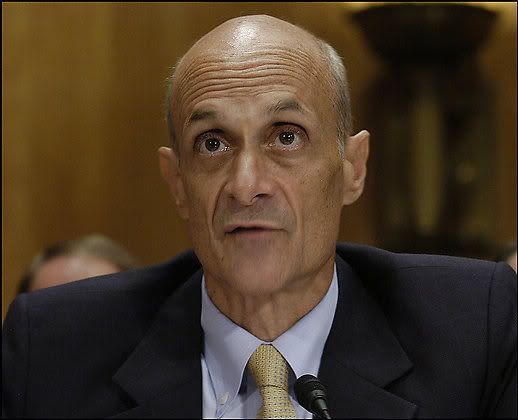
Homeland Security Secretary Michael Chertoff in August 2006 said that "if we learned anything from Sept. 11, 2001, it is that we need to be better at connecting the dots of terrorist-related information. After Sept. 11, we used credit-card and telephone records to identify those linked with the hijackers. But wouldn't it be better to identify such connections before a hijacker boards a plane?" Chertoff said that comparing PNR data with intelligence on terrorists lets the government "identify unknown threats for additional screening" and helps avoid "inconvenient screening of low-risk travelers."

Homeland Security Secretary Michael Chertoff said that "we need to be better at connecting the dots of terrorist-related information." (By Stephanie Kuykendal -- Getty Images)

Knocke, the DHS spokesman, added that the program is not used to determine "guilt by association." He said the DHS has created a program called DHS Trip to provide redress for travelers who faced screening problems at ports of entry.

But DHS Trip does not allow a traveler to challenge an agency decision in court, said David Sobel, senior counsel with the Electronic Frontier Foundation, which has sued the DHS over information concerning the policy underlying the ATS. Because the system is exempted from certain Privacy Act requirements, including the right to "contest the content of the record," a traveler has no ability to correct erroneous information, Sobel said.

Zakariya Reed, a Toledo firefighter, said in an interview that he has been detained at least seven times at the Michigan border since fall 2006. Twice, he said, he was questioned by border officials about "politically charged" opinion pieces he had published in his local newspaper. The essays were critical of U.S. policy in the Middle East, he said. Once, during a secondary interview, he said, "they had them printed out on the table in front of me."

Hear Zakariya Reed on NPR's program, At Home and Abroad: Shared Sacrifices Since September 11th.

Wednesday, April 18, 2007

My Questions About The Virginia Tech Shooting

Map of School Violence

I suspect that after all of the information about Cho Seung Hui is gathered and examined, we will have learned nothing new about why some young men turn to extreme violence or how earlier intervention might have prevented the random deaths of innocents at Virginia Tech.

Cho's profile will wind up looking like the profiles of all the other mass murderers in modern history. It will come as no surprise to most liberals, whose policies on everything from health care and education to immigration, worker protections, corporate and gun regulation, would go a long way in preventing horrific killing fields such as what we saw on Monday in Virginia.

Republican dogma will prevail and nothing will change. Why? Because 32 people killed and a dozen or so wounded does not justify making the changes necessary, spending the money, for preventing similar sieges in the future. Because they're not the right 32 + 12.

That's the truth of capitalist America.

Until Americans realize the connection between our public policies ("money is motive, profit is king") and the violence committed by our government in our names, violence will continue to be a part of our lives. Beyond the massacre on Monday, in every facet of our society. American policies and our lifestyle will go on producing more Cho Seung Huis, like Eric Harris, Dylan Klebold, Timothy McVeigh, Terry Nichols, George Jo Hennard, James Huberty, James Rupert, Mark Barton, Kip Kinkel, and dozens of others, too young to have had their names published outside of the juvenile court system.

Culled from a Washington Post report:
Cho, of Centreville, Va., the son of immigrants who run a dry cleaning business, and the brother of a State Department contractor who graduated from Princeton, was described by those who encountered him over the years as at times angry, menacing, disturbed and so depressed that he seemed near tears.

Cho graduated from Westfield High School in Chantilly in 2003. He turned 23 on Jan. 18 and had lived as a legal permanent resident since entering the United States through Detroit on Sept. 2, 1992, when he was 8 years old, according to the Department of Homeland Security.

Cho held a green card through his parents, and he renewed it Oct. 27, 2003, according to Homeland Security. He listed his residence as Centreville.

Cho's sister, Sun Cho, graduated from Princeton University with a degree in economics in 2004 after she completed summer internships with the State Department in Washington and Bangkok.

A State Department spokesman said Sun Cho currently works as a contractor specializing in personnel matters.

I'd like to know how his parents, South Korean nationals, got into the U.S.

They are described by the Washington Post as "running a dry cleaning business," which could mean that they own the business. Having money might explain how they entered the U.S. (financially solvent, wouldn't be a burden, etc.), but one could infer from 'running a business' that they managed it and/or worked it for others. If that's the case, I'd like to know if the United States was experiencing a shortage of dry cleaning workers fifteen years ago when the Cho family entered the U.S.? After fifteen years in the U.S., presumably with roots in the community and children who have gone through the American school system (and one child working for the U.S. government), why aren't they U.S. citizens?

And about their daughter: What is a State Department 'contractor' in "personnel matters"? She is not a W-2 employee of the State Department; she is an independent contractor. What does she do for the State Department, with a degree in economics, "specializing in personnel matters"?

Does she take care of 'personnel problems'?