
New Republican ad exposing Democratic candidate for the U.S. Congress (OH-16), Bob Ainsworthy, in an act of bestiality:
Happy Friday Cat Blogging!
[Yes, it's a joke.]
Filed under: Friday Cat Blogging, bestiality, election 2006, negative ads, reasons not to vote for Republicans, Animals, The Constant American, Constant American, Technorati Tag, Technorati Tags, tags, categories
Friday, October 27, 2006

Express Your Anger Where It Will Do The Most Good . . . .
. . . . At the ballot box. And then in mail and phone calls to the television and radio networks, to Congress, and with your feet, picket signs and marches in the streets all across America.
If we had the media that we used to have, before Reagan and the privatization of the public's air waves, this week would have been a terrific opportunity to inform the public about Parkinson's disease.
The treatments available for treating Parkinson's aren't cures and come with trade-offs and side effects. The drugs for Parkinson's are a bitch, just as the disease itself is. The drugs are toxic. They were never meant to be taken long term - they're 'stop gap' measures, meaning that living with Parkinson's is so difficult that you're willing to take chemicals that can kill you while researchers look for alternative therapies and treatments. The drugs not only affect the patient physically, but mentally. It's not like taking an aspirin for a headache and within 15 minutes the headache is gone and you're fine. The drugs can cause extreme mood swings, mental confusion, hallucinations.
The drugs don't work for everyone either; what works for one Parkinson's patient may not do a thing for another. The dosage levels need to be carefully titrated and monitored for each patient. A patient's dosage level can change frequently - the amount that worked yesterday may not work today or any longer. The drugs stop working altogether for as many as 75% of Parkinson's patients within 5-10 years.
For patients who are severely afflicted and don't respond to the pharmaceuticals (or have exhausted the drug 'smorgasbord'), there is brain surgery. Brain surgery is also not a cure, but can help to control the symptoms. If you've got a good, experienced surgeon who knows what he or she is doing. Cutting into the body, cutting into the brain, is not a treatment that a patient decides to do casually. Particularly in today's American health care system. But what's the alternative to the chronic soreness, pain, exhaustion of muscles and joints that are in constant motion (or rigid and non-responsive), a body that you can no longer control?
Michael J. Fox has already had the brain surgery. There are not a whole lot of options left for him.
In the course of writing this, Michael J. Fox has responded to Limbaugh:
Railing against Rush Limbaugh is like blaming the scorpion for stinging the frog: Limbaugh is what he is.
Amoral corporations, unrestricted and unregulated, flush with bucks, pay Limbaugh hundreds of millions of dollars to say what the corporations' politicians can't say without getting tossed out of power. Rush Limbaugh is bought and paid for by the Republican party, to influence a particular class of voter that Republicans couldn't reach any other way.
So how does the party that calls itself "the party of life" counter an ad by a beloved icon of conservatives ('Alex P. Keaton'), without exposing themselves as the greedy, callous, insensitive "party of 'you can die as soon as we get your vote'" bastards we know them to be?
They trot out their 'tried and true' formula:
1.) Create an emotionally chaotic backdrop against which rational discussion and clear thinking can't take place,
2.) Prepare a disinformation campaign about both their candidate's position and the subject itself, and
3.) Hit the 'send' on the fax machines with prepared talking points to all of Republican spokesmen around the country.
If you dusted Michael J. Fox for fingerprints, you wouldn't find anybody's fingerprints but Limbaugh's. But the thumbprint of Jim Talent, by virtue of his being the beneficiary of this 'swiftboating,' is on the "launch" button. The only way to put an end to this kind of politics is to throw the bums out.
But I fear that it may be too late for that, too.
If Republicans intend to steal this election as they stole the last two (by hacking the electronic voting machines, on top of all of the Republicans' other efforts to decrease the Democratic ballots), the Republican base has to show up at the polls in full force. That's the only way that Rove (or whoever has been designated to actually do the tampering) can hide it. It can only be done with a massive turnout of the base.
I've been listening to cable news show pundits talking for days, about "What a mistake these ads/controversies (the Corker ads about Harold Ford, the Limbaugh comments about Michael J. Fox, Patricia Heaton, etc.) are for Republicans," because "They're not going to win over the undecideds."
None of this is for the undecideds. These are for the base, the reliable Republican voter, who is planning on not voting at all, because of the Foley scandal, and Ney-Delay-Abramoff-Cunningham, et al, and the war in Iraq. And these ads are also for those who would vote Republican, if they could be relied on to get to the polls. These are the voters who fall between the cracks, who don't go to church regularly, if at all, so they're not on the Republicans' 'Get Out the Vote' phone tree efforts on Election Day. But once they see the Corker ad ("There's an uppity Negro who has come to town, and has his eye on your woman"), nothing is going to prevent them from getting to the polls this year.
The ads, the Limbaugh/Fox controversy, is all keeping the base on board, motivated, to getting them to the polls. Karl Rove is done trying to create more Republican voters - he'll take care of that in the privacy of the Diebold software on Election Day.
What, if anything, are the Democrats doing to prevent it or expose it?
I am so ready for Republicans, of every degree (and that includes the DLC Democrats), to leave the stage. I'm ready for 'the new politics.'
Filed under: elections, election 2006, Michael J. Fox, Rush Limbaugh, reasons not to vote for Republicans, The Constant American, Constant American, Technorati Tag, Technorati Tags, tags, categories
If we had the media that we used to have, before Reagan and the privatization of the public's air waves, this week would have been a terrific opportunity to inform the public about Parkinson's disease.
The treatments available for treating Parkinson's aren't cures and come with trade-offs and side effects. The drugs for Parkinson's are a bitch, just as the disease itself is. The drugs are toxic. They were never meant to be taken long term - they're 'stop gap' measures, meaning that living with Parkinson's is so difficult that you're willing to take chemicals that can kill you while researchers look for alternative therapies and treatments. The drugs not only affect the patient physically, but mentally. It's not like taking an aspirin for a headache and within 15 minutes the headache is gone and you're fine. The drugs can cause extreme mood swings, mental confusion, hallucinations.
The drugs don't work for everyone either; what works for one Parkinson's patient may not do a thing for another. The dosage levels need to be carefully titrated and monitored for each patient. A patient's dosage level can change frequently - the amount that worked yesterday may not work today or any longer. The drugs stop working altogether for as many as 75% of Parkinson's patients within 5-10 years.
For patients who are severely afflicted and don't respond to the pharmaceuticals (or have exhausted the drug 'smorgasbord'), there is brain surgery. Brain surgery is also not a cure, but can help to control the symptoms. If you've got a good, experienced surgeon who knows what he or she is doing. Cutting into the body, cutting into the brain, is not a treatment that a patient decides to do casually. Particularly in today's American health care system. But what's the alternative to the chronic soreness, pain, exhaustion of muscles and joints that are in constant motion (or rigid and non-responsive), a body that you can no longer control?
Michael J. Fox has already had the brain surgery. There are not a whole lot of options left for him.
In the course of writing this, Michael J. Fox has responded to Limbaugh:
Fox said that his mother, Phyllis, was with him while he taped the 30-second spots and was telling people backstage that her son was "trying so hard to be still."
"The irony is that I was too medicated," the four-time Emmy winner said. "Because the thing about…being symptomatic is that it's not comfortable. No one wants to be symptomatic; it's like being hit with a hammer.
"At this point now, if I didn't take medication I wouldn't be able to speak."
Railing against Rush Limbaugh is like blaming the scorpion for stinging the frog: Limbaugh is what he is.
Amoral corporations, unrestricted and unregulated, flush with bucks, pay Limbaugh hundreds of millions of dollars to say what the corporations' politicians can't say without getting tossed out of power. Rush Limbaugh is bought and paid for by the Republican party, to influence a particular class of voter that Republicans couldn't reach any other way.
So how does the party that calls itself "the party of life" counter an ad by a beloved icon of conservatives ('Alex P. Keaton'), without exposing themselves as the greedy, callous, insensitive "party of 'you can die as soon as we get your vote'" bastards we know them to be?
They trot out their 'tried and true' formula:
1.) Create an emotionally chaotic backdrop against which rational discussion and clear thinking can't take place,
2.) Prepare a disinformation campaign about both their candidate's position and the subject itself, and
3.) Hit the 'send' on the fax machines with prepared talking points to all of Republican spokesmen around the country.
If you dusted Michael J. Fox for fingerprints, you wouldn't find anybody's fingerprints but Limbaugh's. But the thumbprint of Jim Talent, by virtue of his being the beneficiary of this 'swiftboating,' is on the "launch" button. The only way to put an end to this kind of politics is to throw the bums out.
But I fear that it may be too late for that, too.
If Republicans intend to steal this election as they stole the last two (by hacking the electronic voting machines, on top of all of the Republicans' other efforts to decrease the Democratic ballots), the Republican base has to show up at the polls in full force. That's the only way that Rove (or whoever has been designated to actually do the tampering) can hide it. It can only be done with a massive turnout of the base.
I've been listening to cable news show pundits talking for days, about "What a mistake these ads/controversies (the Corker ads about Harold Ford, the Limbaugh comments about Michael J. Fox, Patricia Heaton, etc.) are for Republicans," because "They're not going to win over the undecideds."
None of this is for the undecideds. These are for the base, the reliable Republican voter, who is planning on not voting at all, because of the Foley scandal, and Ney-Delay-Abramoff-Cunningham, et al, and the war in Iraq. And these ads are also for those who would vote Republican, if they could be relied on to get to the polls. These are the voters who fall between the cracks, who don't go to church regularly, if at all, so they're not on the Republicans' 'Get Out the Vote' phone tree efforts on Election Day. But once they see the Corker ad ("There's an uppity Negro who has come to town, and has his eye on your woman"), nothing is going to prevent them from getting to the polls this year.
The ads, the Limbaugh/Fox controversy, is all keeping the base on board, motivated, to getting them to the polls. Karl Rove is done trying to create more Republican voters - he'll take care of that in the privacy of the Diebold software on Election Day.
What, if anything, are the Democrats doing to prevent it or expose it?
I am so ready for Republicans, of every degree (and that includes the DLC Democrats), to leave the stage. I'm ready for 'the new politics.'
Filed under: elections, election 2006, Michael J. Fox, Rush Limbaugh, reasons not to vote for Republicans, The Constant American, Constant American, Technorati Tag, Technorati Tags, tags, categories
Wednesday, October 25, 2006
Photos Surface of U.S. Partner's (Germany) Soldiers in Afghanistan, Desecrating Human Skull
The headlines in Germany describe it as "Bad Behavior in Afghanistan" by German soldiers. It could just as easily have been American or British soldiers desecrating the remains of Afghans' dead. Once a nation employs military force and becomes an occupying force, all manner of collateral damage follows. Including the kidnapping and torture of innocents by Germany's elite special forces, who have been collaborating with U.S. CIA in secret prisons.

A European newscast reports what those back at home want to believe of what their soldiers are supposed to be doing in their names. Good works. But the truth is that in occupation, there is very little good work being done. The truth of what happens to young men once they are issued weapons, put on uniforms, and are empowered to exert deadly force on behalf of their government is a story that rarely gets told.

Der Spiegel reports:
Filed under: skull, NATO, CIA, secret+prisons, rendition, scandals, Germany, war+on+terror, Afghanistan, The Constant American, Constant American, Technorati Tag, Technorati Tags, tags, categories

A European newscast reports what those back at home want to believe of what their soldiers are supposed to be doing in their names. Good works. But the truth is that in occupation, there is very little good work being done. The truth of what happens to young men once they are issued weapons, put on uniforms, and are empowered to exert deadly force on behalf of their government is a story that rarely gets told.
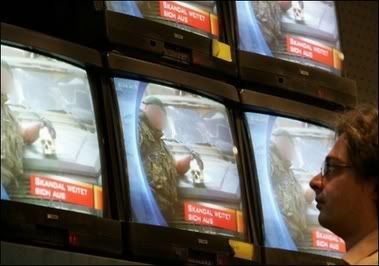
Der Spiegel reports:
Five photos threaten to stain the German military's reputation just as the country debates its role in international security operations. The images, showing German soldiers posing with a skull near Kabul, have sparked outrage from the government and may increase public reluctance to keep troops abroad.
The photos are unmistakably crass, ranging from a shot of a skull mounted over the headlight of a jeep to a close-up of a soldier holding his penis in his left hand and the skull next to it in his right. These are just two of five photos published Wednesday by the German daily Bild, showing members of German security forces in Afghanistan desecrating human remains evidently found while on patrol near Kabul. Two other photos show the skull affixed to a metal pole -- a "cable cutter" -- that extends vertically like a flag mast from the jeep's front bumper. Another shows a German soldier holding the skull and grinning.
The origin of the skull is not clear. Bild speculates it could come from a Muslim mass grave in the area, or that it could belong to one of many Russian soldiers who died fighting in Afghanistan in the 1980s. Regardless of where it comes from, the damage is done.
A chorus of voices has emerged from the government to express disgust at the photos. German Defense Minister, Franz Josef Jung told reporters: "It is clear and unmistakable that this kind of behavior from German soldiers cannot be tolerated." He added "This behavior is diametrically opposed to the values and behavior we teach and train our soldiers in. The pictures provoke disgust and absolute incomprehension."
The photos couldn't come at a worse time. On Wednesday, the Bundestag's defense committee will discuss the case of Murat Kurnaz, the Turkish-born German resident who was released this summer from the the US military prison at Guantanamo Bay and has since accused German elite soldiers of abusing him in Afghanistan's Kandahar region. Also on Wednesday, the government announced that it is to extend its commitment to the anti-terror Operation Enduring Freedom, but that the number of German troops in Afghanistan will be reduced from 2,800 to 1,800.
Evidence that German soldiers may be participating in some of the uglier aspects of war may well increase public opposition to the keeping the troops in Afghanistan at all.

Filed under: skull, NATO, CIA, secret+prisons, rendition, scandals, Germany, war+on+terror, Afghanistan, The Constant American, Constant American, Technorati Tag, Technorati Tags, tags, categories
Tuesday, October 24, 2006
What's the Matter with Connecticut?"
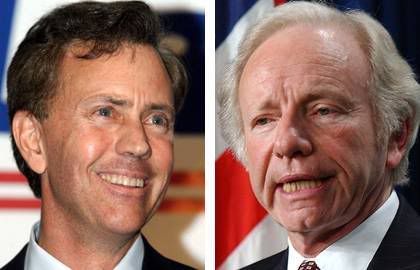
Why is Joe Lieberman 17 points ahead of Ned Lamont?
WTNH reports:
Trailing in polls, Lamont returns to criticism of Iraq war:
In recent weeks, Lamont has broadened his campaign message to include issues ranging from education to health care and the environment. Some Democrats have voiced concern that his wider message could undercut his core anti-war appeal in a state where the vast majority of voters oppose the war.
Lamont hasn't really been "broadening" his campaign message - he's been avoiding the anti-war campaign that he won Connecticut's Democratic primary with. All Democratic incumbents, apparently on orders of the DLC, have been avoiding anti-war talk.
Amy Goodman at Democracy Now! asks, "Can Lamont Beat Lieberman Again?" - A Look at Connecticut’s Senate Race:
Ned Lamont, a wealthy telecommunications executive, is trying to pull off a second upset over Senator Joseph Lieberman after defeating him in the Democratic primary this summer. Lieberman is running as an independent but says he’ll caucus with Senate Democrats if he keeps his seat.
Despite a celebrated victory in the primary, Lamont now faces an uphill battle. The latest polls show him trailing Lieberman by seventeen points.
Last night, the two frontrunners along with Republican Alan Schlesinger held their final debate before the election. In themes that have marked their respective campaigns, Lamont criticized Lieberman’s support for the Iraq war and other policies of the White House. Lieberman defended his record and said Lamont’s call for a withdrawal timetable of US troops from Iraq would lead to disaster. The debate came hours after Lamont filed a complaint with the Federal Election Commission accusing Lieberman of failing to account for nearly $400,000 dollars in campaign spending in the days before the Democratic primary.
AMY GOODMAN: For more on this race, we go to Hartford, Connecticut. We're joined by Bill Curry, former Connecticut state comptroller and state senator, and twice the state Democratic nominee for governor. Curry served as counselor to President Clinton from ’95 to ’97. He now writes a weekly column for the Hartford Courant. Welcome to Democracy Now!, Bill.
BILL CURRY: Great to be here, Amy. Thank you.
AMY GOODMAN: Well, can you talk about this race -- the Democrat, the so-called Independent and the Republican?
BILL CURRY: First of all, I don’t think it’s a 17-point race. I think that Lieberman clearly has an advantage, but it’s not that wide an advantage. The second thing I would say is that it has been a race in which the distinctions have blurred in the general election. And I would say that Lieberman has run a more thematic race. Lamont has tried to run a more substantive, concrete issue-based race. Lieberman’s run on experience, bipartisanship, fear of attack from abroad, and he is also presented himself as a victim of unfair attacks from Lamont.
And it strikes me that Lamont hasn't done a great job of countering that. You know, what a year to run on experience. This is the most experienced Congress, literally, in modern history, because of gerrymandering, government propaganda and special interest money. How are they doing, you know? What have we gotten out of that? In terms of bipartisanship, this has been the least bipartisan president, certainly in my memory. You can’t claim to have gotten compromises out of the Bush crowd, but only to go along with them. I think Joe Lieberman's mistake, in a sense, you could say, is being bipartisan with the wrong Republicans. There are plenty of people here in Connecticut who’ve been looking for alternatives to Bush's leadership, but not something you accomplish by aligning yourself with Bush, Cheney and Rumsfeld. And so, Lamont has had a lot of openings, but I haven't seen him take advantage of them. And if anything, he’s become somewhat more of a classic Democratic candidate, blurring distinctions and being very, very careful on issues. And I think it’s sapped some of the momentum from his campaign.
AMY GOODMAN: What effect --
BILL CURRY: I’m having a little trouble -- go ahead.
AMY GOODMAN: If you could bear with the sound, if you’re having little trouble. What effect does Karl Rove have on the Democrats?
BILL CURRY: Well, Karl Rove frightens the Democrats to death. And I think what happens is that -- I’ll just point out two things. One, Rove’s game, I guess it's brilliant. It's stale. We’ve seen him run it again and again. It's a miracle it keeps working. What Rove does is frighten all the Democrats who have been battered by the culture wars and by their political reverses in all these years. He frightens them with the tag "extremist," and the Democrats are so fearful of being labeled extremist that they say absolutely nothing. And then voters vote against them, because they had nothing to say. You could call it the John Kerry effect, I think, fairly in that race.
And I see it here. And I was listening to John Nichols’s very smart observations. In Connecticut, certainly, it's a little different than it is in the industrial Midwest. We don't have many populist candidates running in this part of the country. I agree that even here, less than in Michigan, but strongly, trade would be a very powerful issue -- the erosion of jobs, the fact that the American middle class hasn’t gotten a raise in a generation, the fact that the baby boomers are about to die broke and didn’t see it coming. There are a lot of fundamental issues here. But you don't find Democrats running on them. Instead, you know, my old White House colleagues, Rahm Emmanuel and Bruce Reed, and a handful of other sort of consultant types in Washington, have made most of the congressional candidates in this country sound exactly the same.Bruce Reed, President of the DLC.
Rahm Emmanuel, representative from Illinois to Congress and chairman of the Democratic Congressional Campaign Committee.
The usual Democratic strategy, no doubt in part because of Rove, for -- the usual Democratic strategy for winning is basically just to wait and hope the other side punts. You know, our grand plan is usually to win by default. This is a year in which people's dissatisfaction with Bush is so strong, their desire to put him under some kind of political house arrest is so deep, that the strategy is going to work, I think almost certainly. They then, however, get up the next morning and then need to plan to govern, and it’s not evident -- it’s not as evident to me as perhaps it is to John what exactly that will be.
AMY GOODMAN: Bill Curry, if Lieberman were to win, while he says he will caucus with the Democrats, he doesn't help the balance of power for Democrats in taking the Senate, right?
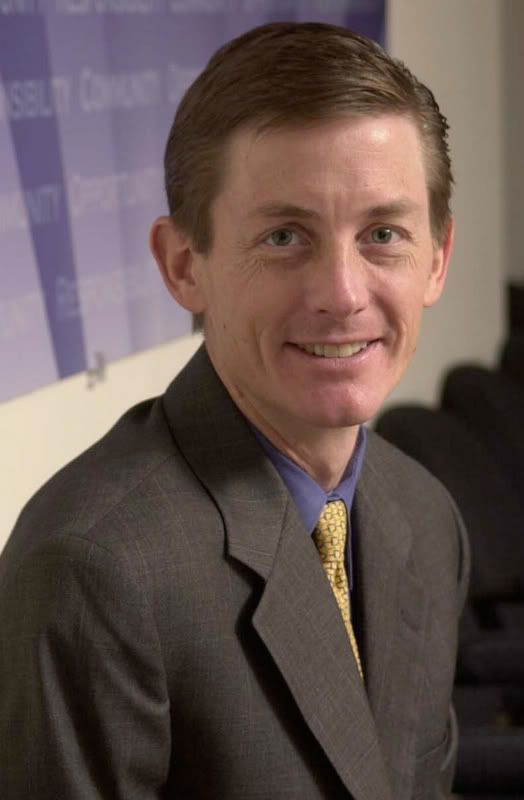
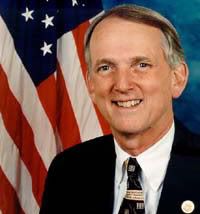
BILL CURRY: No, it’s a Democratic seat. One of the things that’s happened to Lamont, in fairness, we have three very competitive House races in this state. In the Second District, my lifelong friend, a great progressive, Joe Courtney is in a dead heat with former CIA operative, Rob Simmons. Diane Farrell challenging Chris Shays in Fairfield County, and Christopher Murphy challenging Nancy Johnson, the architect of our modern healthcare system, in the Fifth Congressional District, these are exciting races. They're all in a dead heat. And frankly --Democratic candidate for Congress, Joe Courtney.
Republican incumbent in Congress, Rob Simmons
Democratic candidate for Congress, Diane Farrell.
Republican incumbent in Congress, Chris Shays.
Democratic candidate for Congress, Christopher Murphy.
AMY GOODMAN: What do you mean, Nancy Johnson is the architect of the modern healthcare system?Nancy Johnson, Republican representative to Congress from Connecticut.
BILL CURRY: Well, in a very real way, Nancy Johnson has been the single most influential member of her party in Washington on healthcare for the quarter century that she sat in Congress. She chairs the Subcommittee on Healthcare at Ways and Means. And it would actually -- if you were to simply say, “Who is the living American who has most given us this debacle of a health system?” it’s hard to imagine who, other than Nancy Johnson, you would suggest for that honor. Again, it’s like the experience argument, you know: how do you feel that’s working?
Nancy was also a key architect of the Gingrich revolution, an important lieutenant in his fight to take over power, and then the chair of the Ethics Committee, who began the process of the Ethics Committee no longer doing its job at all, staving off investigations past an election, and then finally leaving the position herself, but creating a tendency there that’s lasted a long time, to turn a blind eye to obvious misdeeds.Newt Gingrich
And so, in that race again, we’re all aware of the problem. You know, the Republicans are hanging their hats on it, that people like their own congressman so much, the congressman’s personal favorabilities are higher. Most Americans only learn about their own congressmen from the congressmen's taxpayer-funded mailings and self-flattering press releases and ads. There aren’t enough reporters left from the states, even covering Washington, to tell them anything else. So the Congress is at an all-time low, because we have the data of the news and the quality of our own lives to help us evaluate the institution, but all we have on the individual members is what they tell us about themselves. Therefore, you have this odd phenomenon of individual congressmen being very popular, despite the fact that the institution is detested. And in Connecticut, they're hoping that will happen.
You also have had gerrymandering as a factor here in a very strong way, and all three Republican incumbents will outspend their challengers by a substantial margin. Nevertheless, what it feels like here is such a strong tide coming in, that it’s just one of those deals where I think it’s far too much. And even though I don’t think the Democratic candidates have done a very good job of arguing the differences, I think the really important debates right now are going on inside people's own heads, and they're just taking a look at what they see at their own lives, in Iraq, at the squalor in Washington, and they're going to vote to change this.
AMY GOODMAN: Bill Curry, you're talking to us from Connecticut. But you're look at races in the Northeast. What about Rhode Island, a very close race there for Senate?
BILL CURRY: Rhode Island and Connecticut, you know, each state is about, you know, like the size of Monaco. And we’re very similar in some ways. But Rhode Island is a much more Democratic state. Connecticut, actually, we’re a blue state, but we’re a swing state. Three of those five House seats have been Republican now for a long time. We’ve had a Republican governor. I lost twice to a multiple felon, John Rowland, running for governor, an unusual distinction. We swing back and forth in the presidential races.
Rhode Island is much more deeply a Democratic state. And Sheldon Whitehouse is -- again, he’s sort of the perfect profile of what the Democratic Party likes to run. He’s a former prosecutor. He’s a former attorney general, where you could develop a strong patina of consumer activism. I think he is a decent candidate, by the way, and I think right now that he’s ahead. I know that that’s the closest of the four races that people say lean strongly to the Democrats. But given the nature of the state and the qualities of the two candidates, in the end I think that will be Sheldon Whitehouse's to lose, and I don’t think he will. I think he’ll take it.Democratic incumbent for Congress, Sheldon Whitehouse.
AMY GOODMAN: Lincoln Chafee has not exactly been a favorite son of the Republican Party, though his father also was a senator.
BILL CURRY: No, no. Although, yes, there’s a strong family -- Lincoln Chafee, who was a blacksmith, actually shoed horses at a racetrack for a number of years and then became a mayor in, I believe, Warwick, Rhode Island, and then advanced to the family, you know, barony of the Senate seat. And I think that he seems like a nice guy, when you see him on C-SPAN. He has broken with his party a number of times.Lincoln Chafee, Senator from Rhode Island.
But there are two issues that are out there. By the way, the Republicans are coming in. And as with Chris Shays in Connecticut, who had never run negative ads and had always been more of a maverick, now that they’re aligned with their parties, these guys are running campaigns that would make you cringe.
And the basic question here, even for all these undecided voters in the middle -- I mean, in our country, two groups of people vote their interest with ruthless intelligence: the very rich and the very poor. In the middle are a lot of confused people. And one of the things that they like to say is “I don't vote the party. I vote the person.” I think this is the first year in my adult life in which no one’s said that to me, that the fundamental argument that John Nichols was raising earlier -- you have a constitutional system of checks and balances that's had no checks and no balances, and it’s not a question of whether Democrats are going to come in and conduct witch hunts. People desperately want to see oversight of the executive branch by the legislative branch of government. And I just think that in the end, as all this sludge of the 30-seconds ads fades, as all of this now -- as we come to the end of it, the voters stop listening, and the real important debates are within themselves, and they are going to vote for some kind of accountability.
AMY GOODMAN: Bill Curry, I want to thank you very much for being with us, former Connecticut state comptroller and state senator.
BILL CURRY: My pleasure.







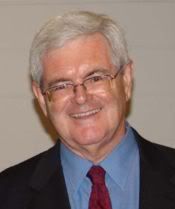


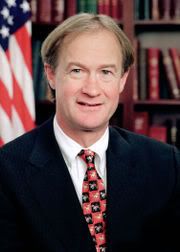
If Ned Lamont loses this, will democratic voters around the country realize that the DLC made it happen, and is not a friend of the democratic voters?
Filed under: election 2006, elections, Newt Gingrich, Bruce Reed, Ned Lamont, Joe Lieberman, Rhode Island, Connecticut, Rahm Emmanuel, DLC, Christopher Shays, Nancy Johnson, Democracy Now, Amy Goodman, Lincoln Chafee, Diane Farrell, Sheldon Whitehouse, Christopher Murphy, Republicans, Nancy Johnson, Bush, The Constant American, Constant American, Technorati Tag, Technorati Tags, tags, categories
*BREAKING NEWS*...Bush Drops 'Stay The Course' Phrase...
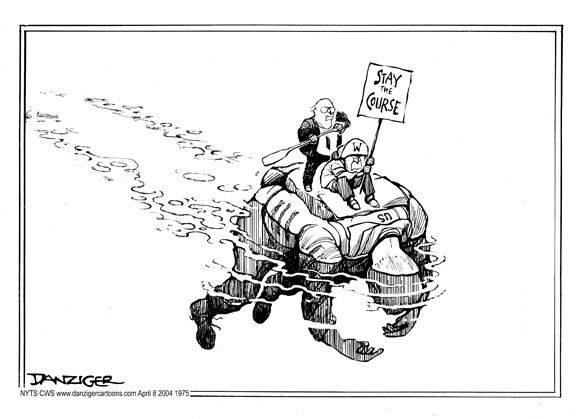
That's what the problem has been in Iraq. Not "staying the course," but SAYING that we're "staying the course."
With just two weeks until Election Day, the White House sought to ease political anxieties over security in Iraq — most notably by no longer saying the United States will "stay the course" in Iraq — but rejected calls from lawmakers for a dramatic policy shift.
White House press secretary Tony Snow said Monday the phrase "stay the course" doesn't capture the "dynamism" of the tactics America and its allies are employing.
"He stopped using it," Snow said of that phrase.
Snow said the United States would adjust its Iraq strategy but would not issue any ultimatums to the Iraqis.
"Are there dramatic shifts in policy? The answer is no," Snow said.
Meanwhile, the top U.S. commander in Iraq said Tuesday that Iraqi forces should be able to take full control of security in the country within the next 12 to 18 months with minimal American support.
Google "12-18 months" and "Iraq." Since the summer of 2003, the year that Bush-Cheney embarked on this adventure, you'll see that this administration has said Iraq's forces will be able to provide for their own security and that the U.S. can draw down our forces in "12-18 months" every few months.
Gen. George Casey said the United States should continue to focus on drawing down the number of American forces in the country, adding that he would not hesitate to ask for more troops if he felt they were necessary.
U.S. Ambassador Zalmay Khalilzad, who opened the rare joint press conference with Casey, said that the Iraqi government had agreed to develop a timeline for progress by the end of the year. He declared that the United States needed to redouble its efforts to succeed in Iraq.
The Nov. 7 elections will determine whether Republicans retain control of Congress, and lawmakers in both parties are calling on President Bush to change his war plans.
"We're on the verge of chaos, and the current plan is not working," Sen. Lindsey Graham, R-S.C., said in an Associated Press interview. U.S. and Iraqi officials should be held accountable for the lack of progress, said Graham, a Republican who is a frequent critic of the administration's policies.
Asked who in particular should be held accountable — Defense Secretary Donald Rumsfeld, perhaps, or the generals leading the war, Graham said: "All of them. It's their job to come up with a game plan" to end the violence.
What are the chances that we'll be able to hold Lindsay Graham accountable, for supporting the war, for voting for the Torture Bill, for protecting this administration from the moment he left the Clinton impeachment and stepped into Jesse Helms's seat in the Senate?
They all need to be held accountable. Every member of Congress and the Bush administration.
Mr. Bush, in a CNBC interview, said, "Well, I've been talking about a change in tactics ever since I — ever since we went in, because the role of the commander in chief is to say to our generals, `You adjust to the enemy on the battlefield."'
Showing progress in Iraq is critical because the approaching elections are widely viewed as a referendum on the war.
A report in Sunday's New York Times said the head of the U.S.-led Multinational Forces in Iraq and Khalilzad were working on a plan that probably would — for the first time — outline milestones for disarming sectarian militias and meeting other political and economic goals.
Rumsfeld, in remarks at the Pentagon, said U.S. government and military officials were working with Iraq to set a broad timetable for Iraqis to take over 16 provinces still being controlled by U.S. troops. But he said officials were not talking about penalizing the Iraqis if they don't hit certain benchmarks.
Keep repeating, "U.S. is building permanent bases in Iraq."
The Iraqis have taken control of two southern provinces but have been slow to take the lead in others, particularly those around Baghdad and in the volatile regions north and west of the capital. Rumsfeld said specific target dates probably will not be set.
Rumsfeld visited the White House early Monday with Gen. Peter Pace, chairman of the Joint Chiefs of Staff. Rumsfeld said the United States was looking at when the Iraqis would move close to setting up a reconciliation process to help quell worsening sectarian violence between Sunnis and Shiites.
On Monday, White House counselor Dan Bartlett said that Iraq needed to "step up" it's commitment to ending sectarian violence and added of the Bush administration, "We aren't sitting there with our heads in the sand. We are completely changing on a week-by-week basis."
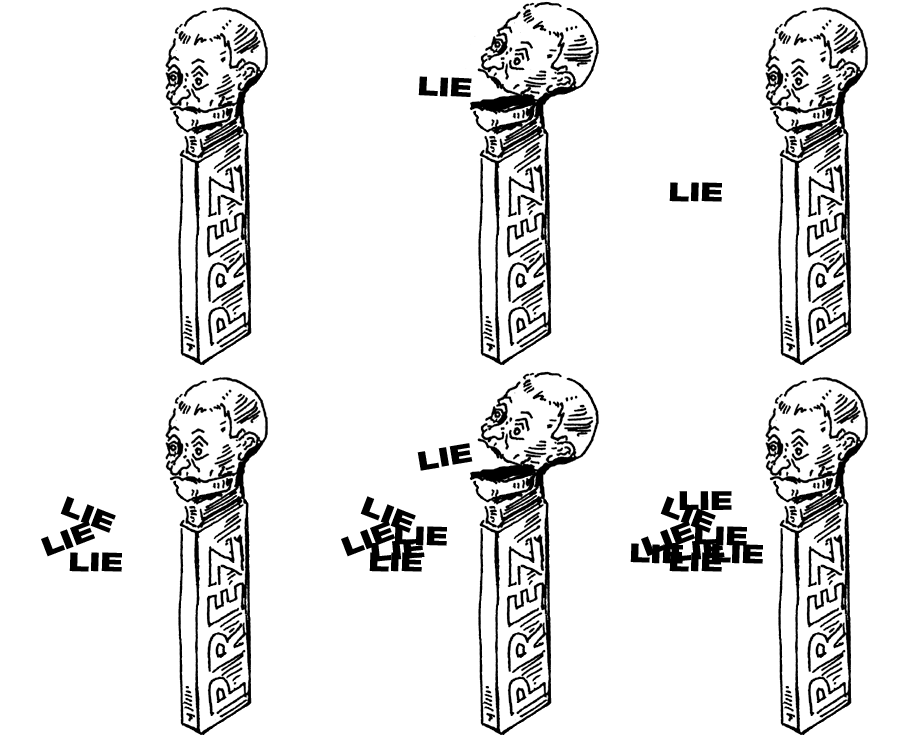
Changing socks? Changing underwear? Changing colors? ["The aspens, they turn in clusters..."] What are they changing?
Facing growing impatience with Prime Minister Nouri al-Maliki's failure to stem the carnage, Deputy Prime Minister Barham Saleh said international forces must not abandon Iraq while the situation there remains volatile.
"I do believe there is no option for the international community to cut and run," he told reporters after meeting Prime Minister Tony Blair in London. He said Iraqis and the international community need to be realistic, "but not defeatist."
"We need to understand that there is a need of utmost urgency to deal with many of the problems of Iraq but we must not give in to panic," he said.
At least 2,799 members of the U.S. military have died since the beginning of the Iraq war in March 2003, according to an Associated Press count. The figure includes seven military civilians. At least 2,236 died as a result of hostile action, according to the military's numbers.
"How do you ask a man to be the last man to die for a mistake?
We need to be out of Iraq. Now.
Filed under: stay the course, General George Casey, Tony Snow, Lindsay Graham, Dan Bartlett, Iraq, war in Iraq, Bush, The Constant American, Constant American, Technorati Tag, Technorati Tags, tags, categories
Update: The Iraqi Dead & The Study in Lancet
Lead author of the study responds and corrects UK scientists' attack:
Link to earlier post.
Filed under: Iraq, Lancet, The Constant American, Constant American, Technorati Tag, Technorati Tags, tags, categories
A study which found that more than 650,000 Iraqi people have died since the US-led invasion was attacked yesterday by scientists in the UK, who claimed that the households interviewed tended to be located in violence-hit streets.
Sean Gourley and Professor Neil Johnson of the physics department at Oxford University and Professor Michael Spagat of the economics department of Royal Holloway, University of London, claimed the methodology of the study was fundamentally flawed by what they term "main street bias".
But the lead author of the study, which was published by the Lancet medical journal, said their criticism was "a misconception". Gilbert Burnham of the Johns Hopkins school of public health in Baltimore, said the methodology had not been published in full by the Lancet and that streets away from obvious conflict had been chosen.
Prof Spagat and colleagues levelled their criticism in email exchanges with Prof Burnham and colleagues which were mediated by Science magazine. They claimed the sampling methods used "will result in an over-estimation of the death toll in Iraq".
The Lancet researchers interviewed 40 households in 47 clusters randomly chosen across Iraq to reflect the spread of the population. The starting point for each cluster was the main street. Residential streets were then chosen which crossed the main street.
The critics argued that the Lancet paper does not indicate that the researchers moved far enough away from the main street. "The further away you get, the further you are from the convoys that roll down the streets and the car bombs and the general violence," said Sean Gourley. "By sampling only cross streets which are more accessible, you get an over-estimation of deaths."
But Prof Burnham said the researchers penetrated much further into residential areas than was clear from the Lancet paper.
The notion "that we avoided back alleys was totally untrue". He added that 28% of households were in rural areas - which matches the population spread.
Others had suggested that it was impossible for 40 households to be surveyed in one day - but in fact the researchers were split into two teams and conducted 20 household interviews each, he said. "Our point is that it is a big number, we set out to prove that we had the power to say the mortality rate has more than doubled."
Link to earlier post.
Filed under: Iraq, Lancet, The Constant American, Constant American, Technorati Tag, Technorati Tags, tags, categories
Monday, October 23, 2006
Bush says, "I don't email 'cuz I need to deny I know anything"
Transcript:
BARTIROMO: I'm curious, have you ever Googled anybody? Do you use Google?
BUSH: Occasionally. One of the things that I've used on the Google is to pull up maps. It's very interesting to see, I forgot the name of the program, but where you get the satellite, and you can, like I kind of like to look at the ranch, remind me of where I want to be sometimes Uh, yeah, I do it some. I'm not a, I tend not to email, not only tend not to email, I don't email, because of, the different record requests that could happen to a president. I don't want to receive emails, 'cuz, you know, there's no telling what somebody would email me and it would show up as, you know, part of some kind of a story that, and I wouldn't be able to say, "Well, I didn't read the email", "But I sent it your address, how can you say you didn't?" So, in other words, I'm very cautious about emailing.
Someone might want to inform Bush that if it's good satellite pictures of his ranch that he uses 'the Google' for, he might want to toddle on down to the White House Situation Room where, I'm sure, the director would be delighted to pull up more current, real time images, instead of the 3-year old ones on 'the Google.'
Better yet, if he really wants to be at his ranch, there is always pen and paper and the two little words: "I resign."
Congressman Mark Foley *ACTION FIGURE* on eBay

Six inches tall. This is a sculptural Mockup in polymer clay it is not articulated. ONE OF A KIND this is the only one.
Artist David Johnson of SpectreStudios
A Blackberry® in his right hand; nice touch.
The current high bid is $305.00 USD, ($8.00 USD shipping).
(PayPal account required, Make no payments for 3 months - What a deal!)
Bidding [here] closes October 23, 2006, 19:27:57 PDT.
Ain't America grand?
[I love the internets.]
Filed under: American culture, western culture, toys, Mark Foley, eBay, The Constant American, Constant American, Technorati Tag, Technorati Tags, tags, categories
*NEWS FLASH* - Bush Tells MSNBC, "Privatizing Social Security is Back on the Table"

As Nancy Pelosi likes to say, "Elections have consequences."
One of the consequences of Republicans winning these elections and maintaining majorities in both houses of Congress is that Bush is going after social security. Again.
In an interview at the White House today, CNBC's Maria Bartiromo asked Bush what is on his agenda for his last two years in office:
BARTIROMO: In addition to those issues, we also talked about C.E.O. compensation. He said he was floored by some of the numbers out there that C.E.O.‘s are taking home. I also asked him what is on his agenda for his final two years in office and, among the topics, is Social Security. He is putting that back on the table.
He suggested that the privatization plan, that did not work for him last time, is not dead by any means. And he gave some detail as far as how that might work. In addition, when I asked him about the midterm elections specifically, he said it is not a referendum on Iraq. It is about the economy as well.
(BEGIN VIDEO CLIP)
BUSH: I think it‘s a referendum on a lot of things. I definitely think the economy is an issue. We will just see what happens. I believe we will hold the House and the Senate. No question, a strong economy is going to help our candidates. Primarily because they have something to run on. They can say our economy is good because I voted for tax relief.
(END VIDEO CLIP)
BARTIROMO: And finally, I asked him about the revolution going on in media. And I actually, Chris, asked him if he ever has Googled anybody. He says he does use Google. He doesn‘t e-mail, but he uses Google to look at the ranch. He likes Google Maps.
MATTHEWS: Well, I don‘t know what to make of those points from him. He seems like he was overwhelmed by your presence or something. I‘m serious Maria, he doesn‘t seem to be totally focused in those interviews. Those weren‘t very sharp answers.
BARTIROMO: Well, he was very focused on the economy. And I think that he is not necessarily trying to change the conversation from Iraq to the economy, but I think that his advisors are telling him that he is not getting any credit for an economy that has been strengthening. And, of course, another thing is that he said—I said look, if you actually -- if your party does retain control of both houses, are you going push to make those tax cuts permanent and he said absolutely.
MATTHEWS: Well, I think you made news, just as a news junkie here, because you got to him to bring back the personal accounts of Social Security back on to the front table. I assume that some of those Democratic candidates from working class or middle class neighborhoods, which is most of the country, will be saying, here he goes again. He wants to tamper with Social Security. You put a story back in play, and I don‘t know why he would want to put that back in play right before an election, with older people especially.
BARTIROMO: It was definitely one of his priorities. He said the other priority is finding alternatives to oil. I said look, has the momentum been lost, or slowed in any way, given the fact that now gasoline is back below $2.00 a gallon in some areas. He says no, at all, that they are still very hot on Ethanol and hybrids.
MATTHEWS: Yes, I am not sure Dick Cheney wants to find an alternative to oil. Any way, thank you very much Maria Bartiromo. I‘m serious, what a great get for you today.
BARTIROMO: Thank you.
From TCA five months ago:
All that Republicans have to do is get past the mid-term elections (five-and-a-half months from now) and keep both houses of Congress (more likely than not) in order to be "home-free" - no hearings, no investigations, pass the rest of the Bush-Republican agenda (more tax and economic reform favoring the wealthy, massive sell-off and privatization of America's resources, Patriot Act II with more elimination of our civil liberties, elimination of social security and medicare and other programs, etc.) and Bush can write his own legacy.
Bush just put social security back into play as an election issue.
Will Democratic candidates use Bush's declaration in their campaigns? Will the DNC make it into an ad? Will the media follow up, and ask Republican candidates about privatizing (destroying) social security?

Filed under: elections, economics, election 2006, tax cuts, Maria Bartiromo, social security, Bush, The Constant American, Constant American, Technorati Tag, Technorati Tags, tags, categories
The Iraqi Dead

Kevin Drum at The Washington Monthly is back talking about the Johns Hopkins study published in Lancet which estimated that more than 600,000 Iraqis have died since Bush invaded Iraq in 2003.
I have stayed away from the topic, and the controversy, because 30,000 dead Iraqis (the figure that the Bush administration grudgingly admits) doesn't make the war any more acceptable than 655,000 dead Iraqis. By trying to get others to dismiss the survey, Republicans expose the myth of their being "the party of life."
Lancet is the gold standard, and reputable polling organizations have agreed with the methodology used - "Polling experts supported the methods used by the surveyors":
"The sampling is solid. The methodology is as good as it gets," said John Zogby, whose Utica, N.Y.-based polling agency, Zogby International, has done several surveys in Iraq since the war began. "It is what people in the statistics business do."
Zogby said similar survey methods have been used to estimate casualty figures in other conflicts, such as Darfur and the Democratic People's Republic of Congo.
Ronald Waldman, an epidemiologist at Columbia University who worked at the Centers for Disease Control and Prevention for many years, told the Washington Post the survey method was "tried and true." He said that "this is the best estimate of mortality we have."
Frank Harrell Jr., chairman of the biostatistics department at Vanderbilt University, told the Associated Press the study incorporated "rigorous, well-justified analysis of the data."
I know a little about polling and statistical analysis (emphasis on a little meaning just that, a little, no sarcasm intended), but enough to know who to go to for thorough, accurate, legitimate and useful information.
All that Bush and Republicans have countered with is a belief that "it's wrong" - "If the death toll were really that high, there would be massive refugee outflows from Iraq." There are massive refugee outflows from Iraq.
The traditional Republican pollsters whom Republicans send out to cable news programs, like Frank Luntz and Kellyanne Conway, are noticeably absent from this discussion. Luntz and Conway, celebrity pollsters, use that role to influence public opinion. Whatever polling data that they deliver on CNN or Hardball has been specifically phrased to get the answer that will spin viewers. They may provide their Republican clients with other, legitimate information, but that's not what they go in front of the cameras with. They go public with words and phrases that have been through focus groups and tested to persuade and sell the Republican anti-people|pro-corporate policies.
There will probably be a future issue of Lancet devoted to reasoned, deliberative arguments on both sides of this issue. Decide then on its merits, and not the political significance. Until then, I wouldn't pay much attention to the responses that come out either in the popular press or TV talk shows or the internet. My sense about such arguments is that they will be mainly arguments from people who have axes to grind, who come from a position rather than "let's look at this data very carefully."
Until then, we have an election on the horizon, and the issues facing us are not getting discussed by either party. The war is only one of the issues.
This is the time, the only time in our form of democracy, when the people get a voice and play a part. We have an ignorant electorate that presumes the positions of candidates because of their party affiliation. Republican voters think that the Clintons are liberals, and unfortunately, so do most democratic voters. Bill Clinton does bear some responsibility in the center being moved so far to the right in this country, when most Americans agree with liberals on the issues, yet they run from the label of 'liberal.'
The candidates want to say as little as possible, the media are co-conspirators in the deception, and we-the-people are left surprised after election day when the winners turn out to be not what we-the-people imagined 'compassionate conservatives' would be like.
Now is the time that we get to hold our candidates' feet to the fire, and demand specifics from their rhetoric. How long are we going to let ourselves be duped, by both parties. How long are we going to give a pass to Democrats?
Filed under: Frank Harrell, Jr., Centers for Disease Control, CDC, Ronald Waldman, Zogby, Johns Hopkins, Iraq, Lancet, polling, Frank Luntz, Kellyanne Conway, Republicans, Washington Monthly, Kevin Drum, Bush, The Constant American, Constant American, Technorati Tag, Technorati Tags, tags, categories
It's 2 Weeks to Election '06 - Why Is Barack Obama Sucking Up The Air Time & Air Space with Speculation About an '08 Presidential Run?
Obama could be the second coming of Christ (he's not), but why, with just a little over two weeks until the mid-term elections, is Time magazine devoting their cover story to him? Because he said, "I may run for President in 2008"? We'll talk after the 2006 elections and if he decides to run. But Obama isn't even up for reelection this election. He's not up for reelection until 2010. Why are all of the political programs devoting any air time to a candidate who isn't even running in the '06 race?
Could it be that Democrats don't want to discuss any issues before this election and are banking on Republicans imploding on their own? (Yes.)
The sad truth about the state of our political process is that Democrats should be doing much better than they are, given how Republicans' chickens have come home to roost. How is it that Joe Lieberman is 17 points ahead of Ned Lamont in the polls? Ned Lamont is Joe Lieberman-lite (with support for abortion and gay marriage, and without the support for the war in Iraq). As a Democrat, Lamont would certainly caucus with the Democrats, as opposed to Lieberman, who will caucus with whomever happens to be giving him, personally, and not the citizens of Connecticut, a better deal. As voters turn away from Republicans, voters shouldn't have any hesitation at all about voting for Democrats. Instead, when voters consider not voting for Republicans, they're saying, "But look at the alternative." That voters are having any doubts at all about voting for Democrats can be laid squarely at the feet of the current Democrats in office.
It is a scandal that there are any working Americans who don't identify themselves as democrats and of the Democratic party. And if we had any authentic Democrats in office today (and not DINO), Democrats wouldn't be walking on eggshells, trying to avoid talking about the issues.
We have much to discuss about the direction and future of our nation. If not now, before an election, WHEN?
Filed under: Ned Lamont, Joe Lieberman, elections, election 2008, election 2006, Republicans, Barack+Obama, DLC, DINO, Democrats, The Constant American, Constant American, Technorati Tag, Technorati Tags, tags, categories
Could it be that Democrats don't want to discuss any issues before this election and are banking on Republicans imploding on their own? (Yes.)
The sad truth about the state of our political process is that Democrats should be doing much better than they are, given how Republicans' chickens have come home to roost. How is it that Joe Lieberman is 17 points ahead of Ned Lamont in the polls? Ned Lamont is Joe Lieberman-lite (with support for abortion and gay marriage, and without the support for the war in Iraq). As a Democrat, Lamont would certainly caucus with the Democrats, as opposed to Lieberman, who will caucus with whomever happens to be giving him, personally, and not the citizens of Connecticut, a better deal. As voters turn away from Republicans, voters shouldn't have any hesitation at all about voting for Democrats. Instead, when voters consider not voting for Republicans, they're saying, "But look at the alternative." That voters are having any doubts at all about voting for Democrats can be laid squarely at the feet of the current Democrats in office.
It is a scandal that there are any working Americans who don't identify themselves as democrats and of the Democratic party. And if we had any authentic Democrats in office today (and not DINO), Democrats wouldn't be walking on eggshells, trying to avoid talking about the issues.
We have much to discuss about the direction and future of our nation. If not now, before an election, WHEN?
Filed under: Ned Lamont, Joe Lieberman, elections, election 2008, election 2006, Republicans, Barack+Obama, DLC, DINO, Democrats, The Constant American, Constant American, Technorati Tag, Technorati Tags, tags, categories
Sunday, October 22, 2006
Bush's Family Profits From 'No Child' Act
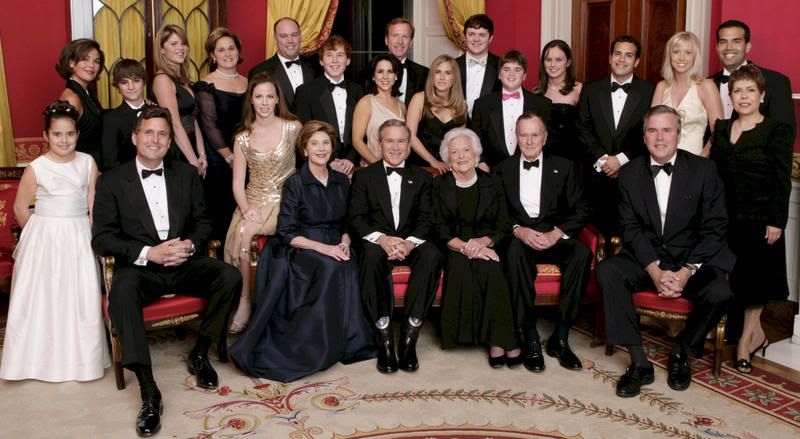
Anyone who holds the Bush family in high esteem, as icons of morality, ethics and values, doesn't know the Bush family.
Last year, when Barbara Bush donated $10,000 to aid the victims of Hurricane Katrina on the condition that the money be spent at her son, Neil's, Ignite! Learning company, she was taking out the money one of her left pocket and putting it into her right pocket (along with some of the American taxpayers' dollars for having made a charitable donation). It turns out that she and George H. W. Bush are investors in Ignite!
And there's more:
A company headed by President Bush's brother and partly owned by his parents is benefiting from Republican connections and federal dollars targeted for economically disadvantaged students under the No Child Left Behind Act.
With investments from his parents, George H.W. and Barbara Bush, and other backers, Neil Bush's company, Ignite! Learning, has placed its products in 40 U.S. school districts and plans to market internationally.
At least 13 U.S. school districts have used federal funds available through the president's signature education reform, the No Child Left Behind Act of 2001, to buy Ignite's portable learning centers at $3,800 apiece.
The law provides federal funds to help school districts better serve disadvantaged students and improve their performance, especially in reading and math.
But Ignite does not offer reading instruction, and its math program is not available until next year.
The federal Department of Education does not monitor individual school district expenditures under the No Child program, but sets guidelines the states are expected to enforce, said spokesman Chad Colby.
Ignite executive Tom Deliganis said, "Some districts seem to feel OK (about using No Child money for the Ignite purchases), and others do not."
Neil Bush said in an e-mail to the Los Angeles Times that Ignite's program had demonstrated success in improving the test scores of economically disadvantaged children. He also said political influence had not played a role in Ignite's rapid growth. "As our business matures in the USA we have plans to expand overseas and to work with many distinguished individuals in Asia, Europe, the Middle East and Africa," he wrote. "Not one of these associates by the way has ever asked for any access to either of my political brothers, not one White House tour, not one autographed photo, and not one Lincoln bedroom overnight stay."
Interviews and a review of school district documents obtained under the Freedom of Information Act, found that educators and legal experts were sharply divided over whether Ignite's products were worth their cost or qualified under the No Child law.
The federal law requires schools to show they are meeting educational standards or risk losing critical funding. If students fail to meet annual performance goals in reading and math tests, schools must supplement their educational offerings with tutoring and other special programs.
Leigh Manasevit, a Washington, D.C., attorney who specializes in federal education funding, said that districts using the No Child funds to buy products such as Ignite's would have to meet "very strict" student eligibility requirements and ensure that the Ignite services were supplemental to existing programs.
Known as COW, for Curriculum on Wheels (the portable learning centers resemble cows on wheels), Ignite's product line is geared toward middle school social studies, history and science. The company says it has developed a social studies program that meets state curriculum requirements in seven states. Its science program meets requirements in six states.
Most of Ignite's business has been obtained through sole-source contracts without competitive bidding. Neil Bush has been directly involved in marketing the product.
In addition to federal or state funds, foundations and corporations have helped buy Ignite products.
The Washington Times Foundation, backed by the Rev. Sun Myung Moon, head of the South Korea-based Unification Church, has peppered classrooms throughout Virginia with Ignite's COWs under a $1 million grant.
Oil companies and Middle East interests with long political ties to the Bush family have made similar bequests. Aramco Services Co., an arm of the Saudi-owned oil company, has donated COWs to schools, as have Apache Corp., BP and Shell Oil.
Neil Bush said he is a businessman who does not attempt to exert political influence, and he called the Los Angeles Times' inquiries about his venture -- made just before the election -- "entirely political."
Bush's parents joined Neil as Ignite investors in 1999, according to U.S. Securities and Exchange Commission documents. By 2003, the records show, Neil Bush had raised about $23 million from more than a dozen outside investors, including Mohammed Al Saddah, the head of a Kuwaiti company, and Winston Wong, the head of a Chinese computer company.
Most recently he signed up Russian fugitive business tycoon Boris Berezovsky and Berezovsky's partner Badri Patarkatsishvili.
Barbara Bush enthusiastically has supported Ignite. At an Oklahoma City fundraiser in January 2004, she and Neil Bush were guests of honor at the $1,000-a-table event organized by a foundation supporting the Western Heights School District. Proceeds were earmarked for the purchase of Ignite products.
Organizer Mary Blankenship Pointer said she planned the event because district students were "utilizing Ignite courseware and experiencing great results. Our students were thriving."
But Western Heights school Superintendent Joe Kitchens said the district eventually dropped its use of Ignite because it disagreed with changes Ignite had made in its products. "Our interest waned in it," he said.
The former first lady spurred controversy recently when she contributed to a Hurricane Katrina relief foundation for storm victims who had relocated to Texas.
Her donation carried one stipulation: It had to be used by local schools for purchases of COWs.
Texas accounts for 75 percent of Ignite's business, which is expanding rapidly in other states, Deliganis said.
The company also has COWs deployed in North Carolina, Virginia, Nevada, California, the District of Columbia, Georgia and Florida, he said.
Neil Bush said Ignite had more than 1,700 COWs in classrooms.
But Ignite's educational strategy has changed dramatically, and some are critical of its new approach. Shortly after Ignite was formed in Austin, Texas, in 1999, it bought the software developed by another small Austin company, Adaptive Learning Technology.
Adaptive Learning's founder Mary Schenck-Ross said the software's interactive lessons allowed teachers "to get away from the mass-treatment approach (to education)." When a student typed in a response to a question, the software was designed to react and provide a customized learning path.
"The original concept was to avoid 'one size fits all.' That was the point," said Catherine Malloy, who worked on the software development.
Two years ago, however, Ignite dropped the individualized learning approach. Working with artists and illustrators, it created a large purple COW that could be wheeled from classroom to classroom and plugged in, offering lessons that could be played to a roomful of students.
The developers of Adaptive Learning's software complain that Ignite replaced individualized instruction with a gimmick.
"It breaks my heart what they have done. The concept was totally perverted," Schenck Ross said.
Nevertheless, Ignite found many receptive school districts. In Texas, 30 school districts use COWs.
In Houston, where Neil Bush and his parents live, the district has used various funding sources to acquire $400,000 in Ignite products. Another $240,000 in purchases has been authorized in the last six months.
Correspondence obtained by The Times shows that Neil Bush met with top Houston officials, sent e-mails and left voice mail messages urging bigger and faster allocations. An e-mail to colleagues from a school procurement official said Bush had made it clear that he had a "good working relationship" with a school board member.
Another Ignite official asked a Texas state education official to endorse the company. In an e-mail, Neil Bush's partner Ken Leonard asked Michelle Ungurait, state director of social studies programs, to tell Houston officials her "positive impressions of our content, system and approach."
Ungurait, identified in another Leonard e-mail as "our good friend" at the state office, told her superiors in response to The Times' inquiry that she never acted on Leonard's request.
Leonard said he did not ask Ungurait to do anything that would be improper.
Houston school officials gave Ignite's products "high" ratings in eight categories and recommended approval.
Some people in Houston's schools question the expenditures, however. Jon Dansby was teaching at Houston's Fleming Middle School when Ignite products arrived.
"You can't even get basics like paper and scissors, and we went out and bought them. I just see red," he said.
In Las Vegas, the schools have approved more than $300,000 in Ignite purchases. Records show the board recommended spending $150,000 in No Child funding on Ignite products.
Sources familiar with the Las Vegas purchases said pressure to buy Ignite products came from Sig Rogich, an influential local figure and prominent Republican whose fundraising of more than $200,000 for President Bush's 2004 reelection campaign qualified him as a "Bush Ranger."
Rogich, who chairs a foundation that supports local schools, said he applied no pressure but became interested in COWs after Neil Bush contacted him. Rogich donated $6,000 to purchase two COWs for a middle school named after him.
Dr. Christy Falba, the former Clark County school official who oversaw the contracts, said she and her husband attended a dinner with Neil Bush to discuss the products. She said Rogich encouraged the district "to look at the Ignite program" but applied no pressure.
Few independent studies have been done to assess the effectiveness of Ignite's teaching strategies. Neil Bush said the company had gotten "great feedback" from educators and planned to conduct a "major scientifically valid study" to assess the COW's impact. The results should be in by next summer, he said.
Although Ignite's products get generally rave reviews from Texas educators, the opinion is not universal.
The Tornillo, Texas, Independent School District no longer uses the Ignite programs it purchased several years ago for $43,000.
I wouldn't advise anyone else to use it," said Superintendent Paul Vranish. "Nobody wanted to use it, and the principal who bought it is no longer here."
Ignite's Web site features glowing videotaped testimonials from teachers, administrators, students and parents.
Many of the videos were shot at the Del Valle Junior High School near Austin, where school district officials allowed Ignite to film facilities and students.
In the video, a student named India explains, "I was feeling bad about my grades. I didn't know what my teacher was talking about." The COW changed everything, the girl's father says on the video.
Lori, a woman identified as India's teacher, says the child was not paying attention until the COW was brought in.
The woman, however, is not India's teacher, but Lori Anderson, a former teacher and now Ignite's marketing director. Ignite says Anderson was simply role-playing.
In return for use of its students and facilities, a district spokeswoman said Ignite donated a free COW. Five others were purchased with district funds.
District spokeswoman Celina Bley acknowledged that regulations bar school officials from endorsing products. But she said that restriction did not apply to the videos.
"It is illegal for individuals to make an endorsement but this was a district-wide endorsement," Bley said in an e-mail.
The Washington Post reports (12/28/03) on "The Relatively Charmed Life of Neil Bush".
Filed under: corruption, Hurricane Katrina, Neil Bush, education, No Child Left Behind, No Child Left Behind Act, Ignite Learning, Ignite, Ignite!, Bush, Barbara Bush, George H. W. Bush, The Constant American, Constant American, Technorati Tag, Technorati Tags, tags, categories
The Solution: To Graffiti

Graffiti, a.k.a tagging, is up all over the world, and it's one of the earliest symptoms of the erosion of society. Whether it's gang-related, hate-crime oriented (Aryan Nation in Iraq) or just kids, little 'frustrated artists,' hellbent on expressing themselves, the taggers have one thing in common: A disregard for the property of others. That's never a good trait for people who rely on respect for the rule of law to keep chaos from breaking out. The cost to remove graffiti is out of reach for many cities. And those cities that do have aggressive graffiti removal find that once it is removed, the taggers return before the paint on the repair dries.
Lodi (a city at the north end of California's central valley, just south of Sacramento) is left to rely on the kindness of volunteers to paint over and perform other maintenance chores on public grounds that local budgets can't afford. Sheriffs in Mendocino County in California have discovered that when graffiti is allowed to remain, and is visible to inmates riding on California Department of Correction and Rehabilitation buses heading to Pelican Bay State Prison on Hwy. 101 it can communicate a dangerous message.
"When they see graffiti, it tells them who's there and what's going on in that town," Pearce said. "It's a real sign that they might have the ability to function in a particular town."
Mendocino has just passed a Graffiti Suppression Ordinance which allows the county to remove graffiti from private and public property in its unincorporated areas at no cost to the property owner and little cost to the county itself.
But Santa Rosa, California, has a program that could be called "smart government" (liberal) in that it tackles the problem from a whole systems approach:
It is scrawled in spray paint or marker, on walls beneath freeway bridges, on fences and mailboxes, houses, businesses and street signs, some of it intricately patterned, most of it an eyesore that's hard to remove.
"Once you start to look for it, you see it everywhere," said Georgia Pedgrift, Santa Rosa's graffiti abatement coordinator, a job she took after four years on the Sonoma County Sheriff's Department's graffiti detail.
A Santa Rosa native who not so long ago aspired to do standup comedy, Pedgrift, 27, is part graffiti gumshoe, part bureaucratic enforcer, part educator and part maintenance worker.
She navigates the secret world of adrenaline-fueled taggers and stops to wipe garbage cans clean of scribbled tags. She teaches elementary school students about graffiti's impacts and costs. She appears on the doorsteps of the property owners hit by taggers and instructs them, under city law, to clean up the graffiti left on their walls within 72 hours.
A civilian employee of the Police Department, she's no prototypically fearless crime fighter. Rough neighborhoods rattle her - she requested a bulletproof vest when she worked for the Sheriff's Department. She asked that any news photographs conceal her identity. And other aspects of law enforcement unnerve her, she said.
But she's earned a reputation as the right person to have on the front lines of the fight against graffiti.
"She is just a ball of fire," said San Bernardino Police Sgt. Dwight Waldo, a nationally known expert who runs his department's graffiti task force and trained Pedgrift when she joined the Sheriff's Department.
"She is a really good person to have in charge of this stuff," said Waldo, adding that he would rank Pedgrift among "the top 10 or 15" graffiti-fighting experts in the country.
Pedgrift took anti-graffiti efforts to "the next level," said Sheriff's Capt. Matt McCaffrey.
She shifted the focus from "reactive" cleanup efforts to a "proactive and preventive" approach of tracking and identifying taggers so they could be prosecuted, he said.
After joining the city, Pedgrift worked on the investigation that led to the arrest this month of Santa Rosa Junior College art student Saif Azzuz, 18, who is suspected of writing hundreds of "El Barto" and "Bart" tags around the city.
"Now the graffiti is 'Viva El Barto,'" she said. "We're getting the backlash graffiti."
The El Barto tags - like most of the graffiti in the city outside of a few neighborhoods where gangs have a strong presence - were not gang related, Pedgrift said. But at least one tagging crew, she said, has begun to include a norteño gang slogan in its usual graffiti writing.
For those who consider graffiti little worse than the eruptions of frustrated young artists, she has this bracing bad news: "The community doesn't understand that graffiti and the subculture around it becomes kind of an addiction. It's an entire lifestyle."
Taggers socialize together, align with crews and, online, trade photographs and tips on techniques, boast of their exploits and post obscene jeers at those who track and clean up after them.
"It becomes all-consuming," she said. "Taggers themselves will say, 'I feel addicted.' So I think we have to kind of address it like that - instead of just thinking, you know, 'These kids are logically just going to realize it's a bad idea.'"
The higher a tag - a "heaven's piece," in tagger slang - the better. The more visible, the better. The more tags are placed, the better. The greater the risk of being caught, the better.
Bigger, higher, more, fame: graffiti is a pursuit twined tightly with the ego.
"And a huge part of it, most of them will tell you," said Pedgrift, "is the rush they get from breaking the law, from being part of this underground subculture."
Six walls supporting a Highway 101 overpass near Windsor - not quite underground but reached via a descending dirt path tangled with blackberry bushes - colorfully illustrate the taggers' obsessions, and, by virtue of location, offer an insight into what drives them.
"This is where they come to show off," said Pedgrift on a recent visit. "It's not to show off for you and me, none of it's really to show off for you and me."
Out-of-the-way places like this - on walls, the roof, the rock-reinforced embankments - are where taggers erect their best, most elaborate work.
Empty spray paint cans and lids litter the ground near a small creek, signs of carelessness that contrast sharply with the obvious effort displayed in tagger nicknames rendered in dazzlingly complex, multi-colored abstract patterns that rise to heights topping eight feet.
Under one is written: "I ditch cops, 2006."
In the El Barto case, police estimated that damage from the tags - tallied in the cost of cleanup and resources spent tracking them - reached $100,000.
Azzuz, who is free on $50,000 bail and has pleaded not guilty, could face more than five years in prison if convicted on all the vandalism counts he faces.
Tracking, understanding and eradicating graffiti energizes Pedgrift. But the actual closing in on and capture of suspected taggers can be a wrenching process for this daughter of a math professor, therapist and former Santa Rosa city councilman.
Writing the affidavits in support of the search warrants that police used in arresting Azzuz has been "my least favorite part of the job so far," she said.
"I'm all for accountability, don't get me wrong," she said. "It's not that I think we should give everyone a hug and be on our way, I just get emotionally caught up and feel bad."
Her job is cut out for her.
Graffiti "hits" in Santa Rosa shot from an estimated 200 in 1992 to 20,000 in 2004, said Steve Kroeck, the city's deputy director of field services. Now the city spends more than $500,000 a year to clean it up.
That was a key reason for ordinances adopted in 2001, 2003 and 2005 that require property owners to clean up graffiti within 72 hours of notification and that successively strengthened the city's ability to prosecute graffiti crimes.
Pedgrift acknowledged that forcing tenants and property owners to clean up graffiti can be seen as unfair. But the city can't shoulder the financial burden alone, she said.
"In an ideal world that wouldn't happen. Why would you come ask a victim, not only ask them, but tell them, 'You have to clean up damage someone else has done.'"
The answer, she said, is that "it's for you, it's for us, it's for the community."
Which would you rather have blighting your neighborhood?
This . . .

Or this . . . .
. . . . and this:
How to make a LED throwie:
If you must be an outlaw, then do it with style . . . .
Filed under: LED throwies, Santa Rosa, California, Mendocino, Lodi, graffiti, tagger, solutions, The Constant American, Constant American, Technorati Tag, Technorati Tags, tags, categories
Moral Equivalency

Dear Maeven,
I am 16 years old and after I graduate (high school and college), I want to be writer.
My English teacher entered a short story I wrote in a nationwide writing competition, with a first place prize of a $10,000 scholarship and a meeting over lunch with only my most favorite author. My best friend since first grade (she also wants to be a writer and we dream about going to New York and being roomates) goes to a different high school. Her English teacher entered one of her short stories in the same contest.
I won. My best friend came in second place ($500 and a Montblanc pen).
The prizes will be awarded at a formal ceremony in our state capitol next month. In the meantime, the chairman of the organization that sponsored the competition returned my story along with a certificate (suitable for framing). Only, the story that won, the story that was returned to me, my story, had been rewritten.
I talked to my teacher about it, and she said she "polished" it. (She did more than "polish" it; she cut out one of the characters and changed the ending.) I got really upset and my teacher said that I had better get used to "the editing process" if I wanted to have a career in writing. She also said that she was sure that the other stories in the competition had been "polished" by the students' teachers: "That's how it's been done, 'time in memoriam'."
I know that's not true. After I talked to my teacher, I went to my best friend's house and read the copy that the prize committee returned to her. It was the same as when I first read it, before she turned it in at school. Her teacher didn't "polish" it.
Maeven, what should I do?
Signed,
Ivana Caypid
What would you counsel? What do you think evangelical Christians who vote for Republicans would counsel?
Is it comparable to this, "Phone-sex line wrong number sets off campaign flap"?:
The real story:
Both major-party candidates for a congressional seat are decrying an ad sponsored by a national Republican committee that accuses the Democrat of billing taxpayers for a call to a phone-sex line.
The ad, which began airing Friday, shows Michael Arcuri leering at the silhouette of a dancing woman who says, "Hi, sexy. You've reached the live, one-on-one fantasy line."
Arcuri's campaign said an associate mistakenly dialed an 800-number sex line two years ago from Arcuri's New York City hotel room, and released records supporting the claim.
The number shares the same last seven digits with the number for the state Department of Criminal Justice Services, which was dialed the minute after the first call was made.
Arcuri, the district attorney in Oneida County, said the ad was "clearly libelous" and threatened to file a lawsuit. His GOP opponent, state Sen. Ray Meier, described it as "way over the line."
At least seven TV stations in Syracuse, Utica and Binghamton refused to run the ad, Arcuri said.
The ad's sponsor, the National Republican Congressional Committee, stood by the 30-second message.
Spokesman Ed Patru insisted it was "totally true" and said Meier was not consulted.
The two candidates, who say they are friends, are running to fill the seat left open by the retirement of Republican Rep. Sherwood Boehlert.
Political analysts have said the race is among the nation's most competitive.
Arcuri said he had "never seen such an unfair commercial. I have a 12-year-old daughter. She's going to have to go to school and hear other kids talk about this."
Robert Thompson, professor of TV and popular culture at Syracuse University, called the ad "an egregiously stupid accusation."
I think there is only one solution for the party that claims the moral and ethical high ground and that caters to the evangelical Christian Right: Ray Meier, the Republican candidate, should withdraw from the race. Losing your candidate in the race seems a fitting penalty to me. It might even drive the scurrilous dogs who are behind these dirty politics out of business.
If Meier has any integrity at all, he'll realize that a grave injury has been done not only to the man he calls his friend (the Democratic candidate whom he is running against), but also the democratic process in America. By not dropping out, and should Meier win, he will have benefitted by the slanderous, defamatory ads.
There will be other campaigns and future elections. Meier will have earned the respect of the voters for taking a stand against the kind of politics that has caused Americans to have given up on their government and democracy. I might even vote for a Republican who showed this kind of integrity. It could happen.
Filed under: election 2006, elections, New York, Sherwood Boehlert, U.S. Congress, Dear Maeven, evangelical Christians, dirty politics, Michael Arcuri, Ed Patru, Ray Meier, Republicans, The Constant American, Constant American, Technorati Tag, Technorati Tags, tags, categories
Subscribe to:
Posts (Atom)