
A 2-minute video of British troops chasing Iraqi youth involved in a street protest, dragging them into a walled compound and beating them as other British troops returning from the dispersed protest pass by with barely a glance.
Most disturbing, perhaps, is the British soldier who is videotaping the attacks from a distance above. He gives voice to the actions being committed by his fellow soldiers in the courtyard below, cheering them on.
"I didn't know" is not a valid excuse.
In a democratic republic, it's a citizen's responsibility to know what our government (and those governments with whom we partner) is doing in our name. It's our responsibility to question authority and demand answers. If none are forthcoming, it is our obligation to throw the bums out. Because it is the decisions that are made in our name that create the conditions that causes terrorism. It's not those making the decisions who are on the front line of the backlash that is terrorism. It's me, it's you, it's our families and friends. Bush and Cheney don't have to fly commercial or take mass public transit. Regular Americans don't reap the great riches that are the result of Bush-Cheney policies.
Monday, June 19, 2006

Sunday, June 18, 2006
CIA Communique From Inside American Embassy in Baghdad

Hours before Bush left on a surprise and secret trip last Monday to the Green Zone in Baghdad for a photo op, the U.S. Embassy in Iraq painted a starkly different portrait of increasing danger and hardship faced by its Iraqi employees. This cable, marked "sensitive" and obtained by The Washington Post, outlines in spare prose the daily-worsening conditions for those who live outside the heavily guarded international zone: harassment, threats and the employees' constant fears that their neighbors will discover they work for the U.S. government.
June 06 2006
From: American Embassy Baghdad
To: Secretary of State, Washington, D.C.
Info Iraq Collective
Subject: Snapshots from the Office: Public Affairs Staff Show Strains of Social Discord
Sensitive
1. (SBU) Beginning in March, and picking up in mid-May, Iraqi staff in the Public Affairs section have complained that Islamist and/or militia groups have been negatively affecting their daily routine. Harassment over proper dress and habits has been increasingly pervasive. They also report that power cuts and fuel prices have diminished their quality of life. Conditions vary by neighborhood, but even upscale neighborhoods such as Mansur have visibly deteriorated.Women’s Rights
2. (SBU) The Public Affairs Press office has 9 local Iraqi employees. Two of our three female employees report stepped up harassment beginning in mid-May. One, a Shiite who favors Western clothing, was advised by an unknown woman in her upscale Shiite/Christian Baghdad neighborhood to wear a veil and not to drive her own car. Indeed, she said, some groups are pushing women to cover even their face, a step not taken in Iran even at its most conservative.
3. (SBU) Another, a Sunni, said that people in her middle-class neighborhood are harassing women and telling them to cover up and stop using cell phones (suspected channel to licentious relationships with men). She said that the taxi driver who brings her every day to the green zone checkpoint has told her he cannot let her ride unless she wears a headcover. A female in the PAS cultural section is now wearing a full abaya after receiving direct threats in May. She says her neighborhood, Adhamiya, is no longer permissive if she is not clad so modestly.
4. (SBU) These women say they cannot identify the groups that are pressuring them; many times, the cautions come from other women, sometimes from men who they say could be Sunni or Shiite, but appear conservative. They also tell us that some ministries, notably the Sadrist controlled Ministry of Transportation, have been forcing females to wear the hijab at work.
Dress Code for All?
5. (SBU) Staff members have reported that it is now dangerous for men to wear shorts in public; they no longer allow their children to play outside in shorts. People who wear jeans in public have come under attack from what staff members describe as Wahabis and Sadrists.
Evictions
6. (SBU) One colleague beseeched us to weigh in to help a neighbor who was uprooted in May from her home of 30 years, on the pretense of application of some long-disused law that allows others to evict tenants after 14 years. The woman, who is a Fayli Kurd, says she has nowhere to go, no other home, but the courts give them no recourse to this new assertion of power. Such uprootings may be a response by new Shiite government authorities to similar actions against Arabs by Kurds in other parts of Iraq. (NOTE: An Arab newspaper editor told us he is preparing an extensive survey of ethnic cleansing, which he said is taking place in almost every Iraqi province, as political parties and their militias are seemingly engaged in tit-for-tat reprisals all over Iraq. One editor told us that the KDP is Now planning to set up tent cities in Irbil, to house Kurds being evicted from Baghdad.)Power Cuts and Fuel Shortages a Drain on Society
7. Temperatures in Baghdad have already reached 115 degrees. Employees all confirm that by the last week of May, they were getting one hour of power for every six hours without. That was only about four hours of power a day for the city. By early June, the situation had improved slightly.
In Hal al Shaab, power has recently improved from one in six to one in three hours. Other staff report similar variances. Central Baghdad neighborhood Bab al Mu’atham has had no city power for over a month. Areas near hospitals, political party headquarters, and the green zone have the best supply, in some cases reaching 24 hours. One staff member reported that a friend lives in a building that houses a new minister; within 24 hours of his appointment, her building had city power 24 hours a day.
8. (SBU) All employees supplement city power with service contracted with neighborhood generator hookups that they pay for monthly. One employee pays 7500 ID per ampere to get 10 amperes per month (75,000 ID = USD 50/month). For this, her family gets 6 hours of power per day, with service ending at 2 a.m. Another employee pays 9000 ID per ampere to get 10 amperes per month (90,000 = USD 60). For this, his family gets 8 hours per day, with service running until 5 a.m.
9. (SBU) Fuel lines have also taxed our staff. One employee told us May 29 that he had spent 12 hours on his day off (Saturday) waiting to get gas.
Another staff member confirmed that shortages were so dire, prices on the black market in much of Baghdad were now above 1,000 Iraqi dinars per liter (the official, subsidized price is 250 ID).
Kidnappings and Threats of Worse
10. (SBU) One employee informed us in March that his brother-in-law had been kidnapped. The man was eventually released, but this caused enormous emotional distress to the entire family. One employee, a Sunni Kurd, received an indirect threat on her life in April. She took extended leaves, and by May, relocated abroad with her family.
Security Forces Mistrusted
11. (SBU) In April, employees began reporting a change in demeanor of guards at the green zone checkpoints. They seemed to be more militia-like, in some cases seemingly taunting. One employee asked us to explore getting her press credentials because guards had held her embassy badge up and proclaimed loudly to nearby passers-by “Embassy” as she entered. Such information is a death sentence if overheard by the wrong people.
Supervising a Staff at High Risk
12. (SBU) Employees all share a common tale of their lives; of nine employees in March, only four had family members who knew they worked at the embassy. That makes it difficult for them, and for us. Iraqi colleagues called after hours often speak Arabic as an indication they cannot speak openly in English.
13. (SBU) We cannot call employees in on weekends or holidays without blowing their “cover.” Likewise, they have been unavailable during multiple security closures imposed by the government since February. A Sunni Arab female employee tells us that family pressures and the inability to share details of her employment is very tough; she told her family she was in Jordan when we sent her on a training to the U.S. in February. Mounting criticisms of the U.S. at home among family members also makes her life difficult. She told us in mid-June that most of her family believes the U.S. – which is widely perceived as fully controlling the country and tolerating the malaise – is punishing populations as Saddam did (but with Sunnis and very poor Shiites now at the bottom of the list). Otherwise, she says, the allocation of power and security would not be so arbitrary.
14. (SBU) Some of our staff do not take home their American cell phones, as this makes them a target. Planning for their own possible abduction, they used code names for friends and colleagues and contacts entered into Iraq cell phones. For at least six months, we have not been able to use any local staff members for translation at on-camera press events.
15. (SBU) More recently, we have begun shredding documents printed out that show local staff surnames. In March, a few staff members approached us to ask what provisions would we make for them if we evacuate.
Sectarian Tensions Within Families
16. Ethnic and sectarian faultlines are also becoming part of the daily media fare in the country. One Shiite employee told us in late May that she can no longer watch TV news with her mother, who is Sunni, because her mother blamed all government failings on the fact that Shiites are in charge. Many of the employee’s immediate family members, including her father, one sister, and a brother, left Iraq years ago. This month, another sister is departing for Egypt, as she imagines the future here is too bleak.
Frayed Nerves and Mistrust in the Office
17. (SBU) Against this backdrop of frayed social networks, tension and moodiness have risen. One Shiite made disparaging comments about the Sunni caliph Othman which angered a Kurd A Sunni Arab female apparently insulted a Shiite female colleague by criticizing her overly liberal dress. One colleague told us he feels “defeated” by circumstances, citing the example of being unable to help his two year old son who has asthma and cannot sleep in stifling heat.
18. (SBU) Another employee tells us that life outside the Green Zone has become “emotionally draining.” He lives in a mostly Shiite area and claims to attend a funeral “every evening.” He, like other local employees, is financially responsible for his immediate and extended families.. He revealed that “the burden of responsibility; new stress coming from social circles who increasingly disapprove of the coalition presence, and everyday threats weigh very heavily.” This employee became extremely agitated in late May at website reports of an abduction of an Iraqi working with KNFI, whose expired Embassy and KNFI badges were posted on the website.
Staying Straight with Neighborhood Governments and the ‘Alasa’
19. (SBU) Staff members say they daily assess how to move safely in public. Often, if they must travel outside their own neighborhoods, they adopt the clothing, language, and traits of the area.
In Jadryiya, for example, one needs to conform to the SCIRI/Badr ethic; in Yusufiya, a strict Sunni conservative dress code has taken hold. Abhamiya and Salihiya, controlled by the secular Ministry of Defense, are not conservative.
Moving inconspicuously in Sadr city requires Shiite conservative dress and a particular lingo. Once-upscale Mansur district, near the Green Zone, according to one employee, by early June was an “unrecognizable ghost town.”
20. (SBU) Since Samarra, Baghdadis have honed these survival skills. Vocabulary has shifted to reflect new behavior. Our staff – and our contacts – have become adept in modifying behavior to avoid “Alasas,” informants who keep an eye out for “outsiders” in neighborhoods. The Alasa mentality is becoming entrenched as Iraq security forces fail to gain public confidence.
21. (SBU) Our staff report that security and services are being rerouted through “local providers” whose affiliations are vague. As noted above, those who are admonishing citizens on their dress are not known to the residents. Neighborhood power providers are not well known either, nor is it clear how they avoid robbery or targeting. Personal safety depends on good relations with the “neighborhood” governments, who barricade streets and ward off outsiders. The central government, our staff says, is not relevant; even local mukhtars have been displaced or coopted by militias. People no longer trust most neighbors.
22. (SBU) A resident of upscale Shiite/Christian Karrada district told us that “outsiders” have moved in and now control the local mukhtars, one of whom now has cows and goats grazing in the streets. When she expressed her concern at the dereliction, he told her to butt out.Comment
23. (SBU) Although our staff retain a professional demeanor, strains are apparent. We see that their personal fears are reinforcing divisive sectarian or ethnic channels, despite talk of reconciliation by officials. Employees are apprehensive enough that we fear they may exaggerate developments or steer us towards news that comports with their own worldview. Objectivity, civility, and logic that make for a functional workplace may falter if social pressures outside the Green Zone don’t abate.


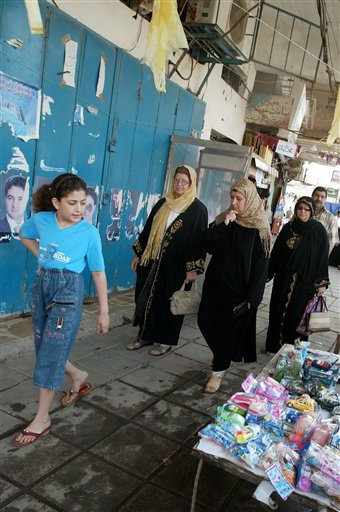


Writing this, and then sending it, was a supreme act of courage and patriotism. The last two CIA/U.S. Embassy officials who wrote cables like this one from Iraq wound up with deadended careers:
After the war, efforts within the CIA to dispel illusion and acknowledge reality in Iraq met with punishment. In November 2003, the CIA station chief in Baghdad submitted what is internally called an "aardwolf," a formal report on country conditions. "It pulled no punches in detailing how the new insurgency was gaining strength from the political and economic vacuum that the United States had allowed to develop in Baghdad," writes Risen. For his honesty, the station chief was subjected to "inflammatory accusations about his personal behavior, all of which he flatly denied," and "quit the CIA in disgust". The destruction of his career led other CIA officers to hedge their reports, especially on Chalabi. The new station chief, in an "aardwolf" in late 2004, described the lethal conditions on the ground, and as a reward "his political allegiances were quickly questioned by the White House." Reality remained unwelcome.The Emperor Bush does not like hearing that he's as naked as a jaybird.
This is some democracy that Bush has brought to the Middle East, which he hopes will "spread like wildfire throughout the Middle East." The middle class is fleeing Iraq, and without a middle class there can be no democracy. Getting U.S. troops out of Iraq is the least of it - the embassy staff is going to have to be evacuated soon.
Filed under: CIA, American Embassy, aardwolf, James Risen, Sidney Blumenthal, Iraq, Baghdad, worsening conditions, Secretary of State, Condoleeza Rice, threats, harassment
Saturday, June 17, 2006
Meet the Butt of the Joke: Lynn Westmoreland, Congressman From Georgia's 8th District
THE COLBERT REPORT, June 14, 2006
A profile of Westmoreland's constituents (Georgia's district 8, south of Atlanta, but due to redistricting, in the 2006 election Westmoreland is running in district 3) reveals them to be remarkably similar to the national average in many areas - White, Christian, suburbanites.

The question is, however, are Westmoreland's supporters voting in their best interests when they keep him in office?
Wikipedia's biography of Lynn Westmoreland:
Westmoreland likes to claim that he's a fiscal hawk, but the fact is that he has joined all other Republicans in Congress in blocking oversight and investigations into the billions of taxpayer dollars appropriated for the war in Iraq, but unaccounted for.
Westmoreland has also sponsored this legislation:
H.AMDT.664 (A029)
Amends: H.R.4437
Sponsor: Rep Westmoreland, Lynn A. [GA-8] (offered 12/16/2005)
What is in some of his constituents' and biggest contributors' best interests (real estate developers) is clearly in opposition to what voters in his district (and all over the country) are clamouring for: Secure borders, tougher laws and enforcement of existing laws barring illegal immigration, heavy employer sanctions for hiring illegal, undocumented workers.
Westmoreland was one of only 11 congressmen, all Republicans, to vote against the emergency aid package for victims of Hurricane Katrina (HR 3673).
More recently, Westmoreland led a group of about 20 Southern Republicans to stall House leadership plans to renew key provisions of the Voting Rights Act that are expiring which they believe are no longer needed or impose a financial burden on states, or the:
One congressman in this gang, Roger Wicker, said he would:
It sounds like they've got some major voter disenfranchisement plans up their sleeves. Georgia State Rep. Tyrone Brooks and president of the Georgia Association of Black Elected Officials and Charles Steele, national president of the Southern Christian Leadership Conference and a former Alabama state senator wrote:
Oh yeah, they're up to something.
We should treat laws like the Voting Rights Act as we treat viruses that we store at the CDC (like smallpox) - when there hasn't been an outbreak anywhere in the world for 100 years, THEN we can destroy the stored sample.
Mike McGraw, a "new Democrat" (conservative), is running against Westmoreland. He's the only Democratic candidate that I know of who has taken Newt Gingrich's suggestion and is running on the campaign slogan "Had Enough?"

Filed under: Lynn Westmoreland, Stephen Colbert Report, Georgia, 8th district, 3rd district, Mike McGraw
A profile of Westmoreland's constituents (Georgia's district 8, south of Atlanta, but due to redistricting, in the 2006 election Westmoreland is running in district 3) reveals them to be remarkably similar to the national average in many areas - White, Christian, suburbanites.
The question is, however, are Westmoreland's supporters voting in their best interests when they keep him in office?
Unless Westmoreland's constituents like paying $3+/gallon of gas, his voting record isn't supportive of their best interests:
Westmoreland voted against cracking down on the oil and gas industries price gouging.
Westmoreland voted for the GOP energy bill that gave billions to oil, gas and nuclear industries.
Big oil and gas industries have given Westmoreland $22,000.
Big drug interests have given $2,000 to Westmoreland over the Representative's career.
Westmoreland received $9,000 from House Majority Leader John Boehner's "Freedom Project" PAC.
Westmoreland received $5,967 from GOP Whip Roy Blunt's "Rely on Your Beliefs" PAC.
Westmoreland has taken $15,000 from Tom DeLay's ARMPAC.
- Voted to weaken House ethics rules when DeLay proposed doing so as GOP Majority Leader.
- Voted with Tom DeLay 93% of the time (through 3/31/2006)
Westmoreland voted with President Bush 90% of the time.
Westmoreland voted the GOP party line 98% of the time.
Westmoreland voted to continue awarding contracts to Halliburton even if the Pentagon's own audit processes found that more than $100 million of their contractor's costs in Iraq were unreasonable.
Westmoreland opposed expanding access to the military's TRICARE health insurance program to thousands of Reservist and National Guard members, even though 20 percent of all Reservists do not have health insurance, and 40 percent of Reservists aged 19 to 35 lack health coverage.
1,861 water systems in 29 states have been contaminated with MTBE, exposing as many as 45 million Americans to this potential carcinogen, but Westmoreland voted to protect the companies responsible from lawsuits by communities that need their help to clean up these systems.
Westmoreland voted against bipartisan reform of the Endangered Species Act.
Westmoreland voted for a massive sell off of public lands to mining interests.
While tuition costs are rising for ordinary Americans, Westmoreland voted to cut Federal student aid by $12.7 billion -- the biggest such cuts in history.
Westmoreland sided with social conservatives against patients with debilitating diseases and voted against expanding Federal funding of stem cell research.
Wikipedia's biography of Lynn Westmoreland:
Prior to his election to the United States Congress, Westmoreland owned a construction company and worked as a real estate developer. He also served in the Georgia House of Representatives beginning in 1993 and began serving as the House Republican Leader in 2001, until he resigned from that position to pursue his Congressional campaign in late 2003. He continued to serve in the Georgia House until his election to the U.S. House in 2004.
Westmoreland was the top vote-getter in his Republican primary election in 2004, but faced fellow Republican Dylan Glenn in a runoff. Westmoreland received 55.5% of the vote in the runoff, before going on to receive 75.6% of the vote in the general election against Democrat Silvia Delamar.
Westmoreland is a fiscal hawk concerned with taxes and government regulation.
Westmoreland likes to claim that he's a fiscal hawk, but the fact is that he has joined all other Republicans in Congress in blocking oversight and investigations into the billions of taxpayer dollars appropriated for the war in Iraq, but unaccounted for.
During his time as the Republican Leader in the Georgia House, he led the fight against redistricting by the Democratic majority in 2001, and then was instrumental in the re-redistricting that took place in Georgia in 2005 after Republicans won control of the Georgia legislature in the 2004 elections.
In 2005, Westmoreland received criticism for spreading a memo to fellow House members which consisted of auto-industry talking points, verbatim, even using the same font as the auto-industry document. An aide defended him, saying, "such behavior is standard practice."
During his first term in the 109th Congress, Westmoreland was appointed to the U.S. House Committee on Small Business, U.S. House Committee on Government Reform, and the U.S. House Committee on Transportation and Infrastructure. Westmoreland has sponsored a bill that the ten commandments could be displayed in courthouses in a historical setting, although when asked to name them by Stephen Colbert, he could only name three.
Westmoreland has also sponsored this legislation:
H.AMDT.664 (A029)
Amends: H.R.4437
Sponsor: Rep Westmoreland, Lynn A. [GA-8] (offered 12/16/2005)
AMENDMENT DESCRIPTION:
Amendment sets caps on employer sanctions penalties; provides an exemption from penalties for initial good-faith violations; and provides a safe harbor for contractors whose subcontractors employ illegal aliens.
AMENDMENT PURPOSE:
An amendment numbered 15 printed in House Report 109-350 to set caps on the monetary penalties set forth in Title VII of the bill for hiring or employing unauthorized aliens of $7,500 for first time offenses, $15,000 for second offenses, and $40,000 for all subsequent offenses; Provides an exemption from penalty for initial good faith violations; and provides a safe harbor for contractors if their subcontractor employees an unauthorized alien (provided the contractor did not know the employee was an unauthorized alien).
STATUS:
12/16/2005 8:01pm:
Amendment (A029) offered by Mr. Westmoreland. (consideration: CR H11976-11978, H11987-11988; text: CR H11976)
12/16/2005 9:36pm:
On agreeing to the Westmoreland amendment (A029) Agreed to by recorded vote: 247 - 170, 1 Present (Roll no. 657).
What is in some of his constituents' and biggest contributors' best interests (real estate developers) is clearly in opposition to what voters in his district (and all over the country) are clamouring for: Secure borders, tougher laws and enforcement of existing laws barring illegal immigration, heavy employer sanctions for hiring illegal, undocumented workers.
Westmoreland was one of only 11 congressmen, all Republicans, to vote against the emergency aid package for victims of Hurricane Katrina (HR 3673).
More recently, Westmoreland led a group of about 20 Southern Republicans to stall House leadership plans to renew key provisions of the Voting Rights Act that are expiring which they believe are no longer needed or impose a financial burden on states, or the:
....provision that requires states with a history of discrimination to get approval from the U.S. Department of Justice or a federal court before making election changes. Known as pre-clearance, it applies to 16 states, including Mississippi and most other Southern states.
One congressman in this gang, Roger Wicker, said he would:
...prefer federal judges approve electoral changes. "It does seem that in 2006, we should be able to have enough confidence in federal judges everywhere."
One amendment from Westmoreland would require an updated review of voting participation rates in states.
"Judge us on what we're doing today, not on what we did in 1964," said Brian Robinson, a spokesman for Westmoreland.
It sounds like they've got some major voter disenfranchisement plans up their sleeves. Georgia State Rep. Tyrone Brooks and president of the Georgia Association of Black Elected Officials and Charles Steele, national president of the Southern Christian Leadership Conference and a former Alabama state senator wrote:
Much progress has indeed been made in minority voting rights and office holding in our state, and in the South, but it has been made in large measure because of the existence of Section 5 and the other provisions of the VRA. Had there been no federal intervention in the voting and redistricting process, it is unlikely that most Southern states would have ceased their practices of denying and diluting the black vote.
Obtaining federal approval of changes to voting procedures is critical because it prevents discrimination before it happens, ensuring that minorities are able to exercise their right to vote. U.S. Rep. Lynn Westmoreland (R-Ga.) and others would like to see Georgia exempted from Section 5. However, without these protections, it is likely that new barriers to voting would wipe out the advances of the past few decades.
Discrimination in voting is still persistent in Georgia and the rest of the states covered under these provisions. Since the VRA was last renewed in 1982, Georgia has received 83 objections from the Department of Justice to changes in voting procedures --- many within the past five years. This is the fourth highest number in the country. In addition, the Georgia Legislature has now twice passed the infamous Georgia photo ID law, which Department of Justice lawyers and a federal judge stated was likely to discriminate against black voters.
The VRA is one of the most effective civil rights laws ever passed. It outlawed literacy tests, language hurdles and other discriminatory barriers that have been used to prevent minorities from voting. The provisions that must be renewed include Section 5, which requires jurisdictions with a history of discrimination in voting to get federal approval of any new voting practices or procedures; Section 203, which ensures that American citizens with limited English proficiency get the help they need at the polls; and Sections 6-9, which authorize the attorney general to appoint federal election observers where there is evidence of attempts to intimidate minority voters.
Oh yeah, they're up to something.
We should treat laws like the Voting Rights Act as we treat viruses that we store at the CDC (like smallpox) - when there hasn't been an outbreak anywhere in the world for 100 years, THEN we can destroy the stored sample.
Some Republicans also take issue with plans to vote on the measure without allowing amendments and limiting debate.
"We're going to fight tooth and nail to keep the bill from coming to the floor under suspension...We don't want to wage an insurgency over this. We want people to listen to us."
But supporters say the provisions still are needed and that the measure that took months to negotiate should be voted on intact.
Mike McGraw, a "new Democrat" (conservative), is running against Westmoreland. He's the only Democratic candidate that I know of who has taken Newt Gingrich's suggestion and is running on the campaign slogan "Had Enough?"
Filed under: Lynn Westmoreland, Stephen Colbert Report, Georgia, 8th district, 3rd district, Mike McGraw
Friday, June 16, 2006
Jack, the Cat, and the Scaredy-Bear
For Anyone Who Missed It, Or Just for Posterity, a bonus "Friday Cat Blogging":
A black bear picked the wrong New Jersey yard for a jaunt earlier this week, running into a territorial tabby who ran the furry beast up a tree -- twice.
Jack, a 15-pound orange-and-white cat, keeps a close vigil on his property, chasing small animals when he can, but his owners and neighbors say his latest escapade was surprising.
"We used to joke, 'Jack's on duty,' never knowing he'd go after a bear," cat owner Donna Dickey told The Star-Ledger of Newark for Friday's newspapers.
Neighbor Suzanne Giovanetti first spotted Jack's accomplishment after her husband saw a bear climb a tree on the edge of their northern New Jersey home's back yard on Sunday. Giovanetti thought Jack was simply looking up at the bear, but soon realized the much larger animal was afraid of the hissing cat.
After about 15 minutes peering down at the cat from the tree, the bear descended and tried to run away, only to have Jack chase it up another tree.
At this point Dickey, who feared for her cat, called Jack back home and the bear scurried back to the woods.
"He doesn't want anybody in his yard," Dickey said.
Bear sightings are not unusual in West Milford, which experts consider one of the state's most bear-populated areas.
"The Police Can Now Knock Down Your Door, Enter & Search," says U.S. Supreme Court

The law required police to knock and announce before entering your home. Not anymore, according to a ruling handed down today by the U.S. Supreme Court (the case is Hudson vs. Michigan, 04-1360):
Supreme Court backs wide police search powers:
A divided Supreme Court said Thursday that police with search warrants who barged into homes without knocking didn't risk having evidence they uncovered tossed out at trial, a ruling that civil liberties advocates called a major blow to privacy protections.
The 5-4 decision turns on a distinction drawn between how police enter a home and what they find once they're inside.
Yes, the so-called knock-and-announce rule is violated when police fail to announce their presence and wait a reasonable amount of time before entering someone's home. But no, that violation isn't sufficiently related to what they find during a search to justify banning drugs, guns or any other evidence that's uncovered from later criminal proceedings.
Justice Antonin Scalia said the increasing professionalism of police and the threat of civil suits was enough of a deterrent to keep officers from abusing their authority.

What planet is he living on?
Four justices, Alito, Roberts, Scalia and Thomas, would have given prosecutors a more sweeping victory but did not have the vote of Justice Anthony M. Kennedy. Kennedy joined in most of the ruling but wrote to explain that he did not support ending the knock requirement.
"It bears repeating that it is a serious matter if law enforcement officers violate the sanctity of the home by ignoring the requisites of lawful entry," said Kennedy, who is expected to be an important swing voter at the court.
Kennedy said that legislatures can intervene if police officers do not "act competently and lawfully." He also said that people whose homes are wrongly searched can file a civil rights lawsuit.
Justice Antonin Scalia, writing for the majority, said that there are public-interest law firms and attorneys who specialize in civil rights grievances.
"Breyer said that though police departments can be sued, there is no evidence of anyone collecting much money in such cases."
It's now official - the People of the U.S. have NOBODY safeguarding their Constitutional rights. Not the Congress, not the President, and not the "last stop," the Supreme Court.
I suppose that men who have spent most of the waking hours of their entire adult life submersed in all things law (and getting paid for it) have no idea what a royal pain in the ass seeking justice in a court of law is. It's expensive, it's all-consuming of your life (it takes years for a case to get to court), and costs a large fortune. The cost of pre-trial depositions alone is enough to discourage most people from turning to the courts for justice. While you're in depositions (and then once the trial starts), you're not working. No income.
Once you finally get to court, you're on the hook for the costs of the courtroom - it's thousands of dollars per day. If you prevail, if you win your case, you can get the court to order the other side to pay, but that's after the trial. You are required to pay court costs up front. The best you'll get is reimbursed. That could take years if the other side appeals, and expect the other side to appeal. They can afford it; they're the government. The police, the district attorney, they're not actually spending their own money - they're spending the PEOPLE'S money. And getting paid for it, too, because they're on the clock.
What the hell are these justices thinking? Can they really be this out of touch and removed from the ordinary American's way of life?
"Dissenting justices predicted that police will now feel free to ignore previous court rulings requiring officers with search warrants to knock and announce themselves to avoid running afoul of the Constitution's Fourth Amendment ban on unreasonable searches."
"The knock-and-announce rule is dead in the United States," said David Moran, a Wayne State University professor who represented Hudson. "There are going to be a lot more doors knocked down. There are going to be a lot more people terrified and humiliated."
To exclude evidence from a trial merely because of an entry violation, the court said, would unnecessarily increase the risk of "grave, adverse" consequences, including the technical exoneration of guilty - and often dangerous - criminals.
The "jackpot" for criminals would be enormous, wrote Scalia, who was joined by Chief Justice John G. Roberts and Justices Anthony Kennedy, Clarence Thomas and Samuel Alito. He said the court essentially would be issuing "get-out-of-jail-free" cards if it indulged suppression of evidence based on an entry violation.
Scalia, Roberts, Thomas and Alito went further, and seemed to question decades of precedents on the exclusionary rule, which calls for booting evidence when police break the law during a search. Kennedy didn't join that part of the opinion, however, and wrote a concurrence that said the exclusionary rule wasn't in jeopardy.
Justice Stephen Breyer penned a sharp dissent that accused the court of misreading its own precedents and defying "elementary logic." Compliance with knock-and-announce procedure is one way that the court judges the reasonableness of a search under the Constitution's Fourth Amendment, he wrote. And the threat of losing valuable evidence for defying the rules is the "driving purpose" behind provisions such as the knock-and-announce requirement.
The court's ruling means that a Detroit man's conviction for drug possession stands, despite the fact that police rushed into his home without knocking. Once inside, they found crack cocaine in Booker Hudson's pockets.
Detroit police acknowledge violating the knock-and-announce rule when they called out their presence at Hudson's door, failed to knock, then went inside three seconds to five seconds later.
Hudson's attorneys, relying on a line of court decisions over the last decade, said the officers' failure to knock and announce themselves before entering made the evidence they obtained the "fruit" of a "poisonous tree."
That idea is bedrock in Fourth Amendment law, which governs when and how government may search a citizen's home or person. It presumes, most of the time, that any illegal action during a search taints all the evidence that's turned up. It's the reason that confessions that come after a beating aren't any good and that an unreasonable search performed without a warrant can't help convict someone.
Scalia wrote, though, that "the interests protected by the knock-and-announce requirement are quite different." He said the rule was intended to protect police whose unannounced entry might trigger a self-defense instinct by a homeowner, to give citizens the chance to comply with requests for police access and to give homeowners time to "collect" themselves before answering the door.
I would like to see the precedents that Scalia is basing this twisted logic on.
Those interests don't extend to shielding relevant evidence from government eyes, he wrote.
Breyer said the court's opinion "weakens, perhaps destroys, much of the practical value of the Constitution's knock-and-announce protection." He said separating the manner of entry from the ensuing search "slices the violation too finely." He said the failure to knock and announce wasn't an independent event, but a "factor that renders the search constitutionally defective."
Four justices complained in the dissent that the decision erases more than 90 years of Supreme Court precedent.
"It weakens, perhaps destroys, much of the practical value of the Constitution's knock-and-announce protection," Justice Stephen Breyer wrote for himself and Justices John Paul Stevens, David H. Souter and Ruth Bader Ginsburg.
Booker Hudson had lost his case in a Michigan appeals court. Justices agreed to hear his appeal last June, four days before Justice Sandra Day O'Connor's surprise announcement that she was retiring.
O'Connor was still on the bench in January when his case was first argued, and she seemed ready to vote with Hudson. "Is there no policy of protecting the homeowner a little bit and the sanctity of the home from this immediate entry?" she asked.
She retired before the case was decided, and a new argument was held this spring so that her successor, Alito, could participate, apparently to break a 4-4 tie.

On its own, what the U.S. Supreme Court has done is chilling. But when you consider that the U.S. is now arresting and prosecuting people for thought crimes (this has gotten little notice in the media), it's positively a surreal nightmare:
Prosecutors presented no evidence that any of the 11 convicted men had planned U.S. attacks. But several admitted in court that they had intended to use their training to fight U.S. troops in Afghanistan, and one, Muhammed Aatique, said at his guilty plea hearing in 2003: "The United States could have been one of the possible opponents if the conspiracy had gone ahead."
Law enforcement officials said yesterday that prevention played a significant role in the decision to prosecute the case. That emphasis would continue in the post-Sept. 11 climate, they said.
"You had a cadre of people who had gone overseas and obtained training from violent jihadist groups whose primary ideology is hatred of the United States," said one law enforcement official, who spoke on condition of anonymity because he was not authorized to speak on the record.
"They were walking around the national capital area with training in small arms, infantry tactics, any number of skills that could be used to mount a strike," the official said. "It has to be unacceptable to wait until there is a threat of actual direct violence to take action."
Filed under: U.S. Supreme Court, Hudson vs. Michigan, USSC, Scalia, Kennedy, O'Connor, Ginsburg, knock and announce, fourth amendment, 04-1360, thought crime
Thursday, June 15, 2006
Bush's Bitch, Colin Powell
Colin Powell can't seem to figure out which side of the Force he wants to stand on.
Today:

The next time anybody tries to rehabilitate Powell (TCA:"All that is necessary for evil to prevail is for good men to do nothing"-Larry Wilkerson on C-Span) as "a good man," who was "taken in by this criminal administration," add this latest endorsement and photo op to the long list of Powell's betrayals of the American people.
Filed under: Bush, Colin Powell, Initiative for Global Development, 2006 National Summit
Today:
President George W. Bush is introduced by former Secretary of State Colin Powell at the Initiative for Global Development's 2006 National Summit in Washington, D.C., Thursday, June 15, 2006. "We have a moral duty to care for those who hurt here at home, and we have a moral duty to care for those as best as we can for those abroad, said the President. "That's part of the foreign policy of our country."
The next time anybody tries to rehabilitate Powell (TCA:"All that is necessary for evil to prevail is for good men to do nothing"-Larry Wilkerson on C-Span) as "a good man," who was "taken in by this criminal administration," add this latest endorsement and photo op to the long list of Powell's betrayals of the American people.
Filed under: Bush, Colin Powell, Initiative for Global Development, 2006 National Summit
"CUT OUT 'Da Noise, CUT OUT 'Da Funk" - What Bush Doesn't Want You to Know

Bush and the Republican-controlled Congress have turned up the rhetorical volume again, and have begun another frenzied campaign of do-nothing, stay-the-same-course activities against a background of congressional-yeehaw-ism. Whenever the people of the United States begin to exercise independent thought and question the failed policies of the Bush administration, we have seen Bush and the Republican party take some event and turn it into razzle-dazzle - this latest time is the killing of Zarqawi.

NOW is just one of those times in America's democratic process when the fate of the country, and the world, is in the hands of the American people. The months and weeks before a national election is the only time when democratic compact is in the hands of the PEOPLE. When the people decide whom will do the deciding for them for the following two years. And the Bush administration doesn't want the people to consider any other way but Bush's and the Neocons way. The way that has created more enemies, debt and danger for the American citizen, while lining the pockets of those in Bush's class with black gold, energy stocks' interest, defense industry contracts and high-yield dividends.

To get out of this mess that Bush and the Corporate Class has us mired in, we have to turn down the volume (cut off their microphones), and let others be heard. Others with vast and broad knowledge of the people, the problems and the situation:
”Why They Don't Hate Us," the latest book by University of California professor Mark LeVine, is his attempt to "figure out how to get out of the mess the Muslim world and the West have gotten into since 9/11," says the author. LeVine writes that "Why do they hate us?" is the wrong post-9/11 question for the West to ask. He argues that although an "axis of arrogance and ignorance" has produced the violence that defines global politics, there are models for empathy and understanding emerging in youth culture and the world music scene. LeVine recently spoke to Beliefnet senior editor Alice Chasan about his book.
Why does it appear to many Americans that discontented Muslims are violent?
There are two answers. The first is that even if a million Muslims around the world were actively engaged in terroristic violence—which is a fantasy number—that's still one million out of 1.4 billion. So we're talking about an incredibly minuscule percentage of Muslims who are actively using violence to register their discontent. The fact that the media cover the violence as if it's representative of the larger Muslim world is part of the problem, not part of the reality.
We need to understand that most Muslims who are opposed to the way their societies are governed or to the global world order are either passively accepting it and just grumbling, like most people, or trying to work through politics, or trying to emigrate to other countries. They're protesting the same way most of us protest.
Let's turn to two specific examples from the headlines. The first one is the ongoing violence in France. Young Muslims rioted for more than two weeks. What does Islam have to do with their rage, if anything?
In France, Islam is not the problem. The problem is that the people who are "revolting"--the word that President Chirac has used--are doing so because they are Muslim and have been discriminated against because of this for decades. In other words, because they are Muslim and black African, they have been discriminated against. They come from countries all of which were colonized, often brutally, by France. They come to France with the promise of the republican ideal of equality. But instead they are segregated into ghettoes, get the worst jobs, don't get access to good housing, good education, or a chance for a good life
And is this an expression of what you refer to as "ghetto Islam"?
Yes. And this is very important, because while it's a ghetto Islam in the sense that these are Muslims who have been segregated into ghettoes who are rioting, they're not doing so because they're Muslim. In fact, the last time there was a very specifically anti-Muslim event in France, the passage of the anti-head scarf ban in 2004, Muslims responded peacefully. When the organized Muslim community felt a slight by the state, it responded within the system.
This time, these are kids who are Muslim culturally, certainly by heritage. But most are not acting as Muslims. And the only good thing to come out of these riots is the surprising fact to most commentators that it appears that the extremist Muslim groups have not been a presence here. So far, they have not been able to make the inroads everyone was scared that they would make among these poor French kids who would seem to be the natural recruiting ground for them.
Does this prove or disprove that "they" don't hate "us"?
I think it proves it. I was in France a few weeks ago, right before the riots broke out, speaking to [Muslim] activists. They were saying the same thing the kids are saying now: "We want to become integrated into France." This is not a bunch of nihilistic kids who have lost all hope. This is a typical French response. There's a history of this kind of violent response in France over exclusion from the vaunted French Republican identity. So Islam has played a role in many ways by its absence; not by its presence.
Let's talk about the second news-related example: the recent terror attacks in Amman, Jordan—Muslims killing Muslims.
It's an example of what I believe is the failure of Muslim leaders across the board to respond early on when this kind of jihadi culture was emerging in the '80s and '90s. Too many mainstream and leading Muslim voices either ignored it, or excused it, or justified it, or criticized it except when it came to the two or three exceptions, which always includes Israel and one or two others, such as Chechnya.
I wrote a piece called "Sheik al-Dhari's Disastrous Gamble and Ours". When I was in Iraq and met with him last year, I asked him how Iraqis could resist the U.S. occupation. He said, "We will get rid of the Americans even if means killing every infidel." This kind of nonchalant embrace of violence is just one example of the larger unwillingness of too many--although by no means all or even most--Muslim leaders to take on the violent culture that has emerged within Muslim societies and has allowed this to mushroom. And it's at least partly why, in my opinion, the so-called moderate religious leaders have become increasingly irrelevant.
Why did this happen in Amman?
Because [Al-Qaeda in Mesopotamia leader] Abu Musab al-Zarqawi and the insurgents in Iraq understand full well that Amman is the foreign base of the occupation of Iraq. Tens of thousands of Westerners are there as part of the Iraq occupation. And Amman has become a place where Iraqis who are part of the political process come to meet each other if it's generally too dangerous to do so in Iraq. These bombings, in one sense, were given a religious veneer in the way Zarqawi talks about them: Jordan in bed with the infidels and the crusaders. But the truth is that the terrorists went there because these hotels in Amman have become a strategic base for the occupation of Iraq, which is the crucial thing they're fighting against.
A culture and a system helped turn Zarqawi from a street thug into the arch-terrorist successor to Osama bin Laden. And that system, while it's still very much a minority within Islam, has a lot of power and money. And too many Muslim leaders have not acknowledged it or tried to deal with it until recently.
I want to constantly hold up a mirror to both sides. Because when you hold up a mirror to either side, you always see the other. So if I want to challenge Muslims to deal with the violence that has increasingly come to define Muslim politics or responses to oppression, you need to do the same thing in America and see how violent a society America has become.
Take the invasion of Iraq, for example, from a Muslim perspective: We've gone into a country without any good reason, based on lies, and killed over a 100,000 people, and brought about exactly the opposite of what we said we were going to do. And only a tiny minority of Americans has actively come out and opposed it. So it looks as if American society backs violent, aggressive, and unlawful behavior of their government. That's how Muslims view us. With good reason, the same way we can look at the Muslim world and say, "Why aren't there bigger outcries?"
How is it that what I call this pathology of violence has been able to emerge in the Muslim world? It's because too many Muslim leaders didn't stop it at the root because it wasn't directed against them. And it was a good way to channel people's anger toward someone other than their own societies and their own elites, or their own positions.
This is where arrogance and ignorance come in: Both Muslims and Westerners, Americans more specifically, are ignorant of the fact that it's still a small minority of people involved in this violence and hatred and so-called clash of civilizations.
If the Muslim world has a high percentage of regimes that oppress their people and encourage them to direct their anger outward rather than to have internal reform, why are you critical of those people who want to bring democracy to the Muslim world?
I am in no way critical of wanting to bring democracy to the Muslim world. What I'm critical of is the hypocrisy involved with people assuming you can bring democracy through occupation, invasion, or force. When I go to the Middle East, the thing that people tell me is, the rhetoric is so great; Bush constantly says that we are supporting Arab democracy or Middle East democracy. But the reality is U.S. policies have in no way changed. We have not fundamentally challenged any of our ally governments in the region to democratize.
For example, Professor Noah Feldman went to Iraq after writing a book called "After Jihad," which is a great idea. Who wouldn't like jihad to be transcended? But when you start the book as he did, with a hadith from the Prophet Muhammad about the greater jihad being spiritual and the lesser jihad being on the battlefield, you begin in the wrong way. This is not considered sound, strong hadith. Most Muslim theologians do not believe that the prophet Muhammad actually said it. And conservative Muslims have been using this fact to bash moderate Muslims, saying, in effect, "You don't even know your own religion. You're using this hadith as if this is a strong argument for stopping violence, or stopping jihad when, in fact, it's not considered to be the Prophet's words."
I'm all for people wanting to go to Iraq after the invasion. I went to Iraq after the invasion. But Feldman went in as part of an occupying army [as an adviser to the Coalition Provisional Authority on the creation of the Iraqi constitution]. What Feldman and others could have done is to go to Iraq as citizens and say, "Look, I don't support this war. I think it was immoral. But I'm here if you need help to build a free and democratic society."
In the book, you call for a change in our thinking about the Muslim world to ask "What must it feel like to be a Muslim?" Can you give examples of how Jews or Christians could respond to events such as the London subway bombing or the unrest in France, or the bombings in Amman, through this new paradigm?
I asked that question in the context of the fact that with the exception of a small part of the Arabian peninsula, most territory in the Muslim world has been colonized by Europe and/or America in the past 200 years. Muslims perceive this colonization and brutalization as ongoing today.
So when most Muslims are thinking about their interactions with the West, or with non-Muslims...
They look at them through a prism of centuries of European domination and then American domination.
And even people who are not well educated think that way?
Sure. You don't need to be schooled to know who your colonizers were. That's the one bit of information people generally know. Muslims are looking at this new global world from the perspective of two centuries or more of European imperial and colonial domination and American involvement they feel is continuing right now.
When Muslim critics write about globalization, secular or religious, they frequently describe it as a new form of imperialism. It's a matter of contemporary reality. And that's the first thing we need to understand when we try to understand any specific actions by someone acting in the name of Islam.
In France, these kids are not rebelling in the name of Islam. They happen to be Muslim. But if we're speaking specifically about people who are using Islam for violence, which is what most Americans care about, we need to look at the worldview that has been shaped, the vision--based on the history that most feel, with good reason, is still the reality.
Then we need to understand why there is no Muslim Gandhi. In fact, there have been many Muslims who have tried to develop nonviolent alternatives. But these people are oppressed by their political leaders, ignored, or actively worked against by America, such as someone like [scholar] Tariq Ramadan. And largely ignored by the media.
So a few Muslims use spectacular violence to change this situation and they get the media. Then the millions who are trying to figure out other ways--the intellectuals, the activists, the academics, the progressive religious scholars--are largely ignored or even actively worked against. So whenever we see this violence, we need to say, "OK, this is horrible. But the Muslim world is much bigger than this." And as consumers of news and information, we need to be determined to find out all the other ways that Muslims are reacting against the violence so that we can help them prevail.
Most Americans are not political activists. Is a better model found in the example of individuals like Professors Akbar Ahmed and Judea Pearl, who conduct their Muslim-Jewish dialogues throughout the country and around the world?
This is the way it's going to happen. These are two people, unfortunately, united by a tragedy [the murder of Judea Pearl's son, Daniel Pearl, by terrorists in Pakistan], and it's sad that it takes tragedy to bring people together. But at least that's something good that can come out of it.
Talk about your personal journey. How did it bring you to concern for understanding people in the Muslim world?
I came to this as a kid, growing up imbued with biblical prophetic ideals, plus the more recent secular prophets, Gandhi and King. In my household, that was what it meant to be Jewish.
You're also a musician who has played with musicians around the world. That greatly informed your perspective in the book, where you propose "culture jamming" to help heal the breach between the Muslim world and Western society.
I've always noticed that musicians tend to get along better than everyone else, and that the greatest music is usually made when you have musicians from many different musical or cultural traditions coming together. Musicians can think beyond the cultural and political differences before and better than anyone. As the best blues guitarist in Iraq told me last year, "Look, I know John Coltrane. I know Jimmy Hendrix. I know all your great musicians. How many Americans actually know any of our great musicians?"
Great music only comes when you think beyond difference because if you put a bunch of differences together on a page, you're not going to create any kind of organic whole. So music is, I think, a great metaphor for how people need to relate.
Culture jamming originally meant intercepting the dominant culture's messages and replacing them with subversive messages. For example, someone would take the Marlboro man's face on a billboard and turn it into a skull and bones. But for me, as a musician, culture jamming means bringing together artists, activists, scholars, religious leaders from around the world to talk and perform and create together. I've done these culture jams in almost a dozen countries; it's the best way to help figure out new ways we can come together to transcend our differences.
This is where religion is so crucial. Not as a metaphor, but as an example. Religions are all based on critique and then on transformation. Similarly, culture jamming is the crucial way to give people a positive vision, a new kind of identity based on what I call empathy, which, for me comes from the great French-Jewish philosopher, Emmanuel Levinas. His idea of empathy was based on radically recognizing the other, whoever your others are. In other words, getting rid of any suppositions you have, getting rid of any historical relations of power.
Take, for example, the way the French look at their Muslim populations--through the prism of "These are the people we colonized. These people are somehow less than us." [French Interior Minister Nicolas] Sarkozy calls them "subhuman scum." This is very relevant because Sarkozy's not just the interior minister, he's also the religion minister. The minister of religion for France says he's going to sandblast subhuman scum out of existence: This is how the man is talking about the 12-24-year-old who are revolting against decades of discrimination. So this is what we're up against. In the face of such attitudes, we need to be able to create a new, transformative vision.
The Abrahamic faiths have the idea of human beings made in the image of God.
Absolutely. Levinas got his idea of empathy from his deep knowledge of Talmud and Jewish tradition. And his great student Jacques Derrida, an Algerian Jew, also learned much of his activism from his being the absolute other. That forced him to think about how you see through false dichotomies and simplistic descriptions of people.
You're saying both sides seem to be mutually deaf and blind to one another's complexity.
I'll give you one example. I'm doing a project now called Heavy Metal Islam, meeting with and recording, performing, dialoguing with some of the best rock and hip hop artists in the Muslim world. I was with a bunch of them in Lebanon a few weeks ago during Ramadan. These are heavy metal musicians. So on one hand, you think of heavy metal musicians: long hair, crazy, completely libertine, without principles, no morals at all. But the truth is that these are smart guys who see no dichotomy between being religious and deeply spiritual Muslims and also embracing the most quintessentially American popular cultural forms like heavy metal or hip hop.
So why are they invisible to most media?
They don't fit the paradigm we have, the false dichotomies. We think if you're a metal musician, you can't be smart. You certainly can't be a religious Muslim and be progressive. It's too hard to wrap your head around a religiously progressive Muslim heavy metal musician.
It's not too hard for the musicians or their fans. I was playing at a festival in Morocco this summer, where there were 20,000 kids for four nights in a row to see these people. They can be all these things. And that's why we need to be much more willing to search out the people who are still in the shadows, who might have the answers for what kind of alternative identities we need to construct if we're going to really move beyond the war on terror.
Is that what you call for at the end of your book as the hudna, the truce that you want the West to work out with Islam?
Our leaders, on both sides, have decided that violence is the best way to relate to each other. And in our names, huge sums of money and a huge amount of blood is being spilled to pursue this agenda. The only way it's going to stop is just more and more of us say, "You know what? We don't have the answers. We don't necessarily know who's ultimately to blame but we know that this situation is untenable. We want all violence by all sides to stop." On all sides, whether Muslim terrorists, U.S. soldiers in Iraq, Palestinians, or Israelis. People on the grass-roots level have to say, "Enough!"
We need a truce so that we can then move toward real dialogue and real peace and real democracy. America has one standard for allies, another standard for everyone else. We want Iraq to be democratic supposedly, but our biggest allies in the region, like Jordan, or Morocco, or Egypt, or Pakistan, aren't. The hard-core left--which largely sets the agenda of the anti-war and alternative globalization movements--wants to fight against the occupation of Iraq and Palestine, but could care less about the occupation of Tibet, or about the legitimate rights of other peoples, whether it's Jews or others, to have their own national or communal goals. So all of us are operating with double standards. And that allows the status quo to continue.
If everyone adopted one standard, which I try to articulate at the end of the book, then it would be impossible for us to endorse all the things we do because we couldn't by our very own standards.
Where do we start?
The first thing is education. We start by understanding the double standards. If we're talking about Americans, by educating ourselves about the reality of our foreign policy and our history. Because Muslims know the history and the present reality of American foreign policy much better than Americans do. Once we understand the realities, we can then know what we need to change. Second, we need to take on the hard task of being brutally honest with each other. And accepting that, My God, my government, let's say for America, or my religion, if you're a Muslim or a Jew or a Christian, has been used to kill or to oppress many, many people or to engage in terroristic violence against many people and I can't be passive anymore.
Why is there so much hatred toward Jews within Islam?
There's a very confusing relationship toward Jews. On one hand, when Islam emerged, Judaism was the main institutionalized historically powerful religion. Jews were the first real organized group that Muslims had to encounter, especially in Medina. And in Muslim theology, the idea of a Jewish betrayal of Muhammad and of the early Muslims produced a very strong trend of anti-Jewish sentiment within Islam right from the start. Muhammad is coming in saying that, he's completing their book. You know, he is coming to fulfill God's will. Well, they heard that before, didn't they? Someone else said that 622 years earlier. So Jews were quite naturally not going to take kindly to yet another person saying he's completing a process that they thought was completed in their own religion, and then his followers wanting to take all the spiritual and economic and political power into their hands.
So there's certainly clear historical and theological reasons why Islam has a negative view toward Judaism at its very start. But the reality is that as Islam developed, that view was muted by the fact that Jews were able to live in Muslim societies. Certainly there was prejudice and certainly there were attacks and discrimination and even violence against Jews, but compared to Europe during much of the past 1,400 years, Jews have fared better in the Muslim world.
In contemporary politics, you have Israel, a state defining itself as Jewish, which is involved from a Muslim perspective in taking away land from Muslims, especially the third most holy land in Islam, and being aligned to the two most powerful forces in the world in the last century, Britain and America. It's not an excuse for Muslims to be this way. It's just an explanation.
But, of course, we're not living in 628. Or 624. And as Tariq Ramadan and other progressive Muslim leaders have said, we need to talk about today. We need to talk about how we build, from a Muslim perspective, a new umma (peoplehood), or, in Judaism, a new am (people or nation) that encompasses everyone.
If something is good for Islam, but is bad for someone else, then we can no longer see it as being good for Islam. To me that is the perfect statement of how all of us need to be thinking. If something's good for Judaism or Christianity, or Islam, and in so doing, it's bad for someone else, then we can no longer define it as good. And that's where I think the idea of one standard of doing things everyone can embrace.
And that's where your idea of "human nationalism" comes in?
The human nationalism idea was inspired by a Muslim writer who said, "You're trying to impose an inhuman globalism on us. But you haven't even given us the chance to have a human nationalism yet." In other words, we Muslims have never been able to realize the West's great humanistic ideals of liberty, fraternity, equality, and you're trying to take away the state and impose some homogenizing globalization on us that's only going to exclude us and marginalize us even more! This is certainly not something most Muslims, or any of us, would accept if we were in their shoes.
So the question is, what can we work out together? That's really the discussion we need to be having.
Filed under: Bush, Mark LeVine, Why They Don't Hate Us
Can We Finally Bury This?


Or am I being overly optimistic in thinking that we've matured as a nation?

Filed under: Bush, Michael Dukakis, Mission Accomplished, Tony Snow, Dan Bartlett, parachute clips, tank, helmet
American Revolutionary War Flags Sell for Over $17 million

Happy Flag Day:
An anonymous bidder paid nearly $17.4 million Wednesday for four rare flags from the American Revolution. The remarkably intact regimental standards captured by a British officer in 1779-80 were put up for auction by one of his direct descendants 225 years later.
"These are inspirational, an extraordinary window into the birth of our country," said David Redding, a vice president of Sotheby's, which conducted the sale.
Redding said that during wars of the 18th century, the primary targets in a battle were the opposing commanders and their units' flags, as trophies of victory.
"You can imagine the soldiers carrying them, who suffered grievous wounds and made sacrifices to defend what were sacred objects," he said in a telephone interview. "You look at them, and you really get a sense of looking at something that has a great deal of spiritual significance."
The final sales price for the four flags was well over Sotheby's pre-sale estimate of $4 million to $10 million. The eventual buyer, bidding by telephone, asked not to be identified, Sotheby's spokeswoman Lauren Gioia said.
Only about 30 Revolutionary War flags are known to exist, and all except the four sold at auction are in museums or other institutional collections, Sotheby's said. Most also are in physical fragments with only bits of historic information available about them.
The four flags, by contrast, are in good condition and their histories were well documented by Lt. Col. Banastre Tarleton, a firebrand British officer who captured them in battles in two widely separated locations nearly a year apart.
On July 2, 1779, the 24-year-old Tarleton led his cavalry unit, known as the Green Dragoons, in a surprise attack on the Continental Army's 2nd Light Dragoons, a Connecticut regiment also known as Sheldon's Dragoons, at Pound Ridge.
The redcoats routed the Americans, capturing supplies, weapons and the unit's battle flag -- a banner with 13 red and white stripes and a field with a painted thundercloud.
Nine months later, on May 29, 1780, Tarleton did it again, capturing three flags belonging to a Virginia regiment led by Lt. Col. Abraham Buford, in a clash at Waxhaws, on the border of North and South Carolina.
In a post-war memoir, Tarleton said "upwards of 100 officers and men were killed and "three colours ... fell into the possession of the victors."
The three flags, Sotheby's said, are "the only intact set of American battle flags surviving from the Revolutionary War."
The main flag is of gold silk, depicting a beaver gnawing on a palmetto tree, the state symbol of South Carolina. The others are gold and blue silk, bearing the word "Regiment."
Sotheby's identified the seller of the flag collection as Capt. Christopher Tarleton Fagan, a direct descendant of the officer whose forces captured them.
The Connecticut Dragoons flag, with an estimated presale value of $1.5 to $3.5 million, was sold for $12.36 million. The group of three Buford flags, known as the Waxhaws Colors, went for $5.056 million, after a presale estimate of $2.5 to $6.5 million.
Given the rarity of these flags and their historical provenance, do you think they belong in a private collection or in a public museum, displayed for all who want to see them?
Wednesday, June 14, 2006
Witnesses to Killings of Mother & Pregnant Daughter in Labor in Iraq by U.S. Soldiers
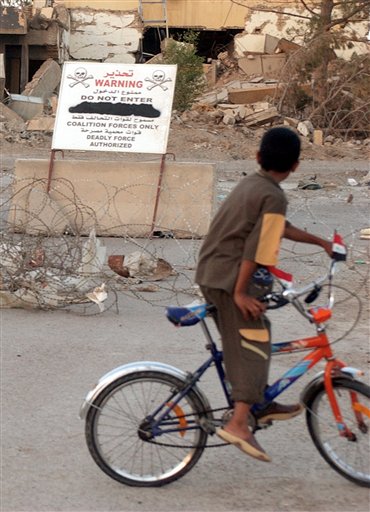
Amy Goodman of Democracy Now! interviewing Dahr Jamail, an Iraqi journalist with video of the scene in Iraq and statements by eyewitnesses where two women (one pregnant and in labor, and her mother) on their way to a hospital in Samarra in a car driven by the women's son/brother, were shot and killed by U.S. snipers.
Tuesday, June 13, 2006
Everything I Need to Know About the Zarqawi Killing & Bush's Camp David Summit I Learned on FoodTVPart 3*

Son of a bitch.
Rove managed to get the "chick magnet" (Air Force 1) in, too.
Filed under: Bush, Iraq, Air Force 1
Everything I Need to Know About the Zarqawi Killing & Bush's Camp David Summit I Learned on FoodTV, Part 2*


Killing Zarqawi was the official kick-off of the Republican's 2006 midterm election campaign, as designed by Karl Rove.
If I'm right, if Patrick Fitzgerald isn't going to indict Karl Rove (or anybody else in the Bush administration), Rove found out about it before last week. And more likely even before that. Like a few weeks ago. And the decision to locate and kill Zarqawi, convene a photo op of Bush's cabinet, stage it all at Camp David, came out of Karl Rove's office, as his strategy for Republicans winning the midterm elections this November.
It's vintage-Rove.
What do you do when your candidate is losing in the polls, when he's hemorrhaging, when he's BLEEDING OUT before everybody's eyes? You have to do something that will change the subject. Something drastic, dramatic, that will pre-empt regular programming.
Since you're not willing to change the policies that are causing your numbers to dive, you're going to have to create a diversion, shock and awe, CHANGE THE SUBJECT by doing your job dramatically. Kill Zarqawi.
Lend all the stagecraft that you can to the event. Pull out all the stops. You don't want people looking too closely, asking questions, like "How is it that you were able to do it now when you've only been after Zarqawi for years?" or,
 "Two 500-lb. bombs that pulverized concrete and rebar, incinerated the other people in the house, and yet Zarqawi's body survived intact (he was alive for an hour beyond the blast), in good shape, and recognizable....how is that possible?"
 No, you don't want those types of questions lingering in the public discourse, so you'll have to keep up a brisk, tight schedule of events after the killing. And keep the visuals coming:

A gold-framed blow-up photograph of the dead Zarqawi (suitable for Sotheby's),

[Physical Scientist Kristi Oberbroeckling carries a bag containing three boxes of biological samples believed to be from Abu Musab al-Zarqawi or his associates in to the FBI Lab in Quantico, Va., on Thursday evening, June 8, 2006. (AP Photo/Kevin Wolf, pool)]
Ship DNA samples back to U.S. government labs (and have a pool photographer standing by to photograph the delivery); fly in to Iraq two of the top U.S. Defense Department forensic pathologists to perform the autopsies on Zarqawi, Rahman and a third man, keep the raids coming, kill more of them "terr'ists," release autopsy results (but not the documentation).

Stall the tough stuff, like, "Where and how did the FBI find a different DNA sample from al-Zarqawi for comparison?" and "Who gets Zarqawi's body for burial?" - put them off, change the subject before people begin to realize that these aren't difficult questions to answer, or state secrets..... just KEEP EVERYTHING and EVERYBODY MOVING!
Change the stage, move the location of the action. From the battlefields of Iraq to the White House, and fill the schedule with activities. Stage a PRODUCTION: A Presidential War Council, using all of the trappings of the office of the Presidency to make the candidate look *PRESIDENTIAL*. It's Rove as Busby Berkley, directing a Mickey Rooney-Judy Garland show-stopping *extravaganza*: "Let's put on a show, AT CAMP DAVID!"
Surround Bush with his entire Cabinet and the Chairman of the Joint Chiefs. No substance to the headlines this would generate, just photo ops against a beautiful summer back-drop "Bush and His War Council at Camp David", after the killing of Zarqawi. It's back to politics-as-usual. Show biz, Republican-style. In fact, everything that this Republican party does is political show biz:

George W. Bush, surrounded by members of his Cabinet and his national security team during the first day of a two-day meeting on Iraq. Among those attending the war council summit at Camp David were Chairman of the Joint Chiefs of Staff General Peter Pace, Vice President Dick Cheney, Secretary of Defense Donald Rumsfeld, Secretary of State Condoleezza Rice, Secretary of Commerce Carlos Gutierrez and Secretary of Agriculture Mike Johanns, National Security Advisor Stephen Hadley, Attorney General Alberto Gonzalez, National Security Director John Negroponte, Energy Secretary Sam Bodman.
Too bad it's only a short armored SUV drive or a Marine 1 helicopter hop to Camp David, because if there was ever a job for Air Force 1, this was it. If Rove could have figured out a way to fit in the ultimate "chick magnet" (Air Force 1), he would have.
If you don't believe that the killing of Zarqawi, the rallying of Bush's cabinet at a "war council summit" at Camp David was planned weeks ago, that it was all politically calculated by Rove to jumpstart the Republicans bid to hold onto power through the fall elections, you just haven't been paying attention.
Karl Rove on manipulating the media:
In 1986, Rove was managing Bill Clements in the Texas gubenatorial campaign against incumbent Mark White. Clements was steadily losing what had been a 35-point lead in the polls. Clements was not unlike George W. Bush and Dan Quayle - ignorant and inarticulate. It had been widely assumed and reported in the media that Governor White was going to wipe the floor with Clements in the debates and easily overtake Clements in the polls after the first debate. Anticipating the next day's headlines ("Governor Wipes the Floor with Rove's Candidate Clements"), Rove was said to have been desperate to keep the Texas press corps away from the first debate.
In the hours before the debate was set to begin, Rove notified the press that:
....a listening device [was] allegedly found in Rove's office by a private security firm a few days before a televised debate. The case made headlines around the state. It was investigated by Rove's friend, FBI agent Greg Rampton, who never found the alleged perpetrator.
According to James Moore and Wayne Slater in "Bush's Brain," the announcement by Rove that a bugging device had been found in his office brought the Texas press corps to his office and kept them there, away from the debate site (two hours away). Rove spun the story that his office had been bugged. No proof. But the insinuation that White's people had carried out the bugging was reported by the media. The press corps didn't cover the debate, and Rove's candidate was spared their excoriation in print the following day. It changed the momentum of the race and is recognized as the turning point in the campaign. Rove's candidate Clements defeated Governor White. It served as the blueprint for the campaign that Rove ran for Bush in 1992 against Governor Ann Richards.
In the movie made from the book "Bush's Brain," John Weaver, vice-chair of the Clements campaign, says that he was initially “euphoric,” but then “It began to look fishy to us.” An FBI report said that judging by its battery use, the bug had been in the wall just 15 minutes when it was “discovered” (by Karl Rove). According to Rove's statement to investigators and his appointment book, he had been working in his office for several hours, never leaving, before he "discovered" the device. That would mean that the perpetrator planted the listening device with Rove present in the room.
John Weaver now says he doesn’t think White had anything to do with it.
Glenn Smith, a journalist with the Houston Post and probably Rove’s harshest critic in the film, comments:
“I like to say I play hardball, but I would never consider planting a bug in my own office and blaming it on my opponent.”
That's because Glenn Smith doesn't understand that what Rove does isn't hardball; it's CRIMINAL. Somewhere in the last 35 years, Republicans have gotten away with cloaking illegal acts in benign gaming terms.
Molly Ivins, April 2006:
"In 1991, Rove was undergoing state Senate confirmation hearings for an appointment to the East Texas State University board of regents. Sen. Bob Glasgow was questioning Rove about his work for Gov. Bill Clements in the 1986 campaign against Gov. Mark White":
Glasgow: "Ah, Mr. Rove, would you now tell us publicly who bugged your office that you blamed upon Mark White publicly and the press statewide?"
Rove: "Ah, first of all, I did not blame it on Mark White. If, ah, if you'll recall I specifically said at the time that we disclosed the bugging that we did not know who did it, but we knew who might benefit from it. And no, I do not know. ..."
Glasgow: "And are you now satisfied that Mark White and the Democratic Party did not bug your office as you -- as you released, ah, to the newspapers?"
Rove: "Senator, I never said Mark White bugged my office, I'm not certain he has an electronic background. I never said the Democratic Party bugged it either. ... As to who bugged it, Senator, I do not know -- and the FBI does not know. ..."
Glasgow: "How long have you known an FBI agent by the name of Greg (Rampton)?"
Rove: "Ah, Senator, it depends -- would you define 'know' for me?"
Glasgow: "What is your relationship with him?"
Rove: "Ah, I know, I would not recognize Greg (Rampton) if he walked in the door. We have talked on the phone a var- -- a number of times. Ah, and he has visited in my office once or twice, but we do not have a social or personal relationship whatsoever. ..."
Glasgow: "During the Rick Perry campaign (against Jim Hightower), did you have any conversations with FBI agent Rampton about the course and conduct of that campaign?"
Rove: "Yes, I did, two or three times. ..."
Glasgow: "Did you issue a press release in Washington, at a fund-raiser, about information you'd received from the FBI implicating -- implicating, ah, Hightower?"
Rove: "We did not issue a press release. ... We did not issue a news release. I talked to a member of the press ..."
Glasgow: "I'm gonna let you expound on anything you want to. Ah, involved in campaigns that you've been involved in, do you know why agent Rampton conducted a criminal investigation of Garry Mauro at the time you were involved in that campaign, pulled the finance records of Bob Bullock at the time you were involved in that campaign, pulled the campaign records of Jim Hightower at the time you were involved in that campaign?"
Rove: "Well, Senator, first of all, as I said before, I was not involved in either Bob Bullock or Garry Mauro's campaigns or the campaigns of their Republican opponent. I'd be hard pressed to tell you who Garry Mauro's opponent was in 1986. Ah, and I'd -- think I'd be hard pressed even to remember who Bob Bullock's opponent was in 1986. So I can't answer that part of the question. I do know that I became involved in Rick Perry's campaign in November of 1989. At that point there was already an investigation ongoing of the Texas Department of Agriculture, prompted by stories which had appeared in August and September, I believe, in The Dallas Morning News regarding the use of Texas Department of Agriculture funds."
Glasgow shifts to the Board for International Broadcasting appointment: "And in answering a question for that perspective (sic) federal appointment, did you make a claim in there that you were involved in the Hightower investigation at the request of special agent Rampton of the Federal Bureau of Investigation?"
Rove: "No, sir."
Glasgow: "You did not make that statement in response ..."
Rove: "I did not, and I was ..."
Glasgow: "Let me finish my question. Did you make that statement in response to a written questionnaire?"
Rove: "Ah, Senator, ah, no, I did not make that statement, but I ..."
Glasgow: "Thank you very much."
Rampton, who was subsequently involved with the FBI operation at Ruby Ridge, said that he had not talked to Rove about the Hightower case. Told that Rove had so claimed in his federal questionnaire, Rampton said:
"Let me think. I couldn't recall talking to him on that particular case at all. My memory, if there was a conversation we had on that case, well, I can't recall it. He was not an integral part of that case. I don't even remember bouncing anything off him as somebody who was familiar with politics in Austin."
I sure hope I'm wrong.
[*Explained in a future post.]
Filed under: Bush, Camp David, Republicans, war council, Rove, Bush's Brain, Governor White, Bill Clements, Zarqawi, James Moore, Wayne Slater, Greg Rampton, James Weaver, Ann Richards, Iraq, Radio Shack, bugging device, Jim Hightower
Subscribe to:
Posts (Atom)