
Monday, April 28, 2008

Friday, April 25, 2008
Is It All Over (Superdelegates Making Up Their Minds) But The Shouting?
Democrats' Suspense May Be Unnecessary
At Politico.com, Elizabeth Drew reports:
The torrent of speculation about the end game of the Democratic nomination contest is creating a false sense of suspense – and wasting a lot of time of the multitudes who are anxious to know how this contest is going to turn out.
Notwithstanding the plentiful commentary to the effect that the Pennsylvania primary must have shaken superdelegates planning to support Barack Obama, causing them to rethink their position, key Democrats on Capitol Hill are unbudged.
“I don’t think anyone’s shaken,” a leading House Democrat told me. The critical mass of Democratic congressmen that has been prepared to endorse Obama when the timing seemed right remains prepared to do so. Their reasons, ones they have held for months, have not changed – and by their very nature are unlikely to.
Essentially, they are three:
(a) Hillary Rodham Clinton is such a polarizing figure that everyone who ever considered voting Republican in November, and even many who never did, will go to the polls to vote against her, thus jeopardizing Democrats down the ticket – i.e., themselves, or, for party leaders, the sizeable majorities they hope to gain in the House and the Senate in November.
(b) To take the nomination away from Obama when he is leading in the elected delegate count would deeply alienate the black base of the Democratic Party, and, in the words of one leading Democrat, “The superdelegates are not going to switch their votes and jeopardize the future of the Democratic Party for generations.” Such a move, he said, would also disillusion the new, mostly young, voters who have entered into politics for the first time because of Obama, and lose the votes of independents who could make the critical difference in November.
(c) Because the black vote can make the decisive difference in numerous congressional districts, discarding Obama could cost the Democrats numerous seats.
One Democratic leader told me, “If we overrule the elected delegates there would be mayhem.” Hillary Rodham Clinton’s claim that she has, or will have, won the popular vote does not impress them – both because of her dubious math and because, as another key Democrat says firmly, “The rules are that it’s the delegates, period.” (These views are closely aligned with Speaker Nancy Pelosi’s statement earlier this year that the superdelegates should not overrule the votes of the elected delegates.)
Furthermore, the congressional Democratic leaders don’t draw the same conclusion from Pennsylvania and also earlier contests that many observers think they do: that Obama’s candidacy is fatally flawed because he has as yet been largely unable to win the votes of working class whites. They point out something that has been largely overlooked in all the talk – the Ohio and Pennsylvania primaries were closed primaries, and, one key congressional Democrat says, “Yes, he doesn’t do really well with a big part of the Democratic base, but she doesn’t do well with independents, who will be critical to success in November.”
At Politico.com, Elizabeth Drew reports:
The torrent of speculation about the end game of the Democratic nomination contest is creating a false sense of suspense – and wasting a lot of time of the multitudes who are anxious to know how this contest is going to turn out.
Notwithstanding the plentiful commentary to the effect that the Pennsylvania primary must have shaken superdelegates planning to support Barack Obama, causing them to rethink their position, key Democrats on Capitol Hill are unbudged.
“I don’t think anyone’s shaken,” a leading House Democrat told me. The critical mass of Democratic congressmen that has been prepared to endorse Obama when the timing seemed right remains prepared to do so. Their reasons, ones they have held for months, have not changed – and by their very nature are unlikely to.
Essentially, they are three:
(a) Hillary Rodham Clinton is such a polarizing figure that everyone who ever considered voting Republican in November, and even many who never did, will go to the polls to vote against her, thus jeopardizing Democrats down the ticket – i.e., themselves, or, for party leaders, the sizeable majorities they hope to gain in the House and the Senate in November.
(b) To take the nomination away from Obama when he is leading in the elected delegate count would deeply alienate the black base of the Democratic Party, and, in the words of one leading Democrat, “The superdelegates are not going to switch their votes and jeopardize the future of the Democratic Party for generations.” Such a move, he said, would also disillusion the new, mostly young, voters who have entered into politics for the first time because of Obama, and lose the votes of independents who could make the critical difference in November.
(c) Because the black vote can make the decisive difference in numerous congressional districts, discarding Obama could cost the Democrats numerous seats.
One Democratic leader told me, “If we overrule the elected delegates there would be mayhem.” Hillary Rodham Clinton’s claim that she has, or will have, won the popular vote does not impress them – both because of her dubious math and because, as another key Democrat says firmly, “The rules are that it’s the delegates, period.” (These views are closely aligned with Speaker Nancy Pelosi’s statement earlier this year that the superdelegates should not overrule the votes of the elected delegates.)
Furthermore, the congressional Democratic leaders don’t draw the same conclusion from Pennsylvania and also earlier contests that many observers think they do: that Obama’s candidacy is fatally flawed because he has as yet been largely unable to win the votes of working class whites. They point out something that has been largely overlooked in all the talk – the Ohio and Pennsylvania primaries were closed primaries, and, one key congressional Democrat says, “Yes, he doesn’t do really well with a big part of the Democratic base, but she doesn’t do well with independents, who will be critical to success in November.”
Wednesday, April 23, 2008
Crazy? Or Crazy Like A Fox?
What Bill Clinton's Odd Denial of Previous Day's Comment ("They Played the Race Card On Me") May Be About....Because He Surely Did Say It
Here are Chris Matthews and Chuck Todd talking about on Pennsylvania primary day:
MSNBC's pundits have a habit of bending over backwards to give the Clintons every benefit of doubt (or ignore the obvious entirely), and Chuck Todd doesn't break with that tradition.
Let's look at the story as it unfolded on Monday.

CNN reports:
Question for Bill Clinton: Is your knowledge of these memos (the "memos from the campaign and everything" that you spoke about with Susan Phillips in the WHYY interview that you claim "show that they planned to do it all along") connected to the break-in of Obama campaign offices in Allentown on April 19, 2008, where laptops and cell phones were stolen?
The memo on the subject of race from Amaya Smith, S. Carolina press secretary for Obama for America lists news accounts of events during the campaign, and nothing else.
Here are Chris Matthews and Chuck Todd talking about on Pennsylvania primary day:
MSNBC's pundits have a habit of bending over backwards to give the Clintons every benefit of doubt (or ignore the obvious entirely), and Chuck Todd doesn't break with that tradition.
Let's look at the story as it unfolded on Monday.
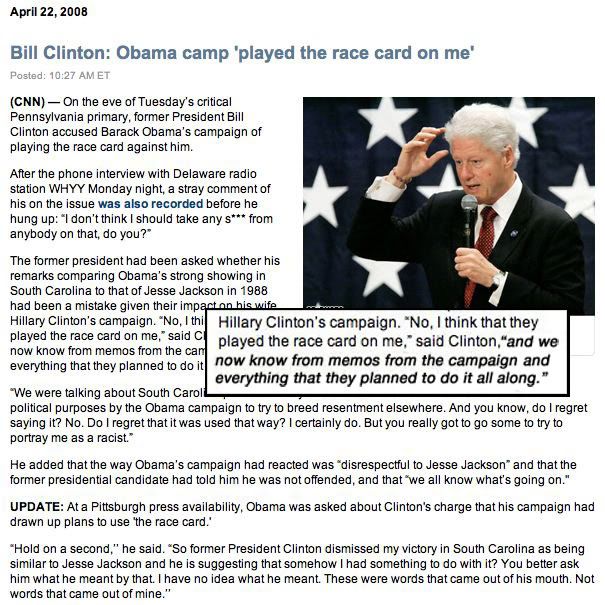
CNN reports:
Former President Bill Clinton denied Tuesday he had accused Senator Barack Obama's campaign of "playing the race card" during an interview Monday.
Bill Clinton is facing tough questions Tuesday over an interview with a Delaware radio station.
A recording of the former president making the comment is posted on the WHYY Web site.
It says he made the comment in a telephone interview with the Philadelphia public radio station Monday night.
Clinton was asked whether his remarks comparing Obama's strong showing in South Carolina to that of Jesse Jackson in 1988 had been a mistake given their impact on his wife Sen. Hillary Clinton's campaign.
"No, I think that they played the race card on me," said Clinton, "and we now know from memos from the campaign and everything that they planned to do it all along."
"We were talking about South Carolina political history and this was used out of context and twisted for political purposes by the Obama campaign to try to breed resentment elsewhere. And you know, do I regret saying it? No. Do I regret that it was used that way? I certainly do. But you really got to go some to try to portray me as a racist."
After the phone interview, a stray comment of his on the issue was also recorded before he hung up: "I don't think I should take any s*** from anybody on that, do you?"
But outside a Pittsburgh campaign event Tuesday, a reporter asked Clinton what he had meant "when you said the Obama campaign was playing the race card on you?"
Clinton responded: "When did I say that and to whom did I say that?"
"You have mischaracterized it to get another cheap story to divert the American people from the real urgent issues before us, and I choose not to play your games today," Clinton added.
"I said what I said -- you can go back and look at the interview, and if you will be real honest you will also report what the question was and what the answer was. But I'm not helping you."
Clinton did not respond when asked what he meant when he charged that the Obama campaign had a memo in which they said they had planned to play the race card.
Meanwhile, at a Pittsburgh press availability on Tuesday, Obama was asked about Clinton's charge that his campaign had drawn up plans to use "the race card."
"Hold on a second,'' he said. "So former President Clinton dismissed my victory in South Carolina as being similar to Jesse Jackson and he is suggesting that somehow I had something to do with it?"
"You better ask him what he meant by that. I have no idea what he meant. These were words that came out of his mouth. Not words that came out of mine.''
Clinton commented just before the South Carolina primary that "Jesse Jackson won South Carolina in '84 and '88. Jackson ran a good campaign. And Obama ran a good campaign here."
Question for Bill Clinton: Is your knowledge of these memos (the "memos from the campaign and everything" that you spoke about with Susan Phillips in the WHYY interview that you claim "show that they planned to do it all along") connected to the break-in of Obama campaign offices in Allentown on April 19, 2008, where laptops and cell phones were stolen?
The memo on the subject of race from Amaya Smith, S. Carolina press secretary for Obama for America lists news accounts of events during the campaign, and nothing else.
Thursday, March 20, 2008
Was Obama's Passport File an Inside Job By The Clinton Campaign?
Just one week ago, on March 13, Daniel Malloy reported in the Pittsburgh Post-Gazette:
At 1:46 p.m. yesterday the e-mail arrived in reporters' inboxes from Sen. Barack Obama's campaign: "Obama Receives Endorsement of Flag Officers from Army, Navy and Air Force."How did the Clinton campaign know Barack Obama's travel history?
It touted a news conference earlier in the day at which 10 high-ranking former military officers had announced their support of Mr. Obama, an attempt to show the senator's strength on national security issues.
Exactly 24 minutes later, Sen. Hillary Clinton's campaign returned the salvo with a missive of its own -- a list of 31 high-ranking former military officers who have pledged their support for Mrs. Clinton in the past. Two minutes after that, the campaign issued a memo with pointed questions for Mr. Obama on national security, including:
"As voters evaluate you as a potential Commander-in-Chief, do you think it's legitimate for people to be concerned that you have traveled to only one NATO country, on a brief stopover trip in 2005, and have never traveled to Latin America?"
Just another day in the e-mail crossfire.
Thursday, March 13, 2008
His Imminent Eminence . . . .
 . . . . Soon-to-be New York Governor, David Paterson
 [Photo: Getty Images]
From NYmag.com:
David Paterson just gave his first public address since Eliot Spitzer's resignation yesterday. He made noises about "getting back to work" and the budget, talked about being black and blind, indicated he wasn't planning any major changes to his predecessors more controversial policies, and became the first human being in government to express sympathy for Spitzer himself. "My heart goes out to Eliot Spitzer, his wife Silda, his daughters," he said. "I know what he's gone through this week. In my heart, I think he's suffered enough."
Paterson also displayed a rather awesome sense of humor. "Just so we don't have to go through this whole resignation thing again," one ballsy reporter asked, "have you ever patronized a prostitute?" Patterson thought for a minute. "Only the lobbyists," he said.
Thursday, March 06, 2008
The George W. Bush Lieberry
The Chronicle of Higher Education asked readers to submit their designs for the George W. Bush Library:
Cast your vote for the best design.
Cast your vote for the best design.
Tensions Rise in South America: Where Do Clinton & Obama Weigh In?
 Colombia will ask the International Criminal Court to try the Venezuelan President Hugo Chavez of supporting genocide. (Reuters: Jorge Silva)
Pepe Escobar at TheRealNews.com reports:
The Australian Broadcasting Corporation reports:
Venezuela has moved 10 army battalions to the border with Colombia, as diplomats struggle to defuse the regional crisis triggered by Colombia's cross-border attack in Ecuador last weekend.
The Organisation of American States says Colombia violated Ecuador's sovereignty in the raid and Colombia has said it will ask the International Criminal Court to try the Venezuelan President Hugo Chavez for genocide, claiming he is financing the rebels.
Ecuador has accused Colombia of violating its sovereignty when it raided the FARC's jungle camp - killing the rebel group's second-in-command, Raul Reyes.
Colombian President Alvaro Uribe says the leftist governments of Venezuela and Ecuador provide support to the rebels and has now signalled he will seek to bring charges of supporting genocide against the Venezuelan President Hugo Chavez.
"We are proposing to the International Criminal Court that President Hugo Chavez of Venezuela be denounced for the presumed crime of financing genocide.
"We have suffered 40 years of terrorism, and we can't accept that a country should be in solidarity and in complicity with terrorists."
But Ecuador's President Rafael Correa sees it differently.
"Here is a naked, irrefutable fact" he said.
"International law has been trampled upon; the letter to the Organisation of American States has been trampled upon; the fundamental respect that needs to exist for a sovereign country, a friend and a dear brother, has also been trampled upon"
Organisation of American States secretary Reinaldo Rodriguez Gallad says Correa is now being backed by the organisation, after an emergency meeting in Washington.
"We reaffirm the principle that a state's territory can't be violated and can't be the subject of military occupation, nor any other forceful measure taken by any other state, whatever the motive may be, even temporarily."
The United States was the only nation in the OAS to offer Colombia unqualified support.
Ecuador has since rejected a Colombian apology as insufficient and President Correa has mobilised thousands of Ecuadorian troops towards the border.
And the Colombian raid has also infuriated President Chavez, who has ordered his own tanks and troops to the border area.
President Chavez says he believes conflict with Colombia and its ally, the United States, is inevitable, but his country wants peace.
"Nothing and nobody will take us off the road to true peace," he said.
Dr Yvonne Corcoran-Nantes is a senior lecturer with the School of Political and International Studies at Flinders University and says Colombia has broken all the existing protocol.
"The co-existence and the solidarity that been developed over the last decade within South America has been really, really important and this has really broken all the protocols or many of them that have been sustained and supported over the last decade," she said.
Dr Corcoran-Nantes says there is little basis to Colombia's claims that Chavez is supporting the FARC rebels.
"International political positions, particularly those that support the United States will consistently blame Hugo Chavez for almost everything that goes on in Latin America that it doesn't like," she said.
"I don't think for one minute that Chavez is supporting in any substantive financial or materialistic way, FARC for example.
Dr Corcoran-Nantes says that the crisis will eventually pan out.
"I think that Columbia will come to a point when it will make some grudging apology," she said.
"But at the same time it will justify what it has done and whether that is acceptable or not remains to be seen.
"I don't believe, we are going to break out in all out war, unless pushed.
"The United States wouldn't want that, but I think it will make the relationship between Columbia and Ecuador and Columbia and Venezuela extremely fraught."
Meanwhile, border commerce between Venezuela and Colombia has already been disrupted as the tensions worsen.
What one Venezuelan citizen says perhaps best sums up the mood of the people there.
"Everybody is afraid of what could happen," he said.
"The truth is, as far as I'm concerned, this shouldn't be happening, how can we fight if we are brothers?"
Barack Obama's press release:
"The Colombian people have suffered for more than four decades at the hands of a brutal terrorist insurgency, and the Colombian government has every right to defend itself against the Revolutionary Armed Forces of Colombia (FARC).Hillary Clinton's statement:
The recent targeted killing of a senior FARC leader must not be used as a pretense to ratchet up tensions or to threaten the stability of the region.
The presidents of Colombia, Ecuador and Venezuela have a responsibility to ensure that events not spiral out of control, and to peacefully address any disputes through active diplomacy with the help of international actors."
“Hugo Chavez’s order yesterday to send ten battalions to the Colombian border is unwarranted and dangerous. The Colombian state has every right to defend itself against drug trafficking terrorist organizations that have kidnapped innocent civilians, including American citizens. By praising and supporting the Revolutionary Armed Forces of Colombia, Chavez is openly siding with terrorists that threaten Colombian democracy and the peace and security of the region. Rather than criticizing Colombia’s actions in combating terrorist groups in the border regions, Venezuela and Ecuador should work with their neighbor to ensure that their territories no longer serve as safe havens for terrorist groups. After reviewing this situation, I am hopeful that the government of Ecuador will determine that its interests lie in closer cooperation with Colombia on this issue. Hugo Chavez must call a halt to this provocative action. As president, I will work with our partners in the region and the OAS to support democracy, promote an end to conflict, and to press Chavez to change course.”
Tuesday, February 26, 2008
GOP Halts Effort to Retrieve White House E-Mails
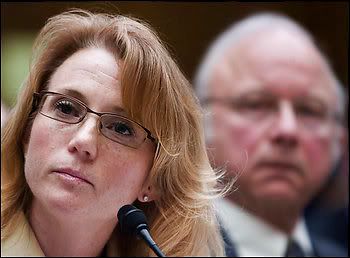 Theresa Payton, White House Office of Administration chief information officer, and Allen Weinstein, United States archivist, testify on Capitol Hill. (By Manuel Balce Ceneta -- Associated Press)
The Washington Post reports:
After promising last year to search its computers for tens of thousands of e-mails sent by White House officials, the Republican National Committee has informed a House committee that it no longer plans to retrieve the communications by restoring computer backup tapes, the panel's chairman said yesterday.
The move increases the likelihood that an untold number of RNC e-mails dealing with official White House business during the first term of the Bush administration -- including many sent or received by former presidential adviser Karl Rove -- will never be recovered, said House Democrats and public records advocates.
The RNC had previously told the House Oversight and Government Reform Committee that it was attempting to restore e-mails from 2001 to 2003, when the RNC had a policy of purging all e-mails, including those to and from White House officials, after 30 days. But Chairman Henry A. Waxman (D-Calif.) disclosed during a hearing yesterday that the RNC has now said it "has no intention of trying to restore the missing White House e-mails."So what is Henry Waxman going to do?
"The result is a potentially enormous gap in the historical record," Waxman said, including the buildup to the Iraq war.
Spokesman Danny Diaz said in a statement that the RNC "is fully compliant with the spirit and letter of the law." He declined further comment.
Administration officials have acknowledged that Rove and many other White House officials routinely used RNC accounts for government business, despite rules requiring that they conduct such business through official communications channels. The RNC deleted all e-mails until 2004, when it exempted White House officials from its e-mail purging policy.
About 80 White House aides used RNC accounts for official government business, committee staff members said. Rove, for example, sent or received 140,000 e-mails on RNC servers from 2002 to 2007, and more than half involved official ".gov" accounts, the panel has said.
The RNC dispute is part of a broader debate over whether the Bush administration has complied with long-standing statutory requirements to preserve official White House records -- including those reflecting potentially sensitive policy discussions -- for history and in case of future legal demands.
The committee is investigating allegations that vast stores of official Bush administration e-mails have also gone missing from the White House, which scrapped a Clinton-era archiving system and has struggled with data retention problems.
A former White House technology manager told the committee in statements released yesterday that the Bush administration's e-mail system "was primitive and the risk that data would be lost was high."
Steven McDevitt, who left the White House in 2006, said he supervised an internal study that found hundreds of days in which no electronic messages were stored for one or more White House offices from January 2003 to August 2005. The study stated a range when tallying the total number of days in which an office had no recorded e-mails, from 473 -- which had been previously reported -- to more than 1,000, McDevitt said.
McDevitt also said security was so lax that e-mail could be modified by anyone on the computer network until the middle of 2005.
Administration officials defended their efforts to fix the problems, and said they are still working to locate and identify e-mails reported as missing. "We are very energized about getting to the bottom of this," said Theresa Payton, chief information officer at the Office of Administration.
At the hearing, Payton and GOP lawmakers attacked the 2005 White House study overseen by McDevitt, calling it flawed and unreliable. McDevitt said the 250-page study involved numerous senior technology officials as well as outside contractors.
Rep. Thomas M. Davis III (Va.), the committee's ranking Republican, said in a statement that the missing e-mail allegations are "based on a discredited internal report conveniently leaked to the media." He also said that yesterday's hearing was "less about preserving records and more about resurrecting the spurious claim that the White House 'lost millions of official e-mails.'"
Davis also said, based on a briefing by Payton, that the actual number of days with missing e-mails was 202. "A substantial portion of the so-called 'missing' e-mails appear not to be missing at all, just filed in the wrong digital drawer," Davis said. No other committee member followed up on that allegation during the hearing.
It's not as if Congress wasn't forewarned about Bush's choice of archivists or Bush's assaults on the public's right to know and access to his administrations' documents, both in Washington and Texas.
According to News.com, recovery may be an issue of money and moving obstructionist Republicans on the committee (like Davis and Darrel Issa) out of the way.
Monday, February 25, 2008
Thursday, February 21, 2008
Filed Under: What The Hell Were They Thinking?
Security Relaxed At Obama Rally
 Democratic Presidential candidate Sen. Barack Obama (D-IL) speaks to supporters during a campaign rally at Reunion Arena in Dallas on February 20, 2008. More than 17,000 people filled the building for a chance to see the Illinois senator on his first public appearance in Dallas since announcing his presidential candidacy. (UPI Photo/Robert Hughes)
The Star-Telegram reports:
The Secret Service told Dallas police to stop screening for weapons while people were still arriving at a campaign rally for Barack Obama, a report said.
Police stopped checking people for weapons at the front gates of Reunion Arena more than an hour before the Democratic presidential hopeful appeared on stage Wednesday, the Fort Worth (Texas) Star-Telegram reported.
Police said the order to stop using metal detectors and checking purses and laptop bags constituted a security lapse, the newspaper reported.
Dallas Deputy Police Chief T.W. Lawrence -- who heads the department's homeland security and special operations divisions -- told the Star-Telegram the order had been intended to speed up seating of the more than 17,000 people who came to hear the candidate speak.
Lawrence said he was concerned about the large number of people being let in without being screened, but that the crowd seemed "friendly," the newspaper said.
Several Dallas police officers -- speaking on condition of anonymity because the order came from federal officers -- told the newspaper it was worrying to see so many people get it without even a cursory inspection.
The Star-Telegram said the Secret Service did not return a call seeking comment.
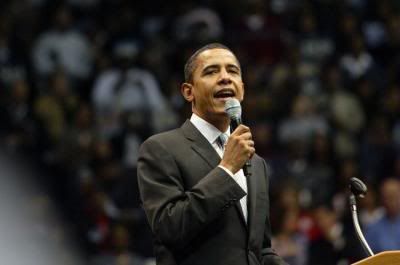 Democratic Presidential candidate Sen. Barack Obama (D-IL) speaks to supporters during a campaign rally at Reunion Arena in Dallas on February 20, 2008. More than 17,000 people filled the building for a chance to see the Illinois senator on his first public appearance in Dallas since announcing his presidential candidacy. (UPI Photo/Robert Hughes)
The Star-Telegram reports:
The Secret Service told Dallas police to stop screening for weapons while people were still arriving at a campaign rally for Barack Obama, a report said.
Police stopped checking people for weapons at the front gates of Reunion Arena more than an hour before the Democratic presidential hopeful appeared on stage Wednesday, the Fort Worth (Texas) Star-Telegram reported.
Police said the order to stop using metal detectors and checking purses and laptop bags constituted a security lapse, the newspaper reported.
Dallas Deputy Police Chief T.W. Lawrence -- who heads the department's homeland security and special operations divisions -- told the Star-Telegram the order had been intended to speed up seating of the more than 17,000 people who came to hear the candidate speak.
Lawrence said he was concerned about the large number of people being let in without being screened, but that the crowd seemed "friendly," the newspaper said.
Several Dallas police officers -- speaking on condition of anonymity because the order came from federal officers -- told the newspaper it was worrying to see so many people get it without even a cursory inspection.
The Star-Telegram said the Secret Service did not return a call seeking comment.
Wednesday, February 13, 2008
Senate Votes to Expand Spy Powers
Hillary Clinton, Barack Obama and Lindsay Graham skip the festivities
 “Holding all the Democrats together on this,” Senator Harry Reid said of the FISA bill, “is not something that’s doable.”
In a stunning betrayal of their constituents, Democrats in the Senate aided Bush and Republicans in passing the Fisa Amendments Act of 2007 (S.2248), and provided cover for the absent Democratic presidential candidates. The New York Times reports:
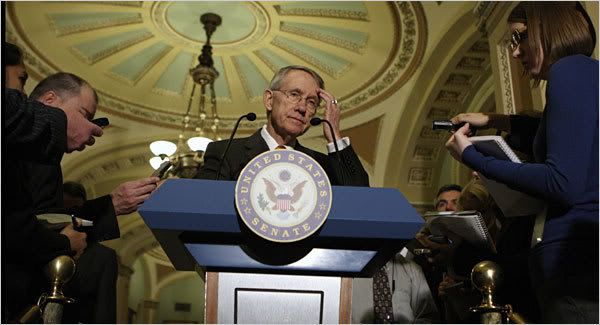 “Holding all the Democrats together on this,” Senator Harry Reid said of the FISA bill, “is not something that’s doable.”
In a stunning betrayal of their constituents, Democrats in the Senate aided Bush and Republicans in passing the Fisa Amendments Act of 2007 (S.2248), and provided cover for the absent Democratic presidential candidates. The New York Times reports:
After more than a year of wrangling, the Senate handed the White House a major victory on Tuesday by voting to broaden the government’s spy powers and to give legal protection to phone companies that cooperated in President Bush’s program of eavesdropping without warrants.
One by one, the Senate rejected amendments that would have imposed greater civil liberties checks on the government’s surveillance powers. Finally, the Senate voted 68 to 29 to approve legislation that the White House had been pushing for months. Mr. Bush hailed the vote and urged the House to move quickly in following the Senate’s lead.
The outcome in the Senate amounted, in effect, to a broader proxy vote in support of Mr. Bush’s wiretapping program. The wide-ranging debate before the final vote presaged discussion that will play out this year in the presidential and Congressional elections on other issues testing the president’s wartime authority, including secret detentions, torture and Iraq war financing.
Republicans hailed the reworking of the surveillance law as essential to protecting national security, but some Democrats and many liberal advocacy groups saw the outcome as another example of the Democrats’ fears of being branded weak on terrorism.Senate roll call vote here.
“Some people around here get cold feet when threatened by the administration,” said Senator Patrick J. Leahy, the Vermont Democrat who leads the Judiciary Committee and who had unsuccessfully pushed a much more restrictive set of surveillance measures.
Among the presidential contenders, Senator John McCain, Republican of Arizona, voted in favor of the final measure, while the two Democrats, Senator Barack Obama of Illinois and Senator Hillary Rodham Clinton of New York, did not vote. Mr. Obama did oppose immunity on a key earlier motion to end debate. Mrs. Clinton, campaigning in Texas, issued a statement saying she would have voted to oppose the final measure.
The measure extends, for at least six years, many of the broad new surveillance powers that Congress hastily approved last August just before its summer recess. Intelligence officials said court rulings had left dangerous gaps in their ability to intercept terrorist communications.
The bill, which had the strong backing of the White House, allows the government to eavesdrop on large bundles of foreign-based communications on its own authority so long as Americans are not the targets. A secret intelligence court, which traditionally has issued individual warrants before wiretapping began, would review the procedures set up by the executive branch only after the fact to determine whether there were abuses involving Americans.
“This is a dramatic restructuring” of surveillance law, said Michael Sussmann, a former Justice Department intelligence lawyer who represents several telecommunication companies. “And the thing that’s so dramatic about this is that you’ve removed the court review. There may be some checks after the fact, but the administration is picking the targets.”
The Senate plan also adds one provision considered critical by the White House: shielding phone companies from any legal liability for their roles in the eavesdropping program approved by Mr. Bush after the Sept. 11 attacks. The program allowed the National Security Agency to eavesdrop without warrants on the international communications of Americans suspected of having ties to Al Qaeda.
AT&T and other major phone companies are facing some 40 lawsuits from customers who claim their actions were illegal. The Bush administration maintains that if the suits are allowed to continue in court, they could bankrupt the companies and discourage them from cooperating in future intelligence operations.
The House approved a surveillance bill in November that intentionally left out immunity for the phone companies, and leaders from the two chambers will now have to find a way to work out significant differences between their two bills.
Democratic opponents, led by Senators Russ Feingold of Wisconsin and Christopher J. Dodd of Connecticut, argued that the plan effectively rewarded phone companies by providing them with legal insulation for actions that violated longstanding law and their own privacy obligations to their customers. But immunity supporters said the phone carriers acted out of patriotism after the Sept. 11 attacks in complying with what they believed in good faith was a legally binding order from the president.
“This, I believe, is the right way to go for the security of the nation,” said Senator John D. Rockefeller, the West Virginia Democrat who leads the intelligence committee. His support for the plan, after intense negotiations with the White House and his Republican colleagues, was considered critical to its passage but drew criticism from civil liberties groups because of $42,000 in contributions that Mr. Rockefeller received last year from AT&T and Verizon executives.
Senator Olympia J. Snowe, a Maine Republican on the intelligence panel, said the bill struck the right balance between protecting the rights of Americans and protecting the country “from terrorism and other foreign threats.”
Democratic opponents, who six months ago vowed to undo the results of the August surveillance vote, said they were deeply disappointed by the defection of 19 Democrats who backed the bill.
Mr. Dodd, who spoke on the floor for more than 20 hours in recent weeks in an effort to stall the bill, said future generations would view the vote as a test of whether the country heeds “the rule of law or the rule of men.”
But with Democrats splintered, Mr. Dodd acknowledged that the national security argument had won the day. “Unfortunately, those who are advocating this notion that you have to give up liberties to be more secure are apparently prevailing,” he said. “They’re convincing people that we’re at risk either politically, or at risk as a nation.”
There was a measure of frustration in the voice of Harry Reid, the Senate majority leader, as he told reporters during a break in the daylong debate, “Holding all the Democrats together on this, we’ve learned a long time ago, is not something that’s doable.”
Senate Republicans predict that they will be able to persuade the House to include immunity in the final bill, especially now that the White House has agreed to give House lawmakers access to internal documents on the wiretapping program. But House Democrats vowed Tuesday to continue opposing immunity.
Congress faces a Saturday deadline for extending the current law, but Democrats want to extend the deadline for two weeks to allow more time for talks. The White House has said it opposes a further extension.
Meanwhile, Senate Democrats hope to put some pressure on Republicans on Wednesday over another security-related issue by bringing up an intelligence measure that would apply Army field manual prohibitions against torture to civilian agencies like the Central Intelligence Agency.
Republicans plan to try to eliminate that provision, a vote that Democrats say will force Republicans to declare whether they condone torture. Democrats also say it could show the gap between Mr. McCain, who has opposed torture, and the administration on the issue.
“We know how we would feel if a member of the armed services captured by the enemy were, for example, waterboarded,” Mr. Reid said. “So I think that we’re headed in the right direction, and I hope that we’ll get Republican support on this.”
Dancin' Cheek-to-Cheek
First Time Ever: Gorillas Photographed Mating Face-To-Face
 Western gorillas 'Leah' and unidentified male in Mbeli Bai in the Republic of Congo.
(Credit: Copyright Thomas Breuer – WCS/MPI-EVA)
From Science Daily:
Scientists from the Wildlife Conservation Society and Max Planck Institute for Evolutionary Anthropology have released the first known photographs of gorillas performing face-to-face copulation in the wild. This is the first time that western gorillas have been observed and photographed mating in such a manner.
The photographs were part of a study conducted in a forest clearing in Nouabalé-Ndoki National Park in the Republic of Congo that appeared in a recent issue of The Gorilla Gazette.
"Understanding the behavior of our cousins the great apes sheds light on the evolution of behavioral traits in our own species and our ancestors," said Thomas Breuer, a researcher at the Max Planck Institute for Evolutionary Anthropology and WCS and lead author of the study. "It is also interesting that this same adult female has been noted for innovative behaviors before."
The western lowland gorilla is listed as Critically Endangered as a result of hunting by humans, habitat destruction, and health threats such as the Ebola virus.
The female gorilla in the photograph, nicknamed "Leah" by researchers, made history in 2005 when she was observed using tools -- another never-before-seen behavior for her kind in the wild. Breuer and others witnessed Leah using a stick to test the depth of a pool of water before wading into it in Mbeli Bai, where researchers have been monitoring the gorilla population since 1995.
Researchers say that few primates mate in a face-to-face position, known technically as ventro-ventral copulation; most primate species copulate in what's known as the dorso-ventral position, with both animals facing in the same direction. Besides humans, only bonobos have been known to frequently employ ventro-ventral mating positions. On a few occasions, mountain gorillas have been observed in ventro-ventral positions, but never photographed. Western gorillas in captivity have been known to mate face-to-face, but not in the wild, which makes this observation a noteworthy first.
"Our current knowledge of wild western gorillas is very limited, and this report provides information on various aspects of their sexual behavior," added Breuer, whose study is funded by the Brevard Zoo, Columbus Zoo and Aquarium, Cincinnati Zoo and Botanical Garden, Max Planck Society, Sea World & Busch Gardens Conservation Fund, Toronto Zoo, Wildlife Conservation Society and Woodland Park Zoo. "We can't say how common this manner of mating is, but it has never been observed with western gorillas in the forest. It is fascinating to see similarities between gorilla and human sexual behavior demonstrated by our observation."
Scientists estimate that western gorillas have declined 60 percent in recent years due to habitat loss, illegal hunting, and Ebola hemorrhagic fever. The Wildlife Conservation Society, which is the only organization working to protect all four gorilla sub-species (also including the Cross River Gorilla, the mountain gorilla, and the Grauer's gorilla), has been studying gorillas and other wildlife in the Republic of Congo since the 1980s. In 1993, the Congolese Government, working in tandem with technical assistance from WCS, established Nouabalé-Ndoki National Park.
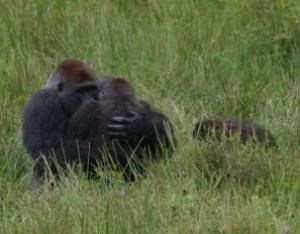 Western gorillas 'Leah' and unidentified male in Mbeli Bai in the Republic of Congo.
(Credit: Copyright Thomas Breuer – WCS/MPI-EVA)
From Science Daily:
Scientists from the Wildlife Conservation Society and Max Planck Institute for Evolutionary Anthropology have released the first known photographs of gorillas performing face-to-face copulation in the wild. This is the first time that western gorillas have been observed and photographed mating in such a manner.
The photographs were part of a study conducted in a forest clearing in Nouabalé-Ndoki National Park in the Republic of Congo that appeared in a recent issue of The Gorilla Gazette.
"Understanding the behavior of our cousins the great apes sheds light on the evolution of behavioral traits in our own species and our ancestors," said Thomas Breuer, a researcher at the Max Planck Institute for Evolutionary Anthropology and WCS and lead author of the study. "It is also interesting that this same adult female has been noted for innovative behaviors before."
The western lowland gorilla is listed as Critically Endangered as a result of hunting by humans, habitat destruction, and health threats such as the Ebola virus.
The female gorilla in the photograph, nicknamed "Leah" by researchers, made history in 2005 when she was observed using tools -- another never-before-seen behavior for her kind in the wild. Breuer and others witnessed Leah using a stick to test the depth of a pool of water before wading into it in Mbeli Bai, where researchers have been monitoring the gorilla population since 1995.
Researchers say that few primates mate in a face-to-face position, known technically as ventro-ventral copulation; most primate species copulate in what's known as the dorso-ventral position, with both animals facing in the same direction. Besides humans, only bonobos have been known to frequently employ ventro-ventral mating positions. On a few occasions, mountain gorillas have been observed in ventro-ventral positions, but never photographed. Western gorillas in captivity have been known to mate face-to-face, but not in the wild, which makes this observation a noteworthy first.
"Our current knowledge of wild western gorillas is very limited, and this report provides information on various aspects of their sexual behavior," added Breuer, whose study is funded by the Brevard Zoo, Columbus Zoo and Aquarium, Cincinnati Zoo and Botanical Garden, Max Planck Society, Sea World & Busch Gardens Conservation Fund, Toronto Zoo, Wildlife Conservation Society and Woodland Park Zoo. "We can't say how common this manner of mating is, but it has never been observed with western gorillas in the forest. It is fascinating to see similarities between gorilla and human sexual behavior demonstrated by our observation."
Scientists estimate that western gorillas have declined 60 percent in recent years due to habitat loss, illegal hunting, and Ebola hemorrhagic fever. The Wildlife Conservation Society, which is the only organization working to protect all four gorilla sub-species (also including the Cross River Gorilla, the mountain gorilla, and the Grauer's gorilla), has been studying gorillas and other wildlife in the Republic of Congo since the 1980s. In 1993, the Congolese Government, working in tandem with technical assistance from WCS, established Nouabalé-Ndoki National Park.
Saturday, January 26, 2008
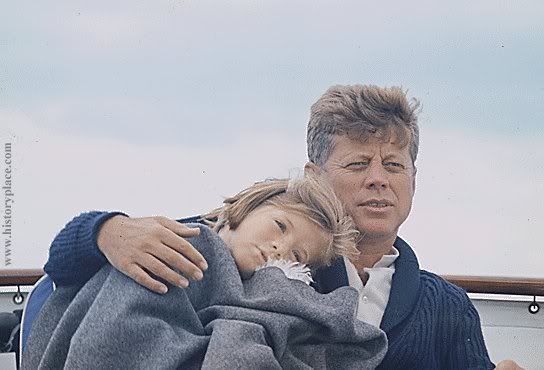
Caroline Kennedy Endorses Obama
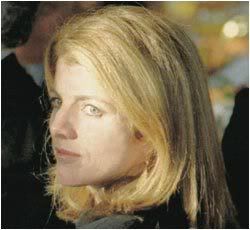
In an op-ed for the New York Times, Caroline Kennedy writes:
Over the years, I’ve been deeply moved by the people who’ve told me they wished they could feel inspired and hopeful about America the way people did when my father was president. This sense is even more profound today. That is why I am supporting a presidential candidate in the Democratic primaries, Barack Obama.
My reasons are patriotic, political and personal, and the three are intertwined. All my life, people have told me that my father changed their lives, that they got involved in public service or politics because he asked them to. And the generation he inspired has passed that spirit on to its children. I meet young people who were born long after John F. Kennedy was president, yet who ask me how to live out his ideals.
Sometimes it takes a while to recognize that someone has a special ability to get us to believe in ourselves, to tie that belief to our highest ideals and imagine that together we can do great things. In those rare moments, when such a person comes along, we need to put aside our plans and reach for what we know is possible.
We have that kind of opportunity with Senator Obama. It isn’t that the other candidates are not experienced or knowledgeable. But this year, that may not be enough. We need a change in the leadership of this country — just as we did in 1960.
Most of us would prefer to base our voting decision on policy differences. However, the candidates’ goals are similar. They have all laid out detailed plans on everything from strengthening our middle class to investing in early childhood education. So qualities of leadership, character and judgment play a larger role than usual.
Senator Obama has demonstrated these qualities throughout his more than two decades of public service, not just in the United States Senate but in Illinois, where he helped turn around struggling communities, taught constitutional law and was an elected state official for eight years. And Senator Obama is showing the same qualities today. He has built a movement that is changing the face of politics in this country, and he has demonstrated a special gift for inspiring young people — known for a willingness to volunteer, but an aversion to politics — to become engaged in the political process.
I have spent the past five years working in the New York City public schools and have three teenage children of my own. There is a generation coming of age that is hopeful, hard-working, innovative and imaginative. But too many of them are also hopeless, defeated and disengaged. As parents, we have a responsibility to help our children to believe in themselves and in their power to shape their future. Senator Obama is inspiring my children, my parents’ grandchildren, with that sense of possibility.
Senator Obama is running a dignified and honest campaign. He has spoken eloquently about the role of faith in his life, and opened a window into his character in two compelling books. And when it comes to judgment, Barack Obama made the right call on the most important issue of our time by opposing the war in Iraq from the beginning.
I want a president who understands that his responsibility is to articulate a vision and encourage others to achieve it; who holds himself, and those around him, to the highest ethical standards; who appeals to the hopes of those who still believe in the American Dream, and those around the world who still believe in the American ideal; and who can lift our spirits, and make us believe again that our country needs every one of us to get involved.
I have never had a president who inspired me the way people tell me that my father inspired them. But for the first time, I believe I have found the man who could be that president — not just for me, but for a new generation of Americans.
Monday, January 21, 2008
She's Nothing If Not Indecisive
Norma McCorvey, 'Jane Roe' in Roe vs. Wade, chooses a presidential candidate like she chooses sides on the abortion debate: "I'm for Brownback Huckabee Paul"
 Norma McCorvey on the steps of the U.S. Supreme Court with Gloria Alred in 1987
 Norma McCorvey's baptism by Rev. Phillip Benham in 1995
ABC News' Z. Byron Wolf reports:
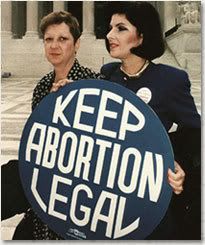 Norma McCorvey on the steps of the U.S. Supreme Court with Gloria Alred in 1987
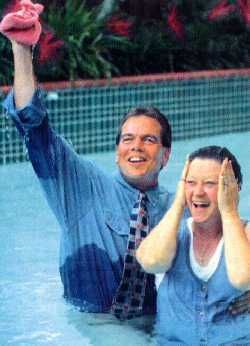 Norma McCorvey's baptism by Rev. Phillip Benham in 1995
ABC News' Z. Byron Wolf reports:
It's not as well-known as his anti-war stance, but Ron Paul - an OB-GYN by trade - is also pro-life.McCorvey, a pathetic woman with a trainwreck of a life, should never have become the face for safe and legal abortion; a pox on any group that tries to exploit her for their cause. Any cause.
This is a fact he has highlighted in Republican early primaries as he has tried to sell his libertarian, anti-establishment ethos to the Republican rank and file.
He will get a boost at an event in Washington tomorrow when the "Roe" in the Roe v. Wade 1973 court case, Norma McCorvey, endorses his bid for the presidency.
McCorvey has famously changed her mind about abortion and now the woman whose court case created current abortion law crusades against the practice. Paul is McCorvey's current choice for President, but he was not her first.
Back when the Presidential campaign was getting going, before the summer, McCorvey endorsed Sen. Sam Brownback, R-Kan. She even campaigned for him at the Iowa straw poll in August, which is an early test of a campaign's organization in that state.
At the outset of the 2008 campaign, Brownback was seen as the pro-life candidate of choice. But his star fell with the rise of former Arkansas Governor Mike Huckabee, who eventually won in Iowa at the January caucus.
It's interesting that McCorvey is now going to go with Paul, although, with Brownback as evidence, don't expect her endorsement to turn the public tide in Paul's favor.
Thursday, January 17, 2008
As If We Needed Any More Proof Of A Failed & Corrupt Democracy
Edwards' Campaign Funds Frozen As Partisan Tiff Paralyzes Election Panel
Boston.com reports:
Boston.com reports:
John Edwards, who is relying on federal money to help fund his presidential campaign, may not get any more. The list of lobbyists raising cash for the candidates, and how much they have brought in, remains hidden.
The Federal Election Commission doesn't have enough members to oversee what is expected to be the most expensive election in US history. Down to just two of its six commissioners, the FEC can't assemble the quorum of four votes required to approve federal campaign funds, enact regulations, undertake fraud investigations, or provide legal advice to candidates.
The reason: Senate Democrats have refused to confirm former Justice Department official Hans von Spakovsky to a seat on the FEC, and, in response, Senate Republicans won't let through President Bush's three other nominees.
"There are decisions that need to be made; now there is no one to make them," said Gary Kalman, a lobbyist with the Boston-based Public Interest Research Group, which favors stronger campaign finance laws.
So far, Edwards is the only top-tier presidential candidate to agree to limit campaign spending to $50 million in exchange for partial federal funding. The FEC can't approve any more money for Edwards beyond the $8.8 million it certified in December. The government has yet to disburse Edwards's money, though he can borrow against the promise of getting federal funds.
"We fully expect the FEC to meet their obligations under the public-financing system," Edwards spokesman Eric Schultz said.
Wednesday, January 16, 2008
John McCain Cheated On His Sixth Grade Math Test??!??
Who knows, but you'll get it in a minute . . . .
 John King and Glenn Greenwald
At Salon.com, Glenn Greenwald writes:
I can't think of any other profession where the measure for how well you're doing your job is by the number of dissatisfied customers you are creating.
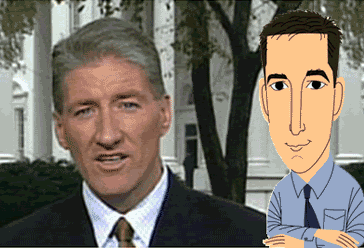 John King and Glenn Greenwald
At Salon.com, Glenn Greenwald writes:
Over the weekend, I wrote about an adulating interview which CNN's John King conducted with John McCain while riding on the storied Straight Talk Express bus. The interview was broadcast on "Situation Room" with Wolf Blitzer. In that post, I printed all of the "questions" King asked of McCain in their full, unedited entirety as broadcast on CNN, linked to the full transcript of the program, and then added some commentary.Here we have yet another journalist with a mainstream media outlet who believes that if both the left and the right complain, he must be doing a good job.
Yesterday, I received a response from King via e-mail, the authenticity of which was confirmed in a subsequent exchange:
From: King, John C
To: GGreenwald@salon.com
Sent: Tuesday, January 15, 2008 5:40 PM
Subject: excuse me?
I don't read biased uninformed drivel so I'm a little late to the game.
But a friend who understands how my business works and knows a little something about my 20 plus years in it sent me the link to your ramblings.
Since the site suggests you have law training, maybe you forgot that good lawyers to a little research before they spit out words.
Did you think to ask me or anyone who works with me whether that was the entire interview? No. (It was not; just a portion used by one of the many CNN programs.)
Did you reach out to ask the purpose of that specific interview? No.
Or how it might have fit in with other questions being asked of other candidates that day? No.
Or anything that might have put facts or context or fairness into your critique. No.
McCain, for better or worse, is a very accessible candidate. If you did a little research (there he goes with that word again) you would find I have had my share of contentious moments with him over the years.
But because of that accessibility, you don't have to go into every interview asking him about the time he cheated on his sixth grade math test.
The interview was mainly to get a couple of questions to him on his thoughts on the role of government when the economy is teetering on the edge of recession, in conjunction with similar questions being put to several of the other candidates.
The portion you cited was aired by one of our programs -- so by all means it is fair game for whatever "analysis" you care to apply to it using your right of free speech and your lack of any journalistic standards or fact checking or just plain basic curiosity.
You clearly know very little about journalism. But credibility matters. It is what allows you to cover six presidential campaigns and be viewed as fair and respectful, while perhaps a little cranky, but Democrats and Republicans alike. When I am writing something that calls someone's credibility into question, I pick up the phone and give them a chance to give their side, or perspective.
That way, even on days that I don't consider my best, or anywhere close, I can look myself in the mirror and know I tried to be fair and didn't call into question someone's credibility just for sport, or because I like seeing my name on a website or my face on TV.
During our subsequent exchange, when I pointed out that this was not the first time he appeared to be reverent of John McCain, as documented by Media Matters, he said: "Go to its conservative counterpart and you will find me there, too. Comes with the territory."
Most of this speaks for itself, but it's worth noting how often journalists' responses to criticisms contain so many of the same elements which King's email contains. They always want you to know that they never read what you write and that you're an Unserious, biased, partisan amateur (without any recognition of the glaring contradiction between those two claims).
They boast of what they believe to be their reputation, assuring you that they are widely respected and admired by the People Who Count. Even though they never read you, they're repulsed by the idea that you would dare to critique their work because you know absolutely nothing about the High Art of Journalism and never get any messages on your Blackberry from Ed Gillespie or Karl Rove or Anyone.
They invariably point to criticisms from both Left and Right as proof that they're unbiased straight-shooters. They chide you for being unaware of the secret, concealed information (interview questions that weren't broadcast, paragraphs that were edited out) which somehow disproves your critique of what they did broadcast or publish.
They proudly inform you that there have, indeed, been some instances over the many decades that they've been working when they've stood up to someone and asked something other than mindlessly reverent questions, and if you had looked hard enough, you might have found a couple. They tell you it's appalling to comment on what they publish to their readers or viewers without first talking to them about it, even though you linked to or even printed in full everything they said and wrote. And they close by telling you that you have no standards, no ethics, no understanding of their Complex Profession, and no decency -- that you're just a shrill, ignorant partisan pushing a lowly agenda while they are in the business of Real Unvarnished, Objective Reporting.
Ponder how much better things would be if establishment journalists -- in response to being endlessly lied to and manipulated by political officials and upon witnessing extreme lawbreaking and corruption at the highest levels of our government -- were able to muster just a tiny fraction of the high dudgeon, petulant offense, and melodramatic outrage that comes pouring forth whenever their "reporting" is criticized. All this energized invective from King because CNN aired an "interview" with the GOP front-running presidential candidate consisting of one adoring question after the next, which I printed in full.
It's not exactly a secret that the traveling press harbors bountiful, blinding love for John McCain. That love was glaringly evident in King's "interview." Judging by his response, King quite clearly knows this, too. It's not actually that complicated. The next time you or your colleagues interview McCain, keep your affection to yourself; skip the part where you lavish him with praise; exercise journalistic skepticism; and just ask real questions.
-- Glenn Greenwald
I can't think of any other profession where the measure for how well you're doing your job is by the number of dissatisfied customers you are creating.
Tuesday, January 15, 2008
Cloned Animals May Be Used for Food in U.S., FDA Says
And like the rest of our altered food supplies, labeling won't be required.
 The Food and Drug Administration has concluded that milk and meat from cloned animals, such as these cows, should be allowed on the market. That stance has raised a debate over whether food from clones that are raised organically could still carry the organic label. (PRNewsFoto/ViaGen)
Reuters reports:
 The original cloned animal, Dolly. Suffering from an incurable lung disease, she was euthanized at an early age. She is seen here stuffed and displayed at the National Museums of Scotland. Photo: Trustees of National Museums Scotland
Clones not only don't live as long, but they contract diseases not seen in the 'parent'. There clearly are differences between the original and the clone, and the consumption of clones can't be declared as 'safe' simply because scientists haven't identified any problems in the short term. The only testing that has been done has been on the animals; not on humans who have eaten clones. Without bans or any regulations at all, there is nothing to prevent the industry from introducing cloned products into the food chain without notifying consumers. Currently under consideration is a public relations campaign to "educate" to raise the consumer's "comfort level" (lull the consumer into acquiescence).
Bloomberg reports:
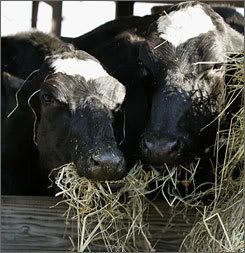 The Food and Drug Administration has concluded that milk and meat from cloned animals, such as these cows, should be allowed on the market. That stance has raised a debate over whether food from clones that are raised organically could still carry the organic label. (PRNewsFoto/ViaGen)
Reuters reports:
While the science appears to have come down on the side of the cloning industry, the technology remains controversial, even within the agriculture industry.
Some dairy firms oppose cloning, betting that consumers will shun goods they see linked to cloning technology.
Others believe that more investigation is needed to conclude cloning is safe -- especially after a year in which consumer confidence was marred by numerous food scares -- or oppose it on moral or religious grounds.
"Despite widespread public disapproval, FDA is not planning to require labeling of The U.S. Food and Drug Administration has ruled food from certain cloned animals and their offspring is as safe as other food, opening the door to using the controversial technology in the U.S. food supply.Meanwhile, the BBC reports on the other side of the Atlantic Ocean:
The FDA confirmed preliminary findings in a final risk assessment on cloning on Tuesday.
"Extensive evaluation of the available data has not identified any subtle hazards that might indicate food consumption risks in healthy clones of cattle, swine or goats," the agency wrote.
The FDA said it did not have enough information, however, to make the same assertion about cloned sheep.
The FDA ruling is the latest twist after years of debate over the reproductive technology, which advocates say will provide consumers with top-quality food by replicating prized animals that can breed highly productive offspring.
The cloning industry, made up so far of only a handful of firms, expects that it will be the offspring of cloned animals, not the costly clones themselves, that would eventually provide meat or milk to U.S. consumers.
There are currently about 570 cloned animals in the United States, but the livestock industry has so far followed a voluntary ban on marketing food from the animals.
It could take four or five years before consumers are able to buy products derived from cloned animals.
products from cloned animals, keeping already wary consumers in the dark," Food and Water Watch, an advocacy group, said in a statement.
Greg Jaffe, director of biotechnology at the Center for Science in the Public Interest, says the cloning industry must now convince the public why cloning is useful.
"Just because the technology is safe, it doesn't mean that as a society there is reason to embrace it," he said.
Jaffe expects Congress or some states may try to impose additional restrictions on marketing or labeling.
The Senate has passed a bill, which must be merged with a House bill and approved by the president, that would delay FDA approval until after more studies are completed.
Several major food companies quickly stated that they are not signing up, at least right away. Tyson Foods Inc, the largest U.S. meat producer, said on Tuesday it has no immediate plans to buy cloned livestock.
The FDA cloning decision comes as biotechnology becomes an ever more important part of global agriculture.
Last week, the European Food Safety Authority made an interim ruling about food from cloned animals and their offspring, saying it was unlikely there was any difference from food derived from traditionally bred animals.
An influential Italian farmers' union has threatened to challenge an EU report that says products from cloned animals are probably safe.The Washington Post reports that consumer groups object to FDA approval of cloned food:
The European Food Safety Authority (EFSA) says it is "very unlikely" that such food is any different from that from conventionally bred animals.
But the Italian farmers' group Coldiretti believes cloned foods would pose an "unacceptable risk".
Reaction from consumer groups was quick and largely negative today as word spread that the Food and Drug Administration had concluded that milk and meat from cloned farm animals is safe to eat.The concern that eating products from such animals may be unsafe is not unfounded:
The agency's final report, to be released today, makes it likely that food from clones and their offspring will start making its way into the food supply over the next few years.
But opponents, and in particular people and organizations concerned about the health and welfare of cloned animals, raised objections immediately.
"Despite the fact that cloned animals suffer high mortality rates and those who survive are often plagued with birth defects and diseases, the FDA did not give adequate consideration to the welfare of these animals or their surrogate mothers in its deliberations," said Wayne Pacelle, president and CEO of the Humane Society of the United States. "Furthermore, no regulations exist in the United States that protect farm animals during cloning research."
"The Food and Drug Administration's decision to allow the sale of meat and milk from cloned animals leaves consumers at risk and releases another questionable technology into the food supply," added Patty Lovera of Food & Water Watch, a nonprofit consumer rights organization.
The long-awaited FDA report concludes that foods from healthy cloned animals and their offspring are as safe as those from ordinary animals, effectively removing the last U.S. regulatory barrier to the marketing of meat and milk from cloned cattle, pigs and goats.
The 968-page "final risk assessment," finds no evidence to support opponents' concerns that food from clones may harbor hidden risks.
But, recognizing that a majority of consumers are wary of food from clones -- and that cloning could undermine the wholesome image of American milk and meat -- the agency report includes hundreds of pages of raw data so that others can see how it came to its conclusions.
The report also acknowledges that human health concerns are not the only issues raised by the emergence of cloned farm animals.
"Moral, religious and ethical concerns . . . have been raised," the agency notes in a document accompanying the report. But the risk assessment is "strictly a science-based evaluation," it reports, because the agency is not authorized by law to consider those issues.
In practice, it will be years before foods from clones make their way to store shelves in appreciable quantities, in part because the clones themselves are too valuable to slaughter or milk. Instead, the pricey animals -- replicas of some of the finest farm animals ever born -- will be used primarily as breeding stock to create what proponents say will be a new generation of superior farm animals.
When food from those animals hits the market, the public may yet have its say. FDA officials have said they do not expect to require food from clones to be labeled as such, but they may allow foods from ordinary animals to be labeled as not from clones.
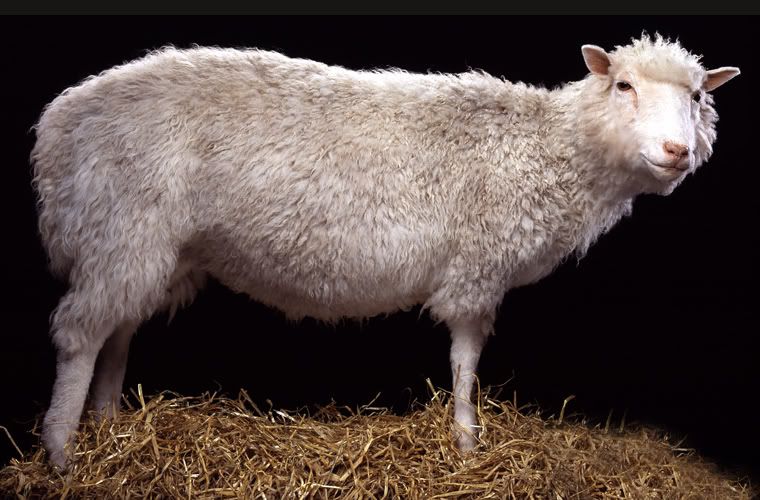 The original cloned animal, Dolly. Suffering from an incurable lung disease, she was euthanized at an early age. She is seen here stuffed and displayed at the National Museums of Scotland. Photo: Trustees of National Museums Scotland
Clones not only don't live as long, but they contract diseases not seen in the 'parent'. There clearly are differences between the original and the clone, and the consumption of clones can't be declared as 'safe' simply because scientists haven't identified any problems in the short term. The only testing that has been done has been on the animals; not on humans who have eaten clones. Without bans or any regulations at all, there is nothing to prevent the industry from introducing cloned products into the food chain without notifying consumers. Currently under consideration is a public relations campaign to "educate" to raise the consumer's "comfort level" (lull the consumer into acquiescence).
Bloomberg reports:
Registering ClonesIt looks as if we will be unsuspecting guinea pigs.
The major producers of cloned animals, ViaGen Inc. and Trans Ova Genetics, have pledged to register all of their livestock clones so food manufacturers can exclude the animals if they choose, though the program won't apply to the natural-born offspring of replicated animals. Testing for this link is impossible, and it shouldn't make consumers wary of eating meat and dairy products, ViaGen Chief Executive Officer Mark Walton said in a Dec. 19 phone interview.
``If you were to go ask a consumer today if they were concerned about offspring, they would say `Of course I am,''' Walton said. ``When you educate and provide the information and help them understand that progeny and offspring are not cloned, the comfort level goes way, way up.''
Industry groups, including the American Meat Institute, the National Milk Producers Federation, the Grocery Manufacturers Association and the Food Marketing Institute, have said they support registering clones as a way to ease public queasiness.
650 Live Clones
There are now an estimated 650 live clones in the U.S., mostly cattle produced by Austin, Texas-based ViaGen and Trans Ova, of Sioux Center, Iowa. The companies charge about $13,500 to copy a cow, and they expect the clones to be used exclusively for breeding bigger, stronger and perhaps tastier herds.
Cloning allows ranchers to replicate a prize-winning animal or replace one that is injured or aging. About 80 percent of ViaGen's animals so far have gone into the entertainment business as rodeo horses, bucking bulls and show cows. The rest went to ranchers betting the FDA would repeal the voluntary moratorium on sale of food from clones and their offspring.
Senator Barbara A. Mikulski, a Maryland Democrat who has raised objections to cloned food, sent a letter in December to FDA Commissioner Andrew von Eschenbach telling him not to ``pull a fast one'' by acting on cloned foods without conducting additional studies sought by lawmakers.
The Senate included an amendment that would have required more study of cloning in a $286 billion farm bill that awaits negotiation with the House. Congress earlier added language urging the FDA to delay action in an omnibus spending measure signed by President George W. Bush.
The Center for Food Safety has also challenged the agency's review of the scientific data supporting cloned food. The FDA relied on incomplete evidence and misrepresented its findings, the Washington-based consumer group said in a 32-page critique submitted among the public comments.
Call for Hearings
``Congress should hold hearings on the animal-welfare, ethical, and environmental implications of cloning,'' said Gregory Jaffe, director of biotechnology for the Center for Science in the Public Interest, in Washington, in an e-mail today. ``FDA is charged with assessing the safety issues surrounding animal cloning. It is not the agency's job to address other objections that make cloned animals controversial.''
A Little Perspective On Martin Luther King's Birthday
A censored clip, never broadcast, from a 1974 Merv Griffin Show.
Former presidential candidate Pat Paulsen:
It's taken thirty-three years to get from there to here:
...and we still can't talk about race and ethnicity without someone's hackles getting raised.
Former presidential candidate Pat Paulsen:
It's taken thirty-three years to get from there to here:
...and we still can't talk about race and ethnicity without someone's hackles getting raised.
Friday, January 04, 2008
The Democrats' New Front-Runner, Fresh Out of the Gate

From the New York Observer:
Referring to his new status as the Democratic front-runner, Barack Obama said: "This feels good. It's just like I imagined it when I was talking to my kindergarten teacher."
Barack Obama and the Speech That Launched a Thousand "SHEE-IT!"s
The speech did nothing for me, but apparently it did plenty for his supporters and pundits across the political spectrum:
I think Obama's read on what his win in Iowa meant, and on where Americans are at ("hope over fear", "unity over divisiveness", "moving beyond the bitterness and pettiness and anger in Washington") is his speechwriter's fantasy. I hear that it helps to be in the room when Obama gives a speech, in order to understand his appeal.
Transcript:
I think Obama's read on what his win in Iowa meant, and on where Americans are at ("hope over fear", "unity over divisiveness", "moving beyond the bitterness and pettiness and anger in Washington") is his speechwriter's fantasy. I hear that it helps to be in the room when Obama gives a speech, in order to understand his appeal.
Transcript:
SENATOR BARACK OBAMA: Thank you, Iowa.
You know, they said this day would never come.
They said our sights were set too high. They said this country was too divided, too disillusioned to ever come together around a common purpose.
But on this January night, at this defining moment in history, you have done what the cynics said we couldn't do.
You have done what the state of New Hampshire can do in five days. You have done what America can do in this new year, 2008.
In lines that stretched around schools and churches, in small towns and in big cities, you came together as Democrats, Republicans and independents, to stand up and say that we are one nation. We are one people. And our time for change has come.
You said the time has come to move beyond the bitterness and pettiness and anger that's consumed Washington.
To end the political strategy that's been all about division, and instead make it about addition. To build a coalition for change that stretches through red states and blue states.
Because that's how we'll win in November, and that's how we'll finally meet the challenges that we face as a nation.
We are choosing hope over fear.
We're choosing unity over division, and sending a powerful message that change is coming to America.
You said the time has come to tell the lobbyists who think their money and their influence speak louder than our voices that they don't own this government -- we do. And we are here to take it back.
The time has come for a president who will be honest about the choices and the challenges we face, who will listen to you and learn from you, even when we disagree, who won't just tell you what you want to hear, but what you need to know.
And in New Hampshire, if you give me the same chance that Iowa did tonight, I will be that president for America.
I'll be a president who finally makes health care affordable and available to every single American, the same way I expanded health care in Illinois, by...
... by bringing Democrats and Republicans together to get the job done. I'll be a president who ends the tax breaks for companies that ship our jobs overseas and put a middle-class tax cut into the pockets of working Americans who deserve it.
I'll be a president who harnesses the ingenuity of farmers and scientists and entrepreneurs to free this nation from the tyranny of oil once and for all.
And I'll be a president who ends this war in Iraq and finally brings our troops home...
... who restores our moral standing, who understands that 9/11 is not a way to scare up votes but a challenge that should unite America and the world against the common threats of the 21st century.
Common threats of terrorism and nuclear weapons, climate change and poverty, genocide and disease.
Tonight, we are one step closer to that vision of America because of what you did here in Iowa.
And so I'd especially like to thank the organizers and the precinct captains, the volunteers and the staff who made this all possible.
And while I'm at it on thank yous, I think it makes sense for me to thank the love of my life, the rock of the Obama family, the closer on the campaign trail.
Give it up for Michelle Obama.
I know you didn't do this for me. You did this -- you did this because you believed so deeply in the most American of ideas -- that in the face of impossible odds, people who love this country can change it.
I know this. I know this because while I may be standing here tonight, I'll never forget that my journey began on the streets of Chicago doing what so many of you have done for this campaign and all the campaigns here in Iowa, organizing and working and fighting to make people's lives just a little bit better.
I know how hard it is. It comes with little sleep, little pay and a lot of sacrifice. There are days of disappointment. But sometimes, just sometimes, there are nights like this; a night that, years from now, when we've made the changes we believe in, when more families can afford to see a doctor, when our children -- when Malia and Sasha and your children inherit a planet that's a little cleaner and safer, when the world sees America differently, and America sees itself as a nation less divided and more united, you'll be able to look back with pride and say that this was the moment when it all began.
This was the moment when the improbable beat what Washington always said was inevitable.
This was the moment when we tore down barriers that have divided us for too long; when we rallied people of all parties and ages to a common cause; when we finally gave Americans who have never participated in politics a reason to stand up and to do so.
This was the moment when we finally beat back the policies of fear and doubts and cynicism, the politics where we tear each other down instead of lifting this country up. This was the moment.
Years from now, you'll look back and you'll say that this was the moment, this was the place where America remembered what it means to hope. For many months, we've been teased, even derided for talking about hope. But we always knew that hope is not blind optimism. It's not ignoring the enormity of the tasks ahead or the roadblocks that stand in our path.
It's not sitting on the sidelines or shirking from a fight. Hope is that thing inside us that insists, despite all the evidence to the contrary, that something better awaits us if we have the courage to reach for it and to work for it and to fight for it.
Hope is what I saw in the eyes of the young woman in Cedar Rapids who works the night shift after a full day of college and still can't afford health care for a sister who's ill. A young woman who still believes that this country will give her the chance to live out her dreams.
Hope is what I heard in the voice of the New Hampshire woman who told me that she hasn't been able to breathe since her nephew left for Iraq. Who still goes to bed each night praying for his safe return.
Hope is what led a band of colonists to rise up against an empire. What led the greatest of generations to free a continent and heal a nation. What led young women and young men to sit at lunch counters and brave fire hoses and march through Selma and Montgomery for freedom's cause.
Hope -- hope is what led me here today. With a father from Kenya, a mother from Kansas and a story that could only happen in the United States of America.
Hope is the bedrock of this nation. The belief that our destiny will not be written for us, but by us, by all those men and women who are not content to settle for the world as it is, who have the courage to remake the world as it should be.
That is what we started here in Iowa and that is the message we can now carry to New Hampshire and beyond.
The same message we had when we were up and when we were down; the one that can save this country, brick by brick, block by block, (inaudible) that together, ordinary people can do extraordinary things.
Because we are not a collection of red states and blue states. We are the United States of America. And in this moment, in this election, we are ready to believe again.
Thank you, Iowa.
Subscribe to:
Posts (Atom)