Showing posts with label elections 2008. Show all posts

Wednesday, June 25, 2008

Obama Does Not Support Return of Fairness Doctrine


There may be some Democrats talking about reimposing the Fairness Doctrine, but one very important one does not: Presumptive presidential nominee Barack Obama.

Over at Broadcasting & Cable, John Eggerton reports:
The Illinois senator’s top aide said the issue continues to be used as a distraction from more pressing media business.

"Sen. Obama does not support reimposing the Fairness Doctrine on broadcasters," press secretary Michael Ortiz said in an e-mail to B&C late Wednesday.

"He considers this debate to be a distraction from the conversation we should be having about opening up the airwaves and modern communications to as many diverse viewpoints as possible," Ortiz added. "That is why Sen. Obama supports media-ownership caps, network neutrality, public broadcasting, as well as increasing minority ownership of broadcasting and print outlets."
The Fairness Doctrine issue flared up in recent days after reports that House Speaker Nancy Pelosi (D-Calif.) was talking about a Democratic push to reinstate it, although it was unclear at press time whether that was a new pledge or the restating of a long-held position.

Conservative paper Human Events reported that Pelosi was not planning to bring to a vote a bill to block the reimposition of the doctrine.

The paper went on to say that Pelosi “added that ‘the interest in my caucus is the reverse’ and that New York Democratic Rep. ‘Louise Slaughter has been active behind this [revival of the Fairness Doctrine] for a while now.’”

But it was unclear whether Pelosi was talking about a push, or simply restating her long-held view that the doctrine should return.

President George W. Bush pledged to veto any attempt to legislatively establish the doctrine, and Rep. Ed Markey (D-Mass.) told B&C in an interview last fall that there were no plans to try to bring the doctrine back.

One year ago, the House passed a bill, from Indiana Republican and former radio talker Mike Pence, that put a one-year moratorium on funding any Federal Communications Commission reimposition of the doctrine. Democrats, led by David Obey (D-Wis.), suggested that the amendment was a red herring, a nonissue and that it was being debated, such as it was -- no Democrats stood to oppose it -- to provide sound bites for conservative talkers and "yap yap TV," who had ginned up the issue.

In a Shakespearian mood, Obey said the amendment was "much ado about nothing" and "sound and fury, signifying nothing."

It was a permanent version of that moratorium, also pushed by Pence, that Pelosi was reportedly saying would have no chance.

But other Democrats suggested that the sticking point was the current administration, and some big names, including Sen. John Kerry (Mass.), talked about the possibility of bringing it back. Sen. John Edwards (N.C.) went so far as to say he would make the doctrine part of his media agenda.

The Fairness Doctrine required broadcasters to air both sides of controversial issues. The FCC found the doctrine unconstitutional back in 1987, and President Reagan vetoed an attempt by congressional Democrats to reinstate it.

It is a sensitive topic with Republicans, who fear that Democrats will use it to try and rein in conservative talk radio, the rise of which followed the scrapping of the doctrine.

In the wake of press reports about Pelosi's comments, Rep. John Boehner (R-Ohio), a longtime foe of the doctrine, said its return would be "nothing less than a sweeping takeover by Washington bureaucrats of broadcast media, and it is designed to squelch conservative speech on the airwaves."

Pelosi's office had not returned calls at press time on what she said, and meant, by her comments to the paper.
This is not good news.

Saturday, January 26, 2008

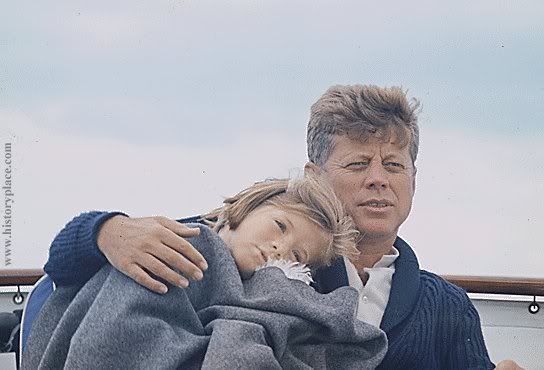
Caroline Kennedy Endorses Obama


In an op-ed for the New York Times, Caroline Kennedy writes:
Over the years, I’ve been deeply moved by the people who’ve told me they wished they could feel inspired and hopeful about America the way people did when my father was president. This sense is even more profound today. That is why I am supporting a presidential candidate in the Democratic primaries, Barack Obama.
My reasons are patriotic, political and personal, and the three are intertwined. All my life, people have told me that my father changed their lives, that they got involved in public service or politics because he asked them to. And the generation he inspired has passed that spirit on to its children. I meet young people who were born long after John F. Kennedy was president, yet who ask me how to live out his ideals.

Sometimes it takes a while to recognize that someone has a special ability to get us to believe in ourselves, to tie that belief to our highest ideals and imagine that together we can do great things. In those rare moments, when such a person comes along, we need to put aside our plans and reach for what we know is possible.

We have that kind of opportunity with Senator Obama. It isn’t that the other candidates are not experienced or knowledgeable. But this year, that may not be enough. We need a change in the leadership of this country — just as we did in 1960.

Most of us would prefer to base our voting decision on policy differences. However, the candidates’ goals are similar. They have all laid out detailed plans on everything from strengthening our middle class to investing in early childhood education. So qualities of leadership, character and judgment play a larger role than usual.

Senator Obama has demonstrated these qualities throughout his more than two decades of public service, not just in the United States Senate but in Illinois, where he helped turn around struggling communities, taught constitutional law and was an elected state official for eight years. And Senator Obama is showing the same qualities today. He has built a movement that is changing the face of politics in this country, and he has demonstrated a special gift for inspiring young people — known for a willingness to volunteer, but an aversion to politics — to become engaged in the political process.

I have spent the past five years working in the New York City public schools and have three teenage children of my own. There is a generation coming of age that is hopeful, hard-working, innovative and imaginative. But too many of them are also hopeless, defeated and disengaged. As parents, we have a responsibility to help our children to believe in themselves and in their power to shape their future. Senator Obama is inspiring my children, my parents’ grandchildren, with that sense of possibility.

Senator Obama is running a dignified and honest campaign. He has spoken eloquently about the role of faith in his life, and opened a window into his character in two compelling books. And when it comes to judgment, Barack Obama made the right call on the most important issue of our time by opposing the war in Iraq from the beginning.

I want a president who understands that his responsibility is to articulate a vision and encourage others to achieve it; who holds himself, and those around him, to the highest ethical standards; who appeals to the hopes of those who still believe in the American Dream, and those around the world who still believe in the American ideal; and who can lift our spirits, and make us believe again that our country needs every one of us to get involved.

I have never had a president who inspired me the way people tell me that my father inspired them. But for the first time, I believe I have found the man who could be that president — not just for me, but for a new generation of Americans.

Tuesday, January 15, 2008

A Little Perspective On Martin Luther King's Birthday

A censored clip, never broadcast, from a 1974 Merv Griffin Show.

Former presidential candidate Pat Paulsen:


It's taken thirty-three years to get from there to here:


...and we still can't talk about race and ethnicity without someone's hackles getting raised.

Friday, January 04, 2008

The Democrats' New Front-Runner, Fresh Out of the Gate


From the New York Observer:

Referring to his new status as the Democratic front-runner, Barack Obama said: "This feels good. It's just like I imagined it when I was talking to my kindergarten teacher."

And In 2nd Place . . . .

. . . . John Edwards:

I prefer Edwards' positions on most of the issues out of all of the other candidates (except for Dennis Kucinich's positions, but let's get real here - Kucinich doesn't stand a chance in hell and this race will be over within a month).

I love Elizabeth Edwards. I wish it was she who was running. Elizabeth thinks on her feet, has keen instincts, knows what's important, and what Americans want and need to hear from the candidate. Elizabeth is, inarguably, John Edwards's best advisor and asset. However, her first and most valuable role in this campaign is as the candidate's wife. If she is going to advise her husband, she has to do it out of sight of the public, in private.

Advisors in politics must work behind a veil of invisibility. When a candidate takes his advisor's advice, it must look as if it came from the candidate, that it was the candidate's own idea. Or else, voters might start asking, "Why aren't we electing the advisor?":


This shouldn't ever happen. John Edwards' has enough trouble selling himself as a dynamic alpha male, without looking as if he's taking direction from his 'mommy'.

Candidates are chosen, not only for their stands on the issues, but on how they come across as leaders. The candidate who is able to evoke the voters' imagination, positively, as to how he would lead in a national emergency, is the candidate who will get the job. Unless it's an incumbent running for reelection, a candidate for the presidency of the United States has only those situations that crop up during the campaign to interact with and show his stuff. He has to take advantage of every seemingly petty and picayune attack leveled against him, using them to show the electorate that he's got the right stuff.

Throughout the campaign, the Edwards' campaign has looked (and been) out of sync and out of touch. Edwards' himself has detached, removed, "a day late and a dollar short", and (worst of all), looking above-it-all when it comes to responding to his critics. How it is that Edwards hasn't seen his critics coming?

If you intend to run as a populist, don't buy a 102-acre parcel of land right before you toss your hat in the ring. Or build a 28,000 square foot home (with indoor basketball and handball courts, indoor swimming pool, etc.). Or buy rural 'transitional' property to build your dream house next to old time residents who are being forced out of their properties because they can't afford to pay the increase in their property taxes because of the changing base you represent. Or make any disparaging comments about your neighbors (in this case, an old "gun-toting Republican" living in a rundown house across the road that has been his family for generations).

Any candidate who isn't a step ahead of his critics, with a crack media team anticipating assaults from all directions, is worrisome. Because he can be taken off message any time his opponents need a distraction.

Here's John Edwards's entire speech:


Transcript:
EDWARDS: Thank you. Thank you.

The one thing that’s clear from the results in Iowa tonight is the status quo lost and change won.

(APPLAUSE)

And now we move on. We move on from Iowa to New Hampshire and to the other states to determine who’s best suited to bring about the change that this country so desperately needed. Because what we’ve seen here in Iowa is we’ve seen two candidates who thought their money would make them inevitable. But what the Iowa caucus-goers have shown, is if you’re willing to have a little backbone, to have a little courage, to speak for the middle class, to speak for those who have no voice.

(APPLAUSE)

If you’re willing -- if you’re willing to stand up to corporate greed, that message and the American people are unstoppable. No matter how much money is spent, no matter how much. And we are so proud of this cause.

But I want all of us to remember tonight while we’re having all these political celebrations, that just a few weeks ago in America, Nataline Sarkisian (ph), a 17- year-old girl who had a -- needed a liver transplant, and whose insurance company decided they wouldn’t pay for her liver transplant operation.

Finally, her nurses spoke up on her behalf. Her doctors spoke up on her behalf. Ultimately, the American people spoke up on her behalf by marching and picketing in front of her health insurance carrier. And, finally, the insurance carrier caved in and agreed to pay for her operation. And when they notified the family just a few hours later, she died. She lost her life. Why? Why?

James Lowe was born 51 years ago in the United States of America with a severe cleft palate, which kept him from being able to speak. And he lived for 50 years in the greatest, most prosperous nation on the planet, not able to speak because he didn’t have health-care coverage and couldn’t pay for a simple operation. Why?

Doug Bishop, who’s actually behind me tonight, Doug and his family worked at the Maytag plant in Newton -- Newton, Iowa. For generations, for generations, they worked. They sacrificed. They did everything you’re supposed to do in America. And then recently, this plant closed. And the jobs went overseas. Why? The reason is because corporate greed has got a stranglehold on America. And unless and until we have a president in the proud tradition of Teddy Roosevelt, Franklin Roosevelt, Harry Truman, who has a little backbone, who has some strength, who has some fight, who’s willing to stand up to these people, nothing will change.

We will never have the America that all of us dream of. The promise of America, which has been available to so many of us, will not be available to our children and our grandchildren. And I take this very personally.

I watched my grandmother, who I loved dearly, work year after year after year in the mills. And we lived in the same neighborhood. She would cook for us, leave the house, walk her way to the mill, work her shift, and come back home and take care of us again.

My grandfather, who was partially paralyzed, would go to work the graveyard shift in that mill and come back in the morning, when we’d have breakfast together.

My father, who’s here with me tonight, worked 36 years in the mills -- hard, tedious work; hard, tedious work. Why did he do it? Why did he struggle and sacrifice? Why did your parents and grandparents struggle and sacrifice? They did it so that you could have a better life. My parents did it so that I could have a better life.

And we, all of us to whom the torch has been passed, we carry an enormous responsibility. And that responsibility transcends politics and transcends elections. It’s our responsibility to ensure that we leave America better than we found it; that we give our children a better life than we’ve had.

And this is what I see in America today. I see an America where last year, the CEO of one of the largest health insurance companies in America made hundreds of millions of dollars -- in one year.

I see an America where ExxonMobil’s (NYSE:XOM) profits were $40 billion just a couple of years ago. Record amounts -- record profits.

All of that happening at the same time that this picture of America emerges. Tonight, 47 million Americans will go to bed knowing that if their child gets sick, they’ll have to go to the emergency room and beg for health care. Tomorrow morning, women will go to their doctor and be diagnosed with breast cancer, just like Elizabeth was. But unlike Elizabeth, they’ll have no health care coverage. And as a result, they know that they can’t go to the emergency room and get chemotherapy. What are they supposed to do? What are they supposed to do? You can literally see the fear and terror in their eyes.

Tomorrow morning, 37 million of our own people will wake up literally worried about feeding and clothing their own children. I went to a shelter here in Des Moines just a few weeks ago, where they took single moms with their children who had no place to live. And I said: Do you ever have to turn people away? Yes, a few months ago, they had to turn 70 to 75 families away in one month. And I said: These are moms with kids -- yes -- some of them with three or four children. And I said: Well, where did they go when you sent them away? They went back to the street, back to their homes. Thirty-five million people in America went hungry last year in the richest nation on the planet.

And tonight, 200,000 men and women who wore our uniform proudly and served this country courageously as veterans will go to sleep under bridges and on grates. We’re better than this. The United States of America’s better than this. And what happened tonight is the Iowa caucus-goers said, we want something different. We are going to stand up, we are going to rise up, we’re going to create an America that all of us believe in.

Because the truth is, when we speak up, when we speak up for James Lowe and the millions like him who live in the darkness, when we speak up against corporate greed and for the 37 million Americans who live in poverty, when we speak up for single moms who have no place to live with their children, when we speak up for hundreds of thousands of veterans who served this country proudly and are homeless with no place to live at night, when we do that together, as a nation -- and Iowa caucus-goers did it tonight -- when we do it, America’s a better place.

It says something about who we are. It says something about our character. Because when we do, America rises up. America becomes what it’s capable of being. And what began -- and it is not over -- what began tonight in the heartland of America is the Iowa caucus- goers said: Enough is enough. We are better than this. We are going to bring the change that this country needs.

And you have created and started a wave of change, a tidal wave of change that will travel from here to New Hampshire to Nevada to South Carolina, all across this country.
(APPLAUSE)

Because we know the torch has been passed to us. We stand proudly on the shoulders of our parents and grandparents and all those generations who came before us. And we take our responsibility seriously.

And this tidal wave of change that began tonight in Iowa and that will sweep across America, when that wave is finished, when it is done, every one of us are going to be able to look our children in the eye and say, we did what our parents did for us and what our grandparents did for us. Which is: We left America better than we found it, and we gave our children a better life than we had.

That’s what this is about. That’s what this change is about.

Continue on. This march of change continues on. God bless you. Thank you for everything you’ve done. Stay with us in this fight. We are in this fight together. Thank you.

In 3rd Place . . . .

. . . . Hillary Clinton:


My biggest complaint about Hillary's speech was the visual.

Whose terrible idea was it to have her flanked at the podium with the old (Bill) Clinton administration appointees (former Secretary of State Madeleine Albright and retired General Wesley Clarke) most identified with the Clinton administration's aggressive and highly controversial military activities in Kosovo? She doesn't leave herself any room for even the possibility of movement away from her pro-war/hawk, establishment/corporate position. Given the early Democratic primary goers desire for change, painting herself into a corner doesn't seem to be the wisest strategy for winning over an electorate thoroughly done leaders who stubbornly cling to failed policies.

And what's with this?:


Who was that dark-haired, cross-eyed fellow standing behind Hillary, who wouldn't move for the candidate's husband, the former president of the U.S.? Bill Clinton had to pivot around and squeeze by this guy to make sure he was in the camera frame with his wife. The candidate's daughter (Chelsea) and the governor of the state (Tom Vilsack) had to move to the end of the row (to the far right side of the stage) because this stranger wouldn't move out of the picture.

Transcript:
SENATOR HILLARY RODHAM CLINTON: Well, we’re going to take this enthusiasm and go right to New Hampshire tonight. This is a great night for Democrats. We have seen an unprecedented turnout here in Iowa. And that is good news, because today we’re sending a clear message: that we are going to have change, and that change will be a Democratic president in the White House in 2009.

(APPLAUSE)

I am so proud to have run with such exceptional candidates. I congratulate Senator Obama and Senator Edwards. I thank Senator Dodd, and Senator Biden, and Governor Richardson, and Congressman Kucinich. Together, we have presented the case for change and have made it absolutely clear that America needs a new beginning.

And I am as ready as I can be, after having had this incredible experience here in Iowa, starting out a long time ago, and making this journey with so many people who have become my friends and who I am so grateful for, their hard work and support, those from Iowa, those who have come from around the country. And the people who were there exceeding anybody’s expectations about what it would mean to have the caucuses this year, I thank you. I thank each and every one of you for coming out and standing up for a Democrat.

What is most important now is that, as we go on with this contest, that we keep focused on the two big issues, that we answer correctly the questions that each of us has posed. How will we win in November 2008, by nominating a candidate who will be able to go the distance? And who will be the best president on day one? I am ready for that contest.

(APPLAUSE)

Now, you know, we have always planned to run a national campaign all the way through the early contests, because I want the people of America, and particularly Democrats, and like-minded independents... (LAUGHTER) ... and Republicans who have seen the light... (APPLAUSE) ... to understand, number one, that the stakes are huge, that the job is enormous, but that I believe we’re going to make the right decision.

There will be a lot of people who will get involved, as they have here in Iowa, of all ages. That is what we want, because we’re not just trying to elect a president; we’re trying to change our country. That is what I am committed to doing.

I have set big goals for our country. I want to rebuild a strong and prosperous middle class. And to me, that is the most important job the next president will have here at home, because if we don’t begin to pay attention to the people who do the work, and raise the families, and make this country great, we will not recognize America in a few years.

And I want to make it absolutely clear I intend to restore America’s leadership and our moral authority in the world. And we’re going to tackle all of the problems that are going to be inherited because of the current administration, including ending the war in Iraq, and bringing our troops home, and then giving them the support that they need.

And we’re going to reform our government. We’re going to make sure that it is not the government of the few, by the few, and for the few, but it actually works for every American again.

And we’re going to reclaim the future for our children. I have done this work for 35 years. It is the work of my lifetime. I have done -- I have been involved in making it possible for young people to have a better education and for people of all ages to have health care, and that transforming work is what we desperately need in our country again. I am so ready for the rest of this campaign, and I am so ready to lead.

So if you’re concerned about whether or not we can have quality, affordable health care for every American, then I’m your candidate. And if you’re concerned about whether we can have an energy policy that will break the shackles of our dependence on foreign oil and set forth a new set of goals for us to meet together, then I’m your candidate. And if you are worried about once and for all taking on global warming, making it clear that we will end the unfunded mandate known as No Child Left Behind, that we will make college affordable again, that we will be once again the country of values and ideals that we cherish so much, then, please, join me in this campaign.

We have a long way to go, but I am confident and optimistic, both about the campaign, but maybe more importantly about our country. This country deserves everything we can give to it. You know, there were a lot of people who couldn’t caucus tonight, despite the very large turnout. There are a lot of Iowans who are in the military. They are in Iraq or Afghanistan or somewhere else serving our country, and they need a commander-in-chief who respects them and who understands that force should be only used as a last resort, not a first resort.

(APPLAUSE)

And there are a lot of people who work at night, people who are on their feet, people who are taking care of patients in a hospital, or waiting on a table in a restaurant, or maybe in a patrol car keeping our streets safe. And they need a president who’s going to care about them and their families.

You know, I wrote a book some years ago called ”It Takes a Village to Raise a Child,” and in it I have a chapter that I titled ”Every Child Needs a Champion.” Well, I think that the American people need a president who is their champion, and that is what I intend to be.

(APPLAUSE)

So I want to thank all the people who have been part of this campaign so far. I especially want to thank all of my friends here in Iowa who have worked so hard. I want to thank those who have come from across America. I want to thank all of the unions, the more than 6 million union members who support my candidacy.

And I know that we’re going to get up tomorrow and keep pushing as hard as we can to get the message out about what is at stake in this election, because we know that it is literally the future of our country.

So thank you all so very much for caring enough to be involved in politics, for giving of your time and your resources, for understanding that this great democracy of ours deserves to have all of our best efforts. And I promise you this campaign that I am running will certainly have mine and I ask for yours, as well. Thank you all very, very much. God bless you.

The Republican To Beat (For the Moment) . . . .

. . . . Mike Huckabee:


In the purest Republican tradition of hijacking the English language to lead people into believing you've said something entirely different, this was the speech of the night. The word to look and listen for is 'change'; tonight it became the word that will define the 2008 election, and that each of the candidates will shape their campaigns around from here on out. The question that they now must answer is, "How?"

Transcript:
MIKE HUCKABEE: Thank you, Iowa.

Thank you. Thank you very much.

You know, I wasn't sure that I would ever be able to love a state as much as I love my home state of Arkansas.

But tonight, I love Iowa a whole lot.

Over the past several months, my family and I have had the marvelous joy and privilege of getting to know many of you. And it's been an incredible honor.

I was thinking last night that some of the friendships that we've forged here in the last several months are friendships that will last a lifetime.

And we didn't know how this was going to turn out tonight. But I knew one thing: I would be forever grateful to the people that I met, the ones who voted for me, even the ones who didn't, who still treated me with respect and who gave me their attention, who have allowed me to come often, not just into their communities, but into their homes, not once, but time and time again.

And a few of them, I even convinced to vote for me tonight and that's really remarkable.

I want to say how much I appreciate my wife, Janet.

She was a wonderful first lady of Arkansas.

And I think she'll be a wonderful first lady for the United States of America.

We also want to say thanks. Our three children are with us tonight.

I would like them to come and just be a part of this tonight. They have all been so much involved. Our oldest son, John Mark, our son, David, his wife, Lauren, our daughter, Sarah, who has literally lived in Iowa for the past two and a half months.

And I told her if she stayed much longer, she'll have to get her an Iowa driver's license and probably start paying even more taxes up here.

And I say thanks to all of them for joining with us in this effort, because a family goes through it, not just the candidate. But tonight is a celebration for everybody on our team, so many of you who have traveled from all across America to be here.

I'm amazed, but I'm encouraged, because tonight what we have seen is a new day in American politics. A new day is needed in American politics, just like a new day is needed in American government. And tonight it starts here in Iowa.

But it doesn't end here. It goes all the way through the other states and ends at 1600 Pennsylvania Avenue one year from now.

I think we've learned three very important things through this victory tonight. The first thing we've learned is that people really are more important than the purse, and what a great lesson for America to learn. Most of the pundits believe that when you're outspent at least 15 to 1, it's simply impossible to overcome that mountain of money and somehow garner the level of support that's necessary to win an election.

Well, tonight we proved that American politics still is in the hands of ordinary folks like you and across this country who believe that it wasn't about who raised the most money but who raised the greatest hopes, dreams and aspirations for our children and their future.

And tonight I hope we will forever change the way Americans look at their political system and how we elect presidents and elected officials.

Tonight, the people of Iowa made a choice, and their choice was clear.

Their choice was for a change.

But that choice for a change doesn't end just saying, "Let's change things."

Change can be for the better. It could be for the worse.

Americans are looking for a change. But what they want is a change that starts with a challenge to those of us who were given this sacred trust of office so that we recognize that what our challenge is to bring this country back together, to make Americans, once again, more proud to be Americans than just to be Democrats or Republicans.

To be more concerned about being going up instead of just going to the left or to the right.

And while we have deep convictions that we'll stand by and not waiver on, or compromise -- those convictions are what brought us to this room tonight. But we carry those convictions not so that we can somehow push back the others, but so we can bring along the others and bring this country to its greatest days ever.

Because I'm still one who believes that the greatest generation doesn't have to be the ones behind us. The greatest generation can be those who have yet to even be born.

And that's what we are going to...

And, ladies and gentlemen, we've learned something else tonight, and that is that this election is not about me. It's about we.

And I don't say that lightly. I'm the person whose name gets on the signs, who occasionally gets the attention in some...

... of the few ads that came out here and there.

But the election is not about me. And the country is not just about me.

What is happening tonight in Iowa is going to start really a prairie fire of new hope and zeal. And it's already happening across this nation because it is about we; we the people.

We saw it tonight. We've seen it in other states. And we're going to continue to see it because this country yearns and is hungry for leadership that recognizes that when one is elected to public office, one is not elected to be a part of the ruling class; he's elected to be a part of the serving class. Because we the people are the ruling class of America.

G.K. Chesterton once said that a true soldier fights not because he hates those who are in front of him, but because he loves those who are behind him. Ladies and gentlemen, I recognize that running for office, it's not hating those who are in front of us. It's loving those who are behind us.

It's recognizing that behind us are great patriots dating back to the beginning of this wonderful country, when 56 brave men put their signatures on a document that started forth the greatest experiment in government in the history of mankind, and gave birth to the idea that all of us are created equal, and we have been given by our creator inalienable rights: life, liberty and the pursuit of happiness.

And these who signed that document, who gave birth to this dream, were the beginnings of those throughout our history who have continued, with great sacrifice, extraordinary valor, to pass on to us that liberty and the quest for something better than the generation before them had.

I stand here tonight the result of parents who made incredible sacrifices as part of a great generation, who went through a Depression and a world war and said our kids won't have to go through these things. And every sacrifice they made were to lift us on their shoulders and give us a better America than they ever could have envisioned. And they were successful in doing that.

Now, ladies and gentlemen, for the same reason that our founding fathers and those before us saw what was behind us and gave it their best, I ask you to join me across Iowa and the rest of America to look out there in front of us and not to hate those, but to look behind us and to love them so much that we will do whatever it takes to make America a better country, to give our kids a better future, to give this world a better leader.

And we join together tonight for that purpose. God help you and thank you for all you've done. I'm so grateful for the support, the incredible work that you've done. And now we've got a long journey ahead of us.

I wish it were all over tonight, and we could just celebrate the whole thing. But unfortunately, if this were a marathon, we've only run half of it. But we've run it well.

And now it's on from here to New Hampshire, and then to the rest of the country. But I'll always be wanting to come back to this place and say, wherever it ends -- and we know where that's going to be -- it started here in Iowa.

Thank you and God bless you, every one of you. Thank you tonight. Thank you.

Wednesday, January 02, 2008

Look Who Swift Boat Veterans Are Giving It ($$$) Up For . . . .


. . . . And McCain's taking it ($$$)!

Back in the 2004 presidential campaign, John McCain condemned the Swift Boat Veterans for Truth ad against John Kerry, calling it, "dishonest and dishonorable." When asked if the White House was behind it, McCain said: "I hope not, but I don't know. But I think the Bush campaign should specifically condemn the ad."

Fast forward to today - Politicians don't bother even giving lipservice to having integrity anymore. The Nation reports:
More than three years after John Kerry's bitter defeat, at the dawn of what looks like a far more promising campaign cycle for the Democrats, the party is still haunted by the specter of the Swift Boat Veterans for Truth. Once upon a time, "Swift boat" denoted an obscure military vessel, but thanks to the activities of this group it has come to represent movement conservatism's penchant for ruthlessly (and effectively) smearing any and all political opponents, from a sitting senator and war hero to an 11-year-old boy with a cranial fracture.

Research by The Nation into Federal Election Commission records of the group's top twenty donors reveals that they've been remarkably active in this cycle, contributing and bundling nearly $200,000 to presidential candidates. This does not bode well. During the last presidential campaign, the wealthy backers of Swift Boat Veterans for Truth--now rebranded as Swift Vets and POWs for Truth--didn't do their real dirty work until the general election, where as a tax-exempt 527 group they operated outside the restraints of direct campaign contributions. We may wish we were done with the Swift Boaters, but they aren't done with us.
In 2004 the top twenty donors all gave (with one exception) at least $50,000 to the group. The top three--Houston home builder Bob Perry, Texas oilman T. Boone Pickens and billionaire drugstore impresario and investor Harold Simmons--gave a combined $9.5 million ($4.45 million, $3 million and $2 million, respectively). Calculating the influence of these and the slightly less wealthy Swift Boat donors during this cycle is a touch more complicated than simply adding up their contributions. Each one exerts far more influence as a bundler, given the federal restrictions on individual giving, which limit donors to a maximum of $4,600 per cycle. So The Nation looked not only at the contributions of the donors themselves but also at those of their family members and employees. It's an imperfect method, since some employees are clearly contributing of their own volition (such as one employee of a Simmons company who gave money to Hillary Clinton), but it gives a rough estimate of who's backing whom and to what extent.

The most notable recipient of Swift Boat largesse is John McCain, erstwhile front-runner and Stand Up Guy. When the Swift Boat ads were first unleashed, McCain was alone among his Republican colleagues to condemn them. A fellow Vietnam veteran, a good friend of Kerry's and a former target of smears about his own service, McCain called the ads "dishonest and dishonorable," a "cheap stunt," and he urged Bush to condemn them. But in pursuit of the GOP nomination, McCain ditched the mantle of maverick for that of hack, and his once-floundering, possibly rejuvenated campaign has been aided along the way by $61,650 from Swift Boat donors and their associates. "There is such a thing as dirty money," said Senator Kerry in a statement, after The Nation informed him of McCain's FEC records. "I'm surprised that the John McCain I knew who was smeared in 2000 and thought so-called Swift Boating was wrong in 2004 would feel comfortable taking their money after seeing the way it was used to hurt the veterans I know he loves." (McCain's office did not return calls for comment.)

McCain's Swift Boat bounty is exceeded only by that of Mitt Romney, who has raked in $70,550. Romney's success with Swift Boat donors is significant because he has surpassed even McCain in his demonstrated willingness to do or say anything in pursuit of the presidency and because he has emerged as the GOP establishment's favored candidate. Last year, when McCain held that position, the Arizona senator received significant backing from Swift Boat donors. But many have subsequently switched their allegiance. Pickens, who donated to McCain in June 2006, is now an enthusiastic Giuliani donor and fundraiser (Giuliani ranks third in Swift Boat funding, with $47,950). Perry, who also recorded several donations to McCain's PAC in 2005 and 2006, is now a major donor and fundraiser for Romney. If the list of top Swift Boat donors is expanded to fifty, Romney's fundraising edge is even more pronounced. (Neither Romney nor Giuliani's campaign returned calls for comment.)

Also noticeable among the recipients of Swift Boat largesse is one who received only a single donation: Mike Huckabee. Despite meager fundraising and little national name recognition, the former Arkansas governor has experienced a bubble-like expansion of support and media attention, taking the lead in Iowa and approaching a steady lead in national polls. But the lack of Swift Boat contributions lends credence to the claim that Huckabee is viewed warily by the money men who call the shots in the modern GOP. Despite proposing a radically regressive tax change and taking Grover Norquist's antitax pledge, he's been attacked savagely by the Club for Growth and eviscerated by columnist George Will for "comprehensive apostasy against core Republican beliefs," among them "free trade, low taxes, the essential legitimacy of America's corporate entities and the market system allocating wealth and opportunity."

This all supports the notion that the people behind the Swift Boat operation are chiefly concerned with the continued upward redistribution of wealth that is, more or less, the contemporary GOP's raison d'être. In 2006 Perry ponied up $5 million to start the Economic Freedom Fund, a 527 group devoted to attacking Democratic incumbents, and landed a large donation from prominent Swift Boat donor Carl Lindner. All of which is to say that the Swift Boaters aren't some kind of side show, a coterie of vicious mudslingers operating at the edges of respectability. They are the show. They are modern conservatism's core funders and beneficiaries. With conservatives staring straight into the abyss, their activities in this election cycle could very well make the Swift Boat smears look tame by comparison.

Not Walking The Talk

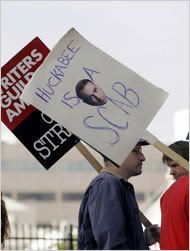
Striking writers outside the Burbank, Calif. studios of NBC. (Photo: Ric Francis/Associated Press)

Last week, it was Huckabee's mistakes about Pakistan. Just three weeks earlier, it was his ignorant blunders about the NIE on Iran which he blamed his failure "to keep up on every little thing, from Britney to 'Dancing with the Stars'" to being on the campaign trail.

Now he's showing us his plain ignorance about the status of the writer's strike (it's not over, 'dimples'), as well as proper recognition of striking employees whom you claim to "support" - You don't cross their picket line!

The New York Times'-blog reports:
Former Governor Mike Huckabee of Arkansas today professed his support for the striking television writers union just a few hours before he was expected to board a plane for a taping of the Jay Leno show where he will face a vocal picket line of striking writers.

Mr. Leno’s program is returning to the air for the first time since a long hiatus for the strike. Speaking to reporters, Mr. Huckabee said he was unaware that he would be crossing picket lines and believed that the program had reached a special agreement with the union.
Although crossing picket lines might not be unusual for most Republican candidates, Mr. Huckabee has waged an unusual populist campaign on economic issues, stressing his empathy with the anxieties of working people. On Wednesday, he said he identified with the striking television workers as an author himself and believed they deserved a share of the proceeds from the sale of their work.

Mr. Huckabee’s inconsistency about the picket lines outside the Leno show are the latest in a string of missteps that have underscored the ad-hoc, on-the-fly nature of his insurgent campaign. Last week, he made a series of small misstatements about Pakistan that raised questions about his fluency in matters of foreign affairs and raised eyebrows when he suggested applying special scrutiny to Pakistanis at the borders in the interest of national security. Then, he reversed a pledge to avoid attacking his opponent, Mitt Romney, and two days ago reversed himself again to renounce those attacks.

On Wednesday, Mr. Huckabee appeared to edge back once again toward explicit swipes at his opponent. Asked by a reporter about Mr. Romney’s roughly $17 million in personal loans to his campaign, Mr. Huckabee asked how voters could expect understanding of their problems from a candidate who “writes checks for tens of millions of dollars and doesn’t miss the money?”

In a stump speech in Fort Dodge, Iowa, Mr. Huckabee did not name Mr. Romney but made veiled references to his opponent. Alluding to Mr. Romney’s professed change of heart on abortion rights, Mr. Huckabee said he was a candidate whose views in the issue did not change depending on polls or where he was running.

“You want someone who is authentic, you want someone who is consistent, you want someone who can lead,” Mr. Huckabee said.

“Some of us come to you with the views that we had because they are convictions not political conveniences,” he said later in Mason City, Iowa.

“Wouldn’t it be something if the people of Iowa proved that they cannot be bought?” he said, alluding to Mr. Romney’s heavy spending on the campaign.

Speaking to reporters, he said he expected his appearance on the Jay Leno show to reach more Iowa voters than a day of appearances to crowds of a few hundred each. He said he planned to fly back to Iowa by the end of the day, spending as little time as possible out of the state. He is continuing to wage his Iowa campaign largely from the airwaves of national television, beginning Wednesday with three morning television interviews before boarding a bus for two appearances on the stump.

Episodes like these offer candidates unique opportunities to own the moment by sucking all of the oxygen out of the air (waves) with a grand gesture (or stunt).

If I was on Huckabee's staff and advising him, I wouldn't let him go into NBC's studios. I'd have him stand on the street with the picketers (after clearing it with the WGA) and get Leno to wire him up for a remote interview. I'd focus the interview on the striking writers, working Americans, quality television, and have some prearranged gag that the writers had prepared. Something like this:

Huckabee Tells His Bloggers, "God Wants You To Clog The Net, Prevent Press From Filing Bad Stories About Me"

Yesterday in Des Moines, former Arkansas governor Mike Huckabee hosted an event thanking roughly 700 bloggers who, he said, were responsible for keeping his campaign alive.

Calling them his secret weapon, Huckabee urged the bloggers to clog up the wireless system in Des Moines so that reporters couldnt file any more bad stories about him. He added that by blocking the free press from doing their jobs, bloggers were doing the Lords work:

The New York Times-blog reports:

Mike Huckabee held a little event here on Tuesday to thank the roughly 700 bloggers who, he said, were responsible for keeping his campaign alive. Because he had no money and initially got very little media attention, he said, he could not have kept going without their dedication.

He said the bloggers, whom he called his “secret weapon,” spent their days “pounding their keyboards and hitting ‘send’ in the middle of the night.” Ed Rollins, his campaign consultant, said none of the bloggers were on Mr. Huckabee’s payroll, chuckling at the idea of a payroll.

At one point, Chuck Norris, Mr. Huckabee’s most famous supporter, wandered into the small meeting room where the event was being held. Mr. Norris, the martial artist and action actor, confessed to being “computer illiterate” himself, but thanked the bloggers for getting him and Mr. Huckabee together.

Mr. Norris proposed holding a fundraiser for Mr. Huckabee with a “virtual barbeque” at his Texas ranch on Jan. 20. He said he would take the blogosphere on a virtual tour of the ranch, including his 2,000-square-foot gym, and perhaps Mr. Huckabee would sing with his band. One blogger proposed that all bloggers hold actual barbeques in their home towns at the same time to raise money. The bloggers applauded their approval.

“Pork across America!” Mr. Huckabee proclaimed.

About a dozen or so bloggers had set up their laptops to take notes and blog as Mr. Huckabee and Mr. Norris spoke; the mainstream media was allowed to observe but not ask questions.

Mr. Huckabee had a rough time yesterday at the hands of the media when he announced he was canceling a negative ad against Mitt Romney and then showed the ad to the assembled reporters, who burst out laughing. Today, he turned the tables. He noted that the mainstream media might be “filing a bad story” right now, and if the bloggers were relying on the same wireless system at the hotel, they might be “clogging up the lines” and preventing them from filing.

If that’s the case, “thank you,” he said. “You’re doing the Lord’s work.”

Mr. Huckabee was asked if he became president whether he would hold an event like this one in the White House. He said he would. “You gotta dance with the one that brought you,” he said.

Afterwards, Anthony Bonna, 20, a blogger from Florida who is a student at Georgetown University in Washington, D.C., said he supported Mr. Huckabee because he is “the authentic conservative” in the race. His Web site, www.huckamania.com, is devoted to him.

Saturday, December 29, 2007

Who's Briefing This Guy?


If he isn't ducking questions (such as why, in his autobiography, he linked homosexuality with pedophilia, necrophilia and sadomasochism) or promising to throw doctors in jail for providing women with the safe medical procedure of abortion (let's all try to remember that abortion is still legal in the U.S.), Arkansas-governor-and-presidential-wannabe Mike Huckabee is showing off his credentials from the Nodda Cloo foreign policy school at Ouachita Baptist University.

USA Today reports:
As his campaign has surged, Mike Huckabee has made a series of public foreign policy gaffes, fueling attacks by rivals that he lacks the international experience to be president.

The former governor of Arkansas has confused the status of martial law in Pakistan, raised questions about Pakistanis crossing the U.S. border and wasn't initially familiar with the latest U.S. intelligence assessment of Iran's nuclear weapons program.

While the missteps are his, a tough foreign policy critique has often been lobbed against governors, or past governors, running for president — Ronald Reagan, Bill Clinton and George W. Bush, among them. But what Reagan, Clinton and Bush had — and what Huckabee seems to sorely lack in his bid for the Republican presidential nomination — was a roster of respected foreign policy advisers to reassure voters on national security issues.
On Friday morning, Huckabee listed former U.N. ambassador John Bolton as someone with whom he either has "spoken or will continue to speak."

At a Thursday evening news conference, Huckabee said, "I've corresponded with John Bolton, who's agreed to work with us on developing foreign policy."

Bolton, however, has a different view. "I'd be happy to speak with Huckabee, but I haven't spoken with him yet," said Bolton, now a senior fellow at the American Enterprise Institute, a conservative think tank in Washington.

"I'm not an official or unofficial adviser to anyone," said Bolton, who mentioned he'd had conversations with other Republican candidates but declined to name any names.

Asked to explain Bolton's comments, Huckabee aides said the former Arkansas governor had e-mailed with Bolton. Bolton did not immediately respond to a request to address Huckabee's e-mailing claims.

Huckabee said he had also spoken with former State Department official Richard Haass (now president of the Council on Foreign Relations); military analyst Ken Allard; former national security adviser Richard Allen; former House speaker Newt Gingrich; Frank Gaffney, founder of the Center for Security Policy, a conservative think tank; and a "number of military personnel."

A Gingrich spokesman said the two men had spoken, on an unofficial basis, on Friday.

Council on Foreign Relations spokeswoman Lisa Shields said Haass has "briefed Huckabee on foreign policy issues as well as [briefing] many other candidates" in both parties. Shields stressed that the relationship was not exclusive and that Haass was not affiliated with the campaign.

Reached via e-mail, Allen said an intermediary asked him to speak with Huckabee, but he hadn't yet agreed. "I'm gradually getting older, but am fully capable of recalling with whom I have spoken," said the former Nixon and Reagan foreign policy campaign adviser.

Allard and Gaffney could not be reached for comment.

Huckabee argues that foreign policy is less about experience and more about judgment. "The most important thing a president does is to make tough decisions when confronted with a crisis," he said Friday. As a governor, "you've dealt with the unexpected, a crisis, time and time again."

The confusion over Bolton, however, is the latest in a growing list of foreign policy hiccups by the Iowa front-runner. And to succeed nationally, Huckabee must broaden support beyond his socially conservative base by proving his competency on issues such as national security.

On Thursday, he commented on the assassination of former Pakistani prime minister Benazir Bhutto, saying the U.S. needs to consider "what impact does it have on whether or not there's going to be martial law continuing in Pakistan." Martial law, as it turns out, was lifted two weeks ago.

Huckabee clarified the point later that day. "What I said was, you know, it was not that I was unaware that it was suspended two weeks ago, or lifted two weeks ago. The point was continued: ... Would it be reinstated? Would it be placed back in?" he said.

Huckabee also raised eyebrows Thursday when he said that Bhutto's death should prompt "an immediate, very clear monitoring of our borders and particularly to make sure if there's any unusual activity of Pakistanis coming into the country."

And earlier this month, Huckabee said he was unfamiliar with the National Intelligence Estimate reporting that Iran hadn't had a program to develop nuclear weapons since 2003.

Huckabee's lack of foreign policy experience has fueled a host of critics. On Thursday, rival Sen. John McCain of Arizona said Bhutto's assassination highlights Huckabee's lack of foreign policy experience.

"You know, I don't think it's appropriate to respond in a political way," Huckabee said.

Last week, Secretary of State Condoleezza Rice denounced Huckabee's critique of the Bush administration as having a "bunker mentality" when it comes to foreign policy.

"The idea that somehow this is a go-it-alone policy is just simply ludicrous," she said at a State Department news conference. "One would only have to be not observing the facts, let me say that, to say that this is now a go-it-alone foreign policy."
I long for the good old days, when candidates for the highest office in the land and the leadership of the free world brought a firm base of knowledge about the affairs of the world based on a sound education, extensive travel and life experience in business, government service, or both.

Nowadays it seems that more of them would prefer on-the-job training, a precedent that was set by Bush 41, who called on his former aides to put together a crash tutorial on world history to prepare his 52-year-old son for a Presidential run.

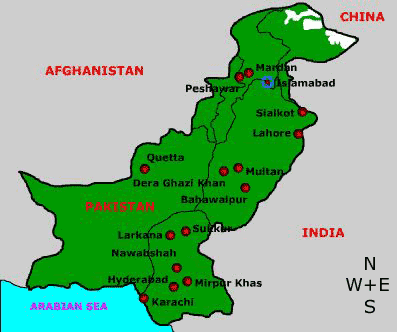
Call me crazy, but I'd like our next Commander-in-Chief to be able to find Pakistan on a map. It isn't this guy:


Will Evangelicals Do It To America Again?

Will evangelical Christians saddle us with another president too ignorant to be trusted with the awesome responsibility that is the Commander-in-Chief of the greatest military power in the world?


The New York Times reports:
In discussing the volatile situation in Pakistan, Mike Huckabee has made several erroneous or misleading statements at a time when he has been under increasing scrutiny from fellow presidential candidates for a lack of fluency in foreign policy issues.

Explaining statements he made suggesting that the instability in Pakistan should remind Americans to tighten security on the southern border of the United States, Mr. Huckabee said Friday that “we have more Pakistani illegals coming across our border than all other nationalities, except those immediately south of the border.”

Asked to justify the statement, he later cited a March 2006 article in The Denver Post reporting that from 2002 to 2005, Pakistanis were the most numerous non-Latin Americans caught entering the United States illegally. According to The Post, 660 Pakistanis were detained in that period.

A recent report from the Department of Homeland Security, however, concluded that, over all, illegal immigrants from the Philippines, India, Korea, China and Vietnam were all far more numerous than those from Pakistan.
In a separate interview on Friday on MSNBC, Mr. Huckabee, a Republican, said that the Pakistani government “does not have enough control of those eastern borders near Afghanistan to be able go after the terrorists.” Those borders are on the western side of Pakistan, not the eastern side.

Further, he offered an Orlando crowd his “apologies for what has happened in Pakistan.” His aides said later that he meant to say “sympathies.”

He also said he was worried about martial law “continuing” in Pakistan, although Mr. Musharraf lifted the state of emergency on Dec. 15. Mr. Huckabee later said that he was referring to a renewal of full martial law and said that some elements, including restrictions on judges and the news media, had continued.

Mr. Huckabee’s comments on the situation in Pakistan were not the first time he has been caught unprepared on foreign policy matters. Early this month, after the release of a National Intelligence Estimate concluding that Iran had stopped its nuclear weapons program in 2003, Mr. Huckabee said that he was not familiar with the report, even though it had been widely reported in the news for more than 30 hours.
When do those who gave us Bush and Cheney realize that the most important decision they should be ever be trusted with again is what to wear when they get out of bed every day? And when are we going to say this out loud to them?

Campaigns Turn To Pakistan

Candidates stress fighting terrorism

McClatchy reports:
The presidential campaign erupted Friday into a full-blown debate over how best to stabilize Pakistan as candidates vied in the few days before Thursday's Iowa caucuses to show who was best prepared to lead the fight against terrorism.
In the wake of Thursday's assassination of Pakistani opposition leader Benazir Bhutto, Republican and Democratic presidential candidates spent much of Friday laying out specific policies they'd follow now -- or, for Democratic Illinois Sen. Barack Obama and two former Republican governors, Mike Huckabee of Arkansas and Mitt Romney of Massachusetts, trying to convince voters that they're qualified to play in that league.

The rivals with thicker foreign-policy resumes offered detailed blueprints of how they would deal with Pakistan. New Mexico Gov. Bill Richardson, a former United Nations ambassador, struck first, telling a Des Moines audience that the United States should give Pakistan "not one penny more until [President Pervez] Musharraf is gone and the rule of law is restored."

Most Democratic candidates wouldn't go that far; New York Sen. Hillary Rodham Clinton offered a multi-part plan to restore stability but stopped short of calling for Musharraf's ouster.

"I don't think the Pakistani government at this time under President Musharraf has any credibility at all," Clinton said as she visited Story City. "They have disbanded an independent judiciary. They have oppressed a free press."

She called for a "full, independent, international investigation."

Senate Foreign Relations Committee Chairman Joseph Biden, D-Del., urged putting new pressure on Musharraf to hold "fair elections as soon as possible," while Sen. Christopher Dodd, D-Conn., a senior Foreign Relations member, urged that Pakistan's elections be postponed.

The fight was not just over ideas -- it was over foreign policy pedigree, too.

Dodd took aim at Clinton, questioning her experience.

"It isn't enough to be sitting on the sidelines, watching your husband deal with these problems over the years," Dodd said. And he termed Richardson's call for Musharraf to resign "a dangerous idea."

GOP backs Musharraf

The Republican debate had a different tone. Most candidates were more willing to tolerate, and in some cases even praise, Musharraf, while they painted Democrats as unsteady and weak.

"I don't think it would be a good idea to call for him [Musharraf] to step down now," former Tennessee Sen. Fred Thompson told CNN on Friday. "I hope that we as candidates out here don't start lobbing these ideas that get plenty of attention but are not very sound. This is a serious matter. It's going to be with us for some time, and we need to be deliberate in our approach to it because we have several interests involved."

Arizona Sen. John McCain said, "You're going to hear a lot of criticism about Musharraf, that he hasn't done everything we wanted him to do, but he did agree to step down as head of the military, and he did get the elections."

Romney stressed his experience as a business executive -- saying he could put together "a great team" to help manage crises -- while Huckabee linked the assassination to illegal immigration, saying it highlighted the importance of securing the nation's borders by building a fence along the Mexican border.

Thursday, December 13, 2007

So Now We Know Where That Tidbit In Novak's Column Came From

Jeanne Shaheen's Husband Resigns as Hillary Clinton's Co-Chairman After Insinuating Obama Had Been A Drug Dealer

I guess we now know the source of Robert Novak's reported 'rumor' last month.
The Hill reports:
New Hampshire power player Billy Shaheen stepped down as national co-chairman of Sen. Hillary Rodham Clinton’s (D-N.Y.) campaign just a day after bringing up Sen. Barack Obama’s (D-Ill.) drug use in an interview with a reporter.

Shaheen, whose wife, former New Hampshire Gov. Jeanne Shaheen (D) is running against Sen. John Sununu (R), told The Washington Post Wednesday that Democrats should consider how Republicans might use Obama’s admission of past drug use against him in a general election.

“It'll be, ‘When was the last time? Did you ever give drugs to anyone? Did you sell them to anyone?’” Shaheen said in the interview.
This wouldn't be any worse than what Republicans would do with another go 'round at Hillary 'Rose law firm' Clinton (or 'murderer of Vince Foster', or 'cattle futures' or 'White House travel office' or 'killer of Kathleen Willey's cat', etc., etc., etc.).
In the firestorm that followed, Shaheen said the comments were not authorized by the campaign, and Clinton said she personally apologized to Obama, promising not to engage in personal attacks for the remainder of the campaign.

Obama’s campaign immediately seized on Shaheen’s comments Wednesday and turned them into a fundraising plea.

“This race took a sharply negative turn yesterday,” Obama campaign manager David Plouffe said in an e-mail to supporters. “With recent polls giving Barack the lead in Iowa, New Hampshire, and South Carolina, and just three weeks left before the Iowa caucuses, the attacks on Barack’s character that Hillary Clinton has called ‘the fun part’ of this campaign have reached a new low.”

In his statement as released by the Clinton campaign, Shaheen said he wanted “to reiterate that I deeply regret my comments yesterday and say again that they were in no way authorized by Sen. Clinton or the Clinton campaign.”

Uh huh.
“Sen. Clinton has been running a positive campaign focused on the issues that matter to America’s families,” Shaheen said in his statement. “She is the best qualified to be the next president of the United States because she can lead starting on day one. I made a mistake and in light of what happened, I have made the personal decision that I will step down as the co-chair of the Hillary for President campaign. This election is too important and we must all get back to electing the best-qualified candidate who has the record of making change happen in this country. That candidate is Hillary Clinton.”

Each day that passes, I am less likely to vote for Hillary Clinton. At the beginning of her campaign, as much as I loathe what Bush-Cheney and Republicans have done to this country, I couldn't imagine ever voting for Hillary.
What comes of Bill Shaheen's "stepping down" (versus Hillary's not firing him) is that when the sleaziness dies down a few weeks down the road, he'll rejoin her campaign.

I've never been enamoured of Jeanne Shaheen; not as a leader, not as a politician, nor now of her spouse's ethics. A 'moderate Democrat' (which has come to mean 'Republican who has infiltrated the Democratic party), the only Democratic policies she claims are pro-gay rights (not much of a political risk in New Hampshire, the state the Sopranos' gay mobster, Vito, hid out in from Tony Soprano's homophobic crew) and pro-choice (moot these days, after years of Republicans gutting women's access to abortion). After losing the Senate race to John Sununu in 2004, Shaheen became one of the entitled losers we're seeing so frequently nowadays - As if another chance is owed to them.

I'm in complete agreement with Chris Bowers:
Shaheen is one of the many, many Democrats who first helped lead the party into simultaneous minority and pro-war status back in 2002-2003, but who is now capitalizing on the favorable electoral stage that was prepared mainly by the progressive movement during four years of intense guerilla warfare against conservatism from 2003-2006. While the Jean Shaheen's and Rahm Emanual's of the party were supporting things like the Bush tax cuts, the pre-emptive invasion of Iraq, and legislation to support Terry Schaivo, it was the netroots who were doing the bulk of the heavy lifting in opposition to Republicans. I feel like they are capitalizing on what we rightfully earned, and both dissing us and preparing to destroy all of our work in the process. They are pretenders to the new Democratic majority.
What good is winning with just any Democrat (Hillary, Obama, et al) if all that happens is politics and policies worthy of Republicans?

Monday, November 12, 2007

John Edwards To Congress on Universal Health Care


"If you don't pass universal health care by July, 2009, I'm going to use my power as president to take your health care away from you. There's no excuse for politicians in Washington having health care when American citizens don't have health care."

Sounds about right to me.

There is something inherently undemocratic about elected representatives not having to live under the same conditions that they impose on everyone else. As corporations nationwide are slithering away from the most efficient, convenient, and cost effective method of providing health care and retirement funds for its workers, the American people seem unable to do the same thing to their employees, the U.S. Congress.

Of all the health care plans proposed by the Democratic presidential candidates, I prefer Dennis Kucinich's (single payer) over all others (and Hillary Clinton's least). But John Edwards's plan will do, if for no other reason than he's electable.

Friday, November 02, 2007

"I Sold My Soul For the Company Store"

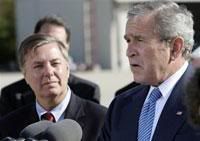
Lindsey Graham's big photo op, two days after backing down on his oh so principled stand against torture, agreeing to support Bush's nominee for Attorney General, Michael Mukasey, despite Mukasey's failure to declare waterboarding torture.


The State reports:
It has taken a few years to get Columbia’s white house ready — more than 120 years all told — but Kirkman Finlay believes his home is ready for the resident of the most famous White House.

Today, Finlay, his wife, Kathleen, and three children will host President George W. Bush and more than 500 others at a campaign fundraiser for U.S. Sen. Lindsey Graham at the Finlay home.

Planning Southern hospitality on a presidential scale has not been easy, Finlay said.

“It’s all about trying to make it as presentable as you can. To have your home look as good as possible for what I consider a historic event.”

Finlay is a Columbia City Council member and the son of former Columbia Mayor Kirkman Finlay Jr. He is also advising former U.S. Sen. Fred Thompson’s S.C. presidential campaign.

Thursday morning, workers were adjusting the tents set up in the backyard for the lunchtime visit. Elsewhere, landscapers spruced up the lawn and shrubbery and tidied mulch.

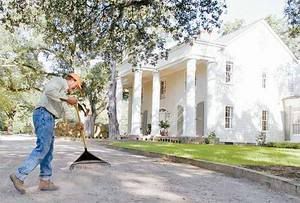
Stage set for Lindsey Graham fundraiser with Bush as the centerpiece: "Finlay has polished mansion for president’s fundraising visit today." Ronnie Monts rakes the driveway Thursday at Columbia City Councilman Kirkman Finlay’s home in preparation for today’s visit by President Bush.

Finlay declined to discuss much of the preparation for security reasons, and did not allow a tour of the property. Likewise, neither the White House nor the Graham campaign would confirm the event’s location, though Finlay’s home is listed on invitations sent out last month.
According to the invitation, the minimum donation to attend was $250, while those giving or raising $10,000 could have a photo taken with Graham and Bush.

Bush has headlined fundraisers in Charleston, Myrtle Beach and Greenville, but Friday’s event is his first fundraiser in Columbia since becoming president in 2001.

Supporters “have been really excited about this event,” said Scott Farmer, Graham’s campaign spokesman. “People from all over the state are coming to attend.”

Farmer said Bush’s visit is a “seminal moment” for the re-election campaign.

Planning has been stressful, but the staffs of the White House and Graham’s campaign have smoothed the logistics.

Finlay admitted he has made a few trips to home improvement stores during the month since he was asked to host.

“We’ve done everything from mulching to putting in rye seed,” Finlay said. The benefit, he said, is that he has knocked out a number of long-needed home improvement projects.

“That ‘to do’ list has been whittled down,” he said.

The home off Garners Ferry Road, known as Millwood Plantation, was formerly the three-bedroom homestead of Finlay’s Hampton family ancestors. The columns of Confederate Gen. Wade Hampton’s burned home still stand on the property.

The house has been expanded “three or four times,” Finlay said. According to property records, the 5-bedroom home is 7,100 square feet.

Finlay also has stables on the property, but expected Bush’s schedule would be too tight to ride with the Texas rancher.

Apparently, Finlay has no idea that Bush is a 'windshield cowboy', doesn't ride horses, nor that his home in Crawford, Texas is only a ranch in the colloquial sense. The 1600 acre property was purchased in anticipation of Bush's 2000 presidential run, a house was built and a barn constructed like a set for a western movie. Bush has never ranched, nor farmed, nor struck oil.
Much easier was planning lunch, which will be catered by Doc’s Barbecue and Southern Buffet, of which Finlay is a co-owner. Dessert will be petit fours (small cakes).

“A nice meal with a Southern flair,” Finlay said.

Elsewhere in S. Carolina:
President Bush said Friday that U.S. military deaths have fallen to their lowest levels in 19 months and the Iraqi people are slowly "taking back their country“ in the wake of the American troop buildup there.

U.S. military deaths have fallen, due to the U.S. changing tactics in both Iraq and Afghanistan by increasing the air bombing campaigns. The numbers of Iraqi civilians killed has increased.
Speaking at a graduation ceremony for new soldiers at Fort Jackson, Bush said that parts of Iraq continue to be violent and that terrorists remain determined.

"But what they have learned about the United States of America is that we are more determined,“ Bush said. "We are more determined to protect ourselves and to help people realize the blessings of freedom."

Bush said corruption remains a problem and unemployment remains high, but that Iraqi forces have now assumed responsibility in security in eight of Iraq’s 18 provinces.

"With our help, the Iraqi people are going on the offense against the enemy. They’re confronting the terrorists and they’re are taking their country back."

Before he spoke, he took a tour of the school’s "fit-to-win course,“ which requires recruits to negotiate up to twenty obstacles. He addressed about 180 soldiers at the site deep in the piney woods, telling them he was proud of their efforts and that they would help secure a peaceful future for America.

Tuesday, October 23, 2007

A Muzak Presidency That Would Be Hillary

The Guardian's Michael Tomasky Interviews Hillary Clinton

This is what you get when both the interviewer and subject play it safe, and say absolutely nothing substantive.

Michael Tomasky writes:
I have interviewed Hillary Clinton a handful of times since our initial meeting in 2000, during her first Senate race, when I must have seen her give 50 - 100 speeches en route to her thrashing of Republican opponent Rick Lazio.

She is a much more fluid politician today than she was in the fall of 1999, certainly. But she is still not known as an especially expansive interview subject. She has a reputation for avoiding actually answering the question, and reverting to a pre-ordained script, to a degree even greater than your average politician.

These qualities were on display at times in our chat. When I asked, for example, about the Democratic Congress' failure to cut off funding for the war, she went into a critique of Republican legislators' unwillingness to break with President Bush and said "the political reality is we don't have the votes".

The trick, then, I thought, would be to ask some germane but slightly offbeat questions in the hope that she hasn't already been asked them a thousand times and might say something new. I began with three such questions on foreign policy-related issues, and overall, her answers gave a somewhat new picture of Clinton in that in each case, the candidate who has spent years cultivating a relatively hawkish foreign policy image notably did not give the most hawkish answer she might have.
On executive power, I pointed out that if elected she would be entering the White House with far more power than her husband had as a result of moves by Bush and Dick Cheney to invest a degree of unilateral power in the executive branch that some find dangerous. "Well, I think it is clear that the power grab undertaken by the Bush-Cheney administration has gone much further than any other president and has been sustained for longer," Clinton said. "Other presidents like Lincoln have had to take on extraordinary powers but would later go to the Congress for either ratification or rejection."

She continued: "There were a lot of actions which they took that were clearly beyond any power the Congress would have granted or that in my view that was inherent in the constitution. There were other actions they've taken which could have obtained congressional authorisation but they deliberately chose not to pursue it as a matter of principle."

Here I asked whether a sitting president, once invested with such powers, could really give some of them up in the name of constitutional principle. Clinton said: "Oh, absolutely, Michael. I mean that has to be part of the review that I undertake when I get to the White House, and I intend to do that."

Moving to Iraq, I asked whether she felt that war fit within the tradition of cold war liberalism that we associate with Harry Truman and his secretary of state, Dean Acheson. This question has been intensely debated among liberal war supporters and opponents since 2003, and how one answers it-especially if one is a Democrat-gives some indication of how one views the morality of pre-emptive or preventive war, and thus, of how one might make future foreign policy decisions. Many liberal war supporters have argued that the fight against terrorism is analogous to the cold war battle with the Soviet Union.

Clinton seemed to reject this. "It's hard to take what was a philosophy with respect to the use and containment of power during the cold war and try to shoehorn it into a post-cold war context," she said. "So I don't really think there is an easy or satisfying answer to that."

Most interesting was Clinton's answer to my question about whether terrorists hate us for our freedoms, or whether they have specific geopolitical objectives. Bush and other administration officials have said repeatedly that terrorists hate us for our freedoms. The implication of this premise, of course, is a fight to the death that is never over until the president says it's over (which in turn requires that we trust the president with enormous unilateral powers). It was one of those premises on which, in the days right after September 11, we were all supposed to agree.

Clinton clearly takes a different view: "Well, I believe that terrorism is a tool that has been utilised throughout history to achieve certain objectives. Some have been ideological, others territorial...And I think we've got to do a much better job of clarifying what are the motivations, the raisons d'etre of terrorists."

She added, "I think one of our mistakes has been painting with such a broad brush, which has not been particularly helpful in understanding what it is we were up against when it comes to those who pursue terrorism for whichever ends they're seeking."

So it's not, I asked, helpful to America's fight to say they hate us for our freedoms? "Well, some do," Clinton said. "But is that a diagnosis? I don't think it's proven to be an effective one."

Clinton has run, it is almost unanimously agreed, a brilliant campaign to this point. Having closely watched her slowly and methodically woo New Yorkers over a 16-month period in 1999 and 2000, allaying their concerns and getting them to submit finally to her undeniable competence and intelligence, I can say that I see much the same kind of process unfolding in its early stages this year. The lead she has steadily built up in the national polls among Democrats, however relevant to the selection process they may or may not be, is testament to this.

Still, of course, many questions remain about both her electability and how she would govern if elected. I'd love to have been able to go through all of these matters in detail, but time was running short, so I just chose to focus on one thing, having to do with how she would govern.

One major concern of liberals about Clinton is her preternatural caution as a politician-her general unwillingness to stick her neck out and risk political capital in behalf of a progressive policy goal that wasn't a safe issue. I asked her to name one issue during her Senate tenure on which she'd done this. Answer: "Well, I think, you know, voting against funding. What did we get, 12, 13, 14 votes on that?" She was referring to a vote last May to make emergency supplemental appropriations to the Iraq war effort. The measure passed 80-14. Clinton and her chief rival for the Democratic nomination, Barack Obama, both voted no, announcing their votes very late in the process.

This, of course, wasn't really what I meant. By the time of this vote, she was in full presidential campaign mode and trying to establish her bona fides with the party's anti-war base. So the political risk inherent in this vote was small. Indeed it was Joe Biden, who was the only senator/presidential candidate to vote yea, who risked something politically, whatever one thinks of his vote substantively.

After I followed up, Clinton went into a defence of how progressive her voting record was; but again, this wasn't what I meant. I was asking about examples of leadership. So the answer to the question was that there really wasn't one thing that she could think of on which she'd taken a risk in behalf of a progressive policy end.

For many Democratic voters, this is the heart of the continuing Clinton conundrum. She is running on a reasonably progressive platform, especially with regard to health care, and even on issues like labour and trade, where she has staked out positions somewhat to her husband's left. Some of her answers to me on foreign policy suggest that she could depart more strongly from the neoconservative agenda than some sceptics might assume ("one of the lessons that I think we all should take out of the last six-and-a-half years is that ideologically driven foreign policy that is not rooted in a realistic assessment of the world as we find it today is not likely to result in any positive outcome").

But at the end of the day there remains the question of how aggressively she would pursue some of her more laudable goals as president. Passing universal health care and bringing the war in Iraq toward its conclusion will both need to be done early in her tenure. Both will require enormous risks of political capital and courageous leadership, especially considering how intensely her political opponents are likely to fight her. As a senator, aware that she is a lightning rod for the right wing, she has tended to work behind the scenes, letting colleagues take the lead.

That's worked well for her. But the difference between the Senate and the White House is that a president has no colleagues. "Change is just a word," she told me, "if you don't have the strength and experience to make it happen." She meant the sentence as a knock on Barack Obama, but they will be words for President Hillary Clinton to live by as well.

Thursday, October 18, 2007

Dodd Did It!

Chris Dodd Places "Hold" on FISA Bill

Today Senator Dodd will send a letter to Majority Leader Harry Reid informing him that he will be placing a hold on FISA legislation that includes amnesty for telecommunications companies who enabled the President's assault on the Constitution by providing personal information on their customers without judicial authorization.

Take action and add your name to the list of people who don't want the Senate to provide telecom companies with amnesty for violating Americans' civil liberties. Stand with Chris Dodd today.

In our democratic republic, there are very few times when We, The People, get a say. This is one of them.

We've wanted our members of Congress to do our bidding, restore the Constitution and the repair the damage that the Bush-Cheney regime have inflicted and stand up to the Republican machine. Finally, ONE Democrat is doing it. If we want to see more of it, we've got to weigh in and do it now by giving what we can to Chris Dodd's presidential campaign. That's what all other Democrats will be watching.