
Showing posts with label Iraq. Show all posts

Friday, August 31, 2007

We've Met The Enemy & It's Our Own Ignorant Fellow Americans

Iraqi-Americans Removed From Flight For Speaking Arabic

The Iraqi-Americans grounded for speaking Arabic on an American Airlines plane.
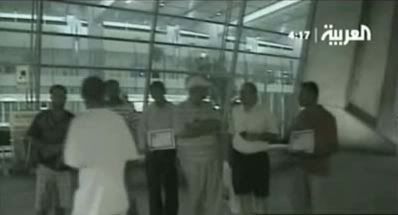
Two of the six Iraqi-Americans on the American Airlines plane exhibiting "strange behavior."

This story, at this time, strikes me as suspicious. Six years later and an American woman passenger, terrified by the Bush-Cheney renewed fear campaign, is able to ground a plane due to her own irrational fear and ignorance. To believe that this was on the level, you have to accept that after billions have been squandered not securing the homeland from terrorist attacks, the airlines still have no method for assuring the safety of airline travel and will ground a plane overnight, put all of the passengers up at hotels, because one woman was frightened because of Arabic speakers on her plane.

I'd like to know the identity of the woman who reported these men as exhibiting "strange behavior."

At a time when Bush-Cheney are racheting up the fear card again in order to pressure Congrees into supporting the continuation of the war in Iraq (and, according to the latest reports, expand it to Iran), it wouldn't surprise me to learn that the woman who complained was a Republican operative.

News.com.au reports:
An American Airlines flight from San Diego to Chicago was delayed when passengers complained about a group of Iraqi men speaking Arabic, US media reported today.

The flight was supposed to leave about 11pm on Tuesday when a woman boarding the plane complained about the other passengers, airline spokeswoman Mary Francis Fagan said.

The dispute delayed the plane which was then forced to cancel when it fell under the curfew at San Diego airport, Ms Fagan said, acccording to the Daily Herald online.

According to media reports, the woman complained because the men were speaking Arabic.

Irene McCormack, a spokeswoman for the San Diego Unified Port District said the woman expressed concerns to the flight crew before boarding that six men were speaking a foreign language and exhibiting “strange behaviour”.
The passenger continued telling the crew her concerns, within earshot of the men, after the jet taxied from the gate, Ms McCormack said yesterday.

She said the pilot decided to return to the gate and police were called.

An Associated Press report said the six Iraqi men had been training Marines at Camp Pendleton and worked for Defense Training Systems, a unit of International Logistics Services.

The six Iraqis had been training US Marines at Camp Pendleton and worked for Defence Training Systems, a unit of the Alaska-based International Logistics Services Corp, said the company's chief executive R David Stephens.

“They did nothing wrong,” he said.


A company news release called it “an unfortunate situation for all flight passengers.”

"We were hired for this Government. We can prove ourselves. We are good people, not a bad people," said one of the men involved, Dave Alwatan, who is a US citizen.

"How can we be bad if we are helping our people here - American people? Why are we getting treated like that?" he was quoted as saying by ABC7 Chicago.

All 126 passengers had to be acccommodated overnight and put on other flights on Wednesday.

Ahmed Rehab, executive director of the Council on American-Islamic Relations in Chicago, was upset about the airline's actions.

"It is one thing to flag suspicious behavior, but to flag a global language? We are deplaning people for who they are, not what they do," Mr Rehab said.

Perhaps the way to put an end to the Bush-Cheney fear campaign is for Americans to turn in Arab-speaking passengers on all domestic flights, and report that they are exhibiting "strange behavior."

If enough planes are grounded and travel was brought to a halt, maybe big business would pressure Bush-Cheney that it's time they stopped their nonsensical "war on terror" and get us back to a time of real life in the real world.

Saturday, August 11, 2007

Dick Cheney, Circa 1994

In this interview from April 15th, 1994, Dick Cheney reveals the reasons why invading Baghdad and toppling Saddam Hussein wouldn't be a great idea. He also stipulates that "not very many" American soldiers' lives were worth losing to take out Saddam during the Gulf War.


This clip was originally aired on C-SPAN3 [History] on the evening of Thursday, August 9, 2007.

Thursday, May 10, 2007

Iraq Kurd Leader On Oil Law

UPI reports:
To Iraq's Kurdish leadership, the issue of how to apportion the third-largest pools of oil in the world is "a make-or-break deal" for the country as a whole, a top official told United Press International.

"The oil issue for us is a red line. It will signify our participation in Iraq or not," Qubad Talabani, son of Iraqi President Jalal Talabani and the Kurdistan Regional Government's representative to the United States, said in an interview from his Washington office.
The KRG and the central Iraqi government reached a deal in February on the hydrocarbons framework -- though not on other key companion bills -- and a self-imposed deadline of late May seemed possible to meet.

But the Iraqi Oil Ministry, at a meeting it set up last month in Dubai, in the United Arab Emirates, with other Iraqi oil experts and politicians, unveiled the annexes to the hydrocarbons law -- its list distributing control of oil fields between central and KRG control -- and a law re-establishing the Iraq National Oil Co., which Kurdish leadership automatically rejected.

"This sets us back to square one, a point that's unacceptable to us. We're trying to modernize Iraq, build a new Iraq, built on new foundations, new policies. The symbol of this new Iraq will be how it manages its oil infrastructure," Talabani said. "And if people want to revert back to Saddam-era policies of a state-controlled oil sector with no accountability, with no accountability to the Parliament or the people of the country, with no oversight except from by one or two, then I'm sorry, that is not the Iraq that the Kurds bought into. That is not the Iraq that the Kurds would want to be part of."

"If a centralized oil regime is imposed on us, we will not participate in the state of Iraq," Talabani said. "And we have to make it absolutely clear to our friends in Washington, to our brothers in Baghdad, this is a make-or-break deal for Iraq."

He said Iraq needs to embrace the free market and break free from the nationalized mindset. Numerous oil and Iraqi experts as well as key Iraq oil union leaders have told UPI that Iraqis see nationalized oil with pride. And opponents of the oil law also say it gives too much to foreign companies.

The Kurds, however, have little to show from the Saddam Hussein era, aside from persecution, death and little investment in its economy or oil sector. They gained autonomy in 1991 and, governing an autonomous three-province region now, are prospering. Airplanes fly internationally from the airport in Irbil, Iraqi Kurdistan's capital. Violence in the region is relatively nil compared with the rest of the country, though the first major attack in more than four years killed 14 people in Irbil Wednesday. Despite lacking the law, the KRG has signed multiple deals with foreign companies to develop its oil and natural-gas sector.

Iraq only produces about 2 million barrels per day. With investment -- domestic or foreign -- Iraq's 115 billion barrels in reserves could handle much higher output.

Many of the arguments over the law are related to the 2005 constitution. It was written vaguely to garner support. Now there is a dispute as to which oil fields are to be governed by the central government and which by the regions.

Tariq Shafiq, an Iraq oil expert now living in Amman, Jordan, and drafter of the original law last summer, said the Iraq National Oil Co. should be independent of the Oil Ministry, and regions could choose the company's board of directors. (Shafiq has since come out against the law, saying it has been altered too much in negotiations.) He said Iraq needs a central strategy for the best management of the country's oil.

Talabani said the KRG favors an INOC limited in scope and open to foreign investment, and says the current law gives INOC control over 93 percent of Iraq's oil. "This will hamper needed investment," he said.

"It's only by bringing in the biggest and the best from the international community, to partner with, not to steal, but to partner with the Iraqi government, can we develop Iraq's oil accordingly," Talabani said. "And there's a worrying unwillingness to act under a free-market-style concept here. It won't go through. It won't go through the Parliament this way. There will be too many people opposed to it."

Other bills needing to be passed include a reorganization of the Oil Ministry and the revenue-sharing law. Talabani said there were lingering fears Kurds will again be deprived of funds and investment.

"We want to create an automatic payment mechanism where it doesn't rely on the goodwill of the finance minister or the oil minister for the regions to get their fair share," he said.

"Trust is lacking in Iraq, and unfortunately it's been Iraq's miserable history that has created this system, this society that mistrusts each other, which is why something as critical as oil can be a trust-building measure," Talabani said. "By putting in place mechanisms and institutions that can ensure that I will not get robbed again, that my resources will not be used against me again, will eventually over time build my trust."

Monday, February 19, 2007

War Jitters

Newsweek reports, "America's Hidden War With Iran":
Jalal Sharafi was carrying a videogame, a gift for his daughter, when he found himself surrounded. On that chilly Sunday morning, the second secretary at the Iranian Embassy in Baghdad had driven himself to the commercial district of Arasat Hindi to checkout the site for a new Iranian bank. He had ducked into a nearby electronics store with his bodyguards, and as they emerged four armored cars roared up and disgorged at least 20 gunmen wearing bulletproof vests and Iraqi National Guard uniforms. They flashed official IDs, and manhandled Sharafi into one car. Iraqi police gave chase, guns blazing. They shot up one of the other vehicles, capturing four assailants who by late last week had yet to be publicly identified. Sharafi and the others disappeared.
At the embassy, the diplomat's colleagues were furious. "This was a group directly under American supervision," said one distraught Iranian official, who was not authorized to speak on the record. Abdul Karim Inizi, a former Iraqi Security minister close to the Iranians, pointed the finger at an Iraqi black-ops unit based out at the Baghdad airport, who answer to American Special Forces officers. "It's plausible," says a senior Coalition adviser who is also not authorized to speak on the record. The unit does exist—and does specialize in snatch operations.

The Iranians have reason to feel paranoid. In recent weeks senior American officers have condemned Tehran for providing training and deadly explosives to insurgents. In a predawn raid on Dec. 21, U.S. troops barged into the compound of the most powerful political party in the country, the Supreme Council for the Islamic Revolution in Iraq, and grabbed two men they claimed were officers in Iran's Revolutionary Guards. Three weeks later U.S. troops stormed an Iranian diplomatic office in Irbil, arresting five more Iranians. The Americans have hinted that as part of an escalating tit-for-tat, Iranians may have had a hand in a spectacular raid in Karbala on Jan. 20, in which four American soldiers were kidnapped and later found shot, execution style, in the head. U.S. forces promised to defend themselves.

Some view the spiraling attacks as a strand in a worrisome pattern. At least one former White House official contends that some Bush advisers secretly want an excuse to attack Iran. "They intend to be as provocative as possible and make the Iranians do something [America] would be forced to retaliate for," says Hillary Mann, the administration's former National Security Council director for Iran and Persian Gulf Affairs. U.S. officials insist they have no intention of provoking or otherwise starting a war with Iran, and they were also quick to deny any link to Sharafi's kidnapping. But the fact remains that the longstanding war of words between Washington and Tehran is edging toward something more dangerous. A second Navy carrier group is steaming toward the Persian Gulf, and NEWSWEEK has learned that a third carrier will likely follow. Iran shot off a few missiles in those same tense waters last week, in a highly publicized test. With Americans and Iranians jousting on the chaotic battleground of Iraq, the chances of a small incident's spiraling into a crisis are higher than they've been in years.

Sometimes it seems as if a state of conflict is natural to the U.S.-Iranian relationship—troubled since the CIA-backed coup that restored the shah to power in 1953, tortured since Ayatollah Khomeini's triumph in 1979. With the election of George W. Bush on the one hand, and Iranian President Mahmoud Ahmadinejad on the other, the two countries are now led by men who deeply mistrust the intentions and indeed doubt the sanity of the other. Tehran insists that U.S. policy is aimed at toppling the regime and subjugating Iran. The White House charges that Iran is violently sabotaging U.S. efforts to stabilize the Middle East while not so secretly developing nuclear weapons. As the raids and skirmishes in Iraq underscore, a hidden war is already unfolding.

Yet a NEWSWEEK investigation has also found periods of marked cooperation and even tentative steps toward possible reconciliation in recent years—far more than is commonly realized. After September 11 in particular, relations grew warmer than at any time since the fall of the shah. America wanted Iran's help in Afghanistan, and Iran gave it, partly out of fear of an angry superpower and partly in order to be rid of its troublesome Taliban neighbors. In time, hard-liners on both sides were able to undo the efforts of diplomats to build on that foundation. The damage only worsened as those hawks became intoxicated with their own success. The secret history of the Bush administration's dealings with Iran is one of arrogance, mistrust and failure. But it is also a history that offers some hope.

For Iran's reformists, 9/11 was a blessing in disguise. Previous attempts to reach out to America had been stymied by conservative mullahs. But the fear that an enraged superpower would blindly lash out focused minds in Tehran. Mohammad Hossein Adeli was one of only two deputies on duty at the Foreign Ministry when the attacks took place, late on a sweltering summer afternoon. He immediately began contacting top officials, insisting that Iran respond quickly. "We wanted to truly condemn the attacks but we also wished to offer an olive branch to the United States, showing we were interested in peace," says Adeli. To his relief, Iran's top official, Ayatollah Ali Khameini, quickly agreed. "The Supreme Leader was deeply suspicious of the American government," says a Khameini aide whose position does not allow him to be named. "But [he] was repulsed by these terrorist acts and was truly sad about the loss of the civilian lives in America." For two weeks worshipers at Friday prayers even stopped chanting "Death to America."

The fear dissipated after Sept. 20, when the FBI announced that Al Qaeda was behind the attacks. But there was new reason for cooperation: for years Tehran had been backing the Afghan guerrillas fighting the Taliban, Osama bin Laden's hosts. Suddenly, having U.S. troops next door in Afghanistan didn't seem like a bad idea. American and Iranian officials met repeatedly in Geneva in the days before the Oct. 7 U.S. invasion. The Iranians were more than supportive. "In fact, they were impatient," says a U.S. official involved in the talks, who asked not to be named speaking about topics that remain sensitive. "They'd ask, 'When's the military action going to start? Let's get going!' "

Opinions differ wildly over how much help the Iranians actually were on the ground. But what is beyond doubt is how critical they were to stabilizing the country after the fall of Kabul. In late November 2001, the leaders of Afghanistan's triumphant anti-Taliban factions flew to Bonn, Germany, to map out an interim Afghan government with the help of representatives from 18 Coalition countries. It was rainy and unseasonably cold, and the penitential month of Ramadan was in full sway, but a carnival mood prevailed. The setting was a splendid hotel on the Rhine, and after sunset the German hosts laid on generous buffet meals under a big sign promising that everything was pork-free.

The Iranian team's leader, Javad Zarif, was a good-humored University of Denver alumnus with a deep, measured voice, who would later become U.N. ambassador. Jim Dobbins, Bush's first envoy to the Afghans, recalls sharing coffee with Zarif in one of the sitting rooms, poring over a draft of the agreement laying out the new Afghan government. "Zarif asked me, 'Have you looked at it?' I said, 'Yes, I read it over once'," Dobbins recalls. "Then he said, with a certain twinkle in his eye: 'I don't think there's anything in it that mentions democracy. Don't you think there could be some commitment to democratization?' This was before the Bush administration had discovered democracy as a panacea for the Middle East. I said that's a good idea."

Toward the end of the Bonn talks, Dobbins says, "we reached a pivotal moment." The various parties had decided that the suave, American-backed Hamid Karzai would lead the new Afghan government. But he was a Pashtun tribal leader from the south, and rivals from the north had actually won the capital. In the brutal world of Afghan power politics, that was a recipe for conflict. At 2 a.m. on the night before the deal was meant to be signed, the Northern Alliance delegate Yunus Qanooni was stubbornly demanding 18 out of 24 new ministries. Frantic negotiators gathered in the suite of United Nations envoy Lakhdar Brahimi. A sleepy Zarif translated for Qanooni. Finally, at close to 4 a.m., he leaned over to whisper in the Afghan's ear: " 'This is the best deal you're going to get'." Qanooni said, " 'OK'."

That moment, Dobbins says now, was critical. "The Russians and the Indians had been making similar points," he says. "But it wasn't until Zarif took him aside that it was settled ... We might have had a situation like we had in Iraq, where we were never able to settle on a single leader and government." A month later Tehran backed up the political support with financial muscle: at a donor's conference in Tokyo, Iran pledged $500 million (at the time, more than double the Americans') to help rebuild Afghanistan.

In a pattern that would become familiar, however, a chill quickly followed the warming in relations. Barely a week after the Tokyo meeting, Iran was included with Iraq and North Korea in the "Axis of Evil." Michael Gerson, now a NEWSWEEK contributor, headed the White House speechwriting shop at the time. He says Iran and North Korea were inserted into Bush's controversial State of the Union address in order to avoid focusing solely on Iraq. At the time, Bush was already making plans to topple Saddam Hussein, but he wasn't ready to say so. Gerson says it was Condoleezza Rice, then national-security adviser, who told him which two countries to include along with Iraq. But the phrase also appealed to a president who felt himself thrust into a grand struggle. Senior aides say it reminded him of Ronald Reagan's ringing denunciations of the "evil empire."

Once again, Iran's reformists were knocked back on their heels. "Those who were in favor of a rapprochement with the United States were marginalized," says Adeli. "The speech somehow exonerated those who had always doubted America's intentions." The Khameini aide concurs: "The Axis of Evil speech did not surprise the Supreme Leader. He never trusted the Americans."

It would be another war that nudged the two countries together again. At the beginning of 2003, as the Pentagon readied for battle against Iraq, the Americans wanted Tehran's help in case a flood of refugees headed for the border, or if U.S. pilots were downed inside Iran. After U.S. tanks thundered into Baghdad, those worries eased. "We had the strong hand at that point," recalls Colin Powell, who was secretary of State at the time. If anything, though, America's lightning campaign made the Iranians even more eager to deal. Low-level meetings between the two sides had continued even after the Axis of Evil speech. At one of them that spring, Zarif raised the question of the Mujahedin-e Khalq (MEK), a rabidly anti-Iranian militant group based in Iraq. Iran had detained a number of senior Qaeda operatives after 9/11. Zarif floated the possibility of "reciprocity"—your terrorists for ours.

The idea was brought up at a mid-May meeting between Bush and his chief advisers in the wood-paneled Situation Room in the White House basement. Riding high, Bush seemed to like the idea of a swap, says a participant who asked to remain anonymous because the meeting was classified. Some in the room argued that designating the militants as terrorists had been a mistake, others that they might prove useful against Iran someday. Powell opposed the handover for a different reason: he worried that the captives might be tortured. The vice president, silent through most of the meeting as was his wont, muttered something about "preserving all our options." (Cheney declined to comment.) The MEK's status remains unresolved.

Around this time what struck some in the U.S. government as an even more dramatic offer arrived in Washington—a faxed two-page proposal for comprehensive bilateral talks. To the NSC's Mann, among others, the Iranians seemed willing to discuss, at least, cracking down on Hizbullah and Hamas (or turning them into peaceful political organizations) and "full transparency" on Iran's nuclear program. In return, the Iranian "aims" in the document called for a "halt in U.S. hostile behavior and rectification of the status of Iran in the U.S. and abolishing sanctions," as well as pursuit of the MEK.

An Iranian diplomat admits to NEWSWEEK that he had a hand in preparing the proposal, but denies that he was its original author. Asking not to be named because the topic is politically sensitive, he says he got the rough draft from an intermediary with connections at the White House and the State Department. He suggested some relatively minor revisions in ballpoint pen and dispatched the working draft to Tehran, where it was shown to only the top ranks of the regime. "We didn't want to have an 'Irangate 2'," the diplomat says, referring to the secret negotiations to trade weapons for hostages that ended in scandal during Reagan's administration. After Iran's National Security Council approved the document (under orders from Khameini), a final copy was produced and sent to Washington, according to the diplomat.

The letter received a mixed reception. Powell and his deputy Richard Armitage were suspicious. Armitage says he thinks the letter represented creative diplomacy by the Swiss ambassador, Tim Guldimann, who was serving as a go-between. "We couldn't determine what [in the proposal] was the Iranians' and what was the Swiss ambassador's," he says. He added that his impression at the time was that the Iranians "were trying to put too much on the table." Quizzed about the letter in front of Congress last week, Rice denied ever seeing it. "I don't care if it originally came from Mars," Mann says now. "If the Iranians said it was fully vetted and cleared, then it could have been as important as the two-page document" that Richard Nixon and Henry Kissinger received from Beijing in 1971, indicating Mao Zedong's interest in opening China.

A few days later bombs tore through three housing complexes in Saudi Arabia and killed 29 people, including seven Americans. Furious administration hard-liners blamed Tehran. Citing telephone intercepts, they claimed the bombings had been ordered by Saif al-Adel, a senior Qaeda leader supposedly imprisoned in Iran. "There's no question but that there have been and are today senior Al Qaeda leaders in Iran, and they are busy," Defense Secretary Donald Rumsfeld growled. Although there was no evidence the Iranian government knew of Adel's activities, his presence in the country was enough to undermine those who wanted to reach out.

Powell, for one, thinks Bush simply wasn't prepared to deal with a regime he thought should not be in power. As secretary of State he met fierce resistance to any diplomatic overtures to Iran and its ally Syria. "My position in the remaining year and a half was that we ought to find ways to restart talks with Iran," he says of the end of his term. "But there was a reluctance on the part of the president to do that." The former secretary of State angrily rejects the administration's characterization of efforts by him and his top aides to deal with Tehran and Damascus as failures. "I don't like the administration saying, 'Powell went, Armitage went ... and [they] got nothing.' We got plenty," he says. "You can't negotiate when you tell the other side, 'Give us what a negotiation would produce before the negotiations start'."

Terrorism wasn't the only concern when it came to Iran. For decades, Washington's abiding fear has been that Iran might pick up where the shah's nuclear program (initially U.S.-backed) left off, and make the Great Satan the target of its atomic weapons. The Iranians, who were signatories to the Nuclear Non-Proliferation Treaty, insisted they had nothing to hide. They lied. In August 2002, a group affiliated with the MEK revealed the extent of nuclear activities at a facility in Isfahan, where the Iranians had been converting yellowcake to uranium gas, and in Natanz, where the infrastructure needed to enrich that material to weapons-grade uranium was being built. A year later Pakistani scientist AQ Khan's covert nuclear-technology network unraveled, bringing further embarrassments and investigations.

For months, European negotiators worked to get Tehran to formalize a temporary and tenuous deal to freeze its nuclear fuel-development program. In May 2005, they met with Iran's chief nuclear negotiator, Hassan Rowhani, at the Iranian ambassador's opulent Geneva residence. There was some reason to be optimistic: in Washington, Rice had announced that the United States would not block Iran's bid to join the World Trade Organization. Yet a sense of enormous tension filled the room, according to a diplomat who was there but asked not to be identified revealing official discussions. The Europeans told Rowhani they hadn't nailed down exactly what they could offer in return for a freeze, and the Americans still weren't fully onboard. Iran would have to wait for the details for a few more months. But in the meantime, the program had to remain suspended.

Rowhani, in full clerical robes and turban, obviously was not authorized to make any such deal. "The man was in front of us sweating," says the European diplomat. "He was trapped: he couldn't go further ... I realized very clearly that he couldn't deliver, that he was not allowed to deliver. Psychologically he was broken. Physically he was almost broken."

Part of the problem was that elections in Iran were only a few days away. They brought to power a man who satisfied the darkest stereotypes of Iran's fervid leaders. Mahmoud Ahmadinejad publicly renounced the freeze on Iran's nuclear fuel-development program, broke the seals the International Atomic Energy Agency had placed on Iran's conversion facilities at Isfahan and pushed ahead with work at Natanz. In the span of no more than a month or two, nuclear enrichment had become a symbol of national pride for a much wider spectrum of Iranian society than the voters who elected Ahmadinejad. In a warped parallel to Bush, who found his voice after 9/11 rallying Americans to the struggle against a vast and unforgiving enemy, the Iranian president rose in stature throughout the Middle East as he railed against America. The one problem U.S. negotiators had always had with Iran was determining who in the byzantine regime to talk to, and whether they could deliver anything. Now they faced another: the Iranians had almost no incentive to talk. With the United States bogged down in Iraq, Iran now had the leverage—roles had reversed.

In its second term the Bush administration, despite Powell's sour memories, has supported European efforts to resolve the nuclear impasse diplomatically. Rice has offered to meet her Iranian counterpart "any time, anywhere." "What has blocked such contact is the refusal of Iran to meet the demands of the entire international community," says a White House official, who could not be named discussing Iran. The official expressed deep frustration with critics. He argued they were naive about Tehran's intentions, and "parroting Iranian propaganda."

By last summer Iran seemed ascendant. Hizbullah's performance in the Lebanon war had rallied support for Ahmadinejad, one of the group's loudest proponents, across the Arab world. In a series of meetings in New York in September the Iranian president was defiant, almost giddy. (A senior British official who would only speak anonymously about deliberations with the Americans describes Tehran's mood around this time as "cock-a-hoop.") He would not back down when grilled about his dismissals of the Holocaust, and scoffed at the threat of U.N. sanctions over Iran's nuclear defiance.

The West's patience was running out. In Baghdad, American troops seemed powerless to stop a wave of gruesome sectarian killings that they claimed were fueled by Iran. In Amman and Riyadh, Arab leaders warned darkly of a rising "Shia crescent." After Bush's defeat in the midterm elections, Israeli officials began wondering aloud if they would have to deal with the Iranian threat on their own. Partly in consultation with the British, U.S. officials began to map out a broader strategy to fight back. "We felt we needed to have a much more knitted-together policy, with a number of different strands working, to hit different parts of the Iranian system," says the senior British official.

Critics have questioned how much of that plan is military—whether the administration is secretly setting a course for war as it did back in 2002. Last week officials were at great pains to deny that scenario. "We are not planning offensive military operations against Iran," said Under Secretary of State Nicholas Burns. The Pentagon does have contingency plans for all-out war with Iran, on which Bush was briefed last summer. The targets would include Iran's air-defense systems, its nuclear- and chemical-weapons facilities, ballistic missile sites, naval and Revolutionary Guard bases in the gulf, and intelligence headquarters. But generals are convinced that no amount of firepower could do more than delay Tehran's nuclear program. U.S. military analysts have concluded that nothing short of regime change would completely eliminate the threat—and America simply doesn't have the troops needed.

Iraq is another story. American military officials and politicians accuse the Iranian government of providing Iraqis with an new arsenal of advanced rocket-propelled-grenade launchers, heavy-duty mortars and the newest armor-piercing technology for roadside bombs—explosively formed projectiles (EFPs), said to have been developed by Hizbullah. Military security experts are especially worried by "passive infrared sensors," readily available devices that are often used for burglar alarms or automatic light switches but increasingly seen as triggers for improvised explosive devices (IEDs). Unlike cell phones, remote-control systems and garage-door openers, the sensors emit no signal, making them that much tougher to spot before they detonate.

What's scant is hard evidence that the weapons are provided by the Iranian government, rather than arms dealers or rogue Revolutionary Guard elements. "Iranian lethal support for select groups of Iraqi Shia militants clearly intensifies the conflict in Iraq," says the latest National Intelligence Estimate on Iraq. But the most that can be said with certainty is that Tehran is failing to stop the traffic. The Iranians themselves admit they're not trying as hard as they could. "I can give you my word that we don't give IEDs to the Mahdi Army," says an Iranian intelligence official who asked not to be named because secrecy is his business. "But if you asked me if we could control our borders better if we wanted to, I would say: 'Yes, if we knew that the Americans would not use Iraq as a base to attack Iran'."

The real thrust of Washington's multipronged attack is political. Banking restrictions levied by the U.S. Treasury have begun to pinch the Iranian economy. Voters angry about rising prices dealt Ahmadinejad an embarrassing blow in municipal elections in December, when his supporters were trounced. That wouldn't much matter if he still retained Khameini's support. But that may no longer be the case. The Khameini aide says the Supreme Leader blames Ahmadinejad's overheated rhetoric about Israel and the Holocaust for the unanimous Security Council resolution that passed in late December, demanding that Tehran suspend its nuclear program.

Every time America or Iran has gained an advantage over the other in the last five years, however, they've overplayed their hand. More pressure on Ahmadinejad could well make him popular again—the chief martyr in a martyr culture. Sunni insurgents in Iraq need only kill some Americans and plant Iranian IDs nearby to start a full-scale war. Like so many times in this complicated relationship, this is a moment of opportunity. And one of equally great danger.


Saturday, March 08, 2003

Ambassador Joseph C. Wilson on CNN: "Bush's Entire Case Against Iraq Is Tainted"


Transcript of CNN Sunday interview with Ambassador Joseph C. Wilson:
RENAY SAN MIGUEL, CNN ANCHOR: Diplomats are burning up the phone lines today trying to win votes for or against the latest U.N. resolution on Iraq. The resolution would give Iraq until March 17 to disarm or be disarmed by force. Richard Roth joins us now from the United Nations -- Richard.

RICHARD ROTH, CNN SR. U.N. CORRESPONDENT: Yes, President Bush is going to start making calls on Monday. He made a call to Chile's president on Friday. Chile, one of the undecided six, so-called swing votes that remain on the Security Council. And it's going to be hard in the next couple of days to find out exactly where countries are leaning, because the U.S., you never know, could make changes to the resolution yet again.

Friday, some amendments added, basically a big deadline added. March 17, for Iraq to turn over all of its weapons of mass destruction.

Here at the United Nations, it's quiet, but phone calls are being made around the world. The French foreign minister, Dominique de Villepin, is traveling to three African countries, the three swing African votes, Guinea, Cameroon, Angola. Angola's representative yesterday said he wasn't really happy with the draft resolution. Angola and Chile believing that Iraq should be given more time, that the 17th of March just comes up too soon.

The U.S. says it could call for a vote as early as Tuesday, which would give Iraq less than a week to turn over weapons of mass destruction. The impact of such a deadline on the weapons inspectors certainly would give them less time to be in the country to certify that Iraq is in the clear.

(BEGIN VIDEO CLIP)

MOHAMED ELBARADEI, DIRECTOR GENERAL, IAEA: On the one hand, there is a lot of indication in the intelligence community that there are -- Iraq still has chemical and biological weapons. On the other hand, none of the inspectors are able to find any of these weapons. So there is no smoking gun.

(END VIDEO CLIP)

ROTH: That's Mohamed ElBaradei of the International Atomic Energy Agency saying that the weapons inspectors on his side and Dr. Blix have not found a smoking gun, that Iraq is beginning to cooperating more. And as for the war, well, it means that they will never be able to certify with certainty that Iraq's nuclear program has not been revived, though there are no indications right now about that.

What else is Mr. ElBaradei reporting to the Security Council? Well, it drew little notice, because of the high powered debate and arguments among the big powers, but the director general of the International Atomic Energy Agency reported that his group has certified that documents provided by countries that allege possibly that the Iraqis were doing deals with the African nation of Niger to get enriched uranium for nuclear production were fakes, were forgeries. They refused to say whether it was the U.S. that gave them all the documents or Britain, but they're just saying what they were given to examine shows no confirmation that Iraq, as President Bush alleged in his State of the Union address, was getting enriched uranium in a potential deal with the African nation of Niger -- Renay.

SAN MIGUEL: Well, Richard, back in the region that we're talking about here, there are reports that the United Nations is pulling out some of its observers from Kuwait?

ROTH: That's right. Civilian staff being moved away while the U.N. mission along the Iraq/Kuwait Demilitarized Zone remains in place. The U.N. operation there is called UNICOM (ph), and you're going to see this over the next few days. The United Nations humanitarian team has been pared down dramatically in Iraq. Basically, UNICOM's (ph) 195 observers will stay in place the 775th Bangladeshi military support unit will be there.

Also of note along that demilitarized zone, in the last few days, civilians, said to be Kuwaiti construction workers, but some Marines in the area, cutting holes in the fence, an electric fence along that border, holes as wide as 75 feet. You can certainly bring a lot of big military vehicles through that, and also perhaps 75 gaps in all.

The U.N. reported this as a violation of the Security Council resolution. It's up to the Security Council what to do with it. The U.S. defends this action. If there's any link to the U.S. government, and no doubt there is, because they say Iraq has been a threat to Kuwait for more than 12 years. Stay tuned -- Renay.

SAN MIGUEL: As we certainly will. Richard Roth, thank you very much.

Now, as Richard just said, during his report yesterday, Mohamed ElBaradei said some of the evidence that Secretary of State Colin Powell presented to the U.N. was apparently faked. Joining us now from our Washington bureau is Joseph Wilson, who was acting ambassador to Iraq when the first Gulf War began. Mr. Wilson, thank you so much for joining us today.

JOSEPH WILSON, FORMER AMB. TO IRAQ: Hi, Renay. How are you.

SAN MIGUEL: Just fine. How could this happen? It is the perception that documents like these are vetted to within an inch of their life by intelligence agencies. How do you think this managed to slip by?

WILSON: Well, this particular case is outrageous. I actually started my foreign service career in Niger and ended my foreign service career doing -- in charge of Africa in the Clinton White House. We know a lot about the uranium business in Niger, and for something like this to go unchallenged by U.S. -- the U.S. government is just simply stupid. It would have taken a couple of phone calls. We have had an embassy there since the early '60s. All this stuff is open. It's a restricted market of buyers and sellers. The Nigerians (sic) have always been very open with us.

For this to have gotten to the IAEA is on the face of it dumb, but more to the point, it taints the whole rest of the case that the government is trying to build against Iraq.

SAN MIGUEL: I was just going to ask you, I mean, I got the idea from your answer about this, but just how damaging is this to the U.S. case with the stakes being as high as they are?

WILSON: Well, you know what it's like when you go into court. A prosecutor comes up with some evidence that is obviously false, it casts doubt on every other bit of evidence that he produces. And I think it's safe to say that the U.S. government should have or did know that this report was a fake before Dr. ElBaradei mentioned it in his report at the U.N. yesterday.

SAN MIGUEL: There's also another courtroom saying that, you know, lawyers like to say, never ask a question that you don't know the answer to. That could play into this as well.

But Mr. ElBaradei did tell our Richard Roth today, during an interview, that the intelligence isn't just coming from the U.S., that there were other countries involved. Which other countries do you think, and how is it that all of these intelligence agencies or intelligence agencies from these countries that were involved could be taken in by these forgeries?

WILSON: Well, the report I saw said that the Brits were involved. Maybe it was the British that passed this report on. I don't know who else might have been involved, but I can tell you this: The report in "The Washington Post" today said -- quoted a U.S. official as saying, "we just fell for it."

That's just not good enough. Either he's being disingenuous, or he shouldn't be drawing a government paycheck.

SAN MIGUEL: So how do you play this, then? I mean, what, do you admit it, do you just move on? Do you try to get these things verified if you do believe, indeed, that Iraq was trying to buy this material from Niger? I mean, how do you handle this? What's the damage control on this?

WILSON: I have no idea. I'm not in the government. I would not want to be doing damage control on this. I think you probably just fess up and try to move on and say there's sufficient other evidence to convict Saddam of being involved in the nuclear arms trade. But Dr. ElBaradei yesterday was pretty clear. He doesn't see that this is happening.


SAN MIGUEL: We'll have to leave it there. Joseph Wilson, former acting ambassador to Iraq for the U.S., thank you very much for your time.

WILSON: Good to be with you.


Friday, February 28, 2003

NOW With Bill Moyers: Moyers Talks With Joe Wilson, February 28, 2003

Transcript of Bill Moyers interview with Joseph C. Wilson:
MOYERS: With war in Iraq more imminent than ever, we're going to talk tonight to the last senior American diplomat to meet with Saddam Hussein. Joseph Wilson was the Deputy Chief of Mission, the acting ambassador at the US Embassy in Iraq 12 years ago during Desert Shield, the lead-up to the first Gulf War.
He was a member of the American Foreign Service for 23 years. Our ambassador to two African countries. And served as the political advisor to the Commander in Chief of US Forces in Europe. He now heads his own international business firm and is an adjunct scholar at the Middle East Institute in Washington. Thank you for joining us.

WILSON: Oh, it's my pleasure.

MOYERS: Here we are, what one could reading our papers, say is the eve of war. What do you think is going through Saddam Hussein's mind this weekend?

WILSON: Well, I think Saddam Hussein is probably if the Gulf War is any example, I think has probably resigned themselves at some point that the war is going to happen. There may be one or two more games that they'll try and play, give out a few more missiles, allow more U.N. inspectors, or offer to allow Peacekeepers and inspectors in.

But ultimately, I think they've probably resigned themselves to the fact that they're going to be attacked. I suspect Saddam, being the survivalist he is, hopes that he will survive to fight another day. And I think that he probably believes that if he doesn't survive he will want to go down in history as somebody who actually confronted the West.

Because you know, in the Arab world, it has been enough to confront the West. You haven't had to defeat the West. You've just had to confront the West to achieve a certain status in the Arab world.

MOYERS: But if the United States attacks, he's a dead man.

WILSON: Well, I'm not sure about that. He's been preparing his security apparatus for 30 years. He knows his country. He may well have an out.

As the senior American diplomat 12 years ago in Iraq, did you support the effort to remove Saddam Hussein from Kuwait by force?

WILSON: I supported the effort to get Saddam Hussein out of Kuwait. And I understood fully that in order to get him out of Kuwait you had to have the credible threat of force. And in order for that force to be credible, you had to be prepared to use it.

MOYERS: Diplomacy had failed there as because he was so intransigent.

WILSON: That's right. That's right.

MOYERS: He's still just as intransigent.

WILSON: And I fear diplomacy is going to fail again.

MOYERS: What is the trip wire in your opinion for the use of force? What is your trip wire?

WILSON: Well, I've always said it's the first time he poses an obstacle to your conducting an inspection then you go in and you use force against that particular site. But you keep the use of force focused on disarmament. Let me give you an example.

When Colin Powell was up at the United Nations, he showed a couple of pictures of the site. He said, "This is a chemical weapons site and this is the trucks going out of that site just before the inspectors arrive at the front door. The trucks are going out the back door." That becomes a legitimate target for additional action on the part of the United Nations and the US. For example, that truck convoy leaving the site, as far as I'm concerned, becomes a legitimate target as does the site itself.

MOYERS: You're not against using force. So help me understand the distinction between the quantity of force you would use and the quantity of force that George W. Bush is proposing to you.

WILSON: Well, first of all, I think there's a question of objective. I'm not against the use of force for the purposes of achieving the objective that has been agreed upon by the United Nations in the international community, disarmament. If and when it becomes necessary. I think that is legitimate. Essentially, you could a lot of that just by the air. You do…

MOYERS: Precision bombing?

WILSON: …precision bombing. They've got more surveillance planes out there now. You've got the U2s. The French or moving some Mirages on. You've got the place blanketed.

MOYERS: You are calling for coercive inspections.

WILSON: That's right. Muscular disarmament, coercive inspections, coercive containment, whatever you want to call it. I don't think containment's the right word because we're really talking about disarmament.

MOYERS: Does it seem to you that the President, George Bush, is prepared to accept a disarmed Hussein? Or does he want a dead Hussein?

WILSON: I think he wants a dead Hussein. I don't think there's any doubt about it.

MOYERS: President Bush's recent speech to the American Enterprise Institute, he said, let me quote it to you. "The danger posed by Saddam Hussein and his weapons cannot be ignored or wished away." You agree with that?

WILSON: I agree with that. Sure. I…

MOYERS: "The danger must be confronted." You agree with that? "We would hope that the Iraqi regime will meet the demands of the United Nations and disarm fully and peacefully. If it does not, we are prepared to disarm Iraq by force. Either way, this danger will be removed. The safety of the American people depends on ending this direct and growing threat." You agree with that?

WILSON: I agree with that. Sure. The President goes on to say in that speech as he did in the State of the Union Address is we will liberate Iraq from a brutal dictator. All of which is true. But the only thing Saddam Hussein hears in this speech or the State of the Union Address is, "He's coming to kill me. He doesn't care if I have weapons of mass destruction or not. His objective is to come and overthrow my regime and to kill me." And that then does not provide any incentive whatsoever to disarm.

MOYERS: All of us change in 12 years and obviously Saddam Hussein has changed since you last saw him. But what do you know about him that would help us understand what might be going through his mind right now?

WILSON: Well, I think, first of all, it's important to understand that he's a creature of his-- of his country and of his region. His worldview is very limited. It is essentially what he sees from his palace and what his sycophants come and tell him.

So he does not have a broad vision of what's going on around him. There's, I think, a tendency to think of the world as rotating around not just Iraq but around his own palace. Secondly, he's a coldly rational political actor. But given that his worldview is limited, there is a tendency to develop a logical argument where the premise is skewed.

MOYERS: Such as?

WILSON: So he will, for example — four days after he invaded Kuwait when I saw him in August of 1990 — he said that the United States lacked the intestinal fortitude and the stamina to confront his invasion in Kuwait. And it was clear to me that he was drawing upon his interpretation of our experiences in Vietnam, Beirut and possibly Tehran. And he had drawn exactly the wrong lessons from that.

We, in fact, stayed in Vietnam far longer than we should have perhaps. We were there for 15 years. And we suffered 50,000 casualties. We did not cut and run. We did spill the blood of our soldiers for many, many years. Give you another example, the whole decision to go into Kuwait was, from his perspective, rational based upon his understanding of the region and of what the international community would do.

MOYERS: His decision to go…

WILSON: His decision to go into Kuwait. The only reason he had Ambassador Gillespie in to see him and then me in to see him four days after the invasion. Both were unprecedented meetings. He would normally meet only with senior diplomats resident in Baghdad when they were accompanying envoys from their respective capitals. So for him to have Ambassador Gillepsie and then me was really a first.

And it was clear that what he wanted to do in that is he wanted to deflect attention from what he really intended to do. And that's what he did with April Gillespie. He lied to her. He lied to President Mubarak that he was going to allow the negotiating process to go forward.

And with me, he wanted to make sure that the United States would not respond unilaterally. And so that he would get this thrown into the United Nations. And the reason he wanted it in the United Nations was because his experience was with Israeli-Palestinian issues, specifically Resolutions 242 and 338, which related to occupation of Palestinian territories. And as most people know, the Israeli withdrawal from Palestinian territories has not taken place even though those territories were occupied in the '60s and early '70s.

MOYERS: So what does he conclude from that?

WILSON: He concludes from that that if it goes into the United Nations system, he's got 25 or 30 years to occupy Kuwait during which time he can flag Kuwait City with Iraqis, pump all their oil, steal all their money and then submit it to a referendum which he would have stacked the odds for his victory.

MOYERS: So President Bush is not being naive to think that the UN may backfire on him. He's not being naive when he thinks that Saddam Hussein is lying to us, deceiving us, right?

WILSON: One should never believe Saddam Hussein. We certainly have enough experience with his deception and his lies not to be too trusting with him. With respect to the United Nations, it seems to me that the United Nations has far more often acted in a way that is-- that is consistent with our interests. And it has a obstacle to our interests. And it is our interests who have a broad international support for an objective.

And in order to get that broad international support, you have to frame your goals in such a way that you can get the allies as we did in the Gulf War.

MOYERS: So you're saying that it is important to enforce United Nations resolutions.

WILSON: Absolutely.

MOYERS: You think war is inevitable?

WILSON: I think war is inevitable. Essentially, the speech that the President gave at the American Enterprise Institute was so much on the overthrow of the regime and the liberation of the Iraqi people that I suspect that Saddam understands that this is not about disarmament.

MOYERS: Most Americans, including yours truly, know very little about Iraq. You've lived there. Tell me what we should know about it.

WILSON: Well, first of all, it is a wonderful country. It is the heart of Mesopotamia and everything that everybody understands about Mesopotamia…

MOYERS: The old biblical culture.

WILSON: And the breadbasket of that part of the world for many years. Two of the great rivers of history flow through it.

MOYERS: Tigris and the Euph…

WILSON: Tigris and Euphrates. It's got a population of about 25 million. Iraqis are wonderful people. They are imbued with a sense of their own history. They know who they are. They're fiercely nationalistic. They're a proud people.

They have tribal and ethnic cleavages that are difficult for outsiders to understand but which make up the fabric of politics and make it a very, very difficult place to govern as history has shown. That said they are educated. There is — was, when I was there, a vibrant commercial class, a vibrant educated class.

They grow dates. They produce oil. There was a wonderful construction industry. And, of course, we've seen from their ability to retrofit arms that they are active in the development of exotic weaponry. Which means that they've got engineering skills and science skills which have been put, unfortunately, to the wrong uses.

MOYERS: A great culture except that it's ruled by a dictator.

WILSON: As it has been for way too many years, for sure.

MOYERS: Tell me what you think we should do about Baghdad, the city, because apparently the strategy will be for — Saddam's strategy will be to defend Baghdad and make the war so bloody that he will create a worldwide reaction. And the United States is considering something called "Shock and Awe." Have you heard of that?

WILSON: I have. Yeah. And I've heard American military officials talk about how Baghdad would not be a safe place to be during the first several days of the air campaign. From what I understand about shock and awe, it will be a several day air assault in which they will drop as much ordinance in four or five days as they did during the 39-day bombing campaign of the Gulf War.

MOYERS: Missiles, bombs…

WILSON: Missiles, bombs, precision bombs. I believe the President and our military officials, when they say they will do everything to minimize casualties to the civilian population. But it was difficult to imagine dropping that much ordinance on a population of four million people without having a lot of casualties that are unanticipated. A lot of civilian casualties.

MOYERS: As I understand this concept of shock and awe, the United States would fire 100, maybe thousands of missiles the first day to shock…

WILSON: That's right.

MOYERS: …the Baghdad and the Iraqi population. And then wait to see what happens. Hoping that they might rise up against Saddam. Or the Republican Guards, his elite troops might flee in fear. Do you think that's a viable concept given what you know?

WILSON: Well, I think that from everything that I know about Iraq, Saddam will probably be surrounded by between 80 and 100,000 hardcore Republican Guard fighters who are prepared to die with him and who understand that their future is with him, live or die. And so they will probably defend him pretty close to the bitter end.

Now, defending Saddam Hussein will give them license to take on anybody who attempted to overthrow Saddam. So you might well have a bloody uprising in Baghdad in which pits essentially the Iraqi population against the Republican Guard in Saddam's palace. I think far more likely, is that most Baghdadis will just simply go into hiding and try and avoid getting hit by this American ordinance and/or getting killed by the Republican Guard.

Remember that Saddam Hussein, in his own mind, personifies Iraq. He is Iraq and Iraq is him. And so long as he's Iraq…

MOYERS: Just as Hitler with Germany. Hitler saw himself as Germany.

WILSON: And that permits him — that permits, in his own mind, to send as many Iraqis to their deaths as necessary so long as he survives.

MOYERS: Knowing this about — why do you think knowing this that the President Bush is so eager for war?

WILSON: Well, that's a — I think that's a very good question. I think that there is a sense in the administration that the time has run out for Saddam Hussein and the only way that they can achieve the disarmament objective that they want is to go in. But more importantly…

MOYERS: And you agree with that, don't you?

WILSON: Well, no, I don't think that that's the only way. That's where I disagree. I mean, I think that there are several other steps that can be taken before you have to go to total war for the purposes of achieving disarmament.

MOYERS: Coercive…

WILSON: But I think disarmament is only one of the objectives. And the President has touched repeatedly and more openly on the other objectives in recent speeches including this idea of liberating Iraq and liberating its people from a brutal dictator. And I agree that Saddam Hussein is a brutal dictator.

And I agree along with everybody else that the Iraqi people could — would well be far better off without Saddam Hussein. The problem really is a war which has us invading, conquering and then subsequently occupying Iraq may not achieve that liberation that we're talking about.

MOYERS: So this is not just about weapons of mass destruction.

WILSON: Oh, no, I think it's far more about re-growing the political map of the Middle East.

MOYERS: What does that mean?

WILSON: Well, that basically means trying to install regimes in the Middle East that are far more friendly to the United States — there are those in the administration that call them democracies. Somehow it's hard for me to imagine that a democratic system will emerge out of the ashes of Iraq in the near term. And when and if it does, it's hard for me to believe that it will be more pro-American and more pro-Israeli than what you've got now.

MOYERS: Tell me what you think about the arguments of one of those men, Richard Perle, who is perhaps the most influential advocate in the President's and the administration's ear arguing to get rid of Saddam Hussein. What do you think about his argument?

WILSON: Well, he's certainly the architect of a study that was produced in the mid-'90s for the Likud Israeli government called "a clean break, a new strategy for the realm." And it makes the argument that the best way to secure Israeli security is through the changing of some of these regimes beginning with Iraq and also including Syria. And that's been since expanded to include Iran.

MOYERS: So this was drawn up during the '90s…

WILSON: Right. During the '90s, absolutely.

MOYERS: By men outside of all this?

WILSON: Outside of all this, yeah.

MOYERS: And…

WILSON: Now, Richard Perle's been outside of office since the Reagan years.

MOYERS: And this, you're saying that this has become a blueprint for the Bush Administration?

WILSON: Well, I think this is part of what has been the underpinning of the-- of the philosophical argument that calls for basically radically changing the political dynamics in the Middle East and…

MOYERS: To favor Israel?

WILSON: Well, to favor American national security interests and Israeli national security interests which are tied. I mean, we have…

MOYERS: How so?

WILSON: We have an important strategic responsibility to ensure the territorial integrity of Israel. It's one that we've accepted since 1948. It's one that's been increasingly close. There are those who believe that perhaps we've confused our responsibilities with the slavish adherence to the Likud strategy.

MOYERS: Likud, the party.

WILSON: It's the party in power right now. And certainly when the President or when Sharon comes — the Prime Minister comes to Washington and says that George Bush is the best friend that Israel ever had. And George Bush calls him a man of peace, calls Sharon a man of peace, there are those who wonder about the depth of our ties and the extent to which our national security responsibilities may somehow be confused with our support for the current government in Israel.

MOYERS: So help us understand why removing Saddam Hussein and expanding that movement, throughout the Middle East which would benefit Israel?

WILSON: Well, I think those are the sorts of questions that you need to ask to Richard Perle. The argument that I would make…

MOYERS: We asked him but he didn't want to come on the show.

WILSON: Yeah. The argument that it seems to me — I've done democracy in Africa for 25 years. And I can tell you that doing democracy in the most benign environments is really tough sledding. And the place like Iraq where politics is a blood sport and where you have these clan, tribal, ethnic and confessional cleavages, coming up with a democratic system that is pluralistic, functioning and, as we like to say about democracies, is not inclined to make war on other democracies, is going to be extraordinarily difficult.

And let me just suggest a scenario. Assuming that you get the civic institutions and a thriving political culture in the first few iterations of presidential elections, you're going to have Candidate A who is likely going to be a demagogue. And Candidate B who is likely going to be a populist. That's what emerges from political discourse.

Candidate A, Candidate B, the demagogue and the populist, are going to want to win elections of the presidency. And the way to win election is enflame the passions of your population. The easy way for a demagogue or a populist in the Middle East to enflame the passion of the population is to define himself or herself by their enemies.

And the great enemy in the Middle East is Israel and its supplier, the United States. So it's hard to believe, for me, that a thriving democracy certainly in the immediate and near-term and medium-term future is going to yield a successful presidential candidate who is going to be pro-Israel or pro-America.

MOYERS: So you anticipate many unanticipated consequences to a war with Iraq?

WILSON: Not to anticipate unanticipated consequences is a dangerous thing to do. And my military planners used to always tell me, "Hope is not a plan of action." So you don't want to base things on how you hope the outcome is going to turn out.

MOYERS: Talk to me a moment about the notion of preemptive action and regime change. Preemptive action means an attack.

WILSON: That's right. That's right. We have historically reserved as part of our right of legitimate self-defense the authority to go in and take out an enemy before that enemy has an opportunity to take us out. Now what I worry about most is that we've lose focus on the war on terrorism where we've actually gone after al Qaeda and where we should continue to go after al Qaeda both in militarily as well as with our intelligence and our police assets.

We've got lost focus on that. The game has shifted to Iraq for reasons that are confused to everybody. The millions of people who are on the streets of our country and of Europe, as I said the other day, it strikes me as — it may prove that Abraham Lincoln is right. You cannot fool all the people all the time.

They have been sold. We have been sold a war on disarmament or terrorism or the nexus between terrorism and weapons of mass destruction or liberation. Any one of the four. And now with the President's speeches, you clearly have the idea that we're going to go in and take this preemptive action to overthrow a regime, occupy its country for the purposes, the explicit purposes of fostering the blossoming of democracy in a part of the world where we really have very little ground, truth or experience.

And, certainly, I hope along with everybody that the President in his assessment is correct. And that I am so wrong that I'm never invited to another foreign policy debate again.

MOYERS: You're not likely to be after this. (LAUGHTER)

WILSON: Because if I am right, this could be a real disaster. If I am wrong and the President is right, and you do have the democratic state that emerges, and you do have the power of the United States there as an arbiter, and you have a renewed commitment, as the President suggested in his speech to moving the Israeli-Palestinian process forward, then it could go well.

But I do believe — and it could be good for Israel. But I continue to believe that the path to peace in the Middle East goes through Jerusalem far more than it goes through Baghdad.

MOYERS: To a peaceful settlement between the Palestinians and the Israelis…

WILSON: Not just that. But that is the thorn that has to be pulled from the region in order for, in my judgment, the evolution of other governments in a more modern way. So long as you have the Palestinian — the Israeli-Palestinian problem there, any of these governments can use that…

MOYERS: Sure.

WILSON: …as the external enemy against which they mobilize their own populations.

MOYERS: And…

WILSON: And avoid responsibility for their own destinies.

MOYERS: Yeah. Joseph Wilson, thank you very much for this conversation.

WILSON: It's my pleasure.