skip to main |
skip to sidebar
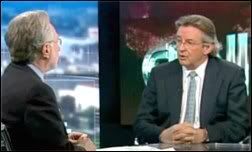 Transcript of CNN Sunday interview with Ambassador Joseph C. Wilson:
RENAY SAN MIGUEL, CNN ANCHOR: Diplomats are burning up the phone lines today trying to win votes for or against the latest U.N. resolution on Iraq. The resolution would give Iraq until March 17 to disarm or be disarmed by force. Richard Roth joins us now from the United Nations -- Richard.
RICHARD ROTH, CNN SR. U.N. CORRESPONDENT: Yes, President Bush is going to start making calls on Monday. He made a call to Chile's president on Friday. Chile, one of the undecided six, so-called swing votes that remain on the Security Council. And it's going to be hard in the next couple of days to find out exactly where countries are leaning, because the U.S., you never know, could make changes to the resolution yet again.
Friday, some amendments added, basically a big deadline added. March 17, for Iraq to turn over all of its weapons of mass destruction.
Here at the United Nations, it's quiet, but phone calls are being made around the world. The French foreign minister, Dominique de Villepin, is traveling to three African countries, the three swing African votes, Guinea, Cameroon, Angola. Angola's representative yesterday said he wasn't really happy with the draft resolution. Angola and Chile believing that Iraq should be given more time, that the 17th of March just comes up too soon.
The U.S. says it could call for a vote as early as Tuesday, which would give Iraq less than a week to turn over weapons of mass destruction. The impact of such a deadline on the weapons inspectors certainly would give them less time to be in the country to certify that Iraq is in the clear.
(BEGIN VIDEO CLIP)
MOHAMED ELBARADEI, DIRECTOR GENERAL, IAEA: On the one hand, there is a lot of indication in the intelligence community that there are -- Iraq still has chemical and biological weapons. On the other hand, none of the inspectors are able to find any of these weapons. So there is no smoking gun.
(END VIDEO CLIP)
ROTH: That's Mohamed ElBaradei of the International Atomic Energy Agency saying that the weapons inspectors on his side and Dr. Blix have not found a smoking gun, that Iraq is beginning to cooperating more. And as for the war, well, it means that they will never be able to certify with certainty that Iraq's nuclear program has not been revived, though there are no indications right now about that.
What else is Mr. ElBaradei reporting to the Security Council? Well, it drew little notice, because of the high powered debate and arguments among the big powers, but the director general of the International Atomic Energy Agency reported that his group has certified that documents provided by countries that allege possibly that the Iraqis were doing deals with the African nation of Niger to get enriched uranium for nuclear production were fakes, were forgeries. They refused to say whether it was the U.S. that gave them all the documents or Britain, but they're just saying what they were given to examine shows no confirmation that Iraq, as President Bush alleged in his State of the Union address, was getting enriched uranium in a potential deal with the African nation of Niger -- Renay.
SAN MIGUEL: Well, Richard, back in the region that we're talking about here, there are reports that the United Nations is pulling out some of its observers from Kuwait?
ROTH: That's right. Civilian staff being moved away while the U.N. mission along the Iraq/Kuwait Demilitarized Zone remains in place. The U.N. operation there is called UNICOM (ph), and you're going to see this over the next few days. The United Nations humanitarian team has been pared down dramatically in Iraq. Basically, UNICOM's (ph) 195 observers will stay in place the 775th Bangladeshi military support unit will be there.
Also of note along that demilitarized zone, in the last few days, civilians, said to be Kuwaiti construction workers, but some Marines in the area, cutting holes in the fence, an electric fence along that border, holes as wide as 75 feet. You can certainly bring a lot of big military vehicles through that, and also perhaps 75 gaps in all.
The U.N. reported this as a violation of the Security Council resolution. It's up to the Security Council what to do with it. The U.S. defends this action. If there's any link to the U.S. government, and no doubt there is, because they say Iraq has been a threat to Kuwait for more than 12 years. Stay tuned -- Renay.
SAN MIGUEL: As we certainly will. Richard Roth, thank you very much.
Now, as Richard just said, during his report yesterday, Mohamed ElBaradei said some of the evidence that Secretary of State Colin Powell presented to the U.N. was apparently faked. Joining us now from our Washington bureau is Joseph Wilson, who was acting ambassador to Iraq when the first Gulf War began. Mr. Wilson, thank you so much for joining us today.
JOSEPH WILSON, FORMER AMB. TO IRAQ: Hi, Renay. How are you.
SAN MIGUEL: Just fine. How could this happen? It is the perception that documents like these are vetted to within an inch of their life by intelligence agencies. How do you think this managed to slip by?
WILSON: Well, this particular case is outrageous. I actually started my foreign service career in Niger and ended my foreign service career doing -- in charge of Africa in the Clinton White House. We know a lot about the uranium business in Niger, and for something like this to go unchallenged by U.S. -- the U.S. government is just simply stupid. It would have taken a couple of phone calls. We have had an embassy there since the early '60s. All this stuff is open. It's a restricted market of buyers and sellers. The Nigerians (sic) have always been very open with us.
For this to have gotten to the IAEA is on the face of it dumb, but more to the point, it taints the whole rest of the case that the government is trying to build against Iraq.
SAN MIGUEL: I was just going to ask you, I mean, I got the idea from your answer about this, but just how damaging is this to the U.S. case with the stakes being as high as they are?
WILSON: Well, you know what it's like when you go into court. A prosecutor comes up with some evidence that is obviously false, it casts doubt on every other bit of evidence that he produces. And I think it's safe to say that the U.S. government should have or did know that this report was a fake before Dr. ElBaradei mentioned it in his report at the U.N. yesterday.
SAN MIGUEL: There's also another courtroom saying that, you know, lawyers like to say, never ask a question that you don't know the answer to. That could play into this as well.
But Mr. ElBaradei did tell our Richard Roth today, during an interview, that the intelligence isn't just coming from the U.S., that there were other countries involved. Which other countries do you think, and how is it that all of these intelligence agencies or intelligence agencies from these countries that were involved could be taken in by these forgeries?
WILSON: Well, the report I saw said that the Brits were involved. Maybe it was the British that passed this report on. I don't know who else might have been involved, but I can tell you this: The report in "The Washington Post" today said -- quoted a U.S. official as saying, "we just fell for it."
That's just not good enough. Either he's being disingenuous, or he shouldn't be drawing a government paycheck.
SAN MIGUEL: So how do you play this, then? I mean, what, do you admit it, do you just move on? Do you try to get these things verified if you do believe, indeed, that Iraq was trying to buy this material from Niger? I mean, how do you handle this? What's the damage control on this?
WILSON: I have no idea. I'm not in the government. I would not want to be doing damage control on this. I think you probably just fess up and try to move on and say there's sufficient other evidence to convict Saddam of being involved in the nuclear arms trade. But Dr. ElBaradei yesterday was pretty clear. He doesn't see that this is happening.
SAN MIGUEL: We'll have to leave it there. Joseph Wilson, former acting ambassador to Iraq for the U.S., thank you very much for your time.
WILSON: Good to be with you.
Transcript of Bill Moyers interview with Joseph C. Wilson:MOYERS: With war in Iraq more imminent than ever, we're going to talk tonight to the last senior American diplomat to meet with Saddam Hussein. Joseph Wilson was the Deputy Chief of Mission, the acting ambassador at the US Embassy in Iraq 12 years ago during Desert Shield, the lead-up to the first Gulf War.
He was a member of the American Foreign Service for 23 years. Our ambassador to two African countries. And served as the political advisor to the Commander in Chief of US Forces in Europe. He now heads his own international business firm and is an adjunct scholar at the Middle East Institute in Washington. Thank you for joining us.
WILSON: Oh, it's my pleasure.
MOYERS: Here we are, what one could reading our papers, say is the eve of war. What do you think is going through Saddam Hussein's mind this weekend?
WILSON: Well, I think Saddam Hussein is probably if the Gulf War is any example, I think has probably resigned themselves at some point that the war is going to happen. There may be one or two more games that they'll try and play, give out a few more missiles, allow more U.N. inspectors, or offer to allow Peacekeepers and inspectors in.
But ultimately, I think they've probably resigned themselves to the fact that they're going to be attacked. I suspect Saddam, being the survivalist he is, hopes that he will survive to fight another day. And I think that he probably believes that if he doesn't survive he will want to go down in history as somebody who actually confronted the West.
Because you know, in the Arab world, it has been enough to confront the West. You haven't had to defeat the West. You've just had to confront the West to achieve a certain status in the Arab world.
MOYERS: But if the United States attacks, he's a dead man.
WILSON: Well, I'm not sure about that. He's been preparing his security apparatus for 30 years. He knows his country. He may well have an out.
As the senior American diplomat 12 years ago in Iraq, did you support the effort to remove Saddam Hussein from Kuwait by force?
WILSON: I supported the effort to get Saddam Hussein out of Kuwait. And I understood fully that in order to get him out of Kuwait you had to have the credible threat of force. And in order for that force to be credible, you had to be prepared to use it.
MOYERS: Diplomacy had failed there as because he was so intransigent.
WILSON: That's right. That's right.
MOYERS: He's still just as intransigent.
WILSON: And I fear diplomacy is going to fail again.
MOYERS: What is the trip wire in your opinion for the use of force? What is your trip wire?
WILSON: Well, I've always said it's the first time he poses an obstacle to your conducting an inspection then you go in and you use force against that particular site. But you keep the use of force focused on disarmament. Let me give you an example.
When Colin Powell was up at the United Nations, he showed a couple of pictures of the site. He said, "This is a chemical weapons site and this is the trucks going out of that site just before the inspectors arrive at the front door. The trucks are going out the back door." That becomes a legitimate target for additional action on the part of the United Nations and the US. For example, that truck convoy leaving the site, as far as I'm concerned, becomes a legitimate target as does the site itself.
MOYERS: You're not against using force. So help me understand the distinction between the quantity of force you would use and the quantity of force that George W. Bush is proposing to you.
WILSON: Well, first of all, I think there's a question of objective. I'm not against the use of force for the purposes of achieving the objective that has been agreed upon by the United Nations in the international community, disarmament. If and when it becomes necessary. I think that is legitimate. Essentially, you could a lot of that just by the air. You do…
MOYERS: Precision bombing?
WILSON: …precision bombing. They've got more surveillance planes out there now. You've got the U2s. The French or moving some Mirages on. You've got the place blanketed.
MOYERS: You are calling for coercive inspections.
WILSON: That's right. Muscular disarmament, coercive inspections, coercive containment, whatever you want to call it. I don't think containment's the right word because we're really talking about disarmament.
MOYERS: Does it seem to you that the President, George Bush, is prepared to accept a disarmed Hussein? Or does he want a dead Hussein?
WILSON: I think he wants a dead Hussein. I don't think there's any doubt about it.
MOYERS: President Bush's recent speech to the American Enterprise Institute, he said, let me quote it to you. "The danger posed by Saddam Hussein and his weapons cannot be ignored or wished away." You agree with that?
WILSON: I agree with that. Sure. I…
MOYERS: "The danger must be confronted." You agree with that? "We would hope that the Iraqi regime will meet the demands of the United Nations and disarm fully and peacefully. If it does not, we are prepared to disarm Iraq by force. Either way, this danger will be removed. The safety of the American people depends on ending this direct and growing threat." You agree with that?
WILSON: I agree with that. Sure. The President goes on to say in that speech as he did in the State of the Union Address is we will liberate Iraq from a brutal dictator. All of which is true. But the only thing Saddam Hussein hears in this speech or the State of the Union Address is, "He's coming to kill me. He doesn't care if I have weapons of mass destruction or not. His objective is to come and overthrow my regime and to kill me." And that then does not provide any incentive whatsoever to disarm.
MOYERS: All of us change in 12 years and obviously Saddam Hussein has changed since you last saw him. But what do you know about him that would help us understand what might be going through his mind right now?
WILSON: Well, I think, first of all, it's important to understand that he's a creature of his-- of his country and of his region. His worldview is very limited. It is essentially what he sees from his palace and what his sycophants come and tell him.
So he does not have a broad vision of what's going on around him. There's, I think, a tendency to think of the world as rotating around not just Iraq but around his own palace. Secondly, he's a coldly rational political actor. But given that his worldview is limited, there is a tendency to develop a logical argument where the premise is skewed.
MOYERS: Such as?
WILSON: So he will, for example — four days after he invaded Kuwait when I saw him in August of 1990 — he said that the United States lacked the intestinal fortitude and the stamina to confront his invasion in Kuwait. And it was clear to me that he was drawing upon his interpretation of our experiences in Vietnam, Beirut and possibly Tehran. And he had drawn exactly the wrong lessons from that.
We, in fact, stayed in Vietnam far longer than we should have perhaps. We were there for 15 years. And we suffered 50,000 casualties. We did not cut and run. We did spill the blood of our soldiers for many, many years. Give you another example, the whole decision to go into Kuwait was, from his perspective, rational based upon his understanding of the region and of what the international community would do.
MOYERS: His decision to go…
WILSON: His decision to go into Kuwait. The only reason he had Ambassador Gillespie in to see him and then me in to see him four days after the invasion. Both were unprecedented meetings. He would normally meet only with senior diplomats resident in Baghdad when they were accompanying envoys from their respective capitals. So for him to have Ambassador Gillepsie and then me was really a first.
And it was clear that what he wanted to do in that is he wanted to deflect attention from what he really intended to do. And that's what he did with April Gillespie. He lied to her. He lied to President Mubarak that he was going to allow the negotiating process to go forward.
And with me, he wanted to make sure that the United States would not respond unilaterally. And so that he would get this thrown into the United Nations. And the reason he wanted it in the United Nations was because his experience was with Israeli-Palestinian issues, specifically Resolutions 242 and 338, which related to occupation of Palestinian territories. And as most people know, the Israeli withdrawal from Palestinian territories has not taken place even though those territories were occupied in the '60s and early '70s.
MOYERS: So what does he conclude from that?
WILSON: He concludes from that that if it goes into the United Nations system, he's got 25 or 30 years to occupy Kuwait during which time he can flag Kuwait City with Iraqis, pump all their oil, steal all their money and then submit it to a referendum which he would have stacked the odds for his victory.
MOYERS: So President Bush is not being naive to think that the UN may backfire on him. He's not being naive when he thinks that Saddam Hussein is lying to us, deceiving us, right?
WILSON: One should never believe Saddam Hussein. We certainly have enough experience with his deception and his lies not to be too trusting with him. With respect to the United Nations, it seems to me that the United Nations has far more often acted in a way that is-- that is consistent with our interests. And it has a obstacle to our interests. And it is our interests who have a broad international support for an objective.
And in order to get that broad international support, you have to frame your goals in such a way that you can get the allies as we did in the Gulf War.
MOYERS: So you're saying that it is important to enforce United Nations resolutions.
WILSON: Absolutely.
MOYERS: You think war is inevitable?
WILSON: I think war is inevitable. Essentially, the speech that the President gave at the American Enterprise Institute was so much on the overthrow of the regime and the liberation of the Iraqi people that I suspect that Saddam understands that this is not about disarmament.
MOYERS: Most Americans, including yours truly, know very little about Iraq. You've lived there. Tell me what we should know about it.
WILSON: Well, first of all, it is a wonderful country. It is the heart of Mesopotamia and everything that everybody understands about Mesopotamia…
MOYERS: The old biblical culture.
WILSON: And the breadbasket of that part of the world for many years. Two of the great rivers of history flow through it.
MOYERS: Tigris and the Euph…
WILSON: Tigris and Euphrates. It's got a population of about 25 million. Iraqis are wonderful people. They are imbued with a sense of their own history. They know who they are. They're fiercely nationalistic. They're a proud people.
They have tribal and ethnic cleavages that are difficult for outsiders to understand but which make up the fabric of politics and make it a very, very difficult place to govern as history has shown. That said they are educated. There is — was, when I was there, a vibrant commercial class, a vibrant educated class.
They grow dates. They produce oil. There was a wonderful construction industry. And, of course, we've seen from their ability to retrofit arms that they are active in the development of exotic weaponry. Which means that they've got engineering skills and science skills which have been put, unfortunately, to the wrong uses.
MOYERS: A great culture except that it's ruled by a dictator.
WILSON: As it has been for way too many years, for sure.
MOYERS: Tell me what you think we should do about Baghdad, the city, because apparently the strategy will be for — Saddam's strategy will be to defend Baghdad and make the war so bloody that he will create a worldwide reaction. And the United States is considering something called "Shock and Awe." Have you heard of that?
WILSON: I have. Yeah. And I've heard American military officials talk about how Baghdad would not be a safe place to be during the first several days of the air campaign. From what I understand about shock and awe, it will be a several day air assault in which they will drop as much ordinance in four or five days as they did during the 39-day bombing campaign of the Gulf War.
MOYERS: Missiles, bombs…
WILSON: Missiles, bombs, precision bombs. I believe the President and our military officials, when they say they will do everything to minimize casualties to the civilian population. But it was difficult to imagine dropping that much ordinance on a population of four million people without having a lot of casualties that are unanticipated. A lot of civilian casualties.
MOYERS: As I understand this concept of shock and awe, the United States would fire 100, maybe thousands of missiles the first day to shock…
WILSON: That's right.
MOYERS: …the Baghdad and the Iraqi population. And then wait to see what happens. Hoping that they might rise up against Saddam. Or the Republican Guards, his elite troops might flee in fear. Do you think that's a viable concept given what you know?
WILSON: Well, I think that from everything that I know about Iraq, Saddam will probably be surrounded by between 80 and 100,000 hardcore Republican Guard fighters who are prepared to die with him and who understand that their future is with him, live or die. And so they will probably defend him pretty close to the bitter end.
Now, defending Saddam Hussein will give them license to take on anybody who attempted to overthrow Saddam. So you might well have a bloody uprising in Baghdad in which pits essentially the Iraqi population against the Republican Guard in Saddam's palace. I think far more likely, is that most Baghdadis will just simply go into hiding and try and avoid getting hit by this American ordinance and/or getting killed by the Republican Guard.
Remember that Saddam Hussein, in his own mind, personifies Iraq. He is Iraq and Iraq is him. And so long as he's Iraq…
MOYERS: Just as Hitler with Germany. Hitler saw himself as Germany.
WILSON: And that permits him — that permits, in his own mind, to send as many Iraqis to their deaths as necessary so long as he survives.
MOYERS: Knowing this about — why do you think knowing this that the President Bush is so eager for war?
WILSON: Well, that's a — I think that's a very good question. I think that there is a sense in the administration that the time has run out for Saddam Hussein and the only way that they can achieve the disarmament objective that they want is to go in. But more importantly…
MOYERS: And you agree with that, don't you?
WILSON: Well, no, I don't think that that's the only way. That's where I disagree. I mean, I think that there are several other steps that can be taken before you have to go to total war for the purposes of achieving disarmament.
MOYERS: Coercive…
WILSON: But I think disarmament is only one of the objectives. And the President has touched repeatedly and more openly on the other objectives in recent speeches including this idea of liberating Iraq and liberating its people from a brutal dictator. And I agree that Saddam Hussein is a brutal dictator.
And I agree along with everybody else that the Iraqi people could — would well be far better off without Saddam Hussein. The problem really is a war which has us invading, conquering and then subsequently occupying Iraq may not achieve that liberation that we're talking about.
MOYERS: So this is not just about weapons of mass destruction.
WILSON: Oh, no, I think it's far more about re-growing the political map of the Middle East.
MOYERS: What does that mean?
WILSON: Well, that basically means trying to install regimes in the Middle East that are far more friendly to the United States — there are those in the administration that call them democracies. Somehow it's hard for me to imagine that a democratic system will emerge out of the ashes of Iraq in the near term. And when and if it does, it's hard for me to believe that it will be more pro-American and more pro-Israeli than what you've got now.
MOYERS: Tell me what you think about the arguments of one of those men, Richard Perle, who is perhaps the most influential advocate in the President's and the administration's ear arguing to get rid of Saddam Hussein. What do you think about his argument?
WILSON: Well, he's certainly the architect of a study that was produced in the mid-'90s for the Likud Israeli government called "a clean break, a new strategy for the realm." And it makes the argument that the best way to secure Israeli security is through the changing of some of these regimes beginning with Iraq and also including Syria. And that's been since expanded to include Iran.
MOYERS: So this was drawn up during the '90s…
WILSON: Right. During the '90s, absolutely.
MOYERS: By men outside of all this?
WILSON: Outside of all this, yeah.
MOYERS: And…
WILSON: Now, Richard Perle's been outside of office since the Reagan years.
MOYERS: And this, you're saying that this has become a blueprint for the Bush Administration?
WILSON: Well, I think this is part of what has been the underpinning of the-- of the philosophical argument that calls for basically radically changing the political dynamics in the Middle East and…
MOYERS: To favor Israel?
WILSON: Well, to favor American national security interests and Israeli national security interests which are tied. I mean, we have…
MOYERS: How so?
WILSON: We have an important strategic responsibility to ensure the territorial integrity of Israel. It's one that we've accepted since 1948. It's one that's been increasingly close. There are those who believe that perhaps we've confused our responsibilities with the slavish adherence to the Likud strategy.
MOYERS: Likud, the party.
WILSON: It's the party in power right now. And certainly when the President or when Sharon comes — the Prime Minister comes to Washington and says that George Bush is the best friend that Israel ever had. And George Bush calls him a man of peace, calls Sharon a man of peace, there are those who wonder about the depth of our ties and the extent to which our national security responsibilities may somehow be confused with our support for the current government in Israel.
MOYERS: So help us understand why removing Saddam Hussein and expanding that movement, throughout the Middle East which would benefit Israel?
WILSON: Well, I think those are the sorts of questions that you need to ask to Richard Perle. The argument that I would make…
MOYERS: We asked him but he didn't want to come on the show.
WILSON: Yeah. The argument that it seems to me — I've done democracy in Africa for 25 years. And I can tell you that doing democracy in the most benign environments is really tough sledding. And the place like Iraq where politics is a blood sport and where you have these clan, tribal, ethnic and confessional cleavages, coming up with a democratic system that is pluralistic, functioning and, as we like to say about democracies, is not inclined to make war on other democracies, is going to be extraordinarily difficult.
And let me just suggest a scenario. Assuming that you get the civic institutions and a thriving political culture in the first few iterations of presidential elections, you're going to have Candidate A who is likely going to be a demagogue. And Candidate B who is likely going to be a populist. That's what emerges from political discourse.
Candidate A, Candidate B, the demagogue and the populist, are going to want to win elections of the presidency. And the way to win election is enflame the passions of your population. The easy way for a demagogue or a populist in the Middle East to enflame the passion of the population is to define himself or herself by their enemies.
And the great enemy in the Middle East is Israel and its supplier, the United States. So it's hard to believe, for me, that a thriving democracy certainly in the immediate and near-term and medium-term future is going to yield a successful presidential candidate who is going to be pro-Israel or pro-America.
MOYERS: So you anticipate many unanticipated consequences to a war with Iraq?
WILSON: Not to anticipate unanticipated consequences is a dangerous thing to do. And my military planners used to always tell me, "Hope is not a plan of action." So you don't want to base things on how you hope the outcome is going to turn out.
MOYERS: Talk to me a moment about the notion of preemptive action and regime change. Preemptive action means an attack.
WILSON: That's right. That's right. We have historically reserved as part of our right of legitimate self-defense the authority to go in and take out an enemy before that enemy has an opportunity to take us out. Now what I worry about most is that we've lose focus on the war on terrorism where we've actually gone after al Qaeda and where we should continue to go after al Qaeda both in militarily as well as with our intelligence and our police assets.
We've got lost focus on that. The game has shifted to Iraq for reasons that are confused to everybody. The millions of people who are on the streets of our country and of Europe, as I said the other day, it strikes me as — it may prove that Abraham Lincoln is right. You cannot fool all the people all the time.
They have been sold. We have been sold a war on disarmament or terrorism or the nexus between terrorism and weapons of mass destruction or liberation. Any one of the four. And now with the President's speeches, you clearly have the idea that we're going to go in and take this preemptive action to overthrow a regime, occupy its country for the purposes, the explicit purposes of fostering the blossoming of democracy in a part of the world where we really have very little ground, truth or experience.
And, certainly, I hope along with everybody that the President in his assessment is correct. And that I am so wrong that I'm never invited to another foreign policy debate again.
MOYERS: You're not likely to be after this. (LAUGHTER)
WILSON: Because if I am right, this could be a real disaster. If I am wrong and the President is right, and you do have the democratic state that emerges, and you do have the power of the United States there as an arbiter, and you have a renewed commitment, as the President suggested in his speech to moving the Israeli-Palestinian process forward, then it could go well.
But I do believe — and it could be good for Israel. But I continue to believe that the path to peace in the Middle East goes through Jerusalem far more than it goes through Baghdad.
MOYERS: To a peaceful settlement between the Palestinians and the Israelis…
WILSON: Not just that. But that is the thorn that has to be pulled from the region in order for, in my judgment, the evolution of other governments in a more modern way. So long as you have the Palestinian — the Israeli-Palestinian problem there, any of these governments can use that…
MOYERS: Sure.
WILSON: …as the external enemy against which they mobilize their own populations.
MOYERS: And…
WILSON: And avoid responsibility for their own destinies.
MOYERS: Yeah. Joseph Wilson, thank you very much for this conversation.
WILSON: It's my pleasure.

