
The U.S. Army does not have enough evidence for murder charges against a U.S. soldier accused of killing a wounded Iraqi near Kirkuk, a military official ruled.
Lt. Col. Raul Gonzalez has recommended aggravated assault instead of murder charges be lodged against Spc. Christopher P. Shore, the Atlanta Journal-Constitution reported Wednesday.
During a hearing in Hawaii, Shore said his commanding officer, Sgt. 1st Class Trey A. Corrales, ordered him to "finish" a detainee who was on the ground bleeding, the newspaper said. The man died two days later.
Gonzalez, the presiding officer investigating the case, said evidence indicated Corrales -- not Shore -- shot and hit the victim multiple times with an M-4 rifle and displayed intent to kill.
Furthermore, Gonzalez said Corrales created an "unhealthy environment" for his platoon via his "abusive" and "unlawful" behavior, the newspaper said.
Shore, home in Winder, Ga., on leave, told the Journal-Constitution he was relieved by the decision.
"I think the man did the right thing," he said.
Showing posts with label in our names. Show all posts
Showing posts with label in our names. Show all posts
Wednesday, November 07, 2007
Another Day, Another War Crime Swept Under a Rug
UPI reports:

Thursday, November 01, 2007
Blackwater Sneaks Silencers into Iraq?
Security firm under investigation for allegedly sidestepping export controls
 A Blackwater employee shows off a silencer-equipped rifle in Iraq in a photo obtained by NBC News. The picture has been digitally altered to protect the identity of the subject.
MSNBC.com reports:
A Blackwater employee shows off a silencer-equipped rifle in Iraq in a photo obtained by NBC News. The picture has been digitally altered to protect the identity of the subject.MSNBC.com reports:
Federal agents are investigating allegations that the Blackwater USA security firm illegally exported dozens of firearms sound suppressors — commonly known as silencers — to Iraq and other countries for use by company operatives, sources close to the investigation tell NBC News.
Investigators from various federal agencies, including the Bureau of Alcohol, Tobacco and Firearms, Immigration and Customs Enforcement, the State Department and the Commerce Department, are digging into the allegations that the company exported the silencers without getting necessary export approval, according to law enforcement sources, who spoke to NBC News on condition of anonymity. The sources said the investigation is part of a broader examination of potential firearms and export violations.
Coincidentally, the company’s main responsibility in Iraq is protecting officials of the State Department, the agency that regulates exports of arms. The firm had more than $500 million in federal contracts in 2006.
Anne Tyrrell, a Blackwater spokeswoman, refused to comment on any specific allegations of the firearms investigation but said that “of course we would cooperate as we do in any investigation.”
The company has come under intense scrutiny since the Sept. 16 shooting deaths of 17 Iraqi civilians by Blackwater employees in an attack the Iraqi government contends was unjustified. Since then, other instances where company employees appeared to operate outside the law — including an incident in which a Blackwater employee allegedly killed a guard to Iraqi Vice President Adel Abdul Mahdi and was removed from the country with the help of the U.S. Embassy — have surfaced
The sources tell NBC News that Blackwater purchased the silencers legally from SWR Manufacturing, formerly of Georgia and now located in Pickens, S.C. SWR manufactures the devices for pistols, rifles and machine guns. The purchases took place over several years, the sources say.
Ex-official confirms Blackwater a customer
A former official at SWR Manufacturing of South Carolina, also speaking on condition of anonymity, confirmed that Blackwater had been a customer. The former SWR official would not say how many suppressors Blackwater purchased, but another source said law-enforcement officials have been told that the number was more than 100.
The former SWR official said he faxed copies of all paperwork relating to Blackwater’s business with SWR to the ATF more than a year ago after federal investigators contacted him. The former official said investigators told him that Blackwater sent the silencers overseas with its employees without getting the necessary export approval.
Maarten Sengers, an expert on arms export compliance in Washington, who is not involved in the investigation, said the criminal penalties for exporting silencers without proper paperwork can be stiff — up to 10 years in prison and fines up to $1 million per count.
While silencers are rare in America because their possession is highly restricted, they are common props in movies and television programs, used by actors playing hit men or members of the special forces. The military uses them for covert action and nighttime tactical assaults where stealth and surprise are required, but experts say it is not clear why Blackwater guards would need them for missions such as personal protection of diplomats.
Details of case slow to emerge
It has been reported that two former Blackwater employees who pleaded guilty to firearms violations earlier this year are cooperating with federal investigators in a firearms investigation, but the specifics of the case, including the details about the silencers, have not previously been disclosed.
Getting permission from the State Department to export such items is extremely difficult. Several sources involved in the investigation said that in the rush to prepare for war and execute federal contracts, private security companies sometimes have overlooked the requirements for their licenses.
Controversy over Blackwater's overseas operations erupted after a major shootout in Iraq on Sept. 16 that left 17 Iraqis dead. The company claimed its guards were fired on first, but witnesses and the Iraqi government say that Blackwater operatives fired without provocation. That incident is now under FBI investigation.
The export investigation is separate from that case. A spokeswoman for the U.S. Attorney’s Office for the Eastern District of North Carolina, the district where Blackwater is based, refused to comment on the matter.
Saturday, September 29, 2007
U.S. Sniper Acquitted of Murder, Convicted of Planting Evidence in Iraq
Killings of Iraqis led to court case.
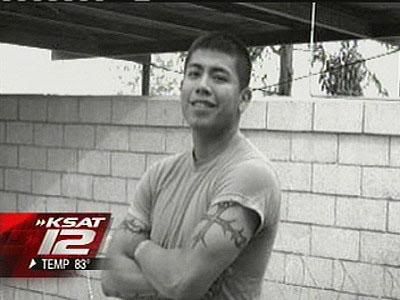 Spc. Jorge G. Sandoval
The Boston Globe reports:
So.
Spc. Jorge G. SandovalThe Boston Globe reports:
A military panel acquitted US Army Specialist Jorge G. Sandoval of two counts of murder yesterday, apparently swayed by testimony from fellow Army snipers that two Iraqi men were killed on orders from a higher-ranking soldier.
Sandoval was convicted of a less serious charge of planting detonation wire on one of the bodies to make it look like the victim was an insurgent. As a result, he still could face five years in prison. The seven-member jury deliberated less than two hours in clearing him of all but one charge.
Sandoval, 22, of Laredo, Texas, had faced five charges in the deaths of the two unidentified Iraqi men.
In dramatic testimony during the two-day court-martial, Sandoval's colleagues testified they were following orders when they shot the men during two separate events, on April 27 and May 11. The shootings took place near Iskandariyah, a volatile Sunni-dominated area 30 miles south of Baghdad.
Specialist Alexander Flores, of Hayward, Calif., who was in the same squad as Sandoval on the day of the April killing, testified their platoon leader said the suspect was "our guy" and ordered them to move in, which they interpreted as "take the target out."
The suspect, who wore dark clothing and used a sickle to cut grass in a field, matched the general description Iraqi soldiers had given the Americans of one of two insurgents they had faced earlier in the day, according to testimony.
After the killing, Flores said Staff Sergeant Michael Hensley told him to place the detonation wire on the body and in the man's pocket, which he said he did.
But prosecutors cited an interview with Sandoval immediately after his arrest in which he said he planted the wire.
Outside court, Flores stood by his testimony.
"He was just doing his job, as he was told. It's not his fault," said Flores, who, along with the rest of Sandoval's sniper platoon, greeted him with hugs and well wishes.
In the May shooting, Sergeant Evan Vela said Hensley told him to shoot a man who had stumbled upon their snipers' hideout, although he was not armed and had his hands in the air when he approached the soldiers.
"He [Hensley] asked me if I was ready. I had the pistol out. I heard the word shoot. I don't remember pulling the trigger. It took me a second to realize that the shot came from the pistol in my hand," Vela testified, crying.
Sandoval, who was charged with murder because prosecutors said he did nothing to stop the killing, also was acquitted yesterday of charges he planted the weapon on the second man's body.
Vela of Rigby, Idaho, and Hensley of Candler, N.C., are both charged in the case and will be tried separately.
All three soldiers are part of the 25th Infantry Division at Fort Richardson, Alaska.
So.
Friday, September 28, 2007
Making More Terrorists, Day by Day, Airstrike by Airstrike
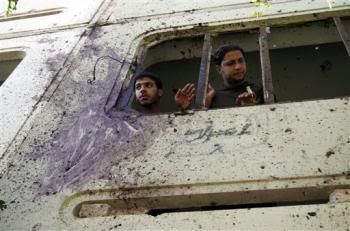 Two Iraqi men look out from a damaged window, from where the body of a civilian was recovered, at an apartment building after a U.S airstrike in the Sihha district in Dora southern Baghdad, Iraq, early Friday, Sept. 28, 2007. Iraqi police and witnesses said U.S. troops backed by helicopter gunships raided an apartment building in a primarily Sunni neighborhood in southern Baghdad on killing at list 10 civilians and wounding 12. The U.S. military said it was checking into the report. (AP Photo/Loay Hameed)
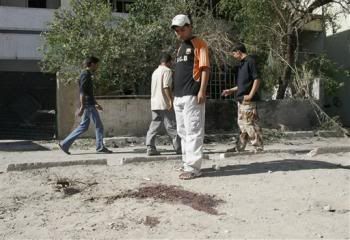
An Iraqi man stands behind a pool of blood outside an apartment building after a U.S. air strike in the Sihha district in Dora southern Baghdad, Iraq, early Friday, Sept. 28, 2007. Iraqi police and witnesses said U.S. troops backed by helicopter gun ships raided an apartment building in a primarily Sunni neighborhood in southern Baghdad on killing at list 10 civilians and wounding 12. The U.S. military said it was checking into the report. (AP Photo/Loay Hameed)
 Iraqi women react during a funeral after a U.S airstrike in the Sihha district in Dora southern Baghdad, Iraq, early Friday, Sept. 28, 2007. Iraqi police and witnesses said U.S. troops backed by helicopter gunships raided an apartment building in a primarily Sunni neighborhood in southern Baghdad on killing at list 10 civilians and wounding 12. The U.S. military said it was checking into the report. (AP Photo/Loay Hameed )
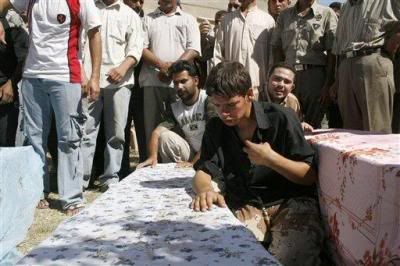 Iraqi men stand in front of three coffins during a funeral of victims after a U.S. air strike in the Sihha district in Dora southern Baghdad, Iraq, early Friday, Sept. 28, 2007. Iraqi police and witnesses said U.S. troops backed by helicopter gun ships raided an apartment building in a primarily Sunni neighborhood in southern Baghdad on killing at list 10 civilians and wounding 12. The U.S. military said it was checking into the report. (AP Photo/Loay Hameed )
The International Herald Tribune reports:
Iraqi police and witnesses said U.S. troops backed by helicopter gunships raided an apartment building in a primarily Sunni neighborhood in southern Baghdad on Friday, killing 10 civilians and wounding 12. The U.S. military said it was checking into the report.
An unknown number of people also were detained after the 2 a.m. incident in the Sihha district in Dora where clashes took place between U.S. helicopters and gunmen, said a police officer who spoke on condition of anonymity because he was not authorized to release the information.
Shaheed Abdul-Al, a 42-year-old metal worker who lives in the area, said his family was awakened by the sound of helicopters, heavy gunfire and bombing.
"We saw a big spark of light with bombing sounds come from the direction of the (targeted) building," he said. "We were horrified and still awake at sunrise."
Ahmed Salim, a 16-year-old student who lives near the targeted complex, said he saw U.S. military vehicles through his window.
"When the Americans left, I and others rushed to the site where people began to rescue victims," he said. "I saw some injured ones and dead bodies."
In violence north of Baghdad, at least six people were killed when four gunmen with long beards wearing military uniforms barged into a busy cafe late Thursday as people were playing a popular game to celebrate the end of the dawn-to-dusk fast during the Islamic holy month of Ramadan.
The men arrived in a Russian-made military vehicle used by the Saddam Hussein-era army and opened fire, shouting, "God is great," according to a provincial police officer who asked that his name not be used for fear of reprisals.
The six killed included three off-duty police officers and eight other people were wounded, the officer said.
The attack occurred in Sadiyah, a town some 95 kilometers (60 miles) north of Baghdad in the volatile Diyala province.
Thursday, September 27, 2007
Sniper Describes Killing Captive
Testimony in Court-Martial Describes a Sniper Squad Pressed to Raise Body Count
The New York Times reports:
The New York Times reports:
An Army sniper is taught to kill people “calmly and deliberately,” even when they pose no immediate danger to him. “A sniper,” Army Field Manual 23-10 goes on to state, “must not be susceptible to emotions such as anxiety or remorse.”
But in a crowded military courtroom seemingly stunned into silence on Thursday, Sgt. Evan Vela all but broke down as he described firing two bullets into an unarmed Iraqi man his unit arrested last May.
In anguished, eloquent sentences, Sergeant Vela, a member of an elite sniper scout platoon with the First Battalion, 501st Infantry Regiment, quietly described how his squad leader, Staff Sgt. Michael A. Hensley, cut off the man’s handcuffs, wrestled him to his feet and ordered Sergeant Vela, standing a few feet away, to fire the 9-millimeter service pistol into the detainee’s head.
“I heard the word ‘Shoot,’” Sergeant Vela recalled. “I don’t remember pulling the trigger,” he said. “I just came through and the guy was dead, and it just took me a second to realize the shot had come from the pistol.”
Then, Sergeant Vela said, as the man, a suspected insurgent, convulsed on the ground, Sergeant Hensley kicked him in the throat and told Sergeant Vela to shoot him again. Sergeant Vela, who is not on trial but faces murder charges in connection with the killing, said he fired a second time.
His testimony on Thursday, in the court-martial of Specialist Jorge G. Sandoval Jr., another sniper who is accused of murder, provided a glimpse into the dark moments of a platoon exhausted, emotionally and physically, by days-long missions in the region south of Baghdad that soldiers call the “triangle of death.” In their testimony, Sergeant Vela and other soldiers described how their teams were pushed beyond limits by battalion commanders eager to raise their kill ratio against a ruthless enemy.
During a separate hearing here in July, Sgt. Anthony G. Murphy said he and other First Battalion snipers felt “an underlying tone” of disappointment from field commanders seeking higher enemy body counts.
“It just kind of felt like, ‘What are you guys doing wrong out there?’” he said at the time.
That attitude among superiors changed earlier this year after Sergeant Hensley, an expert marksman, became a team leader, according to soldiers’ testimony. Though sometimes unorthodox, soldiers said, Sergeant Hensley and other snipers around him began racking up many more kills, pleasing the commanders.
Soldiers also testified that battalion commanders authorized a classified new technique that used fake explosives and detonation wires as “bait” to lure and kill suspected insurgents around Iskandariya, a hostile Sunni Arab region south of Baghdad.
As their superiors sought less restrictive rules of engagement — to legalize the combat killing of anyone who made a soldier “feel threatened,” for example, instead of showing hostile intent or actions — the baiting program, as it was known, succeeded in killing more Iraqis suspected of being terrorists, soldiers testified.
But testimony in proceedings for Sergeant Hensley and, on Thursday, for Specialist Sandoval, both of whom face murder charges in connection with separate killings of Iraqi men last spring, suggest that as the integrity of the battalion’s secret baiting program began to crack, so did Sergeant Hensley.
Only a select group of snipers in the battalion were told of the program, but many more were ordered, without explanation, to carry the baiting items on missions, creating rumors that the items were intended to be planted on victims of unjustified killings, soldiers testified.
Sergeant Hensley, according to several snipers, added to such suspicions when he told a junior member of his team to plant a roll of copper wire — clear contraband — on a suspected insurgent that Specialist Sandoval killed on April 27 after being authorized to shoot by his platoon commander.
On a separate mission two weeks earlier, Sergeant Hensley had killed another Iraqi man he said appeared to be “laying wire” near an irrigation ditch, as the man’s wife and children worked and played nearby.
Then on May 11, Sergeant Vela killed the unarmed man. Afterward, as he testified Thursday, Sergeant Hensley pulled an AK-47, a weapon favored by insurgents, out of his pack and placed it on the body, telling his team that the gun would “say” what happened.
Specialist Sandoval’s court-martial on murder charges began here on Wednesday, and is scheduled to conclude Friday. Sergeant Hensley’s court-martial on murder charges is scheduled to begin here Oct. 22.
An evidentiary hearing for Sergeant Vela, who took the stand on Thursday in the Sandoval court-martial after being granted immunity from incriminating himself in that case, is expected later this year.
Sergeant Murphy has been investigated for a killing of another Iraqi man on April 7. Prosecutors have warned two more battalion members that they are also suspected of committing possible crimes as accomplices in the murder cases.
Struggling to explain why a highly trained Army sniper unit, renowned for its lethal economy of patience and discipline, would bog down under a cloud of murder investigations, some soldiers in interviews faulted commanders for pushing units to keep their kill counts high.
Others pointed toward the outsized influence on the unit by Sergeant Hensley, who, according to other soldiers’ testimony, was dealing with two recent deaths: that of a close friend, killed in a roadside bomb, and also the suicide of his girlfriend back home.
“Staff Sgt. Hensley just continued to drive on,” said Specialist Joshua Lee Michaud, in testimony at the July hearing about the sergeant’s toughness. “Both of them didn’t even faze him.”
A trainer of snipers, Sgt. First Class Terrol Peterson, testified Thursday that the very emotions a sniper must control to do his job properly — anxiety and remorse — sometimes emerge in unexpected and painful ways. “When a sniper breaks, he breaks bad,” Sergeant Peterson said.
Tuesday, September 25, 2007
U.S. Snipers Accused of 'Baiting' Iraqis
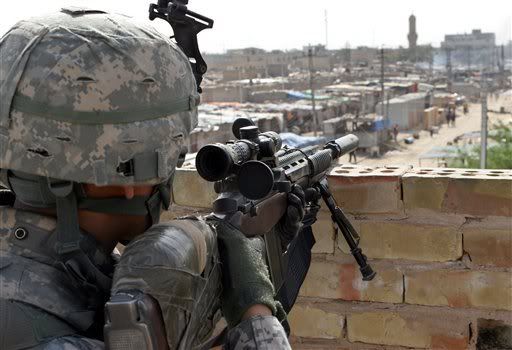 A U.S. soldier holds his sniper position on a rooftop in a Shiite enclave of Sadr City in Baghdad, Iraq, in this April file photo. Army snipers hunting insurgents in Iraq were under orders to "bait" their targets with suspicious materials, such as detonation cords, and then kill whoever picked up the items, according to the defense attorney for a soldier accused of planting evidence on an Iraqi he killed. (AP photo)
The New York Times reports:
Under a program developed by a Defense Department warfare unit, Army snipers have begun using a new method to kill Iraqis suspected of being insurgents, using fake weapons and bomb-making material as bait and then killing anyone who picks them up, according to testimony presented in a military court.
The existence of the classified “baiting program,” as it has come to be known, was disclosed as part of defense lawyers’ efforts to respond to murder charges the Army pressed this summer against three members of a Ranger sniper team. Each soldier is accused of killing an unarmed Iraqi in three separate shootings between April and June near Iskandariya, and with planting “drop weapons” like detonation wires or other incriminating evidence on the bodies of the victims.
In sworn statements, soldiers testifying for the defense have said the sniper team was employing a “baiting program” developed at the Pentagon by the Asymmetrical Warfare Group, which met with Ranger sniper teams in Iraq in January and gave equipment to them.
The Washington Post described the baiting program on Monday.
An Army spokesman, Paul Boyce, said Monday that the Army did not publicly discuss specific methods for “targeting enemy combatants,” and that no classified program authorized the use of “drop weapons” to make a killing appear justified. Army officers involved in evidentiary hearings in Baghdad in July did not dispute the existence or use of a baiting program.
The court-martial of one accused soldier, Specialist Jorge G. Sandoval Jr., is scheduled to begin in Baghdad on Wednesday. The two other soldiers facing premeditated murder charges are Staff Sgt. Michael A. Hensley, the sniper team squad leader, and Sgt. Evan Vela. All three are part of the headquarters of the First Battalion, 501st Infantry Regiment, Fourth Brigade (Airborne), 25th Infantry Division, based at Fort Richardson, Alaska.
None of the soldiers deny that they killed the three Iraqis they are charged with murdering. Through their lawyers and in court documents, the soldiers say the killings were legal and authorized by their superiors. But defense lawyers raised the issue of the baiting program in response to prosecutors’ allegations that the soldiers had planted items, like wire for making bombs, on the bodies of the victims.
A transcript of the hearing was provided by a family member of an accused soldier.
Snipers are among the most specialized of soldiers, using camouflage clothing and makeup to infiltrate enemy locations, and high-powered rifles and scopes to stalk and kill enemy fighters. The three snipers accused of murder had for months ventured into some of the most dangerous areas of Iraq, said lawyers for Sergeant Vela.
“Snipers are special people who are trained to shoot in a detached fashion, not to see their targets as human beings,” said James D. Culp, one of Sergeant Vela’s lawyers. “Snipers have split seconds to take shots, and he had a split second to decide whether to shoot.”
After visiting the sniper unit in Iraq, members of the Asymmetrical Warfare Group gave soldiers ammunition boxes containing so-called “drop items” like bullets, plastic explosives and bomb detonation cords to use to pinpoint Iraqis involved in insurgent activity, according to Capt. Matthew P. Didier, a sniper platoon leader who gave sworn testimony in the accused soldiers’ court hearings.
Captain Didier, in a sworn statement about the program that was obtained by The New York Times, described baiting as “putting an object out there that we know they will use, with the intention of destroying the enemy.”
After placing the bait, snipers observed the area around it, Captain Didier said in his statement. “If someone found the item, picked it up and attempted to leave with the item,” he said, “we would engage the individual, as I saw this as a sign that they would use the item against U.S. forces.” (Engage is a military euphemism for firing on or killing an enemy.)
The Asymmetrical Warfare Group, based at Fort Meade, Md., grew out of a task force created after the American invasion of Iraq in 2003 to develop methods to defeat roadside bombs. Not all of the group’s tactics were meant for sniper units, and most of them have not been publicly disclosed.
For instance, the group last year advised “kill teams” from the Third Brigade, Second Infantry Division, to dig holes resembling those used by insurgents to hide roadside bombs, and to shoot Iraqis who tried to place things in the holes, said a soldier who was briefed on the program and who spoke on condition of anonymity to avoid retribution.
The kill teams used the tactic not to kill people, but to wound them with gunshots and then capture and interrogate them, the soldier said. “It’s pretty common, and it’s pretty effective,” the soldier said in an interview. The soldier lamented the disclosure of the baiting and other anti-insurgent combat tactics because “it’s probably saving a lot of soldiers’ lives.”
James Ross, the legal and policy director for Human Rights Watch, said using fake weapons and ammunition as bait to attract and kill insurgents creates blurry ethical boundaries for soldiers fighting in Iraq, and great risk to civilians who are not legal targets in war. International law recognizes that killing “any individual who is directly or indirectly taking part in hostilities” can be justified, Mr. Ross said, but it is not precise about how such distinctions should be applied.
Mr. Ross said the dispersal of ammunition and explosives by American forces as part of an effort to attract insurgents would present obvious human rights problems.
“It seems to me that there are all sorts of reasons that civilians would want to pick up ammunition that is sitting on the ground,” he said.
Specialist Sandoval is the first of the three suspects to be tried in a court-martial. He and Sergeant Hensley were accused of leaving a spool of wire that could be used to detonate roadside bombs in a pocket of the man whom Specialist Sandoval shot in April, on Sergeant Hensley’s command.
Sunday, July 22, 2007
Director of Intelligence: "The U.S. Does NOT Engage in Torture....
....depending on what your definition of torture is."
On Meet the Press, Tim Russert talks with National Intelligence Director, Mike McConnell:
Part 1
Part 2
Part 3
Transcript:
I saw Road To Guantanamo on Dishnet (the Sundance channel) last week:
A clip from Road To Guantanamo
The horror and abuse begin long before the three arrive in Guantanamo. If this account is anything close to what actually happened, we are seriously off the path of what the United States is all about, and what most Americans believe our government should be doing in our names.
On Meet the Press, Tim Russert talks with National Intelligence Director, Mike McConnell:
Part 1
Part 2
Part 3
Transcript:
RUSSERT: Our issues this Sunday -- what is the real terrorist threat to the United States homeland? How good is our intelligence gathering, and nearly six years after September 11th, why is Osama bin Laden still at large? With us -- the director of National Intelligence, Admiral Mike McConnell, in his first television interview.
Then -- briefings, debates, and votes -- the Iraq war front and center. With us, Democratic senator from Wisconsin, Russ Feingold. And in our roundtable, insight and analysis from New York Times Columnist, David Brooks; The Washington Post, Bob Woodward; and The Weekly Standard, Stephen Hayes, author of "Change, The Untold Story of America's Most Powerful and Controversial Vice President."
But, first, this week, this document, the National Intelligence Estimate entitled "The Terrorist Threat to the U.S. Homeland," was released. How serious is this threat and what can we do about it? Joining us for an exclusive interview is the director of National Intelligence, Admiral Mike McConnell -- welcome.
McCONNELL: Thank you.
RUSSERT: Let me show you a key judgment from this report, "We judge the U.S. homeland will face a persistent and evolving terrorist threat over the next three years."
In laymen's language, for the American viewers watching today, what is the most serious threat facing our country?
McCONNELL: Tim, the most serious threat is that the plotters that are being observed will be successful in penetrating our defenses and conducting an attack that would result in mass casualties. Their intent is to effect and attack with mass casualties. A secondary attempt would be a political or infrastructure targets to even include economic targets that would have long-lasting impact.
RUSSERT: Is it biological and chemical, or did they achieve nuclear?
McCONNELL: They have not achieved nuclear based on our current understanding. The intent is either chemical, biological, nuclear radiological, or even nuclear to include a nuclear yield. I would add what we see currently is primarily a focus on explosives -- explosives that can generate a large explosion, but they're put together with commercially available material.
RUSSERT: Why aren't we seeing more suicide bombers the way we see in the Middle East?
McCONNELL: In the United States, you mean? The efforts that the United States and our allies have gone through over the past five years have been significant in establishing barriers. So the terrorists perceive us as a much more difficult target, very different from what it was at 9/11.
So barriers have been established, databases have been established, the National Counterterrorism Center, which conducts three times a day a teleconference with all the players -- federal level, state level, international -- to try to coordinate these things, and if someone can be identified, they'll be taken out of the pipeline in their process to come into the United States.
RUSSERT: Let me read another key judgment, "Although we have discovered only a handful of individuals in the United States with ties to al Qaeda's senior leadership since September 11th, we judge that al Qaeda will intensify its efforts to put operatives here."
But there are people in the United States, you are saying, who have direct ties to al Qaeda senior leadership?
McCONNELL: The way we describe it is we have strategic warning, we know what al Qaeda and their safe haven in Pakistan intends to do. We're watching them train and recruit, and their effort is to put someone inside the United States.
There have been some clues in some cases where there would be attack, but we do not have tactical warning currently that there are sleeper cells tied directly to al Qaeda inside the United States. So we have the strategic warning not the specific tactical warning, but we know their intent.
RUSSERT: But you say there are handfuls of individuals in the United States with ties to al Qaeda senior leadership.
McCONNELL: That's correct, and that's in the form of raising money or being sympathetic to. But we haven't identified individuals who are actively plotting or planning. But there have been some that have been sympathetic to al Qaeda's cause.
RUSSERT: Do you believe there are sleeper cells in the U.S.?
McCONNELL: I worry that there are sleeper cells in the U.S. I do not know. There is no specific on a sleeper cell. There are some elements under surveillance because we're not sure, so it's warranted -- court-approved, warranted surveillance. We have some ties. This is what I meant when I said we've raised the barriers and made it more difficult.
RUSSERT: This intelligence report that came out this month raised a lot of concern and alarm in the U.S., and it seems to be in stark contrast to the National Intelligence Estimate from last April -- this one. Let me read that key judgment to you, "United States- led counterterrorism efforts have seriously damaged leadership of al Qaeda and disrupted its operations. We assess the global jihadist movement is decentralized; lacks a coherent global strategy; is becoming more diffuse.
That seems so different than your assessment in July of '07. What a difference a year makes. What changed? We were told that the al Qaeda had been, in many ways, close to being destroyed or dismantled.
McCONNELL: Following the invasion of Afghanistan in 2001, about two-thirds of al Qaeda's not only leadership but their soldiers, the foot soldiers, had been eliminated. And at that point in time, that was an accurate assessment of where we were.
Now, what happened? What's different? What changed? In Pakistan, where they're enjoying a safe haven -- the government of Pakistan chose to try a political solution. A political solution meant a peace treaty with the region that's never been governed -- not governed from the outside, not governed by Pakistan. The opposite occurred. Instead of pushing al Qaeda out, the people who live in these federally administered travel areas, rather than pushing al Qaeda out, they made a safe haven for training and recruiting.
And so in that period of time, al Qaeda has been able to regain some of its momentum. The leadership is intact, they have operational planners, and they have safe haven. The thing they're missing are operatives inside the United States. So that's the difference between last year and this year in our assessment.
RUSSERT: Why haven't we captured Osama bin Laden?
McCONNELL: Think about attempting to capture a single human being whose primary purpose and emphasis is to remain unobserved or hidden. It's a very difficult challenge. From having been in intelligence for most of my professional life, it's not difficult to find something large -- an armored division, ships that are being built or airplanes or whatever, but a single human being that wants to be unobserved, who is being assisted in that process, it just makes it very, very difficult.
RUSSERT: If we captured Osama bin Laden, we might lose General Musharraf and Pakistan because of unrest such apprehension might create in his country. Would it be worth losing Musharraf but apprehending Osama bin Laden?
McCONNELL: Well, first, I wouldn't agree that if we capture or kill Osama bin Laden it would be a particularly increased or direct threat to President Musharraf. President Musharraf is one of our strongest allies. He agrees with capturing or killing Osama bin Laden, and while he tried the political arrangement, the peace agreement, last fall, he has made decisions over the last few weeks -- you are aware of the Red Mosque and cleaning that out -- and he's gone on the offensive to go back into this federally administered travel area, FATA, is the shorthand we use to refer to it.
Now, in doing that, there's been a price. He has lost already, I would say, 100 troops. Broadly, across Pakistan, the number is probably approaching 300 from suicide bombs and roadside attacks. So there is a price to pay, but President Musharraf is a moderate, he has a moderate view, and he is attempting to cause the nation of Pakistan to rally around a moderate's view to eliminate the extremists.
RUSSERT: If his government fell, how detrimental would it be to the U.S.?
McCONNELL: It would have severe impact. It would depend -- if it fell, it depends on who would replace him. It's a democratic nation, if they continue down this current path, so if the process of turnover happens in a democratic way, it may not have severe impact.
One of the things that I would like to highlight, however, is President Musharraf is one of our most valued allies, and let me just highlight this -- Probably, the majority of the senior leadership have been captured or killed or is the direct result of assistance and cooperation and participation by the Pakistanis.
RUSSERT: Are you convinced Osama bin Laden is alive?
McCONNELL: We have not heard from Osama bin Laden for over a year. There's a recent video where he appeared. Many people thought that was current. That was actually old videotape. So it's been a year. There are rumors about his illness. My personal view is that he's alive, but we don't know because we can't confirm it for over a year.
RUSSERT: And living in Pakistan?
McCONNELL: I believe he is in the tribal region of Pakistan, and how he conducts his affairs, only speaking to a courier, staying complete removed from anything we could exploit to find him, I think he's in that region.
RUSSERT: Let me ask you about the executive order the president issued about enhanced interrogation measures. What does that allow a CIA-held target? What kind of measures can you use to get information from them?
McCONNELL: Well, Tim, as you know, I can't discuss specific measures. There's a variety of reasons for that. One, if I announce what the specific measures are, it would aid those who want to resist those measures to train, to understand it, and so on, so I won't be too specific.
Let me go back to a higher calling in this context. The United States does not engage in torture. The president has been very clear about that. The executive order spells it out. There are means and methods to conduct interrogation that will result in information that we need, and what I would highlight -- I was concerned and worried and, quite frankly, appalled by Abu Ghraib. My view is America risked losing the moral high ground, and so I focused on this when I came back.
What I can report to you is that was an aberration. The people who were responsible for the atrocities at Abu Ghraib have been held accountable, and they're serving a sentence for that. That is not the program the CIA was administering. It is not the program that the president approved in the recent executive order.
RUSSERT: But by use of the term "enhanced interrogation measures," there clearly are things that are used to elicit information. Have we eliminated water-boarding? Can you confirm that?
McCONNELL: I would rather not be specific on eliminating exactly what the techniques are with regard to any specific. When I was in a situation where I had to sign off, as a member of the process, my name to this executive order, I sat down with those who have been trained to do it, doctors who monitor it, understanding that no one is subjected to torture. They are treated in a way that they have adequate diet and not exposed to heat or cold, they are not abused in any way, but I did understand when exposed to the techniques how they work and why they work -- all under medical supervision, and one of the things that's very important, I think, for the American public to know -- in the history of this program it's been fewer than 100 people.
And so this is a program where we capture someone known to be a terrorist, we need information that they possess, and it has saved countless lives because they believe these techniques might involve torture, and they don't understand them, they tend to speak to us, talk to us in a very candid way.
RUSSERT: Does this new executive order allow measures that if were used against a U.S. citizen who was apprehended by the enemy would be troubling to the American people?
McCONNELL: I can report to you that it's not torture.
RUSSERT: How do you define torture?
McCONNELL: Well, torture is -- an attempt to define torture in the executive order gives examples of mutilation or murder or rape or physical pain, those kinds of things.
Let me just leave it by saying the techniques work. It's not torture, you're not subjected to heat or cold, but it is effective, and it's a psychological approach to causing someone to have uncertainty and, in a situation where they will feel compelled to talk to you about what you're asking on that.
RUSSERT: Then you would find it acceptable if a U.S. citizen experienced the same kind of enhanced interrogation measures?
McCONNELL: Tim, it's not torture. I would not want a U.S. citizen to go through the process, but it is not torture, and there would be no permanent damage to that citizen.
RUSSERT: Let me turn to Iraq, another key judgment from the National Intelligence Estimate, "We assess that its association with AQI, al Qaeda in Iraq, helps al Qaeda to energize the broader Sunni extremist community, raise resources and recruit and indoctrinate operatives including for homeland attacks."
That seems to suggest that the Iraq War has been a very effective recruiting tool for al Qaeda.
McCONNELL: It has served as a recruiting tool to draw additional terrorists into Iraq, but it's a mutually beneficial situation for both organizations.
Now, the debate often is -- was al Qaeda in Iraq prior to the U.S.-led coalition invasion? Some members of those who associate with al Qaeda were there -- Zarqawi, who had served in Pakistan with Osama bin Laden, was the principal lead. In 2004 he swore allegiance to Osama bin Laden. As you know, he was subsequently killed about a year ago -- June 2006. The person that replaced him as sworn allegiance to Osama bin Laden.
So al Qaeda finds it beneficial in that it's in the press. It draws in recruits, and al Qaeda in Iraq found it beneficial because it unites in a broader context.
There's one thing I think is very important is in the NIE that's often overlooked -- there is an element of extremism in the Middle East that runs from North Africa down into South Africa into the Levant, Syria, into Iraq and over to Afghanistan, even Pakistan. What al Qaeda has done is find a method for uniting those extremist views, and so what we see now is groups who are predisposed to extremism and terrorism are uniting under the al Qaeda banner.
RUSSERT: But al Qaeda is a much more robust and larger presence in Iraq now than it was before the war?
McCONNELL: That's fair to say, that's fair to say. Now, but, let me just highlight one thing that's also important -- At one point in the war, al Qaeda controlled the huge expanse to the west, it's called Anbar Province. What's happened is because of the atrocities in their approach that leadership, tribal sheikhs in that region, collaborated with the coalition and turned on al Qaeda.
So has al Qaeda defeated in Iraq -- no. But in some areas, they're back on their heels for two reasons. The local citizens have turned against -- Iraqi citizens have turned against al Qaeda, and the coalition has been much more effective. As you know, the troops in this surge arrived in about the middle of June, and so the effort has been to take the fight to al Qaeda, and they have a very high level of success in doing that.
RUSSERT: In terms of the balance in Iraq, which creates more of the violence? Which is the greater cause for violence? The sectarian conflict or al Qaeda?
McCONNELL: I think it is both. In some cases, we even have Shi'a on Shi'a sectarian violence. But, for the most part, it is Sunni versus Shi'a, and al Qaeda is the one that takes -- is the organization that attempts purposefully to serve as an accelerant attacking things like the mosque, the Grand Mosque that was destroyed over a year ago, and then revisiting with attacking the two minarets that were still up.
The whole purpose is something massive against the Shi'a or against something Shi'a holds sacred to act as an accelerant to stimulate the violence.
RUSSERT: But there seems to be, Admiral, a coordinated campaign by the administration to elevate al Qaeda is the threat in Iraq, and yet the Pentagon quarterly report, which came out in March, said this, "The conflict in Iraq has changed from a predominantly Sunni-led insurgency against foreign occupation to a struggle for the division of political and economic influence among sectarian groups and organized criminal activity," the Pentagon quarterly report on Iraq to Congress.
The Pentagon report also said sectarian violence has become "the greatest impediment to the establishment of security and effective governance in Iraq." Do you agree with that?
McCONNELL: I agree with that, it's true. But what I would highlight is al Qaeda is part of that sectarian violence, al Qaeda is part of that crime. In some neighborhoods, it would be a classic shakedown -- "We will provide security if you give us money and resources." So al Qaeda is a major portion -- not the only. It's had significant impact, but there are other sectarian disagreements and criminal activity going on, as I mentioned, even Shi'a on Shi'a in some cases.
RUSSERT: Stephen Hayes has written his book on Vice President Cheney, and as I was reading it, I found an interview with you about your views of the administration and some of their methods of gathering intelligence, and I want to share that with you and have a chance to talk about it.
It says here, "In November of 2006, Michael McConnell, who had been working on intelligence issues in the private sector since resigning from the NSA in '96 was asked to consider joining the Bush administration as the nation's top intelligence official. McConnell was honored to be asked but had serious reservations. He had been unimpressed with many aspects of the Bush administration and its conduct of the war on terror, particularly what he felt was a politicized use of intelligence and lead-up to the war.
All of these current players, Secretary Rumsfeld, Vice President Cheney, and the president,' McConnell said in an interview in late November '06, 'must come through from me as a citizen. I am no longer on active duty, so I can say these things. They had, first and foremost, very strong political convictions. My sense of it is their political faith and convictions influence how they took information and interpreted it, how they picked up and interpreted outside events. As a former intel pro, when you don't like the answer, and you set up your own thing, you tend to get the answer you want. You hire people that think like you do or want to satisfy the boss. I've read much more about the current set of players, and they did set up a whole new interpretation because they didn't like the answers. They got results that, in my view, now have been disastrous.'"
That's pretty harsh.
McCONNELL: We're all influenced by what we see and hear and read. I am a concerned citizen. I read those things and read those accounts. What I was taking greatest exception to was to have a secondary unit established in the Pentagon to reinterpret information.
The problem I have with that is the way you do intelligence is all sources considered. You have to factor one issue against another and balance it. If you start an independent effort with a point of view, it's not infrequent that you would take a single piece of data to make a point as opposed to consider everything.
So what I was referring to and talking about at that time is I was worried that in the Pentagon there had been established this separate unit, and I thought it would have been too influential. Now, you can imagine, I consider myself an intelligence professional, I've been doing this either on active duty or serving this community for 40 years. The first responsibility of an intelligence professional is ground truth, and the second responsibility is to speak truth to power.
So when I was asked to consider this nomination, that was the condition under which I would consider it, and I focused on it very intently once I came back. What I found, or what I discovered, was quite refreshing. As you know, I meet with the president and vice president six days and, on occasion, seven days a week. That dialog is open and frank and direct, and the thing that the president and the vice president frequently will do, whether they're talking to me or one of the analysts that go in with me, is that we're not telling you what to think or how to think or what your conclusion should be. We need your information. We can challenge your assumptions or your assessment, but we want to know what your opinion is.
RUSSERT: But leading up to the war in Iraq, you strongly suggest that many Americans believe that we went to war on Iraq on faulty intelligence, skewed intelligence, or cherry-picked intelligence.
McCONNELL: I would just report what came out of the WMD commission and even the 9/11 commission, to some extent, the assessment that was concluded, I think it was October 2002, determined or made an assessment that Saddam had weapons of mass destruction. I believed it at the time, and I mostly believed it because of my experience as intelligence officer for General Powell in the first Gulf War. I knew they had them, I knew Saddam had killed 300,000 of his own countrymen. He had engaged in two wars. He had those weapons, so I believed it.
What I believe happened is that the community allowed itself to be lulled into making the call on information, in some cases, from people who thought they had them -- even Saddam's generals thought they had weapons of mass destruction. So those threads took us to a place that turned out to be not valid.
RUSSERT: But did the policymakers hype the intelligence?
McCONNELL: That's a judgment that I think the American people will have to make. I have paid very close attention to hyping of intelligence, and what I can tell you from personal experience is the decision-makers are making every attempt to call it straightforward based on the information that we provide to them, and we are not being asked to cherry-pick or to go down one path or another path but to give them complete information or the best assessments we can.
RUSSERT: Admiral Mike McConnell, we thank you very much for coming here and sharing your views this morning.
McCONNELL: Thank you so much.
I saw Road To Guantanamo on Dishnet (the Sundance channel) last week:
...the terrifying, first-hand account of three British citizens who were held for two years without charges in the American military prison at Guantanamo Bay, Cuba. Known as the "Tipton Three," in reference to their home town in Britain, the three were eventually returned to Britain and released, still having had no formal charges ever made against them at any time during their ordeal.
Part documentary, part dramatization, the film chronicles the sequence of events that led from the trio setting out from Tipton in the British Midlands for a wedding in Pakistan, to their crossing the Afghanistan border just as the U.S. began their invasion, to their eventual capture by the Northern Alliance and their imprisonment in Camp X-Ray and later at Camp Delta in Guantanamo.
A clip from Road To Guantanamo
Mixing documentary footage, interviews and dramatic recreations, filmmakers Michael Winterbottom (IN THIS WORLD) and Mat Whitecross reveal the harsh realities of the American detention facility in Guantanamo Bay. THE ROAD TO GUANTANAMO tells the story of the "Tipton Three," a trio of young British citizens of Pakistani heritage who naively ventured into Afghanistan in the fall of 2001 and were eventually rounded up in a sweep of terrorist suspects. "A wrenching and dismaying account of cruelty and bureaucratic indifference" - New York Times.
The horror and abuse begin long before the three arrive in Guantanamo. If this account is anything close to what actually happened, we are seriously off the path of what the United States is all about, and what most Americans believe our government should be doing in our names.
Monday, July 09, 2007
Cindy Sheehan Planning To Run Against Pelosi
And if she does, I will seriously consider moving to San Francisco so that I can vote for Sheehan.
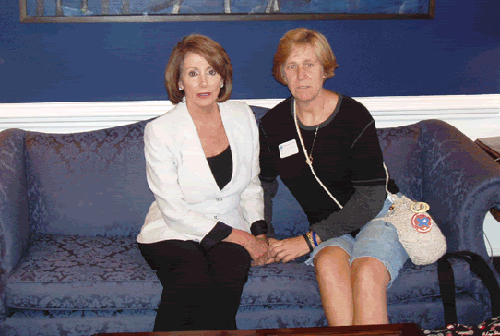
The AP reports:
I live close enough to Pelosi's district now that moving there wouldn't be a great effort. But neither would staying where I am, writing her a fat check and volunteering to work for her instead. Not for me and millions of others who are disgusted by what professional politicians are doing, in our names, to this country and to others around the world.
Sheehan could become a very rich candidate, amassing a war chest of contributions and a volunteer base from around the country. A Sheehan congressional run has the power to launch other populist campaigns and galvanize Americans who are starving for change and new leadership to become active and challenge the status quo. To retire politicians like Patrick Leahy, who, earlier today on Meet The Press, said that calling Scooter Libby to testify before the Senate Judiciary Committee was useless. "It would do no good to call Scooter Libby. His silence has been bought and paid for," he said, referring to Bush’s commutation, "and he would just take the fifth."
Maybe Libby would, maybe he wouldn't, but Leahy and Democrats have let Republicans spin every single situation without offering an alternative explanation for Americans, and it's something that the American people need to see and hear for themselves. Democrats on the committee need to frame questions to Libby that tell the story to the American people of what this administration has done and ask, "What are they hiding?"
For the last 6 years (longer if you count Al Gore's half-hearted effort to win against Bush in the Florida post-election debaucle), the Democrats in Congress have rolled over, played dead, and failed to put up any resistance to the Bush-Cheney-Republican blitzkrieg. Every anti-populist, pro-corporate, 'against the poor and middle class and for the richest .2%'-legislation has been steamrolled through Congress without the slightest resistance by Democrats. Between the wars in Afghanistan and Iraq, the Patriot Act, the Bankruptcy Reform bill, Medicare Reform Act, Democrats have aided Republicans in signing away our civil rights and driving us into debt for generations. They have reminded me of Marcia Clarke and Christopher Darden, the prosecutors in the O.J. Simpson case, out of their depths and intimidated by "the Dream Team."
So this news (welcome and overdue) about Cindy Sheehan stepping up to challenge the most powerful Democrat in office today, the woman who "took impeachment off the table" in order to become Speaker of the House, is a shot across the bow of all Democrats in Congress.
The AP reports:
Cindy Sheehan, the soldier's mother who galvanized the anti-war movement, said Sunday that she plans to run against House Speaker Nancy Pelosi unless Pelosi introduces articles of impeachment against President Bush in the next two weeks.
Sheehan said she will run against the San Francisco Democrat in 2008 as an independent if Pelosi does not seek by July 23 to impeach Bush. That's when Sheehan and her supporters are to arrive in Washington after a 13-day caravan and walking tour starting next week from the group's war protest site near Bush's Crawford ranch.
"Democrats and Americans feel betrayed by the Democratic leadership," Sheehan told The Associated Press. "We hired them to bring an end to the war."
Pelosi spokesman Brendan Daly said the congresswoman has said repeatedly that her focus is on ending the war in Iraq.
"She believes that the best way to support our troops in Iraq is to bring them home safely and soon," Daly said in an e-mail to The Associated Press. "July will be a month of action in Congress to end the war, including a vote to redeploy our troops by next spring."
The White House declined to comment on Sheehan's plans.
Sheehan plans her official candidacy announcement Tuesday.
Sunday wrapped up what is expected to be her final weekend at the Crawford lot that she sold to California radio talk show host Bree Walker, who plans to keep it open to protesters.
Sheehan first came to Crawford in August 2005 during a Bush vacation, demanding to talk to him about the war that killed her son Casey in 2004.
Sheehan, who will turn 50 on Tuesday, said she believes Bush should be impeached because he misled the public about the reasons for going to war, violated the Geneva Convention by torturing detainees, and crossed the line by commuting the prison sentence of former vice presidential aide Lewis "Scooter" Libby.
She said other grounds for impeachment are the domestic spying program and the "inadequate and tragic" response to Hurricane Katrina.
I live close enough to Pelosi's district now that moving there wouldn't be a great effort. But neither would staying where I am, writing her a fat check and volunteering to work for her instead. Not for me and millions of others who are disgusted by what professional politicians are doing, in our names, to this country and to others around the world.
Sheehan could become a very rich candidate, amassing a war chest of contributions and a volunteer base from around the country. A Sheehan congressional run has the power to launch other populist campaigns and galvanize Americans who are starving for change and new leadership to become active and challenge the status quo. To retire politicians like Patrick Leahy, who, earlier today on Meet The Press, said that calling Scooter Libby to testify before the Senate Judiciary Committee was useless. "It would do no good to call Scooter Libby. His silence has been bought and paid for," he said, referring to Bush’s commutation, "and he would just take the fifth."
Maybe Libby would, maybe he wouldn't, but Leahy and Democrats have let Republicans spin every single situation without offering an alternative explanation for Americans, and it's something that the American people need to see and hear for themselves. Democrats on the committee need to frame questions to Libby that tell the story to the American people of what this administration has done and ask, "What are they hiding?"
For the last 6 years (longer if you count Al Gore's half-hearted effort to win against Bush in the Florida post-election debaucle), the Democrats in Congress have rolled over, played dead, and failed to put up any resistance to the Bush-Cheney-Republican blitzkrieg. Every anti-populist, pro-corporate, 'against the poor and middle class and for the richest .2%'-legislation has been steamrolled through Congress without the slightest resistance by Democrats. Between the wars in Afghanistan and Iraq, the Patriot Act, the Bankruptcy Reform bill, Medicare Reform Act, Democrats have aided Republicans in signing away our civil rights and driving us into debt for generations. They have reminded me of Marcia Clarke and Christopher Darden, the prosecutors in the O.J. Simpson case, out of their depths and intimidated by "the Dream Team."
So this news (welcome and overdue) about Cindy Sheehan stepping up to challenge the most powerful Democrat in office today, the woman who "took impeachment off the table" in order to become Speaker of the House, is a shot across the bow of all Democrats in Congress.
Tuesday, July 03, 2007
3rd American Soldier Charged in Murder of an Iraqi Civilian
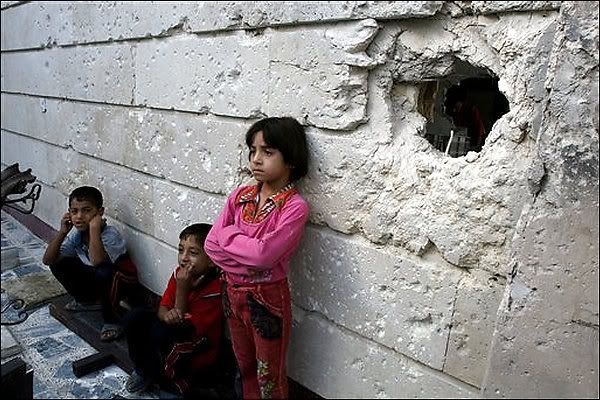 Iraqi kids stand by their damaged house in the Shiite enclave of Sadr City Saturday, June 30, 2007. U.S. soldiers killed 26 suspected insurgents before dawn Saturday in Baghdad's Sadr City neighborhood, the military said. Iraqi police and hospital officials said the victims were civilians killed in their homes. (AP Photo/Karim Kadim)
The New York Times reports:
A third American soldier has been charged with murdering an Iraqi civilian and planting a weapon in a shooting that the soldiers tried to cover up, the United States military said Monday.
The soldier, Sgt. Evan Vela, of Phoenix, Idaho, served in the headquarters unit of the First Battalion, 501st Infantry, of the 25th Infantry Division, based at Fort Richardson, Alaska. That is the same unit as Staff Sgt. Michael A. Hensley and Specialist Jorge G. Sandoval Jr., who were charged last week with killing three Iraqis and placing weapons near their bodies to make it seem as though they were combatants.
Sergeant Vela is charged with one count of premeditated murder, and also of placing a weapon with the body, obstruction of justice and making a false statement, according to a statement by the military.
The killings happened near Iskandariya, south of Baghdad, between April and June, the military said in a statement. All three soldiers have been detained and are awaiting trial.
The military said two soldiers and one marine were killed in western Anbar Province on Sunday, in addition to two soldiers whose deaths were reported earlier. Those follow 101 American military deaths in June, according to figures from the Iraq Coalition Casualty Count, making the 331 fatalities from April through June the deadliest quarter yet for United States forces.
In Diyala Province, the scene of heavy recent fighting between Sunni militants and American forces, an Iraqi police official in Muqdadiya said the civilian death toll from terrorist attacks in the Sherween area on Sunday night had reached 16, with 30 wounded. However, Maj. Gen. Abdul Karim al-Rubaie, the Iraqi commander of operations in Diyala, said coalition and Iraqi forces had made significant advances during the recent large-scale operation to clear Al Qaeda from Baquba.
“The terrorists even targeted schools, as they wanted to halt the progress of science in these areas,” he said Monday. “Life has gradually started to go back to normality in these areas, and residents were happy with the military operations.”
In Baghdad, Brig. Gen. Qassim Atta, an Iraqi military spokesman, said the security crackdown there had led to a reduction in attacks on civilians but an increase in attacks on American-led forces. However, hours later a car bomb in Binouk, a district in northern Baghdad, killed four people and wounded 25, an Interior Ministry official said last night.
Farther south, American F-16s bombed buildings in Diwaniya after insurgents launched 75 rockets and mortar shells at a coalition base. Iraqi officials said the jets killed 10 civilians, including women and children, wounded 30 others and destroyed several houses.
A statement from the United States military said the jets “targeted and bombed the insurgent launch sites.” Accusing insurgents of using civilians as human shields, it said coalition forces were “reviewing the incident to ensure that appropriate and proportionate force was used.”
The strike led to a protest march by residents, some of whom opened fire on a government building, leading to an exchange in which a 17-year-old demonstrator and two security guards were killed.
Sunday, July 01, 2007
2 U.S. Soldiers Charged With Murder of 3 Iraqis
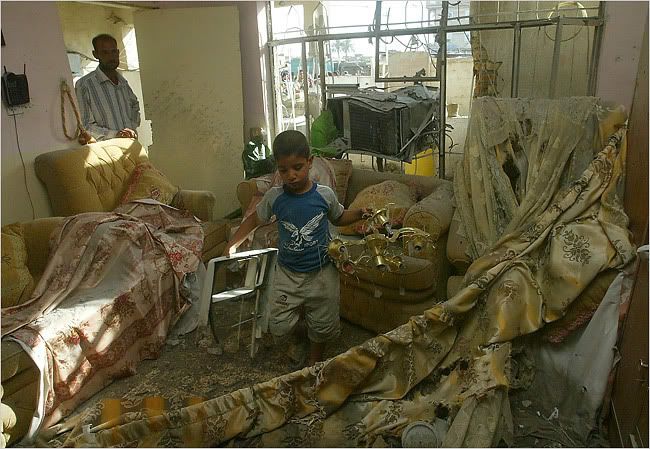 Officials of American-led forces said soldiers killed 26 militants in a raid in Sadr City Saturday, but some residents said civilians were killed. [Kareen Raheem, Reuters]
The New York Times reports:
Two American soldiers have been charged with premeditated murder and planting weapons on dead Iraqis, the United States military said Saturday.
Officials of American-led forces said soldiers killed 26 militants in a raid in Sadr City Saturday, but some residents said civilians were killed.
The soldiers, Staff Sgt. Michael A. Hensley and Specialist Jorge G. Sandoval Jr., were detained after fellow soldiers reported they had been involved in the deaths of three Iraqis near Iskandariya, a stronghold of the Sunni Arab insurgency south of Baghdad, in separate events between April and June this year.
Also on Saturday, the United States military mounted an early morning raid into the Shiite district of Sadr City in Baghdad. Officials with the American-led forces said soldiers had killed 26 militants, but some residents and Mahdi Army militia commanders accused them of killing civilians.
In the murder case, American military officials said Sergeant Hensley, 27, from Candler, N.C., faces three charges of premeditated murder, obstruction of justice and wrongfully placing weapons with the remains of deceased Iraqis. Specialist Sandoval, 20, faces one charge of premeditated murder and one of wrongfully placing a weapon on one of the three Iraqis killed.
Both were serving with the First Battalion, 501st Infantry, of the 25th Infantry Division, which has its headquarters at Fort Richardson, Alaska. Specialist Sandoval was picked up while at home on a two-week leave in Laredo, Tex., the military said. Charges were filed Thursday, and both men are in confinement in Kuwait.
The military said in a statement that an investigation was under way.
The area, part of the so-called Sunni Triangle, is no stranger to controversy.
Two American soldiers have admitted to raping a 14-year-old and killing her and her family in Mahmudiya, a town near Iskandariya, in March 2006, and others also face trial in the killings. Tension has been high since May 12, when an insurgent ambush on a patrol near Mahmudiya killed four American soldiers and one Iraqi, and led to the abduction of three Americans. One soldier’s body was later found but the other two soldiers are still missing.
In Baghdad, Lt. Col. Christopher Garver, an American military spokesman, said the raid in Sadr City on Saturday was against a militant cell that was smuggling weapons, explosively formed penetrators, a particularly lethal type of bomb, and money from Iran to aid Iraqi militias.
He said soldiers killed about 26 fighters and detained 17 suspects, but came under attack from small arms, rocket-propelled grenades and roadside bombs as they withdrew from the area. The Americans returned fire against militants shooting from behind buildings and cars.
“Everyone who got shot was shooting at U.S. troops at the time,” Colonel Garver said. “It was an intense firefight.”
But Iraqi officials said that the death toll was much lower, around eight, and some said that civilians were killed, including a man, his wife and their daughter, who had left their home to check on the disturbance.
Sadr City residents said the American operation was directed at more than one part of the district. Abu Jamal, 50, said he heard troops outside his house in the Sabee Qusoor area early in the morning.
“We were sitting on the roof, all of a sudden the helicopters started throwing flares,” he said. “We were afraid, so we left and went downstairs. The whole family went into one room because we started hearing the sound of firing from the helicopters. We couldn’t hear any firing from machine guns, only the aircraft firing. It was a horrible night.”
In Najaf, a spokesman for the anti-American cleric Moktada al-Sadr, the nominal leader of the Mahdi Army, condemned the raid Saturday and insisted that the militia was not involved in the fight.
“We reject these repeated assaults against civilians. The allegation that Mahdi Army members were the only ones targeted is baseless and wrong,” said the spokesman, Sheik Salah al-Obaidi. “The bombing hurt only innocent civilians.”
The battle prompted an immediate statement from the office of Prime Minister Nuri Kamal al-Maliki, saying that he would demand clarification from the military.
On the political front, Mr. Maliki appealed for Iraq’s largest Sunni bloc, the Iraqi Consensus Front, to end its boycott of his Shiite-dominated government. The boycott began last week as a protest of an arrest warrant issued against one of its members, Culture Minister Asad al-Hashimi, in a murder investigation.
Mr. Maliki said boycotts would only “complicate” matters, and urged them to embrace dialogue as “the only way to solve all the problems now and in the future.”
In Diyala Province, a suicide bomber killed three police recruits and wounded 34 lined up outside a police station in Muqdadiya.
Meanwhile, the American military said it killed Abu Abdel Rahman al-Masri, a senior figure in Al Qaeda in Mesopotamia, in a raid east of Falluja on Friday. Colonel Garver said that Mr. Masri, an Egyptian, had worked closely with Abu Ayyub al-Masri, the military leader of the group, and that his body had been identified by known associates.
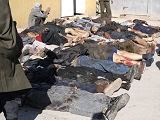
American commanders also said that on Friday night a tip from an Iraqi led them to a grave containing dozens of bodies near Ferris, 20 miles south of Falluja. The military said in a statement: “Coalition forces uncovered 35 to 40 bodies at the site. The remains were bound and had gunshot wounds. This incident is currently under investigation.” It is unclear when or how the victims were killed.
Separately, an American command sergeant major, the most senior enlisted member serving in a major command, was sentenced to four months in detention after being convicted of possessing alcohol and pornography, engaging in an inappropriate relationship with a female soldier in his unit, and maltreating a soldier.
The command sergeant major, Edward Ramsdell, of the 411th Engineer Brigade, was working in Diyala Province at the time, and he was given a court-martial in October. Prosecutors said he had possessed a “large quantity” of alcohol and pornography in his quarters, tried to conceal the evidence when discovered and then tried to escape from investigating officers.
Wednesday, April 18, 2007
My Questions About The Virginia Tech Shooting
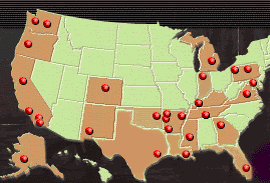 Map of School Violence
I suspect that after all of the information about Cho Seung Hui is gathered and examined, we will have learned nothing new about why some young men turn to extreme violence or how earlier intervention might have prevented the random deaths of innocents at Virginia Tech.
Cho's profile will wind up looking like the profiles of all the other mass murderers in modern history. It will come as no surprise to most liberals, whose policies on everything from health care and education to immigration, worker protections, corporate and gun regulation, would go a long way in preventing horrific killing fields such as what we saw on Monday in Virginia.
Republican dogma will prevail and nothing will change. Why? Because 32 people killed and a dozen or so wounded does not justify making the changes necessary, spending the money, for preventing similar sieges in the future. Because they're not the right 32 + 12.
That's the truth of capitalist America.
Until Americans realize the connection between our public policies ("money is motive, profit is king") and the violence committed by our government in our names, violence will continue to be a part of our lives. Beyond the massacre on Monday, in every facet of our society. American policies and our lifestyle will go on producing more Cho Seung Huis, like Eric Harris, Dylan Klebold, Timothy McVeigh, Terry Nichols, George Jo Hennard, James Huberty, James Rupert, Mark Barton, Kip Kinkel, and dozens of others, too young to have had their names published outside of the juvenile court system.
Culled from a Washington Post report:
Cho, of Centreville, Va., the son of immigrants who run a dry cleaning business, and the brother of a State Department contractor who graduated from Princeton, was described by those who encountered him over the years as at times angry, menacing, disturbed and so depressed that he seemed near tears.
Cho graduated from Westfield High School in Chantilly in 2003. He turned 23 on Jan. 18 and had lived as a legal permanent resident since entering the United States through Detroit on Sept. 2, 1992, when he was 8 years old, according to the Department of Homeland Security.
Cho held a green card through his parents, and he renewed it Oct. 27, 2003, according to Homeland Security. He listed his residence as Centreville.
Cho's sister, Sun Cho, graduated from Princeton University with a degree in economics in 2004 after she completed summer internships with the State Department in Washington and Bangkok.
A State Department spokesman said Sun Cho currently works as a contractor specializing in personnel matters.
I'd like to know how his parents, South Korean nationals, got into the U.S.
They are described by the Washington Post as "running a dry cleaning business," which could mean that they own the business. Having money might explain how they entered the U.S. (financially solvent, wouldn't be a burden, etc.), but one could infer from 'running a business' that they managed it and/or worked it for others. If that's the case, I'd like to know if the United States was experiencing a shortage of dry cleaning workers fifteen years ago when the Cho family entered the U.S.? After fifteen years in the U.S., presumably with roots in the community and children who have gone through the American school system (and one child working for the U.S. government), why aren't they U.S. citizens?
And about their daughter: What is a State Department 'contractor' in "personnel matters"? She is not a W-2 employee of the State Department; she is an independent contractor. What does she do for the State Department, with a degree in economics, "specializing in personnel matters"?
Does she take care of 'personnel problems'?
Wednesday, March 28, 2007
Documents Uncovered: UK Govt Scientists told Blair & Ministers, "Lancet Study (655,000 Iraqi Civilians Killed) Is Accurate"
"Ministers were told not to rubbish Iraq deaths study" . . . .
. . . . But Tony Blair (and George W. Bush) chose to lie and said, "The study isn't accurate."
The Guardian reports:
Richard Horton, Lancet's editor, comments in The Guardian:
. . . . But Tony Blair (and George W. Bush) chose to lie and said, "The study isn't accurate."
The Guardian reports:
Chief government advisers accepted as "robust" research that put the death toll from the Iraq war 10 times higher than any previous estimate, new documents have revealed.
The study, by the Johns Hopkins School of Public Health, prompted worldwide alarm when it was published in the Lancet medical journal in October last year.
It estimated that 655,000 Iraqis had died due to the violence in the country. It has now emerged chief advisers warned ministers not to "rubbish" the report.
At the time, both the British and US governments were quick to dismiss the peer reviewed study. The Foreign Office said it was based on a "fairly small sample ...extrapolated across the country". Iraqi government data was more likely to be accurate, it added.
The US was more blunt. President George Bush said: "I don't consider it a credible report."
However, according to papers obtained by the BBC World Service's Newshour programme under the Freedom of Information Act, senior officials warned the methods used in the survey were "robust" and "close to best practice".
The survey came up with its findings by comparing mortality rates before and after the invasion. Researchers surveyed 47 randomly-chosen areas across 16 provinces in Iraq, speaking to nearly 1,850 families, comprising more than 12,800 people.
One of the documents obtained by the BBC is a memo by the Ministry of Defence's chief scientific adviser, Sir Roy Anderson, dated October 13 2006, two days after the report was published.
"The study design is robust and employs methods that are regarded as close to 'best practice' in this area, given the difficulties of data collection and verification in the present circumstances in Iraq," he says.
Another item is an exchange of emails between officials in which one asks: "Are we really sure the report [in the Lancet] is likely to be right? That is certainly what the brief implies."
Another replies: "We do not accept the figures quoted in the Lancet survey as accurate." Later in the same email, the same official writes: "However, the survey methodology used here cannot be rubbished, it is a tried and tested way of measuring mortality in conflict zones."
In a statement issued to Newshour, the government said: "The methodology has been used in other conflict situations, notably the Democratic Republic of Congo.
"However, the Lancet figures are much higher than statistics from other sources, which only goes to show how estimates can vary enormously according to the method of collection.
"There is considerable debate amongst the scientific community over the accuracy of the figures."
Richard Horton, Lancet's editor, comments in The Guardian:
Our collective failure has been to take our political leaders at their word. This week, the BBC reported that the government's own scientists advised ministers that the Johns Hopkins study on Iraq civilian mortality was accurate and reliable. This paper was published in the Lancet last October. It estimated that 650,000 Iraqi civilians had died since the American- and British-led invasion in March 2003.
Immediately after publication, the prime minister's official spokesman said that The Lancet's study "was not one we believe to be anywhere near accurate". The foreign secretary, Margaret Beckett, said that the Lancet figures were "extrapolated" and a "leap". President Bush said: "I don't consider it a credible report".
Scientists at the UK's Department for International Development thought differently. They concluded that the study's methods were "tried and tested". Indeed, the Hopkins approach would likely lead to an "underestimation of mortality".
The Ministry of Defence's chief scientific advisor said the research was "robust", close to "best practice", and "balanced". He recommended "caution in publicly criticising the study".
When these recommendations went to the prime minister's advisers, they were horrified. One person briefing Tony Blair wrote: "are we really sure that the report is likely to be right? That is certainly what the brief implies?" A Foreign Office official was forced to conclude that the government "should not be rubbishing The Lancet".
The prime minister's adviser finally gave in. He wrote: "the survey methodology used here cannot be rubbished, it is a tried and tested way of measuring mortality in conflict zones".
How would the government respond?
Would it welcome the Hopkins study as an important contribution to understanding the military threat to Iraqi civilians? Would it ask for urgent independent verification? Would it invite the Iraqi government to upgrade civilian security?
Of course, our government did none of these things. Tony Blair was advised to say: "the overriding message is that there are no accurate or reliable figures of deaths in Iraq".
His official spokesman went further and rejected the Hopkins report entirely. It was a shameful and cowardly dissembling by a Labour - yes, by a Labour - prime minister.
Indeed, it was even contrary to the Americans' own Iraq Study Group report, which concluded last year that "there is significant underreporting of the violence in Iraq".
This Labour government, which includes Gordon Brown as much as it does Tony Blair, is party to a war crime of monstrous proportions. Yet our political consensus prevents any judicial or civil society response. Britain is paralysed by its own indifference.
At a time when we are celebrating our enlightened abolition of slavery 200 years ago, we are continuing to commit one of the worst international abuses of human rights of the past half-century. It is inexplicable how we allowed this to happen. It is inexplicable why we are not demanding this government's mass resignation.
Two hundred years from now, the Iraq war will be mourned as the moment when Britain violated its delicate democratic constitution and joined the ranks of nations that use extreme pre-emptive killing as a tactic of foreign policy. Some anniversary that will be.
Friday, March 02, 2007
Ex Post Facto
Guantanamo prisoner charged after five years in detention for things that weren't crimes when he did them - It doesn't get any more un-American than that.
Even Iran has a Constitutional prohibition against it.
The Guardian reports:
When it comes to what the Bush administration is doing in our names, nothing has been more damaging to Americans' long and short term interests than the prosecution of the war on terror and the treatment of people caught up in the Bush-Cheney dragnet. Whatever David Hicks did or didn't do is less relevant than what the Bush administration has done with the awesome power that is the United States government.
For instance, would anybody argue that it wasn't a gross conflict of interest to put Ted Olson, then U.S. Solicitor General and husband of Barbara Olson (a passenger on American Airlines Flight 77 on September 11th), in charge of stymieing all challenges to the detentions-without-charge of hundreds of suspects held in Guantanamo Bay? And yet, that's exactly what happened.
The torture of detainees continues, we're no closer to ending the war in Iraq than we were before the midterm elections in November, Democrats are back to a 3-day work week in Congress, and the band plays on.
Even Iran has a Constitutional prohibition against it.
The Guardian reports:
Lawyers and the family of the first Guantánamo Bay inmate likely to face a US military tribunal for alleged terrorism said today that he would not get a fair trial.
More than five years after he was first jailed at Guantánamo Bay, David Hicks, an Australian, was yesterday charged by the Pentagon with providing material support for terrorism,.
Mr Hicks was not charged with attempted murder, as had earlier been recommended by US military prosecutors.
His family and lawyers claimed today that the charges he does face have been tailored to fit his actions and guaranteed he would not get a fair trial.
Mr Hicks's lawyers also confirmed today that he is continuing his attempts to obtain British citizenship - his mother is British - which arguably represents his best chance of getting out of US custody. The Australian government has not pressed for his release.
Stephen Grosz, a British lawyer working on Mr Hicks's case in the UK, told Guardian Unlimited that a document outlining allegations of abuse against his client by US troops had been lodged with a court to try and help his case.
Mr Hicks has claimed he was the victim of torture and brutality at the hands of US troops after he was captured in Afghanistan in late 2001, allegedly while fighting for the Taliban. He claims he was repeatedly beaten and threatened, deprived of sleep and drugged.
He has fought a long legal battle in the UK courts, which ended with senior judges ordering the home secretary to grant Mr Hicks citizenship. However it emerged in January this year that the home secretary, John Reid, had revoked his British citizenship.
Mr Grosz said an appeal against the government's move to deny him citizenship had been lodged with the Special Immigration Appeals Commission (Siac). A two-week hearing will start on May 8, before the US military tribunal begins.
Mr Grosz said the abuse allegations could undermine the US military prosecution because it was based, in part, on admissions Mr Hicks made under interrogation.
Speaking in Australia, Major Michael Mori, Mr Hicks's Pentagon-appointed lawyer, said the decision to drop the attempted murder charge indicated a lack of evidence against his client. The lawyer said the charge against Mr Hicks was unfair because it did not exist at the time of his capture.
"The United States administration - this military commission - is fabricating offences, they're trying to apply them retroactively to David," Maj Mori told Australian television. "It's disgusting that he has spent five years in Guantánamo for made-up charges," he said.
US prosecutors argued the offence did exist at the time of Mr Hicks's capture, though not as a military crime. They said the charge was modified so that Mr Hicks could be charged with it before the military tribunal system.
The argument over the charge underscores a broader debate about the legality of the military tribunal system. Critics claim the system, among other things, denies defendants many legal rights guaranteed under the US constitution.
Mr Hicks's father, Terry Hicks, said the military commission process was unfair because it allowed hearsay evidence and statements made under coercion. "The thing that annoys me is when you have people commit murders, they're out in about eight years, and David could have ... life imprisonment," Terry Hicks said. [see Fair Go For David-website]
Maj Mori said the Australian government, which today expressed confidence in the US military tribunal system, should recognise the process was unfair and demand he be returned home.
The Australian prime minister, John Howard, has refused to ask Washington to repatriate Mr Hicks, saying Australia would have to pass retrospective laws to charge him for alleged terrorist associations.
However, Mr Howard, a staunch US ally and facing elections later this year, has been under increasing political pressure over alleged inaction on Mr Hicks's detention. "We remain very unhappy that it's taken so long for Hicks to be fully charged," Mr Howard told an Australian radio station.
According to the Pentagon, for about a year starting around December 2000, Mr Hicks provided "support or resources to be used in preparation for, or in carrying out, an act of terrorism" and that he "knew or intended" for the support to be used for terrorism.
When it comes to what the Bush administration is doing in our names, nothing has been more damaging to Americans' long and short term interests than the prosecution of the war on terror and the treatment of people caught up in the Bush-Cheney dragnet. Whatever David Hicks did or didn't do is less relevant than what the Bush administration has done with the awesome power that is the United States government.
For instance, would anybody argue that it wasn't a gross conflict of interest to put Ted Olson, then U.S. Solicitor General and husband of Barbara Olson (a passenger on American Airlines Flight 77 on September 11th), in charge of stymieing all challenges to the detentions-without-charge of hundreds of suspects held in Guantanamo Bay? And yet, that's exactly what happened.
The torture of detainees continues, we're no closer to ending the war in Iraq than we were before the midterm elections in November, Democrats are back to a 3-day work week in Congress, and the band plays on.
Wednesday, November 08, 2006
Something To Keep Your Eye On
A case being considered in the High Court wants ministers to lobby for the release of three London residents detained at Guantanamo Bay.
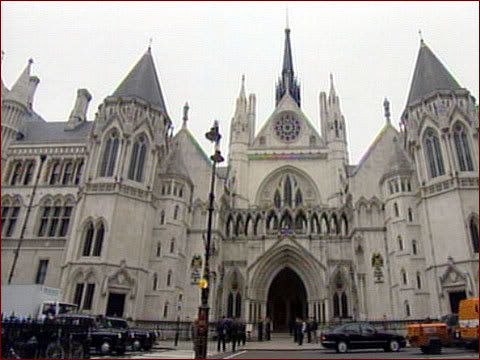 High Court, London, England
Kurt Barling with the BBC reports:
High Court, London, EnglandKurt Barling with the BBC reports:
Last week, sitting in Court number 2 at the High Court on the Strand, I was reminded of a story my father told me when I was a young boy. Sixty years ago he was a teenage witness to the Allied war crimes trials at Nuremberg.
He lived and survived in the city which had been razed to the ground by allied bombing. Those responsible for unleashing war in Europe, bringing tragedy to their own people and millions of others across the continent, were tried in an international military tribunal which tried to avoid “victor’s justice”. The judgement of Nuremberg was just.
Even though there were critics of this process, like others in Germany at the time my father grew to understand and respect the significance of that process of justice which made the Nazi leaders account for their criminal behaviour.
The countless crimes the Nazi leadership committed were judged openly. The courts were presided over by allied civilian judges and then by the court of public opinion, both in Germany and the rest of the world via radio and newspaper reports. Most were sentenced to death, others like Goering cheated Albert Pierrepoint’s noose by committing suicide. Some like Albert Speer were given long prison sentences.
The message from these trials was a challenge to totalitarianism (not withstanding what was subsequently revealed about the Soviet Union). The net result was that the Allied powers were revered for their magnanimity in victory and the nobleness of their approach to meting out justice. Summary justice would have been far easier. These hideous men were allowed a defence and all the world could see how absolute power could corrupt and bring a great civilisation to its knees.
The legacy of the Nuremberg trials survived the Cold War. The United Nations used it to lay the foundations of international criminal law. It could be seen in the trials of Slobodan Milosevic and other offenders charged with war crimes resulting from the conflict after Yugoslavia broke up in the 1990s. In Rwanda in the trials of those responsible for the genocide and now in Baghdad with the trial of Saddam Hussein one imagines the echoes of open justice started at Nuremberg.Bisher al-Rawi
In a sense this legacy found itself in the dock in Court 2 last week. The families of Bisher al-Rawi, Jamil el-Banna and Omar Deghayes were seeking to convince two English judges that they should issue an order compelling the British government to intervene on their relatives’ behalf. None of the men are British nationals. Al-Rawi is Iraqi, el-Banna is Jordanian and Deghayes is Libyan.
All three men have been held since 2002 by the Americans, for the most part at the detention centre at Guantanamo Bay, Cuba. It is the families’ contention that the British government helped put them there. The government has consistently denied this.
The three men have not been charged and are therefore not to be put on trial for any specific offence by the Americans. It is not clear when and how they will be released.
Despite repeated requests by the families, the Foreign Office has refused to intervene over the past three and a bit years. Although not British the men were all long term residents in London and their families reside here. The government maintained it has not been their responsibility to assist them in any way.
The British government, remember, did lobby for the release of a number of British citizens. None were arrested or charged with an offence on their return to the UK.Jamil el Banna
The government argued that as well as not having diplomatic responsibility for these men, they did not want to create a costly precedent for 2.6 million other British residents calling for government support at some future date. Curiously they also argued that having the men there enabled them to constructively engage with the US authorities over general detainee policy. Finally, all three men either pose or might pose unspecified risks to national security according to our intelligence services.
Bisher’s brother Wahad al-Rawi who lives in Leeds has been doggedly trying to get dribs and drabs of information about his brother for three years. His health has deteriorated since I first met him in 2003. The stress of trying to manage his mother’s expectations and that of the rest of his family has taken its toll.
On the first morning of the hearing last week the al-Rawi family and their lawyers were thrown into a state of confusion. A letter from Her Majesty’s Government said they would now make representations to seek Bisher’s release.
Unsure of whether to trust the government, they continued with their case to get the court to compel the government to act. There was no real explanation of why the government had changed its mind. The families remain in a state of confusion.
In a move which appeared on the surface to smack of state arbitrariness, the government made no such offer of help for the other two men at Guantanamo. Because there was no explanation, no-one quite understands on what basis the government is acting. To the advocates of the three men, it does not seem fair particularly as Jamil el-Banna has five children living in north London all of whom are British.Omar Deghayes
It is a matter of public record that several ministers have expressed their disapproval of the continued detentions at Guantanamo. The court was told that the Americans and British governments are in discussions about how to effect the repatriation of detainees. Reading between the lines it seems clear that both administrations are beginning to recognise the stain that is rapidly sullying their international reputations.
Bisher al-Rawi and Jamil el-Banna say they were business partners back in 2002 along with Wahab. They had a plan to set up a factory in the Gambia producing peanut oil and as a consequence, say their relatives, they were on their way to the Gambia on peanut growing business when they were arrested by the Gambian police. The families assume their arrests were requested by the Americans.
Both men were among a small group of Muslims in 2000-2001 who were familiar with Abu Qatada. Qatada was a leading Islamic authority in Britain and as such was sought out for guidance on Islamic matters. Wahad says it was these links that made any information he or his brother had potentially useful to the intelligence services
It appears that this relationship exposed them not only to interest from the British intelligence services but also the CIA’s. Evidence before the judges clarified that the British government had passed information on these two men to a foreign intelligence service.
In court, lawyers for the family made it clear they believed the British information led to the seizure of the two men and their forcible removal to Bagram airbase in Afghanistan. The American military then moved the men to Guantanamo. The families maintain British intelligence officers interviewed the men face to face both in the Gambia and in Guantanamo. The episode so far wouldn’t be out of place in a Cold War spy novel.
The evidence in Court 2 suggested we are possibly entering some kind of end game at Guantanamo. For many Muslims around the world though, Guantanamo has undermined their faith in the values of International Criminal Justice so painstakingly nurtured after Nuremberg.
Unlike the legacy of Nuremberg it is doubtful detention at camp Delta will ever be seen as just. For a start there have been very few trials, precious little accountability and virtually no scrutiny. It will be very difficult for the allied powers to claim the high moral ground for the foreseeable future.
Muslims, both inside and outside the Muslim-majority world, will undoubtedly argue that whilst Britain and America may not be the worst human rights abusers, they can longer claim to be the best protectors of those human rights either. This is more likely to be the legacy of Guantanamo.
The High Court judges will give their written judgement in a few weeks time.
Subscribe to:
Posts (Atom)