Monday, June 18, 2007

Another 'First' For The Bushes

Laura Bush Pitches For The GOP: "For Bush's birthday, a gift for the whole Party"


This time, they're not breaking the law, but breaking with tradition. What's wrong with this?
USA Today reports:
If it's birthday time for a politician, say it with money

Republican Rudy Giuliani held a round of birthday fundraisers in New York last month. Bobbie Edwards promised her special pecan pie recipe to anyone who contributed $6.10 for the June 10 birthday of her son, Democrat John Edwards.

Well, someone else's birthday is coming up, and our USA TODAY colleague Kathy Kiely passes along the latest e-mail solicitation. The Republican National Committee has enlisted Laura Bush to make the pitch.

The first lady asks Republicans to sign an e-card to President Bush, who turns 61 on July 6. Also, she writes, "please consider commemorating President Bush's 61st birthday with a gift our entire Party can share." Suggested gift: $61.

Republicans have slipped in fundraising since the Democrats swept Congress last fall. Democratic party committees have seen jumps, meanwhile, and Democratic candidates for president have so far outraised their Republican counterparts.

What's wrong with it is that it's unseemly.

Once elected to the office of the president, the president becomes the leader of all Americans, and his spouse, traditionally, dedicates her energies to apolitical charities and causes that improve the lives of all Americans, and not the political fortunes of one party over another.

Laura Bush has managed to retain high likeability ratings because she's remained an enigma. People have no idea who she is or what she thinks and believes. The only marks against her are for marrying George W. Bush (for which she is given sympathy, "poor dear, what she's had to endure") and having raised two aimless daughters with drinking problems ("all kids are like that" "mistakes of youth") - something for which she gets more sympathy, for bearing it with "such poise."

Laura Bush's high approval ratings are, literally, skin-deep. A demure demeanor, conservative clothing, hair and make-up, never expressing an opinion or point of view, she's a blank slate upon which people can project almost anything that's generally positive.

I've always believed her more knowledgeable and supportive of her husband's ideology and politics than she's let on. It's one thing to marry a hard-drinking George W. Bush when you're 31 years old after a 3-month courtship; it's another thing entirely to remain married to him. She wanted to be there, through years of infertility, through years of his bad and boorish drunk behavior, through his inability to succeed in business. She is George W. Bush's partner in every way, and should share whatever condemnation is heaped on him. Perhaps even a bigger share of the condemnation, for if, as George W. Bush claims, Laura was influential in his decision to stop drinking, she unleashed an able-bodied George W. Bush with extreme political ideology and radical plans to implement his politics all over the world.

Laura Bush's ideology and politics, her husband's ideology and politics, Big Corporate's fascistic ideology and politics and the evangelical Christian far-rightwing's ideology and politics are one and the same.


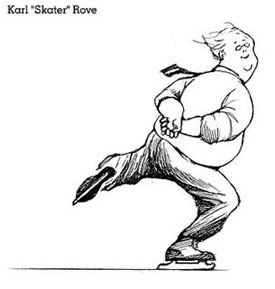

RNC Destroyed Rove's & Others' E-Mails


The House Committee on Oversight and Government Reform reports:

The Oversight Committee has been investigating whether White House officials violated the Presidential Records Act by using e-mail accounts maintained by the Republican National Committee and the Bush Cheney ‘04 campaign for official White House communications. This interim staff report provides a summary of the evidence the Committee has received to date, along with recommendations for next steps in the investigation.
The information the Committee has received in the investigation reveals:
The number of White House officials given RNC e-mail accounts is higher than previously disclosed. In March 2007, White House spokesperson Dana Perino said that only a “handful of officials” had RNC e-mail accounts. In later statements, her estimate rose to “50 over the course of the administration.” In fact, the Committee has learned from the RNC that at least 88 White House officials had RNC e-mail accounts. The officials with RNC e-mail accounts include Karl Rove, the President’s senior advisor; Andrew Card, the former White House Chief of Staff; Ken Mehlman, the former White House Director of Political Affairs; and many other officials in the Office of Political Affairs, the Office of Communications, and the Office of the Vice President.

White House officials made extensive use of their RNC e-mail accounts. The RNC has preserved 140,216 e-mails sent or received by Karl Rove. Over half of these e-mails (75,374) were sent to or received from individuals using official “.gov” e-mail accounts. Other heavy users of RNC e-mail accounts include former White House Director of Political Affairs Sara Taylor (66,018 e-mails) and Deputy Director of Political Affairs Scott Jennings (35,198 e-mails). These e-mail accounts were used by White House officials for official purposes, such as communicating with federal agencies about federal appointments and policies.

There has been extensive destruction of the e-mails of White House officials by the RNC. Of the 88 White House officials who received RNC e-mail accounts, the RNC has preserved no e-mails for 51 officials. In a deposition, Susan Ralston, Mr. Rove’s former executive assistant, testified that many of the White House officials for whom the RNC has no e-mail records were regular users of their RNC e-mail accounts. Although the RNC has preserved no e-mail records for Ken Mehlman, the former Director of Political Affairs, Ms. Ralston testified that Mr. Mehlman used his account “frequently, daily.” In addition, there are major gaps in the e-mail records of the 37 White House officials for whom the RNC did preserve e-mails. The RNC has preserved only 130 e-mails sent to Mr. Rove during President Bush’s first term and no e-mails sent by Mr. Rove prior to November 2003. For many other White House officials, the RNC has no e-mails from before the fall of 2006.

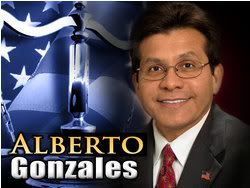
There is evidence that the Office of White House Counsel under Alberto Gonzales may have known that White House officials were using RNC e-mail accounts for official business, but took no action to preserve these presidential records. In her deposition, Ms. Ralston testified that she searched Mr. Rove’s RNC e-mail account in response to an Enron-related investigation in 2001 and the investigation of Special Prosecutor Patrick Fitzgerald later in the Administration. According to Ms. Ralston, the White House Counsel’s office knew about these e-mails because “all of the documents we collected were then turned over to the White House Counsel’s office.” There is no evidence, however, that White House Counsel Gonzales initiated any action to ensure the preservation of the e-mail records that were destroyed by the RNC.

The Presidential Records Act requires the President to “take all such steps as may be necessary to assure that the activities, deliberations, decisions, and policies that reflect the performance of his constitutional, statutory, or other official or ceremonial duties are adequately documented … and maintained as Presidential records.” To implement this legal requirement, the White House Counsel issued clear written policies in February 2001 instructing White House staff to use only the official White House e-mail system for official communications and to retain any official e-mails they received on a nongovernmental account.

The evidence obtained by the Committee indicates that White House officials used their RNC e-mail accounts in a manner that circumvented these requirements. At this point in the investigation, it is not possible to determine precisely how many presidential records may have been destroyed by the RNC. Given the heavy reliance by White House officials on RNC e-mail accounts, the high rank of the White House officials involved, and the large quantity of missing e-mails, the potential violation of the Presidential Records Act may be extensive.

There are several next steps that should be pursued in the investigation into the use of RNC e-mail accounts by White House officials. First, the records of federal agencies should be examined to assess whether they may contain some of the White House e-mails that have been destroyed by the RNC. The Committee has already written to 25 federal agencies to inquire about the e-mail records they may have retained from White House officials who used RNC and Bush Cheney ’04 e-mail accounts. Preliminary responses from the agencies indicate that they may have preserved official communications that were destroyed by the RNC.

Second, the Committee should investigate what former White House Counsel Alberto Gonzales knew about the use of political e-mail accounts by White House officials. If Susan Ralston’s testimony to the Committee is accurate, there is evidence that Mr. Gonzales or counsels working in his office knew in 2001 that Karl Rove was using his RNC e-mail account to communicate about official business, but took no action to preserve Mr. Rove’s official communications.

Third, the Committee may need to issue compulsory process to obtain the cooperation of the Bush Cheney ’04 campaign. The campaign has informed the Committee that it provided e-mail accounts to 11 White House officials, but the campaign has unjustifiably refused to provide the Committee with basic information about these accounts, such as the identity of the White House officials and the number of e-mails that have been preserved.

Documents and Links
• Investigation of Possible Violations of the Presidential Records Act [.pdf]
• Deposition of Susan Ralston [.pdf]
• Errata Sheet for Deposition of Susan Ralston [.pdf]

It's time (long past) for both the Senate and House Judiciary and Oversight Committees to petition the court for a special master, subpoena and impound the machines before any Republican officials do anymore tinkering with the machines in their effort to find more emails.

I don't know what is taking Democrats so long to have done this. They should have instantly gone to court back in March when it was first discovered that the White House was using a "double-bookkeeping system" for their communications.

Friday, June 15, 2007

What's Happening To Some Of Our Most Common Birds?

Top Row, left to right: American Bittern, Black-Throated Sparrow,Boreal Chickadee, Common Grackle, Common Tern; Row 2, left to right: Evening Grosbeak, Eastern Meadowlark, Field Sparrow, Grasshopper Sparrow, Greater Scaup; Row 3, left to right: Horned Lark, Lark Sparrow, Little Blue Heron, Loggerhead Shrike, Northern Bobwhite; Bottom Row: Northern Pintail, Ruffed Grouse, Rufous Hummingbird, Snow Bunting, Whip-poor-will


The NYT reports:
Spreading suburbs and large-scale farming are contributing to a precipitous decline in once common meadow birds like the Northern bobwhite, the Eastern meadowlark, the loggerhead shrike and the field sparrow, a report released yesterday by the Audubon Society said. [List of top 20 common birds in decline.]
Twenty common birds have lost more than half their populations in 40 years. The population of the bobwhite, a rotund robin-size bird that lives in meadows from the mid-Atlantic to the Plains, has dropped more than 80 percent, to 5.5 million from more than 31 million.

The evening grosbeak, with a range from northern New England to the Pacific Northwest, has declined 78 percent, to 3.8 million from 17 million.

The report covers a period when suburbs and exurbs were being carved out of Eastern and Midwestern farmlands and Southern wetlands. It also documents the loss of large numbers of Canadian and Arctic birds like the mallard-like greater scaup, the Northern pintail and the greater tern, all affected by a combination of climate change and development along lakes and rivers.

While the report, published in Audubon magazine has a national focus, it also gives state-by-state snapshots of declines in birds in 48 states where enough information is available.

“The song of Eastern meadowlarks used to be the soundtrack of summer,” said Scott Weidensaul, a naturalist and author born in eastern Pennsylvania who has reviewed the report. “Now it’s a rare thing. The landscape is changing. Farming is much more industrialized. Development is sprawling across these valleys.”

Although the declines since 1967 are steep, the overall populations of the meadow birds still number in the millions, or in the case of the scaup 300,000, making them too robust to qualify for protection under the Endangered Species Act.

The new analysis is the first of three reports. The next will look at birds that may need federal protection. The final installment will track the effects of climate change.

The changing bird demographics largely parallel the changes in the North American landscape wrought by people. In the Northeast, the reversion of fields to forests has hurt some field-dwelling species, and some forest-dwelling species have been hurt by the loss of woodland shrubs overbrowsed by deer.

The most common backyard birds like robins, cardinals and blue jays are thriving, though blue jay numbers have been cut somewhat by West Nile virus, said Greg Butcher, the author of the Audubon report.

The birds that have done best —perhaps too well, in the case of nonmigratory Canada geese — are those most at home in the world of manicured lawns and artificial lakes.

The report coincides with Congressional deliberation of measures like the farm bill, which includes some provisions to set aside agricultural land in conservation reserve programs. Those provisions are under pressure because of the demand for expanded land for corn crops to fuel the ethanol boom.

The report is based on a statistical analysis of two long-range bird censuses, one by the United States Geological Survey and one by Audubon.

Both surveys cover 300 species, said Mr. Butcher, the director of bird conservation at Audubon and a former director of bird population studies at the Cornell Ornithology Laboratory. About 550 are covered by one or the other.

The report has not been submitted for peer review, he said, but its methodology has been vetted in a peer-review process.

On the Audubon Society's website:
How Citizen Science Revealed the Problem
For the first time ever, this analysis combined data from the world’s longest-running uninterrupted bird census — Audubon’s Christmas Bird Count (CBC) — with information from the Breeding Bird Survey (BBS) to study how populations of all common North American species routinely encountered in these surveys have fared during the past 40 years. The CBC data are the product of swarms of volunteers —citizen scientists— who counted birds every winter over this period and submitted their reports to Audubon. The BBS is a standardized morning count of birds along roadsides organized by the U.S. Geological Survey and conducted by volunteers from May into July.

Thursday, June 14, 2007

Shouldn't Americans Be Running America's Political Parties?

California State GOP Goes Outside The U.S. To Hire Top Aide

For the San Francisco Chronicle, Carla Marinucci reports:

The California Republican Party has decided no American is qualified to take one of its most crucial positions -- state deputy political director -- and has hired a Canadian for the job through a coveted H-1B visa, a program favored by Silicon Valley tech firms that is under fire for displacing skilled American workers.

Christopher Matthews, 35, a Canadian citizen, has worked for the state GOP as a campaign consultant since 2004. But he recently was hired as full-time deputy political director, with responsibility for handling campaign operations and information technology for the country's largest state Republican Party operation, California Republican Party Chairman Ron Nehring confirmed in a telephone interview this week.

In the nation's most populous state -- which has produced a roster of nationally known veteran political consultants -- "it's insulting but also embarrassing ... to bring people from the outside who don't know the difference between Lodi and Lancaster ... and who can't even vote," said Karen Hanretty, a political commentator and former state GOP party spokeswoman.

U.S. Department of Labor records show the state Republican Party applied for an H-1B visa to fill the job of "political consultant" and was granted a visa labor certification in March 2007. The three-year H-1B visa does not become valid until Oct. 1, 2007, government records show.

Party officials said Matthews has been working in the interim under a "TN" visa -- a renewable one-year special visa for Canadian and Mexican professional workers created under the North American Free Trade Agreement.

Matthews was hired by Michael Kamburowski, an Australian citizen who was hired this year as the state GOP's chief operations officer. But neither new official has experience in managing a political campaign in the nation's most populous state -- and as foreign citizens, neither is eligible to vote.

Kamburowski, a former real estate agent who sold property in the Dominican Republic, is a permanent U.S. resident in the process of obtaining American citizenship and does not require a specialized work visa, state GOP officials said.

With just months until the state's Feb. 5 primary and Republicans facing a roster of formidable challenges in California -- a key political fundraising state -- some party insiders are shaking their heads at the hirings.

"There are talented Republicans in California, and the message that (party chair) Ron Nehring is sending is that there's no talent pool here," Hanretty said.

The state party and its 58 county operations face several challenges, Hanretty said, including "redistricting on the ballot, uncertain legislative races ahead of us ... and a number of Republican congressmen who are under federal investigation and are going to be challenged by Democrats."

"Who will help these candidates?" she asked. "A couple of foreign transplants who don't know the political landscape and don't know the history of the complicated politics in California?"

Nehring defended his choices by saying Matthews and Kamburowski are highly qualified political professionals who will be an asset to the party -- and dramatize the GOP ideal of welcoming immigrants.

"Chris (Matthews) was inspired by the recall and by the governor to come to California in 2003 and volunteer for the Republican Party of San Diego," said Nehring, who chaired the San Diego party's organization from 2001 to 2007.

Nehring, a conservative Republican, became state chairman earlier this year, replacing Palo Alto attorney Duf Sundheim.

Nehring said he met Matthews while overseeing a campaign school in Calgary, Alberta, "and when the recall started, Chris said he wanted to come down and be part of it."

Matthews spent a month as a volunteer and in 2004 began work as a paid consultant to the San Diego County Republican Central Committee, party officials said.

As deputy political director, Matthews will be responsible for political campaigning and technology issues because "he has a successful track record of working with the party for the last three years," Nehring said. "He's developed an incredible body of knowledge in those areas. ... He's one of the strongest campaigners I've ever met."

Nehring said he has been inspired that Matthews "has wanted to move to America and become an American citizen ... and we embrace that."

"Our job at the California GOP is to build the most effective campaign organization. ... And the fact that we have two people on staff who want to become Americans ... is a great story that is at the heart of what the Republican Party is all about."

But the party nationally has fought efforts to increase immigration, calling during the recent debate in Congress for much tighter border security and resisting efforts to providing a path to citizenship for the estimated 12 million illegal immigrants now in the country.

The hiring of two immigrants at top Republican Party posts has handed ammunition to critics who note that many Republicans have spoken critically about the impacts of waves of Mexican immigrants.

"The hypocrisy is disgusting," said longtime Democratic Party activist Gloria Nieto, policy director at San Jose-based Services Immigration Rights and Education Network, or SIREN, an immigrant advocacy nonprofit organization.

Nieto argued that the party has painted Latinos "as the brown menace. ... But it's perfectly OK to hire people from outside the country? What does it say about the Republican Party that they import their hired guns?"

State campaign finance records show that Matthews earned almost $19,000 for work as a campaign consultant in 2005 with the San Diego GOP but has earned little in other years.

While the hiring of Matthews under the H-1B visa for "specialized workers" is legal, it appears to skirt the intention of the program -- which calls for most employers to make a good-faith effort to hire Americans first, according to U.S. Department of Labor regulations.

The H-1B program -- currently limited to 65,000 workers -- is aimed at providing workers for jobs that presumably cannot be filled by American workers, and prospective employers must publicly advertise or post notice of their intentions to hire under such visas, labor guidelines state.

A bill proposed by Sen. Dick Durbin, D-Ill., would require that all employers seeking such visas be required to pledge they have made such an effort and that the visa holder does not displace an American worker.

The H-1B program's greatest advocates are Silicon Valley technology firms, which have pushed for more visas so they can hire computer specialists from overseas.

Jon Fleischman, Southern California GOP vice chair, said he was not aware of the hiring of Matthews -- but added that hirings are routinely made without consulting party officers. He said he doesn't consider it a problem to hire foreigners if they are the most qualified job applicants.

Nehring and one of his new hires also are connected to one of the nation's most conservative activist groups, Grover Norquist's Americans for Tax Reform.

Kamburowski was chair of the group's Reagan Legacy project, an effort to name landmarks in all 50 states after the deceased president.

Nehring was a senior consultant to Americans for Tax Reform and has listed Norquist as a client of his own consulting group. State GOP officials insist Matthews has never had any connection -- professional or volunteer -- with Norquist or his organization.

Gonzales Uses U.S. Attorney Appointment Power That Congress Banned . . . .

. . . . . And Democrats are about to blow another opportunity.

Raw Story reports:
In a Senate Judiciary Committee business meeting Thursday morning, Senator Patrick Leahy (D-VT) revealed that Attorney General Alberto Gonzales once again used an interim appointment authority at the heart of the US Attorneys controversy that Congress banned in a bill sent to the President for signature on June 4.
"Senator Feinstein’s U.S. Attorney bill....repeals that portion of the Patriot Act Reauthorization that had allowed the Attorney General to circumvent advice and consent with respect to U.S. Attorneys. That bill, the Preserving United States Attorney Independence Act of 2007, has been on the President’s desk since June 4. It seems he just cannot bring himself to sign it. Instead, we were informed yesterday through the Justice Department that the Attorney General has used the power that we have voted to repeal, again," said Senator Leahy, the committee's chairman.

Tracy Schmaler, a spokeswoman for Senator Leahy, clarified the situation in an e-mail to RAW STORY.

"It just so happens the committee got notice yesterday, that on June 16, George Cardona's 210 days as Acting U.S. Attorney in the Central District of California will have run out and the Attorney General will appoint him as an interim U.S. Attorney at that time. (i.e. still using the end-run authority because Bush has slow-walked signing the bill)," she wrote.

RAW STORY could not reach the Justice Department for comment at press time.

On June 4, the Congress sent S. 214, the Preserving United States Attorney Independence Act of 2007, to President George W. Bush. The bill overturned a measure stealthily passed by the Republican-led Congress in 2006 that allowed the Attorney General to indefinitely appoint US Attorneys on an interim basis. Critics said the provision was intended to do an end-run around the standard Senate confirmation process for US Attorneys.

The bill passed the Senate by a 94-2 margin on March 20, and also cleared the House of Representatives by a 306-114 vote on May 22. The President has yet to sign or veto the bill.

Pocket veto.

Once legislation reaches the president's desk, he (or she) must sign it or veto it within ten days (not including Sundays) while Congress is in session, or it automatically becomes law. The one exception (if Congress adjourns before the ten days are up) does not apply here because Congress has been in session since it passed this legislation.

So if Bush doesn't act, exactly when does this bill become law? Article 1, Section 7 of the Constitution:
"...If any Bill shall not be returned by the President within ten Days (Sundays excepted) after it shall have been presented to him, the Same shall be a Law, in like Manner as if he had signed it, unless the Congress by their Adjournment prevent its Return, in which Case it shall not be a Law."

It hit Bush’s desk on Monday, June 4, and there has been one Sunday (June 10). The tenth day is tomorrow, Friday, June 15. After 10 days without a signature or veto, it becomes law. That means it becomes law on Saturday, June 16.

According to all news reports at the time this little known provision in the Patriot Act came to light, Bush’s and Gonzales’ statements have been that the administration never intended to use the little known slip-in to the Patriot Act to avoid Senate confirmation, and would, of course, cooperate with Congress in removing the provision.

If Raw Story’s report is accurate, what pisses me off about the Democrats is how low-key they are in exposing the lies and corruption of the Bush administration. If Leahy is right and Gonzales intends to use the provision to get around Senate confirmation (and what other reason could there be for Bush not having signed this legislation by now?), Democrats ought to be taking to microphones all over the Capitol and hold this up as “Just one more example….”

It’s because of Democrats’ failure to play hardball with Republicans, by making use of the many examples of Bush-Cheney corruption that come to light that the Rush Limbaughs and Hannitys can lie to audiences, and why we are forever playing defense, trying to convince that 29% who still love Bush and vote Republican that it’s us who are the good guys.

Wednesday, June 13, 2007

Earmarks Gone Wild!

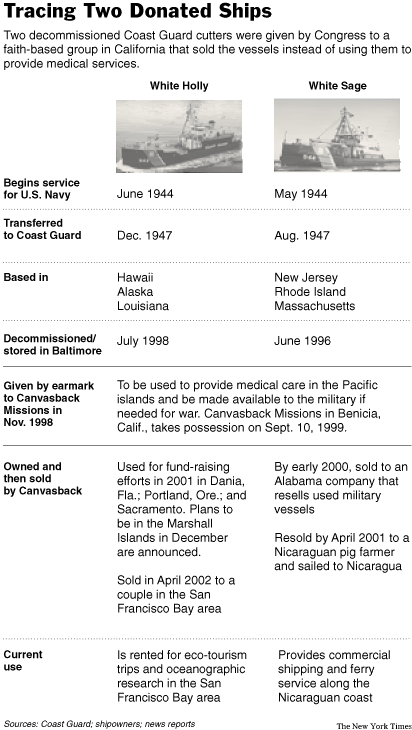
Two Coast Guard cutters were gifted to a Christian missionary group, which then resold them and deposited the money in its general revenue account which supports the group's evangelical activities.

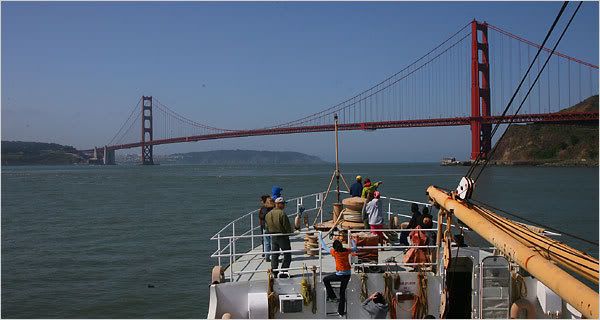
The White Holly cutter approaching the Golden Gate Bridge.

The New York Times reports:
In theory, it was simple: Congress gave two decommissioned Coast Guard cutters to a faith-based group in California, directing that the ships be used only to provide medical services to islands in the South Pacific.

Coast Guard records show that the ships have been providing those services in the South Pacific since the medical mission took possession of them in 1999.

In reality, the ships never got any closer to the South Pacific islands than the San Francisco Bay. The mission group quickly sold one to a maritime equipment company, which sold it for substantially more to a pig farmer who uses it as a commercial ferry off Nicaragua. The group sold the other ship to a Bay Area couple who rent it for eco-tours and marine research.

The gift of the two cutters was one of almost 900 grants Congress has made to faith-based organizations since 1987 through the use of provisions, called earmarks, that are tucked into bills to bypass normal government review and bidding procedures.
Skipping those safeguards can generate more than accusations of political favoritism. As the case of the Coast Guard cutters shows, it also can give rise to grants that never achieve their intended purpose, with the government never even realizing it.

Canvasback Missions, in Benicia, Calif., took ownership of the cutters, the White Sage and the White Holly, in Baltimore in September 1999. This was the first time such ships had been given away through an earmark, the Coast Guard said.

Pressed for cash, Canvasback sold the White Sage a few months later for about $85,000. Two years later, the struggling mission sold the White Holly to the Bay Area couple for $330,000. The mission did not inform the Coast Guard property office about the sales.

Typically, decommissioned Coast Guard vessels are sold at auction, are included in foreign aid packages or are added to the nation’s mothball fleet.

If the two cutters had been sold at auction, the General Services Administration would have monitored their use for five years. But the Canvasback earmark required no such monitoring, and Coast Guard officials said they did not know about the sales until The New York Times asked about them.

The fate of the White Holly and the White Sage comes as a surprise to people who supported the Canvasback earmark.

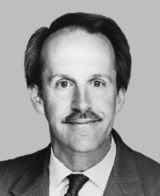
Former Representative Frank D. Riggs, Republican of California, whose staff drafted the earmark, said it “would raise concerns” if the ships were “not used as intended.”Former California Congressman Frank Riggs

Senator Olympia J. Snowe, Republican of Maine, was also credited by Canvasback with working on the earmark. But David Snepp, Ms. Snowe’s spokesman, said she had merely voted for it. Mr. Snepp called Canvasback’s actions troubling and said the senator had asked her staff to research what is now a gray area: whether selling the two ships was legal.

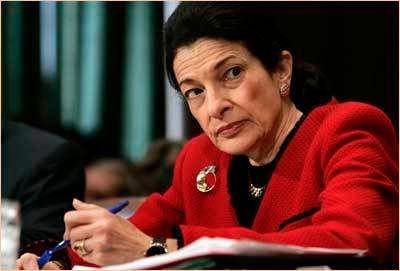
Maine Senator Olympia Snowe

“If they were not used in Micronesia, they were definitely not used in the spirit of the way this was written,” Mr. Snepp said. The text of the earmark gave the government the right to reclaim the ships, he added. While that was perhaps unlikely, he continued: “They were supposed to retain the vessels in case the Coast Guard needed them back. The charity does not have the option to sell.”

A harsher assessment came from Steve Ellis, vice president of Taxpayers for Common Sense, a watchdog group that opposes earmarks, and a former Coast Guard officer. “They are flipping the property,” Mr. Ellis said.

Jamie W. Spence, president and founder of Canvasback Missions, said all the sales proceeds supported the organization’s work in the Marshall Islands, where it has provided eye and dental care and counseling on diabetes prevention to thousands of people since it was founded in 1981.

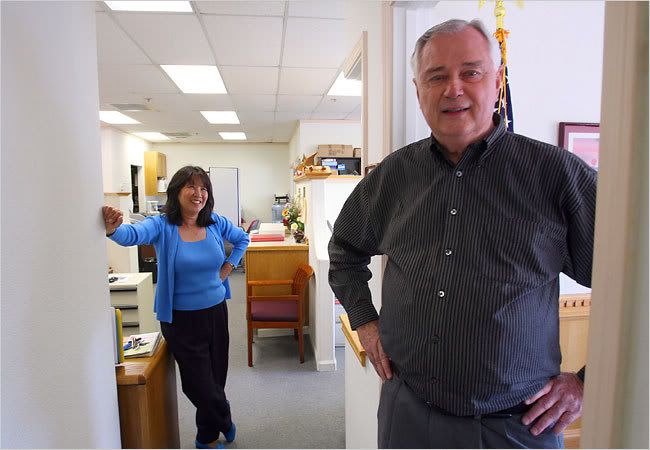
Jacque Spence, left, and her husband, Jamie, at their Canvasback Missions office in Benicia, Calif.

“We did everything in our power to put these ships into service,” Mr. Spence said. But when the group could not raise the money to repair and maintain the vessels, it sold them instead, using the proceeds to cope with its financial difficulties, he said.

Mr. Spence said he had consulted with Canvasback’s legal advisers and was confident the sales were ethical and legal.

Coast Guard officials were surprised at the cutters’ fate. “The White Holly and the White Sage are in the South Pacific,” Lynn Brown, the personal property manager in the decommissioning office, said in March. She affirmed recently that her office had not known that Canvasback sold the ships.

Mr. Spence acknowledged that he did not give notice to Ms. Brown’s office. But he said he told Coast Guard employees in the Bay Area about the White Holly sale and mentioned the White Sage sale to the Coast Guard officer in charge of the Baltimore yard before the deal and to civilian Coast Guard officials afterward. He did not respond to requests to identify those people.

While all earmarks are troublesome to critics like Mr. Ellis, who called the Canvasback gift an “utter indictment of earmarks,” those made for faith-based groups involve special questions about the constitutional borders between church and state.

Vince Backen with students and teachers after giving them a cruise on the White Holly, a former Coast Guard cutter sold to him by Canvasback Missions.
[photo: Jim Wilson/NYT]


The Coast Guard ships were given to Canvasback for a secular purpose, providing medical services. But Mr. Spence said Canvasback did not isolate the sales proceeds; instead it mingled them with its general revenues, which also cover activities that include evangelism. And under most court decisions, evangelism cannot be paid for with federal grants.

Mr. Spence said no constitutional violations occurred. “I’m very certain that the proceeds were used for supporting our medical program,” he said, “and I’m absolutely sure they were not used for evangelism.” He said Canvasback, a nondenominational Christian mission, raises donations separately for its evangelism activities, which included donating Bibles translated into local languages and constructing a chapel.

Mr. Spence and his wife, Jacque, established their medical mission 26 years ago, using a 71-foot catamaran, the Canvasback, to navigate the shallow coasts of the poorer, more remote islands of Micronesia. As the ministry grew, it mobilized medical professionals to volunteer for short stints in the islands and delivered donated medical equipment and supplies.

When they sought the Congressional earmark, the Spences were hoping the two cutters would allow them to expand their medical ministry, Mr. Spence said. But the mission acquired and then sold those vessels, and a third vessel that was privately donated, because Canvasback determined that maintaining and operating the ships was too big a financial burden, he explained. But few of these details can be found in the annual statements Canvasback files with the Internal Revenue Service. Two leading nonprofit accounting experts examined the statements and found them to be incomplete and internally inconsistent.

“There is no clear audit trail for the boats,” said Julie L. Floch of Eisner L.L.P. in Manhattan, a member of the I.R.S.’s national advisory panel on nonprofits. Her view was echoed by Jody Blazek of Blazek & Vetterling L.L.P. in Houston, the author of six books on nonprofit tax law and accounting.

William J. MacLean, the accountant in Seaside, Ore., who prepared the filings, declined to comment.


These days, Canvasback has redirected its efforts from ship-based medical care in the remote islands to land-based clinics on the more populated islands, Mr. Spence said.

That work has won praise from health officials in the Marshall Islands — and fresh support from Congress. The tiny mission is now the lead contractor on a diabetes research program being financed through two $1 million Defense Department contracts. Those grants were directed to Canvasback by Congress through a pair of earmarks.

See the NYTimes video report:


Conservatives Aren't The Only Ones Against The Immigration Bill

ThinkProgress.org tells half the story:
MSNBC goes all conservative for seven hours.
“During the seven hours of the June 11 edition of MSNBC Live (9 a.m.-4 p.m. ET), 15 segments aired about immigration or the Senate immigration bill, none of which featured a Democratic or progressive commentator. Indeed, in nine of the 15 segments, the anchor interviewed a conservative anti-immigration activist who had opposed the bill — including six separate solo interviews with MSNBC political analyst Pat Buchanan.”

MSNBC also had no liberal or progressive Democrat opposed to the immigration bill, of which there are many:


MSNBC misrepresents, by omission, the fact that liberals and progressives also aren't in support of this immigration bill, albeit for different reasons than conservatives. This is one of the rare issues that unite liberals and conservatives although it would be hard to find anyone on either side who realizes it. Bush's trip to Congress yesterday, his first in five years, was an attempt to make sure we never do.

For conservatives, the deal-breakers in the bill are 'amnesty', xenophobia in general and towards Mexicans in specific, and free-floating fear of Al Qaeda sneaking over the border to set off dirty bombs in our shopping malls.

For liberals, it's all about economics (jobs with real living wages for Americans), failed U.S. foreign aid and trade policies, and a U.S. that doesn't have to wage war to keep Americans safe and secure.

Bush's trip to the Hill was to resurrect the bill with assurances to conservatives about their reservations. Just enough assurances to get enough votes on board to pass it. National ID cards for both citizens and immigrants as a requirement for employment for everyone, and/or actually appropriating the money to build that fence on the U.S. southern border, whatever it takes.


Tuesday, June 12, 2007

The Case For Impeachment 'Is Even More Truthful Today' . . . .

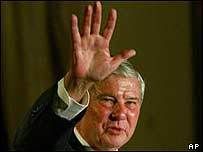
. . . . Says Former Senate Intelligence Chairman Bob Graham


From ThinkProgress.org:
Former Senate Intelligence Committee Chairman Bob Graham (D-FL) was one of 23 Senators to have voted against the Iraq war resolution in October 2002. “With sadness,” he told his colleagues, “I predict we will live to regret this day, Oct. 10, 2002, the day we stood by and we allowed these terrorist organizations to continue growing in the shadows.”

Just four months after Bush launched the Iraq war, Graham floated the idea of impeachment. “Clearly, if the standard is now what the House of Representatives did in the impeachment of Bill Clinton, the actions of this president [are] much more serious in terms of dereliction of duty,” he said. In an interview this week with ThinkProgress, Graham said he stood by his 2003 statement:

How many Americans would say that it is a greater dereliction of duty as President of the United States to have a consensual sexual affair or to take the country to war under manipulated, fabricated, and largely untruthful representations which the President knew or should have known. I think the answer to that question is clear.

Graham added that it’s unlikely Bush would be impeached, explaining that he learned the word impeachment is an “incendiary word” that Americans shy away from. “Americans don’t like impeachment because it connotes the kind of instability that so many other countries around the world have known.” But he added that his original remark regarding impeachment “was a truthful statement at the time and it’s even more truthful today.”

CLICK HERE TO LISTEN

Right before the Senate vote on the Iraq resolution, the mild-mannered Graham sounded the alarms in unusually stark language. “If you believe that the American people are not going to be at additional threat,” he said, “then, frankly, my friends — to use a blunt term — blood is going to be on your hands.”

Asked to reflect on that statement today, Graham said, “There are 3,500 fewer American servicemen alive today in the world since the day I made that statement. There are tens of thousands of civilians who’ve lost their lives. The United States is at dramatically greater risk of terrorism… So I’m afraid that the blood has flown fuller, deeper, and redder that I thought it was going to.”

Graham also ridiculed Sen. Joseph Lieberman’s (I-CT) calls for taking “aggressive military action” against Iran:

I don’t know where we’re going to get the troops to take aggressive offensive action against Iran. Iran’s a country that’s approximately 2.5 times the population of Iraq. It has a GDP that’s twice that of Iraq. It is a much more significant force in the world. And we see how bogged down we are in Iraq, how in the world are we going to even consider using massive military force against Iran?

'Impeachment' is an incendiary word that Americans shy away from because of the way that Republicans used it against Clinton - as a device to stop legislation by Democrats from going forward and becoming law.

Before the midterm elections, polls indicated that the majority of Americans favored impeaching Bush. I haven't seen any polling on that question since the elections, but Bush's approval ratings haven't improved - they've sunk to Nixon's lowest numbers. I think it's a safe bet to conclude that even more people support impeachment.

The only thing preventing impeachment is Congress. The question then becomes, "Why?" Are they lazy? Are they being blackmailed by information culled from one of the many secret surveillance programs that Bush-Cheney are operating outside of the law and judicial oversight?

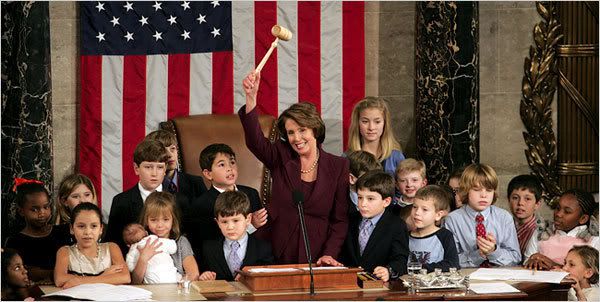
Could it also be that a deal was made last year? That if the Democrats prevailed in the midterm elections and became the majority in the House, Republicans and Democrats would agree to a woman (Pelosi) becoming the first woman Speaker if Democrats dropped all plans to impeach Bush and Cheney? Because if both the President and Vice President were impeached, the Speaker of the House (Pelosi) would be next in line to become President. And that if a woman is to ever become President of the United States, it must be through a direct vote of the people.

What else could explain Pelosi's announcement ("taking impeachment off the table") before the midterm elections?


If I'm right, we traded letting Nancy Pelosi become the first woman Speaker of the House of Representatives for allowing the most corrupt, thieving, murderous administration in the history of the nation remain in power, so that they could continue their assault on the Constitution, on civil liberties, rendition, torture, promote their preemptive war policies (for oil and other profiteering), attack Iran and expand the hostilities in the Middle East and around the world.

I can't think of any other reasons to explain all that this Democratic Congress has failed to do. How many times must Rove and Gonzales and Rice (and Bush, Cheney, Secret Service) ignore subpoenas, refuse to appear or produce documents before you go to court to compel compliance? How can anyone explain a Democratic Congress allowing the Bush administration's failure during Hurricane Katrina to go uninvestigated?

If Congress did proper oversight, all investigations of everything that Bush-Cheney have been up to these last six+years lead to misfeasance, malfeasance, corruption and impeachment. Why wouldn't the Democrats (who are not stupid and just as politically motivated as Republicans) jump at these opportunities to score points at Republicans' expense?

Something is preventing the Democrats. What?

Monday, June 11, 2007

Staunch Women . . . .

. . . . We just don't weaken.

The revolutionary costume pour du jour, Tony-award winner Christine Ebersole in "Grey Gardens":


"Let's win the revolution, with style!

The Revolutionary Costume For Today, from "Grey Gardens," premiered March 7, 2006
Music: Scott Frankel
Lyrics: Michael Korie
Book: Doug Wright
--------------------------------------------------------------------------------

(Speaking)
Oh, hi. Thank heaven you're here. You look absolutely terrific, honestly. (Mother wanted me to come out in a kimono so we had quite a fight...)

(Singing)
The best kind of clothes for a protest pose
Is this ensemble of pantyhose
Pulled over the shorts, worn under the skirt
That doubles as a cape.

To reveal you in capri pants
You fashion out of ski pants,
In a jersey knit designed to fit
The contour of your shape.
Then cinch it with a cord from the drape.

And that's the revolutionary costume for today.
To show the polo riders, in khakis and topsiders,
Just what a revolutionary costume has to say.
It can't be ordered from L.L. Bean.
There's more to living than kelly green.
And that's the revolution, I mean.

Da da da da dum...

(Speaking)
Just listen to this: The Hamptons Bee, July, 1972: "The elderly bed-ridden aunt of former First Lady Jacqueline Kennedy, Mrs. Edith Bouvier Beale..."

My very own mother, can you imagine?

"...and her adult daughter, Miss Edie Beale, a former debutante once known as Body Beautiful Beale..."

They called me Body Beautiful Beale, it's true - that was my whaddyacallit, my uh ... sobriquet.

"...are living on Long Island in a garbage-ridden, filthy 28-room house with 52 cats, fleas, cobwebs, and virtually no plumbing. After vociferous complaints from neighbors, the Board of Health took legal action against the reclusive pair."

Why, it's the most disgusting, atrocious thing ever to happen in America!

(Singing)
You fight City Hall with a Persian shawl
That used to hang on the bedroom wall,
Pinned under the chin, adorned with a pin
And pulled into a twist.

Reinvent the objet trouve,
Make a poncho from a duvet,
Then you can be with cousin Lee
On Mr. Blackwell's list.
The full-length velvet glove hides the fist.

And that's the revolutionary costume for today.
Subvert the CrisCraft boaters, those Nixon-Agnew voters.
Armies of conformity are headed right your way.
To make a statement you need not be
In Boston Harbor upending tea.
And that's a Revolution, to me.

Staunch!
There's nothin' worse, I tell ya,
Staunch!
S-T-A-U-N-C-H.
Staunch women, we just don't weaken.
A little known fact to the fascist pack
Who comes here for antiquin'.

Da da da da dum...

(Speaking)
Honestly, they can get you in East Hampton for wearing red shoes on a Thursday - and all that sort of thing. I don't know whether you know that - I mean, do you know that? They can get you for almost anything - it's a mean, nasty, Republican town.

(Singing)
The best kind of shoes to express bold views
Are strapless mules in assertive hues
Like fuscia or peach, except on the beach,
In which case you wear flats.

When I stood before the nation
At Jack's inauguration,
In a high-heeled hump, I got the jump
On Jackie's pillbox hat.
Just watch it where you step with the cat!

And that's the revolutionary costume pour du jour.
You mix'n'match and, Presto! A fashion manifesto.
That's why a revolutionary costume's de rigeur.

The rhododendrons are hiding spies,
The pussy willows have beady eyes.
Binoculars through the privet hedge,
They peek at you through the window ledge with guile!

We're in a Revolution!
So win the Revolution with style!

Da da da da dum.

Sunday, June 10, 2007

Tony Snow: "It Doesn't Matter What Congress Does, Gonzales Ain't Goin' Nowhere"


Interviewed on Fox News Sunday, Tony Snow said:
"... it doesn't matter what Congress does, Alberto Gonzales is not going anywhere."

The Senate plans debate Sunday on a resolution that declares the attorney general "no longer holds the confidence of the Senate and of the American people."

Interviewed Sunday on "Fox News Sunday," White House Press Secretary Tony Snow said the Senate is wasting it's time. He said Gonzales has done nothing "untoward" and said the president has "the right to hire and fire people who serve at his pleasure." Snow sees tomorrow's Senate vote as "purely symbolic."

Gonzales has been the target of months of investigations prompted by discrepancies in the firing of US attorneys and allegations of political pressure by the administration in the workings of the Justice Department.

And the Congress continues to churn out non-binding resolutions when it has the power to get rid of those who stand in the way of repairing the damage that has been done to the country.

When do we say out loud what appears to be preventing members of both houses of Congress, in both parties, from doing?

Was there a coup d’etat in 2000?

Are our elected representatives honestly disinclined to impeach Gonzales, Cheney and Bush because they see nothing impeachable in their actions over these last six years? Or are they reluctant for reasons that might end their political careers, or embarrass them or their families, or land them in jail? Do they find themselves in compromising situations, due to information mined from one of the numerous secret and unlawful surveillance programs that the Bush administration is operating? Or are they prevented from organizing an impeachment due to the surveillance programs that Bush-Cheney have instituted?

When the emperor has no clothes, and everyone knows it, then what?

Friday, June 08, 2007

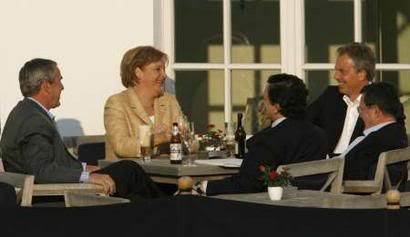
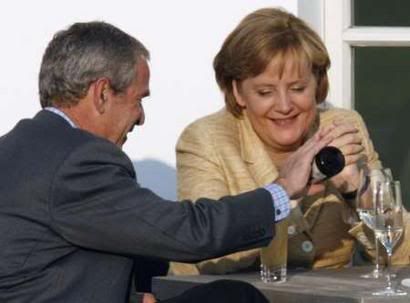
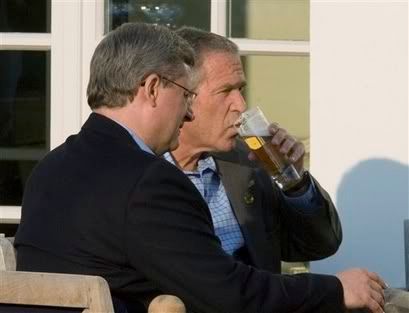
Bush, Sick With Stomach Flu . . . .

. . . . Or hangover?


The Associated Press reports:
President Bush signaled Friday the United States will press ahead with a missile defense shield in Eastern Europe despite Russia's heated objections. Poland's president expressed support for installing interceptor rockets in his country.

An upset stomach crimped Bush's schedule on a busy day that took him from Germany to Poland and finally to Italy. The president stayed in bed and skipped morning sessions at the summit of world leaders in Heiligendamm, Germany, and he appeared subdued later after talks in Poland with President Lech Kaczynski.

"Still not 100 percent but better all the time," White House deputy press secretary Dana Perino said of her boss.
On Saturday, Bush will meet for the first time with Pope Benedict XVI. Large anti-Bush demonstrations are planned in Rome, and Premier Romano Prodi had to ask his Cabinet members to refrain from taking part.

The administration made clear it was not abandoning plans for a missile-defense program in Poland and the Czech Republic despite a surprise counterproposal Thursday by Russian President Vladimir Putin to instead use a Soviet-era radar tracking station in Azerbaijan.

Putin had more suggestions on Friday for locations for missile interceptors: "They could be placed in the south, in U.S. NATO allies such as Turkey, or even Iraq," Putin said. "They could also be placed on sea platforms."

Secretary of State Condoleezza Rice, in an Associated Press interview in New York, said Friday, "One does not choose sites for missile defense out of the blue. It's geometry and geography as to how you intercept a missile."

"This is an idea that has not yet been vetted," she said of Putin's offer. "We have to see whether Azerbaijan makes any sense in the context of missile defense."

The U.S. system calls for a radar screen in the Czech Republic to watch for missile threats, and 10 interceptor rockets in Poland to shoot down any missiles. Both Bush and Kaczynski said the system would not threaten Russia. The Kremlin argues that the system would undermine its nuclear deterrent.

"The system we have proposed is not directed at Russia," Bush said after talks with Kaczynski at the presidential retreat at Jurata, a resort on the Baltic Sea. "Indeed, we would welcome Russian cooperation on missile defense."

Bush said a working group including the United States and Russia would "discuss different opportunities and different options, all aimed at providing protection for people from rogue regimes who might be in a position to either blackmail and/or attack those of us who live in free societies."

Kaczynski voiced strong support for putting the interceptors on Polish soil. "As far as the missile defense system is concerned, the two parties fully agree," Kaczynski said.

"The Russian federation can feel totally safe," said Kaczynski. He said Moscow must recognize that the world has changed since the fall of the Soviet Union nearly two decades ago.

Bush thanked the Polish president for sending troops to both Iraq and Afghanistan. Poland has nearly 900 troops in Iraq, and Bush noted that the country had recently agreed to keep them there at least through the end of the year.


The three-day summit in Heiligendamm ended with agreement to commit more than $60 billion to fight disease in Africa. Half of the money already had been pledged by Bush, and other countries would have to fill in the rest. Anti-poverty activists have complained that promises to boost annual aid to poor countries have not been met.

The leaders also warned Iran to drop its disputed nuclear program, signaling support for U.N. Security Council moves to discuss a third set of sanctions against Tehran. But, in a setback, they failed to reach a deal about the independence-seeking Serbian province of Kosovo.


White House counselor Dan Bartlett said Bush likely fell ill with "some sort of bug, probably more viral in nature" and that it appeared unrelated to anything he ate.

Bartlett joked that Bush's decision to avoid the other leaders for a while was a "precautionary step" to avoid following in the footsteps of his father, former President George H. W. Bush.


At a state dinner in Tokyo in January 1992, the elder Bush fainted and vomited into the lap of Prime Minister Kiichi Miyazawa.


OR,


A game ("The Prison Life: Paris") to get you through the next 45 23 3 21 days.

Wednesday, June 06, 2007

Too Little, Too Late?

China to Revise Food and Drug Safety Rules


The NYT reports:
Responding to growing international concerns about tainted food and counterfeit drugs, China said late Tuesday that it was overhauling its food and drug safety regulations and would introduce nationwide inspections.

The announcement, from the State Council, the nation’s highest administrative body, is the strongest signal yet that Beijing is moving to crack down on the sale of dangerous food and medicine and also trying to calm fears that some of its exports pose health problems.

The move follows a series of embarrassing episodes this year involving China’s export of contaminated pet food ingredients and toothpaste. The shipments of tainted pet food ingredients set off one of the largest pet food recalls in United States history.
Last month, an article in The New York Times revealed that at least 100 people had died in Panama after taking medicine containing a toxic chemical called diethylene glycol that had been produced in China and exported as the harmless syrup glycerine.

And in recent weeks, several countries, including the United States, Panama and Nicaragua, recalled or issued warnings about toothpaste made in China because it contained diethylene glycol.

While Beijing has strongly defended the quality and safety of its food and drug exports, and even denied that toothpaste it exported was unsafe, government regulators at the same time have stepped up safety inspections and shut down companies accused of producing unsafe food or counterfeit drugs.

But with pressure growing from regulators in the United States, Europe and other parts of the world, and international food companies expressing concern about the risks of importing Chinese-made food and feed ingredients, Beijing is pushing for a more forceful response to the crisis.

In its announcement on Tuesday, which was posted on a government Web site, China said that the state council had approved a new food and drug safety guarantee system on April 17 and that an outline of the new program was being distributed to government agencies nationwide.

The government said in its announcement that it planned by 2010 to place new controls on food and drug imports and exports, to step up random testing on medicines and have inspection information on 90 percent of all food products.

It said it also planned safety checks on a large majority of food makers and said that regulators would crack down on the sale of counterfeit drugs and medical devices.

The government did not indicate whether it would provide more funds for the efforts or which agencies would carry out the bulk of the functions.

But in announcing the new measures, the government hinted at its weaknesses in enforcement, saying that after five years one goal was that “100 percent of the significant food safety accidents are investigated and dealt with” and that “80 percent of the food that needs to be recalled is recalled.”

A few weeks ago, the government had announced that it was planning to set up a food recall system.

On Tuesday, the General Administration of Quality Supervision, Inspection and Quarantine, which oversees food and drug exports, also posted statements on its Web site about the issue.

“Recently, our country has had a series of export food problems, and that has triggered a lot of overseas attention about China’s food safety,” said Wei Chuanzhong, deputy director of the agency. “This has put us on high alert, and led us to seriously look into the reasons for the problem.”

Food and drug safety experts have complained for years about an incredibly flawed system that has led to food scares or mass poisonings tied to counterfeit or substandard medicines on the market.

Much of the blame has centered on weak enforcement of the nation’s food and drug regulations, as well as corruption, bribery and a business culture where counterfeiting thrives.

China’s food and drug administration, which is supposed to safeguard the nation’s health, has also been implicated.

Last week, a Chinese court handed down a death sentence against Zheng Xiaoyu, the head of the Food and Drug Administration in China from 1998 to 2005, after he pleaded guilty to bribery and corruption. The government also said that he took bribes to approve drug production licenses and that it was reviewing production licenses the agency had issued.

Some experts say the new food and drug safety program suggests that the nation’s top leaders are taking up the call for reforms and new enforcement measures.

“There’s been concern for a while about food safety in this country, and now that there are growing concerns about China’s international image, the state council has decided to act,” said Russell Leigh Moses, an analyst of Chinese politics who is based in Beijing. “This may be a sign that everyone in the government ought to get in line.”

But the challenges facing China are enormous because its regulatory system is weak and enforcement is particularly difficult, partly because the economy is growing so fast and also because local officials accept bribes and sometimes allow small companies to flout regulations.

Also, regulators here say many exporters of food and medicines are mislabeling goods and shipping them illegally.

Two weeks ago, food and drug safety issues were even on the table in Washington during the strategic economic dialogue hosted by Treasury Secretary Henry M. Paulson Jr.

“These are issues China has to deal with over time,” says Rio D. Praaning, secretary general of the Public Advice International Foundation in Belgium, an advisory group that is working on food and drug safety issues around the world. “But we can’t wait. We have interim developments. We have patience, but frankly patience is out the window when people start dying.”

If Democrats really were liberals, and not deregulation-embracing moderate Republicans, they would be using stories like these to teach the American people what good government is all about and what our tax dollars pay for.

It will take China decades before they have in place the food and drug safety inspections that the U.S. had in place before Conservatives took it into their heads to dismantle U.S. government agencies and do away with regulations requiring safety measures and inspections of our food and drug industries. Until then (and until we sweep Republicans out of government and until liberals regain control over the Democratic party), we will dice with death every time we swallow food or medications. That goes for our pets, too.

Saturday, June 02, 2007

Food Prices Rising Faster Than Gas Prices

Ethanol-driven demand for corn is just one of the causes.

While food prices are rising pretty much across the board, items related to corn are affected the most. That's because increasing demand for ethanol, made from corn, is driving up corn prices, which farmers use to feed their poultry and cattle. The high price of corn is also affecting prices of everything from cereal and other products with corn as an ingredient to the oils used to make potato chips.

The Star Tribune reports:
Rising gasoline prices have been getting all the attention, but the cost of another, more-important staple is actually rising even more: food.

In the past year, food prices have increased 3.7 percent and are on track to jump by as much as 7 percent by year's end. The current increase is more than double the 1.8 percent jump seen the year before, according to the consumer price index.

Meanwhile, gas prices rose 2.9 percent. Only the cost of health care rose more, and then just slightly.

While companies up and down the food chain see the increases, they're only beginning to pass them on to consumers. But with the start of grilling season -- meat prices particularly hurt -- some consumers are already tweaking their spending habits.

A recent study shows that more consumers are using coupons. Marilyn Pearson just resorted to clipping them again, though she hasn't changed what she buys. On a recent evening, the St. Paul resident's shopping cart was filled with collard greens, meat and other supplies for a barbecue. She's noticed the price of meat, some vegetables and dairy going up, but figures, "You gotta eat, you gotta buy."

While food prices are rising pretty much across the board, items related to corn are affected the most. That's because increasing demand for ethanol, made from corn, is driving up corn prices, which farmers use to feed their poultry and cattle. The high price of corn is also affecting prices of everything from cereal and other products with corn as an ingredient to the oils used to make potato chips.

But corn is only one culprit. Higher labor, packaging and fuel costs all play a role. Bad weather in California and Florida was the main contributor to a 20 percent spike in citrus fruit prices as well as higher prices for some vegetables. A drought this summer could cause prices to rise even more than current projections.

"We should all hope we have a really good growing season this year," said Ben Senauer, co-director of the University of Minnesota's Food Industry Center.

Eggs up almost 19 percent

Prices are rising in each grocery aisle. In April, eggs cost 18.6 percent more than a year ago. Whole chicken prices increased 7 percent. Bread is up nearly 6 percent and beef steaks up 5.5 percent.

Even watermelons cost more, according to a spokesman for Lund Food Holdings Inc., the Edina-based owner of the Lunds and Byerly's chains. High corn prices pushed farmers to devote record acreage to corn this summer, leaving some crops in short supply.

Senauer said many price increases haven't made their way to all stores yet, and many stores are absorbing the costs rather than passing them on to customers. "Right now the margins are simply being squeezed," he said.

"But that's not going to last forever," said Wells Fargo & Co. agricultural economist Michael Swanson, predicting no end in sight to food inflation. Swanson forecasts that food inflation will have risen at a rate not seen since 1990, when prices ended the year 5.8 percent higher.

Consumers have responded to higher fuel prices by grouping trips or leaving the car at home, and economists predict that Americans similarly will tweak their food habits -- reallocating some food dollars from eating out to buying groceries, choosing to eat less meat and cooking smaller portions to reduce waste.

Janet and Sam Nelson just purchased a stand-alone freezer so they could buy in bulk on sale. On a recent trip to Cub Foods on University Avenue in St. Paul's Midway area, the St. Paul couple was stocking up on $1 frozen dinners. Janet Nelson, a veterinary technician, said they eat fewer meals out now because of small increases on many items, even ramen noodles. The couple has also buckled down their spending on discretionary items. "There's no spare money for fun shopping," lamented Sam Nelson, who is self-employed.

More increases coming

In recent quarterly earnings conference calls, Target Corp., Supervalu Inc. and Hormel Foods Corp. each cited increased food prices as a factor to contend with. Target described food-price inflation as "fairly aggressive," and said it would need to fight it by increasing productivity at stores and distribution centers. Supervalu expects corn prices to affect the year's overall inflation levels, although the company declined to say whether customers will see rising prices at its stores, such as Cub Foods.

Hormel said the quarter's only disappointment was "that Jennie-O Turkey Store was not able to pass on higher grain costs through pricing as quickly or as thoroughly as we had hoped." The company expects to increase prices further for the rest of 2007.

Mike Oase, vice president of operations for Kowalski's Companies, said the company has had to pass on some of the price increases to consumers because profit margins in the grocery business are always "pretty thin." He characterizes Kowalski's current strategy for dealing with food-price inflation as a "50-50" approach -- the company is absorbing half of the increases and passing the other half along to consumers, who may have noticed the price of milk go up by "a few cents a gallon" in recent months.

Because food is a category that consumers can't cut from their budget, it's the cups of coffee, the entertainment dollars, and the clothes-and-jewelry budget that are scaled back first. In April, retail sales fell 0.2 percent, the first decline in seven months, according to the Commerce Department. Yet consumer confidence rebounded in May, mainly because of to consumers' cautiously optimistic view of business conditions. Still, a stew of high gas prices, food costs , a slumping housing market and adjusting mortgages could be a recipe for trouble for strapped Americans with little wiggle room in their budgets.

Is corn making us fat as well as broke? Michael Pollan argues that U.S. farm policy promoting overproduction of corn has made America overweight--and made big food companies...[an article from New York Times Upfront]

Friday, June 01, 2007

Bush & Cheney Now Have The Secret Service Destroying Official Public Records

The AP reports:
In the past year, lawyers for President Bush and Vice President Dick Cheney directed the Secret Service to maintain the confidentiality of visitor logs, declaring them to be presidential records.

The drive to keep secret the lists of visitors to the White House complex and Cheney's home, the administration says, is essential to ensuring the president and vice president receive candid advice to carry out their duties. The decision made the logs exempt from a law requiring their disclosure to whoever asks to see them.

The latest part of the strategy emerged this week when the government disclosed a letter from Cheney's counsel placing visitor logs for his personal residence on the Naval Observatory grounds in the category of presidential records.

Lawsuits are bringing to light new details about the White House push to make sure the public doesn't learn who has been meeting with top Bush administration officials.
Cheney's counsel wrote the Secret Service last September, instructing the agency not to preserve copies of visitor data for the vice president's personal residence. The Secret Service has been giving the originals to the vice president's office since the start of the Bush administration.

A week ago, the government filed court papers stating that the Secret Service is retaining copies of the visitor logs because of pending lawsuits, and that Cheney's office agrees with the decision.

A private group, Citizens for Responsibility and Ethics in Washington, has filed two lawsuits under the Freedom of Information Act seeking Secret Service visitor logs. But the FOIA does not apply to presidential records.

The Bush administration has exploited that different treatment of records between the two laws, which prompted the fight in federal court. The administration is seeking dismissal of the lawsuits.

In trying to get the cases thrown out, the Justice Department has filed documents in court outlining a behind-the-scenes debate over whether Secret Service records are subject to public disclosure. The discussions date back at least to the administration of President Bush's father and involve the Justice Department and the National Archives as well as the White House and Secret Service.

The government's court filings show that the Bush White House focused on the issue in the months before Election Day 2004.

Discussions moved into high gear when the Jack Abramoff lobbying scandal prompted news organizations and private groups to demand that the administration release Secret Service records of visitors to the White House complex and the vice president's residence.

There was precedent for the demands.

During the Clinton administration, Republican-controlled congressional committees obtained Secret Service visitor logs while conducting investigations of the president and first lady.

Christopher Lehane, a former special assistant counsel to President Clinton and press secretary to then-Vice President Al Gore, points out the political implications of the Bush administration campaign to close off access to the records.

``The question it raises is 'What are these guys hiding?''' said Lehane, now a Democratic consultant. ``They can live with it because they've only got a year or so left, but it doesn't do a lot for public confidence in open government.''

White House spokesman Tony Fratto said Thursday, ``I can't comment on a case in litigation, and I can't speak to the decisions made by other administrations.''

The Bush administration says it is standing on principle.

``It is important that the president be able to receive candid advice from his staff and other members of the administration,'' Fratto said. ``To ensure that he receives candid advice, it is essential as a general matter that the advice remains confidential.''

In a declaration filed in court a week ago, Cheney's deputy chief of staff, Claire O'Donnell, said that ``systematic public release of the information regarding when and with whom the vice president and vice presidential personnel conduct meetings would impinge on the ability of the OVP (office of the vice president) to gather information in confidence and perform its essential functions, including assisting the vice president in his critical roles of advising and assisting the president.''

In May 2006, the Secret Service and the White House signed a memorandum of understanding designating visitor records as presidential.

They are ``not the records of an 'agency' subject to the Freedom of Information Act,'' says the agreement that was not disclosed until months later, in late 2006. The records are ``at all times under the exclusive legal custody and control of the White House.''

Four months after the memorandum of agreement, Cheney's counsel wrote to the Secret Service, stating that visitor records for the vice president's personal residence ``are and shall remain subject to the exclusive ownership, custody and control of OVP.''

The Sept. 13, 2006, date on the Cheney letter coincides with requests by The Washington Post seeking records on the vice president's visitors under the Freedom of Information Act.

The law enforcement agency ``shall not retain any copy of these documents and information upon return to OVP,'' said the letter to the Secret Service's chief counsel.

``If any documents remain in your possession, please return them to OVP as soon as possible,'' the letter added.

The Justice Department filed the Cheney letter last Friday in one of the lawsuits brought by Citizens for Responsibility and Ethics in Washington, which is invoking the FOIA law in seeking the identities of conservative religious leaders who visited the White House complex and the vice president's residence.

The group, which represents Valerie Plame and her husband in their lawsuit against Cheney and other key administration figures in the leak of Plame's CIA identity, also is seeking White House visitor logs in the Abramoff scandal.

According to government documents, the Secret Service routinely destroyed five of eight categories of information relating to visitors to Cheney's residence. Of the records it retained, the Secret Service regularly turned over handwritten visitor logs to Cheney's office.

The Secret Service stopped the destruction in June 2006 because of lawsuits by various groups, according to the court papers. The law enforcement agency also is retaining copies of the material, contrary to the directive in the September 2006 letter from Cheney's counsel.

The court filings by the government show that:

-On three occasions late in the administration of the first President Bush and during the first term of President Clinton, the Secret Service proposed treating copies of White House visitor documents as non-presidential records. In its court filings, the current Bush administration opposes releasing details of the Secret Service proposals, saying this ``poses a substantial risk of creating public confusion'' because the proposals were never adopted.

-In January 2001, as Clinton prepared to leave office, White House lawyers proposed the transfer of visitor records from the Secret Service to the White House. The proposal was entitled ``Disposition of certain presidential records created by the USSS,'' or the Secret Service. The records are now at the Clinton library in Little Rock, Ark., the National Archives confirmed Thursday.

-In September 2004, a lawyer for the Bush White House and a special assistant to the director of the Secret Service proposed ``informal views on one way to address the disposition'' of visitor records, according to court documents. The unnamed associate White House counsel and the Secret Service assistant jointly authored a July 29, 2004, document bearing the same title as the Clinton administration document from 3 years earlier.

-In July 2005, the Secret Service gave a presentation on the issue to the White House counsel's office, the Justice Department and the National Archives.

-On May 11, 2006, the Justice Department's Office of Legal Counsel provided a legal opinion on the issue, which is among the many documents the government is refusing to disclose. Six days later, the White House and the Secret Service signed the agreement designating the records as presidential.

Presidential records are released starting five years after a president leaves office. Under the Presidential Records Act of 1978, nonclassified material is disclosed first, with classified documents and advice to the president released later after review by federal agencies, the White House and the former president.

Under an executive order President Bush signed in 2001, the archivist of the United States cannot unilaterally release the records without the permission of the current president, former presidents and their representatives.

``The scary thing about this move by the vice president's office is the power grab part of it,'' said Tom Blanton, head of the National Security Archive, a private group that uses the FOIA law to pierce government secrecy.

``We're looking at a huge problem if the White House can reach into any agency and say certain records have something to do with the White House and they are presidential from now on,'' Blanton said. ``This White House has been infinitely creative in finding new ways and new forms of government secrecy.''