Friday, June 24, 2005

Pentagon Developing Massive Database on Millions of U.S. Students


Democracy Now! reports:
The Pentagon is working with a private company to create information dossiers on millions of young Americans to help identify college and high school students as young as 16 to target for military recruiting. We speak with the executive director of the Electronic Privacy Center and Rep. Mike Honda (D-CA).

The Pentagon is working with a private company to create information dossiers on millions of young Americans to help identify college and high school students as young as 16 to target for military recruiting.

The massive database includes an array of personal information including birth dates, Social Security numbers, e-mail addresses, grade point averages, ethnicity and what subjects the students are studying. The Pentagon has hired the Massachusetts-based company BeNow to run the database apparently in an effort to circumvent laws that restrict the government's right to collect or hold citizen information by turning to private firms to do the work.

The new database is being created at a time when the Armed Forces is struggling to meet its recruiting goals. The Army has missed its monthly recruiting goals every month so far this year.

The Pentagon's Joint Advertising, Market Research and Studies Group has overseen the data since 2003, when it took over several recruiting databases managed separately by the military.

Privacy advocates learned of the database only recently after the military - as required by law - put a notice in the government publication "The Federal Register," that it keeps such information.

Some data on high school students is already given to military recruiters in a separate program under provisions of the 2002 No Child Left Behind Act.

Under the new system, additional data will be collected from commercial data brokers, state drivers' license records and other sources.

* Mark Rotenberg, Executive Director of the Electronic Privacy Information Center in Washington DC.

* Mike Honda (D-CA), he is sponsoring a bill that would make it easier for parents to block military recruiters from gaining access to their high school-aged children.

NOTE: We called BeNow to get comment, they referred us to Pentagon spokesperson Lt. Col. Ellen Krenke. When we contacted her at the Pentagon, she did not answer our request for an interview.
Say what??
AMY GOODMAN: We're going to go to Congress Member Honda in a minute, but right now, we turn to Mark Rotenberg, Executive Director of the Electronic Privacy Information Center in Washington, D.C. Can you explain this database?

MARK ROTENBERG: Yes. Amy, first of all, it's Mark Rotenberg. And the database that's being proposed by the Department of Defense is an effort to essentially micro-target the recruiting effort. What they are doing is taking information that’s available in public record sources and commercial data brokers and developing profiles on American high school students and American college students who could be recruited into the armed services. EPIC, my organization, which is online at EPIC.org does a lot of privacy act work. And when we saw the notice in the federal register last month about this proposed database we quickly realized that there were Privacy Act problems. And as the story has gone forward over the last month, it's really extraordinary what's coming out now about this program.

JUAN GONZALEZ: What about the whole issue that the armed forces are saying that they are prepared to share the information with other entities of the government, as well?

MARK ROTENBERG: Right. Well, they're saying many different things. I mean, there have been a lot of conflicting statements, even at the press conference last evening when they were talking about the database. They said on the one hand, it was not going to be used to call recruits directly until someone pointed out that, in fact, they were collecting telephone numbers. So they’re having a bit of difficulty, I think, you know, getting the story straight. But one of the important things about the Privacy Act, and this really does go to your question, is that it requires the federal agencies to explain how they propose to use the information. So the Department of Defense says that in the first instance the information will be used for recruiting purposes, and then they set out what are called the Privacy Act Exceptions. And they list 13 different categories of additional use of the information, including a possible use for law enforcement purposes. They have, in effect, by this notice already announced that they reserve the right to use all of this data that they're collecting for law enforcement purposes and to transfer to law enforcement agencies.

AMY GOODMAN: Congress Member Mike Honda of California is also on the phone with us. He is sponsoring a bill that would make it easier for parents to block military recruiters from gaining access to their high school-aged children through this provision of the No Child Left Behind Act. Congress Member Honda, what is the bill that you have introduced?

REP. MIKE HONDA: Hello?

AMY GOODMAN: Hi. Can you hear me?

REP. MIKE HONDA: Yes.

AMY GOODMAN: What is the bill that you have introduced?

REP. MIKE HONDA: Yes, I introduced HR 551. It's the Students’ Personal Information Protection Act. What is possible right now, because of No Child Left Behind was amended to require school districts, public schools to divulge personal information, private information of minor students without the consent of parents. And if a school district or school denies military recruiters of those information, they shall lose federal funding. Now, this bill is not about denying access to the campus for the purpose of recruitment of the military recruiters. It is to protect and put back in place the parent prerogative to share that information of their minor child's information.
I would think that supporters of parental notification laws (ear piercing, abortion) would be marching on Washington to get this passed. But they're not.
AMY GOODMAN: I just want to comment that we did call BeNow, the Massachusetts company, to get comment, and they referred us to the Pentagon. A Pentagon spokesperson, Lieutenant Colonel Ellen Krenke said -- well, would not answer our request for an interview.

REP. MIKE HONDA: Okay.

AMY GOODMAN: Can you talk about this company, and can you talk about this Pentagon corporate relationship? And also the fact that information will also go to corporations, is this right?

REP. MIKE HONDA: That’s my sense. It's something that just came up. What I do know is that there are federal laws that prohibit federal agencies from sharing individually recognizable information without the individual's consent. What the Pentagon is doing is contracting a third party, that is BeNow, that is a very well known data mining organization that can go out and data mine all of the information that is out there publicly, pull that together for the purposes of identifying individuals, and that would include minors who have credit cards or have, you know, access to certain kinds of information technology, oriented identification, and ability to get – buy or sell things on Ebay and things like that. But information is out there, and they're mining it. And the third party, it seems to me, may be exempt from the federal laws in terms of sharing -- in terms of sharing the data that they have gathered. So they don't seem to fall under it, but it seems to me that it escapes the intent and spirit of the law.

AMY GOODMAN: It's just interesting to point out, if you go to the BeNow website, the company that's going to data mine for the Pentagon, that their other clients include Tower Records, Saab (the car), and MetLife.

REP. MIKE HONDA: Right. And those are the areas where -- those rental companies are not able to share information. They're prohibited from sharing it, but it seems like that the information is available to be mined by BeNow, and gather that information. And, you know, it may be a loophole, I don't know. But the bottom line for me is that military recruiters want to come on campus and talk to students. I think that's fine. But I think that to demand that of school districts at the pain of losing federal dollars is not right, and number two, if schools say, “We're not sharing that information, you need parent permission,” I think that's appropriate. Parents should have the first right of refusal to be able to protect their minor child's private information.

JUAN GONZALEZ: And Congressman, you have taken the lead on this issue in Congress. Have you been getting a lot of phone calls from concerned parents that prompted you to do this? Or what are they saying about these attempts to recruit their young, their children?

REP. MIKE HONDA: Yeah. A lot of parents are dismayed that this is going on, and most of them didn't know that this could happen to them and their child. And so, they have complained and made us aware that this is going on. And so, being a high school teacher and an ex-principal of a public school, I understand what they're saying, and I also understand that, you know, public schools have a responsibility to protect their children and be an advocate for the children and for the parents that they serve.

AMY GOODMAN: We're talking to Congress Member Mike Honda of California. Also in the Washington studio with us is Mark Rotenberg with the Electronic Privacy Information Center. How can students opt out of having their personal information put into this database, Mark Rotenberg?

MARK ROTENBERG: Oh, sorry, Amy. Well, there are two different databases actually at issue here. One is under the No Child Left Behind Act, which Congressman Honda described. Parents have the opportunity to fill out a form to say that they don't want their personal information on their children used for recruiting purposes. It's a very difficult provision to exercise. We generally recommend opt in, basically allowing people to express an interest in participating in a database as a better way to go. But that problem and that approach is actually separate from what goes on with the new database that the Department of Defense is proceeding with, which is actually not tied to No Child Left Behind. That database, the one being managed by BeNow, according to the Federal Register, will permit individuals to express a preference not to be contacted for recruiting purposes, but they will still be included in the database, as well as all of the personal information about them that's been acquired. So the privacy protections here that were established are really very weak.

JUAN GONZALEZ: And what about the issue -- we're reading almost every week in the mass media of a new breach of security with these data-collecting services. Now we are getting yet another one being collected by the Pentagon. Your concerns about this continued gathering of information by private companies who often don't have very good security to be able to protect their files?

MARK ROTENBERG: Right. Well, we think that's a very serious issue in a couple of different ways. I mean, one, it's clear this year with all of the security breach notifications that there is a real problem with the security of information databases in this country right now. The most recent breach was about 40 million records maintained by a credit card processing company, and this is also having a direct impact on the crime of identity theft, which according to the Federal Trade Commission last year cost American consumers and businesses over $50 billion. When the Department of Defense announced this database and we looked at the Federal Register notice, and we saw that they were proposing to include the Social Security number, I mean, for us and people in the privacy and security field, that's just a red flag, because it is the Social Security number that enables both the data matching and also the crime of identity theft, and it's another problem under the Privacy Act, because federal agencies, generally speaking, aren’t supposed to collect the SSN.

AMY GOODMAN: Mark Rotenberg and Congress Member Honda, I want to thank you both very much for being with us; Mark Rotenberg with EPIC, Congress Member Honda of California.


Filed under: , , , , , , , , , , , , , , , , , , , , ,

Saturday, May 14, 2005

For Better or Worse, Hillary & Newt Hitch Their Stars To Each Other

Hillary Clinton and Newt Gingrich are both expected to seek their parties' nomination for President in 2008. By working together (and thus validating the other's positions) on both domestic policy legislation (health care) and foreign policy (the war in Iraq), whatever one says on these subjects is reasonable to presume as the other's position. If the U.S. had a working, functioning media, they would automatically speed-dial Newt whenever Hillary speaks on one of these issues, and vice versa.

The NYT reports on the "New odd couple: Hillary Clinton and Newt Gingrich":
What do Newt Gingrich and Hillary Rodham Clinton want from each other?

In the 1990s, these two rivals stood on nearly opposite ends of the political spectrum, with him leading the assault on the Clinton presidency and helping derail the ambitious health care plan she championed.

But oddly enough, something has changed since then, and it has people talking.
Gingrich, the former Republican speaker of the House of Representatives, has been working alongside the wife of former President Bill Clinton, now a Democratic senator from New York, on a number of issues, and even appeared with her at a press conference on Wednesday to promote - of all things - health care legislation.

But more puzzling than that, Gingrich has been talking up Clinton's presidential prospects in 2008, to the chagrin of conservative loyalists who once regarded him as an iconic figure. Last month, he even suggested she might capture the presidency, saying "any Republican who thinks she's going to be easy to beat has a total amnesia about the history of the Clintons."

What gives? For Clinton, standing side-by-side with her husband's onetime nemesis gives her the chance to burnish her credentials among the moderates she has been courting during her time in the Senate.

But in recent comments, she portrayed the rapprochement as one born of shared policy interests, not calculated politics.

"I know it's a bit of an odd-fellow, or odd-woman, mix," she said. "But the speaker and I have been talking about health care and national security now for several years, and I find that he and I have a lot in common in the way we see the problem."

For his part, Gingrich, who helped lead the impeachment fight against the former president, called the senator "very practical" and "very smart and very hard-working," adding, "I have been very struck working with her."

Hillary Clinton has increasingly staked out moderate positions in several areas. On the health care front, she has recently promoted a more gradual approach to guaranteeing health care for more Americans, a departure from her efforts in the 1990s, when Republican critics like Gingrich accused her of advocating a big-government takeover of the health care system.

Her recent views on the subject struck a chord with Gingrich, she recalled. "Newt Gingrich called and said 'You're absolutely right,"' Clinton said.

As it turns out, Gingrich and Clinton have a lot more in common now that they have left behind the politics of the 1990s, when she was seen as a symbol of the liberal excesses of the Clinton White House and he was a fiery spokesman for a resurgent conservative movement in Washington.

Beyond the issue of health care, Clinton and Gingrich have forged a relatively close relationship working on a panel to come up with ways to improve military readiness, say people close to them.

Gingrich says he has been struck by how pro-defense Clinton has turned out to be at a time when other Democrats have criticized President George W. Bush's decision to go to war against Iraq. He chalked that up to her experience in the White House, where her husband had to deal with national security.

"Unlike most members of the legislature, she has been in the White House," Gingrich said. "She's been consistently solid on the need to do the right thing on national defense."

Hillary Clinton is foursquare behind the war in Iraq, and a pro-administration hawk.

Gingrich, a neocon, is a fellow at both the American Enterprise Institute and the Hoover Institute, two bedrock think tanks of neoconservatism. Gingrich has been an influential and driving force for the war in Iraq. Although he resigned from Congress in disgrace, he remains in government on the Pentagon's Defense Policy Board (aka, Defense Advisory Board), which is the heart and soul behind every move that Donald Rumsfeld makes in conducting the war on terror.


Filed under: , , , , , , , , , , , , , , , , ,

Friday, May 13, 2005

Patriot Act Rewards ChoicePoint

"Identity Verification" Exposes Consumers to Risks

Consumer Affairs reports:
Most Americans give their uncritical approval to renewing the USA PATRIOT Act, passed hastily by Congress in the aftermath of 9/11. Few realize that key provisions of the measure put every American's private personal data into the hands of the very bunglers so heartily vilified in recent months for selling, losing and misplacing hundreds of thousands of consumers' records.
The drive to quickly ratify the sweeping measures so quickly passed a few years ago began in April, with Attorney General Albert Gonzales urging Congress to renew every single provision aspect of the Act before key provisions expire in December. "Now is not the time to engage in unilateral disarmament" when dealing with terrorists and their associates, he said.

The words are stirring, as politicians' words so often are. Would the response have been as positive if Gonzales had said, "Now is not the time to delay giving all of our private records to ChoicePoint and LexisNexis?"

The Watch List

One of the key provisions of the PATRIOT Act, Section 326, mandates that banks set up a process to verify the identity of all new customers opening accounts of any kind. That system, called the Customer Identification Program (CIP), would be maintained as a database and cross-referenced against a government-provided "watch list" of known terrorists, suspected terrorists, and individuals being investigated for possible suspicious activity. The database would be used to track money laundering and financing of terrorist activities within the United States.

This raises more than a few privacy concerns. No one wants to end up on a "watch list" simply for sharing a name with a known member of al-Qaeda, after all. But on its face, the system seems to make sense. Tracking the money trail is a proven way to establish criminal activity, as the FBI demonstrated by using the RICO act to take down organized crime families.

However, just as with RICO, the potential exists to use this provision of the Act for far more than just cataloguing suspicious bank account activity. Moreover, a closer observation reveals that this extensive "data mining" actually leaves innocent Americans' private data more vulnerable to identity theft and misuse, not less.

Know Your Customer, Know Your Enemy

Section 326 is titled "Verification of Identification." It involves collecting and maintaining identity data on any customer opening a new financial account at participating institutions, "including name, address, and other identifying information". Since everything the government touches must have an acronym, this is called the "Customer Identification Program", or "CIP."

This provision has brought forth a host of companies and banks offering software and database solutions that supposedly ensure the accurate collection of customer data needed to comply with this section of the act.

The IntegraSys corporation's ID Verification software, for example, cross-checks and references 23 billion data records, including everything from credit report headers to "warm address lists" that target "known sites of fraudulent activity", such as hotel mailboxes, prisons, P.O. boxes, etc.

Data-warehousing giant LexisNexis' Instant ID solution offers a Web-based "robust and high quality tool which financial institutions can utilize to verify and validate the identity of a person opening a new account�fast, convenient and effective solution to assist financial institutions in complying with the USA PATRIOT Act by verifying the identity of new account applicants."

The government "watch lists" used to verify the customer's identity are maintained by the U.S. Treasury's Office of Foreign Assets Control (OFAC). OFAC's purpose is to implement and enforce economic sanctions against known terrorists, drug dealers, and the like, "to accomplish foreign policy and national security goals." OFAC publishes and regularly updates a list of "Specially Designated Nationals" (SDN's), known or suspected terrorists and accomplices, and makes it available on its website.

OFAC itself does not mandate that financial institutions comply with identifying potential suspects ("hits") on the watch list. It instead leaves the duty of compliance up to individual financial regulators and the many companies that have stepped into the breach to provide identity verification. The official word from the Treasury Department's Office of Public Affairs is that "the final rule employs a risk-based approach that allows financial institutions flexibility, within certain parameters, to determine which forms of identification they will accept and under what circumstances."

As Kevin Bankston, staff attorney for the Electronic Frontier Foundation puts it, this was "a huge sop for data warehousers" -- a way for information brokers to further their goals of gathering exhaustive data on consumers. Given the prohibitive amount of time and effort necessary to maintain constant compliance with the frequently changing OFAC lists, data brokers seized the opportunity to gain a new foothold in the identity business.

Further complicating matters, although the PATRIOT Act became law on October 26, 2001, the Treasury Department did not issue guidelines on how Section 326 should be implemented until July of 2002. A final ruling on the guidelines was not issued until September of 2003, with a mandatory compliance date of October 1, 2003. Even given the necessity of extensive inquiries from banks to understand how the rules were to be implemented, the gap of two years between the passage of the law and the final ruling means banks were -- and are -- essentially free to use whatever means necessary to "verify customer identities."

Moreover, a more dangerous aspect of the Act allows that information to be shared with governmental agencies and other financial institutions, often resulting in customers being shut out of banking privileges altogether.

Section 314: Sharing Your Information

According to the Treasury Department's Financial Crimes Information Network (FinCEN), Section 314 of the PATRIOT Act "permits financial institutions, upon providing notice to the United States Department of the Treasury, to share information with one another in order to identify and report to the federal government activities that may involve money laundering or terrorist activity."

Essentially, this rule creates a vast web of personal data, traded between banks, credit bureaus, and the like, from which the government can pick and choose anyone it believes to be engaging in suspicious activity. This provision does have some advantageous aspects, as it was utilized to gather data in the Riggs Bank money-laundering scandal. However, it also means that many innocent Americans or foreign nationals can find themselves "unbanked" if their names match that of a suspected terrorist on the watch list, or if their Social Security Number was used in cases of identity theft.

In their zealous attempts to comply with both OFAC's lists and FinCEN's own Section 314-related lists, many banks have closed customers' accounts suddenly and without explanation -- the hardest hit being those of Arab or Muslim descent, regardless of their actual intentions, citizenship, or activity.

The actual requirements for information gathering under Sections 314 and 326 are actually not terribly daunting. Banks are required to ask for a full name, address (P.O. Boxes won't do), Social Security number, and date of birth from any customer wishing to open a new account as "minimum procedure." "Non-documentary verification" -- that is, proving a customer's identity apart from the papers they present -- can involve anything from using Section 314 to communicate with other banks regarding their financial history, to consulting with the major consumer reporting agencies (CRA's) to determine their credit activity.

Although Section 326 mandates that banks give consumers "adequate notice" that these procedures are being used, the guidelines are so vague that nothing more than a verbal description of the actions being taken can suffice.

In addition, banks are required to compile, submit, and maintain exhaustive records of the customer's identity, how it was verified, and any discrepancies encountered, for up to five years after the consumer closes the account. Imagine the prospect of bank employees coming and going with access to your personal information, even if you no longer maintain an account with that institution.

Information brokers have been lobbying to move from the cumbersome "document solution" to a completely electronic ID-verification system, based solely around mining data records and using Social Security numbers as the linchpin. As one financial services firm puts it, "From conversations with financial institutions, manual solutions can take up to 25 times longer than automated solutions, which can lead to reduced service levels and inefficient processes at the bank."

As they see it, "[u]sing a comprehensive identity verification solution provides the greatest protection against identity fraud while improving customer service, risk management, and operational efficiency."

The key players in the drive for completely automated ID verification warehouses are by no means new to the game -- they are none other than data-mining giant ChoicePoint, and eFunds, the parent company of the ChexSystems banking data clearinghouse.

Unholy Alliances

Years before its now-infamous security breach and the loss of thousands of consumer records, ChoicePoint was a major government contractor. In fact, it is by most measure the federal government's primary source of information on individual Americans.

The federal government has turned to commercial databases for information because it is not allowed to collect such data. In 1974, Congress passed the Privacy Act, which made it illegal for the government to operate its own "Big Brother" database. But Congress did not restrict private companies from conducting surveillance and gathering data on individual Americans. Nor did it prohibit the government from buying that information.

Since at least April of 2001, the Alpharetta, Georgia-based data broker has been providing multiple government agencies with thousands of data records on individuals. According to the Electronic Privacy Information Center (EPIC)'s investigation, ChoicePoint owns dozens of information brokering or collecting services, trafficking in everything from medical records, to drug test results, to arrest and criminal records.

One of their key acquisitions was the Bridger Insight software verification system, designed to provide "enhanced due diligence research to quickly uncover otherwise unknown customer information." The Bridger Insight system allows for a full-scale electronic identity verification, including helpful "risk assessment" scores as to whether or not the individual's identity data constitutes a concern, and full-page "verification reports" with "Pass" or "Fail" marks depending on the results.

If this sounds like the work of a consumer reporting agency or credit bureau, ChoicePoint's pedigree as a spin-off of credit reporting giant Equifax bears that out. However, unlike Equifax, ChoicePoint is not officially classified as a consumer reporting agency, and thus not subject to the terms of the Fair Credit Reporting Act (FCRA).

EPIC filed suit against ChoicePoint in 2004 for what it calls "subverting the policy goals of federal information privacy law." Also very much like a credit reporting agency, ChoicePoint was taken to task for providing inaccurate, outdated, and mixed-up consumer data records -- with a "90% error rate", according to Pam Dixon of the World Privacy Forum. Couple this with the sale of 145,000 data records to an admitted criminal enterprise, and ChoicePoint was the lucky recipient of Privacy International's 2005 "Lifetime Menace" award for being "an abuser and broker of personal information for many years now, collecting information on Americans and foreigners without having to adhere to strict privacy laws."

Nevertheless, ChoicePoint's Bridger Insight system is one of the cornerstones of the PATRIOT Act's identity verification solutions, "help[ing] more than 4,000 clients simplify the process of achieving compliance and conducting due diligence."

As detailed in ConsumerAffairs.Com's special report on ChexSystems, the Bridger Insight software system was partnered with eFunds' ChexSystems database in 2002 to "help streamline Section 326 compliance efforts of financial institutions," according to eFunds' senior vice-president Mark Spilsbury.

The Scottsdale, Arizona-based "information solutions" company has positioned itself as a prime mover in the identity verification field. One of their major subsidiaries, Penley Inc., provides a host of ID verification products, including BackgroundWatch, which researches customer data and returns a three-tiered search result. The "Basic Search" returns general data, such as name, address, SSN, and the like. The "Extended Search" offers more in-depth information, including lists of property records and "possible friends and relatives" (emphasis added).

The "Complete Search" contains all of this data, plus records of any sort of license, weapon registration, and voter registration. All of this information is integrated with the ChexSystems suite to track banking records and evidence of suspicious activity. The end result is a frighteningly complete portrait of an individual's personal records, containing all of their essential data and information.

Furthermore, the "risk assessment" components allow participating financial institutions to not only study a customer's past banking history, but in the case of the QualiFile system, to actually make judgments on their future history based on "[a bank's] pre-determined risk strategy and a risk assessment score that scientifically predicts the likelihood that you will have to force-close this account."

Penley has been a strong advocate of moving to a Web-based solution for its data warehousing for some time. Their cleverly named "ID Verification" system advocates a centralized, one-stop "turnkey" process, with (in their words) "simple 'pass' or 'fail' answers which require little interpretation by the frontline employees."

The system apparently requires nothing more than an Internet connection and a Web browser to use -- no software or hardware required. Given that eFunds proudly proclaims its ownership of one of the largest debit databases in the world , and its ability to outsource its customers' operations to offshore call centers, the potential for identity theft and data mismanagement is tremendous.

Apparently, the notion that a purely Web-based information database might find itself prey to hackers and data thieves is apparently not as high a priority as ensuring that the data is collected and sold to whomever wants it.

Keeping Your Information Safe: What You Need To Know

The sheer number of data mismanagement scandals in recent months has drawn Americans' attention to the fact that their private, personal information is no longer strictly their own. It can be traded among banks, provided to the government, and used by "information brokers" to sell consumers products, predict their shopping patterns, and determine their ability to open bank accounts, receive credit cards, or apply for loans. The PATRIOT Act's "identity verification" provisions grant data brokers even more power to hoard your information and use it for whatever purpose they wish -- or worse, mismanage it and let it fall into the hands of identity thieves.

Sections 314 and 326 are not "sunset" provisions of the Act. They are permanent for as long as the Act remains law. As debate begins swirling over the necessity of the Act and its consequences for Americans, greater attention must be paid to the fact that the very thing this Act was passed to protect -- Americans' freedom and liberty -- was endangered by the ability of data sellers to take our information and turn it into a commodity.

If you are concerned about your right to privacy and keeping your information safe, there are many resources to consult, including the following:

The USA PATRIOT ACT: The full text of the act, a summary, related bills, and other information, direct from the Library of Congress.

The Electronic Privacy Information Center (EPIC): A nonprofit, nonpartisan public research center that specializes in privacy rights, First Amendment protections, and civil liberties. EPIC has a special section devoted to ChoicePoint and its abuse of consumer privacy.

The Electronic Frontier Foundation (EFF): Focused on protecting digital rights, freedom of expression on the Internet, and the right to online privacy.

FinancialPrivacyNow.org: An arm of Consumers' Union, aimed at providing Americans with all the tips and knowledge they need to protect their personal and financial information.

ConsumerAffairs.Com's Financial Services Section: Full of the latest news regarding the financial world and how to make sure you can gain the services you need without sacrificing your privacy or rights as a consumer.


Filed under: , , , , , , , , , , , , , , , ,

Tuesday, March 22, 2005

British Detainee At Guantanamo Claims He Spied For MI5

A democracy can't exist with the government operating in secret, without oversight, one branch overseeing another.

The Guardian reports:
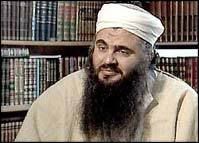
A British man held in Guantánamo Bay because of his association with the alleged militant Abu Qatada says that MI5 urged him to remain friends with the cleric so he could inform on him, according to American military documents, details of which have been learned by the Guardian.

Bisher al-Rawi, originally from Kingston upon Thames in Surrey, says MI5 reassured him that he would not get into trouble for associating with Mr Qatada.

Abu Qatada, alleged militant cleric

Now Mr Qatada is accused of being a terrorist suspect and is subject to one of the government's new control orders.

Mr Rawi alleges that intelligence agents knew Mr Qatada's location when he was supposedly in hiding after the terrorist attacks of September 11 2001, because Mr Rawi had told them.

He also alleges that he acted as a "go-between" between the radical cleric and MI5 when the authorities were saying they did not know where the alleged militant was.

Mr Qatada has been branded as Osama bin Laden's right-hand man in Europe. A video of his sermons was found in the Hamburg flat of Mohammed Atta, the leader of the September 11 hijackings.

The startling claims from Mr Rawi came during a hearing at Guantánamo Bay last year. Key sections had been kept classified by the US military authorities, and are revealed here for the first time.

Mr Rawi was arrested in Gambia while on a business trip, before being interned in Guantánamo Bay without charge or trial.

The British government has refused to represent him, because he is an Iraqi citizen, despite his many years of residence in London. His family, who are British citizens, fear that he may be released from Guantánamo only to be sent to Iraq. His American lawyers have sought an injunction to stop this.

Mr Rawi told the US military panel that he had translated for Mr Qatada, a Palestinian refugee, when he had several meetings with officials from either the British Intelligence Service or the British police: "During a meeting with British Intelligence, I had asked if it was okay for me to continue to have a relationship with Abu Qatada? They assured me it was. They just wanted to understand more about Abu Qatada and the community."

In a letter to the US panel, Mr Rawi said MI5 agents had reassured him that his relationship with Mr Qatada would not get him into trouble. "[I asked] whether it is okay to have, and continue to have a relationship with Abu Qatada? The answer was always yes. The British authorities knew of my assistance to Abu Qatada ... and it was to their advantage."

Mr Rawi called three MI5 officers he said he had contacts with for his Guantánamo hearing. The chairman of the US military tribunal said the British government had refused to cooperate. "We have contacted the British government and at this time, they are not willing to provide the tribunal with that information," the chairman said.

After the September 11 attacks, the British government passed laws allowing it to detain foreign terror suspects without charge.

Mr Qatada, who feared that he would be a target, went on the run, with the British authorities supposedly unable to find him for 10 months.

But Mr Rawi claims that intelligence agents knew exactly where Mr Qatada was. "When he disappeared I received a call from the British Intelligence Agency asking if I knew where Abu was ... I told them I did.

"I took a role as a go-between for the British Intelligence Agency and Abu Qatada," Mr Rawi said. "During the time he was supposedly in hiding from them, the British authorities knew where Abu was and they used it to their advantage."

In a Guardian interview 18 months ago, Mr Rawi's brother Wahab freely admitted that he and Bisher had assisted Mr Qatada while he was on the run.

Wahab al-Rawi said that when they were being interrogated by US agents in Gambia after they were first arrested, one US agent asked if his brother worked for British intelligence.

A number of Muslims in London doubted that the UK authorities could not find Mr Qatada when he was supposedly on the run from December 2001 to October 2002, in part because so many Muslims here knew where he was.

According to one report, this was a view shared by French intelligence, which claimed that the British secret services were shielding the cleric.

Mr Rawi told the US military panel: "My relationship with MI5 ended some time mid-summer 2002. A few months had passed before Abu Qatada was arrested. During that time, I saw Abu Qatada on a regular basis. If Abu Qatada was such a danger, why wasn't he arrested before? I am positive the British Intelligence knew where he was, because I told them."

Asked about Mr Rawi's allegations, the Home Office said: "We would not be able to comment on security matters."

By turning the war on terror into a military operation (where those who are apprehended are tried by secret military tribunals) instead of a law enforcement operation (where those arrested are prosecuted in public trials), corrupt governments are able to railroad and frame innocents, bury evidence of their own wrongdoing, and keep the citizens of a democracy in the dark. The founders of the U.S. never intended this, and terrorism is no reason to dismantle the Constitution.


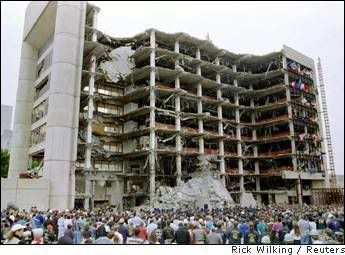
Terrorist acts are crimes. Investigatable and prosecutable, no different than any other crime. No different than the bombing of the Murrah federal building in Oklahoma City, which didn't require shredding the Constitution and holding secret tribunals offshore to bring those responsible to justice.

Wednesday, November 03, 2004

Meet The New Republicans in Congress

This one isn't exactly new, exchanging his House seat for a Senate seat.


USA Today reports:
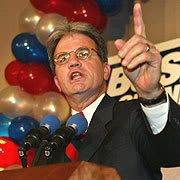
Around his hometown of Muskogee, Oklahoma's new senator is best known for delivering more than 3,000 little Okies as a family doctor.

But in Washington, Tom Coburn's former colleagues in the House of Representatives remember a maverick conservative who in 1999 almost single-handedly forced Congress to cut nearly $1 billion in spending. The Republican vows to be just as tight with taxpayers' money when he returns to Capitol Hill as a senator in January.
Coburn, 56, earned a bachelor's degree in accounting from Oklahoma State University and worked in his family's optical business for almost a decade. When the business was sold, he enrolled at the University of Oklahoma Medical School and, at age 35, became a doctor.

It's not clear whether Coburn will continue to practice one day a week, as he did while in the House, after he replaces retiring 24-year Republican Sen. Don Nickles.

Coburn initially wasn't interested in running for the Senate seat. He had just survived colon cancer and had left Washington in 2001 after a self-imposed limit of three terms in the House. Brad Carson, the Democrat he defeated Tuesday, replaced him in Oklahoma's 2nd Congressional District.

But then conservatives, including the anti-tax Club for Growth, urged him to oppose former Oklahoma City mayor Kirk Humphreys in the GOP primary. Humphreys was the choice of party leaders. Coburn couldn't resist sticking it to the establishment and ran. To the dismay of many Republicans, he won.

Coburn then bested Carson, 37, by painting the moderate Democrat as a liberal who would align himself in the Senate with Edward Kennedy and Hillary Rodham Clinton. Conservative Oklahomans opted for Coburn, a budget hawk who still talks about the need for a balanced budget, even if many of his fellow Republicans don't. He also appealed to religious conservatives with his stands against abortion and gay marriage.

But Coburn's candidacy was almost sunk by controversies of his own making.

He caused a stir when he said he favored the death penalty for "abortionists and other people who take life." He called the race with Carson a choice between "good and evil." Most damaging, he was forced to respond when reports surfaced about an old lawsuit against him by a woman who said he sterilized her without written permission.

Coburn and his wife, Carolyn, have three children.


Coburn is one of those short-sighted, fiscally-conservative, solidly-votes-with-his-fellow-Republicans-overwhelmingly kind of guy who goes to Congress to not vote. Whether it's a Defense Authorization Act, or for hydroelectric plants around the nation, or for cleaning up the nation's water supply (or locating new sources for water), Coburn takes the "not voting" route about 10% of the time. Even on legislation that has negligible financial impact, such as H CON RES 282 (Declaring the “Person of the Century” for the 20th Century to Have Been the American G.I.) and H R 3591, which would have provided for the award of a gold medal on behalf of the Congress to former President Ronald Reagan and his wife Nancy Reagan "in recognition of their service to the nation."

Some of Coburn's "not voting" calls into question his committment to his alternative profession, medicine. I mean, how can a physician not vote on H CON RES 76: Recognizing the Social Problem of Child Abuse and Neglect, and Supporting Efforts to Enhance Public Awareness of It, H CON RES 247: Expressing the Sense of Congress Regarding the Importance of Organ, Tissue, Bone Marrow, and Blood Donation and Supporting National Donor Day, S 632: Poison Control Center Enhancement and Awarenesss Act. How does a man who runs as a "good Christian" justify not voting at all on H R 2130: Hillory J. Farias and Samantha Reid Date-Rape Prevention Drug Act of 1999, or H RES 423: War on Drugs to Protect Children, or H CON RES 107: Expressing the Sense of Congress Concerning the Sexual Relationships Between Adults and Children?

According to Project Vote Smart, Coburn rates 100% with the National Right to Life Committee, 0% with Planned Parenthood, high with business groups and low with human rights groups. The Christian Coalition gives him 100%, the National PTA gives him 14%. On environmental issues, the League of Conservation Voters gives him 13%, and American Land Rights organization loves him with 93%.

Sunday, February 29, 2004

Is Daniel Ellsberg Right Again?

In the San Francisco Chronicle, Bob Cooper writes:
The Pentagon insider-turned-Bay Area activist says the parallels between Vietnam and Iraq are tragic and inescapable. Why, he asks, have our leaders failed to learn from the mistakes of 40 years ago?.

Daniel Ellsberg, 72, is hoarse after speaking for two hours last December about the similarities between the Vietnam and Iraq wars to an overflow Berkeley bookstore crowd. He knows he's drained the air out of the room with his somber monologue, so he concludes the evening by tugging scarves out of his pocket to perform some magic. A lifetime ago, his magic tricks brought smiles to the faces of Vietnamese orphans in bombed-out villages he passed through as a State Department observer from 1965 to 1967. His audiences these days are different, but they, too, appreciate the diversion.

When he wonders aloud which trick to perform, someone wisecracks, "Make Bush disappear." Laughter ripples through the store and Ellsberg grins. He wishes it were that easy. His release of the Pentagon Papers in 1971 may have shortened the Nixon presidency and the Vietnam War, but making Bush and the Iraq War disappear would be a challenge even for Houdini. Ellsberg no longer has access to the sort of secret documents that made him a '60s icon and the pre-eminent government whistle-blower in U.S. history. Now the longtime Bay Area political activist can only educate the public, one bookstore talk at a time, on why he thinks the war in Iraq is Vietnam revisited.
Ellsberg's Berkeley appearance was his 55th nationwide since publication of his American Book Award-winning "Secrets: A Memoir of Vietnam and the Pentagon Papers." The book tour is entering its 18th month as audience interest in Ellsberg's Vietnam-Iraq comparisons remains high, fueled by gloomy news from the occupation. For the middle-aged crowd, especially those who are Vietnam veterans, it's a reopening of old wounds, while for college students it's a history lesson tying their parents' war to their own. Says Ellsberg, "Sometimes I feel I'm waking up to the world I left 40 years ago."

In that world, public support for the Vietnam War was substantial until Ellsberg released the Pentagon Papers to the Senate and 19 newspapers. The 47 volumes of mostly classified documents revealed a pattern of government errors and lies about the war considered to be so inflammatory that the Supreme Court temporarily ordered the New York Times to stop publishing excerpts. Henry Kissinger, who had previously sought out Ellsberg for his expertise on Vietnam, called him "the most dangerous man in America."

Ellsberg was charged with 12 felony counts under the Espionage Act, carrying a maximum sentence of 115 years. The charges against Ellsberg and Anthony Russo (who helped him photocopy the papers) were dismissed in the fifth month of the trial, however, on grounds of governmental misconduct due to illegal wiretapping and evidence tampering. He was free to resume criticizing the government, which he's done assiduously and passionately ever since.

Duped by Our Leaders?

"We were lied into both wars in every aspect - the reasons for going in, the prospects, the length, the scale and the probable costs in lives and dollars," he tells the crowd as rain puddles the sidewalk on Shattuck Avenue. "With Iraq, the big lie is that it represented the No. 1 security threat to the U.S. That's not just questionable, it's absurd. We live in a dangerous world with al Qaeda terrorism, more than 20,000 poorly guarded Russian nuclear weapons and the unstable, nuclear-armed state of Pakistan, where Osama and other al Qaeda leaders are probably hiding. Saddam was a tyrant, but he was never linked to 9/11, and the talk of weapons of mass destruction was at least exaggerated. He wasn't even a threat to his neighbors."

Ellsberg speaks in a gravelly baritone. A swirl of white hair frames a slender, kindly face. He is formal and professorial in dress and speech, remnants of his straight-arrow days as a Harvard man (doctorate in economics), U.S. Marine commander, Rand Corporation think-tank analyst and Pentagon insider. He has studied war for most of his life, but came to a visceral understanding of it while "walking point" (leading foot patrols to draw fire) with troops in Vietnam. That was when he realized the Vietnam War was unwinnable, largely because of what he calls "revolutionary judo" - a guerrilla tactic used against U.S. troops by the Viet Cong and now by Iraqis.

"In judo, you can turn the strength of a stronger opponent against himself, " he explains. "Revolutionary judo in Vietnam often took the form of a single Viet Cong firing a shot at a U.S. chopper from a village, which prompted us to bomb the village. We thought, 'That will teach them a lesson.' But the villagers who saw relatives killed and wounded joined the other side. So our superior firepower was used against us to create support for the enemy. It's how the Viet Cong, with their handmade weapons, prevailed against massive U.S. bombing, and it's also why the Iraqi resistance is not going away."
The Vietnam War killed 58,235 Americans and an estimated 1.5 million Vietnamese, and Ellsberg fears Iraq could be just as catastrophic. Besides "revolutionary judo," he says that U.S. war planners have forgotten other lessons of Vietnam, like the need for an exit strategy and the futility of "pacification." Pacification means that locals can gradually take over for occupying troops, but Ellsberg says hired locals are always seen by fellow citizens as traitorous collaborators. Pacification attempts have consistently failed - in Afghanistan by the Russians; in Vietnam by the French and the Americans; and so far by British and American forces in Iraq.

"We perceive ourselves as liberators opposing the forces of evil," he says, "but the resistance fighters are not seen as evil by most Iraqis, nor were they in Vietnam. Iraqis think we want to occupy the country indefinitely with U.S. troops and a pro-American government, and as long as that perception exists, pacification is impossible."

At the heart of his argument is this: "The fundamental similarity shared by the Vietnam and Iraq wars is that a U.S. occupying force is facing primarily nationalist resistance fighters - locals who feel they are defending their country. These fighters can hide without being found because they have the general support of the population. This happened in our own country when the British were occupiers, but now we're the redcoats."

All the President's Men

How did we get into this mess? Ellsberg blames the president's men - notably Cheney, Rumsfeld, Wolfowitz and Perle - for channeling the outrage over Sept. 11 into an attack on a Muslim country.

Deception was the means, he says, and world oil dominance the end. "It's a lie that this war is part of the war on terror, because every day we occupy Iraq is a good recruiting day for Osama. The occupation of an Arab country increases al Qaeda's support and reduces the cooperation from Muslim countries to stop terrorism, so it actually increases the likelihood of another 9/11."

In most of the world, he adds, the Iraq invasion was seen as an act of naked aggression, comparable to Saddam's invasion of Kuwait or even Hitler's blitzkriegs of Poland and France. "Like Vietnam, this war was started as a result of distortions fed to Congress and the public by the executive branch," Ellsberg says. He witnessed the distortion game firsthand at the dawn of the Vietnam War. While working for Assistant Secretary of Defense John McNaughton in 1964, he received an urgent cable from the captain of a naval destroyer in the Tonkin Gulf describing a torpedo attack. Hours later, however, another cable from Capt. John Herrick stated that "overeager
sonarmen" had probably misinterpreted the ship's own propeller beat for torpedo hits.
"Herrick's new cable didn't slow for a moment the preparations in Washington and the Pacific for a retaliatory air strike," Ellsberg wrote in "Secrets." U.S. bombing commenced the next day, after President Johnson told the nation he had "unequivocal" evidence of an attack. Long after the war ended, Herrick and then-Secretary of Defense Robert McNamara acknowledged the ship was almost certainly never hit.

Congress also deserves some blame for both wars, says Ellsberg. The 1964 Tonkin Gulf Resolution passed overwhelmingly three days after the purported attack, handing war-making powers to Johnson. The 2002 Congress conceded war powers to Bush by passing the Iraq Military Authorization bill. "In both instances, it was unconstitutional and irresponsible for Congress to write an undated blank check to the president to start a war. Even worse, they did it on the basis of brief testimony in the case of Vietnam and no hearings at all in the case of Iraq. Although both resolutions were based on false information from the White House, that doesn't excuse Congress for abdicating its constitutional role."

Iraq War opponents do seem to have a head start on their Vietnam-era counterparts. First, he notes: "Government lying about Vietnam didn't become widely known for four years, while in Iraq the lack of weapons of mass destruction became apparent within weeks." Second, it took five years for anti- Vietnam War street protests to become as large as those that preceded the Iraq invasion. Third, the anti-war candidacy of Howard Dean that made him the early Democratic frontrunner is reminiscent of the Gene McCarthy and George McGovern presidential runs in 1968 and 1972. Richard Nixon won those two elections, however, and the troops didn't come home until Congress finally cut off funds in 1973.

"A major factor that kept us in Vietnam and that's keeping us in Iraq," says Ellsberg, "is the unwillingness by those in power to admit they made a mistake. This would be admitting that lives were wasted and it would look like they're accepting defeat. That thinking was enough to keep Vietnam going year after year. In Iraq, we would be giving up if we withdraw troops . . . but we should give up. It's not for President Bush or any other American to determine the internal policies of Iraq, and prolonging the occupation does nothing to solve Iraq's problems."

Patriot or Traitor?

Ellsberg's release of the Pentagon Papers was like kicking over a beehive. His trial made headlines for months, highlighted by the revelation that the so- called "plumbers" (assigned to plug government leaks) broke into his psychiatrist's office in an attempt to discredit him. They bungled that assignment as badly as their more famous caper, the Watergate burglary, and Ellsberg had the last laugh when they ended up behind bars instead of him. The trial's disclosures also figured in Nixon's resignation, and as an indirect result, hastened the end of the war.

Ellsberg now encourages those with access to similar documents concerning Iraq to turn them over to Congress and the press. "They can omit the portions that in any way involve national security," he says. "I have no doubt there are numerous people who have access to such documents," he says. "[Leaking them] may cost them their careers or even jail time, but it could save many lives."

His role as an unapologetic whistle-blower has caused some to call him a traitor and others a patriot, but he rejects both labels. Nor is he a strict pacifist, although he opposes military aggression. "As a boy during World War II, I believed we were on the right side because we were fighting aggression and I felt the same way about Korea when I joined the Marines. But now I am in the horrifying position of seeing my country being the aggressor."

He has been a political activist since Vietnam. He still feels guilt for not exposing government duplicity in 1964, when he first knew of it, instead of waiting several years. This guilt and haunting memories of Vietnam bloodshed drives his current anti-war work, which takes the form of writing, lecturing and nonviolent protest. He has been arrested for civil disobedience 70 times in protests against nuclear weapons, Central American interventions, the Gulf War and the Iraq War, including once last winter with his 26-year-old son, Michael, at an Iraq protest in front of U.N. Headquarters.

"I felt that Bush was leading America off a cliff with this war," says Michael of his first arrest. "The message my father is trying to get out is important, so I do what I can to help. I'm proud of what he's done in his life. " Michael edits his father's books and manages his Web site (Ellsberg.net). His father is devoting this year to finishing his most ambitious book yet, on nuclear war planning, an area of expertise going back to his Pentagon days. "I will address current dangers in light of the past, which was more dangerous than even people in the anti-nuclear movement realized," he says.

It will be grim, but not lonely, work. He shares a home with a sweeping view of the bay in Kensington, near Berkeley, with his wife of 33 years, Patricia. She insisted that their first date in 1965 was an anti-war demonstration at the Washington Monument, where he worried the whole time that his face would be spotted on the evening news by Pentagon colleagues. The ultimate odd couple, a war planner and an anti-war public radio host, argued through a five-year courtship until his opinions finally yielded to hers. The year they married in 1970, he spoke against the Vietnam War at a college teach- in, a complete turnaround from when he was sent to teach-ins by the Pentagon to defend war policy.

Puzzling Support

Three weeks after his recent bookstore appearance, he is at home, drinking tea from a heavy mug in the living room. Ceiling-high bookcases line the walls. Patricia has left for a hike with friends, while Michael, a Brown University graduate who has returned to the family home for the year, gives a salsa dancing lesson in the next room. On the table beside Ellsberg's mug is a copy of the New York Times, which reports three more U.S. deaths in Iraq.

"I suspect that troop morale is dropping quickly," he says, noticing the headline. "The military didn't want this war, it's the civilians in the White House, the Pentagon and the oil companies. Like the troops in Vietnam, these troops will begin to hate the occupation duty because they aren't safe anywhere and see no purpose in being there. I am guessing that we will soon see widespread drug abuse, with cheap heroin flooding into Iraq from Afghanistan, so we'll have drug-addicted soldiers coming home like we did during Vietnam. What's amazing to me about this war is the amount of public support that still remains."

This support puzzles him, he says, largely because government misbehavior regarding Iraq has been well established, and not only by journalists and liberals. Among the examples he raises:

-- CIA director George Tenet indicated before the war that there was no Saddam-al Qaeda link, which President Bush and Colin Powell have since admitted.

-- Former Ambassador Joseph Wilson revealed the alleged Niger-Iraq enriched uranium sale to be a hoax.

-- The CIA's former chief weapons inspector, David Kay, resigned last month and said there is almost no evidence in Iraq of WMD, which contradicts White House pre-invasion claims of WMD stockpiles.

-- British government translator Katherine Gun is on trial for releasing a classified document showing U.S. and British complicity in bugging the phones of U.N. Security Council members in an attempt to influence their votes on Iraq.

-- A U.S. Army War College report published last month called the Iraq War "unnecessary" and a "war-of-choice distraction" from the war on terrorism.

Meanwhile, the war drags on. March 20 is the one-year anniversary of the invasion, and major protests are planned in San Francisco and worldwide. The anniversary would have passed unnoticed if the war had ended within weeks or months, as expected. Instead, Coalition Forces commander Ricardo Sanchez now says U.S. troops may be in Iraq for two or more additional years.

"We stayed in Vietnam for nine years," notes Ellsberg, "even though it was clear to many people in the first year that it was unwinnable. This is also the case in Iraq, and as we're seeing, the capture of Saddam made no difference because he wasn't coordinating the resistance fighters. But we'll probably be there as long as Americans are willing to accept the casualties."

He sees a dark road ahead. "Unless our leaders learn from Vietnam, this will likely be a long, bloody, escalating stalemate, with casualties on both sides going steadily higher until we leave. Historians will regard this war as a disastrous error."

What Next?

Ellsberg urges Americans to support politicians who favor immediate troop withdrawal from Iraq; oppose Bush and members of Congress who don't; demand Congressional hearings to investigate improprieties during the White House push for war; and participate in all forms of protest against the war. He believes the huge Vietnam War protests saved hundreds of thousands of lives. "The war would have gone on even longer and nuclear weapons would have probably been used against China. Likewise, opposition to the Iraq invasion probably delayed it and slowed plans for other wars in the Middle East."

Protest while you can, he adds, because it may not be as easy in the future. "I will be happily surprised if there isn't a major terrorist attack in the U. S. in the next four years, and if Bush is in office, I think this country will shift to something very close to fascism. Ashcroft and Cheney will use an attack as an excuse to implement police controls far beyond any we've seen. That's why we need to demand a return to the Constitution and Bill of Rights now, before it's too late. Guantanamo is a concentration camp by every historic standard, but in the future there may be scores of them, and not only for Middle Easterners. Someone like myself, for simply exercising free speech like I am now, may be put in these camps without charges."

If all this sounds alarmist, it's not because Ellsberg is some wild-eyed anarchist. His analysis of foreign policy is more rational than radical, and mirrors the thinking of many respected political scientists. But he fears what kind of world he will leave to his three children and five grandchildren.

"Ours is a dangerous time with two relatively new threats, both of them exacerbated by the Iraq invasion and this administration's policies. One is the threat of future terrorism by Osama and al Qaeda. The other is the threat to our freedoms and our constitutional republic. These," he says, worry creasing his face, "are dangers that were never faced before in my lifetime."

Tuesday, September 30, 2003

Washington Insiders' New Firm Consults on Contracts in Iraq

An enterprise set up to fail: Post-war Iraq.

Post-war Iraq will be about cronyism and corruption.

The NYTimes reports:
A group of businessmen linked by their close ties to President Bush, his family and his administration have set up a consulting firm to advise companies that want to do business in Iraq, including those seeking pieces of taxpayer-financed reconstruction projects.

The firm, New Bridge Strategies, is headed by Joe M. Allbaugh, Mr. Bush's campaign manager in 2000 and the director of the Federal Emergency Management Agency until March. Other directors include Edward M. Rogers Jr., vice chairman, and Lanny Griffith, lobbyists who were assistants to the first President George Bush and now have close ties to the White House.

At a time when the administration seeks Congressional approval for $20.3 billion to rebuild Iraq, part of an $87 billion package for military and other spending in Iraq and Afghanistan, the company's Web site, www.newbridgestrategies.com, says, "The opportunities evolving in Iraq today are of such an unprecedented nature and scope that no other existing firm has the necessary skills and experience to be effective both in Washington, D.C., and on the ground in Iraq."
The site calls attention to the links between the company's directors and the two Bush administrations by noting, for example, that Mr. Allbaugh, the chairman, was "chief of staff to then-Gov. Bush of Texas and was the national campaign manager for the Bush-Cheney 2000 presidential campaign."

The president of the company, John Howland, said in a telephone interview that it did not intend to seek any United States government contracts itself, but might be a middleman to advise other companies that seek taxpayer-financed business. The main focus, Mr. Howland said, would be to advise companies that seek opportunities in the private sector in Iraq, including licenses to market products there. The existence of the company was first reported in National Journal, a weekly magazine of government and politics.

Mr. Howland said the company was not trying to promote its political connections. He said that although Mr. Allbaugh, for example, had spent most of his career "in the political arena, there's a lot of cross-pollination between that world and the one that exists in Iraq today."

As part of the administration's postwar work in Iraq, the government has awarded hundreds of millions of dollars in contracts to American businesses. Those contracts, some without competitive bidding, have included more than $500 million to support troops and extinguish oil field fires for Kellogg, Brown & Root, a subsidiary of Halliburton, which Vice President Dick Cheney led from 1995 until 2000.

Of the $3.9 billion a month that the administration is spending on military operations in Iraq, up to one-third may go to contractors who provide food, housing and other services, some military budget experts said. A spokesman for the Pentagon said today that the military could not provide an estimate of the breakdown.

Administration officials, including L. Paul Bremer III, the top American official in Iraq, have said all future contracts will be issued only as a result of competitive bidding. Already, the Web site for the Coalition Provisional Authority, http://cpa-iraq.org/, lists 36 recent solicitations, including those for contractors who might sell new AK-47 assault rifles, nine-millimeter ammunition and other goods for new army and security forces.

New Bridge Strategies was established in May and recently began full-fledged operations, including opening an office in Iraq, its officials said. They added that a decision by the Governing Council of Iraq to allow foreign companies to establish 100 percent ownership of businesses in Iraq, an unusual arrangement in the Mideast, had added to the attractiveness of the market.

Mr. Howland is a principal of Crest Investment in Houston and was president of American Rice, once a major exporter to Iraq. Richard Burt, ambassador to Germany in the Reagan administration and a former assistant secretary of state, and Lord Powell, a member of the British House of Lords and an important military and foreign-policy adviser to Prime Minister Margaret Thatcher, are among the 10 principals.

Mr. Allbaugh, the chairman, spent most of his career in Texas politics before Mr. Bush appointed him to head the federal disaster agency. Mr. Allbaugh, who now heads his own consulting firm here, did not return calls to his office today.

Mr. Rogers, the vice chairman who was a deputy assistant to the first President Bush and an executive assistant to the White House chief of staff, is also vice chairman of Barbour Griffith & Rogers, one of the best-connected Republican lobbying firms in the capital. Mr. Rogers founded it in 1991 with Haley Barbour, who became chairman of the Republican National Committee and is now running for governor of Mississippi.

Shortly after leaving the White House, Mr. Rogers was publicly rebuked by the first President Bush after he signed a $600,000 contract to represent a Saudi, Sheik Kamal Adham, who was a main figure under scrutiny in a case that involved the Bank of Commerce and Credit International. Mr. Rogers canceled his contract to represent the sheik, former head of Saudi intelligence.

Mr. Griffith, a director of the new company, is chief operating officer of Barbour Griffith & Rogers, which he joined in 1993. He was special assistant for intergovernmental affairs to the first President Bush and later worked under him as an assistant secretary of education.

Until November, Mr. Rogers's wife, Edwina, was associate director of the National Economic Council at the White House. Reached by telephone today, Mr. Rogers said he did not want to speak for the record and referred a reporter to Mr. Howland.

The company Web site says the company was "created specifically with the aim of assisting clients to evaluate and take advantage of business opportunities in the Middle East following the conclusion of the U.S.-led war in Iraq."

Wednesday, April 16, 2003

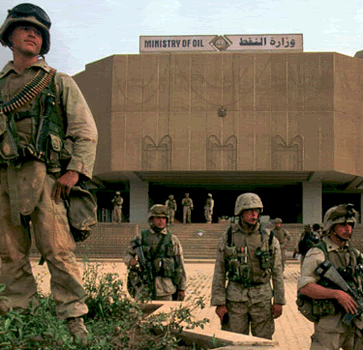
U.S. Troops Secure Iraq's Oil Ministry, Let Building Next Door Get Looted & Burned Down


Oil ministry an untouched building in ravaged Baghdad
April 16 2003, 4:26 PM

Since US forces rolled into central Baghdad a week ago, one of the sole public buildings untouched by looters has been Iraq's massive oil ministry, which is under round-the-clock surveillance by troops.

The imposing building in the Al-Mustarisiya quarter is guarded by around 50 US tanks which block every entrance, while sharpshooters are positioned on the roof and in the windows.

The curious onlooker is clearly unwelcome. Any motorist who drifts within a few metres of the main entrance is told to leave immediately.

Baghdad residents have complained that US troops should do more to protect against the looters, most of them Shi'ite Muslims repressed by Saddam Hussein's Sunni-dominated regime who live in the vast slum known as Saddam City on the northern outskirts.

But while museums, banks, hotels and libraries have been ransacked, the oil ministry remains secure.

The symbolism is loaded, considering how vehemently the United States and Britain denied war opponents' accusations that the campaign to oust Saddam was driven by oil lust.

"They came from the other side of the world. Do you believe they're going to do much for me? They've just come for the oil," fumed Salam Mohammad Hassan, a doctor who lives near the ministry.

Residents noted that the irrigation ministry, just next door, was torched.

US forces, who say they cannot prevent looting across the capital of five million, respond that they are not trying to seize Iraq's oil resources but preserve them.

"Anyone who says we're protecting this ministry to steal Iraqi oil doesn't know what's really going on in this country," US Captain Scott McDonald told AFP at the ministry gates.

The United States, he said, is only safeguarding Iraq's potential which would otherwise be considered game for looters.

"Oil belongs to the Iraqi people; it's their property. It must be protected because it'll go, indirectly, to build schools and hospitals," he said.

McDonald said a few looters had managed to sneak into the ministry-cum-fortress after US troops entered Baghdad. A few offices were robbed but nearly all files and archives remain intact, he said.

Coalition forces also say they control all of Iraq's oilfields.

Amnesty International has criticised the attention on controlling oilfields, which it said must have taken "much planning and resources."

"However, there is scarce evidence of similar levels of planning and allocation of resources for securing public and other institutions essential for the survival and well-being of the population," the London-based rights group said.

Iraq has the world's largest oil resources after Saudi Arabia, with 112 billion barrels of proven reserves.

Before the start of the war, Iraq was producing about 2.5 million barrels a day, of which just under two million were exported under UN supervision through the "oil-for-food" program.

In front of the oil ministry, a young Iraqi sat down in hopes of selling cigarettes.

"Before, lots of people would stop here to buy from me, that's why I've kept coming. But there hasn't been anyone for a few days."

Upon saying that, he was kicked out unceremoniously by a soldier.


Tuesday, April 01, 2003

March/April 2003 Issue of Mother Jones

Three decades ago, in the throes of the energy crisis, Washington's hawks conceived of a strategy for US control of the Persian Gulf's oil. Now, with the same strategists firmly in control of the White House, the Bush administration is playing out their script for global dominance.

Robert Dreyfuss for Mother Jones reports:
If you were to spin the globe and look for real estate critical to building an American empire, your first stop would have to be the Persian Gulf. The desert sands of this region hold two of every three barrels of oil in the world -- Iraq's reserves alone are equal, by some estimates, to those of Russia, the United States, China, and Mexico combined. For the past 30 years, the Gulf has been in the crosshairs of an influential group of Washington foreign-policy strategists, who believe that in order to ensure its global dominance, the United States must seize control of the region and its oil. Born during the energy crisis of the 1970s and refined since then by a generation of policymakers, this approach is finding its boldest expression yet in the Bush administration -- which, with its plan to invade Iraq and install a regime beholden to Washington, has moved closer than any of its predecessors to transforming the Gulf into an American protectorate.

In the geopolitical vision driving current U.S. policy toward Iraq, the key to national security is global hegemony -- dominance over any and all potential rivals. To that end, the United States must not only be able to project its military forces anywhere, at any time. It must also control key resources, chief among them oil -- and especially Gulf oil. To the hawks who now set the tone at the White House and the Pentagon, the region is crucial not simply for its share of the U.S. oil supply (other sources have become more important over the years), but because it would allow the United States to maintain a lock on the world's energy lifeline and potentially deny access to its global competitors. The administration "believes you have to control resources in order to have access to them," says Chas Freeman, who served as U.S. ambassador to Saudi Arabia under the first President Bush. "They are taken with the idea that the end of the Cold War left the United States able to impose its will globally -- and that those who have the ability to shape events with power have the duty to do so. It's ideology."

Iraq, in this view, is a strategic prize of unparalleled importance. Unlike the oil beneath Alaska's frozen tundra, locked away in the steppes of central Asia, or buried under stormy seas, Iraq's crude is readily accessible and, at less than $1.50 a barrel, some of the cheapest in the world to produce. Already, over the past several months, Western companies have been meeting with Iraqi exiles to try to stake a claim to that bonanza.

But while the companies hope to cash in on an American-controlled Iraq, the push to remove Saddam Hussein hasn't been driven by oil executives, many of whom are worried about the consequences of war. Nor are Vice President Cheney and President Bush, both former oilmen, looking at the Gulf simply for the profits that can be earned there. The administration is thinking bigger, much bigger, than that.

"Controlling Iraq is about oil as power, rather than oil as fuel," says Michael Klare, professor of peace and world security studies at Hampshire College and author of Resource Wars. "Control over the Persian Gulf translates into control over Europe, Japan, and China. It's having our hand on the spigot."

Ever since the oil shocks of the 1970s, the United States has steadily been accumulating military muscle in the Gulf by building bases, selling weaponry, and forging military partnerships. Now, it is poised to consolidate its might in a place that will be a fulcrum of the world's balance of power for decades to come. At a stroke, by taking control of Iraq, the Bush administration can solidify a long-running strategic design. "It's the Kissinger plan," says James Akins, a former U.S. diplomat. "I thought it had been killed, but it's back."

Akins learned a hard lesson about the politics of oil when he served as a U.S. envoy in Kuwait and Iraq, and ultimately as ambassador to Saudi Arabia during the oil crisis of 1973 and '74. At his home in Washington, D.C., shelves filled with Middle Eastern pottery and other memorabilia cover the walls, souvenirs of his years in the Foreign Service. Nearly three decades later, he still gets worked up while recalling his first encounter with the idea that the United States should be prepared to occupy Arab oil-producing countries.

In 1975, while Akins was ambassador in Saudi Arabia, an article headlined "Seizing Arab Oil" appeared in Harper's. The author, who used the pseudonym Miles Ignotus, was identified as "a Washington-based professor and defense consultant with intimate links to high-level U.S. policymakers." The article outlined, as Akins puts it, "how we could solve all our economic and political problems by taking over the Arab oil fields [and] bringing in Texans and Oklahomans to operate them." Simultaneously, a rash of similar stories appeared in other magazines and newspapers. "I knew that it had to have been the result of a deep background briefing," Akins says. "You don't have eight people coming up with the same screwy idea at the same time, independently.

"Then I made a fatal mistake," Akins continues. "I said on television that anyone who would propose that is either a madman, a criminal, or an agent of the Soviet Union." Soon afterward, he says, he learned that the background briefing had been conducted by his boss, then-Secretary of State Henry Kissinger. Akins was fired later that year.

Kissinger has never acknowledged having planted the seeds for the article. But in an interview with Business Week that same year, he delivered a thinly veiled threat to the Saudis, musing about bringing oil prices down through "massive political warfare against countries like Saudi Arabia and Iran to make them risk their political stability and maybe their security if they did not cooperate."

In the 1970s, America's military presence in the Gulf was virtually nil, so the idea of seizing control of its oil was a pipe dream. Still, starting with the Miles Ignotus article, and a parallel one by conservative strategist and Johns Hopkins University professor Robert W. Tucker in Commentary, the idea began to gain favor among a feisty group of hardline, pro-Israeli thinkers, especially the hawkish circle aligned with Democratic senators Henry Jackson of Washington and Daniel Patrick Moynihan of New York.

Eventually, this amalgam of strategists came to be known as "neoconservatives," and they played important roles in President Reagan's Defense Department and at think tanks and academic policy centers in the 1980s. Led by Richard Perle, chairman of the Pentagon's influential Defense Policy Board, and Deputy Secretary of Defense Paul Wolfowitz, they now occupy several dozen key posts in the White House, the Pentagon, and the State Department. At the top, they are closest to Vice President Cheney and Defense Secretary Donald Rumsfeld, who have been closely aligned since both men served in the White House under President Ford in the mid-1970s. They also clustered around Cheney when he served as secretary of defense during the Gulf War in 1991.

Throughout those years, and especially after the Gulf War, U.S. forces have steadily encroached on the Gulf and the surrounding region, from the Horn of Africa to Central Asia. In preparing for an invasion and occupation of Iraq, the administration has been building on the steps taken by military and policy planners over the past quarter century.

Step one: The Rapid Deployment Force
In 1973 and '74, and again in 1979, political upheavals in the Middle East led to huge spikes in oil prices, which rose fifteenfold over the decade and focused new attention on the Persian Gulf. In January 1980, President Carter effectively declared the Gulf a zone of U.S. influence, especially against encroachment from the Soviet Union. "Let our position be absolutely clear," he said, announcing what came to be known as the Carter Doctrine. "An attempt by any outside force to gain control of the Persian Gulf region will be regarded as an assault on the vital interests of the United States of America, and such an assault will be repelled by any means necessary, including military force." To back up this doctrine, Carter created the Rapid Deployment Force, an "over-the-horizon" military unit capable of rushing several thousand U.S. troops to the Gulf in a crisis.

Step two: The Central Command
In the 1980s, under President Reagan, the United States began pressing countries in the Gulf for access to bases and support facilities. The Rapid Deployment Force was transformed into the Central Command, a new U.S. military command authority with responsibility for the Gulf and the surrounding region from eastern Africa to Afghanistan. Reagan tried to organize a "strategic consensus" of anti-Soviet allies, including Turkey, Israel, and Saudi Arabia. The United States sold billions of dollars' worth of arms to the Saudis in the early '80s, from AWACS surveillance aircraft to F-15 fighters. And in 1987, at the height of the war between Iraq and Iran, the U.S. Navy created the Joint Task Force-Middle East to protect oil tankers plying the waters of the Gulf, thus expanding a U.S. naval presence of just three or four warships into a flotilla of 40-plus aircraft carriers, battleships, and cruisers.

Step three: The Gulf War
Until 1991, the United States was unable to persuade the Arab Gulf states to allow a permanent American presence on their soil. Meanwhile, Saudi Arabia, while maintaining its close relationship with the United States, began to diversify its commercial and military ties; by the time U.S. Ambassador Chas Freeman arrived there in the late Ô80s, the United States had fallen to fourth place among arms suppliers to the kingdom. "The United States was being supplanted even in commercial terms by the British, the French, even the Chinese," Freeman notes.

All that changed with the Gulf War. Saudi Arabia and other Gulf states no longer opposed a direct U.S. military presence, and American troops, construction squads, arms salesmen, and military assistance teams rushed in. "The Gulf War put Saudi Arabia back on the map and revived a relationship that had been severely attrited," says Freeman.

In the decade after the war, the United States sold more than $43 billion worth of weapons, equipment, and military construction projects to Saudi Arabia, and $16 billion more to Kuwait, Qatar, Bahrain, and the United Arab Emirates, according to data compiled by the Federation of American Scientists. Before Operation Desert Storm, the U.S. military enjoyed the right to stockpile, or "pre-position," military supplies only in the comparatively remote Gulf state of Oman on the Indian Ocean. After the war, nearly every country in the region began conducting joint military exercises, hosting U.S. naval units and Air Force squadrons, and granting the United States pre-positioning rights. "Our military presence in the Middle East has increased dramatically," then-Defense Secretary William Cohen boasted in 1995.

Another boost to the U.S. presence was the unilateral imposition, in 1991, of no-fly zones in northern and southern Iraq, enforced mostly by U.S. aircraft from bases in Turkey and Saudi Arabia. "There was a massive buildup, especially around Incirlik in Turkey, to police the northern no-fly zone, and around [the Saudi capital of] Riyadh, to police the southern no-fly zone," says Colin Robinson of the Center for Defense Information, a Washington think tank. A billion-dollar, high-tech command center was built by Saudi Arabia near Riyadh, and over the past two years the United States has secretly been completing another one in Qatar. The Saudi facilities "were built with capacities far beyond the ability of Saudi Arabia to use them," Robinson says. "And that's exactly what Qatar is doing now."

Step four: Afghanistan
The war in Afghanistan -- and the open-ended war on terrorism, which has led to U.S strikes in Yemen, Pakistan, and elsewhere -- further boosted America's strength in the region. The administration has won large increases in the defense budget -- which now stands at about $400 billion, up from just over $300 billion in 2000 -- and a huge chunk of that budget, perhaps as much as $60 billion, is slated to support U.S. forces in and around the Persian Gulf. Military facilities on the perimeter of the Gulf, from Djibouti in the Horn of Africa to the island of Diego Garcia in the Indian Ocean, have been expanded, and a web of bases and training missions has extended the U.S. presence deep into central Asia. From Afghanistan to the landlocked former Soviet republics of Uzbekistan and Kyrgyzstan, U.S. forces have established themselves in an area that had long been in Russia's sphere of influence. Oil-rich in its own right, and strategically vital, central Asia is now the eastern link in a nearly continuous chain of U.S. bases, facilities, and allies stretching from the Mediterranean and the Red Sea far into the Asian hinterland.

Step five: Iraq
Removing Saddam Hussein could be the final piece of the puzzle, cementing an American imperial presence. It is "highly possible" that the United States will maintain military bases in Iraq, Robert Kagan, a leading neoconservative strategist, recently told the Atlanta Journal-Constitution. "We will probably need a major concentration of forces in the Middle East over a long period of time," he said. "When we have economic problems, it's been caused by disruptions in our oil supply. If we have a force in Iraq, there will be no disruption in oil supplies."

Kagan, along with William Kristol of the Weekly Standard, is a founder of the think tank Project for the New American Century, an assembly of foreign-policy hawks whose supporters include the Pentagon's Perle, New Republic publisher Martin Peretz, and former Central Intelligence Agency director James Woolsey. Among the group's affiliates in the Bush administration are Cheney, Rumsfeld, and Wolfowitz; I. Lewis Libby, the vice president's chief of staff; Elliott Abrams, the Middle East director at the National Security Council; and Zalmay Khalilzad, the White House liaison to the Iraqi opposition groups. Kagan's group, tied to a web of similar neoconservative, pro-Israeli organizations, represents the constellation of thinkers whose ideological affinity was forged in the Nixon and Ford administrations.

To Akins, who has just returned from Saudi Arabia, it's a team that looks all too familiar, seeking to implement the plan first outlined back in 1975. "It'll be easier once we have Iraq," he says. "Kuwait, we already have. Qatar and Bahrain, too. So it's only Saudi Arabia we're talking about, and the United Arab Emirates falls into place."

LAST SUMMER, Perle provided a brief glimpse into his circle's thinking when he invited rand Corporation strategist Laurent Murawiec to make a presentation to his Defense Policy Board, a committee of former senior officials and generals that advises the Pentagon on big-picture policy ideas. Murawiec's closed-door briefing provoked a storm of criticism when it was leaked to the media; he described Saudi Arabia as the "kernel of evil," suggested that the Saudi royal family should be replaced or overthrown, and raised the idea of a U.S. occupation of Saudi oil fields. He ultimately lost his job when rand decided he was too controversial.

Murawiec is part of a Washington school of thought that views virtually all of the nations in the Gulf as unstable "failed states" and maintains that only the United States has the power to forcibly reorganize and rebuild them. In this view, the arms systems and bases that were put in place to defend the region also provide a ready-made infrastructure for taking over countries and their oil fields in the event of a crisis.

The Defense Department likely has contingency plans to occupy Saudi Arabia, says Robert E. Ebel, director of the energy program at the Center for Strategic and International Studies (CSIS), a Washington think tank whose advisers include Kissinger; former Defense Secretary and CIA director James Schlesinger; and Zbigniew Brzezinski, Carter's national security adviser. "If something happens in Saudi Arabia," Ebel says, "if the ruling family is ousted, if they decide to shut off the oil supply, we have to go in."

Two years ago, Ebel, a former mid-level CIA official, oversaw a CSIS task force that included several members of Congress as well as representatives from industry including ExxonMobil, Arco, BP, Shell, Texaco, and the American Petroleum Institute. Its report, "The Geopolitics of Energy Into the 21st Century," concluded that the world will find itself dependent for many years on unstable oil-producing nations, around which conflicts and wars are bound to swirl. "Oil is high-profile stuff," Ebel says. "Oil fuels military power, national treasuries, and international politics. It is no longer a commodity to be bought and sold within the confines of traditional energy supply and demand balances. Rather, it has been transformed into a determinant of well-being, of national security, and of international power."

As vital as the Persian Gulf is now, its strategic importance is likely to grow exponentially in the next 20 years. Nearly one out of every three barrels of oil reserves in the world lie under just two countries: Saudi Arabia (with 259 billion barrels of proven reserves) and Iraq (112 billion). Those figures may understate Iraq's largely unexplored reserves, which according to U.S. government estimates may hold as many as 432 billion barrels.

With supplies in many other regions, especially the United States and the North Sea, nearly exhausted, oil from Saudi Arabia and Iraq is becoming ever more critical -- a fact duly noted in the administration's National Energy Policy, released in 2001 by a White House task force. By 2020, the Gulf will supply between 54 percent and 67 percent of the world's crude, the document said, making the region "vital to U.S. interests." According to G. Daniel Butler, an oil-markets analyst at the U.S. Energy Information Administration (EIA), Saudi Arabia's production capacity will rise from its current 9.4 million barrels a day to 22.1 million over the next 17 years. Iraq, which in 2002 produced a mere 2 million barrels a day, "could easily be a double-digit producer by 2020," says Butler.

U.S. strategists aren't worried primarily about America's own oil supplies; for decades, the United States has worked to diversify its sources of oil, with Venezuela, Nigeria, Mexico, and other countries growing in importance. But for Western Europe and Japan, as well as the developing industrial powers of eastern Asia, the Gulf is all-important. Whoever controls it will maintain crucial global leverage for decades to come.

Today, notes the EIA's Butler, two-thirds of Gulf oil goes to Western industrial nations. By 2015, according to a study by the CIA's National Intelligence Council, three-quarters of the Gulf's oil will go to Asia, chiefly to China. China's growing dependence on the Gulf could cause it to develop closer military and political ties with countries such as Iran and Iraq, according to the report produced by Ebel's CSIS task force. "They have different political interests in the Gulf than we do," Ebel says. "Is it to our advantage to have another competitor for oil in the Persian Gulf?"

David Long, who served as a U.S. diplomat in Saudi Arabia and as chief of the Near East division in the State Department's Bureau of Intelligence and Research during the Reagan administration, likens the Bush administration's approach to the philosophy of Admiral Mahan, the 19th-century military strategist who advocated the use of naval power to create a global American empire. "They want to be the world's enforcer," he says. "It's a worldview, a geopolitical position. They say, 'We need hegemony in the region.'"

UNTIL THE 1970s, the face of American power in the Gulf was the U.S. oil industry, led by Exxon, Mobil, Chevron, Texaco, and Gulf, all of whom competed fiercely with Britain's BP and Anglo-Dutch Shell. But in the early '70s, Iraq, Saudi Arabia, and the other Gulf states nationalized their oil industries, setting up state-run companies to run wells, pipelines, and production facilities. Not only did that enhance the power of opec, enabling that organization to force a series of sharp price increases, but it alarmed U.S. policymakers.

Today, a growing number of Washington strategists are advocating a direct U.S. challenge to state-owned petroleum industries in oil-producing countries, especially the Persian Gulf. Think tanks such as the American Enterprise Institute, the Heritage Foundation, and CSIS are conducting discussions about privatizing Iraq's oil industry. Some of them have put forward detailed plans outlining how Iraq, Saudi Arabia, and other nations could be forced to open up their oil and gas industries to foreign investment. The Bush administration itself has been careful not to say much about what might happen to Iraq's oil. But State Department officials have had preliminary talks about the oil industry with Iraqi exiles, and there have been reports that the U.S. military wants to use at least part of the country's oil revenue to pay for the cost of military occupation.

"One of the major problems with the Persian Gulf is that the means of production are in the hands of the state," Rob Sobhani, an oil-industry consultant, told an American Enterprise Institute conference last fall in Washington. Already, he noted, several U.S. oil companies are studying the possibility of privatization in the Gulf. Dismantling government-owned oil companies, Sobhani argued, could also force political changes in the region. "The beginning of liberal democracy can be achieved if you take the means of production out of the hands of the state," he said, acknowledging that Arabs would resist that idea. "It's going to take a lot of selling, a lot of marketing," he concluded.

Just which companies would get to claim Iraq's oil has been a subject of much debate. After a war, the contracts that Iraq's state-owned oil company has signed with European, Russian, and Chinese oil firms might well be abrogated, leaving the field to U.S. oil companies. "What they have in mind is denationalization, and then parceling Iraqi oil out to American oil companies," says Akins. "The American oil companies are going to be the main beneficiaries of this war."

The would-be rulers of a post-Saddam Iraq have been thinking along the same lines. "American oil companies will have a big shot at Iraqi oil," says Ahmad Chalabi, leader of the Iraqi National Congress, a group of aristocrats and wealthy Iraqis who fled the country when its repressive monarchy was overthrown in 1958. During a visit to Washington last fall, Chalabi held meetings with at least three major U.S. oil companies, trying to enlist their support. Similar meetings between Iraqi exiles and U.S. companies have also been taking place in Europe.

"Iraqi exiles have approached us, saying, 'You can have our oil if we can get back in there,'" says R. Gerald Bailey, who headed Exxon's Middle East operations until 1997. "All the major American companies have met with them in Paris, London, Brussels, all over. They're all jockeying for position. You can't ignore it, but you've got to do it on the QT. And you can't wait till it gets too far along."

But the companies are also anxious about the consequences of war, according to many experts, oil-company executives, and former State Department officials. "The oil companies are caught in the middle," says Bailey. Executives fear that war could create havoc in the region, turning Arab states against the United States and Western oil companies. On the other hand, should a U.S. invasion of Iraq be successful, they want to be there when the oil is divvied up. Says David Long, the former U.S. diplomat, "It's greed versus fear."

Ibrahim Oweiss, a Middle East specialist at Georgetown University who coined the term "petrodollar" and has also been a consultant to Occidental and BP, has been closely watching the cautious maneuvering by the companies. "I know that the oil companies are scared about the outcome of this," he says. "They are not at all sure this is in the best interests of the oil industry."

Anne Joyce, an editor at the Washington-based Middle East Policy Council who has spoken privately to top Exxon officials, says it's clear that most oil-industry executives "are afraid" of what a war in the Persian Gulf could mean in the long term -- especially if tensions in the region spiral out of control. "They see it as much too risky, and they are risk averse," she says. "They think it has 'fiasco' written all over it."


Technorati Tags: , , , , , , , , , ,, , , , , , , , , , , , , , , , , , , , , , categories, , , , , , , , , , , , , , , , , , , , , , , , , , , , , , , , , , , , , , , , , , , , , ,