Showing posts with label privatization. Show all posts

Monday, May 12, 2008

The Price of Freedom

Pennsylvania Gets Offers For Turnpike


The Wall Street Journal reports:
At least two bidding groups submitted undisclosed cash offers late Friday for the 75-year lease of the Pennsylvania Turnpike, in what could represent one of the largest deals in the coveted U.S. infrastructure sector.

One of the bidding groups is led by Spanish toll-road operator Abertis Infraestructuras SA and includes undisclosed financial partners, a company official said Saturday. A person familiar with the situation said another binding bid was filed by Spain's Cintra Concesiones de Infraestructura de Transporte SA in partnership with Australia's Macquarie Infrastructure Group.

Investment bank Morgan Stanley advised Pennsylvania's government that a long-term lease of its Turnpike can cover the $1.7 billion for its annual highway and transit needs, estimating the value of the 500-mile highway at $12 billion to $18 billion.
Disclosed terms of the proposed 75-year lease of the Pennsylvania Turnpike are similar to the privatization of Chicago's Skyway and the Indiana Toll Road. The city of Chicago raised $1.83 billion in 2005 by leasing its Chicago Skyway for 99 years. Indiana, in turn, obtained $3.85 billion in 2006 through the 75-year lease of the Indiana Toll Road. Both deals allow significant toll hikes over the long run, and both were won by Cintra and Macquarie.

The proposed formula for toll increases at the Pennsylvania Turnpike includes a 25% hike set for next year. Tolls can then match inflation or rise annually by at least 2.5%. Pennsylvania's government believes such a tolling formula benefits drivers, as it won't be required to toll other highways.

Thursday, August 16, 2007

The Caged Life

For a nation that prides itself on freedom, the United States has among the highest incarceration rates in the world.

More people are behind bars in the United States than any other country. As of 2006, a record 7 million people were behind bars, on probation or on parole. Of the total, 2.2 million were incarcerated. The People's Republic of China ranks second with 1.5 million. The United States has 5% of the world's population and 25% of the world's incarcerated population.

The U.S. has a high amount of non-violent and victimless offenders incarcerated; half of all persons incarcerated under state jurisdiction are for non-violent offenses, and 20% are incarcerated for drug offences. 270,000 illegal immigrants served jail time in 2003, representing 21% of the federal prison population. It is estimated that currently 27% of federal prison inmates are criminal aliens, noncitizens convicted of crimes while in this country legally or illegally. Criminal justice policy in the United States has also been criticized for the disproportionate representation of blacks and other minorities.

The U.S. spends an estimated $60 billion each year on corrections. The population of inmates housed in prisons and jails in the United States exceeds 2 million, with the per capita incarceration population higher than that officially reported by any other country. Prisons are an industry in America, and growing annually.

Like everything else in America, the prison industrial complex is going privatized. The argument for privatization stresses cost reduction, whereas the arguments against it focus on standards of care, and the question of whether a market economy for prisons might not also lead to a market demand for prisoners (tougher sentencing for cheap labor). There is also the problem of a lack of oversight.

While privatized prisons have only a short history, there is a long tradition of inmates in state and federal-run prisons undertaking active employment in prison for low pay. Three of the leading corporations in the private prison business in the U.S. are the Corrections Corporation of America, the GEO Group, and Cornell Companies. Private companies which provide services to prisons combine in the American Correctional Association, which advocates legislation favorable to the industry.

This is the story of one prisoner in the U.S. prison system.
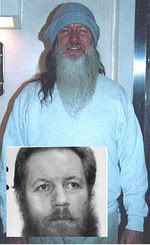
Is Thomas Silverstein a prisoner of his own deadly past — or the first in a new wave of locked-down lifer?

For Denver's Westword News, Alan Prendergast writes:
When the goon squad showed up at his place at five in the morning, Tommy Silverstein knew something was up. He wasn't accustomed to greeting guests at such an ungodly hour — much less a team of corrections officers, helmeted and suited up for action.

In fact, Silverstein wasn't used to company at any hour. His home was a remote cell, known as the Silverstein Suite, in the special housing unit of the federal penitentiary at Leavenworth, Kansas. He'd been cut off from other inmates and all but a few emissaries from the outside world for more than two decades.

He stayed in the Silverstein Suite 23 hours a day. His interactions with staff typically amounted to some tight-lipped turnkey delivering his food through a slot in the cell door. The only change of scenery came when an electronic door slid open, allowing him an hour's solitary exercise in an adjoining recreation cage. Visitors were rarely permitted, and entire years had gone by during which he never left the cell.

But this day was different. Silverstein could think of only a couple of reasons why so many well-padded, well-equipped officers would be at his door, ordering him to strip for a search. Cell shakedown? Time for a game of hockey, with Tommy as the puck? No, that was a captain leading the squad. Something big.

A transfer.

So it came to pass that on July 12, 2005, U.S. Bureau of Prisons inmate #14634-116 left his cage in Kansas for one in Colorado. Security for the move was tighter than Borat's Speedo — about what you'd expect for a former Aryan Brotherhood leader convicted of killing four men behind prison walls. (One conviction was later overturned; Silverstein disputes the second slaying but admits the other two.) The object of all this fuss didn't mind the goon squad. He was enjoying the view — and hoping that the move signaled the end to his eight-thousand-plus days of solitary confinement. Maybe, just maybe, his decades of uneventful good behavior had paid off.

"They said for me to keep my nose clean, and maybe one day it'd happen," he recalled recently. "So I foolishly thought this was it. If you saw me in that van, you'd think I was Disneyland-bound, smiling all the way."

But the smile vanished after Silverstein reached his destination: the U.S. Penitentiary Administrative Maximum, better known as ADX. Located two miles outside of the high-desert town of Florence, ADX is the most secure prison in the country, a hunkered-down maze of locks, alarms and electronic surveillance, designed to house gang leaders, terrorists, drug lords and other high-risk prisoners in profound isolation. Its current guest list is a who's who of enemies of the state, including Unabomber Ted Kaczynski, shoe bomber Richard Reid, plane bomber Dandenis Muñoz Mosquera, abortion clinic bomber Eric Rudolph and double-agent Robert Hanssen.

When it opened in 1994, ADX was hailed as the solution to security flaws at even the highest levels of the federal prison system. Much of the justification for building the place stemmed from official outrage at the brutal murders of two guards in the control unit of the federal pen in Marion, Illinois, during a single 24-hour period in 1983. The first of those killings was committed by Thomas Silverstein, who was already facing multiple life sentences for previous bloodshed at Marion. The slaying of corrections officer Merle Clutts placed Silverstein under a "no human contact" order that's prevailed ever since, and it gave the Bureau of Prisons the perfect rationale for building its high-tech supermax. Although he never bunked there until 2005, you could call ADX the House that Tommy Built.

What greeted Silverstein two years ago was nothing like Disneyland. His hosts hustled him down long, sterile corridors with gleaming black-and-white checkerboard floors that reminded him of A Clockwork Orange or some other cinematic acid trip. One set of doors, then another and another, until he finally arrived at the ass-end of Z Unit, on a special range with only four cells, each double-doored. His new home was less than half the size of the Silverstein Suite and consisted of a steel slab with a thin mattress, a steel stool and desk, a steel sink-and-toilet combination, a steel shower and a small black-and-white TV.

Stripped of most of his small store of personal belongings, Silverstein had little to do besides take stock of his eighty-square-foot digs. The Silverstein Suite was a penthouse at the Plaza compared to this place. There were steel rings on the sides of the bed platform, ready for "four-pointing" difficult inmates. A camera mounted on the ceiling to record his every move. If he stood on the stool and peered out the heavily meshed window, he could get a glimpse of a concrete recreation cage and something like sky. So this was his reward for all those years of following the rules — 24-hour surveillance in his own desolate corner of the Alcatraz of the Rockies. He was no longer simply in the belly of the beast. He was, he would later write, "stuck in its bowels, with no end/exit in sight."

The double doors muffled sound from outside. But over time, Silverstein realized that there was one other prisoner on the range. He shouted greetings. The man shouted back. He asked the man how long he'd been in the unit. Four years, the man said.

Silverstein told the man his name. His neighbor introduced himself: Yousef. Ramzi Yousef. Convicted of the 1993 World Trade Center bombing, the one that killed six people and injured a thousand. Nephew of Khalid Sheikh Mohammed, the al-Qaeda leader who recently confessed to planning that failed effort to bring down the towers as well as the 9/11 attacks.

His keepers had put Silverstein in the beast's bowels, all right — right next to the one man in the entire federal system more loathed than he was. Still, it was somebody to talk to. Shouting to Yousef was the first conversation with another inmate that Silverstein had managed in almost twenty years.

But talking wasn't allowed. Within days, a new barrier was erected in the corridor outside his cell, preventing any further communication between the two residents of the range. Inmate #14634-116's transfer to ADX was now complete.

Entombed, Terrible Tommy was alone again. Naturally.

In the late 1980s, Pete Earley, a former Washington Post reporter, persuaded Bureau of Prison officials to grant him an unprecedented degree of access to inmates and staff at the Leavenworth penitentiary. Earley was allowed to walk the yard without an escort, to interview inmates without official monitoring, to talk candidly with veteran corrections officers about the dangers and frustrations of their work.

The resulting book, The Hot House: Life Inside Leavenworth Prison, is one of the most vivid works of prison reportage ever published. Among several unsettling portraits of career criminals and their keepers, the most memorable character is probably one Thomas Silverstein, who was then being housed, a la Hannibal Lecter, in a zoo-like cage in Leavenworth's basement, where the fluorescent lights stayed on around the clock to make it easier to watch him. Wild-haired and bearded — the BOP would not allow him a razor or a comb — Silverstein spent hours talking into Earley's tape recorder, describing his violent past and the petty torments he claimed the guards were putting him through in an effort to drive him insane.

Earley's book made Leavenworth's dungeon monster seem not only rational but quite possibly human. Granting a journalist unfettered access to him was a public relations blunder the BOP has been unwilling to repeat. Silverstein hasn't been allowed to have a face-to-face interview with a reporter for the past fifteen years. When Westword recently asked to visit him, ADX warden Ron Wiley promptly denied the request, citing "continued security concerns." But then, Wiley and his predecessors haven't let any journalist inside ADX to interview any inmate since 2001 because of "continued security concerns" (see related story).

Although he readily agreed to an interview with Westword, Silverstein isn't a huge fan of the press, either. He remains friendly with Earley, but he's learned to be wary of hit-and-run tabloid writers following in his wake, eager to write about "the most dangerous prisoner in America." Most of what the outside world knows about him, if it pays any attention at all, is the fragmentary image presented in The Hot House; he's a captive of his own legend, like some prehistoric insect trapped in amber. His letters seethe with contempt for lazy "plagiarists" who have simply appropriated snatches of Earley's account as well as for those who've produced long magazine pieces or cheeseball cable programs about the Aryan Brotherhood that largely rely on the lurid tales of government snitches.

"For some odd reason the media pees when Master snaps his fingers," he wrote recently. "I wouldn't call 'em 'mainstream' any more cuz there isn't anything mainstream about 'em. They're just lackeys for the powers that be."

Silverstein's response to the "injurious lies" spread about him has been to launch his own information campaign at www.tommysilverstein.com. That's right — America's most solitary prisoner, a man who's been inside since before the personal computer was invented and has never been allowed near one, has his own website, maintained by outside supporters who forward messages to him and post his responses.

"He's got a pretty impressive network," says Terry Rearick, a California private investigator who has communicated with Silverstein by letter and phone over several years. After the two lost touch for a time, Rearick got a call from a woman in England on Silverstein's behalf.

The same woman posts regularly on the website, where Silverstein himself duels at length with his detractors. (A similarly heated debate has ignited over the wording of Silverstein's entry on Wikipedia; his defenders and his critics alternately revise the account to suit their competing versions of his crimes.) Some visitors to his site dismiss him as a textbook psychopath. But Silverstein contends that if people understood the grim context in which the killings at Marion took place, the snitch games and psychological warfare and organized violence of prison life, they wouldn't be so quick to demonize him.

It's a strangely disconnected argument — a garbled dialogue between cultures on different planets. Most of the visitors to his website know little about Silverstein's world, just as he knows little about theirs. He's been in prison for the past 32 years, and much of what he's learned about life on the street since he was put in solitary in 1983 has come from reading or watching television. No American prisoner, not even Robert Stroud, the Birdman of Alcatraz, has ever been condemned to such a walled-off existence for such a long period of time. Many of Stroud's years of solitary confinement were spent in relative ease at Leavenworth; he had not only frequent visitors, but also a full-time secretary. Even his seventeen-year stretch in Alcatraz allowed for much more daily communication with others than Silverstein has had.

"I'm amazed that he's not stark, raving mad," says Paul Wright, the editor of Prison Legal News, who's corresponded with Silverstein for years and published some of his writing. "He's been in total isolation for almost 25 years. The only people I can think of that have been held in anything remotely like this in modern times are some of the North Korean spies held in South Korea."

Yet the no-contact conditions imposed on Silverstein are becoming less unique by the day. There are now 31 supermax prisons in the country, with more under construction, including Colorado's own 948-bed sequel to the current state supermax, known as Colorado State Penitentiary II. They are costly on several levels — the operational expense per cell can be double that of a less-secure prison, and the rate of mental illness in solitary confinement far exceeds that of the general prison population — but lockdown prisons are all the rage with a vengeful public. Increasingly, they are being used not for short-term punishment (disciplinary segregation) but for long-term confinement of hard-to-manage inmates (administrative segregation), whose privileges keep shrinking. Colorado, for example, no longer allows journalists to interview its supermax inmates except by mail.

"The phenomenon is disturbingly common," says David Fathi, a staff attorney for the ACLU's National Prison Project. "If it's disciplinary confinement, it's finite — when you're done, you're done. But with administrative segregation, there's a real lack of transparency about what a prisoner can do to earn his way out."

In the federal system, the past decade has seen the rise of "special administrative measures," or SAMs, which are imposed on terrorists or other inmates whose communications with the outside world "could result in death or serious bodily injury to persons." There are now at least two dozen SAMs cases in federal prisons, including Yousef and Zacarias Moussaoui, whose access to mail, phone calls, media interviews or other visits are extremely limited or banned outright. At present the restrictions must be approved by the U.S. Attorney General, but the Bush administration is considering changes that would allow wardens at ADX or other high-security prisons to designate inmates as terror threats and thus ban them from all media contact — even if they haven't been convicted on terrorism charges yet, Fathi notes.

Silverstein isn't a SAMs case. He still has his website and his mail (although he claims it's frequently withheld or "messed with" in other ways). But he may be the prototype of what the government has in mind for other infamous prisoners — to bury them in strata of supermax security to the point of oblivion.

Responding in letters to questions about the psychological impact of his isolation, Silverstein struggles to find the right words. "Trying to explain it is like trying to explain what an endless toothache feels like," he writes. "I wish I could paint what it's like."

In an article a few years ago, he called solitary confinement "a slow constant peeling of the skin, stripping of the flesh, the nerve-wracking sound of water dripping from a leaky faucet in the still of the night while you're trying to sleep. Drip, drip, drip, the minutes, hours, days, weeks, months, years, constantly drip away with no end or relief in sight."

In a Darwinian world, predators have to adapt or die, just like their prey. Tommy Silverstein arrived in the federal prison system at a critical phase of its evolution, when the number of inmate assaults on other inmates and staff was rising sharply and officials were looking at the idea of control units as a way to neutralize the growing threat posed by prison gangs. Silverstein quickly became a symbol of the problem — and the inadequacy of the proposed solution. It's not a stretch to say that the Marion control unit helped to make him what he became, just as the mayhem that erupted there helped to reshape the American prison system.

Before he reached the nether regions of the BOP, Silverstein's criminal career had been thoroughly unremarkable. Born in 1952 in California, he'd grown up in a middle-class neighborhood in Long Beach, but he was bullied by other kids who thought he was Jewish. (According to The Hot House, Silverstein's biological father was a man named Thomas Conway, whom his mother divorced when Tommy was four years old; she later married a man named Silverstein.) As a teenager, he ripped off houses for money to buy drugs; his sister, Sydney McMurray, says he was battling a heroin addiction and problems with his volatile, controlling mother.

"We were taught never to throw the first punch, but never to walk away from a fight," McMurray recalls. "My brother started getting into trouble because he was running away from a violent environment at home. Then he got into drugs, and he became a brother I never knew."

At nineteen, Silverstein landed in San Quentin for armed robbery. Paroled, he was soon arrested again for series of robberies — pulled with Conway and another relative — that yielded less than $1,400. This time, he went into the federal system on a fifteen-year jolt. He was 23 years old, and his life on the streets was already over.

At Leavenworth Silverstein became closely associated with Aryan Brotherhood members who allegedly controlled the heroin trade inside the prison — close enough that when convict Danny Atwell was found stabbed to death, supposedly because he'd refused to be a mule for the heroin business, Silverstein and two other AB members were charged with the murder. In 1980, he was convicted at trial on the basis of shifting testimony from other inmates and sentenced to life in prison. A federal appeals court later ruled that much of the testimony should never have been allowed and threw out the conviction. But by that time, Silverstein was in the Marion penitentiary and facing more murder charges.

Marion opened in 1963, the same year that Alcatraz closed. It was intended to be not just a replacement for the Rock but an improvement, with a more open design and modern rehabilitation programs. Yet by the late 1970s, it had the most restrictive segregation unit in the BOP; not coincidentally, it was also the most violent prison in America, a dumping ground for gang leaders and crazies. Between 1979 and 1983, the prison logged 81 inmate assaults on other inmates and 44 on staff; 13 prisoners were killed. BOP reports issued in 1979 and 1981 proposed turning the entire facility into a "closed-unit operation."

Confined to a one-man cell in the control unit 23 hours a day, Silverstein says he spent much of his time learning how to draw and paint. [Silverstein's artwork.] "I could hardly read, write or draw when I first fell," he explains. "But most of us lifers are down for so long and have so much time to kill that we actually fool around and discover our niche in life, often in ways we never even dreamt possible on the streets. We not only find our niche, we excel."

Prison officials worried that Silverstein was finding his niche in other areas, too. Long-simmering disputes between white and black gangs had a way of coming to a boil in the control unit. In 1981, D.C. Blacks member Robert Chappelle was found dead in his cell. He'd apparently been sleeping with his head close to the bars and had been strangled with a wire slipped around his neck, plied by someone exercising on the tier. Silverstein and another convicted killer, Clayton Fountain, received life sentences for the crime; inmates who testified for the prosecution claimed the two had boasted of it.

Silverstein has always denied killing Chappelle. (Another inmate later claimed to have done the deed, but investigators found his confession at odds with the facts.) Yet even if he hadn't been convicted in court, the suspicion that he was responsible was sufficient to trigger more violence. Shortly after the slaying, the BOP saw fit to transfer one of Chappelle's closest friends, D.C. Blacks leader Raymond "Cadillac" Smith, to the Marion control unit from another prison. Within days, Smith had tried to stab Silverstein and shoot him with a zip gun. Silverstein and Fountain responded by cutting their way out of an exercise cage with a piece of hacksaw blade and paying a visit to Smith while he was in the shower. Smith was stabbed 67 times, in what Silverstein still describes as an act of convict self-defense.

"Everyone knew what was going on and no one did anything to keep us apart," he told Earley. "The guards wanted one of us to kill the other."

At the time, there was no federal death penalty for inmate homicides — and not much the system could do to Silverstein, who was already serving multiple life sentences in the worst unit of the worst prison the BOP had to offer. But some staffers, concerned about Silverstein's outsized rep among white inmates, apparently did their best to keep him in check. In the months that followed Cadillac's death, Silverstein began to regard Officer Merle Clutts, a bull-headed regular of the control unit, as his chief tormentor.

Silverstein has given different explanations about what Clutts did to deserve such attention. Clutts trashed his cell during shakedowns and withheld mail; he smudged his artwork and taunted him; he even tried to set him up for attack by other inmates, Silverstein has suggested. Silverstein claims he told Earley "the whole story," but only pieces made it into The Hot House. Earley won't comment, saying he no longer discusses Silverstein with other reporters because of past misunderstandings.

The BOP has denied that Clutts harassed Silverstein. Whatever the source of the feud might have been, there's no question that Silverstein became fixated on Clutts. One study by Harvard psychiatrist Stuart Grassian suggests that prisoners in control units sometimes experience "the emergence of primitive, aggressive fantasies of revenge, torture, and mutilation" of the guards who watch over them.

Silverstein thought about Clutts, and he thought about the difficulties involved in getting to his enemy when he was allowed out of his cell only one hour a day, shackled, escorted by three guards.

Locked down for life, he had a mountain of time to consider the problem.

One day in solitary is pretty much like another. Prisoners have different strategies for filling up their days, but there are always more days to come.

In his cell at Florence, 54-year-old Tom Silverstein usually rises before dawn, catches up on letters and reads, waiting for the grand event that is the delivery of his breakfast. He goes to rec for an hour, comes back to the grand event that is lunch, showers and cleans his cell. Time for some channel-flipping on the small black-and-white TV, in search of something fresh amid the religious chatter and educational programs he's watched over and over. More reading, some yoga. Then dinner, more TV - he's a sucker for Survivor, Big Brother and other "reality-type shows" — and so to bed.

When he was in the Silverstein Suite at Leavenworth, Silverstein had access to paintbrushes, pens and other art supplies. At ADX, he's only permitted pastels, colored pencils and "cheap-ass paper," he reports; consequently, he hasn't drawn a lick since he's been there. He says that every few weeks, he's moved from the cell with the heavily meshed window to one with no window at all, then back again a few weeks later. There are rare, glorious interruptions in the routine — a visit with sister Sydney last May, an occasional lawyer checking in. Visitors sit in a booth outside the cell and talk to him on a phone; he sits shackled on the other side of a glass partition and talks back. But these dazzling bursts of conversation quickly fade into a muddle. Did the last lawyers come before or after his sister? Silverstein isn't sure.

"It's all a blur, a dream state of mind," he writes. "Like my memories. When I venture back to my yesterdays, it's hard to distinguish fact from fiction."

Yet there is one memory, one day that stands out from all the rest — the day that started it all. Twenty-four years later, Silverstein is still in the position of analyzing, defending and regretting the act that has defined his fate. But nothing can explain away the act itself, a murder that was meticulously planned and ruthlessly executed.

Marion wasn't designed to be a supermax. Control unit prisoners had to be shackled and escorted to the shower every day, and the guards permitted them to have brief conversations with other inmates in cells along the way. On October 22, 1983, Silverstein was on his way back from his shower when another inmate in a rec cage called over one of his three escorts — Merle Clutts. Now flanked by only two guards, Silverstein paused at the cell of one of his buddies, Randy Gometz, and struck up a conversation.

Before the guards knew what was happening, Gometz had reached through the bars, uncuffed Silverstein with a hidden key — and supplied him with a shank. Silverstein broke away from the guards and headed toward Clutts, now isolated at the far end of the tier. "This is between me and Clutts!" he shouted.

He stabbed the officer forty times before the dying Clutts could make it off the tier. Hours later, Silverstein's friend Clayton Fountain pulled the same handcuff trick and attacked three more guards in the control unit, fatally wounding Robert L. Hoffman Sr.

Two federal officers slaughtered in one day, on what was supposed to be the most secure unit in the entire BOP, sent the system into shock. The bureau's response was to forge ahead with the long-considered plan to turn all of Marion into a control unit while whisking Silverstein and Fountain into even more restricted quarters. (Fountain died in 2004 at the age of 48).

For years prison activists attempted to challenge the Marion lockdown in court, charging that the prison staff set about beating other prisoners and subjecting them to "forced rectal searches" as payback for the deaths of Clutts and Hoffman. In 1988, a federal judge ruled that the inmate accounts of staff brutality were simply not credible.

By that point, Silverstein and the bureau were already on the road that would lead to ADX — a place where communication among inmates, and physical contact between inmates and staff, could be strictly controlled and all but eliminated.

If the guard killings in Marion happened at any federal prison today, the perpetrators would almost certainly face the death penalty. Silverstein has suggested more than once that death would have been a more merciful option in his case.

"Even though we may not execute people by the masses, as they do in other countries, our government leaders bury people alive for life in cement tombs," he writes. "It's actually more human to execute someone than it is to torture them, year, after year, after year."

Silverstein's last taste of some kind of freedom came in the fall of 1987. Rioting Cuban prisoners broke into his special cell in the Atlanta federal penitentiary and set him loose. For one surreal week, he was able to roam the yard while the riot leaders dickered with federal negotiators over the release of more than a hundred prison staffers who'd been taken hostage.

Then the Cubans jumped him, shackled him and turned him over to the feds. Surrendering Silverstein had been high on the BOP's list of demands for resolving the situation, right up there with releasing all hostages unharmed.

Contrary to the bureau's expectations, Silverstein didn't butcher any guards during his precious days of liberty. He didn't harm anyone. He suggests the episode shows that he's not the killing machine the BOP says he is, and that he could exist in a less restrictive prison without resorting to violence.

The bureau isn't convinced. He killed Clutts.

Terrible Tommy says he's changed. He claims to have gone 21 years without a disciplinary writeup. Other long-term solitaries go berserk, smearing their cells with feces and "gassing" their captors with shit-piss cocktails. Not him.

"The BOP shrinks chalk it up as me being so isolated I haven't anyone to fight with," he writes, "but they're totally oblivious to all the petty BS that I could go off on if I chose to. I can toss a turd and cup of piss with the best of 'em if I desired. What are they going to do, lock me up?

"But I just have more self-control now, after 25 years of yoga, meditation, studying Buddhism and taking some anger-management courses. All that goes unacknowledged."

McMurray says her brother has learned a great deal about patience and suffering over the years. "He's more like the brother I knew on the outside years ago," she says. "I have spoken with the guards who deal with him every day, and they don't have a bad thing to say about him. It's the ones in administration who are trying to make it as difficult as they can for him.

"But my brother has a spirit that is unbreakable. In Leavenworth, at least he could draw. It's been more of a challenge for him in this situation, but he hasn't let it break his spirit."

The bureau doesn't care about his spiritual progress. He killed Clutts.

Silverstein has told reporters that he wants to apologize to the families of the men he killed, "even though it was in self-defense." He has recanted some oft-quoted lines from his interviews with Earley about "smiling at the thought of killing Clutts" and feeling the hatred grow every time he was denied a phone call or a visit. He says he regrets the grief he's caused and no longer seethes with hatred.

The bureau is unmoved by his repentance. He killed Clutts.

Silverstein has been cut off from the operations of the Aryan Brotherhood for decades. His story is still told among the faithful, in an effort to keep his memory alive among the younger members, but he disputes that the group is a white supremacist organization. His own paintings include an ethnically diverse array of portraits. "I think it's worth noting that Tommy is no longer a racist, if he ever was," says Prison Legal News editor Wright.

The bureau could give fuck-all. He killed Clutts.

Twice a year, prison officials hold a brief hearing to review Silverstein's placement in administrative segregation. For many years, the hearings were held in the corridor outside the Silverstein Suite in Leavenworth. Silverstein stopped attending because the result was always the same: no change. At ADX, he's taken to filing grievances, claiming that the move has left him more isolated, with fewer privileges than ever before.

"I am being punished for good conduct under ploy of security reasons," he wrote last year in a formal appeal of his situation. "The goal of these units is clearly to disable prisoners through spiritual, psychological and/or physical breakdown."

In his response, Warden Wiley pointed out that Silverstein is provided with food and medical care, "daily contact with staff members" and access to television, radio and reading materials.

"It's ridiculous to call a nameless guard that shoves a food tray through the hole in the door...a source of meaningful 'human contact,'" Silverstein fired back. "I request placement in general population."

He took his appeal to the regional office, then to headquarters, where it was swiftly denied. "You are serving three consecutive life terms plus 45 years for bank robbery and murder, including the murder of Bureau of Prisons staff," an administrator noted. "You are a member of a disruptive group and an escape risk. Your heinous criminal and institutional behavior warrant a highly individualized and restrictive environment."

Wiley declines to comment on Silverstein's treatment at his prison. Last spring, a group from Human Rights Watch was allowed to tour certain areas of ADX. The group wasn't let in Z-Unit, where Silverstein lives, or anywhere near A-Unit — the "hole," where most disciplinary cases are housed. But they saw enough to realize that the staffers who bring meals "do not converse regularly, if at all, with the inmates." Despite claims that clinical psychologists checked on prisoners every other week, "several inmates said they had not spoken to a psychologist in many months," and such conversations tended to be brief.

The group also reported that many ADX prisoners are trapped in a catch-22 predicament — they've been sent there directly after sentencing but have never been provided any opportunity to "progress" to a less restrictive setting because of the nature of their crime. Every placement review finds that the "reason for placement at ADX has not been sufficiently mitigated."

"No matter how well they behave in prison, they cannot undo the past crimes that landed them in prison, generally, and then ADX, specifically," Human Rights Watch director Jamie Fellner wrote to BOP director Harley Lapin.

Some crimes, it seems, are beyond redemption.

Silverstein got a copy of the do-gooders' report and immediately fired off a letter to the group, suggesting that they come see him in Z-Unit if they want the real story about the government's "failed and draconian penal system."

No one from the group has come to see him yet. Silverstein waits for them in his box within a box. He knows that the bureau just wants to bury him and that he turned the key himself. But he also knows he didn't build that box all on his own.

His earliest possible date of release is eighty-eight years away. He has nothing but time.

The American prison system is a product of our culture.

Tuesday, August 07, 2007

Taxes, Huh Yeah, What Are They Good For, Positively Everything

Sing it again!


The Minnesota bridge collapse may force the nation to address years of neglect of transportation system. The New York Times reports:
In the past two years, Gov. Tim Pawlenty of Minnesota twice vetoed legislation to raise the state’s gas tax to pay for transportation needs.

Now, with at least five people dead in the collapse of the Interstate 35W bridge here, Mr. Pawlenty, a Republican, appears to have had a change of heart.

“He’s open to that,” Brian McClung, a spokesman for the governor, said Monday of a higher gas tax. “He believes we need to do everything we can to address this situation and the extraordinary costs.”

Even as the cause of the bridge disaster here remains under investigation, the collapse is changing a lot of minds about spending priorities. It has focused national attention on the crumbling condition of America’s roadways and bridges — and on the financial and political neglect they have received in Washington and many state capitals.
Despite historic highs in transportation spending, the political muscle of lawmakers, rather than dire need, has typically driven where much of the money goes. That has often meant construction of new, politically popular roads and transit projects rather than the mundane work of maintaining the worn-out ones.

Further, transportation and engineering experts said, lawmakers have financed a boom in rail construction that, while politically popular, has resulted in expensive transit systems that are not used by a vast majority of American commuters.

Representative James L. Oberstar, Democrat of Minnesota and the chairman of the Committee on Transportation and Infrastructure, sent out a news release last month boasting about Minnesota’s share of a recent transportation and housing appropriations bill.

Of the $12 million secured for the state, $10 million is slated for a new 40-mile commuter rail line to Minneapolis, called the Northstar. The remaining $2 million is divided among a new bike and walking path and a few other projects, including highway work and interchange reconstruction.

The $286 billion federal transportation legislation passed by Congress in 2005 included more than 6,000 earmarks, which amounted to blatant gifts to chosen districts, including the so-called Bridge to Nowhere in rural Alaska (that earmark was later removed after a political uproar).

Senator Charles E. Schumer, Democrat of New York, said in a telephone interview Monday that earmarks for transportation in federal legislation were “almost always new construction and not maintenance.” Earlier, Mr. Schumer said that he would introduce legislation next month to double a proposed federal transportation bill appropriation, with a focus on upkeep to $10 billion.

“The bottom line,” Mr. Schumer said, “is that routine but important things like maintenance always get shortchanged because it’s nice for somebody to cut a ribbon for a new structure.”

Last week, Representative John L. Mica of Florida, the ranking Republican on the Transportation and Infrastructure Committee, met with advisers to the Bush administration to urge a nationwide plan to address transportation needs. Rebuilding the I-35W bridge would be only “a Band-Aid” Mr. Mica said, “to a much more serious problem.”

“We don’t have any kind of strategic plan to deal with infrastructure, and we’re falling behind,” he said.

In statehouses across the country, legislators tried this past session to fill some of the void by passing bond acts or allocating money to improve roads, bridges and other pieces of the transportation system.

In Arkansas, lawmakers set aside $80 million, 15 percent of which will be used to repair county roads, 15 percent for city byways and the rest for its highways. New Mexico approved a $200 million plan for local and tribal road projects, and in Texas, $700 million was allotted for state transportation projects over the next two years.

Voters in California this year authorized nearly $20 billion in transportation bonds to pay for repairs and make other improvements to its taxed system.

“We still barely scratched the surface,” said Adam Mendelsohn, the communications director for Gov. Arnold Schwarzenegger, a Republican. “The governor is very concerned about the lack of attention that the federal government has given to infrastructure. It is probably no more acute than in California because of the tremendous strains from population growth.”

The federal budget for transportation comes largely from excise taxes, particularly on gasoline, set by Congress at 18.4 cents in 1993 and eroded over time by inflation and fuel efficiency. As such, over the last decade, state legislatures in 14 states have voted to raise the state gas tax 19 times. And several states are looking at toll roads and congestion pricing initiatives to help shore up the roads.

The National Conference of State Legislatures, a group with members from all 50 states, is calling for a 3-cents per gallon increase in the federal gas tax.

C. Michael Walton, a professor of civil engineering at the University of Texas, Austin, helped write a series of reports issued by the American Society of Civil Engineers that have repeatedly found the nation’s highway system with insufficient money. “Continually falling short of the actual needs,” Professor Walton said, results largely from “our backlash to increases in taxes.”

Professor Walton said states had been looking to the federal government for leadership. “I am not sure transportation falls to the top of the priorities as it should barring a catastrophic failure,” he said in reference to state government spending.

A study released in May by the Urban Land Institute and Ernst & Young found that 83 percent of the nation’s transportation infrastructure was not capable of meeting the country’s needs over the next 10 years. The American Society of Civil Engineers, in its latest national report card, gave transportation infrastructure a D.

Meanwhile, there are urgent needs. The Interstate highway system turned 50 last year and is showing signs of age and inadequate upkeep. Around St. Louis, for instance, old bridges, rocky roads and tight ramp loops have led to a shutdown of parts of Interstate 64/Highway 40 — one of the most important corridors in the state — until late 2009.

“It’s so easy to let this stuff slip,” said Robert Dunphy, a senior resident fellow at the Urban Land Institute.

The national highway system, originally called the National System of Interstate and Defense Highways, came into being under the Eisenhower administration. (The country’s population was 169 million then, and there were about 54 million registered vehicles on the roads.) It was spurred by fears that Americans would have a mobility crisis if the country were attacked in a nuclear war. By the 1970s much of the system was completed.

But since then, the nation’s highways have eroded with age and use, especially in areas like the Southwest where population booms have far outweighed the ability of roads to carry the new drivers.

Typically financing for capital transportation projects comes from the federal government matched with funds from states, which are then charged with maintaining the roads and bridges. But the federal government and states operate trust funds, filled with revenues from various excise taxes, which have been unable to maintain existing roadways adequately or finance capital expenditures.

But it may often be less the amount allocated for transportation than how it is doled out that leads to eroding highways, some critics say.

“Highway funding is supposed to be on the basis of need,” said Raymond Helmer, a transportation consultant in Houston who has worked on transportation projects for over 50 years. “There is supposed to be cost-benefit analysis, and every state does a study as required by federal government and comes up with needs, but then politicians say, ‘I don’t want that road here, I want it here.’ ”

Some transportation experts also said that though light rail and other public transportation projects made sense in cities, investing in them in sprawling suburban regions might not, even if the systems were supported, in theory, by the public.

“Too many American cities are spending far too much money on expensive rail transit projects, which are used for only 1 to 2 percent of local travel, and far too little on highway projects which are used for 95 to 99 percent of local travel,” Randal O’Toole, a senior fellow with the Cato Institute, said in an e-mail interview.

There has also been more emphasis nationwide on building new roads than on the maintenance and upkeep of old ones. Steve Ellis, the vice president of Taxpayers for Common Sense, a group that monitors federal spending, said that might help move traffic in some places, but it left many others with the equivalent of a leaky roof.

“It would be irresponsible of me to go out to dinner if I couldn’t fix a leak in my roof,” Mr. Ellis said. “But that’s essentially what we do. We don’t take care of what we’ve got, but we talk a lot about building more and new.”

Conservatives will balk at raising taxes, and argue that the only people who should have to pay for their building and upkeep are the people who use them. Conservatives conveniently ignore the benefits that they derive from roads and bridges. Goods and services that Conservatives consume and enjoy are transported on those same roads and bridges. Privatizing America's roads, bridges and everything, is what the forces behind globalization have in store for us.

Wednesday, August 01, 2007

California City Reverses Water Privatization

Stockton, California City Council Reverses Water Privatization - It Passed Over Widespread Local Opposition


Part 1


Part 2

Transcript of Democracy Now!, August 1, 2007:
AMY GOODMAN: We end today’s show with a major victory for the opponents of water privatization. I’m talking about Stockton, California, a place that’s long been at the center of California’s water wars.

In late 2003, despite concerted efforts by a wide coalition of groups, the Stockton City Council voted in favor of a $600 million twenty-year water privatization agreement. The deal gave a multinational consortium, made up of the Colorado-based OMI and the London-based Thames Water, full control over Stockton’s water, sewage and storm water systems.
Well, two weeks ago, the City of Stockton reversed its earlier position and voted unanimously to undo the privatization deal and resume control of its water utilities. Before we go to the current victory, let’s go back in time to the Stockton City Council vote in favor of privatization in February of 2003. I want to play a clip from the PBS documentary Thirst that brought national attention to the struggle in Stockton.

DON EVANS: To safeguard the water of Stockton, you have the absolute commitment of our company and you have the commitment of Thames Water to deliver this contract effectively. That’s also, as the president, my personal commitment to you.

STOCKTON RESIDENT: It is clear that the decision to privatize has been made covertly without a public vote.

STOCKTON RESIDENT: I don't think the people at home realize how many hundreds of people were here and that it's all filled up back here and downstairs, and that it was hard to hear, so I appreciate [inaudible].

DEZARAYE BAGALAYOS: City Council Members, by signing this contract without the vote of the people, you will be betraying the people you supposedly represent. Water is life. This company, OMI-Thames, wants to profit from our water. Water for life, not for profit.

STOCKTON RESIDENT: I'm ashamed that we’ve followed this path and have gone down the road at making something happen that was not consensus building, not citizen-involved. It was basically handed down as a dictate. This is not the principle of an All-America City.

MAYOR PODESTO: OK, Council Member Giovanetti.

COUNCIL MEMBER GIOVANETTI: Thank you. I'm prepared to approve this contract tonight, ahead of the so-called vote of the people.

COUNCIL MEMBER: There comes a time when the people become so involved in an issue that it is important that they be heard by way of the ballot.

COUNCIL MEMBER NOMURA: As a Christian, I’ve always felt that prayer is very powerful. And when this process began, I’ve always prayed for guidance in what I should do. It says that in the Constitution, that you will elect representatives to vote and to make decisions that are best for you.

COUNCIL MEMBER MARTIN: We've not been elected to babysit and maintain the city until a vote can be taken by the citizens on major issues.

COUNCIL MEMBER: I do not feel they are too dumb to understand.

COUNCIL MEMBER MARTIN: Nobody said that.

COUNCIL MEMBER: And you know, the people who founded this republic obviously didn't think the people were too dumb to run it.

COUNCIL MEMBER MARTIN: Neither Lorrie and I or anyone on this council believes that the people are too dumb to resolve or to understand the issue. That's not -- that's not what we've said.

MAYOR PODESTO: Alright, quiet down. Officers, close the door, please. Tonight I want to thank the council for their indulgence and their endurance and their hard work to come up with whatever their answers are tonight. Do I believe that this should go to a vote of the people? Absolutely not. And that’s for no more reason than I can think any government by initiative is good. There's been a motion and a second. I'm calling for the question. Please cast your votes. Carries 4-3. Thank you all for your hard work.


AMY GOODMAN: With that, in 2003, the Stockton City Council voted for the privatization of their water supply. This, an excerpt of the award-winning PBS documentary Thirst, on water privatization in Bolivia, India and the United States. Alan Snitow is its co-director, also a board member of Food and Water Watch, and recently co-wrote the book that delves deeper into the implications of water privatization in the United States. It's called Thirst: Fighting the Corporate Theft of Our Water. Alan Snitow joins us from San Francisco. Welcome, Alan, to Democracy Now!

ALAN SNITOW: Thanks, Amy. Thanks for having me.

AMY GOODMAN: Talk about what happened since 2003 in Stockton, California.

ALAN SNITOW: Well, what's happened in Stockton is really quite an extraordinary victory and transformation. It proves that privatization is really fundamentally flawed as a model for something like an essential service like water.

What we’ve seen in the past four years, since the private consortium took over, have been spills -- sewage spills, with a failure to inform people at the height of the summer when the river was being -- when people were using it for recreation and swimming. There was a pass of who was going to tell people that the water actually had fecal matter in it. You're talking about a series of problems, in which you brought in a lot of temp workers, non-union contractors. There were spills into irrigation ditches. There were fines. There was lack of transparency. People couldn't find out what was going on. The rates went up.

There's a series of problems, one after the other, so that in the end you got not only unanimous city council reversal of its decision four years earlier, but even the mayor who had been pushing this in the past, the former mayor, said he agreed with the council decision. The city newspaper, the Stockton Record, which had been a supporter of privatization, said they supported the council decision. There was no one willing to go to bat for this consortium, OMI-Thames, and the only reason that people are not really getting down on them in public is that they signed a no disparagement agreement.

This is the way things work when you make a contract with a private company for something that's really an essential service that people have a right to have. You know, this is something that is too key. It is really -- you know, they say that police and fire and schools have to be something that's in the public sector, that's run for the people. Well, you know, there's something else that also has to go in there, and water -- and some of us would also say, I suppose, healthcare.

AMY GOODMAN: But how did Stockton get out of it? It was a twenty-year deal. And how did this consortium approach Stockton?

ALAN SNITOW: You know, when people say that there's a contract -- “Oh, it's a safe thing to do a privatization, because you have a contract that's hard and fast” -- contracts are changed. That's what lawyers are for. And when you have certain kinds of noncompliance, when the company is not making money, it's always possible to say, “Hey, look, guys, you guys are not doing a good job here, and you're not even making that much money. Let's make a deal to cut you out and get rid of you and return it to public control.” So that's what's happened in this particular case.

And the reason why the company would let it go was that they were not even making money. They realized they were not fulfilling their obligations. But they're going to take an enormous hit, because Stockton was the largest privatization in the western half of the United States. After Atlanta's failure by Suez in the 2002, when they were kicked out of Atlanta, you now got another major failure. This is a real blow to the idea that a private company, a contractor, can come in and take over your water supply and do a better job than public employees.

AMY GOODMAN: In your book and also in your documentary -- in your book, Alan, Nestle -- you talk about Wisconsin, you talk about Michigan. You're speaking to us from San Francisco, where the mayor has banned the flow of money to buy bottled water. Talk about these local initiatives and where you see them going right now. I think, for most people, this is way below the radar screen. They think of bottled water, one thing, as healthy, and people don't realize that water supplies are being taken over.

ALAN SNITOW: Well, you know, people have a visceral response to the loss of control of their water. But water is a local issue. So when you hear about Stockton, it's pretty unusual that you'd hear about Stockton in New York or Michigan or Florida. And the same is true that a small local battle in Massachusetts or in Wisconsin rarely is going to get national press. And the result is that water is a watershed issue. It's both essential, but it's also something that you're not going to hear about outside of the local area.

So what we've found is that all over the country, in towns and cities, you're getting these local movements, visceral upsurges of community reaction to the loss of control of their water services or their water supplies. And supplies -- I know that the folks from Corporate Accountability and Michael Blanding were all talking about the bottled water -- they're also having the same kind of reaction of loss of control of their utility. And this has brought now a kind of emerging movement to try to make it not only that bottled water is something that we're not focusing on, that we're not going to be drinking, but also that we're going to actually provide the money that is necessary to make public water universal, affordable and clean.

And to do that, because you have hundred-year-old pipes in the ground, there needs to be federal investment. And the Bush administration has cut back investment in water by billions of dollars every year. And there's now a fight that's going on in Washington to create a federal trust fund for water, the way we have for highways or building airports, so that you actually can have a clean water trust fund that makes it possible for local areas, for states and cities, to be able to upgrade their water systems so that they won't have to have this kind of situation in which the bottled water companies are implying that their water is pure, when actually they're getting the same source of water, they're using tap water themselves.

AMY GOODMAN: Back on the issue of Stockton, I mean, didn’t -- we're talking about the state weighing in here, too, a judge saying that the Stockton City Council actually violated the Environmental Protection Act -- the state won -- by not doing an environmental assessment. And you had the former mayor, Podesto, or the former head of the city council, who voted for the privatization, turning around. How does that all take place?

ALAN SNITOW: Well, when they passed the privatization, they were in a real rush to do it, because the Citizens Coalition, this amazing and tenacious citizens group in Stockton, had gotten 18,000 signatures from people in the city to put a referendum on the ballot to require a public vote for the privatization. The city council voted to approve the privatization just thirteen days before that vote was to take place. And in order to do that, they had to put in a line saying, “We are exempting this decision from the California Environmental Quality Act.” That was patently illegal. And the result was that two judges have ruled against the privatization and said to the city that they have to reverse it.

The city had a choice that they could have appealed it; they decided not to. They had a choice to take it to the referendum vote and revote on the issue; they decided not to. So what was really going on here was that the privatization hadn't worked on the ground, to some extent. It hadn't worked for the river, it hasn't worked for the water. And so, they decided unanimously to reverse it.

And one of the things that happens is happening here and around the country, this question about preempting the vote in the referendum. One of the things that we found in the movie and in our book Thirst was that you have a constant drumbeat by these companies to undermine democratic input in order to be able to take control of water supplies, because people want it to be a public service.

AMY GOODMAN: Alan Snitow, we only have a few minutes, so I want to just -- bullet points on these struggles that you've documented around the country. For example, Nestle comes to Wisconsin Dells in Wisconsin; what happened?

ALAN SNITOW: There, a series of groups got together and battled against the company and drove Nestle out of the state of Wisconsin, an amazing victory there. But Nestle then moved into the state of Michigan, where the Michigan Citizens for Water Conservation has been fighting against their taking water out of aquifers and streams in Michigan. And they just had a Supreme Court decision in the state of Michigan, which was denying citizens’ groups the right to intervene on certain environmental issues. Again, Nestle trying to intervene against the possibility of people taking a direct role in the future of their water.

AMY GOODMAN: And Nestle, which owns among other water brands, Poland Spring, Arrowhead, Deer Park.

ALAN SNITOW: Ice Mountain. Yeah, Deer Park.

AMY GOODMAN: What about Lee, Massachusetts and Holyoke?

ALAN SNITOW: In Massachusetts, there was a real battle, because there's a state law that allows cities, if they apply for it, to be able to do single-bidder kinds of contracts on essential services. And in Lee, again, a citizens’ movement, sort of spontaneous from below, fought against Veolia North America, a major French-based company, taking over their water. And they fought it successfully.

In Holyoke, they did not succeed. It was very much a parallel case to Stockton, in which Aquarion took over the water system in the city of Holyoke, Massachusetts, again going around the process.

AMY GOODMAN: Lexington, Kentucky?

ALAN SNITOW: Lexington, Kentucky, there, the citizens’ group lost a vote to take back water that was owned by the American Water Company, a part of a big multinational consortium, one of the hundred largest companies in the world, after a multi-year fight. But now it's coming back to haunt the city. And the fight is once again on the agenda over the future of the water in Lexington, Kentucky.

AMY GOODMAN: And Atlanta, Georgia?

ALAN SNITOW: Atlanta was one of the biggest scandals. The mayor who brought in the privatization was indicted. There were charges that he went to Paris on an all-expenses-paid trip with his mistress, paid for by the water company, and then signed off on massive increases in money going to the water company in Atlanta. They were thrown out by the current mayor, Shirley Franklin, because there was brown water, because there was constant eruptions.

AMY GOODMAN: Alan, we're going to have to leave it there.

ALAN SNITOW: All right. Thanks so much.

AMY GOODMAN: I want to thank you very much for being with us, Alan Snitow, co-director of the PBS documentary Thirst, author of Thirst, as well, Fighting the Corporate Theft of our Water.

El Salvadoran Protestors Against Water Privatization Being Tried As Terrorists

. . . . According to laws patterned after Patriot Act (& approved by U.S.).

Water, Water, Everywhere, and Not A Drop (For The People) To Drink:


Transcript of Democracy Now!, August 1, 2007 broadcast:
AMY GOODMAN: We turn to El Salvador, where protests against water privatization early last month ended with the arrest of fourteen protesters, thirteen of whom were subsequently charged with committing acts of terrorism.

On July 2, hundreds of people had gathered in the Suchitoto municipality to protest President Antonio Saca’s plan to decentralize water distribution. They saw the plan as an attempt to privatize municipal water resources as stipulated in a 1998 World Bank loan. The protesters were met with heavily armed riot police, who fired rubber bullets and tear gas on the crowd and detained fourteen people. Among those arrested was a journalist covering the protest and members of CRIPDES, the Association of Rural Communities for the Development of El Salvador. They were on their way to attend the rally in Suchitoto.
Last week, the prisoners were released on bail as a result of national and international pressure. But the charges of terrorism remain, and if found guilty, they could face up to sixty years of prison time. El Salvador's antiterrorism law came into effect last year and is modeled on the USA PATRIOT Act. Human rights groups have condemned the government’s response and application of this draconian law. Human Rights Watch said yesterday the law criminalizes a wide variety of acts most of which “do not fall within any reasonable definition of terrorism.”

Today, Krista Hanson joins us, also from Boston, to tell us more. She's the program director at CISPES, the Committee in Solidarity with the People of El Salvador. Welcome to Democracy Now!, Krista. Explain what's happening in El Salvador.

KRISTA HANSON: Well, I think that what's really important to know about that event on July 2 in Suchitoto is that it comes from -- I mean, the resistance that was happening there comes from a long history in El Salvador of -- first, of this implementation of privatization. People in El Salvador know what privatization of public resources looks like. The telecommunications, electricity, other industries have been privatized, and the rates go up so much that people have no access anymore to those. And so, you can't have that with water, right?

So over the last couple of years people have been out in the streets. And community by community, really, going out, and a common protest tactic is to shut down a street and demand access to water, to demand that it not be decentralized or privatized, or that there even be water. People pay water bills right now, and water comes out one hour a day in their taps, or one day a week or two days as a week, so people have been doing this for the last couple of years.

What was different on July 2 is that we're getting a lot closer to the government pushing forward this general water law that would privatize the currently public water system. So people were out there defending their right to water, defending, trying to stop the announcement of this first step in decentralization.

AMY GOODMAN: And explain the response of the state, of the police, and who the people are who have been arrested.

KRISTA HANSON: So on July 2, the people that went out were the community that lives there in Suchitoto, this fairly rural community, as well as people who are involved nationally in this rural development organization, CRIPDES, the local water union, FMLN representatives. They were all out there trying to stop the announcement of the privatization or what -- the government knows they can't call it “privatization,” so President Saca was there to announce “decentralization,” which, of course, is the first step.

So people were protesting. They were protesting in the street, you know, with signs saying, you know, “Water is a human right.” And the police went in in full, full force, as you were saying, full riot gear, rubber bullets, shooting rubber bullets at close range, shooting tear gas at kids, at old people. And then, actually, four of the people who were arrested were actually in a car a few miles away, driving to the protest. And there's video of this that was shown in court, and it's on our webpage, the CISPES webpage, if people want to see it. And you can really see the police dragging people out of their car who were on their way to the protest. And those are the people that they arrested and are currently charging with terrorism.

AMY GOODMAN: With terrorism.

KRISTA HANSON: They are being charged with terrorism for attempting to go to a peaceful protest against the privatization of water. It's really terrifying, because, as you said, it is exported from the United States. I mean, when this law was passed -- it's not a coincidence, just stepping back a little bit, that CAFTA passed -- CAFTA was implemented, excuse me, in March of 2006. It was September of 2006, last fall, when the rightwing government passed this law called the Antiterrorism Law that would define broadly, broadly define things like occupying a public road as terrorism and allow people to be imprisoned for up to sixty years, which is what these people from Suchitoto are facing. Not coincidentally, the US was behind the passing -- the US government was behind the passage of CAFTA, pushed really hard to get it implemented, because even after it passed, there was resistance. And then in September the US ambassador in El Salvador congratulated the Salvadoran government for passing that law and said, you know, “This is proof that we're partners in the war on terrorism.” So that's the law.

And this is really one of the first times that this law is being used, and it’s being used, not coincidentally, not against any terrorists, but against peaceful protesters. And so, people see this as really precedent-setting, this case that's going to come before the courts in September, of seeing whether or not the government really will move forward in imprisoning people and whether or not they actually -- you know, they're declared guilty of -- you know, supposedly of terrorism. Everyone is really clear that this is about scaring people out of protesting and criminalizing protest to the extent that people are afraid to go out and defend their right to something that's so clearly a human right.

AMY GOODMAN: CAFTA stands for Central American Free Trade Agreement. We only have thirty seconds, but, Krista, what does this have to do with the World Bank? How is the World Bank identified with this so-called “decentralization” program?

KRISTA HANSON: The World Bank gave the loan in 1998 that first pushed decentralization and brought in the element of private corporations having a say in this. And maybe just to conclude, also I think that because the World Bank is a part of this, because the US government is pushing this, that's why as solidarity we're so concerned about accompanying people out there. And the US government is going to continue to be involved through their major elections in 2009 in El Salvador. Whether it's the Democrats or the Republicans in power here, they need to maintain their ally, this rightwing government in El Salvador that's going to push privatization, push the neoliberal model, through repressive policing, through calling protest terrorism and criminal acts.

AMY GOODMAN: We're going to have to leave it there. Krista, I want to thank you very much for being with us.

KRISTA HANSON: Thank you.

AMY GOODMAN: Krista Hanson, program director of CISPES, the Committee in Solidarity with the People of El Salvador, and Gigi Kellett with the Corporate Accountability International, both speaking to us from Boston. Corporate Accountability International is the incarnation of Infact. Link to the video of the Salvador protest.

Monday, July 30, 2007

Our Changing Culture

Money...It isn't even worth counting anymore.

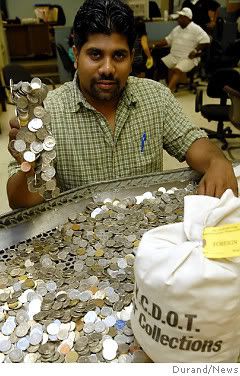
Rheaz Baksh, floor supervisor at Transportation Department collection site, shows pounds of foreign coins taken from city parking meters.

The New York Daily News reports:
Parking cheats have shoved 500 pounds of foreign coins into meters this year - slugs city officials are now trying to hawk.

"We have pretty much every denomination from every continent," said Anthony Alfano, deputy chief of meter collections, rattling off nations from Greece to Ghana. "The most common [are] the Greek drachmas."

The death of the drachma - another hapless victim of the "new world order."
Department of Transportation officials have been collecting bids on the coins and plan to accept the best offer tomorrow.
"We are not expecting a windfall, but it's a way of recouping revenue for the city," Alfano said.

In years past, buyers have paid approximately $2 to $4 a pound - far short of the estimated $8,500 the city lost in revenue because of the foreign impostors, officials said.

The highest bidder must agree to buy all 500 pounds - 8-1/2 bags of coins that are being stored in a secret location for safety reasons.

DOT takes in about $90 million in coins from parking meters annually. It started selling the foreign coins about a decade ago after deciding it was impractical to exchange them to U.S. currency.

"In the scheme of things the money and volume of coins is pretty insignificant," Alfano said.

It's becoming harder to dupe the new high-tech meters with foreign coins, and the annual sale could become obsolete in the next few years. When the coins were sold in 2001, there were 1,402 pounds of foreign slugs - 33 bags. Last year, only 728 pounds were sold.

"The electronic meters are more discriminating," Alfano said.

Last year's batch went to Jim Corliss, a 60-year-old Braintree, Mass., collector who bids under his company name, Sir Speedy Printing. The three-time winner put in a bid again this year.

"Every once in a while I find something of value," he said. One time, he stumbled on a 1835 British shilling. "It sounds exciting, but it was worth $5," he said.

He confessed to collecting "zillions" of coins since he started the hobby as a 12-year-old paperboy sorting through tips. "I have a big house," he said.