Friday, August 03, 2007

Gingrich Says War On Terror 'Phony'

The Atlanta-Journal Constitution reports:
Former House Speaker Newt Gingrich said Thursday the Bush administration is waging a "phony war" on terrorism, warning that the country is losing ground against the kind of Islamic radicals who attacked the country on Sept. 11, 2001.

A more effective approach, said Gingrich, would begin with a national energy strategy aimed at weaning the country from its reliance on imported oil and some of the regimes that petro-dollars support.

"None of you should believe we are winning this war. There is no evidence that we are winning this war," the ex-Georgian told a group of about 300 students attending a conference for collegiate conservatives.
Gingrich, who led the so-called Republican Revolution that won the GOP control of both houses of Congress in 1994 midterm elections, said more must be done to marshal national resources to combat Islamic militants at home and abroad and to prepare the country for future attack. He was unstinting in his criticism of his fellow Republicans, in the White House and on Capitol Hill.

"We were in charge for six years," he said, referring to the period between 2001 and early 2007, when the GOP controlled the White House and both houses of Congress. "I don't think you can look and say that was a great success."

Thursday's National Conservative Student Conference was sponsored by the Young America's Foundation, a Herndon, Va.-based group founded in the 1960s as a political counterpoint to the left-leaning activists who coalesced around the civil rights movement and opposition to the Vietnam War.

Gingrich retains strong support among conservatives and ranked fifth among possible Republican nominees behind former Massachusetts Gov. Mitt Romney, with the backing of 7 percent of those queried in a ABC News/Washington Post poll taken last week. The poll surveyed 403 Republicans and Republican-leaning adults nationwide and has a 5 percentage-point margin of error.

"I believe we need to find leaders who are prepared to tell the truth ... about the failures of the performance of Republicans ... failed bureaucracies ... about how dangerous the world is," he said when asked what kind of Republican he would back for president.

Gingrich has been promoting a weekly political newsletter he calls "Winning the Future." It's available free to those who leave their e-mail addresses at www.winningthefuture.net, one of several Web sites he is connected with or operating. Gingrich began writing the newsletter in April 2006, and it now goes out to 311,000 readers each week, said Gingrich spokesman Rick Tyler.

Political salon

At another Web site — www.americansolutions.com — Gingrich is running a virtual political salon, with video clips, organizational information and contacts revolving around his conservative vision for the country's future. It asks supporters to join in an Internet "Solutions Day" on Sept. 27, the anniversary of Gingrich's so-called Contract With America, a slate of conservative policies he led through Congress as speaker of the House a decade and a half ago.

"What I'm trying to start is a new dialogue that is evidence-based," Gingrich said Thursday. "It doesn't start from the right wing, it doesn't start from the left wing," he said, but is an effort to get politicians and voters to "look honestly at the evidence of what isn't working and tell us how to change it."

Gingrich was interrupted with applause once, when he called for an end to the biting partisanship critics say has polarized national politics and paralyzed the workings of government.

"We have got to get past this partisan baloney, where I'm not allowed to say anything good about Hillary Clinton because 'I'm not a loyal Republican,' and she's not allowed to say anything good about me, or she's not a 'loyal' Democrat. What a stupid way to run a country."

He reserved his most pointed criticism for the administration's handling of the global campaign against terrorist groups.

"We've been engaged in a phony war," said Gingrich. "The only people who have been taking this seriously are the combat military."

His remarks seemed to reflect, in part, the findings of a National Intelligence Estimate made public last month.

In the estimate, the U.S. intelligence community concluded that six years of U.S. efforts to degrade the al-Qaida terrorist group had left the organization constrained but still potent, having "protected or regenerated" the capability to attack the United States in ways that have left the country "in a heightened threat environment."

"We have to take this seriously," said Gingrich.

"We used to be a serious country. When we got attacked at Pearl Harbor, we took on Imperial Japan, Fascist Italy and Nazi Germany," he said, referring to World War II.

"We beat all three in less than four years. We're about to enter the seventh year of this phony war against ... [terrorist groups], and we're losing."

Successful approach

Gingrich said he would lay out in a Sept. 10 speech what a successful U.S. approach to this threat would have looked like over the past six years.

"First of all, we have to have a national energy strategy, which basically says to the Saudis, 'We're not going to rely on you,' " he said.

The United States imports about 14 million barrels of oil a day, making up two-thirds of its total consumption.

Thursday, August 02, 2007

Robert Gates: "Bush Administration May Have Misjudged The Difficulty In Iraq..."

. . . . of achieving reconciliation among Iraq's sectarian factions."

Ya think?

Psssst....the lede is buried in the last graf . . .

The NYTimes reports:
Defense Secretary Robert M. Gates said today that he was discouraged by the departure of the major Sunni Arab bloc from Iraq’s coalition government, and noted that the Bush administration may have misjudged the difficulty of achieving reconciliation among Iraq’s sectarian factions.

In one of his bluntest assessments of the progress of the administration’s Iraq strategy, Mr. Gates said: “I think the developments on political side are somewhat discouraging at the national level. And clearly the withdrawal of the Sunnis from the government is discouraging. My hope is that it can all be patched back together.”
He made the remarks to reporters traveling on his plane as he returned to Washington after a three-day trip to the Middle East, which included stops in Egypt, Saudi Arabia, Kuwait and the United Arab Emirates but not to Iraq.

Mr. Gates said little to indicate whether he would recommend a shift in the administration’s strategy next month, when officials are planning to review the results achieved by sending nearly 30,000 additional American troops to Iraq in an effort to secure Baghdad.

When the Bush administration decided to send the additional troops, he said, “we probably all underestimated the depth of the mistrust, and how difficult it would be for these guys to come together on legislation, which, let’s face it, is not some kind of secondary issue.”

He was referring to the failure of Iraq’s parliament to pass legislation governing the distribution of oil revenue, to set a timetable for provincial elections or to ease work restrictions on former Baath party members — measures that the Bush administration considers crucial for reconciliation between Sunni and Shiite Arabs in Iraq.

While he was critical of the government led by Prime Minister Nuri Kamal al-Maliki, a Shiite Arab, Mr. Gates’s view was not wholly gloomy. The security situation in the country, he said, was “more encouraging than I would have expected three or four months ago.”

He said there had been progress in reducing violence in Anbar Province, and in persuading Sunni tribal sheikhs in some areas of the country to cooperate in security operations against Sunni Arab insurgents, a development he called “in some respects unexpected.”

He said the administration would have to balance the relative lack of progress on the political front with the somewhat encouraging trends in the security realm when it prepares its review in September, which will include reports from Gen. David Petraeus, the top American commander in Iraq, and from Ambassador Ryan Crocker.

Several American military commanders in Iraq have said that the additional troops will be needed in Iraq into next year. Some critics of the Iraq policy, including several Democrats running for president, have called instead for beginning to withdraw troops and shifting to a strategy that focuses more on counterterrorism than on protecting Iraqis.

One of the arguments administration officials made earlier this year for the increase in troop strength and the new emphasis on securing Baghdad was that it would give Mr. Maliki’s government “breathing room” to achieve the political reconciliation and progress on legislation.

But Mr. Gates offered a slightly different formulation today, arguing that political progress would come when Iraqi police and army units proved themselves able to take over primary responsibility for maintaining security in areas now largely patrolled by American troops.

“I think the key is, not only establishing the security, but being able to hold on to those areas, and for Iraqi Army and police to be able to provide the continuity of security over time,” Mr. Gates said. “It’s under that umbrella I think progress will be made at the national level.”

He did not say how long that would take.

As he has traveled around the Middle East this week, Mr. Gates has stressed that whenever the United States begins drawing down its troops in Iraq, it must be careful not to leave the country in chaos, which he warned could spread throughout the region.

Mr. Gates stopped briefly in Abu Dhabi today for talks with Mohammed bin Zayeed al Nahyan, the emirate’s crown prince. On Wednesday, he toured the port in Kuwait City by helicopter; that port would be vital for shipping American military equipment home whenever troops begin to withdraw.

Earlier on his four-day journey, he visited Egypt and Saudi Arabia.

Mr. Gates asked the United States’s Arab allies to help stabilize Iraq and to toughen their enforcement of United Nations sanctions against Iran. He discussed proposed arms sales with each of the countries.

According to a senior Defense Department official, Mr. Gates and Secretary of State Condoleezza Rice, who joined him in Egypt and Saudi Arabia, stressed the need for Arab regimes in the region to support the administration’s effort to isolate Iran, diplomatically and economically.

“There’s not really room for bystanders here,” Mr. Gates said.

But he also tried to put to rest a persistent concern that the Bush administration is preparing to attack Iran, the Defense official said: Mr. Gates was asked why the United States had four aircraft carriers in the Persian Gulf if no attack was planned, and had to explain that, in fact, there was only one American carrier in the area, the Defense official said.

Despite Democratic Promises of Reform, Big Ag Wins Again

Nancy Pelosi is proving to be a big disappointment, in so many ways.

In the San Jose Mercury News, Daniel Weintraub writes:
House Speaker Nancy Pelosi could have listened to Berkeley chef Alice Waters, or to the University of California-Berkeley's Michael Pollan, author of "The Omnivore's Dilemma." Instead, she went with the Farmers Rice Co-op, King Ranch and Buttonwillow Land and Cattle Co.

Waters and Pollan were among those urging Pelosi and the House of Representatives she leads to overhaul the nation's farm policy, shifting billions of dollars from subsidies for corporate agribusiness to a means-tested safety net for real family farmers, plus policies to promote healthier foods and sound stewardship of the land.
But Pelosi last week turned back their pleas and sided with big agriculture - and her political instincts. She is supporting a farm bill that would preserve the worst parts of U.S. policy and, perhaps, help farm-state Democratic incumbents maintain their tenuous hold on districts they captured in the 2006 elections.

Pelosi says that the bill she supports includes the "first steps" toward reform. But at best those steps are tiny. And since the United States sets farm policy only once every five years, this was a rare opportunity for Democrats to show that their newly ascendant leadership in Congress will fight for real change. They've failed that test.

U.S. farm policy is a remnant from the Great Depression, when more than a quarter of Americans made their living from the land and were vulnerable to changes in the weather and market conditions.

Today, farming is a big business increasingly dominated by large corporations. But the subsidies originally adopted for the family farmer continue and have been warped to favor the largest companies at the expense of the little guy.

According to Environmental Defense, 10 percent of farming operations now collect more than 60 percent of direct subsidies paid under the farm bill. And according to OxFam America, a non-profit organization working to end world hunger, 92 percent of the subsidies go to the growers of just five commodities: corn, wheat, cotton, soybeans and rice.

California ranked 10th in the nation in payments received from 1995-2005, but 91 percent of California farmers and ranchers do not get any payments at all, according to the Environmental Working Group, which tracks the subsidies and publishes a database of the recipients. The Rice Co-op was the biggest California recipient last year, with payments of more than $5 million spread among its members. Texas-based King Ranch, with operations in California, and the Buttonwillow Land and Cattle Co. were not far behind.

The subsidies encourage farmers to grow big-volume crops, flooding world markets at the expense of small farmers in other countries and drawing complaints against U.S. policy at the World Trade Organization. The current subsidies also lower the cost of raw materials for the processed food companies that rely on corn syrup and soy, while doing almost nothing for the growers of fresh fruits and vegetables and the consumers who want to buy them.

While it would be better to phase out all subsidies, that isn't feasible in today's political climate. The next best thing might be the idea pushed by the movement Waters and Pollan helped lead. Their coalition is pushing for a third way - not ending the subsidies but overhauling them to put them in the service of a different set of policy goals.

Those goals were reflected in an amendment offered by Wisconsin Democrat Ron Kind and Arizona Republican Jeff Flake. Their proposal would have replaced price guarantees and direct payments with a safety net to protect farmers from declines in prices and crop yields. It would have denied subsidies to farms making more than $500,000 a year (or $250,000 per person), and it would have shifted some of that money into programs to preserve fragile land and promote specialty crops, organic foods and farmers' markets.
But with the House Agriculture committee dominated by farm-state Democrats, including nine freshmen looking to strengthen their holds on their seats, it would have taken strong leadership from Pelosi to steer the debate toward reform. Kind's proposal failed, and the bill that resulted protects the status quo. While it purports to limit payments to $1 million per person or $2 million per farm, critics say that it opens new loopholes that will actually let some operations collect more than ever.

The irony is that the reform proposal would have distributed more money than current policy to the vast majority of congressional districts. That's because the farmers in just 20 districts now collect more than half the subsidies. According to Environmental Defense, 36 of 55 freshmen would have seen their farmers do better under the Kind amendment, with only seven doing worse. For the others it would have been a wash.

But in each district, large and powerful farm operations would have suffered at the expense of smaller, less influential growers. Thus the vote in favor of Big Ag.

Fortunately, the House won't have the last word on this matter. The Senate has yet to act, and House Democrats might have overreached when they included a last-minute tax increase to help pay for programs they added to their bill to buy off the opposition. This is one food fight that is likely to continue all summer.

Wednesday, August 01, 2007

Democrats Cave To Automakers


The Detroit Free Press reports:
In a victory for Detroit automakers, the main backer in the U.S. House of tougher fuel economy standards said late today that he would not push for his 35 mile-per-gallon standard this week.
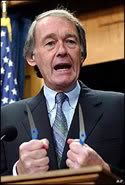
Representative Ed Markey, Democrat from Massachusetts

The move by Rep. Edward Markey, D-Mass., means automakers and the United Auto Workers now have the August recess to prepare for a larger debate in September, when Rep. John Dingell, D-Mich., plans to address fuel economy rules as part of his work on global warming. It also sidesteps what would have been a bruising floor flight between Markey and Dingell as the House Democrats speed through bills ahead of the August recess.

Representative John Dingell, Blue Dog Democrat from Michigan

For the past few weeks, Markey has declined to say whether he would try to attach his plan, which would force the industry to meet an average standard of 35 m.p.g. by 2019, to the energy bill the House is scheduled to consider Friday. Markey said in a statement today that while he believed he had enough votes to move his plan, he would instead back the mileage increase that passed the Senate in June.

That measure, part of a broad energy bill, sets standards of 35 m.p.g. by 2020, and was a significant defeat for the auto industry.

Today's move by Markey suggests that some of the obituaries about the automakers' lobbying power on Capitol Hill were premature.

"I am satisfied that our strength in both the House and the Senate is sufficient to ensure that the progress we have made already to update our fuel economy standards will win out in conference," Markey said. "The country cannot afford to accept less than a 35 m.p.g. standard if we are to wean ourselves off our addiction to imported oil."

Markey's retreat came after weeks of intensive lobbying by Detroit automakers, the UAW, Toyota Motor Co. and dozens of other groups against Markey's plan and for an alternative from Reps. Baron Hill, D-Ind., and Lee Terry, R-Neb. That bill would have required new cars and trucks to meet an average of 32 to 35 m.p.g. by 2022.

Representative Lee Terry, Republican from Nebraska

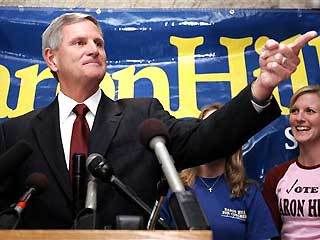
Representative Baron Hill, Democrat from Indiana

The industry has steadily racked up support for the Hill-Terry proposal, adding 141 co-sponsors since it was introduced a few weeks ago. Earlier today, the 47-member Democratic Blue Dog Coalition, a group of conservative Democrats, threw their support behind Hill-Terry.

Automakers maintained the Markey standards are unreachable and would cost thousands of jobs, while environmentalists say the Hill-Terry bill would save far less oil than Markey's plan. Industry executives said they would not push to have the House consider Hill-Terry if Markey's bill didn't make the House floor.

Environmental groups had responded to the automakers' efforts with a lobbying blitz of their own up until the last minute, with 13 state attorneys general weighing in today against the Hill-Terry bill. But those groups had also been preparing for a strategic retreat in recent days.

"If we don't end up with a House provision on Markey, we will have fought the auto industry to a stalemate in the House, and we will win the war in conference," said Daniel Becker, director of the Sierra Club's global warming program.

Yeah, you keep believing that, Danny boy.

Until there is regime change in Washington, this is just one more battle Americans will lose to Big Corporate.

Joe Biden on Bush, Cheney, Rumsfeld : "These Guys Just Never Level"


Mike Barnicle, sitting in for Chris Matthews, interviews Joe Biden.

I think Mike Barnicle is one of the worst journalists around, which explains why Chris Matthews has Barnicle as his permanent substitute host - Matthews can rest easier on vacations knowing that he won't be shown up by his replacement. This interview doesn't change my opinion of Barnicle's journalistic prowess. It does, however, make obvious the questions that our media has consistently failed to ask, or if asked, failed to follow up on these last six Bush years.

Transcript of entire segment with Joe Biden:
BARNICLE: Senator Joe Biden of Delaware is running for president. He‘s the chairman of the Foreign Relations committee and the author of new book called “Promises to Keep.” Senator, before we get to the book and your candidacy, I was watching you as you watched David‘s film piece, and when they showed General Myers and General Abizaid and former secretary of defense Rumsfeld testifying, you had sort of a—what I would consider a sad look on your face. What was going through your mind when you were watching that?

SEN. JOE BIDEN (D-DE), PRESIDENTIAL CANDIDATE: No accountability. This is the only administration that no one‘s ever made a mistake in the face of constant disaster. You know, it used to be—my grandpop used to talk about you got to stand up. I mean, it used to be an honorable thing that somebody‘s come forward and say, Hey, I screwed up. That was me. I mean, think of the fact—I mean, who has been held accountable for anything in this administration? They attorney general, the secretary of defense, secretary of state, vice president, national security adviser, chairman of the Joint Chiefs of Staff? What‘d this all happen on the watch of privates?

I mean, I just find it incredible, the lack of—I don‘t know. My grandpop would call it honor.

BARNICLE: How frustrated is it for you, as a United States senator, never mind being out on the campaign trail, running for president—you‘re a United States senator. You‘ve been there since 1970. How frustrating is it for you that you have this going on, what you consider to be this lack of accountability, and yet you can‘t get people to be held accountable?

BIDEN: Well, you can‘t. You know, it‘s all about elections. You know, we barely have control of the Senate. We have 50 votes. One of our colleagues has still not been able to vote because he‘s still ill. And the House doesn‘t have effective control. It‘s frustrating as the devil.

And what‘s even more frustrating, the people who voted to send the Democrats to Congress last time out expected that somehow we were going to be able to really, you know, have a—you know, operational control, really call people to task. But it‘s—it‘s just really frustrating.

What‘s most frustrating, Mike, is that you got all these folks out there who‘re just losing confidence in the government, losing confidence anything that‘s going on. And you got 160,000 families implicated by having folks over there in Iraq. They don‘t see any plan. They don‘t know what these guys are doing. I mean, it really is. It‘s—it‘s sad.

BARNICLE: What do you think General Petraeus is going to do when he comes back and speaks to you people, speaks to us in September, September 15?

BIDEN: I know General Petraeus well. I‘m in constant contact with him the last four-and-a-half years. I disagree with his plan on the surge, but I think he‘s an honorable guy. I think he‘ll come back and say two things. You‘re going to have to read between the lines. And one‘s going to be we‘ve made some progress in the surge. We‘ve made some military progress. But I think he‘ll be honest enough to say we‘ve made no political progress.

And absent some political accommodation—you just showed—you had the Sunnis getting up and walking out of the cabinet. They continued to adhere, as a lot of my Democratic colleagues do, Mike, to this flawed—fundamentally flawed premise that somehow, you can establish a strong unity government in Baghdad that can control the country. It‘s not going to happen in anybody‘s lifetime.

BARNICLE: You know, I can‘t recall a war that‘s been as difficult for reporters to cover as this war. It‘s so lethal to anybody on the ground working for any news organization.

BIDEN: Absolutely.

BARNICLE: And yet you keep hearing anecdotal information that seems so at odds with what you get out of the White House or the Pentagon in terms—fine, military success in Ramadi. I understand that. I accept that. I believe that. And yet when you hear people who continue to come back, United State senators, as well as regular soldiers, saying they can‘t get the lights on in Baghdad, they can‘t get the water running...

BIDEN: They can‘t. They can‘t. I‘ve been there seven times. I‘m heading back in a couple weeks—actually, a month. I‘m heading back for my eighth trip. And let me tell you something. I‘ve been in and out of the Green Zone, been to Muradi (ph) -- excuse me—I‘ve been down to Basra. I‘ve been out in Anbar Province. I‘ve flown over most of it in a helicopter. I‘ve been up as—far us as—I mean, the idea that somehow there‘s any cohesion here is absolutely fanciful.

What has happened here is, to the extent that Petraeus has concentrated on certain areas and localized—localized—the conflict—that is, let local tribal chiefs have local police forces and local control. To the extent that‘s happened, there‘s been some progress. But absent a larger political agreement here—as soon as we leave—remember Tal Afar?

BARNICLE: Yes.

BIDEN: You know how you learn all these—all these names, you know, average Americans learn them. Well, you know, a year-and-a-half ago, we heralded this as a great example. We had 10,000 combined troops in there. We cleaned out the city. We rebuilt the schools and the city facilities, et cetera. And then we had to leave, and a town of 250,000 people once again became basically a ghost town of 80,000 people.

I mean, same thing‘s going to happen. Same thing‘s going to happen if we leave absent giving local control, local police, local regional power...

BARNICLE: So is this hopeless?

BIDEN: It‘s hopeless absent doing what—I‘m going to say bluntly what Les Gelb and I have been talking about for well over a year. I did on your radio program up in Boston, you know? And now everybody‘s coming around to it. You have General Garner now saying—quoting—I‘m paraphrasing, Biden and Gelb are right.

The only way this ends without the whole thing splintering apart—meaning the whole country—and it‘s not going to just break up in three pieces, Mike. It‘s going to break up not on just a religious basis but tribal basis. You‘re going to see this civil war metastasize into Turkey, into affecting Iran and Syria. And we have a real problem now, it‘s going to get a lot worse. And why they continue to adhere to the prospect that Maliki can put together a unity government that can control the country is just beyond my comprehension.

BARNICLE: So what you‘re talking about, what you‘re saying is not only something that‘s going to be handed off to the first term of the next president, it sounds like the next two terms and perhaps...

BIDEN: Well, let me tell you something...

BARNICLE: ... two presidents.

BIDEN: Yes. I think that‘s—look, Mike, what happens—what happens when, in fact, we leave? We have to leave. We have our commanding general saying you can‘t—the new chief of the Army is saying you can‘t keep 160,000 troops there next year. We don‘t have the troops to do it. We can‘t do it. So everybody knows we‘re going to be leaving, Mike, and you either leave with putting together a political settlement, bringing in the international community that‘s ready to come in—because, look, the French aren‘t looking to help us, the Russians, the Chinese, but they know things are really bad for them if this place fractures.

BARNICLE: You know, back on the point of—the larger point of David‘s piece on the death of Private (SIC) Tillman—do you think Rumsfeld was telling the truth? I mean, how could it be that the secretary of defense could sit there and not find out for several weeks that someone as famous as Corporal Tillman was killed and how he was killed?

BIDEN: I find it absolutely improbable. I—look, they‘re so good at plausible denial. They‘re so good at kicking the can down the road. It‘s a little bit like—go back to Abu Ghraib. Abu Ghraib was a disaster. I went down to see the president right after Abu Ghraib. I said, Mr. President, you got to do something drastic. You got to literally bulldoze the place down, build a hospital, demonstrate our overwhelming distaste for what happened. It‘s not part of us. Nothing happened.

So we go back. I called for Rumsfeld‘s resignation years ago. I go back. I‘m sitting with the president of the United States of America and the secretary—then national security adviser, and the vice president. He said, What‘s this stuff about picking on Rummy? I said, Mr. President, I have to be honest with you. And I turned to the vice president. I said, Mr. Vice president, were you not a constitutional officer, I‘d call for your resignation, too. And the president looked and said, Why? I said, Name me one piece of advice you‘ve been given on Iraq from either the secretary of defense or the vice president that‘s turned out to be correct? Name me one.

BARNICLE: That‘s all in the book.

BIDEN: Well, but also...

(CROSSTALK)

BARNICLE: We‘re going to get to the book.

BIDEN: No, no. But it‘s beyond the book. It goes to your essential point, I think, Mike, and that is these guys just never level. They just never level.

BARNICLE: Senator Biden is staying with us to talk more about his bid for the White House and his new book and his confrontations in the White House.

And coming up later, more on Don Rumsfeld‘s testimony today with two veterans of the Iraq war. Has Pat Tillman‘s death and the Pentagon‘s handling of it hurt our armed forces?

You‘re watching HARDBALL, only on MSNBC.

(COMMERCIAL BREAK)

BARNICLE: Welcome back to HARDBALL. We‘re back with Democratic presidential candidate Senator Joe Biden, author of the new book “Promises to Keep.” I read it. It‘s interesting. It‘s you. It‘s about your life.

And now, at this stage of your life, you‘re running for president again. And let me ask you—you‘ve been in the United States Senate for a long time. You‘ve been on TV for a long time, chairman of the Senate Foreign Relations committee. A lot of people know you. You‘re at 4 points in the polls.

Do you think that the country might be just going someplace else, might be saying, you know, No, I want to look at a woman for president, or a black man for president. I‘m tired of the old Irish guys—not that you‘re old.

(LAUGHTER)

BARNICLE: But where do you think the country‘s at on this?

BIDEN: Well, there may be a piece of that, but I think part of it that—what we find out in our polling, no one really knows me at all. They think, as my pollster said—I think it was she that said that they think I‘m this guy that‘s born behind a podium, went to Yale, is a wealthy guy, and knows a lot about foreign policy.

And so, you know, whereas, ironically, 22 years ago when I looked at this, you know, they knew everything about me personally, didn‘t know anything about what I thought. Now it‘s the flip. And—but I think it‘s early, Mike. I mean, when was the last time any of these polls have made a difference this early out? The polls up in your neck of the woods, out in New Hampshire, show that only 8 percent of the people in New Hampshire has made up their mind, have a definite choice. Nationally, it‘s about the same.

And it‘s an old thing. You know, recognition gets money, money gets recognition, gets coverage and press. So I don‘t think people begin to make up their mind yet. And as long as—as long as national security and foreign policy is a central issue, I think I‘m in the game.

BARNICLE: You know, when I listen to the debates, when I listen to each of the candidates, and when it comes down to issues of national security—well, today, you know, Senator Obama talking about—you‘re smiling. What are you smiling at? You thought he was trying to be General Obama when he was talking about Pakistan and everything? Sounded too much like you? What are you saying?

BIDEN: Well, you know, look...

BARNICLE: Come on!

BIDEN: Look, the truth is the four major things that he called for—and I‘m glad he did, but one of them is a surge in Afghanistan. Well, hell, that‘s what I called for when I was in Afghanistan in 2003, and Hagel and I wrote the legislation adding money. We have new money for Afghanistan in here.

The second thing he called for was, you know, aid to Pakistan be conditional. Well, Tom Lantos and I wrote that into the bill when we passed the 9/11 bill. It‘s law. I mean, it‘s already there. It happened weeks ago.

And he talked about the idea of U.S. troops in Afghanistan (SIC) if there‘s actionable intelligence. Well, that‘s our policy. The only thing you do is you don‘t go and announce it. You don‘t talk about it. But it is our—it is our stated policy.

And so I guess what I‘m trying to say is that I‘m glad that he‘s talking about these things, but there‘s—there‘s not a single thing that I heard of that he spoke about that isn‘t either already policy, already done, or has been spoken to at length before by myself and others.

BARNICLE: I get the impression, when you‘re all on the stage, that you kind of like Senator Clinton. You respect Senator Clinton.

BIDEN: Well, do like her. I do like her. I really like Dodd a lot. I—I mean, there‘s—no, there‘s people you know because you work with...

BARNICLE: Yes.

BIDEN: .. and you are certain of who they are.

I am certain of who Dodd is. He‘s a stand-up guy and he‘s knowledgeable. I‘m certain of who, you know, the governor is, because I have been with him a long time. And I know Senator Clinton a long time.

I don‘t know Barack as well. I have served with him. I respect him.

And I don‘t John Edwards as well. I know him, and I respect him.

And—but I‘m really for a ticket of Kucinich and—and Gravel.

(LAUGHTER)

BARNICLE: Senator Joe Biden, the book is “Promises to Keep.”

(CROSSTALK)

BARNICLE: Senator Biden, Scranton, Pennsylvania, this Saturday. All you Irish guys and Irish women, get up there and buy that book.

(LAUGHTER)

The Subprime Mortgage Disaster

Loan sharks wreak havoc on Main Street and Wall Street


Ethics, Schmethics
THE WALL STREET JOURNAL reports that when Lehman Brothers first considered jumping into the subprime waters, it sent an executive to California to check out a possible partnership with First Alliance, one of the big lenders. In a withering memo, the executive reported back that First Alliance was a financial "sweat shop" specializing in "high-pressure sales," targeting "people who are in a weak state." He added that the lender's employees leave their "ethics at the door." The Lehman high-ups' response: Great! Noting that First Alliance was not breaking any laws, the Wall Street giant invested half a billion bucks in the California company's sleazy subprime operation.


The Hightower Lowdown reports:


One of the most dramatic stories from the New Testament is of the time that Jesus encountered money changers in the temple. Enraged by their usury and sacrilege, he went on a tear--overturning their tables, physically driving them out, and chastising them for converting the temple into a "den of robbers." The Bible doesn't say where these bloodsucking lenders went, but now we know: They have re-emerged in recent years to set up their tables right here in America, working a dark alley of homeowner financing called the "subprime mortgage market." The what? Don't be deterred by the finance industry's jargon (which is intended to numb your brain and keep regular folks from even trying to figure out what's going on). At its core, this is a classically simple story of banker greed and outright sleaze. And the astonishing part is that nearly all of the rank injustice perpetrated by today's money changers is considered legal and is practiced by supposedly reputable financial firms.

"Subprime market" is just another way of saying modest-income people--including the working poor who dream of owning a home and retirees on meager pensions who might need to refinance the house they have. With little cash and poor credit ratings, these people had not been deemed desirable customers for conventional mortgages, known as "prime," and were mostly ignored...until the mid-1990s.

That's when avaricious mortgage hucksters and high-finance manipulators looked upon this broad pool of needy, vulnerable castoffs and suddenly shouted, "Eureka, GOLD!" With interest rates remarkably low, housing prices seemingly on a nonstop rise, and (this is the Big One) practically no regulation of this low-income market, the money changers promptly began to devise clever, Enronian schemes to entice such "subprime" borrowers into high-interest, high-fee loans. Never mind that these families really could not afford (and mostly did not understand) the level of debt being piled on their backs. That was a matter for manana. Today was for raking in profits from the poor.

The subprime schemes are run through an intricate, intertwined system of loan brokers, mortgage lenders, Wall Street trusts, hedge funds, offshore tax havens, and other predators. To entrap borrowers, the industry created an arsenal of arcane financial devices and maneuvers known by such exotic names as "exploding ARMs," YSPs, teaser rates, low-doc mortgages, loan flipping, and equity stripping. Ultimately, these schemes are scams, extracting high payments from the families, sucking out any equity they might build up, and stealing their homes.

This is one of those economic stories, like the savings-and-loan scam of the 1980s, that are usually buried back in the business section of newspapers. But, just as with the S&L collapse, this debacle is growing too big to contain, and all of us need to be paying attention. The built-in traps of the subprime mortgage market have already taken the homes of more than a million people in just the past year, and the dangers are quickly rising for millions more. This collapse in homeownership for the working poor has begun seeping into the rest of the economy, causing thousands of job losses, shaking the soundness and reputations of some major Wall Street firms, and slowly--ever so sloooowly--forcing lackadaisical bank regulators and clueless politicians out of their laissez-faire stupor.

How it works

You might have seen some of the come-ons: "Bad Credit? No Problem!" "Zero % Down Payment!" "Creative Financing!" "No Documentation Needed!" "Quick and Easy Money!"

The key to building the subprime market is hustle and flimflam-trying to rush anxious, uninformed people into signing on the dotted line for what they're assured is the deal of a lifetime. Of course, the mortgage industry casts its work in a noble light, asserting that its primary purpose is to help extend the joys of homeownership to the masses. But an examination of key players reveals little altruism.

BROKERS. These are independent, local operators who troll for borrowers in your town and mine, using flyers, doorbells, phone calls, personal contacts, websites, late-night TV ads, data banks, and every means imaginable to get low-wage renters to sit still for a home-loan sales pitch or to find vulnerable homeowners who can be talked into taking out a refinancing loan. Brokers don't actually make the loans, service them, or have any stake in whether the deals work out. Rather, they are simply "finders" who are paid an upfront fee by the mortgage lenders for every borrower they deliver. And 71% of all subprime mortgages come through them.

The pretense is that the broker is the borrower's trusted advisor in the shark-infested waters of banking. Au contraire, Bubba. In most states, agents have no legal responsibility to represent a buyer's best interest. And, in fact, they don't, for the system gives brokers lucrative incentives to deceive borrowers.

Through a common practice called "steering," unsuspecting families are guided into the most expensive, riskiest subprime loans. For doing this dirty job, brokers are paid cash bonuses called "yield spread premiums" (YSPs)--though you would call them by their more common name: kickbacks. The Center for Responsible Lending reports that these YSP payoffs, averaging $1,850 per loan, are added to about 90% of all subprime loans. That's right, struggling families are silently assessed an extra fee for being secretly steered into a loan with higher interest rates and worse terms than they're entitled to get. They're literally being robbed by their bankers.

LENDERS. These are the brandname players you might recognize. They include non-bank lenders--for example, New Century Financial, Ameriquest, Option One, Countrywide, and Ownit Mortgage Solutions--that sprang up to tap into the new subprime gold rush, and several of them are now bankrupt or under investigation. Many big banking firms, including Wells Fargo, Lehman Brothers, and Citigroup, also joined the free-for-all by setting up their own subprime subsidiaries,

Brokers are on the front lines, but the lenders are the ones who invented the scams that are bleeding borrowers. Only a decade ago, subprime loans were a mere fraction of the home-loan market. Today, these financial instruments are an $800 billion business-about 20% of all housing loans.

How did the subprime market mushroom? The lenders--again, they are not subject to regulation-drastically and deceptively lowered normal banking standards to draw in low-income borrowers. As one broker says, "The culture around all these subprime lenders has been, 'Hey, bring it to us. We'll make it happen.'" If a borrower can pay little or nothing down, recently had a bankruptcy, and doesn't have the income to keep up payments, the bankers say, "That's OK. Bring us that loan."

Rather than do due diligence, lenders cavalierly offer "low-doc" and "stated income" loans--i.e., they make little or no effort to document an applicant's ability to take on this burden, instead accepting almost anyone's word about having the income to meet monthly payments. "You could be dead and get a loan," says one broker.

The loans themselves are doozies, filled with numerous and nasty provisions that set unwitting borrowers up for failure. These are tucked into 20-page loan agreements written in legal gibberish. A friendly, reassuring, always smiling loan agent flips through the pages saying, "It's simple, just sign here...and here...and here." Among the nasties are:

TEASERS. Subprime interest rates are loudly advertised to be only 7% or so, with only small-type notice that these are "adjustable rate mortgages" (ARMs). This means that the interest rate will explode to 11% or more after a couple of years--causing the families' monthly payments to jump by half or more. Over 90% of subprime loans contain ARMs.

BLOATED APPRAISALS. Subprime lenders are notorious for pressuring appraisers to inflate the value of a house, thus causing the borrower to take out a bigger loan than the house is worth. HIDE-THE-ESCROW. In conventional loans, the borrower's property taxes and mortgage insurance premiums are figured directly into the monthly loan payments, with these monies set aside in an escrow account. For subprime loans, however, lenders often don't include these costly items in the mortgage, thus making the loans appear more affordable than they really are. This leads to borrower shock (and sometimes default) when the tax and insurance bills arrive separately in the mailbox. At this point, ever-helpful lenders offer to refinance the loan--thus collecting additional fees.

EXCESSIVE FEES. On conventional mortgages, various lender fees typically total less than 1% of the loan amount. By contrast, subprime borrowers commonly are hit with fees (hidden in mortgage payments) totaling more than 5%.

PREPAYMENT PENALTIES. Obviously, it's in a borrower's interest to get out of an abusive subprime loan as soon as possible and to refinance on better terms. But--Gotcha!--more than 70% of these loans carry a penalty fee of several thousand dollars for paying off the loan early. In the prime market, only about 2% of loans contain such punishment.

WALL STREET. None of the above would be happening (and certainly not on such a massive scale) if the fast-and-easy money crowd on Wall Street hadn't seen a chance to make a killing on lowly subprimers. Lured by the flow of sky-high interest rates being charged to these borrowers (and abetted by the lack of government regulation in this market), Bear Stearns, Lehman Brothers, Merrill Lynch, Goldman Sachs, and other giants lumbered into the action.

They set up special investment units within their banks to buy these risky mortgages from the lenders. Then the Wall Street behemoths consolidated this bulk debt, leveraged it into complex IOUs called "mortgage-backed securities," and sold these packages to wealthy speculators around the world. This Rube Goldberg financial mechanism has shoved hundreds of billions of dollars of capital into the subprime market, fueling lenders' enthusiasm for making even more of these shaky loans.

What a system! Lenders mislead borrowers, collect fat fees from them, then shift the risk of any bad loans to Wall Street. The Wall Street repackagers then transfer the bad-loan risk to their rich investors, drawing even fatter fees. These investor elites get phenomenal yields on the IOUs, then plant their profits in tax-free havens like the Cayman Islands.

It's a brilliant Ponzi scheme... as long as all those Mr. and Ms. Subprimes keep putting their little dabs of cash into it every month. Oops! There's the rub.

The bust

Mr. and Ms. Subprime live on the economic edge, with little margin for financial downturns. In the last couple of years, three bad storms hit them. First, falling wages combined with growing inflation (fueled by rising prices for gasoline, utilities, health care, etc.) to squeeze their meager household finances to the breaking point. Second, their adjustable-rate mortgages began exploding; someone who was paying $1,000 a month at the start of a $150,000 loan had to pay $1,400 a month two years later.

Third, housing prices (which the whole system claimed would only rise and rise and rise) began tumbling, making it impossible for these borrowers to refinance or sell their homes to avoid financial foreclosure. When home sales were booming, George W declared this proved that his push for economic deregulation was creating a glorious new "ownership society." He was so enthused that he even designated June as National Home Ownership Month. But his laissez-faire "success" turns out to be a house of cards. As one market analyst says, "The gain in home ownership over the last four or five years is almost entirely due to looser lending standards [for subprime mortgages]."

Those cards are now crashing down. In the first half of this year, home foreclosures are up by 41%. Today, a record number of subprime borrowers have fallen behind in their monthly payments and face eviction (once you fall 90 days behind, lenders typically proceed with foreclosure). More than $2.28 trillion worth of ARMs are scheduled to explode to their higher interest rates between now and 2009. Two million families are expected to have the wrenching experience of losing their homes, as well as losing all the money they invested in them.

All of this is working its way up the economic chain. More than 80 lenders have gone out of business in the past six months, thousands of jobs are being cut, and hundreds of thousands of houses are being dumped on an already-saturated market (causing a further decline in prices, which makes other subprime homeowners even more vulnerable to foreclosure, which dumps more houses onto the market...and the downward spiral continues).

Wall Street big shots are being stung as well. Bear Stearns, for example, has had to scramble to keep its two subprime hedge funds from imploding, bailing out one of them with a panic infusion of $1.6 billion. Analysts estimate that these funds are holding more than $200 billion worth of subprime loans that are in danger of default.

Regulatory shame

This abuse of vulnerable families and the resulting economic mess would not have happened without the hands-off regulatory ideology that has infected our government. There are no less than five financial agencies at the federal level that could have protected people, yet the subprime surge was allowed to proceed on the fantasy that the financial players would police themselves. The Federal Reserve Board, for example, has direct authority under the Home Ownership and Equity Protection Act to "prohibit acts or practices in connection with mortgage loans that the Board finds to be unfair, deceptive or...associated with abusive lending practices, or that are otherwise not in the interest of the borrower." The Fed simply ignored this law.

Finally, with the entire subprime system crashing around them, the regulators issued "guidelines" on June 29 requiring banks to stop some of the worst abuses, including prepayment penalties. But the new rules still allow many of the predatory practices and--worst of all--do not apply to the non-bank lenders that make a large share of subprime loans. In addition, the guidelines do not directly address the role of Wall Street in pushing such loans.

The subprime industry disingenuously asserts that any attempt to regulate it only hurts the poor people who receive these mortgages, for they have nowhere else to turn for homeowner financing. What self-serving hogwash! There could be subprime loans--from public, if not private, sources--structured and administered without deceit. Rather than target lower-income families as suckers to be had, packaging their dreams into investment playthings for speculators and tax dodgers, let's view these folks as assets to the larger community and realize that homes for them are investments in the common good. And while we're at it, let's recognize that the need for "subprime" mortgages is driven by our low-wage/no-benefit economy and by our country's growing scarcity of affordable housing. It's not merely a low-income mortgage system that must be fixed--our leaders' pursuit of a low-income America must be stopped.

California City Reverses Water Privatization

Stockton, California City Council Reverses Water Privatization - It Passed Over Widespread Local Opposition


Part 1


Part 2

Transcript of Democracy Now!, August 1, 2007:
AMY GOODMAN: We end today’s show with a major victory for the opponents of water privatization. I’m talking about Stockton, California, a place that’s long been at the center of California’s water wars.

In late 2003, despite concerted efforts by a wide coalition of groups, the Stockton City Council voted in favor of a $600 million twenty-year water privatization agreement. The deal gave a multinational consortium, made up of the Colorado-based OMI and the London-based Thames Water, full control over Stockton’s water, sewage and storm water systems.
Well, two weeks ago, the City of Stockton reversed its earlier position and voted unanimously to undo the privatization deal and resume control of its water utilities. Before we go to the current victory, let’s go back in time to the Stockton City Council vote in favor of privatization in February of 2003. I want to play a clip from the PBS documentary Thirst that brought national attention to the struggle in Stockton.

DON EVANS: To safeguard the water of Stockton, you have the absolute commitment of our company and you have the commitment of Thames Water to deliver this contract effectively. That’s also, as the president, my personal commitment to you.

STOCKTON RESIDENT: It is clear that the decision to privatize has been made covertly without a public vote.

STOCKTON RESIDENT: I don't think the people at home realize how many hundreds of people were here and that it's all filled up back here and downstairs, and that it was hard to hear, so I appreciate [inaudible].

DEZARAYE BAGALAYOS: City Council Members, by signing this contract without the vote of the people, you will be betraying the people you supposedly represent. Water is life. This company, OMI-Thames, wants to profit from our water. Water for life, not for profit.

STOCKTON RESIDENT: I'm ashamed that we’ve followed this path and have gone down the road at making something happen that was not consensus building, not citizen-involved. It was basically handed down as a dictate. This is not the principle of an All-America City.

MAYOR PODESTO: OK, Council Member Giovanetti.

COUNCIL MEMBER GIOVANETTI: Thank you. I'm prepared to approve this contract tonight, ahead of the so-called vote of the people.

COUNCIL MEMBER: There comes a time when the people become so involved in an issue that it is important that they be heard by way of the ballot.

COUNCIL MEMBER NOMURA: As a Christian, I’ve always felt that prayer is very powerful. And when this process began, I’ve always prayed for guidance in what I should do. It says that in the Constitution, that you will elect representatives to vote and to make decisions that are best for you.

COUNCIL MEMBER MARTIN: We've not been elected to babysit and maintain the city until a vote can be taken by the citizens on major issues.

COUNCIL MEMBER: I do not feel they are too dumb to understand.

COUNCIL MEMBER MARTIN: Nobody said that.

COUNCIL MEMBER: And you know, the people who founded this republic obviously didn't think the people were too dumb to run it.

COUNCIL MEMBER MARTIN: Neither Lorrie and I or anyone on this council believes that the people are too dumb to resolve or to understand the issue. That's not -- that's not what we've said.

MAYOR PODESTO: Alright, quiet down. Officers, close the door, please. Tonight I want to thank the council for their indulgence and their endurance and their hard work to come up with whatever their answers are tonight. Do I believe that this should go to a vote of the people? Absolutely not. And that’s for no more reason than I can think any government by initiative is good. There's been a motion and a second. I'm calling for the question. Please cast your votes. Carries 4-3. Thank you all for your hard work.


AMY GOODMAN: With that, in 2003, the Stockton City Council voted for the privatization of their water supply. This, an excerpt of the award-winning PBS documentary Thirst, on water privatization in Bolivia, India and the United States. Alan Snitow is its co-director, also a board member of Food and Water Watch, and recently co-wrote the book that delves deeper into the implications of water privatization in the United States. It's called Thirst: Fighting the Corporate Theft of Our Water. Alan Snitow joins us from San Francisco. Welcome, Alan, to Democracy Now!

ALAN SNITOW: Thanks, Amy. Thanks for having me.

AMY GOODMAN: Talk about what happened since 2003 in Stockton, California.

ALAN SNITOW: Well, what's happened in Stockton is really quite an extraordinary victory and transformation. It proves that privatization is really fundamentally flawed as a model for something like an essential service like water.

What we’ve seen in the past four years, since the private consortium took over, have been spills -- sewage spills, with a failure to inform people at the height of the summer when the river was being -- when people were using it for recreation and swimming. There was a pass of who was going to tell people that the water actually had fecal matter in it. You're talking about a series of problems, in which you brought in a lot of temp workers, non-union contractors. There were spills into irrigation ditches. There were fines. There was lack of transparency. People couldn't find out what was going on. The rates went up.

There's a series of problems, one after the other, so that in the end you got not only unanimous city council reversal of its decision four years earlier, but even the mayor who had been pushing this in the past, the former mayor, said he agreed with the council decision. The city newspaper, the Stockton Record, which had been a supporter of privatization, said they supported the council decision. There was no one willing to go to bat for this consortium, OMI-Thames, and the only reason that people are not really getting down on them in public is that they signed a no disparagement agreement.

This is the way things work when you make a contract with a private company for something that's really an essential service that people have a right to have. You know, this is something that is too key. It is really -- you know, they say that police and fire and schools have to be something that's in the public sector, that's run for the people. Well, you know, there's something else that also has to go in there, and water -- and some of us would also say, I suppose, healthcare.

AMY GOODMAN: But how did Stockton get out of it? It was a twenty-year deal. And how did this consortium approach Stockton?

ALAN SNITOW: You know, when people say that there's a contract -- “Oh, it's a safe thing to do a privatization, because you have a contract that's hard and fast” -- contracts are changed. That's what lawyers are for. And when you have certain kinds of noncompliance, when the company is not making money, it's always possible to say, “Hey, look, guys, you guys are not doing a good job here, and you're not even making that much money. Let's make a deal to cut you out and get rid of you and return it to public control.” So that's what's happened in this particular case.

And the reason why the company would let it go was that they were not even making money. They realized they were not fulfilling their obligations. But they're going to take an enormous hit, because Stockton was the largest privatization in the western half of the United States. After Atlanta's failure by Suez in the 2002, when they were kicked out of Atlanta, you now got another major failure. This is a real blow to the idea that a private company, a contractor, can come in and take over your water supply and do a better job than public employees.

AMY GOODMAN: In your book and also in your documentary -- in your book, Alan, Nestle -- you talk about Wisconsin, you talk about Michigan. You're speaking to us from San Francisco, where the mayor has banned the flow of money to buy bottled water. Talk about these local initiatives and where you see them going right now. I think, for most people, this is way below the radar screen. They think of bottled water, one thing, as healthy, and people don't realize that water supplies are being taken over.

ALAN SNITOW: Well, you know, people have a visceral response to the loss of control of their water. But water is a local issue. So when you hear about Stockton, it's pretty unusual that you'd hear about Stockton in New York or Michigan or Florida. And the same is true that a small local battle in Massachusetts or in Wisconsin rarely is going to get national press. And the result is that water is a watershed issue. It's both essential, but it's also something that you're not going to hear about outside of the local area.

So what we've found is that all over the country, in towns and cities, you're getting these local movements, visceral upsurges of community reaction to the loss of control of their water services or their water supplies. And supplies -- I know that the folks from Corporate Accountability and Michael Blanding were all talking about the bottled water -- they're also having the same kind of reaction of loss of control of their utility. And this has brought now a kind of emerging movement to try to make it not only that bottled water is something that we're not focusing on, that we're not going to be drinking, but also that we're going to actually provide the money that is necessary to make public water universal, affordable and clean.

And to do that, because you have hundred-year-old pipes in the ground, there needs to be federal investment. And the Bush administration has cut back investment in water by billions of dollars every year. And there's now a fight that's going on in Washington to create a federal trust fund for water, the way we have for highways or building airports, so that you actually can have a clean water trust fund that makes it possible for local areas, for states and cities, to be able to upgrade their water systems so that they won't have to have this kind of situation in which the bottled water companies are implying that their water is pure, when actually they're getting the same source of water, they're using tap water themselves.

AMY GOODMAN: Back on the issue of Stockton, I mean, didn’t -- we're talking about the state weighing in here, too, a judge saying that the Stockton City Council actually violated the Environmental Protection Act -- the state won -- by not doing an environmental assessment. And you had the former mayor, Podesto, or the former head of the city council, who voted for the privatization, turning around. How does that all take place?

ALAN SNITOW: Well, when they passed the privatization, they were in a real rush to do it, because the Citizens Coalition, this amazing and tenacious citizens group in Stockton, had gotten 18,000 signatures from people in the city to put a referendum on the ballot to require a public vote for the privatization. The city council voted to approve the privatization just thirteen days before that vote was to take place. And in order to do that, they had to put in a line saying, “We are exempting this decision from the California Environmental Quality Act.” That was patently illegal. And the result was that two judges have ruled against the privatization and said to the city that they have to reverse it.

The city had a choice that they could have appealed it; they decided not to. They had a choice to take it to the referendum vote and revote on the issue; they decided not to. So what was really going on here was that the privatization hadn't worked on the ground, to some extent. It hadn't worked for the river, it hasn't worked for the water. And so, they decided unanimously to reverse it.

And one of the things that happens is happening here and around the country, this question about preempting the vote in the referendum. One of the things that we found in the movie and in our book Thirst was that you have a constant drumbeat by these companies to undermine democratic input in order to be able to take control of water supplies, because people want it to be a public service.

AMY GOODMAN: Alan Snitow, we only have a few minutes, so I want to just -- bullet points on these struggles that you've documented around the country. For example, Nestle comes to Wisconsin Dells in Wisconsin; what happened?

ALAN SNITOW: There, a series of groups got together and battled against the company and drove Nestle out of the state of Wisconsin, an amazing victory there. But Nestle then moved into the state of Michigan, where the Michigan Citizens for Water Conservation has been fighting against their taking water out of aquifers and streams in Michigan. And they just had a Supreme Court decision in the state of Michigan, which was denying citizens’ groups the right to intervene on certain environmental issues. Again, Nestle trying to intervene against the possibility of people taking a direct role in the future of their water.

AMY GOODMAN: And Nestle, which owns among other water brands, Poland Spring, Arrowhead, Deer Park.

ALAN SNITOW: Ice Mountain. Yeah, Deer Park.

AMY GOODMAN: What about Lee, Massachusetts and Holyoke?

ALAN SNITOW: In Massachusetts, there was a real battle, because there's a state law that allows cities, if they apply for it, to be able to do single-bidder kinds of contracts on essential services. And in Lee, again, a citizens’ movement, sort of spontaneous from below, fought against Veolia North America, a major French-based company, taking over their water. And they fought it successfully.

In Holyoke, they did not succeed. It was very much a parallel case to Stockton, in which Aquarion took over the water system in the city of Holyoke, Massachusetts, again going around the process.

AMY GOODMAN: Lexington, Kentucky?

ALAN SNITOW: Lexington, Kentucky, there, the citizens’ group lost a vote to take back water that was owned by the American Water Company, a part of a big multinational consortium, one of the hundred largest companies in the world, after a multi-year fight. But now it's coming back to haunt the city. And the fight is once again on the agenda over the future of the water in Lexington, Kentucky.

AMY GOODMAN: And Atlanta, Georgia?

ALAN SNITOW: Atlanta was one of the biggest scandals. The mayor who brought in the privatization was indicted. There were charges that he went to Paris on an all-expenses-paid trip with his mistress, paid for by the water company, and then signed off on massive increases in money going to the water company in Atlanta. They were thrown out by the current mayor, Shirley Franklin, because there was brown water, because there was constant eruptions.

AMY GOODMAN: Alan, we're going to have to leave it there.

ALAN SNITOW: All right. Thanks so much.

AMY GOODMAN: I want to thank you very much for being with us, Alan Snitow, co-director of the PBS documentary Thirst, author of Thirst, as well, Fighting the Corporate Theft of our Water.

El Salvadoran Protestors Against Water Privatization Being Tried As Terrorists

. . . . According to laws patterned after Patriot Act (& approved by U.S.).

Water, Water, Everywhere, and Not A Drop (For The People) To Drink:


Transcript of Democracy Now!, August 1, 2007 broadcast:
AMY GOODMAN: We turn to El Salvador, where protests against water privatization early last month ended with the arrest of fourteen protesters, thirteen of whom were subsequently charged with committing acts of terrorism.

On July 2, hundreds of people had gathered in the Suchitoto municipality to protest President Antonio Saca’s plan to decentralize water distribution. They saw the plan as an attempt to privatize municipal water resources as stipulated in a 1998 World Bank loan. The protesters were met with heavily armed riot police, who fired rubber bullets and tear gas on the crowd and detained fourteen people. Among those arrested was a journalist covering the protest and members of CRIPDES, the Association of Rural Communities for the Development of El Salvador. They were on their way to attend the rally in Suchitoto.
Last week, the prisoners were released on bail as a result of national and international pressure. But the charges of terrorism remain, and if found guilty, they could face up to sixty years of prison time. El Salvador's antiterrorism law came into effect last year and is modeled on the USA PATRIOT Act. Human rights groups have condemned the government’s response and application of this draconian law. Human Rights Watch said yesterday the law criminalizes a wide variety of acts most of which “do not fall within any reasonable definition of terrorism.”

Today, Krista Hanson joins us, also from Boston, to tell us more. She's the program director at CISPES, the Committee in Solidarity with the People of El Salvador. Welcome to Democracy Now!, Krista. Explain what's happening in El Salvador.

KRISTA HANSON: Well, I think that what's really important to know about that event on July 2 in Suchitoto is that it comes from -- I mean, the resistance that was happening there comes from a long history in El Salvador of -- first, of this implementation of privatization. People in El Salvador know what privatization of public resources looks like. The telecommunications, electricity, other industries have been privatized, and the rates go up so much that people have no access anymore to those. And so, you can't have that with water, right?

So over the last couple of years people have been out in the streets. And community by community, really, going out, and a common protest tactic is to shut down a street and demand access to water, to demand that it not be decentralized or privatized, or that there even be water. People pay water bills right now, and water comes out one hour a day in their taps, or one day a week or two days as a week, so people have been doing this for the last couple of years.

What was different on July 2 is that we're getting a lot closer to the government pushing forward this general water law that would privatize the currently public water system. So people were out there defending their right to water, defending, trying to stop the announcement of this first step in decentralization.

AMY GOODMAN: And explain the response of the state, of the police, and who the people are who have been arrested.

KRISTA HANSON: So on July 2, the people that went out were the community that lives there in Suchitoto, this fairly rural community, as well as people who are involved nationally in this rural development organization, CRIPDES, the local water union, FMLN representatives. They were all out there trying to stop the announcement of the privatization or what -- the government knows they can't call it “privatization,” so President Saca was there to announce “decentralization,” which, of course, is the first step.

So people were protesting. They were protesting in the street, you know, with signs saying, you know, “Water is a human right.” And the police went in in full, full force, as you were saying, full riot gear, rubber bullets, shooting rubber bullets at close range, shooting tear gas at kids, at old people. And then, actually, four of the people who were arrested were actually in a car a few miles away, driving to the protest. And there's video of this that was shown in court, and it's on our webpage, the CISPES webpage, if people want to see it. And you can really see the police dragging people out of their car who were on their way to the protest. And those are the people that they arrested and are currently charging with terrorism.

AMY GOODMAN: With terrorism.

KRISTA HANSON: They are being charged with terrorism for attempting to go to a peaceful protest against the privatization of water. It's really terrifying, because, as you said, it is exported from the United States. I mean, when this law was passed -- it's not a coincidence, just stepping back a little bit, that CAFTA passed -- CAFTA was implemented, excuse me, in March of 2006. It was September of 2006, last fall, when the rightwing government passed this law called the Antiterrorism Law that would define broadly, broadly define things like occupying a public road as terrorism and allow people to be imprisoned for up to sixty years, which is what these people from Suchitoto are facing. Not coincidentally, the US was behind the passing -- the US government was behind the passage of CAFTA, pushed really hard to get it implemented, because even after it passed, there was resistance. And then in September the US ambassador in El Salvador congratulated the Salvadoran government for passing that law and said, you know, “This is proof that we're partners in the war on terrorism.” So that's the law.

And this is really one of the first times that this law is being used, and it’s being used, not coincidentally, not against any terrorists, but against peaceful protesters. And so, people see this as really precedent-setting, this case that's going to come before the courts in September, of seeing whether or not the government really will move forward in imprisoning people and whether or not they actually -- you know, they're declared guilty of -- you know, supposedly of terrorism. Everyone is really clear that this is about scaring people out of protesting and criminalizing protest to the extent that people are afraid to go out and defend their right to something that's so clearly a human right.

AMY GOODMAN: CAFTA stands for Central American Free Trade Agreement. We only have thirty seconds, but, Krista, what does this have to do with the World Bank? How is the World Bank identified with this so-called “decentralization” program?

KRISTA HANSON: The World Bank gave the loan in 1998 that first pushed decentralization and brought in the element of private corporations having a say in this. And maybe just to conclude, also I think that because the World Bank is a part of this, because the US government is pushing this, that's why as solidarity we're so concerned about accompanying people out there. And the US government is going to continue to be involved through their major elections in 2009 in El Salvador. Whether it's the Democrats or the Republicans in power here, they need to maintain their ally, this rightwing government in El Salvador that's going to push privatization, push the neoliberal model, through repressive policing, through calling protest terrorism and criminal acts.

AMY GOODMAN: We're going to have to leave it there. Krista, I want to thank you very much for being with us.

KRISTA HANSON: Thank you.

AMY GOODMAN: Krista Hanson, program director of CISPES, the Committee in Solidarity with the People of El Salvador, and Gigi Kellett with the Corporate Accountability International, both speaking to us from Boston. Corporate Accountability International is the incarnation of Infact. Link to the video of the Salvador protest.

The Privatization of America's Water Supply

New Scrutiny Falls on the Economic and Environmental Costs of a Billion Dollar Industry

Aquifers (underground reservoirs) are being depleted by overdevelopment of the land and an increasing population. Global warming is changing weather patterns around the world, causing droughts in densely populated regions and flooding in others where overdevelopment has paved over the land's ability to replenish the aquifers. The flood waters run off instead to places where it (usually) becomes unusable by man.

America's water systems, built and paid for originally by the American taxpayer, is being sold off to multinational corporations. The water is being pumped out of aquifers, bottled and shipped out to the highest bidders.

If not in our lifetime, but certainly in our children's, San Franciscans will be facing thirst, dehydration and death because tap water, taken over by multi-national corporations, will be shipped to those who can pay top dollar for it.
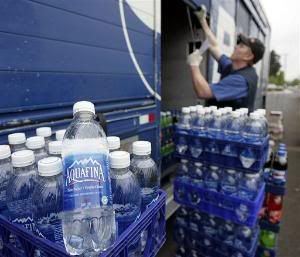
PepsiCo delivery man Nick Jones unloads Aquafina water and other Pepsi products while making a delivery in Tualatin, Ore., in a file photo of April 26, 2006. The label on Aquafina water bottles will soon be changed to spell out that the drink comes from the same source as tap water, the brand's owner PepsiCo said Friday, July 27, 2007. (AP Photo/Don Ryan, file)

Democracy Now! reports:
AMY GOODMAN: The soft drink giant Pepsi has been forced to make an embarrassing admission: its bestselling Aquafina bottled water is nothing more than tap water. Last week, Pepsi agreed to change the labels of Aquafina to indicate the water comes from a public water source. Pepsi agreed to change its label under pressure from the advocacy group Corporate Accountability International, which has been leading an increasingly successful campaign against bottled water.

In San Francisco, Mayor Gavin Newsom recently banned city departments from using city money to buy any kind of bottled water. In New York, local residents are being urged to drink tap water. The US Conference of Mayors has passed a resolution that highlighted the importance of municipal water and called for more scrutiny of the impact of bottled water on city waste.
The environmental impact of the country's obsession with bottled water has been staggering. Each day an estimated sixty million plastic water bottles are thrown away. Most are not recycled. The Pacific Institute has estimated twenty million barrels of oil are used each year to make the plastic for water bottles.

Economically, it makes sense to stop buying bottled water, as well. The Arizona Daily Star recently examined the cost difference between bottled water and water from the city's municipal supply. A half-liter of Pepsi's Aquafina at a Tucson convenience store costs $1.39. The bottle contains purified water from the Tucson water supply. From the tap, you can pour over 6.4 gallons for a penny. That makes the bottled stuff about 7,000 times more expensive, even though Aquafina is using the same source of water.

Gigi Kellett of Corporate Accountability International joins us in Boston, the group spearheading the Think Outside the Bottle campaign. We're also joined by freelance writer Michael Blanding. Last year he wrote an article for alternet.org called “The Bottled Water Lie.” We welcome you both to Democracy Now!

I want to begin with Gigi Kellett. Talk about Pepsi's admission.

GIGI KELLETT: Well, after a couple of years of our Think Outside the Bottle campaign, we have been asking of the bottled water corporations to come clean about where they get their water, what is the source of the water that they're bottling, because most people don't know that Pepsi's Aquafina, Coke's Dasani, comes from our public water systems. And so, after thousands of phone calls, thousands of public comments submitted to the corporation, and us taking these demands directly to the corporation’s annual shareholder meeting this year, Pepsi last week made the announcement that it would reveal that it gets its water from our public water systems.

AMY GOODMAN: Now, where exactly does Pepsi get it? Which public water supply?

GIGI KELLETT: Well, that is the issue that we're really looking at next, is what cities are they bottling the water in. You know, here in Massachusetts, it's coming from Ayre, Massachusetts. So we want to make sure that on those bottles it says: “Public water source: Ayre, Massachusetts.” That way, people know exactly what they're getting when they're buying that Aquafina bottled water.

AMY GOODMAN: Ayre being the name of a town in Massachusetts.

GIGI KELLETT: Ayre is the name of a town, right. Exactly.

AMY GOODMAN: And what happens to the town? They have their public water supply, and they have the plant for Pepsi?

GIGI KELLETT: That's right. We want to make sure that -- you know, Pepsi has certainly taken a lead on this for the bottled water industry, and we want to make sure that Coke and Nestle also follow suit. One of the things that we're finding as we're talking to people about this issue on the street is that they don't know where the water is coming from. And the bottled water corporations have spent tens of millions of dollars on ads that make people think that bottled water is somehow better, cleaner, safer than our public water systems. And in reality, we know that that's not true. And so, we want to make sure that we're increasing our people's confidence in their public water systems once again and knowing that we need to be investing in our public systems.

AMY GOODMAN: Gigi, can you go further who owns what? You mention Nestle. What does Nestle own?

GIGI KELLETT: Nestle owns several dozen brands of bottled water. The bottled water brand they source from our public water systems is called Nestle Pure Life. They also own Poland Spring, Ozarka, Arrowhead. The list goes on. And regionally, it's distributed across the country. And then we also have Coca-Cola, which bottles Dasani water, and, or course, Pepsi with Aquafina.

AMY GOODMAN: And when it comes to being tap water, what is the difference between plain tap water and distilled water from these public sources.

GIGI KELLETT: Well, there's very little difference. You know, our public water systems go through a very rigorous testing and monitoring system and is tested by the Environmental Protection Agency. So we want to make sure that people know that our public water systems are much better regulated than these bottled water brands, which don't have to go through the same rigorous type of process.

AMY GOODMAN: We're talking to Gigi Kellett, associate campaigns director of Corporate Accountability International. Michael Blanding is a freelance writer, has written the piece "The Bottled Water Lie." Michael, what is the lie?

MICHAEL BLANDING: Well, there are actually several lies, I think, that the bottled water companies perpetrate, but I think the main one is exactly what Gigi said, that this image bolstered by, you know, millions and millions of dollars of advertising that bottled water is somehow better for you, it tastes better, it's more pure. And in many cases, that's simply not true. People are paying, you know, enormous premiums for bottled water and don't even realize the fact that in many cases not only does tap water taste the same, but that it's actually more tightly regulated and actually healthier for you. There have been, you know, several cases of bottled water that's actually been contaminated and found to contain hazardous chemicals. And tap water, there’s actually, you know, a rigorous testing and monitoring of the water supply that actually in many cases makes it healthier.

AMY GOODMAN: When we come back from break, I want to talk about some of those cases of contamination, but also talk about the community struggles that are working to take back their water supply. Our guests are Michael Blanding, wrote "The Bottled Water Lie," and Gigi Kellett of Corporate Accountability International. Stay with us.

[break]

AMY GOODMAN: We're talking to Gigi Kellett of Corporate Accountability International and Michael Blanding, wrote “The Bottled Water Lie” for alternet.org. They're both in the Boston studio. We're talking about the bottled water lie.

Now, Michael, you begin your piece by talking about Antonia Mahoney. Talk about who she is.

MICHAEL BLANDING: She was someone who was just walking down the street in downtown Boston when the folks at Corporate Accountability -- Gigi and the folks in her group -- were holding something called the Tap Water Challenge, which was a taste test between tap water and various bottled water brands, Aquafina and Dasani. And I stood there during the afternoon and watched, you know, many people come up who were bottled water drinkers and could swear that they could tell the difference and that they could recognize their brand.

And Antonia Mahoney was one of those who -- she actually had given off drinking bottle -- drinking tap water a few years ago and was drinking only Poland Spring and knew, you know, that she would be able to tell Poland Spring of all the other types of water that she was drinking there. And it turned out that what she thought was Poland Spring was actually the tap water from Boston, the good old tap water, which -- we actually have very good tap water that comes from western Mass here. So she was very surprised and shocked and decided right there that she was going to leave off her contract of paying $30 a month for Poland Spring water that she got delivered to her house. So it was very -- and there were other experiences like that during the day that I witnessed.

AMY GOODMAN: Michael, you write about the problems of a suspected carcinogen chemical, bromate. You talk about the contamination of Dasani water, owned by Coca-Cola, in 2004. Explain what the problems are, the contamination issues.

MICHAEL BLANDING: So, ironically, one of the processes that actually takes the tap water and purifies it -- it’s called ozonation -- can actually in some cases have a byproduct, which is bromate, which is, as you say, a suspected carcinogen. And the largest case of contamination was in the UK in 2004, right when Dasani launched in the United Kingdom. They had something like a half-million bottles of Dasani water actually found to be contaminated, and people were getting sick. And, you know, it's just indicative of the lack of controls and the lack of monitoring that you find with bottled water.

And it's not an isolated case. There have been many others that have occurred. Most recently up in Upstate New York with an independent bottled water company, there were multiple cases of bromate contamination, as well.

AMY GOODMAN: Can you talk about the issue of filtering? First of all, I don't know if people realize when something says “public water source” that it means tap water. But then, what it means for that tap water to be filtered to -- you talk about additional techniques like reverse-osmosis.

MICHAEL BLANDING: Right, yeah. So there are various techniques that the companies use, and, you know, they tout them as these proprietary techniques that, you know, they go through seven different phases of filtering, and all the rest of it. And, you know, when you look at it, though -- you know, reverse-osmosis is the main one, which is basically just pushing water through a membrane to remove contaminants, and it's actually very similar to the type of process that can be found in home water filters, just, you know, the kind that you attach to your tap for a couple of hundred bucks. So, you know, the -- it's not as sophisticated as they might, you know, pretend that it is.

AMY GOODMAN: And internationally, the movements, from Bolivia to Peru, La Paz, all over.

MICHAEL BLANDING: Yeah. What's interesting is that, you know, here in the United States there are, you know, several communities that have actually, you know, had plants take a lot of water from their groundwater up in Michigan, you know, where they can actually see the water level of one of their streams declining because of, you know, the massive amount that Nestle was taking from their water.

And it's even a more critical issue in other countries where water scarcity is a real problem, so places like India, where Coca-Cola and Pepsi have actually, you know, really depleted communities and farmers have been unable to grow their crops, it's kind of been a double whammy. They've taken the water, and then the water that they -- the waste water they've dumped back has been polluted, in many cases. And so, that's one issue, is just the depletion of water from the plants themselves.

And then the other issue, which I know Gigi could talk about, is just the perception that comes across that somehow tap water is -- you know, municipal water is somehow, you know, not as good as water that's been privatized. And so, you have -- it sort of starts this steady creep of where privatization of water sources becomes OK. And there have been many communities, like in Bolivia, where water supplies have been privatized and have been sold back to -- water that was previously free has, you know, skyrocketed in price. And people have taken to the streets and protested and actually got the private companies to leave.

AMY GOODMAN: Gigi Kellett, let's talk about the tainting of the image of the municipal water supply in this country, the effect of the bottled water advertising industry campaigns.

GIGI KELLETT: Well, this is something that’s of real concern to our organization and our members and activists across the country, because we are seeing this -- you know, who are we turning to to provide our drinking water? And there are -- these bottled water corporations are spending tens of millions of dollars every year on ads that effectively undermine people's confidence in their water. There was actually a poll done by the University of Arkansas earlier this year that found young people tend to choose bottled water over tap water, because they feel it's somehow cleaner or better than their public water systems. And as we've already mentioned here, we know that in reality that's not true. So there is a real concern about the impact that these bottled water corporations are having on the way we think about water.

And our Think Outside the Bottle campaign is aiming to change that, and we're having real success with cities like San Francisco and Ann Arbor, Michigan and New York City, taking a lead on putting their public water systems back in the forefront and not contracting with bottled water corporations, for example, like in Salt Lake City and in San Francisco. And we're seeing restaurants turn to the tap in lieu of bottled water. So there’s a lot that people are starting to look at in terms of this industry and what changes we can make to promote our own public water systems here in this country and make sure that they have the funding they need to thrive, and that also we're looking internationally to make sure that countries that may be cash-strapped also have the resources they need to have good, strong public water systems and not turn to privatization.

AMY GOODMAN: Gigi, tell us about what happened in Salt Lake City and in San Francisco, with the mayor announcing that city money cannot be used to buy bottled water.

GIGI KELLETT: That's right. You know, the mayor of San Francisco, Gavin Newsom, after we had been working with his staff there, working with the San Francisco Department of the Environment and the San Francisco Public Utilities Commission, they looked at how much money they were spending on bottled water every year. It was close to a half-million dollars. And they said, “We're the forefront. We're cities. We're the forefront of ensuring that people have access to good, safe, clean water. And we're also now at the forefront of dealing with the waste that results from the bottled water industry. So we need to take a stand as a city.” And in June, Mayor Newsom issued an executive order saying that the city would no longer be buying bottled water. And he joined with the mayor of Salt Lake City, Rocky Anderson, and also the mayor of Minneapolis, R.T. Rybak, to put forward a resolution at the US Conference of Mayors calling on a study to really look at what are the impacts of bottled water on our municipal waste. So it’s a real great leadership that we're seeing of these cities.

AMY GOODMAN: And, Gigi, what about the effect that the water in the plastic bottle has? Is there any kind of leeching out? People think that they're getting healthier water in all sorts of ways, but what about the impact of that plastic?

GIGI KELLETT: Well, there are a number of concerns about the impact of the plastic, yes, of course, in the leeching. These bottles that are made are single-serve bottles, so they're not intended to be reused, because of the potential for leeching of the plastic into -- you know, when you're drinking the water. And then, of course, there are the environmental impacts of the bottles that are ending up in our landfills and on the side of the road as litter. They're not being recycled. Only about 23% of these plastic bottles are being recycled. So it's a huge impact for our environment and, of course, for people's health. So we want people to be looking at turning back to the tap and thinking outside the bottle.

AMY GOODMAN: You talked about international, and we're going to go international now to El Salvador.