Wednesday, October 10, 2007

Debate on Troop Withdrawals Put on Hold

The Associated Press reports:
Congressional Democrats have put on the back burner legislation ordering troops home from Iraq and turned their attention to war-related proposals that Republicans are finding hard to reject.

The legislative agenda marks a dramatic shift for party leaders who vowed repeated votes to end combat and predicted Republicans would eventually join them. But with Democrats still lacking enough votes to bring troops home, the party runs the risk of concluding its first year in control of Congress with little to show for its tough anti-war rhetoric.

"We can no longer approach the discussion on Iraq as a partisan issue," said Rep. John Tanner, a conservative Democrat from Tennessee. "Our soldiers, sailors, Marines, airmen and Guardsmen aren't fighting as Democrats or Republicans but as Americans."
In the past week, the House passed two bills intended to curb misconduct by contractors in Iraq and one proposal by Tanner and Rep. Neil Abercrombie, D-Hawaii, that requires updates on the Bush administration's plans for the eventual withdrawal of U.S. combat forces.

Following last week's rejection of a proposal by Sen. Russ Feingold, D-Wis., to cut off money for combat, the Senate is expected to follow suit with similar bipartisan measures.

Delayed until early next year is debate on the $190 billion the military says it needs to fund the war through September 2008.

There is little doubt that Democrats are biding their time and deliberating their next step. Democrats are divided on whether to continue paying for a war they oppose, or cut off the money and be attacked politically for refusing to support the troops.

There's a third option: The electorate cuts off money to their campaigns, and sends them into retirement for failing to follow through on their 2006 campaign promises.
They also hope that Republicans will grow increasingly nervous about the war's effect on the 2008 elections. Rep. John Murtha, D-Pa., who chairs the panel that oversees military funding, predicted last month that GOP lawmakers will jump ship after the primaries end.

"I see what happens to a Republican when they say we ought to start to get out," Murtha said. "They bash them. I mean they attack them viscerally and of course they're the ones that nominate them. Until that plays out we're going to have a problem."

This is, again, Democrats capitulating to Republicans. Allowing Republicans to avoid what is unpopular in their districts so that they can win their primaries, and then perhaps they will deliver on what they'd told Murtha, and vote with the Democrats. It's a fantasy, because once the primaries are over, Bush and Cheney (and the GOP strategists behind this oil war) will launch a new campaign to keep the war going, most likely, expanding the 'war on terror' to include Iran and Syria.

But, no matter what it is, Democrats choose to let Republicans take the lead, and remain at the effect of Republicans.
Democrats calculate that the Pentagon has enough money for the war, through February or March, by borrowing against its annual budget. Military officials warn that doing so can disrupt vital programs, such as base support and training exercises, and cost more money in the long run.

Democrats say they are still challenging President Bush on the war. The House on Tuesday passed legislation by Abercrombie intended to make it easier to convict private contractors of fraud.

The bill, approved by a 375-3 vote, would create a federal criminal statute banning contracting abuse associated with military operations and reconstruction efforts. It also would ensure federal courts have jurisdiction in all cases, closing what Abercrombie says is a loophole in existing law that has let many contractors off the hook.

A similar measure by Sen. Patrick Leahy, D-Vt., was approved in April by the Senate Judiciary Committee. A spokesman for Leahy said Republican objections have prevented it from getting a quick floor vote.

Democrats in Congress are weak and ineffectual. Leahy should be out in front of the cameras exposing Republicans for their protection of war profiteers. Democrats should be constantly on the offensive, continually reintroducing the bill to withdraw the troops, focusing on the worsening conditions in Iraq. But they're not, and it can only be because they're not on board themselves with ending the war.

Tuesday, October 09, 2007

Bush Administration Leak Severed a Link to Al-Qaeda's Secrets

Firm Says Bush Administration's Handling of Video Ruined Its Spying Efforts

Is Bush ordering an investigation into this leak?

The Washington Post reports:
A small private intelligence company that monitors Islamic terrorist groups obtained a new Osama bin Laden video ahead of its official release last month, and around 10 a.m. on Sept. 7, it notified the Bush administration of its secret acquisition. It gave two senior officials access on the condition that the officials not reveal they had it until the al-Qaeda release.

Within 20 minutes, a range of intelligence agencies had begun downloading it from the company's Web site. By midafternoon that day, the video and a transcript of its audio track had been leaked from within the Bush administration to cable television news and broadcast worldwide.
The founder of the company, the SITE Intelligence Group, says this premature disclosure tipped al-Qaeda to a security breach and destroyed a years-long surveillance operation that the company has used to intercept and pass along secret messages, videos and advance warnings of suicide bombings from the terrorist group's communications network.

"Techniques that took years to develop are now ineffective and worthless," said Rita Katz, the firm's 44-year-old founder, who has garnered wide attention by publicizing statements and videos from extremist chat rooms and Web sites, while attracting controversy over the secrecy of SITE's methodology. Her firm provides intelligence about terrorist groups to a wide range of paying clients, including private firms and military and intelligence agencies from the United States and several other countries.

The precise source of the leak remains unknown. Government officials declined to be interviewed about the circumstances on the record, but they did not challenge Katz's version of events. They also said the incident had no effect on U.S. intelligence-gathering efforts and did not diminish the government's ability to anticipate attacks.

While acknowledging that SITE had achieved success, the officials said U.S. agencies have their own sophisticated means of watching al-Qaeda on the Web. "We have individuals in the right places dealing with all these issues, across all 16 intelligence agencies," said Ross Feinstein, spokesman for the Office of the Director of National Intelligence.

But privately, some intelligence officials called the incident regrettable, and one official said SITE had been "tremendously helpful" in ferreting out al-Qaeda secrets over time.

The al-Qaeda video aired on Sept. 7 attracted international attention as the first new video message from the group's leader in three years. In it, a dark-bearded bin Laden urges Americans to convert to Islam and predicts failure for the Bush administration in Iraq and Afghanistan. The video was aired on hundreds of Western news Web sites nearly a full day before its release by a distribution company linked to al-Qaeda.

Computer logs and records reviewed by The Washington Post support SITE's claim that it snatched the video from al-Qaeda days beforehand. Katz requested that the precise date and details of the acquisition not be made public, saying such disclosures could reveal sensitive details about the company's methods.

SITE -- an acronym for the Search for International Terrorist Entities -- was established in 2002 with the stated goal of tracking and exposing terrorist groups, according to the company's Web site. Katz, an Iraqi-born Israeli citizen whose father was executed by Saddam Hussein in the 1960s, has made the investigation of terrorist groups a passionate quest.

"We were able to establish sources that provided us with unique and important information into al-Qaeda's hidden world," Katz said. Her company's income is drawn from subscriber fees and contracts.

Katz said she decided to offer an advance copy of the bin Laden video to the White House without charge so officials there could prepare for its eventual release.

She spoke first with White House counsel Fred F. Fielding, whom she had previously met, and then with Joel Bagnal, deputy assistant to the president for homeland security. Both expressed interest in obtaining a copy, and Bagnal suggested that she send a copy to Michael Leiter, who holds the No. 2 job at the National Counterterrorism Center.

Administration and intelligence officials would not comment on whether they had obtained the video separately. Katz said Fielding and Bagnal made it clear to her that the White House did not possess a copy at the time she offered hers.

Around 10 a.m. on Sept. 7, Katz sent both Leiter and Fielding an e-mail with a link to a private SITE Web page containing the video and an English transcript. "Please understand the necessity for secrecy," Katz wrote in her e-mail. "We ask you not to distribute . . . [as] it could harm our investigations."

Fielding replied with an e-mail expressing gratitude to Katz. "It is you who deserves the thanks," he wrote, according to a copy of the message. There was no record of a response from Leiter or the national intelligence director's office.

Exactly what happened next is unclear. But within minutes of Katz's e-mail to the White House, government-registered computers began downloading the video from SITE's server, according to a log of file transfers. The records show dozens of downloads over the next three hours from computers with addresses registered to defense and intelligence agencies.

By midafternoon, several television news networks reported obtaining copies of the transcript. A copy posted around 3 p.m. on Fox News's Web site referred to SITE and included page markers identical to those used by the group. "This confirms that the U.S. government was responsible for the leak of this document," Katz wrote in an e-mail to Leiter at 5 p.m.

Al-Qaeda supporters, now alerted to the intrusion into their secret network, put up new obstacles that prevented SITE from gaining the kind of access it had obtained in the past, according to Katz.

A small number of private intelligence companies compete with SITE in scouring terrorists' networks for information and messages, and some have questioned the company's motives and methods, including the claim that its access to al-Qaeda's network was unique. One competitor, Ben Venzke, founder of IntelCenter, said he questions SITE's decision -- as described by Katz -- to offer the video to White House policymakers rather than quietly share it with intelligence analysts.

"It is not just about getting the video first," Venzke said. "It is about having the proper methods and procedures in place to make sure that the appropriate intelligence gets to where it needs to go in the intelligence community and elsewhere in order to support ongoing counterterrorism operations."

Democrats Expected To Concede on Wiretapping

The New York Times reports:
Two months after vowing to roll back broad new wiretapping powers won by the Bush administration, Congressional Democrats appear ready to make concessions that could extend some of the key powers granted to the National Security Agency.

Bush administration officials say they are confident they will win approval of the broadened wiretapping authority that they secured temporarily in August as Congress rushed toward recess, and some Democratic officials admit that they may not come up with the votes to rein in the administration.

As the debate over the N.S.A.’s wiretapping powers begins anew this week, the emerging legislation reflects the political reality confronting the Democrats. While they are willing to oppose the White House on the conduct of the war in Iraq, they remain nervous that they will be labeled as soft on terrorism if they insist on strict curbs on intelligence gathering.
A Democratic bill to be proposed Tuesday in the House would maintain for several years the type of broad, blanket authority for N.S.A. wiretapping that the administration secured in August for just six months. But in an acknowledgment of civil liberties concerns, the measure would also require a more active role by the special foreign intelligence court that oversees the N.S.A.’s interception of foreign-based communications.

A competing proposal in the Senate, still being drafted, may be even closer in line with the administration’s demands, with the possibility of including retroactive immunity for telecommunications companies that took part in the N.S.A.’s once-secret program to wiretap without court warrants.

No one is willing to predict with certainty how the issue will play out. But some Congressional officials and others monitoring the debate over the legislation said the final result may not be much different than it was two months ago, despite Democrats’ insistence that they would not let stand the August extension of the N.S.A.’s powers.

“Many members continue to fear that if they don’t support whatever the president asks for, they’ll be perceived as soft on terrorism,” said William Banks, a professor specializing in terrorism and national security law at Syracuse University who has written extensively on federal wiretapping law.

The August bill, known as the Protect America Act, was approved by Congress in the final hours before its summer recess after heated warnings from the Bush administration that legal loopholes in wiretapping coverage had left the country vulnerable to another terrorist attack. The legislation significantly reduced the role of the foreign intelligence court and broadened the N.S.A.’s ability to listen in on foreign-based communications without a court warrant.

“We want the statute made permanent,” Dean Boyd, a spokesman for the Justice Department, said today. “We view this as a healthy debate. We also view it as an opportunity to inform Congress and the public that we can use these authorities responsibly. We’re going to go forward and look at any proposals that come forth, but we’ll look at them very carefully to make sure they don’t have any consequences that hamper our abilities to protect the country.”

House Democrats overwhelmingly opposed the interim legislation in August and believed at the time they had been forced into a corner by the Bush administration.

As Congress takes up the new legislation, a senior Democratic aide said House leaders are working hard to make sure the administration does not succeed in pushing through a bill that would make permanent all the powers it secured in August for the N.S.A. “That’s what we’re trying to avoid,” the aide said. “We have that concern too.”

The bill to be proposed Tuesday by the Democratic leaders of the House Intelligence and Judiciary Committees would impose more controls over the N.S.A.’s powers, including quarterly audits by the Justice Department’s inspector general. It would also give the foreign intelligence court a role in approving, in advance, “basket” or “umbrella” warrants for bundles of overseas communications, according to a Congressional official.

“We are giving the N.S.A. what it legitimately needs for national security but with far more limitations and protections than are in the Protect America Act,” said Brendan Daly, a spokesman for Speaker Nancy Pelosi, Democrat of California.

Perhaps most important in the eyes of Democratic supporters, the House bill would not give retroactive immunity to the telecommunications companies that took part in the N.S.A.’s domestic eavesdropping program — a proposal that had been a top priority of the Bush administration. The August legislation granted the companies immunity for future acts, but not past deeds.

A number of private groups are trying to prove in federal court that the telecommunications companies violated the law by taking part in the program. A former senior Justice Department lawyer, Jack Goldsmith, seemed to bolster their case last week when he told Congress that the program was a “legal mess” and strongly suggested it was illegal.

In the Senate, the Democratic chairman of the Intelligence Committee, John D. Rockefeller IV of West Virginia, is working with his Republican counterpart, Christopher S. Bond of Missouri, who was one of the main proponents of the August plan, to come up with a compromise wiretapping proposal. Wendy Morigi, a spokeswoman for Mr. Rockefeller, said that retroactive immunity for the telecommunications companies is “under discussion,” but that no final proposal had been developed.

The immunity issue may prove to be the key sticking point between whatever proposals are ultimately passed by the House and the Senate. Representative Jerrold Nadler, a New York Democrat who was among the harshest critics of the legislation passed in August, said he would vigorously oppose any effort to grant retroactive legal protection to telecommunications companies. “There is heavy pressure on the immunity and we should not cave an inch on that,” he said in an interview.

Mr. Nadler said he was worried that the Senate would give too much ground to the administration in its proposal, but he said he was satisfied with the legislation to be proposed Tuesday in the House.

“It is not perfect, but it is a good bill,” he said. “It makes huge improvements in the current law. In some respects it is better than the old FISA law,” referring to the Foreign Intelligence Surveillance Act.

Civil liberties advocates and others who met with House officials today about the proposed bill agreed that it was an improvement over the August plan, but they were not quite as charitable in their overall assessment.

‘This still authorizes the interception of Americans’ international communications without a warrant in far too many instances and without adequate civil liberties protections,” said Kate Martin, director of the Center for National Security Studies, who was among the group that met with House officials.

Caroline Frederickson, director of the Washington legislative office of the American Civil Liberties Union, said she was troubled by the Democrats’ acceptance of broad, blanket warrants for the N.S.A., rather than the individualized warrants traditionally required by the intelligence court.

“The Democratic leadership, philosophically, is with us, but we need to help them realize the political case, which is that Democrats will not be in danger if they don’t reauthorize this Protect America Act,” Ms. Frederickson said. “They’re nervous. There’s a ‘keep the majority’ mentality, which is understandable. But we think they’re putting themselves in more danger by not standing on principle.”

Progressive blogs all around the Internet are once again resembling Marshal Petain and the Vichy regime, calling on readers to get in touch with Democrats in Congress and tell them to support this "compromise" legislation.

We got into this mess because of compromises such as this legislation. To quote Mel Brooks’s Hitler from The Producers, “(All I want is)...little piece of Poland, a little piece of France…” This is NOT the way to deal with these people who are holding our country (and all of the other nations of the world) hostage.

The FISA court, a secret star chamber, is, in itself, unConstitutional. I, an authentic liberal, am not alone in that belief - It’s shared by many legal and Constitutional scholars on both ends of the ideological spectrum. Here is one such scholar, Jonathan Turley, speaking with Keith Olbermann when this legislation originally went through in August, 2007:


Any legislation that cedes authority to FISA court (as this legislation would do), legitimizes it. The longer that it exists without its Constitutionality being challenged, the harder it becomes to get rid of it. Unfortunately, we’re coming up to FISA’s 30th birthday, and its creation was a bad response to criminal activities by the same group of people in power in our government today.

There really is no reason, none, to have a clandestine judicial institution operating in the shadows, out of the view and oversight of anybody, unless it is to hijack the American government and use it for the express wishes of an elite few (the Corporate class).

We need to address the root causes that are creating people who commit the kinds of crimes that the FISA Court was created to deal with. Once sunlight shines on what the FISA Court (and the Bush administration) keep secret, the American people can see how their money and military have been misused around the world: To make very few filthy rich and powerful, and millions of others sick, dead and enslaved.

There should be no compromising, which is what this bill is. The Patriot Act needs to be overturned, the FISA Court needs to be shut down, Congress needs to find the Bush administration in inherent contempt, and Democrats need to rediscover America by sticking to the instruments for democracy and individual rights that the founders left for us.

I urge you to call your elected representatives in the House and Senate now and tell them to stand firm and deliver on the promise they made after they were lied to and pressured by the Bush administration in August to hastily pass S. 1927 (the 'Protect America Act'). You can direct dial toll-free through to the Capitol switchboard any of these numbers:

1 (800) 828 - 0498
1 (800) 459 - 1887
1 (800) 614 - 2803
1 (866) 340 - 9281
1 (866) 338 - 1015
1 (877) 851 - 6437

Monday, October 08, 2007

Games Industry Discovers Gitmo, Hunger and Other Serious Issues

A new breed of computer games -- so-called "serious games" -- has been developed to help interest and educate young people about the world's political conflicts.

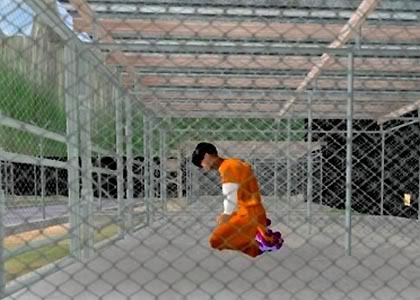
A screenshot of the "Gone Gitmo" game on Second Life: a continuation of the teach-in using new media.

Der Spiegel reports:
They sit onboard an airplane with their hands and feet restrained. Black hoods have been pulled over their heads. Guards roughly push them around until they are delivered to a dog-pound-like area fenced in with barbed wire. Now it is time to wait. There is no formal indictment, no lawyer -- and no escape.

That is roughly what one plot in "Gone Gitmo," a digital recreation of life in the US prison camp in Guantánamo, looks like. "Gone Gitmo" is part of the online phantasy world Second Life.
A virtual penal camp in the midst of a hedonist dreamworld that lures hundreds of thousands of pleasure-seeking computer users by means of shopping malls and nudist beaches -- is that not tasteless? "On the contrary," says Nonny de la Peña, a California-based activist who was involved in developing the politically inflected game. "It's not our playworld that's a scandal, but the conditions inside the real Guantánamo."

De la Peña is documentary film director whose works are shown mainly at small festivals. She hopes the online gulag will help her to reach young Americans who prefer playing computer games to attending demonstrations. To her, the Guantánamo simulation is something like a new-media update of the traditional teach-in.

An entire gamut of so-called "serious games" is hitting computer stores this fall -- games that are serious, challenging and politically correct. The 3D strategy game "Global Conflicts: Palestine," for example, which goes on sale in mid-October, involves the player assuming the role of a journalist doing research in Israel and the Palestinian territories. The player-reporter's task is to find out what is fueling the conflict and whether Israeli security forces are reacting appropriately to terrorist attacks. Instead of hunting monsters or gunning down enemies, players need to assemble -- by mouseclick -- a halfway plausible report on the basis of a plethora of mutually contradictory sources.

"Of course it's a game for a niche market," says Simon Egenfeldt-Nielsen, a Copenhagen-based professor of media studies. "But the niche is growing rapidly. We hope to be able to sell the game to 1,000 schools and 30,000 private customers for use in political education."

"Games for Change"

The new genre is expanding. The conference "Games for Change" was held for the fourth time in New York in June. It's the kind of gathering that sees computer programmers, political science professors and even World Bank and United Nations employees talking with each other.

A screenshot from the political game "Global Conflicts: Palestine."

But many serious games still suffer from serious teething troubles. Sometimes they seem too trivial and sometimes as wooden as an interactive Sunday sermon. "Darfur is Dying," for example, invites players to imagine themselves as refugees in western Sudan forced to hide from the brutal Janjaweed militias. The game was developed at the University of Southern California with the support of firms such as Reebok and MTV. It is neither particularly exciting, nor does it shed light on the conflicts behind the genocide.

"Food Force," on the other hand, is considered one of the most successful political games. It is distributed free of charge by the UN World Food Progam and is not meant to shake people awake by means of shock effects; rather, it is designed to offer insight into the complex world of famine relief. The player's task is to reduce food scarcity on a fictitious island -- despite financial bottlenecks, enemy rebels and numerous practical constraints.

Germany's Federal Agency for Civic Education (BPB) is also introducing a computer game at this year's Frankfurt Book Fair. The game, called "Genius - In The Center of Power," was developed in cooperation with the textbook publisher Cornelsen and resembles a blend of the simulated civilizations of "SimCity" and Social Studies 101.

Players can take on the persona of a politician of their choice and then campaign for the offices of mayor or prime minister. Their success is measured by the degree to which they keep their campaign promises. "In this way, we want to convey a basic understanding of how democracy works," says Arne Busse, who is responsible for the development of political-educational games at BPB. Next, he is planning to develop games for young people with immigrant backgrounds.

Of course, not even the best software can substitute for political discussions; at best they can encourage such debates and provide them with facts. The virtual Guantánamo prison, for example, regularly transforms into an Internet lecture theater where legal experts explain the US Constitution.

"When I conduct a teach-in on Second Life, I'm able to show films, present documentaries and let eyewitnesses speak-- and I reach people all over the world," says the well-known and controversial Mark Denbeaux, 64, a law professor at Seton Hall University, in New Jersey. He also works as a lawyer for Guantánamo prisoners.

Denbeaux hopes to reach a wider audience by means of the seminars he presents in the pixel-prison: "The pioneer spirit on the Internet," he says, "almost reminds me of the rallies held by the civil rights movement in the 1960s."

Sunday, October 07, 2007

"Be Careful What You Wish For"

The Bush administration is quietly relaxing visa regulations because farmworkers are in critically short supply.


The Los Angeles Times reports:
With a nationwide farmworker shortage threatening to leave unharvested fruits and vegetables rotting in fields, the Bush administration has begun quietly rewriting federal regulations to eliminate barriers that restrict how foreign laborers can legally be brought into the country.

The effort, urgently underway at the departments of Homeland Security, State and Labor, is meant to rescue farm owners caught in a vise between a complex process to hire legal guest workers and stepped-up enforcement that has reduced the number of illegal planters, pickers and middle managers crossing the border.

"It is important for the farm sector to have access to labor to stay competitive," said White House spokesman Scott Stanzel. "As the southern border has tightened, some producers have a more difficult time finding a workforce, and that is a factor of what is going on today."
The push to speedily rewrite the regulations is also the Bush administration's attempt to step into a breach left when Congress did not pass an immigration overhaul in June that might have helped American farms. Almost three-quarters of farmworkers are thought to be illegal immigrants.

On all sides of the farm industry, the administration's behind-the-scenes initiative to revamp H-2A farmworker visas is fraught with anxiety. Advocates for immigrants fear the changes will come at the expense of worker protections because the administration has received and is reportedly acting on extensive input from farm lobbyists. And farmers in areas such as the San Joaquin Valley, which is experiencing a 20% labor shortfall, worry the administration's changes will not happen soon enough for the 2008 growing season.

"It's like a ticking time bomb that's going to go off," said Luawanna Hallstrom, chief operating officer of Harry Singh & Sons, a third-generation family farm in Oceanside that grows tomatoes. "I'm looking at my fellow farmers and saying, 'Oh my God, what's going on?' "

Officials at the three federal agencies are scrutinizing the regulations to see whether they can adjust the farmworker program, an unwieldy system used by less than 2% of American farms to bring in foreign workers. They are considering a series of changes, including lengthening the time workers can stay, expanding the types of work they can do, simplifying how their applications are processed, and redefining terms such as "temporary."

Administration sources said they were moving aggressively. They declined to discuss details of the proposals.

The agencies are also working on possible changes to a separate visa program, H-2B, which brings in seasonal workers for resorts, clam-shucking operations and horse stables, among other businesses.

The administration has pursued the project discreetly. The issue of immigration has generated friction between President Bush and the conservative wing of the Republican Party, which has strongly opposed many of the initiatives that Bush has pursued.

The changes to the H-2A visa program comprise one of more than two dozen initiatives the administration announced in August. Most of the initiatives dealt with increased enforcement, the most prominent being a measure that would force employers to either fire workers for whom they've received "no match" notification (indicating their W-2 data don't match Social Security Administration records) or face punitive action from the Department of Homeland Security. When Homeland Security Secretary Michael Chertoff announced the enforcement push, he also acknowledged the problems that agriculture reported.

"Even putting aside no-match letters, just our increased work at the border was actually causing a drop in the number of workers coming across," Chertoff said.

David James, an assistant secretary of Labor, said Bush asked his department, which has jurisdiction over most H-2A rules, to review the entire program. The agency "is now in the process of identifying ways the program can be improved to provide farmers with an orderly and timely flow of legal workers while protecting the rights of both U.S. workers and foreign temporary workers," James said.

The current program, managed by all three agencies, is famously dysfunctional.

Farmers have to apply for workers about a month in advance, but the agencies often fail to coordinate their response in time for the harvest, which farmers can't always predict. At Hallstrom's farm, where tidy rows of tomato plants run almost to the ocean's edge, half of the 1,000 workers are in the H-2A program. (Nationally, about 60,000 H-2A applications a year are usually filed, compared with more than 3 million farm jobs to be filled. There is no cap on the number of H-2A workers allowed into the U.S.)

She remembers submitting an emergency request for H-2A workers one year and getting the visas 60 days later. She said the laborers spent two weeks pulling rotten fruit off the vines, and the farm lost $2.5 million. "Devastating," Hallstrom said.

Growers also complain about paying for workers' housing, transportation, visas and other fees. Harry Yates, a North Carolina Christmas-tree grower, estimates that his labor costs for H-2A workers are $14 an hour, compared with a competitor whose illegal laborers cost about $7.50 an hour. Like other farmers, Yates said using the H-2A program was an invitation to lawsuits from worker advocates and frequent government investigations.

"I understand why so many growers are afraid to use this program. It is too expensive, too complicated, too slow and too likely to land you in court," Yates said.

Some advocates for workers fiercely dispute this. They say farmers just want to keep wages low.

"The employers want to be free of government oversight, legal-services representation for the guest workers, and other efforts to enforce the modest H-2A worker protections," said Bruce Goldstein, executive director of the advocacy group Farmworker Justice, which is affiliated with the nonprofit National Council of La Raza.

Industry lobbyists have sent the Bush administration a set of detailed suggestions for overhauling the H-2A program through administrative changes, which could take weeks to put in place, and through changes in the regulations, a process that takes months.

Some of the suggestions under consideration include changing the procedures farmers must use to try to hire U.S. citizens first. Currently farmers have to advertise the jobs, then submit applications to Labor and Homeland Security to bring in foreign workers. Growers would prefer to move to a system in which they pledged that they had done all they could to recruit U.S. workers, but no longer had to submit an application to Labor.

Other changes under consideration would simplify the detailed H-2A housing requirements, extend the definition of "temporary" beyond 10 months, and expand the definition of "agricultural" workers to include such industries as meatpacking and poultry processing.

The reasons for opposing Bush's and Democrats' legislation for overhauling immigration laws are wide-ranging. Democrats' constituents oppose it on the grounds that illegal immigrants drive down Americans' wages. Conservatives' opposition is racial bias, cloaked in patriotic fervor and 'war on terror'-fears. Conservatives are about to get a taste of what liberals have been swallowing for the last six years: Bush's sheer dogged determination to get what he wants, by any means. In this instance, it's 'backdoor amnesty.'

Before George W. Bush leaves office, he will have legalized, legitimized and made legal every last illegal immigrant in the U.S. He will have called the bluff of the xenophobes who hid behind the 'rule of law' and 'threats to national security' arguments. And once again, it's the American worker who gets the shaft and is left holding the bag. An empty bag.

What's In A Name?

Crackdown Continues in Burma, Diplomatic Debate Rages Abroad

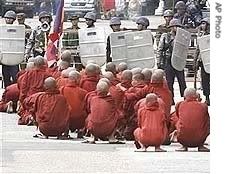
Buddhist monks pray at a riot police's road block in downtown Rangoon, Burma

When did Myanmar become Burma again? Digital Cosunilbo reports:
The Burmese military government's grip on the political situation is growing steadily tighter. The streets of Rangoon were reported quiet Sunday, while the government announced scores more arrests in its crackdown on pro-democracy demonstrations. The government's stranglehold on communications with the outside world is also continuing.

The Burmese military government said Sunday that 78 more people were taken for questioning in connection with mass protests over the last two weeks.

The number of police was meanwhile reported to have decreased, and barricades were taken down, near Rangoon's Shwedagon and the Sule Pagoda - two religious sites where protests had been staged and police fired on demonstrators.
The Internet played a key role in getting information and images to the outside world during the early days of the protests and the crackdown, but the government soon clamped down on Internet access.

An Internet café owner in Rangoon who declined to allow his name to be used told VOA the Internet is only available during the middle of the night, when there is a curfew in effect and it is illegal to be on line.

He says the city has been without Internet for nine or 10 days, though sometimes there is a very slow connection from 10 at night until four in the morning. He says he expects the Internet blackout to be lifted Monday, but nothing is certain.

The government meanwhile says more than 12 hundred people detained for their part in the protests in Rangoon have been released, about half of them Buddhist monks, after they pledged not to demonstrate again.

The military says 135 monks remain in custody, but diplomats and dissident groups say the number of detainees is probably closer to six thousand.

Outside the country, protests and an ongoing diplomatic debate at the United Nations over the Burmese government's actions are continuing.

On Saturday, thousands of demonstrators gathered in London, with smaller protests in cities around the world including Sydney, Stockholm, Paris, Washington D.C., and Bangkok.

A second day of protests here in Bangkok drew about 300 people to the Burmese embassy Sunday. Thailand is home to hundreds of thousands of Burmese exiles and migrant workers.

Britain, France and the U.S. have circulated a draft resolution at the U.N. Security Council calling on Burma's government to free political prisoners and open talks with dissident leaders.

The document would not be legally binding, but the Burmese government may take notice if the statement were approved by China, which is one of Burma's main trading partners and arms suppliers.

Up to now, China, along with Russia, has been opposed to any action against Burma by the U.N. Security Council.

Saturday, October 06, 2007

Novak: Wilson Did Not Forcefully Object To Naming of CIA Wife

What should Wilson have done? Tackled Novak to the ground?

Obviously, it's a slow news day. At TheHill.com, Mike Soraghan writes:
Columnist Robert Novak said Saturday Ambassador Joe Wilson did not forcefully object to the naming of his CIA operative wife, Valerie Plame Wilson, when Novak spoke to him prior to the publication of a column that sparked a federal investigation and sent White House aide I. Lewis “Scooter” Libby to jail.

“He was not terribly exercised about it,” Novak said.

Instead, Wilson focused on not being portrayed as simply an opponent of the Iraq war. Wilson also stressed that his wife went by his last name, Wilson, rather than Plame, Novak said.
Novak forcefully defended his handling of the column and the legal wrangling that surrounded the special counsel investigation in a seminar on the CIA leak case at the 2007 Society of Professional Journalists Convention.

“It was an off-hand remark to a question I asked in an interview I requested,” Novak said. “This was not a conspiracy in the federal government to go after Valerie Plame Wilson.”

Novak said he complied with prosecutor Patrick Fitzgerald’s subpoena to testify because his lawyer told him he had no legal grounds to resist, and losing a court fight could erode the legal protections of the press. He noted that, as a syndicated columnist, he had to pay the legal fees himself, to the tune of $160,000. His home newspaper, the Chicago Sun-Times, contributed $30,000, he said.

He was surprised when the questioning began, that he was not pressed on his source. The reason, he said, was that Fitzgerald already knew that it was then Deputy Secretary of State Richard Armitage.

At one point, he recalled, former White House aide Kenneth Duberstein called Novak on Armitage’s behalf, asking if Armitage was the source.

“I said, ‘I can’t give you that information,’” Novak said with a grin.

Novak said his critics, including those in the press, have attacks his ethics, when in fact their quarrel was with his ideology.

“I was stunned by how little editorial support I received. I was under assault from editorial writers from across the country,” Novak said. “It is startling how little is known about this case by the people who are commenting on it.”

He said his case shows the need for a shield law like the one approved last week by a Senate committee. But he added, “Is it not hypocritical for my critics to support a law that would have saved me from three years of confrontation?”

The problem I have with most conservative journalists in general, and Bob Novak in particular, is that their own narcissistic perspective drives their reporting. Their agenda is to present a story in a way that supports their world view, and they're not particularly sensitive or intuitive to the signals being broadcast right under their noses if it means having to let go of the story they want to publish.

That not true for liberal journalists, who tend to pull their punches, hold-off-on or kill stories if they can't get confirmation or affirmation from at least forty different sources. Liberals hate being caught wrong, and conservatives, when caught wrong, will create as much noise and misdirection possible to distract from their clay feet. So is the case with Novak.

Novak's defense for outing an undercover CIA agent in his July 14, 2003 column has been that it was an innocent mistake and not the result of a conspiracy by the Bush administration to intentionally leak the information as a threat to others who might want to come forward with information proving the reasons the administration used to go to war with Iraq were lies. Novak contends there was no conspiracy because of the person who first told him, Richard Armitage - "He was no political gunslinger."

When I first heard Novak tell the circumstances of his meeting with Armitage and how Armitage happened to blab Mrs. Wilson's identity, I wondered how Novak could think for a moment that it wasn't staged. Particularly after all of the other leaks to reporters were testified to:
June 13 - Richard Armitage tells Bob Woodward about Valerie Plame
June 23, 3:00 pm - Scooter Libby meets with Judith Miller - "My notes indicate that well before Mr. Wilson published his critique, Mr. Libby told me that Mr. Wilson's wife may have worked on unconventional weapons at the C.I.A. " Judith Miller, New York Times
July 6 - Joe Wilson Op-ed, "What I Didn't Find in Niger" is published in the NYT
July 7 - Scooter Libby has lunch with Ari Fleischer, tells him Joe Wilson's wife works for CIA. "hush-hush"
July 7 - Dick Cheney directs secretary Catherine Martin to track coverage of Joe Wilson's claims and report to him and Scooter Libby.
July 8, 8:30 am - Scooter Libby meets Judith Miller at St. Regis Hotel and tells her that Valerie Plame works for WINPAC
July 8, afternoon - Richard Armitage meets with Bob Novak. Novak notes in testimony, he's been turned down for interviews for years...so why now?
July 8 - Dick Cheney ordered Scooter Libby to call NBC's Andrea Mitchell and CBS's David Martin [Catherine Martin testimony]
July 9 - Bob Novak speaks to Karl Rove, Rove confirms report on Valerie Plame
July 9 - Bob Novak speaks to Scooter Libby
July 11, 8:30 am - Ari Fleischer leaks to David Gregory and John Dickerson
July 11, 11:07 am - Karl Rove leaks to Matt Cooper, "allegations of nepotism"
July 12 - Dick Cheney instructs Scooter Libby to leak NIE info to undermine Joe Wilson
July 12, 1:26 pm - Ari Fleisher leaks to Walter Pincus
July 12, 2:24 pm - Scooter Libby again tells Matt Cooper about Valerie Plame
July 12, afternoon - Scooter Libby again tells Judith Miller about Valerie Plame
"My recollection, I told him, was that Mr. Libby wanted to modify our prior understanding that I would attribute information from him to a "senior administration official." When the subject turned to Mr. Wilson, Mr. Libby requested that he be identified only as a "former Hill staffer." I agreed to the new ground rules because I knew that Mr. Libby had once worked on Capitol Hill."

And then, finally, somebody took the bait:
July 14 - Robert Novak writes, "Mission to Niger"

Anybody who buys that the leaking of Plame's name wasn't the result of a conspiracy operating out of the Bush administration is either too stupid or too naive to have a front row seat in the halls of power and to be reporting on the operations of our government to the people.

Friday, October 05, 2007

Bush Defends Interrogations, Saying Methods Aren't Torture

Dear President Bush,
If are being waterboarded, stripped naked and left in freezing cells, 'head-slapped, they are being tortured.

The New York Times reports:
President Bush, reacting to a Congressional uproar over the disclosure of secret Justice Department legal opinions permitting the harsh interrogation of terrorism suspects, defended the methods on Friday, declaring, “This government does not torture people.”

The remarks, Mr. Bush’s first public comments on the memorandums, came at a hastily arranged Oval Office appearance before reporters. It was billed as a talk on the economy, but after heralding new job statistics, Mr. Bush shifted course to a subject he does not often publicly discuss: a once-secret Central Intelligence Agency program to detain and interrogate high-profile terror suspects.
“I have put this program in place for a reason, and that is to better protect the American people,” the president said, without mentioning the C.I.A. by name. “And when we find somebody who may have information regarding a potential attack on America, you bet we’re going to detain them, and you bet we’re going to question them, because the American people expect us to find out information — actionable intelligence so we can help protect them. That’s our job.”

Without confirming the existence of the memorandums or discussing the explicit techniques they authorized, Mr. Bush said the interrogation methods had been “fully disclosed to appropriate members of Congress.”

But his comments only provoked another round of recriminations on Capitol Hill, as Democrats ratcheted up their demands to see the classified memorandums, first reported Thursday by The New York Times.

“The administration can’t have it both ways,” Senator John D. Rockefeller IV, the West Virginia Democrat who is chairman of the Senate Intelligence Committee, said in a statement after the president’s remarks. “I’m tired of these games. They can’t say that Congress has been fully briefed while refusing to turn over key documents used to justify the legality of the program.”

In two separate legal opinions written in 2005, the Justice Department authorized the C.I.A. to barrage terror suspects with a combination of painful physical and psychological tactics, including head-slapping, simulated drowning and frigid temperatures.

The memorandums were written just months after a Justice Department opinion in December 2004 declared torture “abhorrent.”

Administration officials have confirmed the existence of the classified opinions, but will not make them public, saying only that they approved techniques that were “tough, safe, necessary and lawful.”

On Friday, the deputy White House press secretary, Tony Fratto, took The Times to task for publishing the information, saying the newspaper had compromised America’s security.

“I’ve had the awful responsibility to have to work with The New York Times and other news organizations on stories that involve the release of classified information,” Mr. Fratto said. “And I could tell you that every time I’ve dealt with any of these stories, I have felt that we have chipped away at the safety and security of America with the publication of this kind of information.”

The memorandums, and the ensuing debate over them, go to the core of a central theme of the Bush administration: the expansive use of executive power in pursuit of terror suspects.

That theme has been a running controversy on Capitol Hill, where Democrats, and some Republicans, have been furious at the way the administration has kept them out of the loop.

The clash colored Congressional relations with Alberto R. Gonzales, the former attorney general. And by Friday, it was clear that the controversy would now spill over into the confirmation hearings for Michael B. Mukasey, the retired federal judge whom Mr. Bush has nominated to succeed Mr. Gonzales in running the Justice Department.

Senator Carl Levin, the Michigan Democrat who is chairman of the Senate Armed Services Committee, sent a letter to Mr. Mukasey asking him whether, if confirmed, he would provide lawmakers with the Justice Department memorandums.

And Senator Charles E. Schumer, the New York Democrat and Judiciary Committee member, said he expected the memorandums would become a central point in the Mukasey confirmation debate.

“When the president says the Justice Department says it’s O.K., he means Alberto Gonzales said it was O.K.,” Mr. Schumer, who has been a vocal backer of Mr. Mukasey, said in an interview.

“Very few people are going to have much faith in that, and we do need to explore that.”

The administration has been extremely careful with information about the C.I.A. program, which had been reported in the news media but was, officially at least, a secret until Mr. Bush himself publicly disclosed its existence in September 2006.

At the time, the president confirmed that the C.I.A. had held 14 high-profile terrorism suspects — including the man thought to be the mastermind of the Sept. 11 terrorist attacks — in secret prisons, but said the detainees had been transferred to Guantánamo Bay, Cuba.

The 2005 Justice Department opinions form the legal underpinning for the program. On Friday, the director of the C.I.A., Gen. Michael V. Hayden also defended the program, in an e-mail message to agency employees.

“The story has sparked considerable comment,” General Hayden wrote, referring to the account in The Times, “including claims that the opinion opened the door to more harsh interrogation tactics and that information about the interrogation methods we actually have used has been withheld from our oversight committees in Congress. Neither assertion is true.”

Someone needs to teach English to these stupid sonsofbitches.

Penny-Wise, Pound Foolish


There probably exists no better example of why Republicans (as well as the Democrats who sign on with them), with their pro-business, anti-populist, deregulation schemes and anti-tax policies, are bad for America.

NJ.com reports:
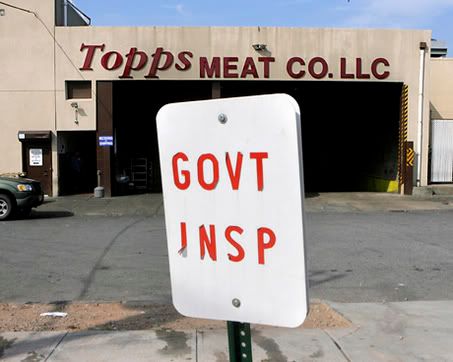
Topps Meat Co. of Elizabeth, which is involved in the second-largest beef recall in U.S. history, said today it is going out of business after more than six decades

The company announced last month it would recall more than 21.7 million pounds of ground beef products because consumers in several states became ill from E. coli bacteria, which was detected in some of the frozen hamburger patties made at the Elizabeth plant.

The company said 77 workers have been laid off and a skeleton crew of about 10 people remain at the meat grinding factory, which had been in operation for 67 years.

Scott Lituchy/The Star-LedgerWorkers who were laid off console each other outside Topps Meat Co.

"'This is tragic for all concerned," said Anthony D'Urso, chief operating officer. "In one week we have gone from the largest U.S. manufacturer of frozen hamburgers to a company that cannot overcome the economic reality of a recall this large. We sincerely regret the impact this will have on our employees, our customers and suppliers, and the community. Most of all, we regret that our products have been linked by public health agencies to recently reported illnesses. We hope and pray for the full recovery of those individuals."

The skeleton crew of workers will remain at the Elizabeth plant to assist U.S. Department of Agriculture officials in their ongoing investigation of the tainted beef recall. USDA officials said yesterday the company had to recall a year's worth of beef product because of improper documentation.

Scott Lituchy/The Star-LedgerAs worker sits in her car and cries after Topps Meat Co. closes down and lays off 77 people today.

"We want to thank our loyal employees and customers who have supported us throughout the 67 years in which Topps Meat has been in business," D'Urso said. "Topps has always prided itself on providing the utmost quality and safety and never had a recall in our history until now. This has been a shocking and sobering experience for everyone."

Topps Meat was founded in 1940 and is a leading manufacturer and supplier of frozen hamburgers and fresh cut steaks.

Voluntary regulation, trusting Big Business to do the right thing because it's the right thing to do just doesn't work.

Thursday, October 04, 2007

Makes You Wanna Go Hmmmm......

Fellow Republicans Denounce Craig's Decision


Well, not all of them.

CQ reports:
Republicans indicated Thursday that they plan to make life in the Senate uncomfortable for Larry E. Craig.

After the Idaho senator announced his determination to remain in office, fellow Republicans raised the possibility of ejecting him from committees and holding public ethics hearings.

“This gets real now,” a Republican aide said. “I think a lot of people waited — gave him the benefit of the doubt until the judge ruled.”

Craig put his colleagues in a political bind Thursday when he did an about-face and said he would stay in office for the rest of the 110th Congress despite a judge’s refusal to allow him to withdraw his guilty plea in a restroom sex sting.

“I will continue my effort to clear my name in the Senate Ethics Committee — something that is not possible if I am not serving in the Senate,” Craig said.

Republican Senate leaders plan to confer during the chamber’s Columbus Day recess about how to cope with Craig’s decision. The consultations could result in his ejection from all of his committee assignments. Craig had already relinquished his status as ranking Republican on one committee and two subcommittees.

GOP leaders had requested an Ethics Committee investigation in August, shortly after learning that Craig had pleaded guilty to misdemeanor disorderly conduct after an undercover police officer interpreted some of Craig’s actions in a restroom as a solicitation for sex. The most extreme option available to that committee is recommending expulsion — something that hasn’t happened in the Senate since the Civil War.

“My guess is there will be” public ethics hearings, said John Ensign, R-Nev., the senator in charge of improving GOP election prospects in 2008. Republicans are defending 22 Senate seats, including several left open by retiring incumbents.

“I think it would be a mistake to put the Senate through an ethics investigation process that could potentially lead to public hearings,” Ensign said. “I think that he should do the right thing and keep his word.”

Last week, Craig backed off his earlier plan to resign as of Sept. 30, saying he wanted to remain “for now” and await the judge’s ruling on his request to retract his misdemeanor guilty plea.

Craig said Thursday he will not run for re-election next year. But having him in the Senate — and featured as the punch line of comedians’ jokes on national television — won’t help Ensign and others at the National Republican Senatorial Committee steer political attention to where they’d prefer it to be.

“This is not just an ordinary misdemeanor charge, and I think we all know that,” Ensign said. “You wouldn’t get this kind of attention here if this was an ordinary misdemeanor charge.”

Norm Coleman, R-Minn., who had been among the first to call for Craig’s resignation, said the Ethics Committee would deal with him now. “I’ll await their findings and recommendations,” said Coleman, who faces a tough re-election battle next year.

“I think most of us have made our views clear in the past that he made the right decision in stepping aside,” said John Thune, R-S.D. “It’s a distraction.”

The one public glimmer of tolerance came from Arlen Specter, R-Pa.

“Disorderly conduct is not moral turpitude, and it’s not a basis for leaving the Senate,” Specter said. “I think he makes a good point when he says he wants to clear his name in an Ethics Committee hearing.”


Barbara Boxer, D-Calif., who chairs the Ethics Committee, said the panel will conduct a preliminary inquiry before making any conclusions about a full investigation or possible public hearings.

“We have just begun,” she said.

Stanley M. Brand, a Washington, D.C., lawyer who represents Craig, maintained that it would be unprecedented to punish a senator “for a misdemeanor occurring outside their official duties.”

Craig pleaded guilty in August to a disorderly conduct charge arising from an incident June 11 in a restroom at the Minneapolis-St. Paul International Airport. An undercover police officer, Sgt. Dave Karsnia, interpreted some of Craig’s bathroom-stall hand and foot motions as an invitation for sex.

On Sept. 1, with the guilty plea no longer a secret, Craig declared his intention to resign from the Senate as of Sept. 30. But Specter told Craig he had acted too hastily and should have fought the charges.

His initial decision to quit was supported by the Republican leadership.

Minority Leader Mitch McConnell, R-Ky., arrived at the Senate for a floor vote Thursday ready with a short reply to the inevitable question about the day’s developments. “That whole matter is before the Ethics Committee, so it will be dealt with, I assume, by Sen. Craig and the Ethics Committee,” he said.

The Ruling

In Minnesota, District Court Judge Charles A. Porter Jr. ruled that defendants do not have an absolute right to withdraw guilty pleas because “public policy favors the finality of judgments and courts are not disposed to encourage accused persons to ‘play games’ with the courts by setting aside judgments of conviction based upon pleas made with deliberation and accepted by the court with caution.”

Craig said he decided to plead guilty only to resolve the episode without publicity in his home state. Porter clearly didn’t buy that argument.

Meanwhile..., PennLive.com reports:
The last time U.S. Sen. Arlen Specter, R-Pa., caught a ride about Air Force One, Pennsyltucky's senior senator violated two of the cardinal rules of traveling aboard the president's airplane.

He wandered back to talk with the press and criticized then Attorney General Alberto Gonzales during a July presidential visit to Philadelphia, thereby flouting the unwritten rules against hobnobbing with the press and criticizing the president or his team.

Despite his rule violations, Specter will once again be traveling in style Wednesday when he joins President Bush aboard Air Force One for Wednesday's quick flight from Washington, D.C. to Lancaster.
U.S. Sen. Bob Casey Jr., D-Pa., will not be making the flight.

Bush will be addressing about 400 members of the Lancaster Chamber of Business and Industry in a town hall-style meeting about spending disagreements with Congress during an hour-long forum at the new Hempfield Twp. headquarters of the Jay Group Inc.

Though Specter disagrees with the president on many of the spending fights, it's protocol to invite the local lawmakers and senators for the trip. And with his approval rating hovering around 30 percent, the president can use all the friends he can get.

Besides, it's a short trip.

What's in it for Specter besides free plane rides aboard AF1?

Chris Matthews! Making News!!

Yawn

The Examiner reports:
Chris Matthews had barely finished praising his colleagues at the 10th anniversary party for his “Hardball” show Thursday night in Washington, D.C. when his remarks turned political and pointed, even suggesting that the Bush administration had "finally been caught in their criminality."
In front of an audience that included such notables as Alan Greenspan, Rep. Patrick Kennedy and Sen. Ted Kennedy, Matthews began his remarks by declaring that he wanted to "make some news" and he certainly didn't disappoint. After praising the drafters of the First Amendment for allowing him to make a living, he outlined what he said was the fundamental difference between the Bush and Clinton administrations.

The Clinton camp, he said, never put pressure on his bosses to silence him.

“Not so this crowd,” he added, explaining that Bush White House officials -- especially those from Vice President Cheney's office -- called MSNBC brass to complain about the content of his show and attempted to influence its editorial content. "They will not silence me!" Matthews declared.

This is no *new news flash*. We learned this soon during the Scooter Libby trial when, on February 7, 2007, Tim Russert was on the witness stand:
2:29 p.m.: All morning, we listened to audio tapes of Scooter Libby's grand jury testimony. Along with yesterday, that makes eight hours of tapes in all. Toward the end of this droning saga, the courtroom gallery was becoming rather sparsely populated.

But now these tapes are, mercifully, over. We've had our lunch break, and the judge and jury are seated. And for some reason, the courtroom is packed. Some reporters can't even get in. Why?

Prosecutor Patrick Fitzgerald steps up to the podium. "The government calls Tim Russert," he says.

And there's the man, walking to the witness stand. Or rather, limping to it. Russert is on crutches—the result of a broken ankle. He takes his seat, spells out his name, and describes his job: host of Meet the Press and Washington bureau chief for NBC News.

Fitzgerald launches into questions about a July 2003 phone call Russert received from Scooter Libby. Russert tells us that Libby called him to complain about something Chris Matthews said on his TV show, Hardball. Libby was "agitated," and his voice was "very firm and direct," Russert recounts.

"What the hell's going on with Hardball?" he asked Russert. "Damn it, I'm tired of hearing my name over and over again."

Fitzgerald asks if Russert had ever before, or since, received a call like that from a vice president's chief of staff. Russert says he has not. The call was really just a "viewer complaint." Besides, there was nothing Russert could do about Hardball, since it wasn't his show. He suggested other NBC people that Libby could complain to. And that was the end of the conversation.
If I didn't know any better, I'd say that Chris Matthews was out hawking another book....Wait a minute, that's exactly what's going on!

Chris Matthews has written another book, is making the talk show rounds, and is trying to appeal to the left for sales before he crawls back to the right and starts sucking up again so that he can get interviews with them during the election season.
"They've finally been caught in their criminality," Matthews continued, although he did not specify the exact criminal behavior to which he referred. He then drew an obvious Bush-Nixon parallel by saying, “Spiro Agnew was not an American hero."

Matthews left the throng of Washington A-listers with a parting shot at Cheney: “God help us if we had Cheney during the Cuban missile crisis. We’d all be under a parking lot.”

Following his remarks, a few network insiders and party goers wondered what kind of effect Matthews' sharp criticism of the White House would have on Tuesday's Republican debate in Dearborn, Michigan, which Matthews co-moderates alongside CNBC's Maria Bartiromo.

"I find it hard to believe that Republican candidates will feel as if they're being given a fair shot at Tuesday's debate given the partisan pot-shots lobbed by Matthews this evening," said one attendee.

When reached, the White House declined to comment and NBC refused requests to release video of the event. The event included such NBC/MSNBC brass as NBC Senior Vice President Phil Griffin (the former "Hardball" executive producer called "Hardball" the "best show on cable television"), "Meet the Press" host Tim Russert, "Today" show executive producer Jim Bell, NBC News Specials Executive Producer Phil Alongi, "Meet the Press" Executive Producer Betsy Fischer, NBC chief foreign affairs correspondent Andrea Mitchell, MSNBC Vice President Tammy Haddad, "Hardball" correspondent David Shuster and Vice President for MSNBC Prime-Time Programming Bill Wolff.

On a side note: Matthews was overheard discussing his Tuesday appearance on "The Daily Show," which featured a heated exchange with host Jon Stewart. According to one source, Matthews was steadfast in his belief that the debate left Stewart crestfallen, and Matthews victorious.


I like to think that venues such as this one on Jon Stewart, where Matthews can't control the conversation, is causing Matthews some introspection into just how responsible he's been for the mess that is the Bush-Cheney administration, by giving Republicans an easy ride these last six years. But then I realize that he said nothing of substance at his book party, and we have no way of knowing which criminality Matthews thinks the administration has been caught in.

Congress Seeks Justice Department Documents on Interrogation

The New York Times reports:

The Democratic chairmen of the Senate and House Judiciary Committees asked the Justice Department today to turn over secret legal opinions issued in 2005 that authorized the use of harsh interrogation techniques against terrorism suspects after the Department publicly repudiated torture as “abhorrent” in a 2004 opinion.

The 2005 legal opinions, disclosed for the first time by The New York Times, remain in effect, according to officials familiar with the Bush administration’s policy on interrogation. One provided legal justification for the use of a battery of aggressive tactics and a second said the techniques did not amount to “cruel, inhuman, or degrading” practices under international agreements.

Senator Patrick J. Leahy, the Vermont Democrat who heads the Senate Judiciary Committee, said it appeared that the Justice Department lawyers had “reversed themselves and reinstated a secret regime, in essence reinterpreting the law in secret.” He said his committee had been seeking information about the Justice Department’s legal interpretations of the law for two years without success and urged the administration to cooperate.

Representative John Conyers Jr. of Michigan, who heads the House Judiciary Committee, requested that the Justice Department’s opinions be turned over to the House panel as well and asked the department to make available for a hearing Steven G. Bradbury, of the department’s office of legal counsel, who signed the 2005 opinions.

Mr. Leahy also said his committee would hold confirmation hearings on the nomination of Michael B. Mukasey to be attorney general on Oct. 17.

Officials at the White House and the Justice Department said the 2005 legal memorandum did not change the administration’s statement in 2004 that publicly renounced torture as “abhorrent.”

“The policy of the United States is not to torture,” said Dana Perino, the White House press secretary. “The president has not authorized it, he will not authorize it.”

“But he had done everything within the corners of the law to make sure that we prevent another attack on this country,” she said at a news briefing today.

“I am not going to comment on any specific alleged techniques,” Ms. Perino said. “It is not appropriate for me to do so. And to do so would provide the enemy with more information for how to train against these techniques.”

Asked whether the disclosure of the 2005 memorandum could harm national security, Ms. Perino said. “You know, it’s secret for a reason. It’s not secret just because we want it to be a secret. It’s secret because it is classified, and classified for the reasons to protect the country from terrorists who are determined to attack us.”

The Justice Department’s spokesman, Brian Roehrkasse, said in a statement that he could not comment on classified legal advice, but he reiterated that any opinions by the department were consistent with the public 2004 memorandum on interrogations. He said the Bush administration’s “strong opposition to torture” had been consistent.

He expressed the department’s support for Mr. Bradbury, whose nomination to be permanent head of legal counsel’s office has been blocked by Senate Democrats. Mr. Roehrkasse said Mr. Bradbury “has worked diligently to ensure that the authority of the office is employed in a careful and prudent manner.”

In the areas of domestic surveillance and detainee issues, Mr. Roehrkasse said Mr. Bradbury’s “efforts have strengthened cooperation among the branches in these key national security areas.”

Something Old Becomes New Again

A previously unrecorded Faberge egg valued at up to $18 million is going up for sale next month, Christie's auction house said Thursday.


The Associated Press reports:

The pink enamel-and-gold egg is one of only a dozen designed to the highest standards for clients other than Russia's ruling family. It has been in the Rothschild banking family since 1902, when it was given as an engagement present.

The egg contains a diamond-set cockerel which pops up every hour and flaps its wings, nods its head and opens and closes its beak.

It will go on sale Nov. 28 at Christie's in London, where it is expected to fetch $12 million to $18 million. If it reaches the top price, it will break the existing record for a Russian artwork, the US$9.6 million paid for a Faberge egg in New York in April 2002.

"The discovery of this masterpiece is the most exciting of my 40-year career," said Anthony Philips, International Director of Silver and Russian Works of Art at Christie's. "Although few examples exist, The Faberge egg is known around the world as one of the most impressive and exclusive works of art ever made."

Craftsmen Peter Carl Faberge created more than 50 of the eggs for Russia's imperial family, though not all survive. Czar Alexander III commissioned the first as an anniversary present for his wife, Empress Maria Fedorovna, on Easter Day 1885. The Empress was so enamored of the enameled egg, with a golden yoke, golden hen, miniature diamond crown and ruby egg inside, that the czar ordered that a unique egg be made for her every Easter Day after.

After the Czar died unexpectedly in 1894, his son Nicholas continued the tradition until the Russian Revolution in 1917. Nicholas and his family were executed on July 17, 1918.

After the revolution, the communist government sold off many of Faberge's creations, which found their way into Western collections.

The Rothschild egg was presented as an engagement gift to Edouard de Rothschild and Germaine Halphen, who married in 1905, by Edouard's sister Beatrice Ephrussi.

More Proof Bush & Congress Working Together To Steal Iraq's Oil

Kurds Reach New Oil Deals, Straining Ties With Baghdad

The NY Times:

The Kurdish regional government has reached four new oil-exploration deals, further straining relations with many Iraqi leaders in Baghdad, who want to maintain a more centralized control over the country’s enormous oil reserves.

The new deals are the latest in an effort by the Kurds to build their own oil industry while national oil legislation languishes in Parliament. A similar agreement reached last month with the Hunt Oil Company of Dallas was criticized as illegal by the Iraqi oil minister, Hussain al-Shahristani.

Kurdish officials, who have said they want to bring about a major increase in oil production, say the deals are consistent with the Iraqi Constitution.

But many in Parliament object to the Kurdish interpretation, and it is unclear how the Kurds’ own regional oil law, passed in August, will conform with whatever might ultimately be approved by the central government.

Many Sunni Arab leaders object to the production-sharing agreements being negotiated by the Kurds, which call for companies to invest large sums for finding and producing oil and to be awarded a portion of the profits generated by the new fields.

Any federal oil law would have to take account of Kurdish and Shiite concerns that provincial governments be given substantial autonomy to carry out their own development plans and of the desire of Sunni Arabs for strong central control to assure that they receive a fair share of the revenues, even though there is little oil in their provinces.

So far, these problems have proved insurmountable, and the oil law, one of President Bush’s benchmarks of progress in Iraq, has stalled.

The Kurds’ new contracts were signed with Heritage Oil Corp., a publicly traded Canadian concern, and Perenco S.A., a privately held French company. Two other deals with “experienced international companies” are to be announced soon. The total initial amount invested is expected to be $500 million, the regional government said.

If the exploration leads to oil production, Kurdish officials said that in rough terms the deals call for the companies to recover their costs and split profits, with 15 percent going to the companies and 85 percent to the government. A Kurdish official said it would take three to five years before any production could start.

In Baghdad, a spokesman for the Iraqi Oil Ministry denounced the new oil-exploration contracts and warned companies not to sign deals without the blessing of the national government.

“Any contracts signed before the approval of the oil law will be ignored or considered illegal,” said the spokesman, Assim Jihad.

A senior State Department official in Baghdad has also criticized the oil contracts as having “needlessly elevated tensions” between the Kurds and Baghdad.

A Kurdish official defended the deals, saying that the revenue would be shared with all Iraqi regions and that delays in signing exploration pacts only postponed the delivery of much needed cash to the treasury. “We can start now to look for exploration, and by the time we need the money the cash flow will be coming into the country,” the official said.

A Western executive involved in negotiations with the Kurds said the regional government seemed to be trying to “create a fait accompli” by signing so many deals with foreign companies that the central government eventually had to accept the provisions sought by the Kurds in any final version of the oil law.

An official at another oil company said the burst of deals reflected the Kurds’ concerns that their oil development was delayed during the time of Saddam Hussein and that they lagged in production compared with Shiite-dominated southern Iraq.

“I just think they know instinctively that they are behind the curve, and they have to move or they will never get their resources out of the ground,” said this official, who was not authorized to speak publicly. “The Kurds might be playing catch-up in the petroleum business, but they are doing a good job.”

If it wasn't all about oil (the war), and if Iraq was truly sovereign, and if Washington (Bush and Congress, which includes Hillary) wasn't conspiring to pressure Iraq's parliament into giving up its oil fields to western multinational oil corporations, Congress and Bush would be calling for laws and sanctions against corporations and nations doing these deals with the Kurds because it undermines U.S. efforts to stabilize the Iraq occupation and fails to recognize the central government of Iraq.

When our own State Department criticizes the deals as having "needlessly elevated tensions" between the Kurds and Baghdad, how serious then is Bush about wanting peace and stability in Iraq? Bush is not, nor has he ever been, interested in a stabilized Iraq; it would mean the end of the occupation.

Monday, October 01, 2007

Germans Relying on Pakistani Torture Interrogation Methods

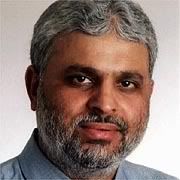
Aleem Nasir was interrogated in Pakistan and then picked up by the German police when he landed in Frankfurt.

Der Spiegel reports:
German prosecutors attempting to prove a salesman guilty of al-Qaida membership have been relying on the results of his interrogation in Pakistan. He says his testimony was extracted by means of torture.

When Aleem Nasir returned from Pakistan on Aug. 25, an unusual VIP service was waiting for him at Frankfurt Airport: A police car took the dealer in semi-precious stones directly to a clinic in Mainz, where he was given a blood test and his hand and arm were photographed. The 45-year-old, who lives in Germersheim in the German state of Rhineland-Palatinate, was far from overjoyed about this unexpected medical examination. After all, the investigators were hoping for a diagnosis that would hardly be favorable to him: They were hoping to prove him a terrorist.
The enforced medical examination had been requested by the Office of the Federal Prosecutor, which had been given carte blanche by Ulrich Hebenstreit, an investigative judge at Germany's Federal Court, in early August. According to a court order written with apparent haste, the examination was intended to prove that Nasir had spent time in an al-Qaida training camp in northern Pakistan. It was alleged that he had attempted to mix "250 grams (8.8 ounces) of potassium nitrate with red phosphorus" and "injured his right hand and arm" when the dangerous concoction exploded.

But so far, the attempt to secure evidence from Nasir's body has not yielded the unambiguous results that had been hoped for. And now the investigators face another problem: The tip-off about Nasir's alleged handling of explosives came from the notorious Pakistani intelligence agency Inter-Services Intelligence (ISI) who interrogated him in Islamabad in June. Nasir says the ISI men, some of them masked, beat him "until I could no longer stand it." The interrogations would routinely begin with between three and five punches and slaps. He was held in an ice-cold cell in a special prison with just five cells run by Americans, Nasir says. In the end, he says, he gave a false testimony just to get out of there.

The allegations are explosive -- particularly in Germany. It is the first time since the Sept. 11, 2001 attacks that German authorities have based the core part of an ongoing terrorism case on the results of questionable interrogation methods. The evidence comes from a country that Amnesty International accuses of carrying out "arbitrary arrests" and of not paying much heed to suspects' basic human rights, particularly terror suspects. Former inmates report having been tortured, says Amnesty. And the German Foreign Ministry also calls the human rights situation in Pakistan "as problematic as ever."

'Forbidden Fruits Marked with Blood'

The case is adding fire to a debate in Berlin about where exactly the line should be drawn in the fight against terrorism, and about whether German authorities "profited from forbidden fruits still marked with dried blood," as Wolfgang Wieland, a member of the opposition Green Party, puts it. A parliamentary commission is currently exploring this question in the Bundestag. In 2006 the chancellery already prohibited Germany's foreign intelligence agency, the Federal Intelligence Service (BND), from carrying out interrogations in countries such as Syria and Pakistan.

Has Germany's Chief Federal Prosecutor Monika Harms tolerated her staff making use of testimonies extracted by torture?

Since then investigators have continued to evaluate information coming from dubious sources. But using such information in preliminary proceedings was considered taboo -- even for officials working for Germany's Chief Federal Prosecutor Monika Harms. This led the prosecutors to shred US files containing interrogation statements by Ramzi Binalshibh -- the alleged chief logistician behind the Sept. 11, 2001 terror attacks -- when it transpired the CIA sometimes uses interrogation techniques such as "waterboarding," which involves submerging the prisoner in water. The transcripts of a visit German investigators paid the Syrian-born German citizen Mohammed Haydar Zammar in Damascus were also not used in German proceedings -- because Zammar, another al-Qaida member, had been interrogated in Syrian prisons.

The federal prosecutors have strayed from this clear principle in the case of Nasir, even if Justice Minister Brigitte Zypries from the Social Democrat Party (SPD) presents sophisticated arguments to show it is all just a matter of following an "investigative lead." Zypries does not believe a precedent has been set.

The behavior of the investigators also reveals how much they suspect Nasir -- and how difficult it would be to prove him guilty. The father of four was born in Pakistan, is married to a German and has been a German citizen since 1992. The German authorities have considered him a "danger" for some time. Indeed, federal prosecutors had already investigated Nasir once before when he allegedly remarked, after the Sept. 11, 2001 terrorist attacks, that such attacks would now occur "everywhere, including Germany." The investigation didn't lead to a conviction.

So the Germans were of course excited when they heard about Nasir's arrest in Pakistan on June 18, 2007. He simply corresponds too well to the image German Interior Minister Wolfgang Schäuble of the Christian Democrat Party (CDU) has been conjuring up for months: that of German Islamists' Pakistan connection.

While Nasir himself admits to having been in Wana, a city in the lawless region of Pakistan widely held to be an al-Qaida stronghold, he also says all he did there was purchase lapis lazuli. And in fact he was carrying 25 kilograms (55 lbs) of the semi-precious stones when he was arrested.

The ISI reports, on the other hand, state that Nasir admitted to having been invited to a training camp by an al-Qaida functionary, Abdul Rehman, and that while there he mixed the explosives correctly the first time around, and injured himself during his second attempt. According to the ISI, Nasir also provided al-Qaida with binoculars and night vision devices in addition to transporting money for the group.

Another statement by Nasir illustrates just how closely Germany and Pakistan have cooperated on this case -- if the statement is true. Nasir says that his Pakistani interrogators repeatedly showed him photographs of Fritz Gelowicz. The German convert to Islam was part of the Islamist cell recently discovered (more...) in Germany's Sauerland region, which is accused of planning terror attacks in the country. The images of Gelowicz -- mostly photos taken while he was under observation -- come from the German prosecutors' files. Nasir says he did not encounter German investigators in the prison where he was held. "But," he adds, "my interrogators had been fully briefed by the German authorities."

Court Rules Delay in Release of Presidential Papers is Illegal -

- Fails to Address Authority of Former Vice Presidents to Hold Up Disclosure of Papers

UPDATE: And as usual, Republicans are up to their usual shenanigans, this time trying to divert Americans' attention by misdirection, by making false claims ("Bill and Hillary Clinton are responsible for preventing the release of Presidential papers"):

The Presidential Records Act of 1978 would have released presidential records had it not been for Bush's Executive Order. Why isn't the RNC pressuring Bush to rescind his order?

A District Court in the District of Columbia has ruled that an Executive Order issued by President George W. Bush in 2001, which severely slowed or prevented the release of historic presidential papers is, in part, invalid.
In a carefully constructed decision, the court held that the Archivist of the United States acts arbitrarily, capriciously, and contrary to law by relying on the Executive Order to delay release of the records of former presidents. The court did not reach the issue of whether it was permissible for President Bush to extend the authority over disclosure of presidential papers to a former president’s heirs or to former vice presidents.

The underlying lawsuit, which was filed in November 2001 by the National Security Archive and other plaintiffs, challenges President Bush's Executive Order 13,233 that gave former Presidents and their heirs (as well as former Vice-Presidents for the first time) indefinite authority to hold up release of White House records. In finding that the plaintiffs have standing to pursue the claim, the court specifically referenced the delays experienced by the National Security Archive for requests pending at the Ronald Reagan Presidential Library. As the Archive’s Director Thomas Blanton testified in Congress this past March, those delays have grown from 18 months in 2001 to “an estimate of 78 months (six and a half years!) [in 2007].”

Archive General Counsel Meredith Fuchs commented, “The court is enforcing procedural standards, but has avoided the hard questions about the role former presidents, former vice presidents, and their heirs can play when it comes to disclosure of presidential records.” She noted, “Unless the Executive Order is reversed or withdrawn, decisions about the release of records from this administration may ultimately be made by the Bush daughters.”

And can Bush or his brothers object to the release of Reagan's papers in whose administration Bush's father was vice-president? And what about the liberal-libertarian independent Ron and Patty Reagan? What if they want their father's papers released, but their neoconservative brother, Michael Reagan (the son adopted by Reagan during his first marriage to Jane Wyman), doesn't agree?
The decision comes at a time when a bill that would overturn Executive Order 13,233 is stalled in the U.S. Senate, reportedly due to a hold placed on the measure by Senator Jim Bunning (R-KY). The bill, H.R. 1255, was approved in the U.S. House of Representatives on March 14, 2007 by a vote of 333-93. The White House has threatened to veto the bill if it is passed in the Senate.

BACKGROUND
The Presidential Records Act of 1978 (PRA) emerged from the scandals of the Nixon presidency to require former presidents to release their records no later than 12 years after they leave office. Under the PRA, as amended, the U.S. government asserts complete "ownership, possession, and control" of all Presidential and Vice-Presidential records. Upon conclusion of the President's term in office, the National Archivist is required to assume custody of the records, and to make them available to the public when permissible under the PRA. Access to the records can be denied after the end of the 12-year embargo only if a former or incumbent president claims an exemption based on a "constitutionally based" executive privilege or continuing national security concern.

On February 8, 2001, shortly after President Bush came into office, he was notified of a scheduled release of Reagan presidential records (68,000 pages of records). His legal counsel requested two successive 90-day extensions of time to review the records prior to their release followed by a third request for an indefinite extension of time so that the White House could evaluate the legal framework and process that would govern release of the records. This was followed on November 1, 2001 with the issuance of Executive Order (E.O. 13,233) that gives the White House and former presidents uncontrolled discretion in deciding whether to deny the release of documents requested by journalists and scholars.

These papers serve and belong to the American people.