Thursday, September 20, 2007

Israel, U.S. Shared Data on Suspected Nuclear Site

The Washington Post reports:
Israel's decision to attack Syria on Sept. 6, bombing a suspected nuclear site set up in apparent collaboration with North Korea, came after Israel shared intelligence with President Bush this summer indicating that North Korean nuclear personnel were in Syria, U.S. government sources said.

The Bush administration has not commented on the Israeli raid or the underlying intelligence. Although the administration was deeply troubled by Israel's assertion that North Korea was assisting the nuclear ambitions of a country closely linked with Iran, sources said, the White House opted against an immediate response because of concerns it would undermine long-running negotiations aimed at persuading North Korea to abandon its nuclear program.
Ultimately, however, the United States is believed to have provided Israel with some corroboration of the original intelligence before Israel proceeded with the raid, which hit the Syrian facility in the dead of night to minimize possible casualties, the sources said.

The target of Israel's attack was said to be in northern Syria, near the Turkish border. A Middle East expert who interviewed one of the pilots involved said they operated under such strict operational security that the airmen flying air cover for the attack aircraft did not know the details of the mission. The pilots who conducted the attack were briefed only after they were in the air, he said. Syrian authorities said there were no casualties.

U.S. sources would discuss the Israeli intelligence, which included satellite imagery, only on condition of anonymity, and many details about the North Korean-Syrian connection remain unknown. The quality of the Israeli intelligence, the extent of North Korean assistance and the seriousness of the Syrian effort are uncertain, raising the possibility that North Korea was merely unloading items it no longer needed. Syria has actively pursued chemical weapons in the past but not nuclear arms -- leaving some proliferation experts skeptical of the intelligence that prompted Israel's attack.

Syria and North Korea both denied this week that they were cooperating on a nuclear program. Bush refused to comment yesterday on the attack, but he issued a blunt warning to North Korea that "the exportation of information and/or materials" would affect negotiations under which North Korea would give up its nuclear programs in exchanges for energy aid and diplomatic recognition.

"To the extent that they are proliferating, we expect them to stop that proliferation, if they want the six-party talks to be successful," he said at a news conference, referring to negotiations that also include China, Japan, South Korea and Russia.

Unlike its destruction of an Iraqi nuclear reactor in 1981, Israel made no announcement of the recent raid and imposed strict censorship on reporting by the Israeli media. Syria made only muted protests, and Arab leaders have remained silent. As a result, a daring and apparently successful attack to eliminate a potential nuclear threat has been shrouded in mystery.

"There is no question it was a major raid. It was an extremely important target," said Bruce Riedel, a former intelligence officer at Brookings Institution's Saban Center for Middle East Policy. "It came at a time the Israelis were very concerned about war with Syria and wanted to dampen down the prospects of war. The decision was taken despite their concerns it could produce a war. That decision reflects how important this target was to Israeli military planners."

Israel has long known about Syria's interest in chemical and even biological weapons, but "if Syria decided to go beyond that, Israel would think that was a real red line," Riedel said.

Edward Djerejian, a former U.S. ambassador to Syria and founding director of Rice University's Baker Institute for Public Policy, said that when he was in Israel this summer he noticed "a great deal of concern in official Israeli circles about the situation in the north," in particular whether Syria's young ruler, Bashar al-Assad, "had the same sensitivity to red lines that his father had." Bashar succeeded his Hafez al-Assad as president of Syria in 2000.

The Israeli attack came just three days after a North Korean ship docked at the Syrian port of Tartus, carrying a cargo that was officially listed as cement.

The ship's role remains obscure. Israeli sources have suggested it carried nuclear equipment. Others have maintained that it contained only missile parts, and some have said the ship's arrival and the attack are merely coincidental. One source suggested that Israel's attack was prompted by a fear of media leaks on the intelligence.

The Bush administration's wariness when presented with the Israeli intelligence contrasts with its reaction in 2002, when U.S. officials believed they had caught North Korea building a clandestine nuclear program in violation of a nuclear-freeze deal arranged by the Clinton administration.

After the Bush administration's accusation, the Clinton deal collapsed and North Korea restarted a nuclear reactor, stockpiled plutonium and eventually conducted a nuclear test. Secretary of State Condoleezza Rice convinced Bush this year to accept a deal with North Korea to shut down the reactor, infuriating conservatives inside and outside the administration.

But for years, Bush has also warned North Korea against engaging in nuclear proliferation, specifically making that a red line that could not be crossed after North Korea tested a nuclear device last year. The Israeli intelligence therefore suggested North Korea was both undermining the agreement and crossing that line.

Conservative critics of the administration's recent diplomacy with North Korea have seized on reports of the Israeli intelligence as evidence that the White House is misguided if it thinks it can ever strike a lasting deal with Pyongyang. "However bad it might be for the six-party talks, U.S. security requires taking this sort of thing seriously," said John R. Bolton, the former U.S. ambassador to the United Nations who was a top arms control official in Bush's first term.

But advocates of engagement have accused critics of trying to sabotage the talks. China on Monday abruptly postponed a round of six-party talks scheduled to begin this week, but U.S. officials now say the talks should start again Thursday.

Some North Korean experts said they are puzzled why, if the reports are true, Pyongyang would jeopardize the hard-won deal with the United States and the other four countries. "It does not make any sense at all in the context of the last nine months," said Charles "Jack" Pritchard, a former U.S. negotiator with North Korea and now president of the Korea Economic Institute.

Life These Days in Gaza

Throughout 40 years of occupation, collective punishments that violate the fourth Geneva Convention have been commonplace

The BBC's Middle East editor, Jeremy Bowen:

The other week, I sat in Gaza City with Raji Sourani, the director of the Palestinian Centre for Human Rights (PCHR).

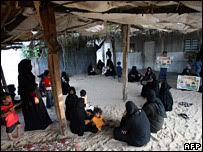
The Gaza Strip's economy has been hit hard by the Israeli embargo


It was a hot Gaza day, the summer was winding down to the holy month of Ramadan, and outside his office not much was moving on the street.

Why should it? The economy of the Gaza Strip is in a state of collapse. The jobs that are left - and they are few - are disappearing.


Since the militant group Hamas used force to drive out its rivals, Fatah, in June, the crossing used for the passage of goods between Gaza, Israel and the outside world has been closed.

Around 1.4 million people live in the Gaza Strip. Some 1.1 million of them receive UN food rations.

For many Palestinians, it is ironic that President Abbas will talk to representatives of the Israeli government, but not to anyone from Hamas


Israel, like most of its Western allies, regards Hamas as an unreconstructed terrorist organisation bent on the destruction of the Jewish state and believes that embargo and isolation are good ways of dispatching it to the dustbin of history.

Fatah, the other main Palestinian faction, also wants pressure on Hamas kept up.

Publicly, Fatah protests about what the embargo does to Gaza's people, privately it gives tacit approval.

For many Palestinians, it is ironic that their President, Mahmoud Abbas, will talk to representatives of the Israeli government, but not to anyone who comes from the Islamist group which won a democratic election in January 2006.

Collective punishment

Raji Sourani and I discussed all of that. Then he spoke about some orange groves his family owned.

Even though Gaza is one of the most crowded places in the world, there is a surprising amount of open agricultural land.

Israel wants to halt to the continued rocket attacks launched from Gaza

Mr Sourani spoke of how on hot days like the one that was sweltering all around us, they would picnic in the shade of the trees.

They could not do it anymore, he said, because Israeli bulldozers had crossed into Gaza and flattened the orange groves.

A wide strip of land along the border has been cleared, Israel says for security reasons, so its soldiers can spot Palestinian militants who want to kill Israelis.

Many Palestinians say that reasons of security can also be a cover for the collective punishment of property owners.

'Worse things happen'

I was expecting Mr Sourani to talk about the pain of losing something that was full of family memories.

He said it did hurt. But he also described the way that his elderly mother, to all and intents and purposes, had told her family to pull themselves together.

Israel has apologised for killing the three young cousins last month

Listen, she said, they were only trees. They have gone, but they can grow again.

The important thing, she told them, is that none of you are dead.

Now, what is the point of writing about all this?

As Mr Sourani's mother said, many worse things happen in Gaza. Violent death is part of everyone's life.

Later the same day, I went to the home of a family that was mourning three children, two boys aged 10 and 12, and a 12-year-old girl.

The young cousins were mistakenly killed by Israeli soldiers last month because they were playing close to rocket launchers outside Beit Hanoun.

I suppose I am mentioning Mr Sourani's mother because she displays not just a commendable sense of proportion, but also a capacity to endure. You won't get far without it in Gaza.

Israeli frustration

They need it too on the other side of the border wire in the southern Israeli town of Sderot, which is regularly rocketed from Gaza.

A couple of days after I met Mr Sourani, a rocket landed close to the town's nursery school.

Sderot residents have protested against perceived Israeli inaction

Very fortunately, nobody was hurt in that attack. But it filled many Israelis who saw television pictures of terrified infants with rage and frustration.

Newspaper columnists asked what Israel would be doing if the children in the Sderot nursery school had been killed (their answer: re-invading Gaza) and angrily rejected the idea that Israel's policy should be dictated by the kill-rate of Palestinian rockets.

That started calls to find a way to punish Gazans for allowing rockets to be fired at Israel, which deepened after more than 60 Israeli soldiers were hurt in another attack.

This week, the Israeli government produced its answer.

It decided to classify Gaza a "hostile entity", and, pending a legal review, to reserve the right to impose collective punishments by cutting supplies of fuel and electricity, and by restricting the movement of people.

'Big prison'

Gaza's new status institutionalises methods that Israel is already using to ratchet up the pressure.

UN Secretary General Ban Ki-moon asked Israel to reconsider.

He said Gaza's people "should not be punished for the unacceptable actions of militants and extremists".

The Palestinians to whom I have spoken ask what is new.

For years, they have routinely described the Gaza Strip as a big prison and it is hard to argue with the description.

Throughout 40 years of occupation, collective punishments that violate the fourth Geneva Convention have been commonplace.

Echoing terminal

In Gaza today, supplies of everything are in short supply because of existing Israeli restrictions, and the movement of Palestinians into and out of the territory has already almost ceased.

Israel has built an enormous border terminal with sophisticated layers of security that culminate with a full body scan.

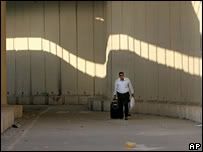
Israel has heavily restricted movement into and out of Gaza

You enter a circular chamber, the doors of which hiss shut behind you.

A loudspeaker voice, owned by a person who presumably is watching what is happening on a TV monitor, tells you to stand with your legs apart and to raise your hands above your head.

Sensors spin and swoop round, looking for dangerous substances that you may have swallowed or inserted into your body.

It does not hurt - nothing touches you and if you pass scrutiny, you walk out into the echoing terminal, glacial with air conditioning, past security people who preside over a building that is almost empty because so few people can cross.

Perhaps the terminal is designed for a better time, of neighbourly relations between two states.

US friends only

And as life for Gaza's civilians becomes worse, Western politicians and diplomats have hopes that for the first time since the collapse of the Camp David summit in 2000, there could be a chance to restart peace talks.

For them, everything has become easier since Hamas took over in Gaza.

Ms Rice has yet to address the problem that her strategy ignores both Hamas and the Syrian government - two entities who have the capacity to wreck anything the conference produces

They can now deal solely with Fatah, which has set up a technocratic "government" without any Hamas participation.

The West - and the Israeli prime minister and the Palestinian Authority president - is focusing on a US plan for an international conference in November, which Secretary of State Condoleezza Rice is working towards this week as she tours the Middle East.

She has yet to address the problem that her strategy ignores both Hamas and the Syrian government - two entities who have the capacity to wreck anything the conference produces that they do not like. Only friends of the US are being invited.

An invitation arrived at Mr Sourani's office to meet the new Middle East peace envoy Tony Blair.

It would have meant going through the empty border terminal and to travel up to Jerusalem, but Mr Sourani was not granted a permit by the Israeli authorities.

He was frustrated, but he also cannot get a permit to visit his wife and children, who are in Egypt.

Guess which hurts most. As his mother said, keep everything in proportion.

When's It Going To End?

Senate Approves Resolution Denouncing MoveOn.org Ad

The NY Times reports:
The Senate approved a resolution on Thursday denouncing the liberal antiwar group MoveOn.org over an advertisement that questioned the credibility of Gen. David H. Petraeus, the American commander in Iraq.

MoveOn.org, with 3.2 million members, has become a powerful force in Democratic politics and the advertisement it paid for, which appeared in The New York Times, has come under sharp attack from Congressional Republicans and others as unpatriotic and impugning the integrity of General Petraeus.

Senator Hillary Rodham Clinton of New York and Senator Christopher J. Dodd of Connecticut, both Democratic candidates for president, voted against the resolution, which passed 72 to 25.

But curiously absent from the vote was Senator Barack Obama of Illinois, also a Democratic candidate for president, who had canceled a campaign appearance in South Carolina so he could be in Washington for votes.
Mr. Obama issued a statement calling the resolution, put forward by Senator John Cornyn, Republican of Texas, “a stunt.” Mr. Obama said, “By not casting a vote, I registered my protest against these empty politics.”

Mr. Obama had voted minutes earlier in favor of an extremely similar resolution proposed by Senator Barbara Boxer, Democrat of California.

Ms. Boxer’s proposal, which failed, called for the Senate to “strongly condemn all attacks on the honor, integrity and patriotism” of anyone in the United States armed forces. It did not mention the MoveOn.org ad. Mr. Dodd and Mrs. Clinton also voted in favor of Ms. Boxer’s proposal.

Senator Joseph R. Biden Jr. of Delaware, who is also seeking the Democratic nomination, was in Iowa and did not vote.

At a White House news conference, President Bush called the advertisement disgusting and said it was an attack not only on General Petraeus but also on the entire American military.

“And I was disappointed that not more leaders in the Democrat Party spoke out strongly against that kind of ad,” Mr. Bush said. “And that leads me to come to this conclusion: that most Democrats are afraid of irritating a left-wing group like MoveOn.org — or more afraid of irritating them than they are of irritating the United States military.”

Representative Thomas M. Davis III, Republican of Virginia, has urged the House to hold hearings on the MoveOn.org ad and to investigate whether The Times gave the group an improper discount. A New York Times Company spokeswoman has said that the group paid a standard “standby” rate.

MoveOn.org lashed out at Mr. Bush’s comments and pledged to double its spending on ads criticizing Republican lawmakers for blocking efforts by Democrats to change the war strategy. Eli Pariser, executive director of MoveOn.org Political Action, said, “What’s disgusting is that the president has more interest in political attacks than developing an exit strategy to get our troops out of Iraq and end this awful war.”

At Huffington Post, R.J. Eskow lays out how Democrats could have strategically played this and won.

I don't believe any strategic games were necessary to win. MoveOn.org has nothing to apologize for, while the Bush administration and Republicans (and now 22 Democrats) have everything to apologize for. Particularly these Democrats that voted for this resolution condemning MoveOn.org:
Feinstein (D-CA)
Baucus (D-MT)
Bayh (D-IN)
Cardin (D-MD)
Carper (D-DE)
Casey (D-PA)
Conrad (D-ND)
Dorgan (D-ND)
Johnson (D-SD)
Klobuchar (D-MN)
Kohl (D-WI)
Landrieu (D-LA)
Leahy (D-VT)
Lieberman (ID-CT)
Lincoln (D-AR)
McCaskill (D-MO)
Mikulski (D-MD)
Nelson (D-FL)
Nelson (D-NE)
Pryor (D-AR)
Salazar (D-CO)
Tester (D-MT)
Webb (D-VA)

Not voting were Biden, Cantwell, and Obama (who is playing games with the base, by moments earlier voting yes on a similar resolution by Barbara Boxer that failed). The full list can be found here.

Another day passed with American troops and Iraqi civilians dying for what we all know is the increased wealth from oil for a very few of Bush's and Cheney's family and friends. Mike Stark at Daily Kos has a plan. I think it's a good one and about Goddamned time.

When Resolved Senators Leave The White House Changed Men

I have to wonder what Bush and Cheney offered John Warner, for him to change his mind about his own amendment.

In the Washington Post, Dana Milbank writes:
To paraphrase the immortal words of John Kerry, Sen. John Warner actually did vote to shorten the Iraq war before he voted to lengthen it.

Just two months ago, the courtly Virginia Republican went to the Senate floor and sided with his Democratic colleague from the commonwealth, Jim Webb, on a plan that would shorten troop deployments in Iraq. Yesterday, he went to the same place to announce that he would now vote against the same bill.

"I endorsed it," Warner said. "I intend now to cast a vote against it."
With those dozen words, the former chairman of the Armed Services Committee put a surprise end to the latest efforts in Congress to limit the Iraq war.

Democrats had been hoping that Warner, who last month endorsed the start of a pullout from Iraq, would bring enough Republicans with him to vote for their best plan to accelerate the troop withdrawal: Webb's plan to limit the troops' deployments. But this effort, like previous ones, ended in failure.

"Senator Webb's amendment, I would say without any equivocation, is designed to help protect the concept of the all-volunteer force, and it was for that reason that I joined him," Warner explained in his discursive floor statement, which led to the conclusion that "I will have to cast a vote against my good friend's amendment."

Pro-war Republicans, who had been grumbling about Warner's perfidy for weeks, suddenly celebrated him as an American hero.

"Having now decided to change his vote on this particular amendment is of monumental importance and is the type of decision that makes all of us proud to serve in this great institution," Sen. Saxby Chambliss (Ga.) pronounced.

Webb was rather less pleased to discover that Warner had retreated from their shared foxhole. The White House "turned up the political heat, and that made people, like particularly Senator Warner, uncomfortable," he deduced.

And when did Webb learn of the betrayal? "Um," Webb replied, "he told me five minutes before the debate began this morning."

Webb should not have been surprised.

In January, Warner drafted a Senate resolution opposing President Bush's "surge" of additional troops into Iraq. Then, on Feb. 5, he voted against bringing up his own resolution for debate. The surge went ahead, unmolested. In the spring, Warner repeatedly flirted with opposition to Bush, but each time he returned to the fold.

Tuesday, September 18, 2007

Top 25 Censored Stories of 2008

Project Censored's list is out:
#1 No Habeas Corpus for “Any Person"

#2 Bush Moves Toward Martial Law

#3 AFRICOM: US Military Control of Africa’s Resources

#4 Frenzy of Increasingly Destructive Trade Agreements

#5 Human Traffic Builds US Embassy in Iraq

#6 Operation FALCON Raids

#7 Behind Blackwater Inc.

#8 KIA: The US Neoliberal Invasion of India

#9 Privatization of America’s Infrastructure

#10 Vulture Funds Threaten Poor Nations’ Debt Relief

#11 The Scam of “Reconstruction” in Afghanistan

#12 Another Massacre in Haiti by UN Troops

#13 Immigrant Roundups to Gain Cheap Labor for US Corporate Giants

#14 Impunity for US War Criminals

#15 Toxic Exposure Can Be Transmitted to Future Generations on a “Second Genetic Code”

#16 No Hard Evidence Connecting Bin Laden to 9/11

#17 Drinking Water Contaminated by Military and Corporations

#18 Mexico’s Stolen Election

#19 People’s Movement Challenges Neoliberal Agenda

#20 Terror Act Against Animal Activists

#21 US Seeks WTO Immunity for Illegal Farm Payments

#22 North Invades Mexico

#23 Feinstein’s Conflict of Interest in Iraq

#24 Media Misquotes Threat From Iran’s President

#25 Who Will Profit from Native Energy?

Home Foreclosures Up 36 Percent in August


The Associated Press reports:
The number of foreclosure filings reported in the U.S. last month more than doubled versus August 2006, and jumped 36 percent from July - a trend that signals many homeowners are increasingly unable to make timely payments on their mortgages or sell their homes amid a national housing slump.

A total of 243,947 foreclosure filings were reported in August, up 115 percent from 113,300 in the same month a year ago, Irvine, California-based RealtyTrac Inc. said Tuesday.

There were 179,599 foreclosure filings reported in July.
The filings include default notices, auction sale notices and bank repossessions. Some properties might have received more than one notice if the owners have multiple mortgages.

August's total represents the highest number of foreclosure filings reported in a single month since the company began tracking monthly filings two years ago.
The national foreclosure rate last month was one filing for every 510 households, the company said.

"The jump in foreclosure filings this month might be the beginning of the next wave of increased foreclosure activity, as a large number of subprime adjustable rate loans are beginning to reset now," RealtyTrac Chief Executive James J. Saccacio said.

The mortgage industry has been rocked by a surge in defaults, particularly among borrowers with subprime loans and adjustable rate mortgages that initially had attractive "teaser" interest rates but then can adjust upward, resulting in a payment shock.

Many of the loans, some of which adjust in as little as two years, were issued in 2005 and 2006 during the height of the housing boom.

Lagging home sales and flat or decreasing home prices have also left homeowners unable to make their mortgage payments hard-pressed to find buyers.

The latest figures also reflect an increase in the number of homes going into foreclosure that are not being picked up in estate sales and are ending up going back to lenders.

The number of bank repossessions jumped to 42,789 in August, compared with 20,116 a year earlier, the RealtyTrac said. In July, there were 26,842 bank repossessions.

Nevada, California and Florida had the highest foreclosure rates in the country last month, the firm said.

Nevada reported one foreclosure filing for every 165 households - more than three times the national average. The state had 6,197 filings in August, an increase of 21 percent from July and more than triple the year-ago figure.

California's foreclosure rate was one filing for every 224 households. The state reported the most foreclosure filings of any single state with 57,875, up 48 percent from July and an increase of more than 300 percent from August 2006.

Florida had one foreclosure filing for every 243 households. In all, the state reported 33,932 foreclosure filings, up 77 percent from July's total and more than twice the year-ago total.

Georgia, Ohio, Michigan, Arizona, Colorado, Texas and Indiana rounded out the 10 states with the highest foreclosure rates.

Monday, September 17, 2007

The End of Privacy As We Known It

You receive a pink slip and a positive HIV test result on the same day? Coincidence, or does your doctor also work for your employer?


The Washington Times reports:
Corporations struggling to stem the rising tide of health care costs are providing on-site medical services that used to be found only in doctors' offices and hospitals.

The National Business Group on Health recently released a survey on the prevalence of on-site clinics among U.S. employers with more than 1,000 employees. Of those surveyed, 23 percent reported offering on-site medical services in 2007, while 29 percent plan to offer a program next year.

"These clinics are also an opportunity to provide services in a more cost-effective way," said Helen Darling, president of the Washington lobbying group. "They will have limited services, and the patient won't get a lot of extra costly services, which the employer would have had to pay for."
A recent Kaiser Family Foundation survey found that the premiums businesses pay for their workers' health care have increased 78 percent since 2001. But creating a medical facility is not exactly a cheap solution to the problem, so the trend is predominantly found among large employers.

Automakers and other manufacturers have been incorporating on-site health care into their business plans for years. Mishaps are a fact of life in manufacturing, where nurses are needed to treat occupational injuries.

But over the past several years, white-collar employers, including technology and pharmaceutical companies, are discovering that it is cost-effective to offer a clinic with a family physician who provides care to employees and their families.

World Health Management of Cleveland has offered on-site health care services to employers for more than 20 years. Jim Hummer, founder of the company, said he witnessed an evolution in employers' thinking on health care during that time.

"All of a sudden, it's in vogue to get involved in workers' health care issues," he said. "Health care costs have gone out of sight, so the employers are realizing they must change. For the first time, there is an alignment of interest between the workers and employers on preventing illnesses."

Isn't it funny how the Washington Times ignored patients' medical privacy issues in this article and the downside of having your doctor working for your employer and not for you? How can anyone not believe that with an arrangement such as this one, management won't be reviewing employees' health records before handing out promotions?

Wednesday, September 12, 2007

U.S. Officials Confirm Israel Strike on Syria

Only in a parallel universe is Israel's act of aggression not considered an act of war.

Reuters reports:
U.S. officials on Wednesday confirmed Israel launched air strikes against Syria last week and said they were to target weapons Israel believes were headed for the militant group Hezbollah.

One defense official dismissed speculation Israel had aimed for any nuclear-related target. Two others said the target included weapons Israeli and U.S. officials have said Iran provides to Hezbollah through Syria.
"They saw a weapons flow," one official said, referring to weapons caches intended for Hezbollah, which fired thousands of rockets into Israel during a 36-day conflict last year.

It was still unclear whether Israel hit its targets in the September 6 air strikes.

Israel has declined comment on the strikes. Syria says the munitions dropped by Israel did no damage.

One U.S. defense official, speaking only on condition of anonymity, said the significance of the strikes was not whether Israel hit its targets, but rather that it displayed a willingness to take military action.

Syria has protested to the United Nations about the air strikes. On Wednesday, Syria's U.N. ambassador said Israel's motive was to torpedo peace moves.

SYRIA AT U.N.

"We think the Israeli purpose behind such an aggressive act is to torpedo the peace process, to torpedo the idea of holding an international conference," Syrian Ambassador Bashar Ja'afari told reporters.

Asked about Hezbollah's weapons, Ja'afari said, "This is blah, blah. This is nonsense, this is an unfounded statement. It is not up to the Israelis or anyone else to assess what we have in Syria."

"There was no target," he added. "They dropped their munitions. They were running away after they were confronted by our air defense."

Israeli public radio stations, which like all media in the country are under military censorship, led morning news bulletins with a New York Times report that U.S. officials had said Israel carried out the strikes -- and that U.S. officials believed Syria may have obtained nuclear material.

While some officials speculated that Syria and North Korea had opened some form of cooperation on nuclear weapons, other U.S. officials and former intelligence officials told Reuters that seemed unlikely and technically difficult.

A European diplomat speaking on condition of anonymity told Reuters satellite surveillance of an alleged nuclear site in Syria had been inconclusive due to poor weather. However, he said monitoring of this site would continue.

Israeli jets last struck in 2003 across a border that remains tense but quiet 34 years after the last war between the two neighbors ended in an edgy ceasefire. In June last year Syrian guns opened fire on Israeli aircraft over Syria.

Israel has urged Syria to stop supporting militant Palestinian groups and the Lebanese movement Hezbollah.

Some Israeli intelligence officials also have suggested Syria's government might be ready to try to take by force parts of the Golan Heights captured by Israel in the war of 1967.

Syrian officials have said Syria was seeking peaceful means to recover the Golan, although some also have suggested force remained an option if diplomacy failed. Israeli-Syrian peace efforts have been stalled for seven years.

And notice how the media went to black-out.

Tuesday, September 11, 2007

Riddle of Chech Body Armor Found with Iraqi Insurgents

Riddle solved . . . . Iraq security forces under suspicion after Prague says equipment was legally supplied to police.

The Sunday Herald reports:
Hundreds OF Iraqi insurgents killed or captured in battle by American-led coalition forces have been found to be wearing state-of-the-art Czech-manufactured body armour. The latest findings have added to mounting concern about the quantity and sophistication of military equipment reaching Islamist fighters, sectarian death squads and al-Qaeda terror gangs inside Iraq.

The riddle of the provenance of the Czech body armour highlights the very thin dividing line between legal and smuggled arms and other war materiel sloshing around in Iraq. According to the Small Arms Survey, a Swiss-based research organisation, seven million unauthorised guns are now in civilians' hands in a country of 27 million.

For months the US military command in Iraq has suspected that illegal shipments of Czech-made body armour and other equipment have been reaching rebels in increasing quantities.
US Army and FBI investigators probing how the Czech flak jackets came into the hands of Iraqi insurgents compiled an impressive dossier, complete with the serial numbers of vests seized from radicals. Then they turned to Prague for help to uncover the Czech end of the presumed smuggling ring.

Last week, Pavla Kopecka, a spokeswoman for the Czech police headquarters, confirmed America's request for help in the investigation.

"We have received information from the Americans about the fact that Czech-made body armour has been found in the hands of rebels in Iraq. We also received a request to investigate how these vests got to the Iraqi insurgents."

The consignment of 6000 flak jackets had been manufactured by a Czech defence department-approved firm in Jevicko, northwest Moravia, and legally exported to Baghdad, Kopecka said.

The real surprise of the Prague investigation, carried out by the Czech organised crime squad, was that the vests had been legally supplied to the Iraqi police at a cost of $2.7million (£1.33m).

It was, the Czech police spokeswoman emphasised, the first instance of legally exported Czech military supplies ending up in the wrong hands in Iraq."Everything in this case was absolutely legal and in accordance with Czech laws. We had not come across any problems with our own or international laws."

Kopecka added: "The problems occurred in Iraq. I could only speculate as to how the body armour delivered to the Iraqi police reached the insurgents."

The stark and unpalatable truth facing the Americans is that Iraq's police force, infiltrated by Shia militias, death squads and al-Qaeda-linked radicals, must have handed over weapons and protective vests to insurgents.

Recently, hundreds of state-of-the-art high-velocity Austrian sniper rifles exported to Iran were found in the hands of Shia insurgents in Iraq. An investigation in Vienna revealed that these formed part of a consignment of 800 specialist rifles legally supplied to the Tehran police drug squad.

The US defence department this summer estimated that some 190,000 American weapons supplied to the Iraqi security forces "have gone missing". This helps explain, in part, how easily legal weapons become illegal guns in Iraq. It appears that one in every 25 weapons supplied by the Americans to the Iraqi security forces have ended up in the hands of insurgents.

And that will not make it any easier to withdraw some of the troops now boosting America's "surge" in Iraq.

The Czechs' vindication in the Iraqi body armour affair and their police's insistence that no illegal shipments of any Czech military materiel had taken place to Iraq does not, however, exonerate their dealings in the world's arms bazaar.

The Czech government's annual report on arms exports has drawn criticism from Amnesty International. The international human rights group accused Prague of exporting weapons to counties which violate human rights, and drew attention to the fact that there were no guarantees that Czech weapons would not end up in a third country trying to outfox a United Nations arms embargo.

Amnesty's criticism has upset Prague. Vaclav Balek, head of the foreign ministry's security policy department, said: "I find this criticism unfair because we are quite open and we do publish all the information possible. In the process of granting a licence we have to take into consideration various factors and one of these is the commitment of Czech exporters."

He added: "If we are talking about tricky' countries, such as Ethiopia or Nigeria, I have to make clear that the exports in question are exports of spare parts for military equipment exported in the past. In particular, we are talking about spare parts for trainer aircraft."

O, to know then what we know now, that the 'insurgents' are, more accurately, 'counter-insurgents'; Iraqis, fighting the real insurgents, us, the occupying U.S. military.

Wait a minute, we did know:
...Gen Shinseki told a congressional committee that he thought an occupying force in the hundreds of thousands would be required to police postwar Iraq. Mr Rumsfeld publicly repudiated him, saying he was "far off the mark".

In semi-private, the Pentagon's civilian leadership was far more scathing. A "senior administration official" told the Village Voice newspaper that Gen Shinseki's remark was "bullshit from a Clintonite enamoured of using the army for peacekeeping and not winning wars".

Then the general said it again. "It could be as high as several hundred thousand," he told another committee. "We all hope it is something less." Most of the media were too distracted by the build-up to war to notice. Serious analysts, however, were staggered by the insubordination.

This appears to have been round two of another, more immediately relevant, dispute about how many troops are needed to win this war. In this case, the military prevailed over the original civilian notion that fewer than 100,000 could do it. As even more soldiers rush to the Gulf to bring the number closer to 300,000, the original Rumsfeld plan looks in hindsight to be what the army said at the time: a recipe for possible catastrophe.

The full reality on the ground may not become known until Saddam Hussein has fallen, but no one can now seriously believe - as many top Pentagon civilians appear to have done a week ago - that the main problem for an occupying force will be what to do with all the floral gifts.

Monday, September 10, 2007

Mission Creep

Kathy Griffin's Emmy Remarks to Be Censored


The AP reports:
Before Kathy Griffin won a creative arts Emmy last weekend for her reality show, 'My Life on the D-List,' she joked that an award would move her to the C-list. She was right: 'C' as in censored. The TV academy said her raucous acceptance speech will be edited when the event, which was taped, is shown Saturday on the E! channel.

The main prime-time Emmy Awards air the next night on Fox.

'Kathy Griffin's offensive remarks will not be part of the E! telecast on Saturday night,' the Academy of Television Arts & Sciences said in a statement Monday.
In her speech, Griffin said that 'a lot of people come up here and thank Jesus for this award. I want you to know that no one had less to do with this award than Jesus.'

She went on to hold up her Emmy, make an off-color remark about Christ and proclaim, 'This award is my god now!'

The comedian's remarks were condemned Monday by Catholic League President Bill Donohue, who called them a 'vulgar, in-your-face brand of hate speech.'

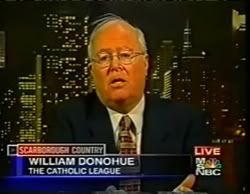
Bill Donohue, president of the Catholic League

According to the TV academy and E!, when the four hour-plus ceremony is edited into a two-hour program, Griffin's remarks will be shown in 'an abbreviated version' in which some language may be bleeped.

The program was in production and unfinished, an E! spokeswoman said Monday.
Requests for comment were left Monday evening by phone and e-mail with Griffin's publicist. They were not immediately returned.

The Catholic League, an anti-defamation group, called on the TV academy to 'denounce Griffin's obscene and blasphemous comment' at Sunday's ceremony.

The academy said Monday it had no plans to address the issue in the prime-time broadcast.

The organization may have another delicate issue to consider, this one involving an off-color fake music video that aired last December on 'Saturday Night Live' and won a creative arts Emmy for best song.

Andy Samberg of 'SNL' said Saturday that he had yet to be asked by the TV academy to perform the tune with Timberlake on the Fox broadcast, but he was willing.

Timberlake, on a concert tour, is scheduled to be in Los Angeles next weekend.
The subject of their '(Blank) in a Box' video: wrapping a certain part of the male anatomy and presenting it to a loved one as a holiday present.

The academy has said that 'show elements are in the process of being worked out.'

Had Kathy Griffin not been Catholic, but had she been born into a Presbyterian family, would Donohue have launched his attack? How is it that Donohue and the Catholic League can own 'Jesus Christ' and dictate what can be said about him? Do they hold a trademark (Jesus Christ®)?

This is a typical example of what evangelical Christians mean when they say that "there is an attack on Christians" - the free speech rights of a private citizen.

P.S. Way to go on the Emmy, Kathy Griffin!

Sunday, September 09, 2007

Fred 'Opportunity Knocks' Thompson Provided Legal Counsel For Pan Am 103 Terrorists


The NY Times reports:
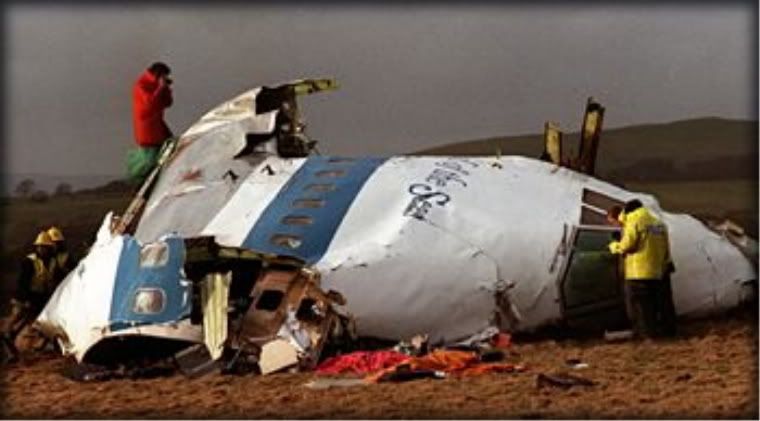
A little over three years after Pan Am Flight 103 blew up over Lockerbie, Scotland, Fred D. Thompson provided advice to a colleague about one of his law firm’s new clients: The man representing the two Libyan intelligence officials charged in the terrorist bombing.

The colleague, John Culver, a partner at the Washington firm of Arent Fox Kintner Plotkin & Kahn began advising the two suspects’ Libyan lawyer in February 1992. Mr. Thompson, according to a memorandum from that era written by his secretary, held “discussions with Culver re: Libya” that same month.

At the time, Libya was facing international outrage for refusing to comply with a United Nations demand that the two suspects be extradited to the West for trial in the 1988 bombing, which killed 270 people. Revelations that American firms were representing Libyan interests provoked a furor among the Pan Am victims’ families. Some law firms refused to represent the country or the suspects, while others withdrew.
The involvement of Mr. Thompson, who worked part-time for Arent Fox as a lawyer and lobbyist from 1991 until shortly before his election to the Senate in 1994, never became public. But Arent Fox’s chairman, Marc L. Fleischaker, confirmed that Mr. Thompson, who is now seeking the Republican presidential nomination, briefly provided Mr. Culver with advice about the suspects’ case, billing the firm for 3.3 hours of his time.

The firm was hired to provide guidance on the tense questions surrounding where the two men should be tried, Mr. Fleischaker said, and Mr. Thompson’s background as a former prosecutor, as well as his government relations experience — he had close ties to senior officials in the first Bush administration — “gave him insight on jurisdictional issues such as that.”

Karen Henretty, a spokeswoman for his presidential campaign, said that Mr. Thompson had no authority to decide which clients the firm represented. Mr. Thompson has faced questions about his work for two other Arent Fox clients. He initially denied working on behalf of a family planning group seeking to overturn an abortion counseling ban at federally financed clinics, but billing records showed that he spent nearly 20 hours on the matter. His work on behalf of Jean-Bertrand Aristide, the deposed Haitian leader — a phone call to John Sununu, then the White House Chief of Staff — has also become fodder for his rivals because of human-rights abuses during Mr. Aristide’s presidency.

The memorandum by Mr. Thompson’s secretary reviewing his work for Arent Fox, compiled in 1993 as he was running for the Senate, was buried among thousands of Mr. Thompson’s papers archived at the University of Tennessee, and casts new light on his time there, beyond his work on the Libya case.

It lists the clients he brought into the firm, which included construction firms and a Texas chemical company embroiled in a case involving the illegal dumping of hazardous waste.

Mr. Thompson also helped others at Arent Fox, the memorandum shows. He met, for instance, with the Chilean ambassador in 1991 and then traveled to Chile to try to garner business for the law firm from that country’s government. He consulted with one of the firm’s partners about a Mexican trade agreement and helped other lawyers with introductions to important Republican officials.

Mr. Thompson has said he makes no apologies for his legal and lobbying work, emphasizing in one online essay that every person, no matter how unpopular, is entitled to representation and that lawyers’ work on behalf of a client is no indication of their own personal views.

Asked about Mr. Thompson’s participation in the Libya case, James Kreindler, a lawyer who represents 130 of the victims’ families, said: “Pan Am 103 was really an attack on the United States, so while some families understood the concept that everyone deserves a defense, a number were offended and angered that American lawyers were willing to earn fees by doing anything to help this pariah nation or the two bombing suspects.”

Today, in the post-Sept. 11 political climate, all the presidential candidates are jockeying to prove their antiterrorism credentials, with Mr. Thompson vowing last week to fight “radical Islamic terrorism” vigorously. Yesterday, his campaign noted that during his eight years in the Senate, Mr. Thompson supported sanctions against Libya.

In 1992, Libya was among those countries the United States listed as state sponsors of terrorism for acts that included the 1989 bombing of a French airliner and the 1986 bombing of a Berlin disco that killed two American soldiers.

Arent Fox, in papers it was required to file with the federal government, reported that from February 1992 to August 1993, it provided advice on American and international law to Ibrahim Legwell, the Libyan lawyer appointed by the Libyan Bar Association to represent the two intelligence officials charged with the Flight 103 bombing. Arent Fox received $833,960 in fees and expenses for its work on the case.

Mr. Legwell, reached in Tripoli, said his main goal was to see that his clients were tried in Libya or in a neutral country. He said Arent Fox “contributed a lot” to the defense effort. Mr. Legwell said he had no record of ever speaking with Mr. Thompson but noted: “I remember that this name was mentioned.”

Mr. Culver, a former Democratic senator from Iowa, said that Mr. Thompson was not a primary member of his team, and that his contribution amounted to “a couple of conversations.”

“In a large firm, you frequently consult with people who have experience” in the field of law at hand, he said. In the end, after protracted negotiations with the United Nations, Libya agreed in 1999 to hand over the two men for trial by a special court in the Netherlands. One of the men was convicted and is serving his sentence in a Scottish jail.

In 2003, Libya accepted responsibility for the Pan Am bombing and agreed to pay the victims $2.7 billion in compensation. After Mr. Qaddafi’s renunciation of terrorism and his agreement to end programs to develop unconventional weapon, the United States last year removed Libya from its list of state sponsors of terrorism.

Republicans don't seem to have any problem coming up with convenient rationalizations for putting their values on a high shelf when it comes justifying their support for Rudy Guiliani. My hunch is that Fred Thompson's inability to pass up a satchel full of blood money won't either.

An Unlikely Hit on Iranian TV

Show Sympathetic to Plight Of Jews During the Holocaust Draws Millions Each Week


Zero Degree Orbit, Part 1 of Episode 1


Zero Degree Orbit, Part 2 of Episode 1

The Wall Street Journal reports:
Every Monday night at 10 o'clock, Iranians by the millions tune into Channel One to watch the most expensive show ever aired on the Islamic republic's state-owned television. Its elaborate 1940s costumes and European locations are a far cry from the typical Iranian TV fare of scarf-clad women and gray-suited men.

But the most surprising thing about the wildly popular show is that it is a heart-wrenching tale of European Jews during World War II.
The hour-long drama, "Zero Degree Turn," centers on a love story between an Iranian-Palestinian Muslim man and a French Jewish woman. Over the course of the 22 episodes, the hero saves his love from Nazi detention camps, and Iranian diplomats in France forge passports for the woman and her family to sneak on to airplanes carrying Iranian Jews to their homeland.

On the surface, the message of the lavish, state-funded production appears sharply at odds with that sent out by Iranian President Mahmoud Ahmadinejad, who has repeatedly called the Holocaust a myth.

In fact, the government's spending on the show underscores the subtle and often sophisticated way in which the Iranian state uses its TV empire to send out political messages. The aim of the show, according to many inside and outside the country, is to draw a clear distinction between the government's views about Judaism -- which is accepted across Iranian society -- and its stance on Israel -- which the leadership denounces every chance it gets.

"Iranians have always differentiated between ordinary Jews and a minority of Zionists," says Hassan Fatthi, the show's writer and director. "The murder of innocent Jews during World War II is just as despicable, sad and shocking as the killing of innocent Palestinian women and children by racist Zionist soldiers," he says.

Mr. Fatthi, 48 years old, is a well-known director of historical fiction for television. In the past, his work has focused on Iranian history. But he also dabbles in comedy, winning international critical acclaim two years ago for a hit feature, "Marriage, Iranian Style."

He says he came up with the idea for "Zero Degree Turn" four years ago as he was reading books about World War II and stumbled across literature about charge d'affaires at the Iranian embassy in Paris. Abdol Hussein Sardari saved over a thousand European Jews by forging Iranian passports and claiming they belonged to an Iranian tribe.

Mr. Fatthi says he chose the title because the world at the time was in dire circumstances, offering few options for avoiding the terrors to come. Shot on location in Paris and Budapest, the show stars Iranian heartthrob Shahab Husseini and is so popular that its theme song -- an ode to getting lost in love -- is a hit, too.

"It's captivating. No matter where I am or what I'm doing, on Monday nights I find a television set and watch the show. So does every Jewish person I know here," says Morris Motamed, the lone Jew in parliament.

Shahab Husseini stars in 'Zero Degree Orbit.'

Mr. Fatthi enlisted the help of Iran's Jewish Association, an independent body that safeguards the community's culture and heritage. The association has criticized Mr. Ahmadinejad's comments about the Holocaust but has praised Mr. Fatthi's show.

Iran is home to some 25,000 Jews, the largest population in the Middle East outside of Israel. Iran's Jews -- along with Christians and Zorastrians -- are guaranteed equal rights in the country's constitution. Iran's Jews are guaranteed one member of parliament and are free to study Hebrew in school, pray in synagogues and shop at kosher supermarkets. Despite Mr. Ahmadinejad's statements, it isn't government policy to question the Holocaust, and the country's supreme leader, Ayatollah Ali Khamenei, hasn't endorsed those views.

While Iran makes it no secret that it considers Israel an enemy, it has been extremely touchy about criticism of its treatment of Jewish citizens. The show is seen as an effort by the government to erase the image that it may be anti-Semitic -- both at home among Jews and non-Jews, and abroad.

"In this show, you notice that a new method of political dialogue is being promoted that is more in line with the modern world," says Mohammad Ali Abtahi, a reformist cleric and former Iranian vice president.

The message appears to be grabbing the public. Sara Khatibi, a 35-year-old mother and chemist in Tehran, says she and her husband never miss an episode. "All we ever hear about Jews is rants from the government about Israel," she says. "This is the first time we are seeing another side of the story and learning about their plight."

The show also pushes Iran's political line regarding the legitimacy of Israel: The Jewish state was conceived in modern times by Western powers rather than as part of a centuries-old desire of Jews for a return to their ancestral homeland. In one scene, a rabbi declares it a bad idea for Jews to resettle in Arab lands. In another, the French Jewish protagonist refuses a marriage offer by a cousin, who is advocating the creation of Israel.

Iran has long used TV to shape public opinion, where newspapers and the Internet are seen as media for the elite. The state's control over radio and television is enshrined in the constitution. Ayatollah Khamenei, the supreme leader, is not only head of the armed forces and the judiciary, but also the national broadcast authority.

"The regime appreciates the fact that to appeal to the masses, both in Iran and the Muslim world, television is the most important outlet," says Karim Sadjadpour, an expert on Iran at the Carnegie Endowment for International Peace in Washington.

On any given day, the country's seven state-run channels broadcast a mostly drab offering of news, sports, cooking shows, soap operas and religious sermons. Political propaganda is constantly fed into the mix. Dissidents such as students or reformers are routinely paraded before cameras to read confessions after stints of solitary imprisonment.

A slick documentary-style program recently aired long interviews with two Iranian-Americans who were detained on allegations of working to overthrow the regime. The interviews -- in which the pair blandly admitted to meeting with Iranian scholars and dissidents, but not to attempting to topple the government -- were intercut with provocative scenes of demonstrations in Ukraine, where the U.S. encouraged groups that eventually staged the successful Orange Revolution in late 2004.

In July, Iran launched a 24-hour English-language satellite news channel called Press TV, joining the ranks of the BBC, CNN and Al Jazeera. Its Arabic news channel, Al Alam, has been broadcasting news with an Iranian slant in the Arab world for several years.

Episodes of "Zero Degree Turn," broadcast in Farsi, can be seen outside of Iran on the Internet, either streaming live or downloaded at tv1.irib.ir/barnameha/sharhefilm.asp?code=0011109036106. It is also broadcast with English subtitles on the state-controlled Jameh Jam satellite channel, which is available on Europe's Hot Bird satellite network. Mr. Fatthi also says Islamic Republic of Iran Broadcasting has been contacted about selling the show to networks in other countries, but he doesn't know which ones.

Saturday, September 08, 2007

New Osama Bin Laden Tape?

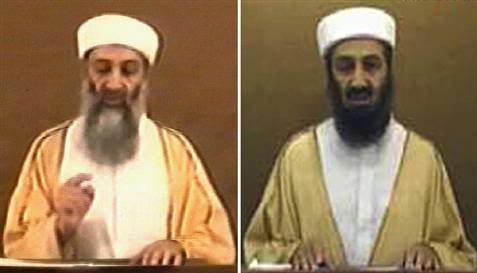
? Osama Bin Laden, 2004 | Osama Bin Laden, 2007 ?

[For current video, see end of post]
- Bin Laden tapes -
October 6, 2001 - audio tape released, supposedly of bin Laden saying any US attack on Muslim world would be repaid "twofold".

November 12, 2001 - apparent video tape of bin Laden warning US allies against supporting "White House gang of butchers".

December 20, 2003 - audio tape, purportedly from bin Laden, accuses Arab governments responding to US calls for democracy of being "infidel" agents of US.

May 6, 2004 - audio recording, said to be from bin Laden, calls for a holy war against the US-led occupation of Iraq.

October 30, 2004 - Days before the US presidential election, bin Laden in a video tells Americans Bush has deceived them and that the US could face more strikes like September 11.

Al Jazeera English reports:
A videotape purporting to show Osama bin Laden has been released in which the al-Qaeda leader warns George Bush that he is repeating the "mistakes of the former Soviet Union".

US officials were studying the tape, which, if proved to be genuine, would be the first message from bin Laden for nearly three years.
In the tape, bin Laden purportedly said that US Democrats had failed to stop the Iraq war because of the power of US corporations.

"The mistakes of Brezhnev are being repeated by Bush," says Bin Laden on the tape, in a reference to the former Soviet invasion of Afghanistan, Reuters reported.

Bin Laden said that the war in Iraq was continuing for "the same reasons which led to the failure of former president [John F] Kennedy to stop the Vietnam war - those with real power and influence are those with the most capital", the Reuters news agency reported.

The tape, released on Friday, purportedly shows Bin Laden telling US citizens that they should join Islam if they want the war in Iraq to end, though it is said to contain no specific threats.

The videotape was issued just days before the 6th anniversary on the September 11 attacks on New York.

Commenting on the video, Bush said the tape was "a reminder about the dangerous world in which we live, and it is a reminder that we must pull together to protect our people against these extremists who murder the innocent in order to achieve their political objective."

Authenticity

In the video bin Laden is shown with his beard much shorter and darker than in his last appearance, when it was streaked with grey.

A banner on the screen reads in English: "A message from Sheikh Osama bin Laden to the American people."

References in the video to Nicolas Sarkozy, the French president, and Gordon Brown, the British prime minister, are believed to suggest the video is only a few weeks old.

Bin Laden also appeared to refer to memorial ceremonies in Hiroshima and Nagasaki that took place barely a month ago, on August 6 and on August 9.

A US official said that this could mean the video was recorded later in August.

US officials have not confirmed the authenticity of the tape, but did say that it was being analysed.

Later Reuters reported an anonymous official as saying the US was "operating under the assumption that the tape is real".

Adel Darwish, political editor of Middle East magazine, told Al Jazeera that he had "doubts" about the authenticity of the tape.

"Any kid these days with an electronic kit can alter images and edit the way that he or she likes," he said.

"There is no close up on bin Laden, the beard is thick and black and then there are large segments where the image is a still."

Website shutdown

Soon after Washington announced it had the video, all the websites that usually carry statements from al-Qaeda went down and were inaccessible, in an unprecedented shutdown, according to the Associated Press news agency.

The reason for the shutdown was not immediately known.

Evan H Kohlmann, an expert at globalterroralert.com, said he suspected it was the work of al-Qaeda itself, trying to find how the video leaked to US officials.

Others suspected the US might be behind the shutdown.

Marwan Bishara, Al Jazeera's senior political analyst, said: "Bin Laden is telling the Americans that he is still there and leading."

"It [the tape]underlines the strength of words in this new asymmetrical warfare in the 21st century between the US and al-Qaeda."

Tony Fratto, a White House spokesman, said the tape demonstrated that "terrorists are out there and they are actively trying to kill Americans and threaten our interests".

Bin Laden was last seen in a video statement shortly before the US presidential election in 2004.

Since then, he has issued a number of audio messages, the last in July 2006 when he vowed al-Qaeda would fight the US across the world.

Latest video purported to have been released by Osama Bin Laden and Al Qaeda:


UPDATE: After a fairly exhaustive search (and like the other videos and audio tapes by Bin Laden of the last years), the actual video isn't anywhere to be found on the internet.

What you see here is what looks like a video news release about the Bin Laden tape by Al Jazeera English (uploaded to YouTube by Al Jazeera English) which includes a few seconds that are allegedly from the Bin Laden tape.

Of particular interest in this news report are the interviews with some "experts" about the Bin Laden video. One is with an unofficial disinformation lieutenant for the Bush administration, conservative author of the disingenuous tome, Losing bin Laden: How Bill Clinton’s Failures Unleashed Global Terror,' PajamasMedia's Richard Miniter. Miniter has a long history of supporting the war in Iraq and perpetuating the myths that "Saddam Hussein hearts Al Qaeda" and "WMD were too found in Iraq!" [No, WMD were not found in Iraq, nor trucked to Syria, Jordan, nor Never Never Land, nor Munchkin Land.]

Just this past May (2007), Miniter wrote:
"Since many of you have been asking, here is a list of links to my reporting from Iraq. I was out there in Iraq for almost five weeks, in the Green Zone*, at Camp Victory, at al Asad, at TQ (a Marine base), and at various places in Iraqi Kurdistan, including Irbil and Sulamaniya. I have more pieces in the works, including an interview with a number of Saddam’s intelligence service who says he worked with al Qaeda, an interview with a key Iranian resistance leader, a humorous feature called “Scenes from the Green Zone” and much more."

Learn more about what Representative Ellen Tauscher (D-CA) calls 'Green Zone fog', or 'death by powerpoint'.

Friday, September 07, 2007

Hayden: "Media Should Leave CIA Oversight to Congress"

At the Center for Foreign Relations:
Gen. Michael V. Hayden, director of the Central Intelligence Agency (CIA), said in a September 7 speech at CFR that among the myriad security threats faced by his agency, “none commands more attention than terrorism.”

Hayden, an Air Force general who ran the National Security Agency from 1999 to 2005, has led the CIA for sixteen months. During that time he has overseen the release of several national intelligence estimates offering cautionary accounts of the “war on terror,” including one describing the Iraq war as “the ‘cause celebre’ for jihadists.”

Speaking at CFR’s New York headquarters, Hayden described two parallel tracks in the “war on terror”: a “close fight” and a “deep fight.” The former, he said, consists of efforts to destroy an enemy that is “easy to kill, but hard to find and quick to regenerate.” The deep fight “requires winning the war of ideas” by reducing the appeal of jihad ideology to disenchanted young Muslims. Hayden was careful to add, “The war of ideas is not about Islam. It’s about fanatics whose victims most often have been Muslims.”

“This is a form of warfare unlike any other in our country’s history,” he said. “It’s an intelligence war as much as a military one.”
In such a war, Hayden argued, the media and society in general needs to factor the need for secrecy into its view of events.

“A free press is critical to good government,” Hayden said, but he argued that the media should not act as a watchdog over the government’s clandestine services. That role, he said, belongs to Congress. “It’s important to bear in mind that my agency is subject to another oversight mechanism that has full access to our operations and takes our security requirements into account: It’s the people’s representatives in Congress.”

Hayden spoke at length about the often tenuous relationship between his agency and the media. “The duty of a free press is to report the facts as they are found. By sticking to that principle, journalists accomplish a great deal in exposing al-Qaeda and its adherents for what they are.” Hayden decried what he considers poor judgment by journalists seeking to expose CIA practices. “In a war that largely depends on our success in collecting intelligence on the enemy, publishing information on our sources and methods can be just as damaging as revelations of troop or ship movements were in the past.” Furthermore, he complained, such exposure has scared away vital sources and even created rifts between the CIA and other nations’ intelligence services.

Hayden cast his agency as adhering to strict boundaries, emphasizing that all detentions, renditions, and interrogations conducted by the CIA have been lawful and infrequent. “Since [the CIA’s detention and interrogation program] began with the capture of Abu Zubaydah in 2002, fewer than one hundred people have been detained at CIA’s facilities. And the number of renditions, apart from the fewer than one hundred detainees, is an even smaller number.”

Members of the audience pressed the director to defend efforts to legalize “enhanced interrogation techniques,” such as waterboarding. They also asked him to explain CIA policy on renditions and the extradition of detainees at Guantanamo Bay and elsewhere to nations with poor human rights records.

Hayden explained that detainees are only extradited to nations where they are citizens or against which they have committed a crime. For instance, the Pentagon announced this week the extradition of sixteen Saudis held at Guantanamo Bay back to their homeland.

“We do not do it to circumvent restrictions on ourselves.” Further, he added, an extradition will only occur if it is deemed to lower the likelihood that a detainee will endure mistreatment: “We have to believe that it is less, rather than more likely that the individual will be tortured.”

Nevertheless, he said, the CIA will transfer custody of a suspect to nations with poor track records of prisoner treatment, provided it received assurances of proper treatment. He depicted the CIA’s appeal for “enhanced interrogation techniques” as simply an effort to clarify boundaries and “exhaust the universe of interrogation techniques allowed under common article three” of the Geneva Conventions.
In explaining the absence of a major terrorist attack on U.S. soil since 9/11, Hayden credited “exceptionally intelligent, creative officers. We haven’t just been lucky, and it isn’t as if the terrorists have been lazy…. We bear responsibility for standing watch on this threat.”

Thursday, September 06, 2007

Craig Decided Not To Seek Re-Election Before Scandal Broke

CNN reports:
Sen. Larry Craig had already decided not to seek re-election before revelations that he pleaded guilty to charges stemming from a Minnesota sex sting, two of the Idaho Republican's political advisers claimed Thursday.

Before news of his arrest became public last month, Craig told his former chief of staff and long time confidante Gregory Casey that he was not going to run for re-election in 2008, Casey told CNN.

"He and Suzanne had decided that he had been in Congress long enough, and it was time for him to go home," Casey said, referring to Craig's wife.

In a separate interview, Craig spokesman Dan Whiting also confirmed to CNN that Craig had already decided not to run for re-election, and originally planned to announce that publicly in September.

Neither Casey nor Whiting could say when that decision was made, but Whiting insisted it was "well before all of this broke."


Hmmm.

How long is "well before all this broke"? A month? Two? Before or after the arrest on June 8th?

How I long for a smart media, for journalists with a nose for news and can appreciate the wider implications of this story.

This goes to the heart of Craig's apparent retraction of his resignation, and the possibility that he's shilling for the Bush administration by providing them with a hot story to wipe General Petraeus's impending visit to Congress and the campaign Bush is waging to keep the war in Iraq going.

And, how is it that a U.S. senator was arrested for solicitation on June 8th, pleaded out on August 8th and the public doesn't learn about it until August 28th? And it wasn't a Minnesota (where the arrest was made) newspaper that broke the story, or an Idaho (Craig's home state) newspaper, but an inside-the-beltway, political insiders' publication, Roll Call. How did Roll Call learn of the arrest?
This disclosure comes as Craig's aides are trying to calm Republicans who are angry about what looked like backtracking on his decision to resign on September 30.

"Larry is not fighting to hold onto power here," said Casey, who insisted that the senator's main goal is to clear his name and reputation. "He is trying to figure out what he is doing for the rest of his life."

"There wasn't much of a notion in his mind," Whiting said. "Again, he is keeping a door open, but he is focused on clearing his name and making the transition as smooth as possible for Idaho."

Tuesday night, Whiting said "He is fighting these charges, and should he be cleared before then, he may, and I emphasize may, not resign."

Saying he "may not resign" left the impression that Craig was pushing to stay in the Senate, even after announcing his intent to resign.

That did not go over well with Republican leaders, who made it abundantly clear in public statements and private conversations that they want Craig to step down.

Now, Craig's spokesman sought to be more precise in his language about Craig's intentions, telling The Associated Press "the most likely scenario, by far, is that by October there will be a new senator from Idaho."

Whiting insists to CNN what he is saying is "nothing new,"

"All along we have said that [Craig] expects to resign on September 30 and he and the staff are working towards that end to ensure the transition is as smooth as possible for Idaho," said Whiting. "I stated that he simply left a very, very small door slightly ajar."

However, the sources close to Craig concede they are now trying to be more clear that they do think Craig will resign, because they believe the impression was that Craig was trying to hold on to power.

Craig was arrested in a restroom in June at the Minneapolis-St. Paul International Airport on suspicion of making sexual advances to an undercover police officer in the next stall. He pleaded guilty to a disorderly conduct charge last month.

In consultation with the Senate's GOP leadership, Craig last week agreed to leave his leadership posts on Senate committees while the Senate Ethics Committee investigates the incident.

Craig attorney Stanley Brand on Wednesday asked that the ethics committee not investigate because events were "wholly unrelated" to official duties.

But later Wednesday the Ethics Committee said it will continue its investigation.

Idaho Lawmaker Asks Craig To Be Clear


The AP reports:
Idaho's senior Republican congressman called on Sen. Larry Craig on Thursday to make it clear he will leave his seat by Sept. 30, as GOP leaders sought to remove any doubt that the embattled senator will resign within weeks.

Craig's chief spokesman said his boss had dropped virtually all notions of trying to finish his third term, which ends in early 2009. But prominent Republicans in Washington and Idaho wanted a firm deadline in hopes of putting the controversy behind them.
Craig pleaded guilty in August to disorderly conduct following a sting operation in a men's bathroom at the Minneapolis airport, but he said this week he hoped to withdraw the plea. He also hinted he was rethinking his weekend announcement that he intended to resign by month's end.

Rep. Mike Simpson, R-Idaho, told The Associated Press that Craig should make his resignation unequivocal so that Gov. C.L. "Butch" Otter, also a Republican, can choose a replacement.

"If there is no vacancy there, he really doesn't know what to do," Simpson said. "This can't go on for very long."

Simpson said Craig "needs to make it clear that he is going to resign at the end of the month, so that Butch can make a replacement."

Craig spokesman Dan Whiting said Thursday that the senator was focused on trying to clear his name and to help Idaho prepare for a replacement. "The most likely scenario, by far, is that by October there will be a new senator from Idaho," Whiting told the AP.

The only circumstances in which Craig might try to complete his term, Whiting said, would require a prompt overturning of his conviction, as well as Senate GOP leaders' agreement to restore the committee leaderships positions they took from him this week.

Those scenarios are unlikely, Whiting said.

Republican Senate leaders welcomed Whiting's comments after a series of confusing signals from Craig's circle. A prompt resignation would enable Republicans to sidestep one of the several ethics dilemmas they face this fall, and avoid the embarrassment of dealing with a colleague who had been stripped of his committee leadership posts and urged to resign by party leaders.

It also would negate the need for a Senate ethics committee investigation, which GOP leaders had requested.

Even if Craig were to complete his term, Whiting said, he would not seek re-election in 2008.

For replacements, Otter said he was considering Lt. Gov. Jim Risch and Idaho Attorney General Lawrence Wasden, both Republicans. He also named Simpson, but Simpson said he does not want to be considered for the job.

Whiting said Craig remains intent on clearing his name, and hopes to be able to withdraw the guilty plea he entered after a police report alleged he had solicited sex from a male officer at the Minneapolis airport in June. Legal scholars say it is difficult but not impossible to have a judge reconsider a guilty plea.

Whiting said Craig also wants the Senate ethics committee to consider his arguments while he is still in office. Craig's lawyer, Stanley Brand, asked the bipartisan panel this week not to pursue a complaint because the events in Minneapolis were "wholly unrelated" to the senator's official duties.

Committee action eventually would lead the Senate down a path of dealing with "a host of minor misdemeanors and transgressions," Brand's letter said.

The ethics committee's leaders said Wednesday they would "continue to review" the complaint against Craig so long as he remained in office. But they noted that the committee has no jurisdiction over former senators.

An ethics committee member, who spoke Thursday on background because of confidentiality rules, said it would be virtually impossible to conduct an investigation in a few weeks, and therefore the panel will not act if Craig resigns soon.

Craig, 62, announced Saturday his intention to resign by Sept. 30, after the newspaper Roll Call published an account of his arrest and conviction. Most Senate Republican leaders praised his decision, and were alarmed by Craig's subsequent change in tone.

On Wednesday they renewed their efforts to persuade him to step aside soon. Senate Minority Leader Mitch McConnell, R-Ky., spoke by phone with Craig on Wednesday and later told reporters: "I thought he made the correct decision, the difficult but correct decision to resign" on Saturday. "That would still be my view today."

Monday, September 03, 2007

Paul Bremer Produces Letter Countering Bush's Claim About Dissolving Iraqi Army

From Robert Draper's book, Dead Certain,:
Mr. Bush acknowledged one major failing of the early occupation of Iraq when he said of disbanding the Saddam Hussein-era military, “The policy was to keep the army intact; didn’t happen.”

But when Mr. Draper pointed out that Mr. Bush’s former Iraq administrator, L. Paul Bremer III, had gone ahead and forced the army’s dissolution and then asked Mr. Bush how he reacted to that, Mr. Bush said, “Yeah, I can’t remember, I’m sure I said, ‘This is the policy, what happened?’ ” But, he added, “Again, Hadley’s got notes on all of this stuff,” referring to Stephen J. Hadley, his national security adviser.

Today's NY Times reports:
A previously undisclosed exchange of letters shows that President Bush was told in advance by his top Iraq envoy in May 2003 of a plan to “dissolve Saddam’s military and intelligence structures,” a plan that the envoy, L. Paul Bremer, said referred to dismantling the Iraqi Army.

Mr. Bremer provided the letters to The New York Times on Monday after reading that Mr. Bush was quoted in a new book as saying that American policy had been “to keep the army intact” but that it “didn’t happen.”
The dismantling of the Iraqi Army in the aftermath of the American invasion is now widely regarded as a mistake that stoked rebellion among hundreds of thousands of former Iraqi soldiers and made it more difficult to reduce sectarian bloodshed and attacks by insurgents. In releasing the letters, Mr. Bremer said he wanted to refute the suggestion in Mr. Bush’s comment that Mr. Bremer had acted to disband the army without the knowledge and concurrence of the White House.

“We must make it clear to everyone that we mean business: that Saddam and the Baathists are finished,” Mr. Bremer wrote in a letter that was drafted on May 20, 2003, and sent to the president on May 22 through Donald H. Rumsfeld, then secretary of defense.

After recounting American efforts to remove members of the Baath Party of Saddam Hussein from civilian agencies, Mr. Bremer told Mr. Bush that he would “parallel this step with an even more robust measure” to dismantle the Iraq military.

One day later, Mr. Bush wrote back a short thank you letter. “Your leadership is apparent,” the president wrote. “You have quickly made a positive and significant impact. You have my full support and confidence.”

On the same day, Mr. Bremer, in Baghdad, had issued the order disbanding the Iraqi military. Mr. Bush did not mention the order to abolish the military, and the letters do not show that he approved the order or even knew much about it. Mr. Bremer referred only fleetingly to his plan midway through his three-page letter and offered no details.

In an interview with Robert Draper, author of the new book, “Dead Certain,” Mr. Bush sounded as if he had been taken aback by the decision, or at least by the need to abandon the original plan to keep the army together.

“The policy had been to keep the army intact; didn’t happen,” Mr. Bush told the interviewer. When Mr. Draper asked the president how he had reacted when he learned that the policy was being reversed, Mr. Bush replied, “Yeah, I can’t remember, I’m sure I said, “This is the policy, what happened?’ ”

Mr. Bremer indicated that he had been smoldering for months as other administration officials had distanced themselves from his order. “This didn’t just pop out of my head,” he said in a telephone interview on Monday, adding that he had sent a draft of the order to top Pentagon officials and discussed it “several times” with Mr. Rumsfeld.

A White House official, who spoke on the condition of anonymity because the White House is not commenting on Mr. Draper’s book, said Mr. Bush indeed understood the order and was acknowledging in the interview with Mr. Draper that the original plan had proved unworkable.

“The plan was to keep the Iraqi Army intact, and that’s accurate,” the official said. “But by the time Jerry Bremer announced the order, it was fairly clear that the Iraqi Army could not be reconstituted, and the president understood that. He was acknowledging that that was something that did not go as planned.”

But the letters, combined with Mr. Bush’s comments, suggest confusion within the administration about what quickly proved to be a decision with explosive repercussions.

Indeed, Mr. Bremer’s letter to Mr. Bush is striking in its almost nonchalant reference to a major decision that a number of American military officials in Iraq strongly opposed. Some senior administration officials, including the secretary of state at the time, Colin L. Powell, have reportedly said subsequently that they did not know about the decision ahead of time.

Gen. Peter Pace, then the vice chairman of the Joint Chiefs of Staff, said at a meeting of the Council on Foreign Relations in February 2004 that the decision to disband the Iraqi Army was made without the input of the joint chiefs. “We were not asked for a recommendation or for advice,” he said.

The reference from Mr. Bremer’s note to Mr. Bush is limited to one sentence at the end of a lengthy paragraph in a three-page letter. The letter devoted much more space to recounting what Mr. Bremer described as “an almost universal expression of thanks” from the Iraqi people “to the U.S. and to you in particular for freeing Iraq from Saddam’s tyranny.” It went on to recall how Mr. Bremer had been kissed by an old Iraqi man who was under the impression that Mr. Bremer was Mr. Bush. In his 2006 memoir, Mr. Bremer said he had briefed senior officials in Washington on the plan, but he did not mention the exchange of letters with Mr. Bush.

On Monday, Mr. Bremer made it clear that he was unhappy about being portrayed as a renegade of sorts by a variety of former administration officials.

Mr. Bremer said he sent a draft of the proposed order on May 9, shortly before he departed for his new post in Baghdad, to Mr. Rumsfeld and other top Pentagon officials.

Among others who received the draft order, he said, were Paul D. Wolfowitz, then the deputy secretary of defense; Douglas J. Feith, then under secretary of defense for policy; Lt. Gen. David D. McKiernan, then head of the American-led coalition forces in Iraq; and the Joint Chiefs of Staff.

Mr. Bremer said that he had briefed Mr. Rumsfeld on the plan “several times,” and that his top security adviser in Baghdad, Walter B. Slocombe, had discussed it in detail with senior Pentagon officials as well as with senior British military officials. He said he received detailed comments back from the joint chiefs, leaving no doubt in his mind that they understood the plan.

“I might add that it was not a controversial decision,” Mr. Bremer said. “The Iraqi Army had disappeared and the only question was whether you were going to recall the army. Recalling the army would have had very practical difficulties, and it would have political consequences. The army had been the main instrument of repression under Saddam Hussein. I would go on to argue that it was the right decision. I’m not second-guessing it.”

General McKiernan reportedly felt unhappy with Mr. Bremer’s plan to slowly build a new Iraqi Army from scratch, as were other American officers. In his farewell meeting with Mr. Bremer in June 2003, he urged him to “go bigger and faster” in fielding a new military.