
Showing posts with label culture. Show all posts
Showing posts with label culture. Show all posts
Tuesday, May 20, 2008

Monday, April 28, 2008
Saturday, December 15, 2007
Miss Landmine
Seriously.

She's one of ten contestants for Miss Landmine 2008.
 Miss BENGUELA
Ana Diogo (32)
City: Benguela
Mine accident: 1984, tending fields
Marital Status: Widow
Kids: 3, aged (12, 11, 3)
Occupation: Unemployed, sells tomatoes in the street when she gets hold of any
Dream job: Anything
Favorite color: Sand
Clothes / Roupa: American Apparel, € 34
Turban & Jewellery / Jóias: Myffdesign, € 15
Location / Locação: Hotel Panorama, Ilha do Cabo, Luanda
Mine / Mina: VS-50 anti-personnel , € 12
Release / Accionamento: Pressure / Por pressao
Explosive / Explosivo: 45 grammes TNT
Produced by / Origem: Italy / Itália
She's one of ten contestants for Miss Landmine 2008.
Miss BENGUELAAna Diogo (32)
City: Benguela
Mine accident: 1984, tending fields
Marital Status: Widow
Kids: 3, aged (12, 11, 3)
Occupation: Unemployed, sells tomatoes in the street when she gets hold of any
Dream job: Anything
Favorite color: Sand
Clothes / Roupa: American Apparel, € 34
Turban & Jewellery / Jóias: Myffdesign, € 15
Location / Locação: Hotel Panorama, Ilha do Cabo, Luanda
Mine / Mina: VS-50 anti-personnel , € 12
Release / Accionamento: Pressure / Por pressao
Explosive / Explosivo: 45 grammes TNT
Produced by / Origem: Italy / Itália
Wednesday, November 14, 2007
Saudi Court Punishes Rape Victim
AFP reports:
A Saudi lawyer and human rights activist said on Wednesday that a court in the ultra-conservative Muslim kingdom withdrew his licence after he objected to a ruling which penalised a female rape victim.
Abdurrahman al-Lahem told AFP that the court in the eastern town of Al-Qatif banned him from handling the rape case and confiscated his lawyer's licence because he challenged the verdict.
"The ministry of justice also summoned me to appear before a disciplinary committee" during the first week of December, Lahem said.
Last year, the court in Al-Qatif sentenced six Saudi men accused of raping the woman to between one and five years in jail while sentencing the woman to 90 lashes, Lahem said.
He said he appealed the ruling at the Higher Judicial Council, which ordered a retrial.
In a new ruling on Wednesday, the court toughened the sentences against the six men to between two and nine years in prison. But it also sentenced the woman to six months in jail and 200 lashes.
Lahem and other activists saw the sentences handed to the accused, who were armed when they assaulted the woman, as too lenient in a country where rape can carry the death penalty.
The case has angered members of Saudi Arabia's minority Shiite community, to which the woman belongs. The accused are Sunnis, the dominant community in the Gulf country which applies a rigorous Islamic doctrine known as Wahhabism.
Lahem said there was no apparent reason for the justice ministry's decision to refer him to a disciplinary committee.
He said the move might be due to his criticism of some judicial institutions, and "contradicts King Abdullah's quest to introduce reform, especially in the justice system."
Abdullah last month approved a new body of laws regulating the judicial system in Saudi Arabia, which rules on the basis of sharia, or Islamic law.
Sunday, November 04, 2007
Tim Cahill Explains How Rocks Go On A Walkabout in Death Valley
 Gathering no moss: No one has ever seen rocks up to 700 pounds go skimming like hockey pucks across the Death Valley playa called the Racetrack when it gets wet, but the tracks bear witness.
Excerpted from the San Francisco Chronicle:
I imagine the sight of Death Valley National Park is something akin to scientific pornography for hard-rock geologists.
There are the obvious soaring mountains and abysmal valleys, of course. But in most other places on Earth, the folding and buckling of rocks, the colliding of crustal plates, the shores of advancing and retreating lakes, the evidence of volcanic activity, the scrape of glaciers across rock, the subtle and not so subtle effects of erosion are covered over in grass or dirt, in snow or ice.
The Earth is a modest mother, but Death Valley is, for the most part, naked.
It is also the only place on Earth where geology itself has made me laugh out loud. I am thinking specifically of an area in the northwest section of Death Valley called the Racetrack, where, inexplicably, rocks as big as microwave ovens go zipping across the desiccated mud for distances of more than half a mile.
The evidence is all there: deep tracks in the surface, with a rock at the end. One concludes, reluctantly, that the rocks somehow traveled a couple of hundred yards, leaving a telltale trail behind. There are over 150 of these roving rocks. But no one has ever seen them move.
The Racetrack proper, about 3 miles long and a mile wide, is what is called a playa, a dry, smooth lake bed. The Racetrack is a mere 2 inches higher on the north end than the south. Flat as a pool table. The surface is sun-baked mud, hard as rock, and patterned in polygons the size of doughnuts. It is an otherworldly sight, and there is a sense on the playa of post-apocalyptic silence, broken only by the whisper and wail of the wind.
This impression is compounded by the Grandstand, a 73-foot-high island of rounded bedrock at the north end that looks like the summit of a mountain buried in a sea of sediment. One supposes that observers - rock-racing fans - might sit on the Grandstand, as at a horse race, and observe stones zooming toward them from the southern end of the playa.
I had plenty of time to contemplate the Grandstand. I'd driven 30 miles from Ubehebe Crater, and the gravel road proved to be less brutal than expected, so I arrived at the Racetrack in the early afternoon. The best time to see the rock raceways is around dawn or dusk, when the slanting rays of the sun show the tracks to their best advantage.
To pass the time, I climbed to a ridge off nearby Ubehebe Peak for one of the most spectacular views in the park. On this February day, the temperature stood in the low 70s and made for pleasant climbing. When I reached the ridge, the slope dropped off like a cliff to the west, where I could see the sands and salt pans of the Saline Valley 4,000 feet below.
And that is one definition of Death Valley: It is a land of intense vertical relief. This is true of most of southeastern California, a region torn by earthquakes, once flooded with vast inland seas and eroded by wind and rain.
Nevertheless, it is primarily rising mountains and falling valley floors that create the astonishing counterpoint of land that lies hundreds of feet below sea level guarded by peaks rising two miles above. Slow tectonic torture corrugates the landscape as two massive crustal plates meet and slide past each other under California: the Pacific and North American plates. The ridge on Ubehebe Peak was a good place to contemplate this ongoing process.
When I turned around, to the east, I was looking directly down onto the Racetrack and the Grandstand. In the desolate wind on the exposed ridge, the Grandstand rocks looked like the very tips of buried buildings, like an undiscovered city swallowed up in silt, like alien and interred skyscrapers.
At the far edge of the Racetrack a multigenerational Japanese family walking on the playa looked as if they were skating across an ice rink. Soon enough, I was walking on the flat, feeling a mild sense of vertigo, a bit of dizziness that suggested I might just fall off. How? Where? I don't know, but try talking sense to your inner ear.
At the south end of the Racetrack, where the playa abuts an 850-foot-high mountain face, rocks had tumbled from elevation out onto the playa. Some were the size of softballs, others suitcases. These rocks did not gather any moss. They were movers. Robert Sharp and Allen Glazner, in their book Geology Underfoot in Death Valley and Owens Valley, explain the process. The playa receives 3 to 4 inches of rain a year during winter storms and summer cloudbursts. Parts of the Racetrack flood. Fine, intensely slippery clay settles, and the winds, which may reach 90 miles an hour, must overcome the forces of friction for the rocks to break free. Once that happens, it takes only about half the wind power to keep the rocks moving.
Some rocks made straight paths, some curved. Some traveled a hundred yards in one direction, stopped in a muddy muddle, apparently thought better of their direction, and made a 180-degree turn to ramble off in another direction.
Some trails were wide for a while, narrow, then wide again. Occasionally, half a dozen rocks took off at once from the base of the mountain and seemed to race straight toward the Grandstand like horses at the derby. The tracks often crossed one another. I followed dozens of them, and when I found the rocks at the terminuses of the tracks, they seemed almost sentient.
Why this made me laugh, I cannot say.
Learn more about Death Valley in National Geographic.
Monday, October 08, 2007
Games Industry Discovers Gitmo, Hunger and Other Serious Issues
A new breed of computer games -- so-called "serious games" -- has been developed to help interest and educate young people about the world's political conflicts.
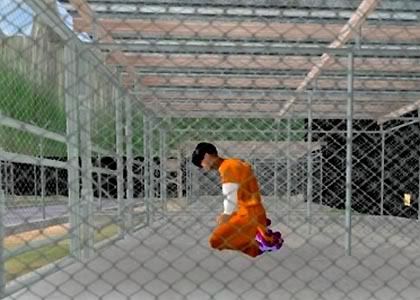 A screenshot of the "Gone Gitmo" game on Second Life: a continuation of the teach-in using new media.
Der Spiegel reports:
A screenshot of the "Gone Gitmo" game on Second Life: a continuation of the teach-in using new media.Der Spiegel reports:
They sit onboard an airplane with their hands and feet restrained. Black hoods have been pulled over their heads. Guards roughly push them around until they are delivered to a dog-pound-like area fenced in with barbed wire. Now it is time to wait. There is no formal indictment, no lawyer -- and no escape.
That is roughly what one plot in "Gone Gitmo," a digital recreation of life in the US prison camp in Guantánamo, looks like. "Gone Gitmo" is part of the online phantasy world Second Life.
A virtual penal camp in the midst of a hedonist dreamworld that lures hundreds of thousands of pleasure-seeking computer users by means of shopping malls and nudist beaches -- is that not tasteless? "On the contrary," says Nonny de la Peña, a California-based activist who was involved in developing the politically inflected game. "It's not our playworld that's a scandal, but the conditions inside the real Guantánamo."
De la Peña is documentary film director whose works are shown mainly at small festivals. She hopes the online gulag will help her to reach young Americans who prefer playing computer games to attending demonstrations. To her, the Guantánamo simulation is something like a new-media update of the traditional teach-in.
An entire gamut of so-called "serious games" is hitting computer stores this fall -- games that are serious, challenging and politically correct. The 3D strategy game "Global Conflicts: Palestine," for example, which goes on sale in mid-October, involves the player assuming the role of a journalist doing research in Israel and the Palestinian territories. The player-reporter's task is to find out what is fueling the conflict and whether Israeli security forces are reacting appropriately to terrorist attacks. Instead of hunting monsters or gunning down enemies, players need to assemble -- by mouseclick -- a halfway plausible report on the basis of a plethora of mutually contradictory sources.
"Of course it's a game for a niche market," says Simon Egenfeldt-Nielsen, a Copenhagen-based professor of media studies. "But the niche is growing rapidly. We hope to be able to sell the game to 1,000 schools and 30,000 private customers for use in political education."
"Games for Change"
The new genre is expanding. The conference "Games for Change" was held for the fourth time in New York in June. It's the kind of gathering that sees computer programmers, political science professors and even World Bank and United Nations employees talking with each other.A screenshot from the political game "Global Conflicts: Palestine."
But many serious games still suffer from serious teething troubles. Sometimes they seem too trivial and sometimes as wooden as an interactive Sunday sermon. "Darfur is Dying," for example, invites players to imagine themselves as refugees in western Sudan forced to hide from the brutal Janjaweed militias. The game was developed at the University of Southern California with the support of firms such as Reebok and MTV. It is neither particularly exciting, nor does it shed light on the conflicts behind the genocide.
"Food Force," on the other hand, is considered one of the most successful political games. It is distributed free of charge by the UN World Food Progam and is not meant to shake people awake by means of shock effects; rather, it is designed to offer insight into the complex world of famine relief. The player's task is to reduce food scarcity on a fictitious island -- despite financial bottlenecks, enemy rebels and numerous practical constraints.
Germany's Federal Agency for Civic Education (BPB) is also introducing a computer game at this year's Frankfurt Book Fair. The game, called "Genius - In The Center of Power," was developed in cooperation with the textbook publisher Cornelsen and resembles a blend of the simulated civilizations of "SimCity" and Social Studies 101.
Players can take on the persona of a politician of their choice and then campaign for the offices of mayor or prime minister. Their success is measured by the degree to which they keep their campaign promises. "In this way, we want to convey a basic understanding of how democracy works," says Arne Busse, who is responsible for the development of political-educational games at BPB. Next, he is planning to develop games for young people with immigrant backgrounds.
Of course, not even the best software can substitute for political discussions; at best they can encourage such debates and provide them with facts. The virtual Guantánamo prison, for example, regularly transforms into an Internet lecture theater where legal experts explain the US Constitution.
"When I conduct a teach-in on Second Life, I'm able to show films, present documentaries and let eyewitnesses speak-- and I reach people all over the world," says the well-known and controversial Mark Denbeaux, 64, a law professor at Seton Hall University, in New Jersey. He also works as a lawyer for Guantánamo prisoners.
Denbeaux hopes to reach a wider audience by means of the seminars he presents in the pixel-prison: "The pioneer spirit on the Internet," he says, "almost reminds me of the rallies held by the civil rights movement in the 1960s."
Thursday, October 04, 2007
Something Old Becomes New Again
A previously unrecorded Faberge egg valued at up to $18 million is going up for sale next month, Christie's auction house said Thursday.

The Associated Press reports:
The pink enamel-and-gold egg is one of only a dozen designed to the highest standards for clients other than Russia's ruling family. It has been in the Rothschild banking family since 1902, when it was given as an engagement present.
The egg contains a diamond-set cockerel which pops up every hour and flaps its wings, nods its head and opens and closes its beak.
It will go on sale Nov. 28 at Christie's in London, where it is expected to fetch $12 million to $18 million. If it reaches the top price, it will break the existing record for a Russian artwork, the US$9.6 million paid for a Faberge egg in New York in April 2002.
"The discovery of this masterpiece is the most exciting of my 40-year career," said Anthony Philips, International Director of Silver and Russian Works of Art at Christie's. "Although few examples exist, The Faberge egg is known around the world as one of the most impressive and exclusive works of art ever made."
Craftsmen Peter Carl Faberge created more than 50 of the eggs for Russia's imperial family, though not all survive. Czar Alexander III commissioned the first as an anniversary present for his wife, Empress Maria Fedorovna, on Easter Day 1885. The Empress was so enamored of the enameled egg, with a golden yoke, golden hen, miniature diamond crown and ruby egg inside, that the czar ordered that a unique egg be made for her every Easter Day after.
After the Czar died unexpectedly in 1894, his son Nicholas continued the tradition until the Russian Revolution in 1917. Nicholas and his family were executed on July 17, 1918.
After the revolution, the communist government sold off many of Faberge's creations, which found their way into Western collections.
The Rothschild egg was presented as an engagement gift to Edouard de Rothschild and Germaine Halphen, who married in 1905, by Edouard's sister Beatrice Ephrussi.
Sunday, September 09, 2007
An Unlikely Hit on Iranian TV
Show Sympathetic to Plight Of Jews During the Holocaust Draws Millions Each Week
Zero Degree Orbit, Part 1 of Episode 1
Zero Degree Orbit, Part 2 of Episode 1
The Wall Street Journal reports:
Zero Degree Orbit, Part 1 of Episode 1
Zero Degree Orbit, Part 2 of Episode 1
The Wall Street Journal reports:
Every Monday night at 10 o'clock, Iranians by the millions tune into Channel One to watch the most expensive show ever aired on the Islamic republic's state-owned television. Its elaborate 1940s costumes and European locations are a far cry from the typical Iranian TV fare of scarf-clad women and gray-suited men.
But the most surprising thing about the wildly popular show is that it is a heart-wrenching tale of European Jews during World War II.
The hour-long drama, "Zero Degree Turn," centers on a love story between an Iranian-Palestinian Muslim man and a French Jewish woman. Over the course of the 22 episodes, the hero saves his love from Nazi detention camps, and Iranian diplomats in France forge passports for the woman and her family to sneak on to airplanes carrying Iranian Jews to their homeland.
On the surface, the message of the lavish, state-funded production appears sharply at odds with that sent out by Iranian President Mahmoud Ahmadinejad, who has repeatedly called the Holocaust a myth.
In fact, the government's spending on the show underscores the subtle and often sophisticated way in which the Iranian state uses its TV empire to send out political messages. The aim of the show, according to many inside and outside the country, is to draw a clear distinction between the government's views about Judaism -- which is accepted across Iranian society -- and its stance on Israel -- which the leadership denounces every chance it gets.
"Iranians have always differentiated between ordinary Jews and a minority of Zionists," says Hassan Fatthi, the show's writer and director. "The murder of innocent Jews during World War II is just as despicable, sad and shocking as the killing of innocent Palestinian women and children by racist Zionist soldiers," he says.
Mr. Fatthi, 48 years old, is a well-known director of historical fiction for television. In the past, his work has focused on Iranian history. But he also dabbles in comedy, winning international critical acclaim two years ago for a hit feature, "Marriage, Iranian Style."
He says he came up with the idea for "Zero Degree Turn" four years ago as he was reading books about World War II and stumbled across literature about charge d'affaires at the Iranian embassy in Paris. Abdol Hussein Sardari saved over a thousand European Jews by forging Iranian passports and claiming they belonged to an Iranian tribe.
Mr. Fatthi says he chose the title because the world at the time was in dire circumstances, offering few options for avoiding the terrors to come. Shot on location in Paris and Budapest, the show stars Iranian heartthrob Shahab Husseini and is so popular that its theme song -- an ode to getting lost in love -- is a hit, too.
"It's captivating. No matter where I am or what I'm doing, on Monday nights I find a television set and watch the show. So does every Jewish person I know here," says Morris Motamed, the lone Jew in parliament.Shahab Husseini stars in 'Zero Degree Orbit.'
Mr. Fatthi enlisted the help of Iran's Jewish Association, an independent body that safeguards the community's culture and heritage. The association has criticized Mr. Ahmadinejad's comments about the Holocaust but has praised Mr. Fatthi's show.
Iran is home to some 25,000 Jews, the largest population in the Middle East outside of Israel. Iran's Jews -- along with Christians and Zorastrians -- are guaranteed equal rights in the country's constitution. Iran's Jews are guaranteed one member of parliament and are free to study Hebrew in school, pray in synagogues and shop at kosher supermarkets. Despite Mr. Ahmadinejad's statements, it isn't government policy to question the Holocaust, and the country's supreme leader, Ayatollah Ali Khamenei, hasn't endorsed those views.
While Iran makes it no secret that it considers Israel an enemy, it has been extremely touchy about criticism of its treatment of Jewish citizens. The show is seen as an effort by the government to erase the image that it may be anti-Semitic -- both at home among Jews and non-Jews, and abroad.
"In this show, you notice that a new method of political dialogue is being promoted that is more in line with the modern world," says Mohammad Ali Abtahi, a reformist cleric and former Iranian vice president.
The message appears to be grabbing the public. Sara Khatibi, a 35-year-old mother and chemist in Tehran, says she and her husband never miss an episode. "All we ever hear about Jews is rants from the government about Israel," she says. "This is the first time we are seeing another side of the story and learning about their plight."
The show also pushes Iran's political line regarding the legitimacy of Israel: The Jewish state was conceived in modern times by Western powers rather than as part of a centuries-old desire of Jews for a return to their ancestral homeland. In one scene, a rabbi declares it a bad idea for Jews to resettle in Arab lands. In another, the French Jewish protagonist refuses a marriage offer by a cousin, who is advocating the creation of Israel.
Iran has long used TV to shape public opinion, where newspapers and the Internet are seen as media for the elite. The state's control over radio and television is enshrined in the constitution. Ayatollah Khamenei, the supreme leader, is not only head of the armed forces and the judiciary, but also the national broadcast authority.
"The regime appreciates the fact that to appeal to the masses, both in Iran and the Muslim world, television is the most important outlet," says Karim Sadjadpour, an expert on Iran at the Carnegie Endowment for International Peace in Washington.
On any given day, the country's seven state-run channels broadcast a mostly drab offering of news, sports, cooking shows, soap operas and religious sermons. Political propaganda is constantly fed into the mix. Dissidents such as students or reformers are routinely paraded before cameras to read confessions after stints of solitary imprisonment.
A slick documentary-style program recently aired long interviews with two Iranian-Americans who were detained on allegations of working to overthrow the regime. The interviews -- in which the pair blandly admitted to meeting with Iranian scholars and dissidents, but not to attempting to topple the government -- were intercut with provocative scenes of demonstrations in Ukraine, where the U.S. encouraged groups that eventually staged the successful Orange Revolution in late 2004.
In July, Iran launched a 24-hour English-language satellite news channel called Press TV, joining the ranks of the BBC, CNN and Al Jazeera. Its Arabic news channel, Al Alam, has been broadcasting news with an Iranian slant in the Arab world for several years.
Episodes of "Zero Degree Turn," broadcast in Farsi, can be seen outside of Iran on the Internet, either streaming live or downloaded at tv1.irib.ir/barnameha/sharhefilm.asp?code=0011109036106. It is also broadcast with English subtitles on the state-controlled Jameh Jam satellite channel, which is available on Europe's Hot Bird satellite network. Mr. Fatthi also says Islamic Republic of Iran Broadcasting has been contacted about selling the show to networks in other countries, but he doesn't know which ones.
Friday, August 31, 2007
Wednesday, August 08, 2007
Our Friends, The Saudis
Teenage Girl Faces Beheading in Saudi Arabia

ABC News reports:
ABC News reports:
The family of a 19-year-old Sri Lankan girl is pleading for her life after a Saudi Arabian court sentenced her to death by beheading.
The court found Rizana Nafeek, 19, guilty of murdering a child in her care while working in the country. Her family (parents pictured above) has appealed the sentence, and human rights groups are calling for the Saudi government to overturn it.
At 17, Rizana Nafeek was sent to Saudi Arabia after the tsunami to work as a maid and make money for her family in Sri Lanka. But after only a few weeks and no child care training, her employers put her in charge of their 4-month-old baby. The baby died, and Nafeek was charged with murder, tried without an attorney and sentenced to death.
"This case raises many troubling questions about the treatment of children and foreigners in Saudi Arabia's criminal justice system," says Varia. "Foreigners simply do not receive the same treatment in the Saudi justice system. This includes having translation during the interrogation and during court proceedings and having an attorney."
About 1.5 million Sri Lankans work abroad, according to the country's labor statistics. Eighty percent of the women working abroad are employed as unskilled domestic workers, primarily in Saudi Arabia.
Varia says domestic workers are vulnerable to mistreatment. When Human Rights Watch sent a team of investigators to Saudi Arabia last year, Varia says the group found egregious abuse.
"The most commonly reported abuse is unpaid wages," she says. "It's routine for employers to take the passports of workers, and in order for the worker to leave the country, they have to get their employer to sign an exit visa."
Under Saudi Arabian law, employers have a heavy hand in how justice is served. After being charged and interrogated, Nafeek signed a guilty confession. If her former employers formally forgive her, she will be released, but they have so far refused to do so.
Nafeek's parents told local media outlets that their daughter was not trained in child care and that the baby "choked on milk." Human Rights Watch is calling for a new investigation into the case.
Varia says that because domestic workers in Saudi Arabia are not protected by labor laws, they don't have access to training, paid leave, reasonable hours or even one day off.
"They're not seen as real human beings," she says.
"It is socially accepted to lock your domestic worker inside the house. There are employers who forbid their workers to make phone calls home or write letters or talk to neighbors," says Varia, who interviewed domestic workers' employers in Saudi Arabia. "The reason they give is that, 'We paid a lot of money for this worker, and if I leave the door unlocked, she'll run away.'"
The problem is so severe that the embassies of Sri Lanka, Indonesia and the Philippines in Saudi Arabia can have as many as 150 women staying in embassy shelters because of abuse suffered at the hand of their employer, says Varia
The Saudi Arabia Embassy in the U.S. has not responded to calls and e-mails from ABCNews.com for this story, but Nafeek's case and other recent cases have drawn attention to the issue in Saudi Arabia. The Saudi government has made public statements condemning abuse of domestic workers. There also have been discussions to place domestic workers under separate labor laws.
Varia says discussions and rhetoric are not enough; the laws must change.
"There needs to be much greater efforts to punish abusive employers and to protect workers," she says. "What will really matter is if domestic workers get the same rights as all other workers in Saudi Arabia."
Thursday, July 26, 2007
Fare-Free Public Transit
It Could Be Headed to a City Near You
Fat cat capitalists (like Steve Forbes) like flat taxes and use taxes because the rich pay disproportionately less of their income than the poor and middle class.
Forbes, a New Yorker, might argue, "Why shouldn't the burden to pay the costs for care and upkeep of the Golden Gate bridge fall on those who use it?", to which I might reply, "Don't trucks cross the Golden Gate to distribute your magazine (Fortune) to your subscribers?" There is some product or service that each of us uses that has crossed the Golden Gate bridge (or gone through the Holland Tunnel) that we ourselves didn't personally have to traverse in order to derive the benefit from.
At Alternet, Dave Olsen writes:
Dave Olsen is a bicycle and public transit consultant, researcher and advocate who lives in Vancouver. You can reach him via editor@thetyee.ca.
This article is adapted from a five-part series published by The Tyee, Canada's leading independent source of online news and views. The series was reader-funded through charitable donations to the Tyee Fellowship Fund for Solutions-oriented Reporting.
Fat cat capitalists (like Steve Forbes) like flat taxes and use taxes because the rich pay disproportionately less of their income than the poor and middle class.
Forbes, a New Yorker, might argue, "Why shouldn't the burden to pay the costs for care and upkeep of the Golden Gate bridge fall on those who use it?", to which I might reply, "Don't trucks cross the Golden Gate to distribute your magazine (Fortune) to your subscribers?" There is some product or service that each of us uses that has crossed the Golden Gate bridge (or gone through the Holland Tunnel) that we ourselves didn't personally have to traverse in order to derive the benefit from.
At Alternet, Dave Olsen writes:
The time has come to stop making people pay to take public transit.
Why do we have any barriers to using buses and urban trains? The threat of global warming is no longer in doubt. The hue and cry of the traffic-jammed driver grows louder every commute. And politicians are getting the message. San Francisco Mayor Gavin Newsom has ordered his staff to seriously examine the costs of charging people to ride public transit. And Michael Bloomberg, mayor of New York, recently voiced to a reporter his top dream: "I would have mass transit be given away for nothing and charge an awful lot for bringing an automobile into the city."
Consider this sampling of communities providing free rides on trolleys, buses, trams and ferries: Staten Island, N.Y.; Island County, Wash.; Chapel Hill, N.C.; Vail, Colo.; Logan and Cache Valley, Utah; Clemson, S.C.; Commerce, Calif.; Châteauroux, Vitré, and Compiègne, France; Hasselt, Belgium; Lubben, Germany; Mariehamn, Finland; Nova Gorica, Slovenia; Türi, Estonia; and Övertorneå, Sweden.
Or speak, as I have, with transit officials in parts of Belgium and the state of Washington, where fare-free transit has hummed along smoothly now for years.
Raising fares kills ridership
As even conservatives like California Gov. Arnold Schwarzenegger trumpet a green agenda, more people are taking a hard look at just how many of their tax dollars subsidize the private car versus less polluting buses and trains. You have to figure in roads, parking and other infrastructure, tax breaks for car and fuel companies, as well as subsidies for car-carrying ferries and federal income tax reductions and write-offs for companies that use motor vehicles.
By some estimates, the government subsidy to each private vehicle owner is about $3,700, while a common cost for providing a single trip by transit is about $5.
Yet big or small, most transit systems are scraping by or on the brink of financial collapse, paradoxically because of their reliance on the farebox. Revenue for any system drops when ridership dips or when fares are increased. Yes, when fares are increased. This is so well proven it has a name: the Simpson-Curtain rule. Most often the dip in ridership is caused by a fare hike.
To understand this cycle better, let's imagine that you are in charge of a transit system. You feel pressure to increase service or to maintain service despite increasing costs. You need to raise more money. Politically and practically, for most systems, the easiest way is to raise fares. But soon after, ridership goes down. It drops 3.8 percent for every 10 percent increase in fares, researchers have found. Which means you either haven't gained much new revenue, or worse, you've started spiraling downward.
Just one example is Toronto's transit system, which went into a 12-year downward spiral throughout the 1990s after a series of fare increases and resultant service cutbacks. The authoritative Transit Cooperative Research Program in Washington, D.C., has clearly documented how fare increases always result in lower ridership.
Fare-free success stories
Recently I met the people who run Island Transit in Whidbey Island, Wash., and rode their fare-free bus system. It's a serious operation with 56 buses and 101 vans. Ridership tops a million a year. Its operating budget is $8,392,677 -- none of it from fares, all from a 0.6 percent sales tax collected in Island County.
Despite the pressure to conform, the pressure to make users pay and the pressure from conservative politicians at all levels, Island Transit has been fare-free from day one and is proudly so 20 years later. Not one Island Transit bus, shelter or van has advertising on it. All of Island Transit's buses are bike rack equipped and wheelchair accessible. For folks with disabilities, Island Transit also offers a paratransit service with door-to-door service.
Island Transit has developed a simple policy around dealing with behavior that is unruly or disturbing to others: "The operator is the captain of their own ship." This is backed up by a state law regarding unlawful bus conduct. A bothersome rider first gets a written warning. The next time, his or her riding privileges are revoked. These privileges are only restored after completing a Rider Privilege Agreement. Island Transit has further protected its employees by installing a camera system in every vehicle. The big brotherness of it is acknowledged, but the safety of their operators simply takes priority. "Show me another transit system in Washington state," said Island Transit operator Odis D. Jenkins, "where the teenagers more often than not say 'thank you' when they get off."
Done right, fare-free transit can transform society, says Patrick Condon, an expert on sustainable urban development who knows the system in Amherst, Mass. "Free transit changed the region for the better. Students, teens and the elderly were able to move much more freely through the region. Some ascribed the resurgence of Northampton, Mass, at least in part, to the availability of free transit. Fares in that region would have provided such a small percentage of capital and operating costs that their loss was made up for by contributions by the major institutions to benefit: the five colleges in the region," says Condon, a professor at the University of British Columbia.
Another success story, a decade old, can be found in Hasselt, Belgium. This city of 70,000 residents, with 300,000 commuters from the surrounding area, has made traveling by bus easy, affordable and efficient. Now, people in Hasselt often speak of "their" bus system and with good reason. The Boulevard Shuttle leaves you waiting for at most five minutes, the Central Shuttle has a 10-minute frequency, and systemwide you never have to wait more than a half an hour.
A prime lesson offered by Hasselt is the fact that it radically improved the bus system as well as its walking and cycling infrastructure before it removed the fareboxes. In 1996, there were only three bus routes with about 18,000 service hours/year. Today, there are 11 routes with more than 95,000 service hours/year.
The transit system in Hasselt cost taxpayers approximately $1.8 million in 2006. This amounts to 1 percent of its municipal budget and makes up about 26 percent of the total operating cost of the transit system. The Flemish national government covered the rest (approximately $5.25 million) under a long-term agreement.
Hasselt City Council's principal aim in introducing free public transport was to promote the new bus system to such a degree that it would catch on and become the natural option for getting around. And it did -- immediately. On the first day, bus ridership increased 783 percent! The first full year of free-fare transit saw an increase of 900 percent over the previous year; by 2001, the increase was up to 1,223 percent, and ridership continues to go up every day.
Planning essential
So how did Hasselt make it happen?
On Jan. 1, 1991, the Flemish Authority brought together three public transport companies and joined them into one autonomously operating state company. This company's raison d'etre is to provide transport for the whole of Flanders. That was the beginning of the Flemish Transport Co., since then generally known under the name "De Lijn." This structure allows it to buy buses more cheaply, and it can even share buses among the different city and regional systems whenever they're needed.
"To be successful," says Jean Vandeputte, the chief engineer-director for the City of Hasselt, "I think that the public transport system must not be crowded at the start. Our project was originally organized to attract more passengers and to have less cars in the city center. The buses also need separate lanes, because traveling by bus has to be faster than by car, so the infrastructure of intersections and streets has to be adapted. The buses have to be modern, clean ... you need to have more bus stops. And the shelters must be attractive."
By making public transport free of charge, it became possible to guarantee the right to mobility for all residents in Hasselt. Their position was that an improved public transport system simply means a better use of the public space that will not only improve the quality of traffic, but the quality of life in general.
The Hasselt experience before 1997 was not much different than anywhere else in the Western world. Car ownership in Hasselt rose by 25 percent from 1987 to 1999, while the population increased by only 3.3 percent during this same period. Although Hasselt is the fourth largest city in Belgium, it ranked first in car ownership during those years.
After implementing fare-free transit, over 40 percent of the people visiting hospitals switched from a car to the bus. Over 32 percent of the people "going to market" switched from using cars to buses. Overall, in November 1997, 16 percent of all bus riders studied previously drove a car. It is important to understand that this was achieved by the elimination of fares, the expansion of service and the implementation of bus priority measures such as bus lanes.
Karl Storchmann, a researcher at Yale University, has documented that even the 12 percent of bus riders that were previously cyclists, as well as the 9 percent that switched from walking to the bus in Hasselt, will produce a net positive change for society, since pedestrians and cyclists "belong to the most endangered road users, [and] every decrease in these modes will lead to a reduction of automobile-caused costs [i.e., deaths and injuries]."
Because Hasselt's policy makers understand that bikes are the most sustainable form of transport, today in Hasselt one can borrow a bicycle, tandem, scooter or wheelchair bike free of charge. On the Groenplein (behind the town hall) you can also borrow a stroller free of charge for your little one (as its website states, "Handy when your toddler can't make the distance"). And two wheelchairs are available for free loan from the tourism bureau. The city's center is cleared of cars, offering instead a network of pedestrian shopping streets."
This approach has saved the City of Hasselt millions of Euros on transportation infrastructure costs, and clearly the city isn't afraid to innovate. As Hasselt Mayor Steve Stevaert declared, "We don't need any more new roads, but new thought highways!"
The costs of collecting fares
A prime reason to quit charging people to take the bus is that collecting bus fares costs a lot of money. It takes both machines and people to sell, make and distribute tickets and collect, count and deposit cash.
King County's Metro Transit System, which includes the city of Seattle and an estimated population of just under 2 million, concludes, after a comprehensive assessment, that the cost of collecting fares will hit about $8 million this year -- enough to buy 18 new buses.
A major analysis of U.S. public transit systems found that for larger systems, fare collection costs can be as high as 22 percent of the revenue collected. Another study showed that New York City's Metropolitan Transportation Authority spends roughly $200 million a year just to collect money from transit riders. What about switching to "smart card" technology? Wouldn't that save money? In Toronto, the city's Transit Commission estimates the switch will cost almost $250 million (or about 520 new buses) for card readers, vending machines and retrofits, and over $10 million a year (22 new buses) after that, which has some transit authorities saying the money could be better used in improving service.
For similar reasons, some cities have decided it just doesn't pay to police people who don't pay fares. In 1996, the Maryland Mass Transit Administration (MTA) wanted to figure out how to stop those few riders that cheat; its Central Light Rail Line was "barrier free." MTA wanted to know whether it should start using barriers in order to force people to pay their fares.
The study found that more people would pay, yes, but the cost of making them pay would be higher than the revenue from extra fares collected. Much higher. The least expensive alternative would cost the MTA $18.54 for each potential fare dollar recovered over a 10-year period. In other words, if $1 million is currently lost to fare evasion, it would cost at least $18.5 million to collect that money.
Spread the burden and benefit
All of which brings us back to the logic of fare-free transit.
Whidbey Island's transit planners did their own studies two decades ago. In 1986 they did an extensive cost-benefit analysis of collecting fares and found that either no significant revenue would be generated for Island Transit, or that the costs of collecting fares would exceed the revenue generated.
Other systems that didn't plan well have had near disastrous experiences, in particular Austin, Texas. As one study from Florida State University concludes, "There has not been a full fare-free policy instituted on a systemwide basis since the experiment in Austin. The negative consequences of these experiments, the Austin experiment in particular, have left lasting impressions on transit operators throughout the country."
But a lot of opposition to the idea is grounded less in practicalities, more in ideology.
It's a matter of faith among most transit officials, for example, that if you remove the fare, the service becomes worthless.
"Be aware that when one moves the price of something to zero, in addition to challenging capacity, one is stating that the product or service is not an economic good -- that is, that it has no value," warned one transit official. "Pricing signals value. I would suggest you keep it nonzero."
Perhaps North America's transit planners need to switch jobs with builders of roads and bridges. Those transportation essentials are, after all, usually paid for through taxes or bonds, and we use them without being charged each time we roll over them.
Imagine if a government tried to put a farebox into every car. Each time drivers took a trip, they would have to dig into their pockets to find a couple dollars -- in exact change.
And yet, we force the poorest among us to live this way. In British Columbia's Lower Mainland, one of the most expensive places to live in North America, a family traveled from a suburb to Vancouver by public transit during spring break. It cost the mother and her three sons $26 in day passes.
For those without well-paying jobs, a bus fare of any amount can be a barrier to finding work, making it to school, visiting friends and relatives or even getting food to eat.
Wouldn't it make more sense to treat public transit the way we treat most road infrastructure and pay for it all by some method of taxation?
Reality check
But before we act, let's make a few important guiding principles clear:
Taking the farebox out of any bus without a plan is just a recipe for disaster. That's the lesson from Island Transit on Whidbey Island and Hasselt, Belgium, which proves beyond doubt that fare-free systems can be safe, clean and very friendly.
Making transit free of charge won't in itself allow huge numbers of people to abandon their cars. We'll need more public transit vehicles, running more frequently, too. The decade-old experience in Hasselt has shown that investing in the service prior to the removal of the fareboxes not only makes the transition smoother, it will get people on the bus and out of their cars.
We need to pay, one way or another. There isn't a transit system on the planet that pays for itself solely through the farebox. If we want a transit system that is adequate, reliable and gets those lonely drivers out of their cars, we need to find funding formulas that are adequate and reliable.
Let us remind ourselves of what really matters. We don't have much time left to reduce our greenhouse gas emissions before catastrophic climatic changes irreversibly occur. It seems absurd, therefore, to continue to make it more difficult than it already is for people to use the bus and train.
Fare-free transit is not only feasible, it may well be critical for us to survive as a species. It can save us money, and it contributes to a much more fair, equitable and mobile society.
The only thing left to do is to let your transit providers and elected officials know how you feel. Speak up now -- for our children and for our planet.
Sixteen reasons to stop charging
Consider the many benefits:
A barrier-free transportation option to every member of the community (no more worries about exact change, expiring transfers or embarrassment about how to pay)
Eliminating a "toll" from a mode of transportation that we as a society want to be used (transit is often the only way of getting around that charges a toll)
Reducing the inequity between the subsidies given to private motorized vehicle users and public transport users
Reducing the need for private motorized vehicle parking
Reducing greenhouse gas emissions, other air pollutants, noise pollution (especially with electric trolleys), and runoff of toxic chemicals into fresh water supplies and ocean environments
Reducing overall consumption of oil and gasoline
Eliminating the perceived need to spend billions on roads and highways
Contributing significantly to the local economy by keeping our money in our communities
Reducing litter (in some cities transfers and tickets have overtaken fast food packaging as the most common form of street garbage)
Saving trees by eliminating the need to print transfers and tickets
Allowing all bus doors to be used to load passengers, making service faster and more efficient
Allowing operators (drivers) to focus on driving safely
Giving operators more time to answer questions
Providing operators a safer work environment since fare disputes are eliminated
Eliminating fare evasion and the criminalization of transit-using citizens
Fostering more public pride in shared, community resources
Bear in mind that free public transit eliminates the significant costs of fare collection and combating fare evasion. It also cuts costs associated with global warming, air and noise pollution, litter collection and garbage removal.
Dave Olsen is a bicycle and public transit consultant, researcher and advocate who lives in Vancouver. You can reach him via editor@thetyee.ca.
This article is adapted from a five-part series published by The Tyee, Canada's leading independent source of online news and views. The series was reader-funded through charitable donations to the Tyee Fellowship Fund for Solutions-oriented Reporting.
Monday, April 16, 2007
Book Bin: "Oil on the Brain," by Lisa Margonelli
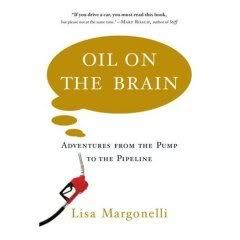
Americans buy 10,000 gallons of gasoline a second, but few of us know how oil is created and drilled, how gas stations compete or what actually goes on in a refinery—let alone what happens in the mysterious Strategic Petroleum Reserve, where the U.S. government stores roughly 700 million barrels of oil in underground salt caverns on the Gulf Coast of Texas.
Author Lisa Margonelli’s desire to learn took her on a one-hundred thousand mile journey from her local gas station to oil fields half a world away. In search of the truth behind the myths, she wriggled her way into some of the most off-limits places on earth: the Strategic Petroleum Reserve, the New York Mercantile Exchange’s crude oil market, oil fields from Venezuela, to Texas, to Chad, and even an Iranian oil platform where the United States fought a forgotten one-day battle.
In the summer of 2003, she started hanging out at independent gas stations, where owners might clear pennies per gallon of gas, surviving on impulse sales of junk food and soda. Her journey takes us up the delivery chain, spending a typical day with a tanker truck driver, hanging out with suppliers, touring refineries, and seeing what life is like at an oil rig. Whether visiting "wildcatters" in Texas, the Strategic Petroleum Reserve in the Gulf of Mexico, or the oil pit at the New York Mercantile Exchange, Margonelli charms her way into the good graces of insiders to report on the vast petroleum network. Her voyage takes us to Venezuela, Chad (whose villagers who are said to wander the oil fields in the guise of lions), Nigeria (where a Nigerian warlord who changed the world price of oil with a single cell phone call), China (where Shanghai bureaucrats dream of creating a new Detroit) and ultimately the Persian Gulf, where she spends time at the Salmon oil fields in Iran. Filled with rich history, industry anecdotes, and politics, Margonelli's book brings a deeper appreciation of the complicated and often tenuous process that we take for granted.
Excerpt:
Chapter 1 - GAS STATION: Chasing The Hidden Penny
Regular Unleaded $1.61 9/10
Twin Peaks Petroleum sits at a welcoming angle to a busy San Francisco intersection. On this morning in the summer of 2003, a thick fog has crawled over the station, folding each of the eight drivers standing at the pumps in an envelope of cold mist. At the back of the lot sits a garage where a small convenience store glows. On the storefront is a poster of an ebullient snowman clutching a cola, while icicle letters drip the words COLD POP over his head. Inside the convenience store, among the security cameras and parabolic mirrors, the Doritos, cigarettes, and Snapples, jammed into a space no larger than a postal truck, a tall man with dark circles under his eyes appears to doze. His eyelids hang low, twitching; he mumbles; he moves with excruciating deliberation as he counts change.[For more, you'll have to get the book.]
I am leaning against a shelf holding several grades of motor oil, individually wrapped strawberry cheesecake muffins, and four flavors of corn nuts: picante, regular, nacho cheese, and ranch. I am no more lively than B. J., the droopy manager. And I am recording the flavors of corn nuts in my notebook to stay awake. “Corn Gone Wrong” say the packages. I record that too. I’ve come to the gas station to watch Americans buy gasoline, as a way of understanding how we fit into the trillion–dollar world oil economy. But now that I’m here, I realize I’ve been here before, bought gas so many times myself I feel there’s nothing to see. The fumble, the stuporous swipe of the card, the far–off look: I know them well. Gas stations are everywhere, but when you’re in one, you’re nowhere in particular. Icicle letters are taking shape in my head: WHAT DID YOU EXPECT?
I keep writing: Trojan spermicidally lubricated snugger fit, two Sominex and a folded paper cup, phone cards, batteries, air fresheners printed to look like ice cream sundaes, a greeting card with a picture of a pansy and the words “You’re too nice to be sick.” The customers standing out at the pumps have a preoccupied, anxious look—could they be distracted enough to buy a card that says “You’re too nice to be sick”?
Gas stations are collections of incidental items, impulses, and routines that seem in themselves to be inconsequential but aggregate into a goliath economy when multiplied by the hungers of 194 million licensed American drivers. Corn nuts, for example, are part of $4.4 billion in salty snacks sold at gas station convenience stores yearly, nearly all impulse buys. The hopeful purchase $25 billion in lottery tickets. People with the sniffles spent $323 million on cold medicine at gas stations in 2001. And the faint smell of gasoline near the pumps? In California alone, the amount of gasoline vapor wafting out of stations, as we fill our cars, totals 15,811 gallons a day—roughly the equivalent of two full tanker trucks (1). In the gas station, we’ve collaborated to create a culture of speed, convenience, low prices, and 64–ounce cup holders, which allow us to express what the industry calls our “passion for fountain drinks.” Japanese auto executives have hired American anthropologists to explain the mystery of why the purchase of a $40,000 car hangs on the super–sizing of the cup holder.
And then there is the gasoline: 1,143 gallons per household per year, purchased in two–and–a–half–minute dashes. We make 16 billion stops at gas stations yearly, taking final delivery on 140 billion gallons of gasoline that has traveled around the world in tanker ships, pipelines, and shiny silver trucks. And then we peel out, get on with our real lives, get back on the highway, or go find a restroom that’s open, for Pete’s sake.
With a wave of our powerful credit cards, American drivers buy one-ninth of the world’s crude oil production per day. That makes us elephants in the global oil economy–our needs are felt around the world, from the tiniest villages in Africa, the Amazon, and the Arctic, to the highest towers in Vienna, Riyadh, and New York. When we lick our lips, they open their taps. When we are in a funk, their governments fall. Here in front of the pump, surrounded by buntings in the joyful colors of children’s birthday party balloons, we have the opportunity to be our truest selves in the great, over–the–top drama/business that is the world oil supply chain.
But as you know, buying gas can be done by the living dead. Swipe card, insert nozzle, punch the button with the greasy sheen: Gasoline flows into the tank while money flows out of the bank account. Filling a car seems less like making a purchase than a ritual, a formality that isn’t quite real.
It’s not even clear what we’re buying—gasoline’s fantastic uniformity means one is as good as another. Water doesn’t mix with gas, so beyond occasional traces of vapor, we don’t even have to worry about buying substandard gasoline. And all traces of where the fuel came from are completely erased by the time it gets to a gas pump. Texaco gasoline is no longer from Texas, and gas from Unocal is not from “Cal.” Both companies have been purchased by Chevron, anyway. If gasoline were coffee, we might believe the Baku blend offered a fast but mellow ride.
As if acknowledging the futility of trying to stand out from the pack when 168,987 gas stations are selling essentially an identical chemical mix, stations have adopted a clannish ugliness. Whether they’re in Fairbanks, Alaska, or Pine Island, Florida, they all subscribe to the familiar topography of canopied islands, cheerful plate glass, struggling hedges, and “Smile. You’re being watched by a surveillance camera” signs. Predictable they are, to the very last 9/10ths of a cent, which is permanently printed on every last gas price sign in the land.
The gas station’s blandness is misleading, though. Hidden in its windows, pumps, and hedges are clues to the true nature of the American bargain with gasoline and the enigma of its role in the world.
On the counter in front of B. J. stands a line of purple plastic wizards, stomachs filled with green candy pebbles. Their shiny eyes stare at me expectantly.
At the periphery of my vision, a van enters Twin Peaks yard and parks near the fence. In the time it takes the door to slam, B. J. grows a foot taller, loses his paunch, and becomes a man of action. He snaps the countertop open, bounces into the yard, and lands in front of the van driver in one tigerlike swoop. Words are exchanged. The driver sulkily returns to his van and B. J. returns to the store, shaking his head. People try to ditch their cars in the station and take the bus, he explains, taking his position behind the wizards. “The customer is always right,” says B. J., “but bad people going round.”
Like vapors, bad people always seem to be wafting through the gas station. Last week B. J. ran out to stop a truck that was barreling toward the station’s lighted canopy. The truck driver ignored him and crunched the canopy. Cars have driven willy nilly through the hedges as he watched. Nightly, people break through the chains on the four entrances. Once he found a gun in the hedge, stashed by a kid on the way to juvenile court. His response? Shave the hedges. Every morning he cleans up garbage, cans, and bottles filled with things we won’t discuss. Daily, and constantly, people try to steal: window squeegees, sodas, condoms, money, and phone calls. Behind B. J.’s head are the counterfeit $20 bills the station has intercepted.
People use elaborate schemes to steal gas, he explains. Sometimes they’ll pay for $5 and shut the pump off when it reaches $4.75. Then they return to the clerk, telling him to turn the pump back on, knowing that the pumps don’t turn off after dispensing amounts less than a dollar. Then they fill their tank and drive off. Others play on the sympathies of the attendant or accuse him of trying to cheat them. In stations where people pump before they pay, they often just drive off. The average gas station loses more than $2,141 a year to gasoline theft. Some lose much more.
Think of a gas station as a crime scene before the fact, and you’ll start to appreciate it as a maze engineered for belligerent rats. Hedges, which I’d interpreted as a pathetic attempt at dignity and baronial pretensions, actually eliminate escape routes for would–be robbers, limiting holdups. Many convenience stores buy “target hardening” kits, which include decals imprinted with rulers so that clerks can tell the police how tall the robbers were, two stickers that say “No 20s, no 50s,” two “Thank You” decals, and one “Smile. You are being watched by our video security.”
Even so, crime is always evolving. “After we did target hardening in stores in the 1980s, the crime moved to the pumps—carjackings and abductions,” says Dr. Rosemary Erickson, a sociologist who’s studied gas station crime for thirty years. “Now it’s public nuisance crimes in the parking lots. Gas stations are considered a magnet.” (2) Nearly nine percent of U.S. robberies happen in gas stations and convenience stores, and the average gas station lost $1,749 to robbery in 2004.
Some of the crimes are not about money at all; they’re about freefloating anger. When gas prices are high, more people get “pump rage” and try to drive off without paying for gas. The Indian and Pakistani immigrants who own and staff many stations bear the brunt. After 9/11, people who were angry at some vague combination of OPEC and Osama bin Laden attacked a hundred clerks at 7–Eleven gas stations and convenience stores in a month. Five men were killed for looking “Middle Ea...
Friday, April 06, 2007


Wednesday, April 04, 2007
On This Day . . . .

In 1991, the Republican Senator from Pennsylvania, John Heinz (Theresa Heinz Kerry's first husband) and six other people were killed when a helicopter collided with Heinz's plane over a schoolyard in Merion, Pa.
In 1984, Bob Bell retired as Bozo the Clown on WGN-TV in Chicago after 24 years.

In 1983, the space shuttle Challenger was launched for the first time.
In 1974, Hank Aaron of the Atlanta Braves tied Babe Ruth's career home run record by hitting his 714th round-tripper in Cincinnati.
In 1968, Martin Luther King Jr., is assassinated in Memphis, Tenn.

In 1967, Johnny Carson quit "The Tonight Show." He returned three weeks later after getting a raise of $30,000 a week.
In 1965, actor/singer Robert Downey, Jr., was born.
Robert Downey, Jr., Chaplin
In 1964, the Beatles held the top five spots on Billboard's Hot 100 ("Can't Buy Me Love," "Twist and Shout," "She Loves You," "I Want to Hold Your Hand," "Please Please Me"), setting an all-time record. They also had the number one album.
The Beatles perform 'Twist and Shout' at the London Palladium, November, 1963
In 1963, Jason Robards, Sr., stage and screen actor and father of Jason Robards, Jr., died in Sherman Oaks, California.

In 1956, David E. Kelley (husband of Michelle Pfeiffer; writer and producer of such television programs as L.A. Law, Doogie Howser, M.D., Picket Fences, Chicago Hope, The Practice, Ally McBeal, Boston Legal) was born.
In 1949, NATO was formed by 12 western democratic nations, including the United States and Great Britain, to safeguard against Soviet aggression. [Guardian Unlimited, Special Report: NATO]
In 1932, Vitamin C was first isolated by C.C. King at the University of Pittsburgh.
In 1928, Maya Angelou was born.
In 1902, British financier Cecil Rhodes left $10 million in his will to provide scholarships for Americans at Oxford University in England.
In 1887, Susanna Medora Salter became the first woman elected mayor of an American community (Argonia, Kansas).
In 1872 in Vienna, Franz Sacher, a 16-year old apprentice chef, came up with a recipe for chocolate cake which bears his name - Sachertorte. It's a rich chocolate cake and is big business for Vienna. The recipe of the Original Sacher Torte is a well-kept secret to this day, protected by copyright, but it is served in the Hotel Sacher Wien (purely organic ingredients, contains no preservatives), can be ordered and shipped anywhere in the world.
 "The Original Sacher-Torte tastes best with unsweetened cream and a cup of Original Sacher Café or tea!"
In 1850 The city of Los Angeles was incorporated, the same year that California was admitted to the United States.
In 1841, President William Henry Harrison died of pneumonia one month after his inauguration, becoming the first U.S. president to die in office.
In 1818, Congress decided the U.S. flag would consist of 13 red and white stripes and 20 stars, with a new star to be added for every new state.
In 1802, Dorothea Dix, activist on behalf of the indigent insane who, through a vigorous program of lobbying state legislatures and the United States Congress, created the first generation of American mental asylums, was born in Maine.
Dorothea Dix, April 4, 1802 – July 17, 1887
In 1648, Grinling Gibbons (master wood carver to King George 1, employed by Sir Christopher Wren to work on St. Paul's Cathedral and other churches around England) was born.
Choir stalls carved by Grinling Gibbons, St. Paul's Cathedral, London
Ends of the bookcases sport intricate carvings by Grinling Gibbons in the lighter limewood. The Wren Library, Cambridge [Explore St. Paul's Cathedral - virtual tour]
In 1581, English navigator Francis Drake returned home after sailing around the world, and was knighted by Queen Elizabeth I.
Drake presented Queen Elizabeth with his diary of the voyage and a map of the world. The original map was lost in a fire but several copies were made. Shown above is the Hondius Map held by University of California-Berkeley's Bancroft Library. [Note the four corners of the map with illustrations of important events that ocurred during the voyage. See Sir Francis Drake History on the Internet for a detailed view.]
Wednesday, March 14, 2007
Monday, March 05, 2007
What's Next? A Whoopee!-Cushion in Her Throne?

Sky News reports:
Princely pranksters Wills and Harry have been accused of recording a bogus message on the Queen's answerphone.
The pair were asked for help by their regal gran when she was baffled by the technology.
But she was reported to be mortified when she heard the end result.
Their message said: "Hey wassup! This is Liz. Sorry I'm away from the throne."
The recording continued: "For a hotline to Philip, press one. For Charles, press two. And for the corgis, press three."
According to The Daily Star, the Queen saw the funny side later when she thought about which VIPs might have heard the message.
But her private secretary was not so amused.
The paper says he almost fell off his chair the first time one of his calls was put through to the voicemail.
The Queen, who is 80, has been taught by Prince William and Prince Harry how to send text messages on her mobile phone.
She was given her first mobile phone in 2001 by the Duke of York.
But she banned servants at the royal palaces from carrying phones on duty, after becoming annoyed at their ring tones.
The ban was reportedly prompted by several mobile phones ringing during a major banquet held for foreign dignitaries.
Thursday, February 15, 2007
Preserving Our Way of Life
Talking Urinal Cakes Warn Against Drunk Driving

MercuryNews.com reports:

MercuryNews.com reports:
New Mexico is hoping to keep drunks off the road by lecturing them at the last place they usually stop before getting behind the wheel: the urinal.
The state recently paid $21 each for about 500 talking urinal-deodorizer cakes and has put them in men's rooms in bars and restaurants across the state.
When a man steps up, the motion-sensitive plastic device says, in a woman's voice that is flirty, then stern: ``Hey, big guy. Having a few drinks? Think you had one too many? Then it's time to call a cab or call a sober friend for a ride home.''
The recorded message ends: ``Remember, your future is in your hand.''
The talking urinal represents just the latest effort to fight drunken driving in New Mexico, which has long had one of the highest rates of alcohol-related traffic deaths in the nation. (The new tactic is aimed only at men, since they account for 78 percent of all driving-under-the-influence-related convictions in New Mexico.)
``It startled me the first time I heard it, but it sure got my attention,'' said Ben Miller, a patron at the Turtle Mountain Brewing Co. bar and restaurant. ``It's a fantastic idea.''
Jim Swatek, who was drinking a beer nearby, said: ``You think, `Maybe I should call the wife to come get me.'''
Turtle Mountain Brewing owner Niko Ortiz commended the New Mexico Transportation Department for ``thinking way outside the box.''
Department spokesman S.U. Mahesh said the bathroom is a perfect place to get the message across. In the restroom, ``guys don't chitchat with other guys,'' he said. ``It's all business. We've got their total attention for 10 to 15 seconds''
Similar urinal cakes have been used for anti-drug campaigns in Colorado, Pennsylvania and Australia, and for anti-DWI efforts on New York's Long Island, said Richard Deutsch of New York-based Healthquest Technologies Inc., which manufactures the devices.
But Deutsch said he believes New Mexico is the only state to buy the devices.
New Mexico had 143 alcohol-related deaths in 2005, for the nation's eighth-highest rate per miles driven. The problem is blamed in part on the wide-open spaces that make it necessary to drive to get anywhere, and the poverty and isolation that can lead people to drink to relieve their boredom or misery.
Also, some have complained that the state has only recently begun to emerge from years of lax enforcement.
Gov. Bill Richardson led a successful push two years ago to require ignition locking devices for anyone convicted of DWI -- a first in the nation -- and each year the Legislature has agreed on tougher penalties for repeat offenders.
New Mexico also has started a toll-free ``drunk buster'' hot line, boosted DWI enforcement in problem areas and increased police checkpoints. The state also has a DWI czar.
In November, a wrong-way drunken driver slammed into a car near Santa Fe, killing five family members, authorities said. The governor has since directed state regulators to issue cease-and-desist orders against three airlines to stop serving alcohol on flights to and from New Mexico. The culprit in the fatal wreck had been seen drinking on a flight into Albuquerque hours before the accident.
At the Turtle Mountain, the urinal cakes have proved so intriguing that three have been swiped already.
``I'm mystified why someone would stick their hand into one of our urinals,'' Ortiz said. ``But I'm sure we'll see them on eBay. Hopefully, the seller will advertise it as, `Stolen from Turtle Mountain.'''
Monday, January 29, 2007
Tim Robbins Speaks at March in Washington Against the War
Transcript:
TIM ROBBINS: I don’t know if you heard the most recent news, just came over the wire: Karl Rove has been subpoenaed. Some have said recently that impeachment is off the table.
AUDIENCE: No!
TIM ROBBINS: What was that?
AUDIENCE: No!
TIM ROBBINS: On the train coming down here today, I talked to a young woman whose brother has just been deployed. Due to the recent Bush escalation, her brother is being rushed into action. Instead of the proper twelve-week training period, this young 20-year-old serviceman will hit the ground in a hostile land with two weeks’ training. Is impeachment still off the table?
AUDIENCE: No!
TIM ROBBINS: This past November, the American people sent a resounding message to Washington, D.C. and the world: we want change. We want this war to end. And how did Bush respond? 21,500 more will risk their lives for his misguided war. Is impeachment still off the table?
AUDIENCE: No!
TIM ROBBINS: Let's get him out of office! Let's get him out of office before --
AUDIENCE: Impeach Bush! Impeach Bush! Impeach Bush! Impeach Bush! Impeach Bush! Impeach Bush!
TIM ROBBINS: Let's get hem out of office before he starts ruling from a bunker. Let's get him out of office before the only one on his side is his dog Barney. Nixon, Richard Nixon, talked to the walls. Bush is talking to God. But it's not a god I recognize. This god seems to be giving George a pass on some of his major commandments. This god seems to be OK with lying or bearing witness, as he puts it, against the US Congress, against the United States people, against the world, bearing false witness on weapons of mass destruction, bearing false witness on nuclear capability, bearing false witness on the imminent threat of Saddam, bearing false witness on the links between al-Qaeda and Iraq.
This god seems to be giving George a pass on stealing, stealing the resources of the Iraqi people, on squandering the hard-earned tax dollars of United States citizens for an unnecessary war! Money that could be used to intelligently fight against terrorism is squandered in a way and in a war that creates more terrorists. Money that could be helping the elderly, the poor, the infirm here at home is instead lining the pockets of war profiteers from Halliburton and private mercenary militias like Blackwater. But George's god says, "That's cool, George." His god tells him to honor his father and mother, but when his father tells him not to occupy Iraq, George's god counsels him to ignore his father.
Well, I think we have a different understanding of those commandments here. And let's not forget that most important one: thou shalt not kill. Thou shalt not kill or recklessly risk the lives of our brave men and women overseas. Over 3,000 dead. Over 50,000 wounded. Thou shalt not kill or needlessly risk the lives of Iraqi civilians. How many? 50,000? 200,000? 400,000? 650,000? Only God knows, George. Only God knows.
Filed under: Tim Robbins, celebrities, culture, video, Washington D.C., rally, march, activism, protest, war in Iraq, Bush, The Constant American, Constant American, Technorati Tag, Technorati Tags, tags, categories
Susan Sarandon Speaks at March in Washington Against the War
Transcript:
SUSAN SARANDON: ”Imagine you are in constant danger from hidden roadside bombs and exposed to ambushes and sniper fire. Imagine that your home is constantly harassed with mortar explosions and rocket attacks while you try to sleep. Imagine you witness your closest friend being torn apart by enemy fire. Imagine you discover that the person you thought was an insurgent that you killed turns out to be an innocent child or someone who looks similar to your mother. Now imagine you lost a limb, you lost your eyesight, you lost a friend, you lost your sanity and you lost your innocence for an unappreciative society and an unconcerned elected government.” This is the testimony of Garrett Reppenhagen, who spoke earlier, cavalry scout and sniper in the US Army First Division from 2004 to 2005.
He continues. “I didn't expect to come home to find there's no plan for addressing the needs of veterans like myself. I don't understand how, despite being in the middle of not one but two wars, our government is actually scaling back on services that are critical for men and women trying to re-enter civilian society.”
Here are some staggering facts. One in three homeless Americans are military vets, and that is rising. One in four vets with PTSD sought medical care from the VA, where they experienced a two to three month wait to see a doctor. Over 53,000 are wounded. The ratio of doctors to patients is one doctor for every 500 patients. Veteran males aged 20 to 24 have twice the unemployment rate. 40% of troops currently being rotated are National Guard or reservists. 95% of them are experiencing problems getting their pay. Many are being sent back are on potent anti-depressants, anti-anxiety drugs with little or no counseling or supervision or screening. Over 200 have committed suicide. There's a 70% divorce rate for returning soldiers. The GOP plan for 2007 drops $65 billion in benefits over the next five years.
There was not a mention of this crisis in the State of the Union address, as if the war only exists over there and not here. And there was not an ounce of criticism from any of our presidential hopefuls. I say to those who tell me that we are fighting this war over there so that it doesn't come here: listen to the sons and daughters who are returning and their families, and you will know that the war is being fought here in the hearts and minds and bodies of those that are returning and have already sacrificed so much. Shame on you! We are here today to say it is time to remove the burden of the political crisis of the Iraq war from our soldiers and commit to caring for a new generation of Americans who are grieving, severely wounded and mentally troubled. Thank you.
Subscribe to:
Posts (Atom)