Thursday, August 09, 2007

MIA - The White House Press Corps

Video & Transcript of Bush's Press Conference - 8-9-07

This had to have been the most dissociative, the squirrelist, of all of Bush's press conferences. Combined.

The White House press corps.

Talk about going through the motions. The White House press corps looks like they'd been roughed up, threatened, and told not to ask Bush anything challenging or provocative (or, "I'll get you, my little pretty...and your little dog/wife/kids, too!"). I don't think I've ever seen them more demoralized or defensive.

We join Bush's press conference already in progress, the first time Bush has faced the White House press corps before the cameras since Valentine's Day, 2007:


First question:
QUESTION: Mr. President, former Chairman of the House Transportation Committee, Republican Don Young, says there are about 500 bridges around the country like the one that collapsed in Minneapolis last week. And Young and other Transportation Committee members are recommending an increase in federal gasoline taxes to pay for repairs. Would you be willing to go along with an increase in gasoline taxes of five cents a gallon or more?

BUSH: First of all, Secretary Peters is gathering information and will report to the White House and report to the nation about what she finds about whether there are any structural design flaws that may be applicable to other bridges. She's in the process of gathering this information now.

The American people need to know that we're working hard to find out why the bridge did what it did so that we can assure people that the bridges over which they will be traveling will be safe. That's step one.

You know, it's an interesting question about how Congress spends and prioritizes highway money. My suggestion would be that they revisit the process by which they spend gasoline money in the first place.

As you probably know, the Public Works Committee is the largest committee -- one of the largest committees in the House of Representatives. From my perspective, the way it seems to have worked is that each member on that committee gets to set his or her own priority first, and then whatever is left over is spent through a funding formula. That's not the right way to prioritize the people's money. So before we raise taxes which could affect economic growth, I would strongly urge the Congress to examine how they set priorities. And if bridges are a priority, let's make sure we set that priority first and foremost before we raise taxes.


Second question:
QUESTION: Thank you, Mr. President. One of your chief allies in the war on terrorism, President Musharraf of Pakistan, has faced so much instability and civil strife recently that there has been talk of declaring a state of emergency. How concerned are you about President Musharraf's situation and whether this might undermine Pakistani efforts against the Taliban and al Qaeda elements in the bordering areas of his country, which have been roundly criticized recently?

BUSH: You know, I've seen the reports of what they call an emergency declaration. I have seen no such evidence that he's made that decision. In my discussions with President Musharraf, I have reminded him that we share a common enemy: extremists and radicals who would like to do harm to our respective societies -- in his case, they would like to kill him, and they've tried.

I have made it clear to him that I would expect there to be full cooperation in sharing intelligence, and I believe we've got good intelligence sharing. I have indicated to him that the American people would expect there to be swift action taken if there is actionable intelligence on high-value targets inside his country. Now, I recognize Pakistan is a sovereign nation, and that's important for Americans to recognize that. But it's also important for Americans to understand that he shares the same concern about radicals and extremists as I do and as the American people do.

So my focus in terms of the domestic scene there is that he have a free and fair election. And that's what we have been talking to him about and I'm hopeful they will.

Yes, we'll just go down the line here.


Third question:
QUESTION: Thank you, Mr. President. You speak often about taking care of the troops and honoring their sacrifice. But the family of Corporal Pat Tillman believes there was a cover up regarding his death, and some say perhaps he was even murdered, instead of just friendly fire. At a hearing last week on Capitol Hill your former Defense Secretary, Donald Rumsfeld, other officials used some version of "I don't recall" 82 times. When it was his term to step up, Pat Tillman gave up a lucrative NFL career, served his country and paid the ultimate sacrifice. Now you have a chance to pledge to the family that your government, your administration will finally get to the bottom of it. Can you make that pledge to the family today, that you'll finally, after seven investigations, find out what really happened?

BUSH: Well, first of all, I can understand why Pat Tillman's family, you know, has got significant emotions, because a man they loved and respected was killed while he was serving his country. I always admired the fact that a person who was relatively comfortable in life would be willing to take off one uniform and put on another to defend America. And the best way to honor that commitment of his is to find out the truth. And I'm confident the Defense Department wants to find out the truth, too, and we'll lay it out for the Tillman family to know.

QUESTION But, Mr. President, there have been seven investigations and the Pentagon has not gotten to the bottom of it. Can you also tell us when you, personally, found out that it was not enemy fire, that it was friendly fire?

BUSH: I can't give you the precise moment. But obviously the minute I heard that the facts that people believed were true were not true, that I expect there to be a full investigation and get to the bottom of it.


Fourth question:
QUESTION: Sir, on Monday, at Camp David, when you met with President Karzai from Afghanistan, you were asked if you had actionable intelligence in Pakistan of top al Qaeda leaders; would you take action unilaterally, if in fact you felt that President Musharraf simply, for one reason or another, just simply couldn't get his people there in time, would you move in? And you said, if we had actionable -- good, actionable intelligence, we would get the job done.

My question, one, is, who is "we"? Does that we include the Pakistanis, or -- because the question says, Musharraf wouldn't be able to be in -- would you do it unilaterally? And one reason this is a hot question this week is that one of the Democratic presidential candidates, Barack Obama, talked about taking unilateral action. He kind of got beaten up by people in the Democratic Party, and by Mitt Romney in your party, Romney comparing him to Dr. Strangelove. I don't know if you would agree with that, or if you would feel --

BUSH: John, I suspect that over the course of the next months, when I hold a press conference, you'll be trying to get me to engage in presidential politics; trying to get me to opine about what candidates are saying, whether they be Republicans or Democrats. And hopefully I'll be disciplined enough not to fall prey to your question, not to fall into that trap.

To the question you asked, and to my answer in Camp David, I said I'm confident that we -- both the Paks and the Americans -- will be able to work up a plan, based upon actionable intelligence, that will bring the top al Qaeda targets to justice. I meant what I said. We spend a lot of time with the leadership in Pakistan, talking about what we will do with actionable intelligence. And the question was, am I confident that they will be brought to justice, and my answer to you is, yes, I am confident.

QUESTION:Are you confident -- permit me to have one follow-up, sir?

BUSH: Sure. We're getting into kind of a relaxed period here. I'll try to be more accommodating to fellows like you.

QUESTION: It's widely assumed that the CIA operatives are in Pakistan, cooperating with the Pakistanis and that they're sharing everything with you, and vice versa. Is that a fair assumption?

BUSH: John, what's fair is -- what you must assume is that I'm not going to talk about ongoing intelligence matters.


Fifth question:
QUESTION: Mr. President, I was talking with a journalist about an hour ago in Baghdad who says to be a cynic in Iraq is to be naive at this point; that there is discernable progress, undeniable progress on the battlefield, but there is just as discernable and undeniable lack of progress on political reconciliation. Given the premise of the surge is to give the Iraqi government breathing space to gets its business done, given that they're not getting their business done, are the American people entitled to hear from you more than, I've told Prime Minister Maliki he's got to do better?

BUSH: As you know, General Petraeus and Ambassador Crocker will be coming back to report on the findings of the success of the surge. The surge success will not only include military successes and military failures, but also political successes and political failures. And my own perspective is, is that they have made some progress, but not enough. I fully recognize this is a difficult assignment. One of the things that -- it's difficult because of years of tyrannical rule that have created a lot of suspicions. And there's a lot of -- these folks need to trust each other more.

Secondly, from my perspective, we're watching leaders learn how to be leaders. This is a new process for people to be democratic leaders. Now, no question they haven't passed some of the law we expected them to pass up to now. That's where a lot of people will focus their attention. On the other hand, there is a presidency council, with people from different political parties, trying to work through some of these difficult issues, trying to work through the distrust that has caused them not to be able to pass some of the law we expect.

And the July 15th report that I submitted to Congress, there were indications that they had met about half the benchmarks, and some of the political benchmarks they were falling short. One of the things I found interesting is that the assembly -- elected parliament has passed about 60 pieces of legislation this year, some of which are directly relevant to reconciliations, like judicial reform; some of which were unwinding Saddam's laws in the past.

One of the questions I recently asked about, is there a functioning government, is there -- a lot of Americans look at it and say, there's nothing happening there; there's, like, no government at all, I expect they're saying. So I asked about the budgeting process -- in other words, is there a centralized budgeting system that takes the oil revenues? I understand about 97 percent of the Iraqi revenues to date come from oil. And do they have a rational way of spending that money for the good of society? Now most of the money, it turns out, is going into their military operations -- operating expenses and capital expenses.

But one of the things I found interesting in my questions was there is revenue sharing -- in other words, a central government revenue sharing to provincial governments. It surprised me, frankly, because the impression you get from people who are reporting out of Iraq is that it's like totally dysfunctional -- that's what your -- I guess your kind of -- your friend or whoever you talked to is implying.

In 2006, the central government allocated $2.3 billion to the provinces. You know, I'm not exactly sure how the funding formula worked, but a quick analysis, there is no question that Shia and Sunni provinces and Kurdish provinces were receiving money. Of the $2.3 billion, $1.9 billion had been obligated or spent. Now, some of that money is being better spent now because of bottom up reconciliation that's taken place in places like Anbar, particularly with the help of our provincial reconstruction teams. The PRTs are helping. That's not to say what -- my point to you there is that there needs still to be work in making sure that the provincial governments are functioning well, to earn the trust of the people -- it's not just the central government that we're working with, we're also working with provincial governments to make sure that people have -- are inspired to believe that the state is in their interest.

The point I'm making to you on this, Jim, is that there is a lot of work left to be done, don't get me wrong. If one were to look hard, they could find indications that -- more than indications, facts that show the government is learning how to function. People say we need an oil revenue sharing law. I agree with that, that needs to be codified. However, there is oil revenue sharing taking place, is my point. There's a lot of work to be done, and the fundamental question facing America is, is it worth it, does it matter whether or not we stay long enough for an ally in this war against radicals and extremists to emerge? And my answer is it does matter. Long-term consequences will face our country if we leave before the job is done. How the troops are configured, what the deployment looks like will depend upon the recommendations of David Petraeus.


Sixth question:
QUESTION: Mr. President, I want to get your thoughts about the volatility in the financial markets, but specifically, a series of questions. Do you think that housing prices will continue to fall? Do you think that the inability of people to borrow money the way they used to is going to spillover into economy generally? And what are you prepared to do about it? And, specifically, are you considering some kind of government bailout for people who might lose their homes?

BUSH: David, I'm wise enough to remind you that I'm not an economist, and that I would ask you direct predictions and forecasts about economic matters to those who make a living making forecasts and predictions. I suspect you'll find on the one hand, on the other hand, in how they predict. (Laughter.)

Now, what I focus on are the fundamentals of our economy. My belief is that people will make rational decision based upon facts. And the fundamentals of our economy are strong. I mentioned some of them before. Job creation is strong. Real after-tax wages are on the rise. Inflation is low. Interestingly enough, the global economy is strong, which has enabled us to gain more exports, which helped the second quarter growth numbers to be robust, at 3.4 percent.

Another factor one has got to look at is the amount of liquidity in the system. In other words, is there enough liquidity to enable markets to be able to correct? And I am told there is enough liquidity in the system to enable markets to correct. One area where we can help consumer -- and obviously anybody who loses their home is somebody with whom we must show enormous empathy.

The word "bailout," I'm not exactly sure what you mean. If you mean direct grants to homeowners, the answer would be no, I don't support that. If you mean making sure that financial institutions like the FHA have got flexibility to help these folks refinance their homes, the answer is yes, I support that.

One thing is for certain, is that there needs to be more transparency in the -- in financial documents. In other words, a lot of people sign up to something they're not exactly sure what they're signing up for. More financial literacy, I guess, is the best way to put it. We've had a lot of really hardworking Americans sign up for loans, and the truth of the matter is they probably didn't fully understand what they were signing up for. And therefore, I do believe it's a proper role for government to enhance financial education initiatives, and we're doing that, we've got money in the budget to do that.

Let's see here --

QUESTION: Can I just ask one follow up, sir? Come on. (Laughter.)

BUSH: Sure.

QUESTION: Because you weren't this circumspect when you were talking to reporters yesterday about the economy.

BUSH: How do you know? You weren't there, David.

QUESTION: Well, you're right, I wasn't, but --

BUSH: I'm curious to know why you weren't there. Ask Baker, he was there. (Laughter.)

QUESTION: Only economics reporters were allowed.

BUSH: I think I pretty much said the same thing yesterday, in all due respect.

QUESTION: What's going on in the housing market, is it a correction or a crisis, in your view? Can you assess that?

BUSH: Yesterday I did comment upon that, that there was a -- I talked about the different scenarios that I had been briefed on about whether or not there would be a precipitous decline in housing or whether it would be what one would call a soft landing, and it appeared at this point that it looks we're headed for a soft landing. And that's what the facts say.


Seventh question:
QUESTION: Mr. President, thank you. There is more evidence of Iranian weapons ending up in Iraq and ultimately killing U.S. troops. And I'm wondering today, sir, if you have a message to the regime in Tehran about these weapons ending up in Iraq and obviously doing harm to American citizens?

BUSH: One of the main reasons that I asked Ambassador Crocker to meet with Iranians inside Iraq was to send the message that there will be consequences for people transporting, delivering EFPs, highly sophisticated IEDs that kill Americans in Iraq. Prime Minister Maliki is visiting in Tehran today. His message, I'm confident will be, stabilize, don't destabilize. And the sending of weapons into Iraq is a destabilizing factor. That's why we -- yes, we've sent the message, Peter, and in that meeting.


Eighth question:
QUESTION: Sir, getting back to the credit crunch caused by defaults in sub-prime mortgages, should Fannie Mae and Freddie Mac be allowed to buy mortgages beyond their current limits, or play any additional role that could help revive mortgage finance?

BUSH: As you know, we put up a robust reform package for these two institutions, a reform package that will cause them to focus on their core mission, first and foremost; a reform package that says like other lending institutions, there ought to be regulatory oversight. And therefore, first things first when it comes to those two institutions. Congress needs to get them reformed, get them streamlined, get them focused, and then I will consider other options.


Ninth question:
QUESTION: Thank you, sir. A two-part question. The New Yorker reports that the Red Cross has found the interrogation program in the CIA detention facilities use interrogation techniques that were tantamount to torture. I'm wondering if you have read that report and what your reaction to it is? And the second part of the question is, more than a year ago you said that you wanted to close the detention facility at Guantanamo, and a year later nothing has actually happened in that regard. And the Vice President, Attorney General and Homeland Security Secretary are reported to be resisting such a move. I wonder if you could tell us who's really in charge on this issue, are you doing anything about it, do you expect Guantanamo to be open or closed when you leave office?

BUSH: I did say it should be a goal of the nation to shut down Guantanamo. I also made it clear that part of the delay was the reluctance of some nations to take back some of the people being held there. In other words, in order to make it work, we've got to have a place for these people to go. I don't know if you noticed a resolution of the Senate the other day, where all but three senators said we don't want these prisoners in the country. I don't know if it was a 97-3 vote, but it was something-to-three vote. In other words, part of the issue, Peter, is the practical issue of, what do we do with the people. And you say nothing has taken place. I strongly disagree with that. First of all, we are working with other nations to send folks back. Again, it's a fairly steep order. A lot of people don't want killers in their midst, and a lot of these people are killers.

Secondly, of course, we want to make sure that when we do send them back, they're treated as humanely as possible. The other issue was whether or not we can get people to be tried. One of the things I'm anxious about, want to see happen, is that there to be trials. Courts have been involved with deciding how to do this, and Defense is trying to work out mechanisms to get the trials up and running. And the sooner we can get that up and running, the better it is, as far as I'm concerned. I don't want to make any predictions about whether Guantanamo will be available or not. I'm just telling you it's a very complicated subject.

And I laid out an aspiration. Whether or not we can achieve that or not, we'll try to. But it is not as easy a subject as some may think on the surface. Again, I refer to you to the Senate vote. When asked whether or not you want to shut down Guantanamo, and therefore receive some of those prisoners in your home state, there didn't seem to be a lot of support for it. Like, three people said, it's okay by me, in the Senate.

Your other question, sir?

QUESTION: Red Cross report?

BUSH: I haven't seen it. We don't torture.


Tenth question:
QUESTION: Thank you, Mr. President. I'd like to pivot off of what you were talking about earlier, with Prime Minister Maliki's visit to Iran. Reports out of Iran today, out of Iran, say that Prime Minister Maliki told President Ahmadinejad that he appreciated Iran's positive and constructive stance. The pictures from the visit are very warm. I'm wondering, do you and your Iraqi counterparts see eye-to-eye on Iran, and what kind of message do those images send to your allies in the region and Americans who are skeptical about the Prime Minister's role?

BUSH: Jim, I haven't seen the reports. Before I would like to comment upon how their meetings went, I would like to get a readout from our embassy, who of course will be in touch with the Prime Minister, and get his readout. And so it's a -- you're asking me to be a little speculative on the subject. I haven't seen the picture.

Look, generally the way these things work is you try to be cordial to the person you're with, and so you don't want the picture to be kind of, you know, ducking it out. Okay, put up your dukes. That's an old boxing expression. (Laughter.)

QUESTION: Once more, please?

BUSH: And so, I don't know, Jim. You've obviously followed this a lot -- you've seen the reports. I'm sure you're confident that what you've asked me is verifiable. I'm not surprised that there's a picture showing people smiling.

QUESTION: However --

BUSH: Let me finish, please. And so it's a -- anyway, let me get the facts on what happened. Now if the signal is that Iran is constructive, I will have to have a heart-to-heart with my friend, the Prime Minister, because I don't believe they are constructive. I don't think he, in his heart of heart, thinks they're constructive, either. Now maybe he's hopeful in trying to get them to be constructive by laying out a positive picture. You're asking me to speculate.

Should I be concerned of a picture -- should the American people be concerned about Iran? Yes, we ought to be very concerned about Iran. They're a destabilizing influence. They are a government that has -- its declared policy is very troubling, obviously, when they announce -- when Ahmadinejad has announced that the destruction of Israel is part of its foreign policy.

That's something, obviously, we cannot live with. They have expressed their desire to be able to enrich uranium, which we believe is a step toward having a nuclear weapons program. That, in itself, coupled with their stated foreign policy, is very dangerous for world stability. They are funders of Hezbollah. Hezbollah is intent upon battling forces of moderation. It's a very troubling nation right now.

Iran can do better. The government is isolating its people. The government has caused America and other nations, rational nations, to say, we will work together to do everything we can to deny you economic opportunity because of the decisions you are making. My message to the Iranian people is, you can do better than this current government; you don't have to be isolated; you don't have to be in a position where you can't realize your full economic potential. And the United States of America will continue to work with our friends and allies in the Security Council and elsewhere to put you in a position to deny you your rightful place in the world, not because of our intention, because of your government's intention.

So it is a very -- it's a difficult issue, Jim. And the American people should be concerned about Iran. They should be concerned about Iran's activity in Iraq, and they ought to be concerned about Iran's activity around the world.


QUESTION: In your previous conversations with Prime Minister Maliki, have you been confident that he shares your view on Iraq [sic]?

BUSH: On Iran?

QUESTION Yes.

BUSH: Yes. He knows that weaponry being smuggled into Iraq from Iran and placed in the hands of extremists over which the government has no control, all aimed at killing innocent life, is a destabilizing factor. He absolutely understands that.

I don't know if you saw yesterday, there was a -- we talked to General Petraeus, or I talked to General Petraeus and Ambassador Crocker yesterday. I noticed in the papers today there was a description of a military operation that took place in Sadr City. The military operation in Sadr City was going after extremist elements, Shia extremist elements. And it was a very robust operation. Obviously, it -- well, I shouldn't say "obviously" -- it was done with the full understanding of the Maliki government.

Now, I don't know whether this extremist element had been fueled by Iran, but I do know that Maliki is committed against extremist elements who are trying to create enough chaos and confusion that this young government and young democracy is not able to progress. So the first thing I looked for was commitment against the extremists. The second thing is does he understand with some extremist groups there is connections with Iran, and he does. And I'm confident.

Now, is he trying to get Iran to play a more constructive role? I presume he is. But that doesn't -- what my question is -- well, what my message to him is, is that when we catch you playing a non-constructive role there will be a price to pay.


Eleventh question:
QUESTION: Mr. President, are you considering a plan to cut corporate taxes? Do you believe America's corporations are not making enough money these days?

BUSH: Actually, we had an interesting discussion on this subject. And if you read carefully the penetrating report by the financial reporter -- kind of like semi-financial reporter -- (laughter) -- you'll find that it was -- I was talking about an idea that has begun to surface as a result of meetings being held at the Treasury Department.

And the whole reason to look at corporate rates is to determine whether or not they make us less competitive in a global economy. And if so -- in other words, if the conclusion is, is that our tax structure makes it harder for businesses to compete, therefore making it harder for people to find work over time, then we need to address the competitive imbalance in our tax code.

I also made it clear that we're at the very early stages of discussion and that in my own judgment, anything that would be submitted to Congress -- if submitted at all -- would have to be revenue neutral. And therefore, what we'd really be talking about is a simplification of a very complex tax code that might be able to lower rates and at the same time simplify the code, which is like shorthand for certain deductions would be taken away -- in other words, certain tax preferences in the code.

My view all along has been the more simple the code, the better -- whether it be in the individual income tax side or the corporate tax side. However, I would readily concede to you this is a difficult issue because the reason there is tax preferences in the first place are there are powerful interests that have worked to get the preference in the code. And as I remarked to the distinguished group of writers I was talking to yesterday, it's much easier to get something in the code than get it out of the code.

But I do think it's in the interests to constantly evaluate our competitive advantages and disadvantages. And what Hank Paulson told me was that there's a lot of folks who really believe the tax code creates a competitive disadvantage and therefore it's certainly worth looking at.

QUESTION: On the subject of tax preferences, what about carried interest? Do you think that taxing those at capital gains rates is fair? A lot of people think it's not.

BUSH: First of all, I think, Mark, that what ends up happening is that in trying to deal with one particular aspect of partnerships is that you end up affecting all partnerships. And partnerships are an important vehicle to encourage investment and capital flows. They've been important vehicles to encourage the entrepreneurial spirit -- in other words, small businesses have been organized as limited partnerships. So we're very, very hesitant about trying to target one aspect of limited partnerships for fear of the spillover it'll have in affecting small business growth. So we don't support that.


Twelfth question:
QUESTION: You've been clear about saying that you will veto overspending by Congress when they come back next month to do appropriations bills. You've also been clear you don't want to raise taxes. Can you do justice to the kind of programs the government needs for bridges, for housing, and also continue to spend as much as you do in the war in Iraq?

BUSH: One can meet priorities if they set priorities. The problem in Congress is they have trouble actually focusing on priorities. Appropriators take their title seriously and they all feel like they got to appropriate, which means there's a myriad of priorities. So the role of the President, it seems to me, is to help Congress focus on that which is important. We have a debate over that which is important, of course, but one thing that we shouldn't have a debate over is whether or not it's important to fund our troops in this war against radicals, extremists, the war on terror. And I think we'll be able to get that kind of cooperation. I would hope that they would get the defense bill to my desk as quickly as possible.

Part of my concerns, of course, is that there are different sets of priorities in both bodies. And it seems like to me that the Congress needs to come together, solve their differences -- solve their differences first, and then bring them to the White House and see if we can find accommodation. I have proven in the past though, Ann, that one is able to set priorities -- keep taxes low, grow the economy and reduce the deficit. In other words, we have cut taxes, causing economic growth, which caused there to be this year alone $187 billion more tax dollars coming into the Treasury; the deficit is reduced to 1.5 percent of GDP, which on a 40-year historical average is very low, or is low, below the average. And we've proven that you can set priorities and meet obligations. And so the Congress needs to learn to do that itself.

QUESTION: But you're confident that you can continue to sustain the kind of level of spending that you've invested in, in Iraq?

BUSH: I would certainly hope so, because when you say, sustain the level of spending, you're mainly talking about making sure our troops have what it takes to do the job we've asked them to do. I know there's a lot of members who don't agree with the decisions I've made; I would certainly hope they would agree, however, that once someone is in combat or in harm's way, that they get the full support of the federal government. That's exactly what their families expect and that's what the Commander-in-Chief expects, as well.


Thirteenth question:
QUESTION: Mr. President, I wanted to ask you about accountability. You're a big believer in it, you've talked about it with regard to the public schools. But given the performance of Iraqi leaders, given your decision to commute the sentence of Lewis Libby, you've also stood by the Attorney General recently -- there have been a lot of questions about your commitment to accountability. And I'm wondering if you could give the American people some clear examples of how you've held people accountable during your presidency?

BUSH: Lewis Libby was held accountable. He was declared guilty by a jury and he's paid a high price for it.

Al Gonzales -- implicit in your questions is that Al Gonzales did something wrong. I haven't seen Congress say he's done anything wrong. As a matter of fact, I believe, David, we're watching a political exercise. I mean, this is a man who has testified, he's sent thousands of papers up there. There's no proof of wrong. Why would I hold somebody accountable who has done nothing wrong? I mean, frankly, I think that's a typical Washington, D.C. assumption -- not to be accusatory, I know you're a kind, open-minded fellow, but you suggested holding the Attorney General accountable for something he did wrong.

And as a matter of fact, I would hope Congress would become more prone to deliver pieces of legislation that matter, as opposed to being the investigative body. I mean, there have been over 600 different hearings and, yet, they're struggling with getting appropriations bills to my desk.

QUESTION: If I could follow -- sorry. Given the decision to commute the sentence of Libby and given the performance of Iraqi leaders, is it fair for people to ask questions about your commitment to accountability?

BUSH: I would hope people would say that I am deliberate in my decision-making; I think about all aspects of the decisions I make; and I'm a fair person.

Back to Iraq, no question they haven't made as much progress as I would have hoped. But I also recognize how difficult the task is. And I repeat to you the fundamental question is, does it matter whether or not there is a self-governing entity that's an ally in the war on terror in Iraq? Does it matter? Does it matter to a guy living in Crawford, Texas? Does it matter to your children? As you know from these press conferences, I have come to the conclusion that it does matter. And it does matter because enemies that would like to do harm to the American people would be emboldened by failure.

I recognize there's a debate here in America as to whether or not failure in Iraq would cause there to be more danger here in America. I strongly believe that's the case. It matters if the United States does not believe in the universality of freedom. It matters to the security of people here at home if we don't work to change the conditions that cause 19 kids to be lured onto airplanes to come and murder our citizens.

The first question one has to ask on Iraq is, is it worth it? I could not send a mother's child into combat if I did not believe it was necessary for our short-term and long-term security to succeed in Iraq. Once you come to the conclusion that it's worth it, then the question you must ask is, how difficult is the task of a young democracy emerging? Those who study the Articles of Confederation would recognize that there are difficult moments in young democracies emerging, particularly after, in this case, tyrannical rule.

That's not to say that, Dave, we shouldn't be pushing hard for all opportunities for reconciliation. But for those of us who believe it's worth it, we'll see progress. For those who believe it's not worth it, there is no progress. And that's going to be the interesting debate. And what it's going to come down to is whether or not the United States should be in Iraq and in the region in a position to enable societies to begin to embrace liberty for the long-term. This is an ideological struggle.

Now, I recognize some don't view it as an ideological struggle, but I firmly believe it is an ideological struggle. And I believe it's a struggle between the forces of moderation and reasonableness and good, and the forces of murder and intolerance. And what has made the stakes so high is that those forces of murder and intolerance have shown they have the capacity to murder innocent people in our own country. I put that in the context of accountability.

In the case of Iraq, it's a lot more complicated than just the passage of four laws, even though I would hope they would get the four laws passed. But again, I repeat, the threshold question, does it matter, does it matter to our security here at home? And the answer is, absolutely, it does. It does. And then the second question really for a lot of Americans is, can we succeed? And in my mind, the answer to that is absolutely, not only we must succeed, we can succeed.

Listen, thank you all for your time. I appreciate it.

By the end of this press conference, Bush is posing the questions to himself.

Wednesday, August 08, 2007

Out of Sight, Out of Mind?

The Loss of Privacy in America


There are 4.2 million closed-circuit TV cameras spying on people as they go about their lives in Great Britain. Cities around America are following Great Britain's lead in watching people's every move. At what cost?

In The Washington Times, former Republican member of the U.S. House of Representatives from Georgia Bob Barr writes:
Though the lion's share of publicity surrounding Tony Blair's recent departure as Britain's prime minister focused on his legacy as George W. Bush's top foreign cheerleader, a more lasting legacy for Mr. Blair's lengthy tenure as Britain's chief "decider" will be that he greatly accelerated Great Britain's ascendancy to the position of the "most surveilled" society in the world. Still, Michael Bloomberg, the Democrat-turned-Republican-turned-independent mayor of New York is giving Mr. Blair a run for the money as the most surveillance-hungry public official in the world.

Even though officials in other cities are embracing and installing surveillance cameras in huge numbers — Chicago, Detroit and Washington, D.C., to name a few — the latest plan unveiled by Mr. Bloomberg and his equally surveillance-enamored police commissioner, Raymond Kelly, leaves these other American cities in the surveillance dust. Truly what we are witnessing being created here is a 21st-century Panopticon.
The Panopticon, as envisaged by British philosopher Jeremy Bentham (1748-1832), was a society (initially proposed as a prison) in which surreptitious surveillance of the citizenry was always possible and ever-known. Control was exercised not by being surveilled continuously but by each person knowing they might be under surveillance at any time, or all the time.

Bentham was a man ahead of his time. His pet project was never fully carried out because the technology available at the time, relying as it did on direct, physical surveillance (electricity as a harnessable force, with which Benjamin Franklin was just then beginning to experiment, was still more than a century away) made creation of a workable Panopticon infeasible. Were Bentham alive today, he probably would be the most sought-after consultant on the planet.

The key to the surveillance society foreseen by Bentham more than two centuries ago was control. Crime was rampant in late 18th-century and early 19th-century London. Controlling the populace by modifying behavior became the central problem for Bentham and other social scientists of the day.

Of course, the notion that surveillance is key to control was not new with Bentham; centuries before, the Greek philosopher Plato had mused about the power of the government to control through surveillance, when he raised the still-relevant question, "Who watches the watchers?"

More recently, of course, George Orwell gave voice to the innate fear that resides deep in many of our psyches against government surveillance, in his nightmare, "Big Brother is Watching You" world of the novel "1984."

Whether in Bentham's world, or Plato's or Orwell's, the central task is to modify behavior by convincing people that the government — that entity with power over their lives — may be watching them all the time or at any particular time. As 20th-century American philosopher and advocate of personal freedom Ayn Rand noted, taking away a person's privacy renders to the government the ability to control absolutely that person.

In fact, studies by Bentham and others have established that individuals do in fact modify their behavior if they believe they are being watched by authorities.

Whether learned of these philosophical treatises or not, Mayor Bloomberg and former Prime Minister Blair epitomize the almost mindless, unquestioning embrace of surveillance as the solution to problems — real, manufactured or exaggerated — that pervades government post-September 11, 2001. Fear of terrorism as much as fear of crime is the currency by which government at all levels convinces a fearful populace that a surveilled society is a safe society.

Of course, Messrs. Bloomberg and Blair have one benefit available to them that was largely denied Bentham — money. Lots of money. "Homeland security" money taken from the wallets of taxpayers, but treated by government appropriators as theirs by right, is eagerly ladled out for cameras to surveill all. Add the magic words "for fighting terrorism" to your request for federal money and the chances of securing those dollars are made many times greater.

Not only is money readily available for government agencies to install, monitor and expand surveillance systems, but the cameras themselves are magnificent generators of money. Already in London, vehicle owners are billed for using their cars and trucks in certain areas and at certain times, through use of surveillance cameras that photograph, record and track vehicle license plates. The multimillion-dollar system being set up by Mayor Bloomberg and Commissioner Kelly will almost certainly be similarly employed down the road.

With more than 4.2 million closed-circuit television surveillance cameras now operating in Great Britain (the vast majority in and around London), Mr. Bloomberg has a long way to catch up to his British counterparts. Yet the eagerness with which he is approaching this challenge, coupled with the easy money available to him and a largely ignorant and compliant citizenry willing to surrender their privacy in the vain hope that thousands of surveillance cameras will guarantee their safety, bodes well for the Gotham City to overtake London as the most surveilled city on the planet. Somewhere, Jeremy Bentham is smiling; and George Orwell is saying, "I told you so."

Jeffrey Rosen, an associate professor at GWU Law School and whom you also may recall from his testimony on one of the panels that testified at Clinton's impeachment, wrote a book entitled, "The Unwanted Gaze: The Destruction of Privacy in America."

In it, he talks about a doctrine in Jewish law, "hezzek re'iyyah," which means "the injury caused by seeing." He quotes the Encyclopedia Talmudit:
"Even the smallest intrusion into private space by the unwanted gaze causes damage, because the injury caused by seeing cannot be measured."

Jewish jurisprudence of the Middle Ages provided for a legal action to stop a neighbor from building a window from which he could peer into your courtyard.
The loss of privacy, our right to an interior experience where we rehearse ideas and innovation away from judgment and interference, has had a devastating impact on our culture.

Just because people don't want to be observed doesn't mean they are engaged in criminal acts or "wrongdoing." And a state that insists that it has the right to determine if that is so, loses the very traits that set the American people apart from others - Our creativity and ingenuity. Innovation requires being able to make mistakes, trial and error, practice, out of the watch of prying and judgmental eyes.


Our Friends, The Saudis

Teenage Girl Faces Beheading in Saudi Arabia


ABC News reports:
The family of a 19-year-old Sri Lankan girl is pleading for her life after a Saudi Arabian court sentenced her to death by beheading.

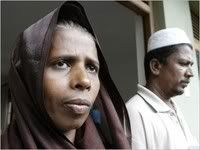
The court found Rizana Nafeek, 19, guilty of murdering a child in her care while working in the country. Her family (parents pictured above) has appealed the sentence, and human rights groups are calling for the Saudi government to overturn it.

At 17, Rizana Nafeek was sent to Saudi Arabia after the tsunami to work as a maid and make money for her family in Sri Lanka. But after only a few weeks and no child care training, her employers put her in charge of their 4-month-old baby. The baby died, and Nafeek was charged with murder, tried without an attorney and sentenced to death.
"This case raises many troubling questions about the treatment of children and foreigners in Saudi Arabia's criminal justice system," says Varia. "Foreigners simply do not receive the same treatment in the Saudi justice system. This includes having translation during the interrogation and during court proceedings and having an attorney."

About 1.5 million Sri Lankans work abroad, according to the country's labor statistics. Eighty percent of the women working abroad are employed as unskilled domestic workers, primarily in Saudi Arabia.

Varia says domestic workers are vulnerable to mistreatment. When Human Rights Watch sent a team of investigators to Saudi Arabia last year, Varia says the group found egregious abuse.

"The most commonly reported abuse is unpaid wages," she says. "It's routine for employers to take the passports of workers, and in order for the worker to leave the country, they have to get their employer to sign an exit visa."

Under Saudi Arabian law, employers have a heavy hand in how justice is served. After being charged and interrogated, Nafeek signed a guilty confession. If her former employers formally forgive her, she will be released, but they have so far refused to do so.

Nafeek's parents told local media outlets that their daughter was not trained in child care and that the baby "choked on milk." Human Rights Watch is calling for a new investigation into the case.

Varia says that because domestic workers in Saudi Arabia are not protected by labor laws, they don't have access to training, paid leave, reasonable hours or even one day off.

"They're not seen as real human beings," she says.

"It is socially accepted to lock your domestic worker inside the house. There are employers who forbid their workers to make phone calls home or write letters or talk to neighbors," says Varia, who interviewed domestic workers' employers in Saudi Arabia. "The reason they give is that, 'We paid a lot of money for this worker, and if I leave the door unlocked, she'll run away.'"

The problem is so severe that the embassies of Sri Lanka, Indonesia and the Philippines in Saudi Arabia can have as many as 150 women staying in embassy shelters because of abuse suffered at the hand of their employer, says Varia

The Saudi Arabia Embassy in the U.S. has not responded to calls and e-mails from ABCNews.com for this story, but Nafeek's case and other recent cases have drawn attention to the issue in Saudi Arabia. The Saudi government has made public statements condemning abuse of domestic workers. There also have been discussions to place domestic workers under separate labor laws.

Varia says discussions and rhetoric are not enough; the laws must change.

"There needs to be much greater efforts to punish abusive employers and to protect workers," she says. "What will really matter is if domestic workers get the same rights as all other workers in Saudi Arabia."

Tuesday, August 07, 2007

Taxes, Huh Yeah, What Are They Good For, Positively Everything

Sing it again!


The Minnesota bridge collapse may force the nation to address years of neglect of transportation system. The New York Times reports:
In the past two years, Gov. Tim Pawlenty of Minnesota twice vetoed legislation to raise the state’s gas tax to pay for transportation needs.

Now, with at least five people dead in the collapse of the Interstate 35W bridge here, Mr. Pawlenty, a Republican, appears to have had a change of heart.

“He’s open to that,” Brian McClung, a spokesman for the governor, said Monday of a higher gas tax. “He believes we need to do everything we can to address this situation and the extraordinary costs.”

Even as the cause of the bridge disaster here remains under investigation, the collapse is changing a lot of minds about spending priorities. It has focused national attention on the crumbling condition of America’s roadways and bridges — and on the financial and political neglect they have received in Washington and many state capitals.
Despite historic highs in transportation spending, the political muscle of lawmakers, rather than dire need, has typically driven where much of the money goes. That has often meant construction of new, politically popular roads and transit projects rather than the mundane work of maintaining the worn-out ones.

Further, transportation and engineering experts said, lawmakers have financed a boom in rail construction that, while politically popular, has resulted in expensive transit systems that are not used by a vast majority of American commuters.

Representative James L. Oberstar, Democrat of Minnesota and the chairman of the Committee on Transportation and Infrastructure, sent out a news release last month boasting about Minnesota’s share of a recent transportation and housing appropriations bill.

Of the $12 million secured for the state, $10 million is slated for a new 40-mile commuter rail line to Minneapolis, called the Northstar. The remaining $2 million is divided among a new bike and walking path and a few other projects, including highway work and interchange reconstruction.

The $286 billion federal transportation legislation passed by Congress in 2005 included more than 6,000 earmarks, which amounted to blatant gifts to chosen districts, including the so-called Bridge to Nowhere in rural Alaska (that earmark was later removed after a political uproar).

Senator Charles E. Schumer, Democrat of New York, said in a telephone interview Monday that earmarks for transportation in federal legislation were “almost always new construction and not maintenance.” Earlier, Mr. Schumer said that he would introduce legislation next month to double a proposed federal transportation bill appropriation, with a focus on upkeep to $10 billion.

“The bottom line,” Mr. Schumer said, “is that routine but important things like maintenance always get shortchanged because it’s nice for somebody to cut a ribbon for a new structure.”

Last week, Representative John L. Mica of Florida, the ranking Republican on the Transportation and Infrastructure Committee, met with advisers to the Bush administration to urge a nationwide plan to address transportation needs. Rebuilding the I-35W bridge would be only “a Band-Aid” Mr. Mica said, “to a much more serious problem.”

“We don’t have any kind of strategic plan to deal with infrastructure, and we’re falling behind,” he said.

In statehouses across the country, legislators tried this past session to fill some of the void by passing bond acts or allocating money to improve roads, bridges and other pieces of the transportation system.

In Arkansas, lawmakers set aside $80 million, 15 percent of which will be used to repair county roads, 15 percent for city byways and the rest for its highways. New Mexico approved a $200 million plan for local and tribal road projects, and in Texas, $700 million was allotted for state transportation projects over the next two years.

Voters in California this year authorized nearly $20 billion in transportation bonds to pay for repairs and make other improvements to its taxed system.

“We still barely scratched the surface,” said Adam Mendelsohn, the communications director for Gov. Arnold Schwarzenegger, a Republican. “The governor is very concerned about the lack of attention that the federal government has given to infrastructure. It is probably no more acute than in California because of the tremendous strains from population growth.”

The federal budget for transportation comes largely from excise taxes, particularly on gasoline, set by Congress at 18.4 cents in 1993 and eroded over time by inflation and fuel efficiency. As such, over the last decade, state legislatures in 14 states have voted to raise the state gas tax 19 times. And several states are looking at toll roads and congestion pricing initiatives to help shore up the roads.

The National Conference of State Legislatures, a group with members from all 50 states, is calling for a 3-cents per gallon increase in the federal gas tax.

C. Michael Walton, a professor of civil engineering at the University of Texas, Austin, helped write a series of reports issued by the American Society of Civil Engineers that have repeatedly found the nation’s highway system with insufficient money. “Continually falling short of the actual needs,” Professor Walton said, results largely from “our backlash to increases in taxes.”

Professor Walton said states had been looking to the federal government for leadership. “I am not sure transportation falls to the top of the priorities as it should barring a catastrophic failure,” he said in reference to state government spending.

A study released in May by the Urban Land Institute and Ernst & Young found that 83 percent of the nation’s transportation infrastructure was not capable of meeting the country’s needs over the next 10 years. The American Society of Civil Engineers, in its latest national report card, gave transportation infrastructure a D.

Meanwhile, there are urgent needs. The Interstate highway system turned 50 last year and is showing signs of age and inadequate upkeep. Around St. Louis, for instance, old bridges, rocky roads and tight ramp loops have led to a shutdown of parts of Interstate 64/Highway 40 — one of the most important corridors in the state — until late 2009.

“It’s so easy to let this stuff slip,” said Robert Dunphy, a senior resident fellow at the Urban Land Institute.

The national highway system, originally called the National System of Interstate and Defense Highways, came into being under the Eisenhower administration. (The country’s population was 169 million then, and there were about 54 million registered vehicles on the roads.) It was spurred by fears that Americans would have a mobility crisis if the country were attacked in a nuclear war. By the 1970s much of the system was completed.

But since then, the nation’s highways have eroded with age and use, especially in areas like the Southwest where population booms have far outweighed the ability of roads to carry the new drivers.

Typically financing for capital transportation projects comes from the federal government matched with funds from states, which are then charged with maintaining the roads and bridges. But the federal government and states operate trust funds, filled with revenues from various excise taxes, which have been unable to maintain existing roadways adequately or finance capital expenditures.

But it may often be less the amount allocated for transportation than how it is doled out that leads to eroding highways, some critics say.

“Highway funding is supposed to be on the basis of need,” said Raymond Helmer, a transportation consultant in Houston who has worked on transportation projects for over 50 years. “There is supposed to be cost-benefit analysis, and every state does a study as required by federal government and comes up with needs, but then politicians say, ‘I don’t want that road here, I want it here.’ ”

Some transportation experts also said that though light rail and other public transportation projects made sense in cities, investing in them in sprawling suburban regions might not, even if the systems were supported, in theory, by the public.

“Too many American cities are spending far too much money on expensive rail transit projects, which are used for only 1 to 2 percent of local travel, and far too little on highway projects which are used for 95 to 99 percent of local travel,” Randal O’Toole, a senior fellow with the Cato Institute, said in an e-mail interview.

There has also been more emphasis nationwide on building new roads than on the maintenance and upkeep of old ones. Steve Ellis, the vice president of Taxpayers for Common Sense, a group that monitors federal spending, said that might help move traffic in some places, but it left many others with the equivalent of a leaky roof.

“It would be irresponsible of me to go out to dinner if I couldn’t fix a leak in my roof,” Mr. Ellis said. “But that’s essentially what we do. We don’t take care of what we’ve got, but we talk a lot about building more and new.”

Conservatives will balk at raising taxes, and argue that the only people who should have to pay for their building and upkeep are the people who use them. Conservatives conveniently ignore the benefits that they derive from roads and bridges. Goods and services that Conservatives consume and enjoy are transported on those same roads and bridges. Privatizing America's roads, bridges and everything, is what the forces behind globalization have in store for us.

Pentagon Admits 190,000 Weapons Missing In Iraq

The Independent reports:
Some 190,000 assault rifles and pistols supplied by the US to Iraqi security forces in 2004 and 2005 have gone missing, according to a report issued here yesterday, and may have fallen into the possession of insurgents.

The embarrassing disclosure, by the watchdog Government Accountability office (GAO), means that the Pentagon does not know what happened to roughly a third of the arms it has provided to train and equip Iraqi forces - an effort whose success is crucial to restoring some semblance of order in the country.
The "lost" arms include 80,000 pistols as well as an estimated 110,000 of the Soviet-made AK-47 assault rifles, many of them originating in eastern Europe, especially the former Yugoslavia. A recent Amnesty International report claims that, in 2004 and 2005, more than 350,000 AK-47s and similar weapons were removed from Bosnia and Serbia by private contractors working for the Pentagon and sent to Iraq, with the approval of local Nato and European commanders.

In addition, some 135,000 pieces of body armour and 115,000 helmets have also vanished, again perhaps to end up in the hands of insurgents. So far, the US has spent more than $19bn (£9.3bn) on developing Iraqi security forces, including almost $3bn on weapons.

According to the GAO, the distribution of the weaponry was "haphazard and rushed," and failed to follow established procedures - accusations the Pentagon does not dispute.

But the affair could be even more problematic for the White House, given that, during the two years under scrutiny, the programme was headed by General David Petraeus, now the top US commander in Iraq, in charge of the current troop "surge". President George Bush now lauds his talents on an almost daily basis, as the man who will finally give the US the upper hand against the insurgents.

The GAO arrived at its figures by comparing the property records of the Multi-National Security Transition Command for Iraq against records kept by General Petraeus of the arms and equipment he ordered. The Pentagon says it is now reviewing procedures "to ensure US-funded equipment reaches the intended Iraqi security forces."

But the controversy fits into a now familiar pattern of mistakes made by the US in Iraq, dating back to the initial failure to secure arms caches found in Iraq immediately after the 2003 invasion, and which merely fuel the insurgency the Americans are trying to stamp out. In this case, says the GAO, the military was "consistently unable" to collect supporting documents showing the weapons had been sent to and received by the intended parties.

There were also "numerous mistakes due to incorrect manual entries". But the military argues that the situation on the ground was so urgent, and the agency responsible for recording the transfers of arms so short staffed, that field commanders had little choice in the matter. "We could have held on to them until every bit of a logistical and property accountability system was in place," one unidentified officer told The Washington Post, which first reported on the missing arms yesterday. Or, he continued, "we could issue them in bulk on some occasions, to the US elements supporting Iraqi units who were needed in the battles." In Fallujah, the scene of fierce fighting in late 2004, one recently created Iraqi brigade dissolved and later used its weapons against American forces.

The GAO findings will be grist for the mill of opponents of the war, less than six weeks before the scheduled report to Congress by General Petraeus and Ryan Crocker, Washington's envoy in Baghdad, on whether the "surge" is succeeding.

That report may be a watershed moment for Iraq policy here. With public patience with the war all but exhausted, and elections barely a year away, many Republicans loyal to Mr Bush have hinted that, barring cast-iron evidence the "surge" is working, they will no longer support the war.

Monday, August 06, 2007

From Someone Else on The Trip To Iraq With O'Hanlon & Pollack


The synopsis of Anthony Cordesman's report for CSIS:
Everyone sees Iraq differently. As one leading US official in Iraq put it, “the current situation is like playing three dimensional chess in the dark while someone is shooting at you.” It is scarcely surprising that my perceptions of a recent trip to Iraq are different from that of two of my traveling companions and those of several other recent think tank travelers to the country.

From my perspective, the US now has only uncertain, high risk options in Iraq. It cannot dictate Iraq’s future, only influence it, and this presents serious problems at a time when the Iraqi political process has failed to move forward in reaching either a new consensus or some form of peaceful coexistence. It is Iraqis that will shape Iraq's ability or inability to rise above its current sectarian and ethnic conflicts, to redefine Iraq's politics and methods of governance, establish some level of stability and security, and move towards a path of economic recovery and development. So far, Iraq’s national government has failed to act at the rate necessary to move the country forward or give American military action political meaning.
The attached trip report does, however, show there is still a tenuous case for strategic patience in Iraq, and for timing reductions in US forces and aid to Iraqi progress rather than arbitrary dates and uncertain benchmarks. It recognizes that strategic patience is a high risk strategy, but it also describes positive trends in the fighting, and hints of future political progress.

These trends are uncertain, and must be considered in the context of a long list of serious political, military, and economic risks that are described in detail. The report also discusses major delays and problems in the original surge strategy. The new US approach to counterinsurgency warfare is making a difference, but it still seems likely from a visit to the scene that the original strategy President Bush announced in January would have failed if it had not been for the Sunni tribal awakening.

Luck, however, is not something that can be ignored, and there is a window of opportunity that could significantly improve the chances of US success in Iraq if the Iraqi government acts upon it. The US also now has a country team in Iraq that is far more capable than in the past, and which may be able to develop and implement the kind of cohesive plans for US action in Iraq that have been weak or lacking to date. If that team can come forward with solid plans for an integrated approach to a sustained US effort to deal with Iraq’s plans and risks, there would be a far stronger and more bipartisan case for strategic patience.

Beyond Disaster

Chris Hedges, the former Middle East bureau chief for The New York Times, spent seven years in the Middle East. He was part of the paper’s team of reporters who won the 2002 Pulitzer Prize for coverage of global terrorism. He is the author of “War Is a Force That Gives Us Meaning.” His latest book is “American Fascists: The Christian Right and the War on America.”

For TruthDig, Chris Hedges writes:
The war in Iraq is about to get worse—much worse. The Democrats’ decision to let the war run its course, while they frantically wash their hands of responsibility, means that it will sputter and stagger forward until the mission collapses. This will be sudden. The security of the Green Zone, our imperial city, will be increasingly breached. Command and control will disintegrate. And we will back out of Iraq humiliated and defeated. But this will not be the end of the conflict. It will, in fact, signal a phase of the war far deadlier and more dangerous to American interests.
Iraq no longer exists as a unified country. The experiment that was Iraq, the cobbling together of disparate and antagonistic patches of the Ottoman Empire by the victorious powers in the wake of World War I, belongs to the history books. It will never come back. The Kurds have set up a de facto state in the north, the Shiites control most of the south and the center of the country is a battleground. There are 2 million Iraqis who have fled their homes and are internally displaced. Another 2 million have left the country, most to Syria and Jordan, which now has the largest number of refugees per capita of any country on Earth. An Oxfam report estimates that one in three Iraqis are in need of emergency aid, but the chaos and violence is so widespread that assistance is impossible. Iraq is in a state of anarchy. The American occupation forces are one more source of terror tossed into the caldron of suicide bombings, mercenary armies, militias, massive explosions, ambushes, kidnappings and mass executions. But wait until we leave.

It was not supposed to turn out like this. Remember all those visions of a democratic Iraq, visions peddled by the White House and fatuous pundits like Thomas Friedman and the gravel-voiced morons who pollute our airwaves on CNN and Fox News? They assured us that the war would be a cakewalk. We would be greeted as liberators. Democracy would seep out over the borders of Iraq to usher in a new Middle East. Now, struggling to salvage their own credibility, they blame the debacle on poor planning and mismanagement.

There are probably about 10,000 Arabists in the United States—people who have lived for prolonged periods in the Middle East and speak Arabic. At the inception of the war you could not have rounded up more than about a dozen who thought this was a good idea. And I include all the Arabists in the State Department, the Pentagon and the intelligence community. Anyone who had spent significant time in Iraq knew this would not work. The war was not doomed because Donald Rumsfeld and Paul Wolfowitz did not do sufficient planning for the occupation. The war was doomed, period. It never had a chance. And even a cursory knowledge of Iraqi history and politics made this apparent.

This is not to deny the stupidity of the occupation. The disbanding of the Iraqi army; the ham-fisted attempt to install the crook and, it now turns out, Iranian spy Ahmed Chalabi in power; the firing of all Baathist public officials, including university professors, primary school teachers, nurses and doctors; the failure to secure Baghdad and the vast weapons depots from looters; allowing heavily armed American units to blast their way through densely populated neighborhoods, giving the insurgency its most potent recruiting tool—all ensured a swift descent into chaos. But Iraq would not have held together even if we had been spared the gross incompetence of the Bush administration. Saddam Hussein, like the more benign dictator Josip Broz Tito in the former Yugoslavia, understood that the glue that held the country together was the secret police.

Iraq, however, is different from Yugoslavia. Iraq has oil—lots of it. It also has water in a part of the world that is running out of water. And the dismemberment of Iraq will unleash a mad scramble for dwindling resources that will include the involvement of neighboring states. The Kurds, like the Shiites and the Sunnis, know that if they do not get their hands on water resources and oil they cannot survive. But Turkey, Syria and Iran have no intention of allowing the Kurds to create a viable enclave. A functioning Kurdistan in northern Iraq means rebellion by the repressed Kurdish minorities in these countries. The Kurds, orphans of the 20th century who have been repeatedly sold out by every ally they ever had, including the United States, will be crushed. The possibility that Iraq will become a Shiite state, run by clerics allied with Iran, terrifies the Arab world. Turkey, as well as Saudi Arabia, the United States and Israel, would most likely keep the conflict going by arming Sunni militias. This anarchy could end with foreign forces, including Iran and Turkey, carving up the battered carcass of Iraq. No matter what happens, many, many Iraqis are going to die. And it is our fault.

The neoconservatives—and the liberal interventionists, who still serve as the neocons’ useful idiots when it comes to Iran—have learned nothing. They talk about hitting Iran and maybe even Pakistan with airstrikes. Strikes on Iran would ensure a regional conflict. Such an action has the potential of drawing Israel into war—especially if Iran retaliates for any airstrikes by hitting Israel, as I would expect Tehran to do. There are still many in the U.S. who cling to the doctrine of pre-emptive war, a doctrine that the post-World War II Nuremberg laws define as a criminal “war of aggression.”

The occupation of Iraq, along with the Afghanistan occupation, has only furthered the spread of failed states and increased authoritarianism, savage violence, instability and anarchy. It has swelled the ranks of our real enemies—the Islamic terrorists—and opened up voids of lawlessness where they can operate and plot against us. It has scuttled the art of diplomacy. It has left us an outlaw state intent on creating more outlaw states. It has empowered Iran, as well as Russia and China, which sit on the sidelines gleefully watching our self-immolation. This is what George W. Bush and all those “reluctant hawks” who supported him have bequeathed us.

What is terrifying is not that the architects and numerous apologists of the Iraq war have learned nothing, but that they may not yet be finished.

Yet nobody calls this President to account. Nobody confronts him with the truths from on the ground, from those not beholden to him, in his line of command.

Bush hasn't had a full court press conference in almost a year. The White House press corps is content to be spun by an assistant press secretary, dutifully writing down her alliterative cliches, and repeating them back into microphones for the evening news.

And the beat goes on.
GAO Estimates 30% of Arms Are Unaccounted For

The Washington Post reports:
The Pentagon has lost track of about 190,000 AK-47 assault rifles and pistols given to Iraqi security forces in 2004 and 2005, according to a new government report, raising fears that some of those weapons have fallen into the hands of insurgents fighting U.S. forces in Iraq.

The author of the report from the Government Accountability Office says U.S. military officials do not know what happened to 30 percent of the weapons the United States distributed to Iraqi forces from 2004 through early this year as part of an effort to train and equip the troops. The highest previous estimate of unaccounted-for weapons was 14,000, in a report issued last year by the inspector general for Iraq reconstruction.
The United States has spent $19.2 billion trying to develop Iraqi security forces since 2003, the GAO said, including at least $2.8 billion to buy and deliver equipment. But the GAO said weapons distribution was haphazard and rushed and failed to follow established procedures, particularly from 2004 to 2005, when security training was led by Gen. David H. Petraeus, who now commands all U.S. forces in Iraq.

The Pentagon did not dispute the GAO findings, saying it has launched its own investigation and indicating it is working to improve tracking. Although controls have been tightened since 2005, the inability of the United States to track weapons with tools such as serial numbers makes it nearly impossible for the U.S. military to know whether it is battling an enemy equipped by American taxpayers.

"They really have no idea where they are," said Rachel Stohl, a senior analyst at the Center for Defense Information who has studied small-arms trade and received Pentagon briefings on the issue. "It likely means that the United States is unintentionally providing weapons to bad actors."

One senior Pentagon official acknowledged that some of the weapons probably are being used against U.S. forces. He cited the Iraqi brigade created at Fallujah that quickly dissolved in September 2004 and turned its weapons against the Americans.

Stohl said insurgents frequently use small-arms fire to force military convoys to move in a particular direction -- often toward roadside bombs. She noted that the Bush administration frequently complains that Iran and Syria are supplying insurgents but has paid little attention to whether U.S. military errors inadvertently play a role. "We know there is seepage and very little is being done to address the problem," she said.

Stohl noted that U.S. forces, focused on a fruitless search for weapons of mass destruction after Baghdad fell, did not secure massive weapons caches. The failure to track small arms given to Iraqi forces repeats that pattern of neglect, she added.

The GAO is studying the financing and weapons sources of insurgent groups, but that report will not be made public. "All of that information is classified," said Joseph A. Christoff, the GAO's director of international affairs and trade.

In an unusual move, the train-and-equip program for Iraqi forces is being managed by the Pentagon. Normally, the traditional security assistance programs are operated by the State Department, the GAO reported. The Defense Department said this change permitted greater flexibility, but as of last month it was unable to tell the GAO what accountability procedures, if any, apply to arms distributed to Iraqi forces, the report said.

Iraqi security forces were virtually nonexistent in early 2004, and in June of that year Petraeus was brought in to build them up. No central record of distributed equipment was kept for a year and a half, until December 2005, and even now the records are on a spreadsheet that requires three computer screens lined up side by side to view a single row, Christoff said.

The GAO found that the military was consistently unable to collect supporting documents to "confirm when the equipment was received, the quantities of equipment delivered, and the Iraqi units receiving the equipment." The agency also said there were "numerous mistakes due to incorrect manual entries" in the records that were maintained.

The GAO reached the estimate of 190,000 missing arms -- 110,000 AK-47s and 80,000 pistols -- by comparing the property records of the Multi-National Security Transition Command for Iraq against records Petraeus maintained of the arms and equipment he had ordered. Petraeus's figures were compared with classified data and other records to ensure that they were accurate enough to compare against the property books.

In all cases, the gaps between the two records were enormous. Petraeus reported that about 185,000 AK-47 rifles, 170,000 pistols, 215,000 pieces of body armor and 140,000 helmets were issued to Iraqi security forces from June 2004 through September 2005. But the property books contained records for 75,000 AK-47 rifles, 90,000 pistols, 80,000 pieces of body armor and 25,000 helmets.

A military commander involved in the program at the time, speaking on the condition of anonymity because he was not authorized to discuss the report, acknowledged in an e-mail, "We did issue some items, including weapons, body armor, etc. to new Iraqi units that were literally going into battle."

But, the commander argued, "there was, frankly, not much of a choice early on: We had very little staff and could have held the weapons until every piece of the logistical and property accountability system was in place, or we could issue them, in bulk on some occasions, to the U.S. elements supporting Iraqi units who were needed in the battles of Najaf, Fallujah, Mosul, Samarra, etc."

The GAO plans to look for similar problems in the training of Afghan security forces.

During the Bosnian conflict, the United States provided about $100 million in defense equipment to the Bosnian Federation Army, and the GAO found no problems in accounting for those weapons.

Much of the equipment provided to Iraqi troops, including the AK-47s, originates from countries in the former Soviet bloc. In a report last year, Amnesty International said that in 2004 and 2005 more than 350,000 AK-47 rifles and similar weapons were taken out of Bosnia and Serbia, for use in Iraq, by private contractors working for the Pentagon and with the approval of NATO and European security forces in Bosnia.
Even under the Democratically-controlled Congress, oversight by and bimonthly mandated reports to Congress on the progress of the war that were required when Congress gave Bush the authority to attack Iraq don't happen.

Sunday, August 05, 2007

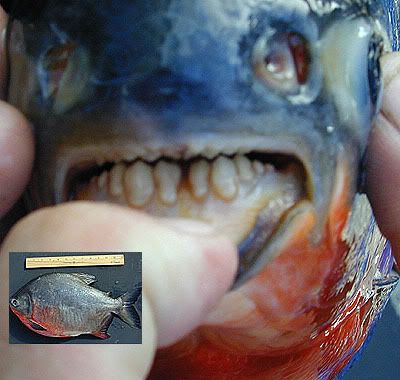
11 Year-Old Reels In A South American Fish In California Waters

South American Pacu

From the San Jose Mercury News:
Andre Roberts was hoping to reel in a whopper while fishing at a suburban Hercules park Tuesday, but no one was expecting what the 11-year-old landed on the end of his hook.

"He goes over and pulls in this big old fish," said Tania Esquivel of El Sobrante, who was fishing at Refugio Valley Park. "It had a stub-nose chin, it had a stub-nose face, and it had a red belly, and we said, `Dang! It looks like a piranha!' "

The proud fisherman put his squirming 2-pound catch in a plastic bucket and fed it some raw fish, which it snapped up immediately, Esquivel said.

Refugio Valley Park in Hercules, California

But authorities say no one should worry that the lake at Refugio Valley Park is teeming with carnivores from the Amazon; the fish has tentatively been identified as a pacu, a largely vegetarian species from South America that closely resembles its more famous cousin.
The 13-inch pacu was likely dumped in the park by a pet owner who did not realize how quickly it would grow, piranha expert Frank Magallanes said. Some types of pacus can grow up to 5 feet long and are legal in California.

The fish is now dead and waiting for state Fish and Game officers to pick it up so animal researchers can study it, Contra Costa County Animal Services Lt. Joe DeCosta said.

This summer, Contra Costa animal control officers caught two alligators, which were most likely dumped by their owners. Over the years, DeCosta said, his department has caught a pair of escaped African lions, an elephant, a Burmese python, gila monsters and injured otters.
"And I don't even want to talk about the whale anymore," DeCosta said with a laugh, referring to a pair of humpback whales that got lost in the Delta during the spring. "You name it, I think we get it."

Every year Magallanes hears of at least two or three cases of someone catching a pacu in a North American lake or river and mistaking it for a piranha. One federal study shows pacus have been caught in nearly every state. By comparison, piranhas have been caught in nine or 10 states, Magallanes said.

In California, three pacus are known to have been caught in the wild in the past 20 years - one in the San Joaquin River in Fresno in 1987, one at the Stevens Creek Reservoir in Santa Clara County in 1996 and one at Adobe Creek in Petaluma in 2000, according to the U.S. Geological Survey.

Pacus can survive in freshwater as cold as 47 degrees, Magallanes said. Piranhas are more delicate, and require warmer water.

When they are young, pacus are omnivores and have been seen scavenging alongside piranhas, Magallanes said. When pacus get bigger, they will eat nuts and seeds that fall into the water.

The chief physical difference between a piranha and a pacu is the fish's jaw - piranhas have razor-sharp teeth that extend out of their mouth like an overbite while pacus have two rows of sharp teeth up top and a row of grinding teeth, much like human teeth, below.

The lake at Refugio Valley Park is mostly filled with catfish, bluegill and trout, said Esquivel, who regularly fishes at popular spots in the county with her son, Jared. She and Jared returned to the park Wednesday with their fishing poles.

"To make a long story short, we're trying to catch piranhas out here," Esquivel said. "I brought some raw hamburger meat and we're putting it out on hooks."

Secret Log At Heart of Wiretap Challenge

In open court and legal filings it's referred to simply as "the Document."


Could this be why Bush was so frantic to get Congress to pass S. 1927, the FISA "fix" which allows the U.S. government to spy on anyone without a warrant?

The Associated Press reports:
Federal officials claim its contents are so sensitive to national security that it is stored in a bombproof safe in Washington and viewed only by prosecutors with top secret security clearances and a few select federal judges.

The Document, described by those who have seen it as a National Security Administration log of calls intercepted between an Islamic charity and its American lawyers, is at the heart of what legal experts say may be the strongest case against the Bush administration's warrantless eavesdropping program. The federal appeals court in San Francisco plans to hear arguments in the case Aug. 15.
The charity's lawyer scoffs at the often surreal lengths the government has taken to keep the Document under wraps.

"Believe me," Oakland attorney Jon Eisenberg said, "if this appeared on the front pages of newspapers, national security would not be jeopardized."

Eisenberg represents the now-defunct U.S. arm of the Al-Haramain Islamic Foundation, a prominent Saudi charity that was shut down by authorities in that kingdom after the U.S. Treasury Department declared it a terrorist organization that was allegedly funding Al-Qaida.

He and his colleagues sued the U.S. government in Portland, Ore.'s federal court, alleging the NSA had illegally intercepted telephone calls without warrants between Soliman al-Buthi, the Saudi national who headed Al-Haramain's U.S. branch, and his two American lawyers, Wendell Belew and Asim Ghafoor.

Unlike dozens of other lawyers who have sued alleging similar violations of civil liberties stemming from the Bush administration's secret terrorism surveillance program, Eisenberg's team had what it claimed to be unequivocal proof: the Document.

In 2004, as the Treasury Department was considering whether to include the group on its list of terrorist organizations, Al-Haramain's Washington lawyer, Lynne Bernabei, asked to see the evidence.

That's when, in a case of bureaucratic bungling, Treasury officials mistakenly handed over the call log _ which has the words "top secret" stamped on every page _ along with press clippings and other unclassified documents deemed relevant to the case.

Six weeks later, the FBI was dispatched to Bernabei's office to retrieve it. But by then she had passed out copies to five other lawyers, a Washington Post reporter and two Al-Haramain directors _ al-Buthi and Pirouz Sedaghaty, also known as Pete Seda.

Still, the lawyers were unsure what they'd been given until December 2005, when The New York Times published a story exposing the Bush administration's warrantless wiretapping program. The attorneys involved in the Al-Haramain case suddenly realized that the call log was proof their clients had been eavesdropped on, and they sued.

An Oregon judge soon ordered Eisenberg and his colleagues to turn over all copies, but in an odd legal twist, U.S. District Court Judge Garr King allowed the lawsuit to go forward with Eisenberg's team forced to rely on their memories of the Document.

Even the laptop computer Eisenberg used to draft legal documents citing the Document is scheduled to be scrubbed clean by government agents Wednesday.

Three judges in the San Francisco-based 9th U.S. Circuit Court of Appeals will now decide whether the wiretapping program authorized shortly after the Sept. 11, 2001, terrorist attacks was illegal.

Each time the judges want to view the Document, a Department of Justice "court security officer" hand carries it from Washington to San Francisco, then returns with it and any notes the judges made that are deemed sensitive, according to court documents.

DOJ spokesman Dean Boyd declined to comment on the case or the handling of the Document.

Even without the Document itself, legal observers say Eisenberg's case may have the best chance of succeeding among the many legal challenges to the wireless wiretapping program, which the Bush administration discontinued earlier this year.

Belew and Ghafoor, the two lawyers whose calls were allegedly intercepted by NSA, appear to be the only U.S. citizens with actual proof that the government eavesdropped on them. They're demanding $1 million each from the federal government and the unfreezing of Al-Haramain's assets.

The 9th Circuit has scheduled arguments for Aug. 15 on the administration's request to dismiss the Al-Haramain case and another lawsuit by telecommunication customers who allege logs of their calls were illegally accessed by the NSA.

In court papers filed last year, then-National Intelligence Director John Negroponte and NSA Director Lt. Gen. Keith Alexander urged a judge to toss the case because to defend it would require the government to disclose "state secrets" that would expose the United States' anti-terrorist efforts.

Last month, the Bush administration reiterated its position in court documents submitted to the appeals court urging dismissal of the case.

"Whether plaintiffs were subjected to surveillance is a state secret, and information tending to confirm or deny that fact is privileged," the filing stated.

More than 50 other lawsuits pending before a San Francisco federal judge are awaiting the appeals court's ruling in the two cases, but none have the kind of hard evidence Al-Haramain purports to have _ through its lawyers' recollections of the call log _ that warrantless eavesdropping of American citizens occurred.

"The biggest obstacle this litigation has faced is the problem showing someone was actually subjected to surveillance," said Duke University law professor Curtis Bradley.

But he said the Al-Haramain lawsuit "has a very good chance to proceed farther than the other cases because it's impossible for the government to erase (the lawyers') memories of the document."

If this lawsuit succeeds, it has the possibility of outlawing Bush's unauthorized, secret surveillance programs. I don't believe it would have any effect, however, on what Congress just passed, S. 1927. I think it would take some target of the surveillance to challenge the Constitutionality, which isn't likely to happen given how unlikely it is for a target to learn that he's being spied on. Unless or until he's arrested (or the victim of 'extraordinary rendition,' in which case it's unlikely he'll ever be heard from again).

Bush Orders FBI Raid On Home Of Former DoJ Lawyer Over Warrantless Wiretap Leak

Leakers of Valerie Plame's identity as CIA operative and Brewster Jennings as the cover corporation she and other CIA operatives worked for still remain employed at the White House, retain their top secret clearances and are shielded by Bush.

Newsweek reports:
The controversy over President Bush's warrantless surveillance program took another surprise turn last week when a team of FBI agents, armed with a classified search warrant, raided the suburban Washington home of a former Justice Department lawyer. The lawyer, Thomas M. Tamm, previously worked in Justice's Office of Intelligence Policy and Review (OIPR)—the supersecret unit that oversees surveillance of terrorist and espionage targets. The agents seized Tamm's desktop computer, two of his children's laptops and a cache of personal files. Tamm and his lawyer, Paul Kemp, declined any comment. So did the FBI. But two legal sources who asked not to be identified talking about an ongoing case told NEWSWEEK the raid was related to a Justice criminal probe into who leaked details of the warrantless eavesdropping program to the news media. The raid appears to be the first significant development in the probe since The New York Times reported in December 2005 that Bush had authorized the National Security Agency to eavesdrop on the international phone calls and e-mails of U.S. residents without court warrants. (At the time, Attorney General Alberto Gonzales said of the leak: "This is really hurting national security; this has really hurt our country.")
A veteran federal prosecutor who left DOJ last year, Tamm worked at OIPR during a critical period in 2004 when senior Justice officials first strongly objected to the surveillance program. Those protests led to a crisis that March when, according to recent Senate testimony, then A.G. John Ashcroft, FBI Director Robert Mueller and others threatened to resign, prompting Bush to scale the program back. Tamm, said one of the legal sources, had shared concerns about he program's legality, but it was unclear whether he actively participated in the internal DOJ protest.

The FBI raid on Tamm's home comes when Gonzales himself is facing criticism for allegedly misleading Congress by denying there had been "serious disagreement" within Justice about the surveillance program. The A.G. last week apologized for "creating confusion," but Senate Judiciary Committee chair Sen. Patrick Leahy said he is weighing asking Justice's inspector general to review Gonzales's testimony.

The raid also came while the White House and Congress were battling over expanding NSA wiretapping authority in order to plug purported "surveillance gaps." James X. Dempsey of the Center for Democracy and Technology said the raid was "amazing" and shows the administration's misplaced priorities: using FBI agents to track down leakers instead of processing intel warrants to close the gaps. A Justice spokesman declined to comment.

Saturday, August 04, 2007

Iraq Bleeds U.S. Treasury, Enriches Contractors

At Asia Times Online, Eli Clifton writes:
In a report to US lawmakers this week, the non-partisan Congressional Budget Office found that the war in Iraq could cost US taxpayers more than a trillion dollars when the long-term costs of caring for soldiers wounded in action, military and economic aid for the Iraqi government, and ongoing costs associated with the 190,000 troops stationed in Iraq are totaled up.

White House Office of Management and Budget director Mitch Daniels' 2003 estimate that the war in Iraq could cost US$50 billion to $60 billion stands in stark contrast to the $500 billion already allocated to the conflict in Iraq and reconstruction projects.

"We are now spending on these activities more than 10% of all the government's annually appropriated funds," said Robert A Sunshine, the assistant director for budget analysis.
In Sunshine's report to Congress, he showed that in an optimistic scenario - the United States reduces its troop levels in Iraq to 30,000 by 2010 - the war will still cost taxpayers an additional $500 billion.

In a less optimistic scenario in which 75,000 US troops remain in Iraq over the next five years, the cost to the US government would total an additional $900 billion.

"This is the consequence of going to war haphazardly and without a plan," Brian Katulis, senior fellow at the Center for American Progress, told Inter Press Service (IPS). "We're at a point where we look at how much is approved by Congress, we're at $450 billion. Then the $116 billion requested by the [George W] Bush administration puts the total at over $556 billion.

"The Vietnam War, when inflation-adjusted, cost $652 billion," he added.

While Congressional Budget Office reports showed a gloomy outlook for US costs in Iraq, last week several of Washington's biggest defense contractors released profit reports disclosing huge growth in divisions benefiting from military contracts in Iraq and Afghanistan.

Northrop Grumman's information and services division showed 15% growth and its electronics division 7% for the second quarter compared with the same fiscal quarter last year.

General Dynamics' combat-systems unit experienced 19% growth in sales due to continued demand for tanks and armored vehicles, while Lockheed Martin announced a 34% rise in profits to $778 million.

Lockheed's newest revenue projections are now as high as $41.75 billion.

Miriam Pemberton, research fellow at the Institute for Policy Studies, told IPS that 2008 military-related appropriations are the highest they've ever been. The year 2007 was the highest before that.

"War spending continues to go on. In addition, [contractors] are cashing in on increasing military budgets that have nothing to do with the war, such as the F-22 Raptor and large-scale weapon systems. Not only has this recent quarter been profitable, they have now locked in spending that will keep those profits going," she said.

The increase in profits by defense contractors can be correlated to only a portion of the current and predicted spending associated with the war in Iraq.

The Congressional Budget Office's report estimated that medical costs will exceed $9 billion if the US stations 30,000 troops in Iraq, but could exceed $13 billion if 75,000 troops remain in Iraq over the next several years.

Training of police and soldiers in Iraq and Afghanistan over the next decade is estimated to cost at least $50 billion.

Estimates for rebuilding and diplomatic expenses suggest that the US government will need to spend at least $20 billion through 2017, outside of military expenses.

Costs in coming months may continue to rise as the military will require funding for the troop "surge" and for the purchase of armored vehicles for the additional troops and to replace vehicles unsafe because of the threat posed by roadside bombs.

In January 2006, Joseph Stiglitz, a Columbia University professor who won the Nobel Prize for economics in 2001, and Linda Bilmes, a Harvard University budget expert, released a report estimating that the cost of the war in Iraq may come to more than $2 trillion when costs associated with lifetime disability and health care for injured soldiers and the overall effect on the economy are taken into account.

Only 3 of the Senate Democrats Who Voted For Bush's FISA Bill Are Up For Re-Election Next Year

Of the Democrats in the Senate who voted for the FISA bill [Evan Bayh (Indiana); Tom Carper (Delaware); Bob Casey (Pennsylvania); Kent Conrad (North Dakota); Dianne Feinstein (California); Daniel Inouye (Hawai‘i); Amy Klobuchar (Minnesota); Mary Landrieu (Louisiana); Blanche Lincoln (Arkansas); Claire McCaskill (Missouri); Barbara Mikulski (Maryland); Bill Nelson (Florida); Ben Nelson (Nebraska); Mark Pryor (Arkansas); Ken Salazar (Colorado); Jim Webb (Virginia)], only these three are up for reelection in 2008: Tom Carper, Mary Landrieu, Mark Pryor.

They had no reason to fear that a vote in 2007 would come back to haunt them in 2011 (when Blanche Lincoln, Ken Salazar, Barbara Mikulski, Daniel Inouye are up for re-election), and 2013 (when Ben Nelson, Bill Nelson, Claire McCaskill, Bob Casey, Dianne Feinstein, Kent Conrad, Amy Klobuchar and Jim Webb are up for reelection). Unless there actually is a terrorist attack in the next 30 days, as Bush and the Republicans are threatening, in which case they'd have years to spin their vote. Or perhaps uncover how Bush was so expert in predicting when a terrorist attack would take place, but so inept about preventing it.

Friday, August 03, 2007

Worse Than Spineless . . . .

. . . . They're useless.

After Bush threatened to disrupt their vacation plans and call Congress back into session if they didn't give him what he wanted, the Senate voted 60-28 to give Bush expanded authority to eavesdrop on any electronic communications that are routed through U.S. circuits without court warrants.

A "yes" vote was a vote to give Bush that authority and a "no" vote was a vote to deny him that authority.

Voting "yes" were 16 Democrats, 43 Republicans and 1 independent.

Voting "no" were 27 Democrats, 0 Republicans and 1 independent.
Alabama

Sessions (R) Yes; Shelby (R) Yes.

Alaska

Murkowski (R) Yes; Stevens (R) Yes.

Arizona

Kyl (R) Yes; McCain (R) Not Voting.

Arkansas

Lincoln (D) Yes; Pryor (D) Yes.

California

Boxer (D) Not Voting; Feinstein (D) Yes.

Colorado

Allard (R) Yes; Salazar (D) Yes.

Connecticut

Dodd (D) No; Lieberman (I) Yes.

Delaware

Biden (D) No; Carper (D) Yes.

Florida

Martinez (R) Yes; Nelson (D) Yes.

Georgia

Chambliss (R) Yes; Isakson (R) Yes.

Hawaii

Akaka (D) No; Inouye (D) Yes.

Idaho

Craig (R) Yes; Crapo (R) Yes.

Illinois

Durbin (D) No; Obama (D) No.

Indiana

Bayh (D) Yes; Lugar (R) Not Voting.

Iowa

Grassley (R) Yes; Harkin (D) Not Voting.

Kansas

Brownback (R) Yes; Roberts (R) Yes.

Kentucky

Bunning (R) Not Voting; McConnell (R) Yes.

Louisiana

Landrieu (D) Yes; Vitter (R) Yes.

Maine

Collins (R) Yes; Snowe (R) Yes.

Maryland

Cardin (D) No; Mikulski (D) Yes.

Massachusetts

Kennedy (D) No; Kerry (D) Not Voting.

Michigan

Levin (D) No; Stabenow (D) No.

Minnesota

Coleman (R) Yes; Klobuchar (D) Yes.

Mississippi

Cochran (R) Yes; Lott (R) Not Voting.

Missouri

Bond (R) Yes; McCaskill (D) Yes.

Montana

Baucus (D) No; Tester (D) No.

Nebraska

Hagel (R) Yes; Nelson (D) Yes.

Nevada

Ensign (R) Yes; Reid (D) No.

New Hampshire

Gregg (R) Not Voting; Sununu (R) Yes.

New Jersey

Lautenberg (D) No; Menendez (D) No.

New Mexico

Bingaman (D) No; Domenici (R) Yes.

New York

Clinton (D) No; Schumer (D) No.

North Carolina

Burr (R) Yes; Dole (R) Yes.

North Dakota

Conrad (D) Yes; Dorgan (D) Not Voting.

Ohio

Brown (D) No; Voinovich (R) Yes.

Oklahoma

Coburn (R) Yes; Inhofe (R) Yes.

Oregon

Smith (R) Yes; Wyden (D) No.

Pennsylvania

Casey (D) Yes; Specter (R) Yes.

Rhode Island

Reed (D) No; Whitehouse (D) No.

South Carolina

DeMint (R) Yes; Graham (R) Yes.

South Dakota

Johnson (D) Not Voting; Thune (R) Yes.

Tennessee

Alexander (R) Not Voting; Corker (R) Yes.

Texas

Cornyn (R) Yes; Hutchison (R) Yes.

Utah

Bennett (R) Yes; Hatch (R) Yes.

Vermont

Leahy (D) No; Sanders (I) No.

Virginia

Warner (R) Yes; Webb (D) Yes.

Washington

Cantwell (D) No; Murray (D) Not Voting.

West Virginia

Byrd (D) No; Rockefeller (D) No.

Wisconsin

Feingold (D) No; Kohl (D) No.

Wyoming

Barrasso (R) Yes; Enzi (R) Yes.

Now the bill goes to the House tomorrow, where it's expected to pass as well.

Why do we even bother having elections anymore?

We're Going Backwards, In Every Way

At U.S. Base, Iraqis Must Use Separate Latrine

FORWARD OPERATING BASE WARHORSE, Iraq — The sign taped to the men's latrine is just five lines:

"US MILITARY CONTRACTORS CIVILIANS ONLY!!!!!"

It needed only one: "NO IRAQIS."

McClatchy reports:
Here at this searing, dusty U.S. military base about four miles west of Baqouba, Iraqis — including interpreters who walk the same foot patrols and sleep in the same tents as U.S. troops — must use segregated bathrooms.

Another sign, in a dining hall, warns Iraqis and "third-country nationals" that they have just one hour for breakfast, lunch or dinner. American troops get three hours. Iraqis say they sometimes wait as long as 45 minutes in hot lines to get inside the chow hall, leaving just 15 minutes to get their food and eat it.

It's been nearly 60 years since President Harry Truman ended racial segregation in the U.S. military. But at Forward Operating Base Warhorse it's alive and well, perhaps the only U.S. military facility with such rules, Iraqi interpreters here say.

It's unclear precisely who ordered the rules. "The rule separating local national latrines from soldiers was enacted about two to three rotations ago," Maj. Raul Marquez, a spokesman for the 3rd Brigade Combat Team of the 1st Cavalry Division, from Fort Hood, Texas, wrote in an e-mail. That was before his brigade or the 3rd Stryker Combat Brigade of the 2nd Infantry Division, from Fort Lewis, Wash., the other major combat force here, was based at Warhorse.

There's also disagreement on the reason.

Marquez cited security. "We are at war, and operational security (OPSEC) and force protection are critical in this environment," Marquez wrote. "We screen all our local nationals working and living in the FOB, however, you can never know what's in their mind."

Other soldiers traced the regulations to what they called cultural differences between the Iraqis and the Americans.

"We've had issues with locals," said Staff Sgt. Oscar Garcia, who mans Warhorse's administrative hub. "It's not because we're segregating."

Garcia said some Iraqis squatted on the rims of unfamiliar American-style toilets or had used showers as toilets, forcing private contractors who maintain the facilities to clean up after them.

Another soldier at the administrative hub who declined to give his name or rank cited conflicts over hygiene habits. "We can't accept people washing their feet where I brush my teeth," he said.

"It's to keep problems from happening," said Army Capt. Janet Herrick, a public affairs officer. "It's a preventive measure . . . so no one gets belittled."

But the Iraqis who're paid $80,000 to $120,000 a year for their interpreting services are offended.

"It sucks," Ahmed Mohammed, 30, said of the latrine policy. He called the signs — in English and Arabic — "racist."

He's worked as an interpreter for the U.S. military since 2004. He's college educated and well versed in the ways of Western plumbing. He said Warhorse was the only American base where he'd encountered U.S.-only signs on latrines and country-of-origin restrictions on dining hours.

"I live in the same tent with 80 Americans," he said.

Mohammed works for L-3 Titan Group, a unit of New York-based L-3 Communications. He declined to have his picture taken for publication. He fears for his life. He said his brother was killed last year in Baghdad for working for an American company.

Mohammed has sold his house and has squirreled away enough money to buy visas for his family of four. He said he intended to quit soon and emigrate to Germany. The latrine policy is part of the reason, he said.

L-3 officials didn't respond to a request for comment.

"On one hand we're asking Iraqis to help us," often at great risk, said Laila al Qatami, spokeswoman for the American-Arab Anti-Discrimination Committee in Washington. "But at the same time we're saying, 'We want to keep you at a distance.' It's a mixed message we're sending.

"I don't understand having separate bathrooms. It seems to go against everything that the United States stands for."

You'd think so, but it's as American as...Coca Cola.


During World War II, the Germans blamed outbreaks of typhus in the ghettoes and camps on the Jews, because "they were dirty people who didn't like to bathe." The truth was that the Germans controlled everything that went into the ghettoes and camps, including water and soap. And neither was "to be wasted on Juden vermin."

American personnel working abroad, be they contractors or soldiers, are our ambassadors. They are the first Americans that many Iraqis will ever meet.
U.S. troops need to leave Iraq, but as that's not going to happen for many years because of our Congress (spineless and gutless no longer explains it - they're now as criminally responsible as Bush and Cheney), the policies at Warhorse should not be allowed to continue. Every day that the occupation continues, our 'ambassadors' make new enemies for us.

The buck stops at our Secretary of Defense, Robert Gates. Given all the change that hasn't happened since Democrats won the midterm elections in 2006, Rumsfeld might as well have retained the job.